Clodura.ai vs Hunter 2026: Which Email Finder Wins?
Clodura.ai bundles sales intelligence and sequences; Hunter keeps email discovery simple. Here's an honest 2026 breakdown of accuracy, pricing, and the best fit for your team.
Clodura.ai vs Hunter: The 2026 Email Finder Showdown
Choosing between Clodura.ai and Hunter usually comes down to one question: do you want an all-in-one sales intelligence platform, or a focused email-finding tool that does one job and stays out of your way? Both are popular, both have real strengths, and both leave gaps that a third option fills better for many teams.
This is a neutral breakdown — features, pricing, accuracy, and use cases — so you can pick the right tool instead of the loudest one.
TL;DR#
- Clodura.ai is a full sales intelligence suite: a 200M+ contact database, email finding, sequences, buyer intent, and an org chart layer. Best for teams that want prospecting and outreach in one login.
- Hunter is a lean email finder and verifier built around domain search. Best for marketers and founders who just need clean emails fast, without learning a platform.
- On raw email accuracy, both are solid but not exceptional; bounce rates climb on catch-all domains where neither excels.
- Pricing: Hunter is cheaper to start and simpler; Clodura.ai costs more but bundles far more functionality.
- If your priority is verified-email accuracy at a fair price, Tomba outperforms both on deliverability while costing less than Clodura.ai.
What is Clodura.ai?#
Clodura.ai is a B2B sales intelligence and prospecting platform. Think of it as a Swiss Army knife: a contact database, an email finder, direct-dial phone numbers, automated email sequences, buyer-intent signals, and technographic data all bundled into one product.
Its pitch is consolidation. Instead of stitching together a database, a finder, a verifier, and a sequencer, you log into one tool. For teams running outbound at scale, that single-pane-of-glass appeal is real. The platform claims a database north of 200 million B2B contacts and 18 million companies, with org charts that map who reports to whom inside an account.
The tradeoff is that breadth costs depth. A tool spread across six functions rarely wins any single category outright, and Clodura's email data quality is good rather than category-leading.
What is Hunter?#
Hunter (hunter.io) is the opposite philosophy: do one thing well. It built its reputation on Domain Search — type a company domain, get every public email pattern and address associated with it, each scored by a confidence percentage.
Hunter layers on an email verifier, a Chrome extension, a simple campaigns feature for cold outreach, and a clean API. It's the tool a lot of people reach for first because the free tier is genuinely usable and the interface needs no onboarding.
What Hunter is not is a database you can filter by job title, industry, and headcount to build a list from scratch. Its model assumes you already know which companies you're targeting. If you need to discover accounts, not just emails, Hunter alone won't get you there — you can read more about the mechanics in this domain search primer.

How do Clodura.ai and Hunter compare on accuracy?#
Accuracy is where most email-finder comparisons get hand-wavy, so let's be concrete about what drives it.
Email finders work two ways: they pull from a stored database of previously collected addresses, and they generate likely permutations (first.last@, flast@, etc.) then verify them against the mail server. Accuracy depends on how fresh the database is and how rigorously the verification step catches dead or risky addresses.
Both tools verify before returning a result, and both publish confidence scores. In day-to-day use:
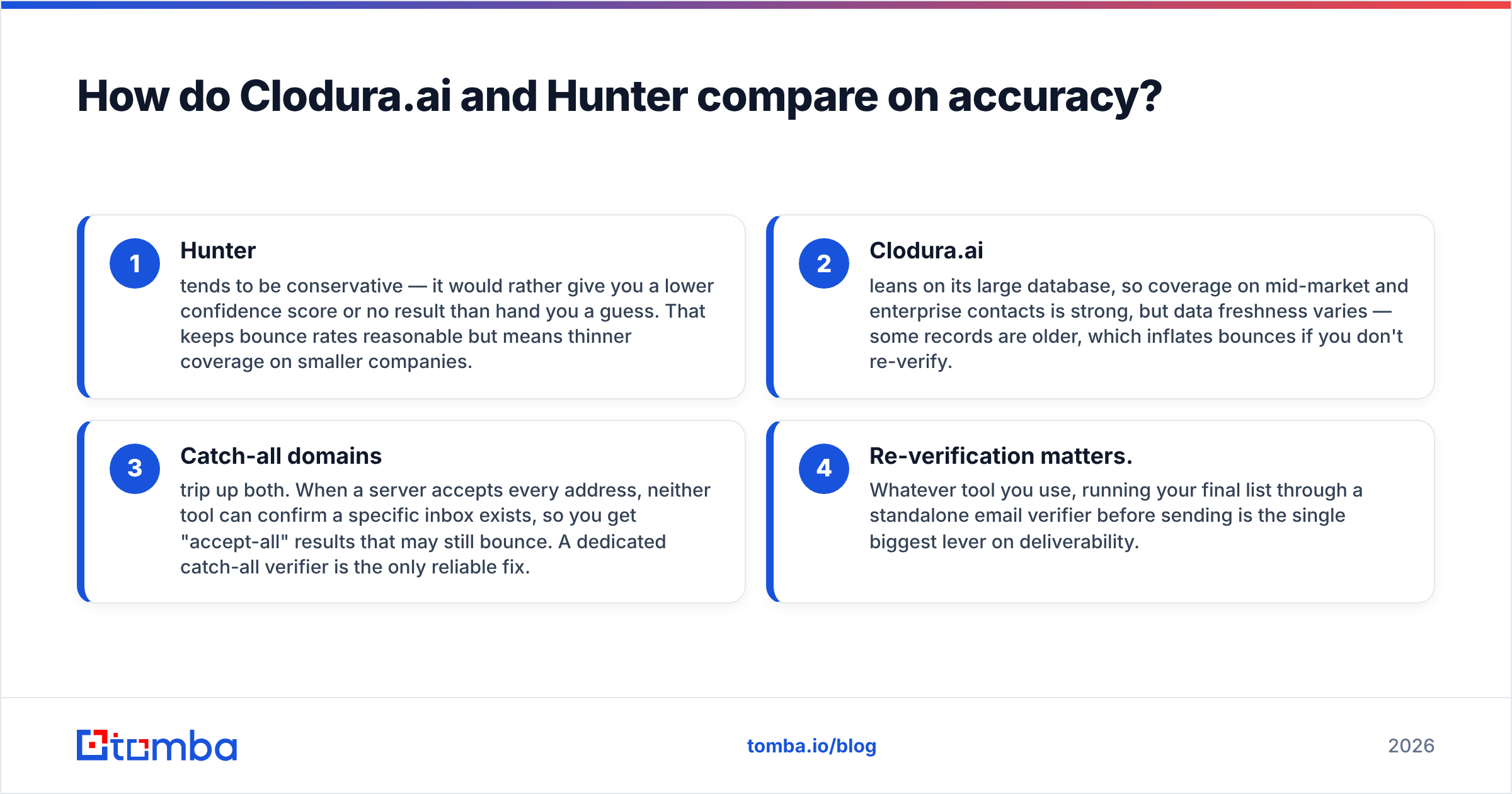
- Hunter tends to be conservative — it would rather give you a lower confidence score or no result than hand you a guess. That keeps bounce rates reasonable but means thinner coverage on smaller companies.
- Clodura.ai leans on its large database, so coverage on mid-market and enterprise contacts is strong, but data freshness varies — some records are older, which inflates bounces if you don't re-verify.
- Catch-all domains trip up both. When a server accepts every address, neither tool can confirm a specific inbox exists, so you get "accept-all" results that may still bounce. A dedicated catch-all verifier is the only reliable fix.
- Re-verification matters. Whatever tool you use, running your final list through a standalone email verifier before sending is the single biggest lever on deliverability.
The honest takeaway: both are "good enough" for warm, well-known targets and both wobble on long-tail SMB and catch-all domains.
)
Clodura.ai vs Hunter: feature and pricing comparison#
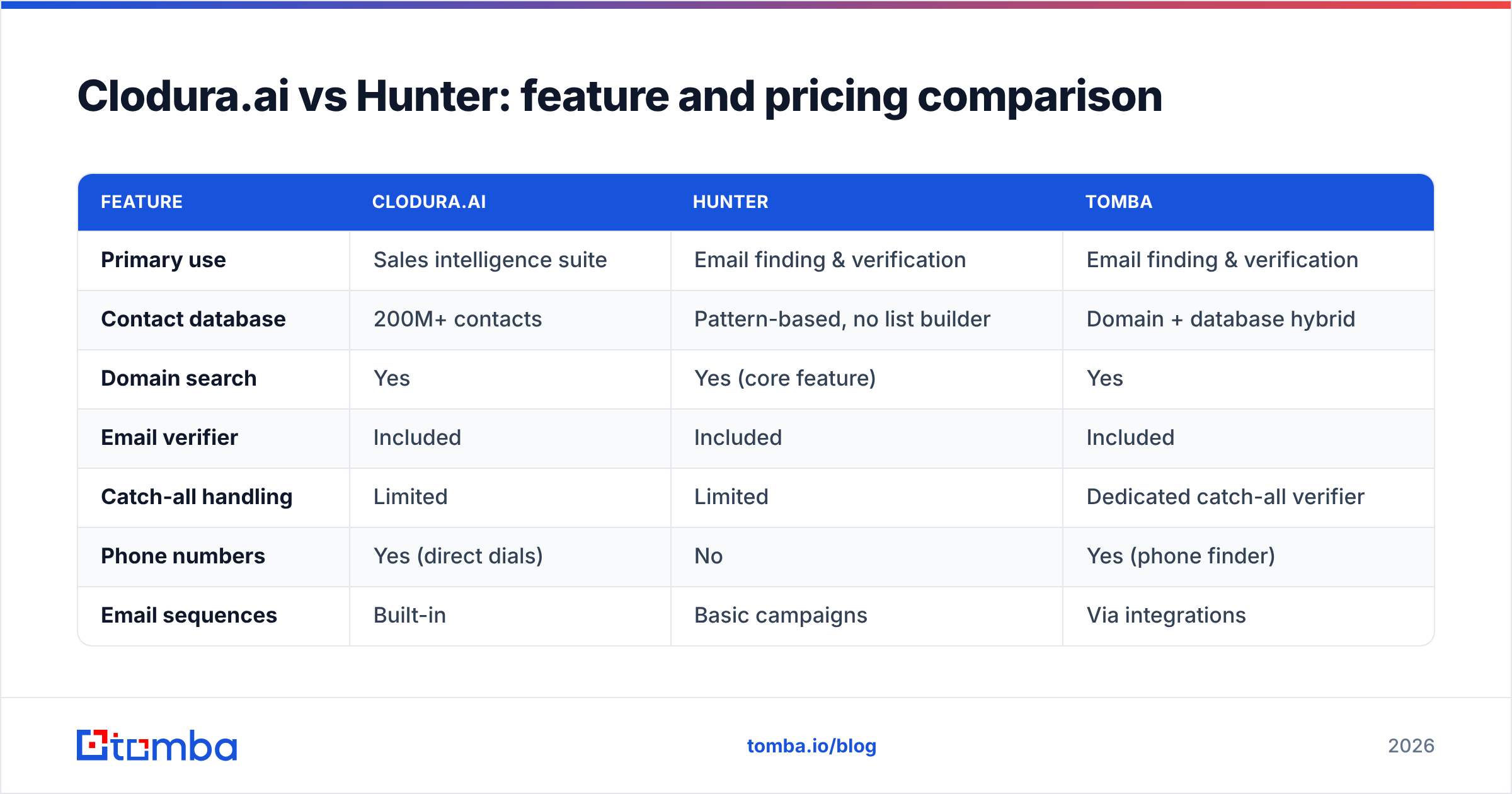
Here's the side-by-side. Prices reflect publicly listed 2026 plans and shift with promotions, so treat them as directional.
| Feature | Clodura.ai | Hunter | Tomba |
|---|---|---|---|
| Primary use | Sales intelligence suite | Email finding & verification | Email finding & verification |
| Contact database | 200M+ contacts | Pattern-based, no list builder | Domain + database hybrid |
| Domain search | Yes | Yes (core feature) | Yes |
| Email verifier | Included | Included | Included |
| Catch-all handling | Limited | Limited | Dedicated catch-all verifier |
| Phone numbers | Yes (direct dials) | No | Yes (phone finder) |
| Email sequences | Built-in | Basic campaigns | Via integrations |
| Free tier | Limited free plan | 25–50 free searches/mo | 25 searches/mo |
| Entry paid price | ~$33–$39/user/mo (annual) | ~$34/mo (Starter) | $49/mo (Starter) |
| Best for | All-in-one outbound teams | Founders, marketers, recruiters | Accuracy-first prospecting |
A few things stand out. Clodura.ai's entry price looks low per user but climbs fast once you add credits and seats. Hunter's Starter is genuinely affordable and the free tier is the most generous of the three for casual use. Tomba sits in the middle on price but leads on verification depth — see full Tomba pricing for the Growth ($99/mo) and Pro ($249/mo) tiers.
Which tool is better for cold outreach?#
It depends on where your bottleneck is.
If your bottleneck is building target lists, Clodura.ai wins. You can filter its database by industry, technology used, headcount, and seniority, then export contacts and push them straight into a sequence without leaving the app. That workflow saves real time for SDR teams who own the full top-of-funnel.
If your bottleneck is just getting clean emails for accounts you already picked, Hunter wins on simplicity and speed. Drop in a domain, grab the pattern, verify, done. No seats to manage, no platform to learn.
But there's a third scenario that catches a lot of teams: you want list-building flexibility and the lowest possible bounce rate without paying enterprise-suite prices. That's the gap Clodura.ai's freshness issues and Hunter's thin SMB coverage both leave open — and it's where pairing a focused finder with strong verification beats either single tool. You can connect that workflow to your stack through Tomba's HubSpot integration or Salesforce integration.
)
Is Clodura.ai worth the higher price?#
Clodura.ai is worth it if you'll use the whole platform. Paying for a 200M-contact database, intent data, sequences, and dialer functionality makes sense when those replace three or four separate subscriptions. If you consolidate Apollo-style prospecting, a finder, and a sequencer into Clodura, the math can favor it.
It's not worth it if you only need emails. Buying a full sales intelligence suite to do what a focused finder does is overpaying, and you inherit the database-freshness risk on top. Many teams find the intent signals noisy and the sequencer less mature than dedicated tools like Instantly or Smartlead — if sequencing is your priority, compare a few Instantly alternatives before committing.
The clearest signal: if more than half the platform's modules would sit unused, you're paying for shelf-ware.
Is Hunter too basic for serious teams?#
Hunter's simplicity is a feature, not a bug — but it has a ceiling.
For a founder doing 50 outreach emails a week, a recruiter sourcing candidates, or a marketer building a partnership list, Hunter is close to ideal. Fast, cheap, reliable enough, and you can teach a new hire to use it in five minutes.
The ceiling appears when you need volume and discovery. Hunter can't build a list from "all Series B fintech companies in Germany with 50–200 employees." It assumes you bring the targets. At higher volumes, its credit costs stack up and the lack of a true database starts to bite. Teams that outgrow Hunter usually move to a database-first tool — or to a finder with bulk capability like Tomba's bulk email finder, which processes thousands of lookups at once.
It's also worth noting Hunter's verification, while decent, treats catch-all domains as a known limitation rather than a solved problem. On lists heavy with catch-all servers, you'll still see bounces.
Where does Tomba fit in this comparison?#
Tomba lands between Clodura.ai's breadth and Hunter's simplicity, optimized for the thing both compromise on: verified-email accuracy.
Tomba pairs a domain-and-database hybrid finder with a dedicated catch-all finder, so the catch-all domains that bounce on Hunter and Clodura get an extra verification pass instead of a shrug. It also adds a phone finder and data enrichment for teams that need more than email, without forcing you into a full six-module suite you'll half-use.
On price, Tomba's Starter is $49/mo with a free tier (25 searches/mo) to test accuracy on your own domains before paying — and its data sources are documented openly, which matters when you're betting deliverability on the result.

Here's a quick decision guide:
| Your situation | Best pick |
|---|---|
| Need full prospecting + sequencing in one tool | Clodura.ai |
| Just need quick, cheap email lookups | Hunter |
| Need lowest bounce rate + catch-all handling | Tomba |
| Building large bulk lists | Tomba bulk finder |
| Tight budget, low volume | Hunter free tier |
How should you decide between them?#
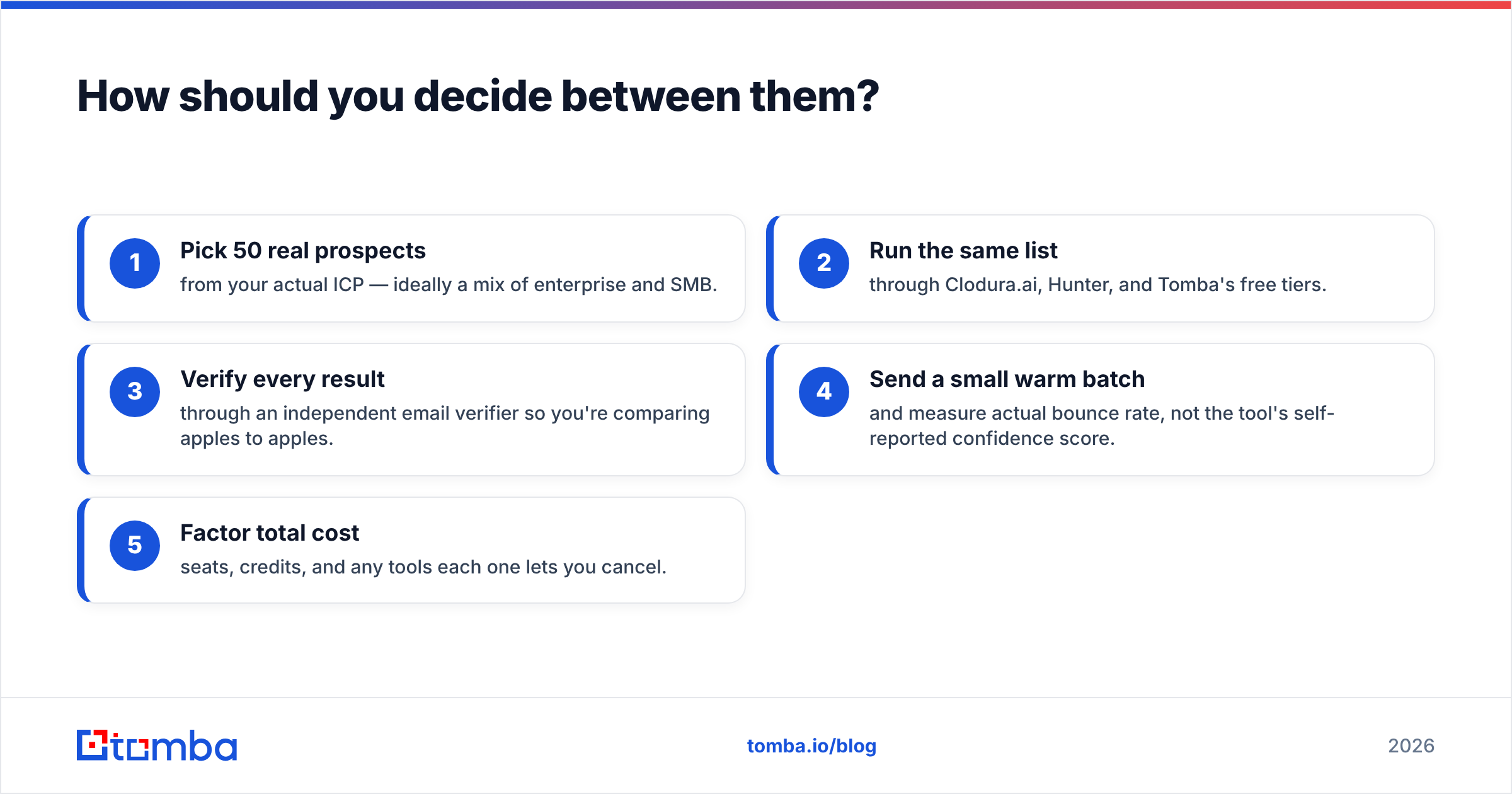
Run a real test, not a feature-sheet comparison. Tools market themselves on database size; what matters is how many emails land in inboxes for your specific targets.
- Pick 50 real prospects from your actual ICP — ideally a mix of enterprise and SMB.
- Run the same list through Clodura.ai, Hunter, and Tomba's free tiers.
- Verify every result through an independent email verifier so you're comparing apples to apples.
- Send a small warm batch and measure actual bounce rate, not the tool's self-reported confidence score.
- Factor total cost — seats, credits, and any tools each one lets you cancel.
This 30-minute test tells you more than any review, including this one. According to G2 and Capterra listings, all three tools score well on usability — the differentiator is always accuracy on your data, which only a test reveals.
The verdict#
There's no universal winner — there's a winner for your workflow:
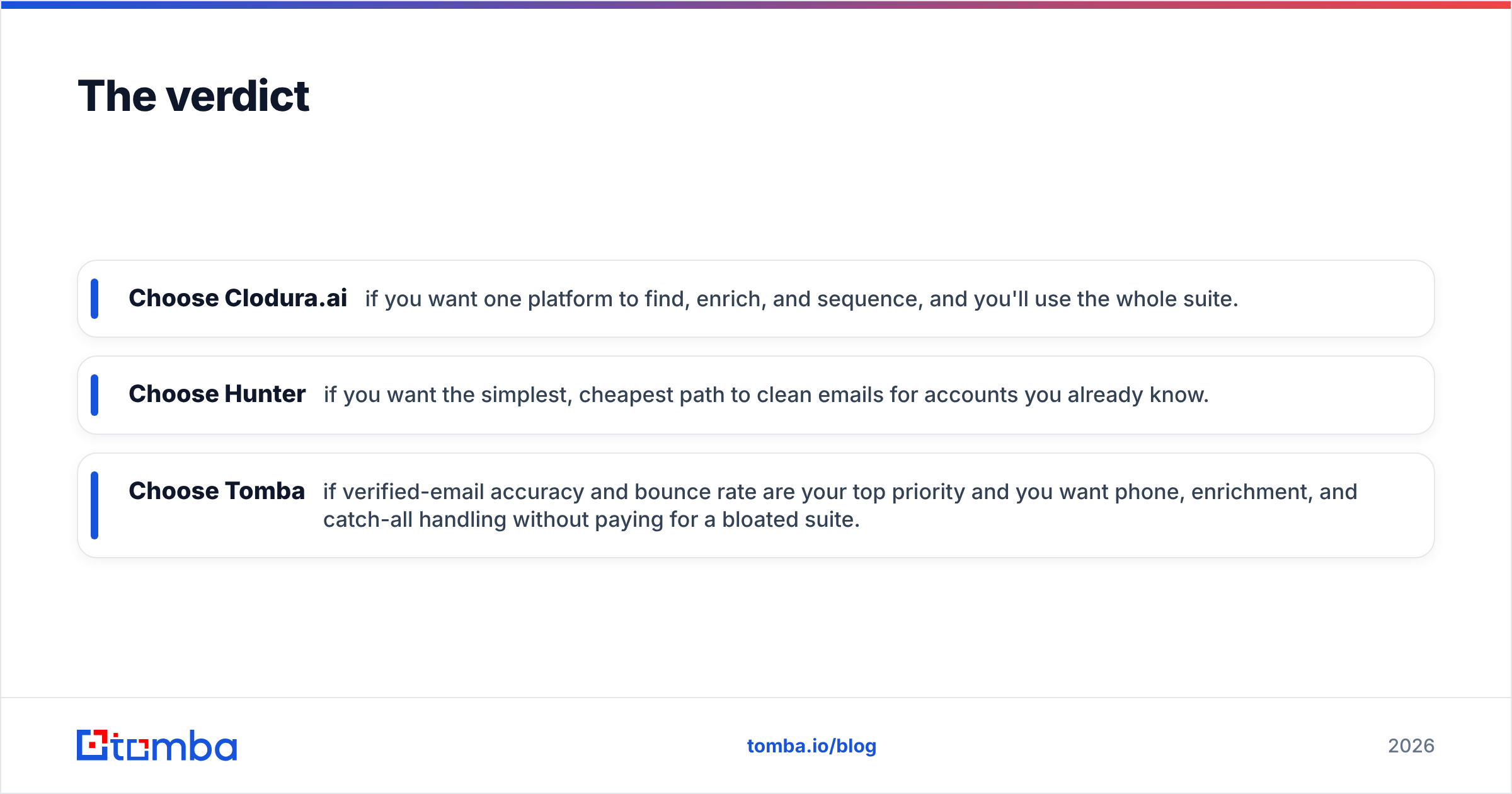
- Choose Clodura.ai if you want one platform to find, enrich, and sequence, and you'll use the whole suite.
- Choose Hunter if you want the simplest, cheapest path to clean emails for accounts you already know.
- Choose Tomba if verified-email accuracy and bounce rate are your top priority and you want phone, enrichment, and catch-all handling without paying for a bloated suite.
Most teams overspend by buying breadth they don't use or undershoot by accepting bounces they didn't have to. Match the tool to your actual bottleneck and you'll spend less and connect more.
Ready to see the accuracy difference on your own list? Start free with the Tomba Email Finder — 25 searches a month, no card required — and run it head-to-head against Clodura.ai and Hunter. When your outreach lives or dies on deliverability, test the tool that's built around verification first, then scale up on Tomba pricing only once the numbers prove out.
Ready to find emails that actually work?
Join 150,000+ professionals who stopped guessing and started sending. Free credits on signup — no credit card required.
Get the Tomba newsletter
Practical outbound tactics and product updates — once every two weeks.
About the author