Cloduraai vs Interseller: 2026 Sales Tool Comparison
Clodura.AI bundles a B2B database with sequencing; Interseller leaned on LinkedIn sourcing before folding into LeadIQ. Here's how they compare in 2026 — and what to use instead.
You came here to pick between Cloduraai vs Interseller — but the honest answer starts with a plot twist: only one of these tools is still taking new customers. Interseller was acquired by LeadIQ and effectively wound down as a standalone product, while Clodura.AI keeps shipping as an all-in-one sales intelligence and outreach platform. That changes the question from "which is better" to "which still fits, and what do you stitch in to replace the gap."
This guide breaks down what each tool actually did, where the data and deliverability hold up, what they cost, and how to assemble a stack that won't be sunset out from under you.
TL;DR#
- Clodura.AI is a single platform: a ~600M-contact B2B database, intent and technographic signals, plus built-in email sequencing. Good for SMB teams that want one login.
- Interseller was a Chrome-extension-first prospecting + sequencing tool that sourced contacts from LinkedIn. It was acquired by LeadIQ; new standalone signups are no longer the path forward.
- The real 2026 decision is data accuracy + deliverability, not feature checklists. A bloated database with stale emails will torch your sender reputation faster than any sequencer can save it.
- For the data layer specifically, a focused email finder with verification beats a do-everything suite that treats accuracy as a side feature.
- Our pick for the find-and-verify foundation: Tomba, then layer your sequencer of choice on top.
What is Clodura.AI?#
Clodura.AI is an all-in-one sales prospecting platform built around its own B2B contact database. The pitch is consolidation: instead of paying for a data vendor, a verification tool, and a sequencer separately, you get one account that handles discovery, enrichment, and outreach.
Its core modules:
- B2B database — hundreds of millions of contacts with direct dials, org charts, and company firmographics.
- Intent + technographics — signals on which accounts are researching your category and what tools they already run.
- Email sequencing — native multi-step cadences so you don't export to a separate tool.
- Email verification — built-in checks before you send.
The trade-off with any "everything in one" platform is depth. A bundled verifier rarely matches a dedicated email verifier, and a bundled database is only as fresh as the vendor's last refresh cycle. For teams that value one invoice over best-in-class accuracy, that's an acceptable swap. For teams whose deliverability is on the line, it's a risk worth scrutinizing.

What was Interseller?#
Interseller was a recruiting- and sales-focused prospecting tool that made its name with a Chrome extension. You'd browse a LinkedIn profile, click the extension, and Interseller would source a verified email and drop the person into an automated email sequence — all without leaving the page.
It was popular with agency recruiters and lean sales teams because the workflow was fast and the sourcing felt native to how people actually prospect. Then LeadIQ acquired Interseller, and over time the standalone product was folded in. If you're evaluating Interseller fresh in 2026, you're effectively evaluating a product in maintenance mode — which is a hard recommendation to make for a multi-year outbound investment.
That's the uncomfortable core of the Cloduraai vs Interseller comparison: it's an active platform versus a sunset one.

Cloduraai vs Interseller: how do they compare?#
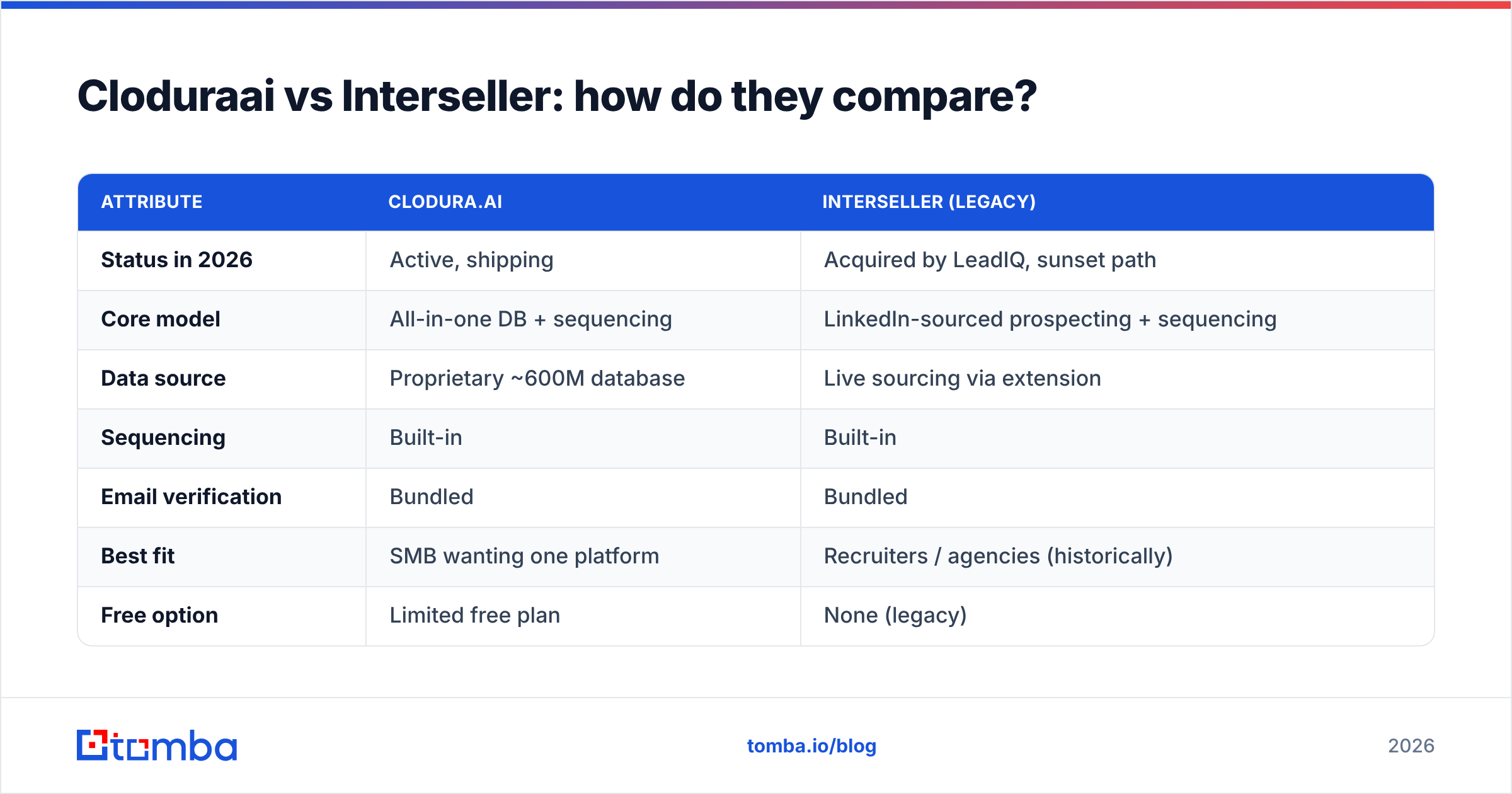
Here's the side-by-side on the attributes that actually move outbound numbers.
| Attribute | Clodura.AI | Interseller (legacy) |
|---|---|---|
| Status in 2026 | Active, shipping | Acquired by LeadIQ, sunset path |
| Core model | All-in-one DB + sequencing | LinkedIn-sourced prospecting + sequencing |
| Data source | Proprietary ~600M database | Live sourcing via extension |
| Sequencing | Built-in | Built-in |
| Email verification | Bundled | Bundled |
| Best fit | SMB wanting one platform | Recruiters / agencies (historically) |
| Free option | Limited free plan | None (legacy) |
| Risk | Bundled-tool depth | Product longevity |
The pattern is clear. Clodura.AI wins on availability and breadth; Interseller won on workflow speed but loses on the one thing you can't fix — it's not the forward path. Neither, though, is purpose-built around the metric that determines whether your cold email lands: data accuracy and sender reputation.
Which has better data accuracy?#
Accuracy is where bundled suites quietly cost you. The cleanest way to think about it: your sequencer is the engine, but your contact data is the fuel. Pour in dirty fuel — outdated addresses, catch-all domains, role accounts — and even a perfectly tuned engine sputters. Every bad send chips at your sender reputation, and once mailbox providers start routing you to spam, your good contacts never see you either.
Clodura.AI's database is large, and large is useful for coverage. But coverage and accuracy aren't the same thing. A 600M-row database refreshed quarterly will contain a meaningful slice of people who've changed jobs, companies that have been acquired, and emails that now bounce. Interseller's live-sourcing model was actually stronger here in spirit — pulling at the moment of need — but it depended on the quality of the underlying enrichment, and it's no longer a product you'd build on.
This is why many teams now decouple the data layer from the sequencing layer. You use a dedicated finder-and-verifier to produce a clean list, then feed that into whatever cadence tool you like. The decoupled approach means your accuracy isn't capped by a sequencer's side-feature verifier.
A focused stack looks like this:
- Find — pull emails by name or domain with a real domain search, not a static dump.
- Verify — run every address through a real-time SMTP check before it enters a sequence.
- Handle catch-alls — use a catch-all verifier so ambiguous domains don't silently bounce.
- Enrich — fill in titles, companies, and phone numbers with data enrichment.
- Sequence — only now hand the clean list to your outreach tool.
When accuracy is its own job rather than a checkbox in a suite, your bounce rate drops and your deliverability holds. According to G2 category reviews, deliverability complaints cluster heavily around tools that bundle weak verification — the exact failure mode of an all-in-one that treats data as secondary.
How do they handle deliverability?#
Deliverability is downstream of data quality, but it's also its own discipline. Both Clodura.AI and Interseller offered native sending, which is convenient and dangerous in equal measure. Native sequencers make it trivially easy to blast a list — including the unverified rows — and that's precisely how teams burn domains.
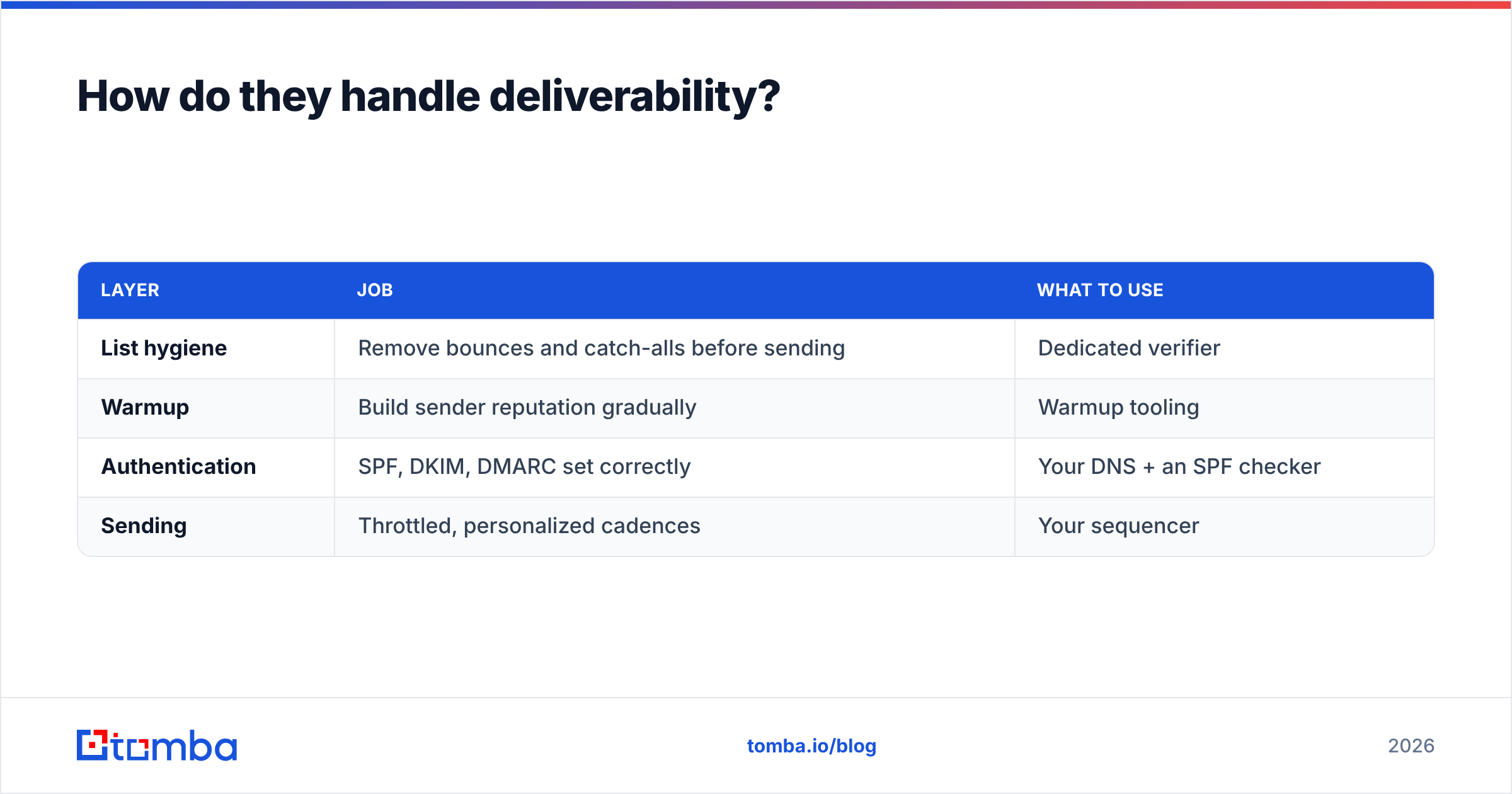
The durable approach separates concerns again:
| Layer | Job | What to use |
|---|---|---|
| List hygiene | Remove bounces and catch-alls before sending | Dedicated verifier |
| Warmup | Build sender reputation gradually | Warmup tooling |
| Authentication | SPF, DKIM, DMARC set correctly | Your DNS + an SPF checker |
| Sending | Throttled, personalized cadences | Your sequencer |
Notice that two of the four layers are data and authentication — neither is a sequencing feature. If you let an all-in-one own all four, you inherit its weakest link. A good rule: never let a tool that profits from "send more" also own "decide what's safe to send." Run your own email verifier pass regardless of what the platform promises, and check email deliverability fundamentals before scaling volume.
What about pricing?#
Pricing is where the bundled-vs-focused choice gets concrete. Clodura.AI offers tiered plans scaling with contact credits and seats, plus a limited free entry point. Interseller's legacy pricing is largely moot now that it sits inside LeadIQ's packaging.
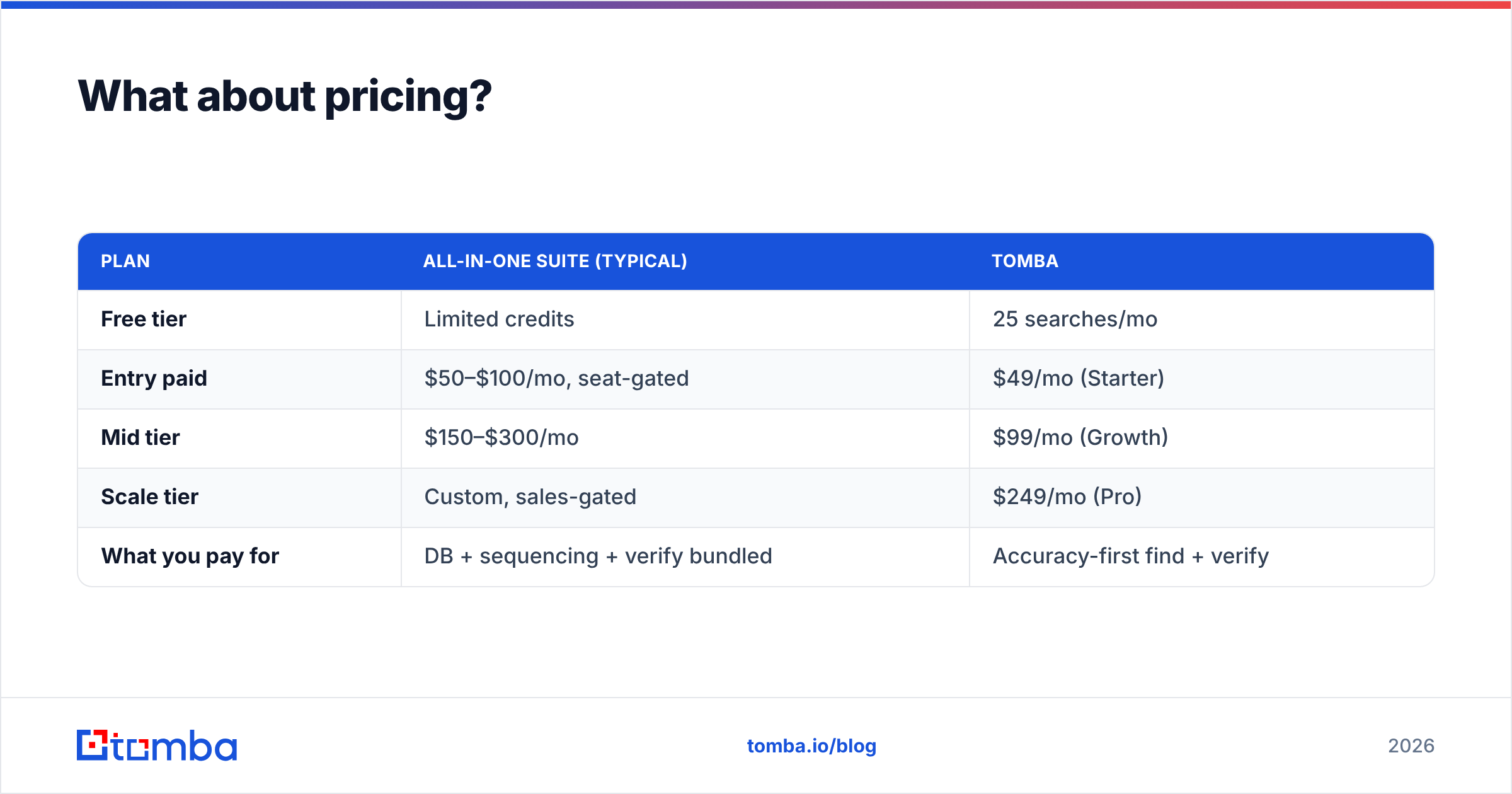
Here's how a focused data layer compares against an all-in-one on cost structure:
| Plan | All-in-one suite (typical) | Tomba |
|---|---|---|
| Free tier | Limited credits | 25 searches/mo |
| Entry paid | $50–$100/mo, seat-gated | $49/mo (Starter) |
| Mid tier | $150–$300/mo | $99/mo (Growth) |
| Scale tier | Custom, sales-gated | $249/mo (Pro) |
| What you pay for | DB + sequencing + verify bundled | Accuracy-first find + verify |
The math that matters isn't the sticker price — it's cost per usable contact. If a cheaper suite delivers 70% deliverable emails and a focused finder delivers 95%, the "expensive" option is cheaper per real conversation started. You can see the full Tomba pricing breakdown to model this against your own volume; the point is to price the outcome, not the login count.
Which should you choose in 2026?#
Conclusion first: don't pick Interseller — it's not a forward-looking product. Between the two, Clodura.AI is the only live option, and it's a reasonable choice for an SMB team that genuinely wants one platform and can tolerate bundled-grade data accuracy.
But the better framing is to stop choosing a monolith at all. Here's the decision tree:
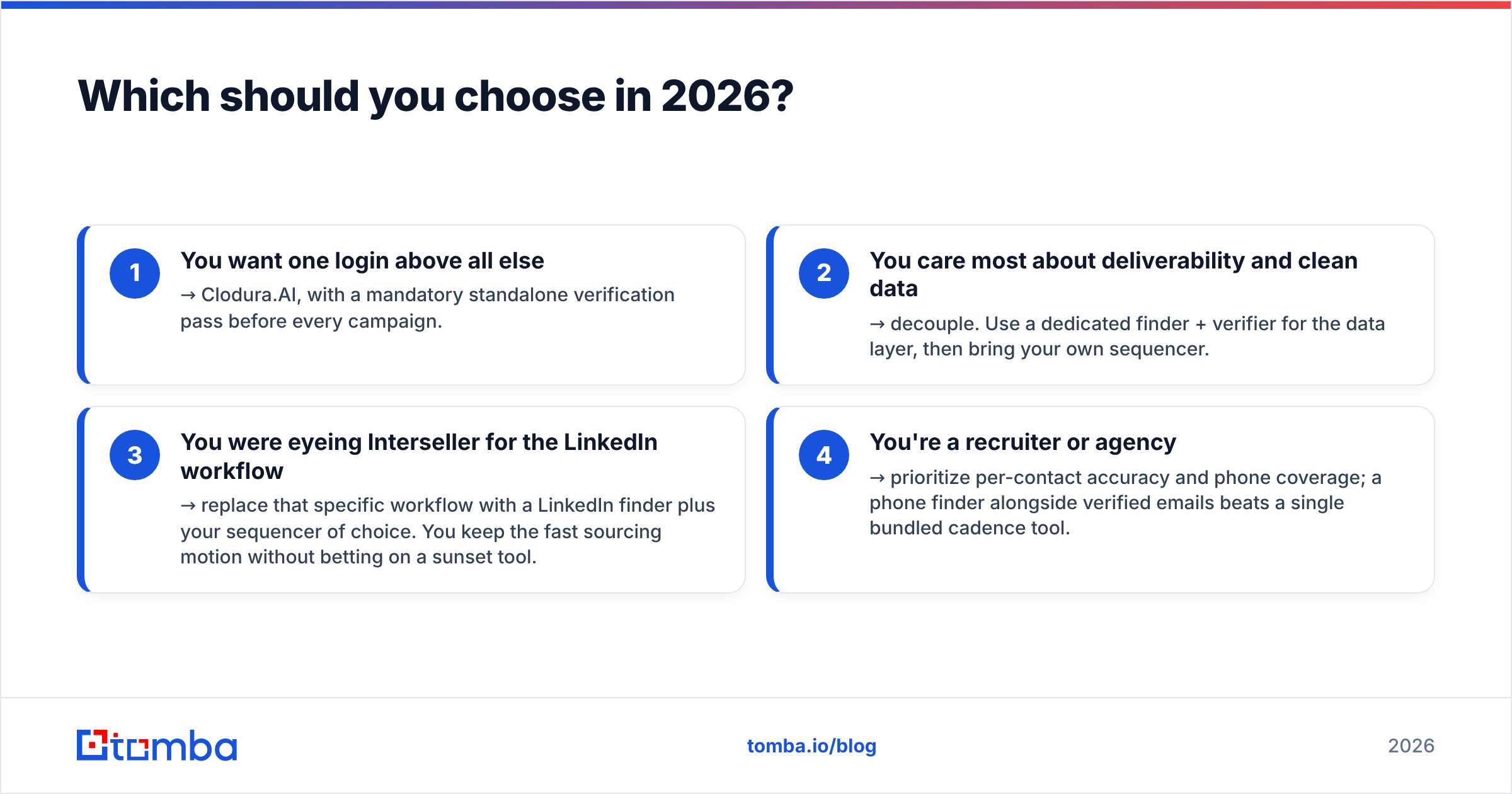
- You want one login above all else → Clodura.AI, with a mandatory standalone verification pass before every campaign.
- You care most about deliverability and clean data → decouple. Use a dedicated finder + verifier for the data layer, then bring your own sequencer.
- You were eyeing Interseller for the LinkedIn workflow → replace that specific workflow with a LinkedIn finder plus your sequencer of choice. You keep the fast sourcing motion without betting on a sunset tool.
- You're a recruiter or agency → prioritize per-contact accuracy and phone coverage; a phone finder alongside verified emails beats a single bundled cadence tool.
The teams that win at outbound in 2026 treat data as the foundation and sequencing as a commodity layer on top — not the other way around. That's the lesson buried in the Interseller story: workflows and sequencers come and go, but a clean, verified contact list is portable across every tool you'll ever use.
The bottom line#
Cloduraai vs Interseller isn't really a fair fight anymore — one ships and one was absorbed. Clodura.AI is the defensible pick if you want consolidation. But the smarter move for most teams is to own your data layer independently so no acquisition or product sunset can strand your pipeline.
That's exactly where Tomba fits. Use the Tomba Email Finder to find professional emails by domain, name, or company, verify every address in real time, and export a clean list into whatever sequencer you trust. Start free with 25 searches a month, scale to Starter at $49/mo when you're ready, and never again let a bundled tool's weakest feature decide your deliverability. Build the foundation first — the rest of the stack is replaceable.
// get started
Find, verify and enrich your first contacts today
Start on the free plan with 25 searches a month, then scale when your team is ready.
Free plan · No credit card required · GDPR & CCPA
// about the author