Clodura.ai vs Istari.ai 2026: B2B Data Platforms Compared
Clodura.ai and Istari.ai both promise sharper B2B data, but they solve different problems. Here's an honest 2026 breakdown of features, pricing, accuracy, and the cheaper way to verify the contacts you actually email.
The cloduraai vs istariai choice usually comes down to one budget and one B2B data tool. You cannot afford to bet it on the wrong category. The two get lumped together because both sell "sales intelligence." But they are built for different buyers and different motions. This breakdown cuts through the marketing pages. You pick on fit, not on whoever ranked first on Google.
TL;DR — Clodura.ai vs Istari.ai in 30 seconds#
- Clodura.ai is an all-in-one sales prospecting platform: a contact database, intent signals, sequences, and email verification bundled for SDR teams running outbound.
- Istari.ai is a market and company intelligence engine — it scans the open web to classify firms, technologies, and trends, and is favored by researchers, marketers, and strategy teams.
- They overlap less than the "vs" suggests: Clodura is a who-do-I-email tool; Istari is a what-is-this-market-doing tool.
- Neither is a pure email finder, so contact-level accuracy varies. Whatever you pick, run every address through a dedicated email verifier before you send.
- If your real need is accurate emails by domain or name, a focused email finder like Tomba will out-deliver either platform's contact export at a fraction of the cost.
What is Clodura.ai?#
Clodura.ai is a sales intelligence and engagement platform aimed at B2B outbound teams. Its pitch is "everything an SDR touches in one login": a contact and company database (it advertises hundreds of millions of direct dials and verified emails), buyer-intent data, an org-chart view, automated email sequences, and built-in verification.
The product is strongest for teams that want to compress their stack. Instead of paying for a database, a sequencer, and a verifier, you get one subscription that does both discovery and outreach. That convenience is also its main trade-off. Bundled databases tend to lag specialist providers on freshness. You are also locked into Clodura's sending tools rather than your own.
Typical Clodura.ai users:
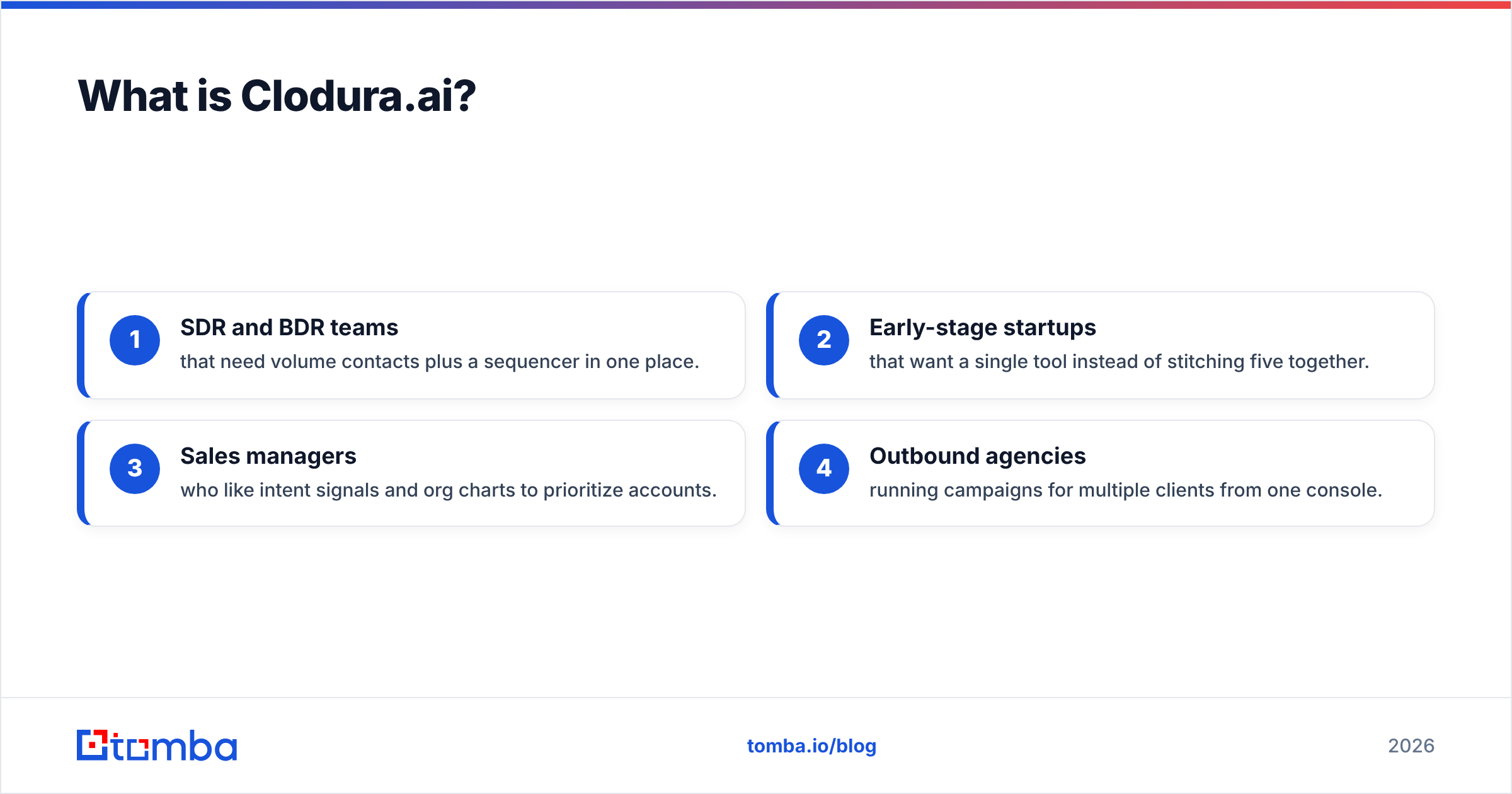
- SDR and BDR teams that need volume contacts plus a sequencer in one place.
- Early-stage startups that want a single tool instead of stitching five together.
- Sales managers who like intent signals and org charts to prioritize accounts.
- Outbound agencies running campaigns for multiple clients from one console.
What is Istari.ai?#
Istari.ai is a market intelligence platform that uses AI to read and classify the public web — company websites, news, filings, and technology footprints — into structured data. It does not hand you a list of contacts to email. Instead, it tells you which companies exist in a market, what they do, which technologies they use, and how a segment is evolving.
This is a fundamentally different job. Istari is built for market sizing, account discovery in niche verticals, competitive landscapes, and innovation research. European data teams and analysts use it because web-mined firmographics surface long-tail companies that traditional databases miss.
The trade-off is the mirror image of Clodura's. Istari excels at breadth and classification. But it is not designed to be your day-to-day "give me the VP of Sales' email" tool. You get rich company context, then still need a contact layer on top.
Cloduraai vs Istariai: the core difference#
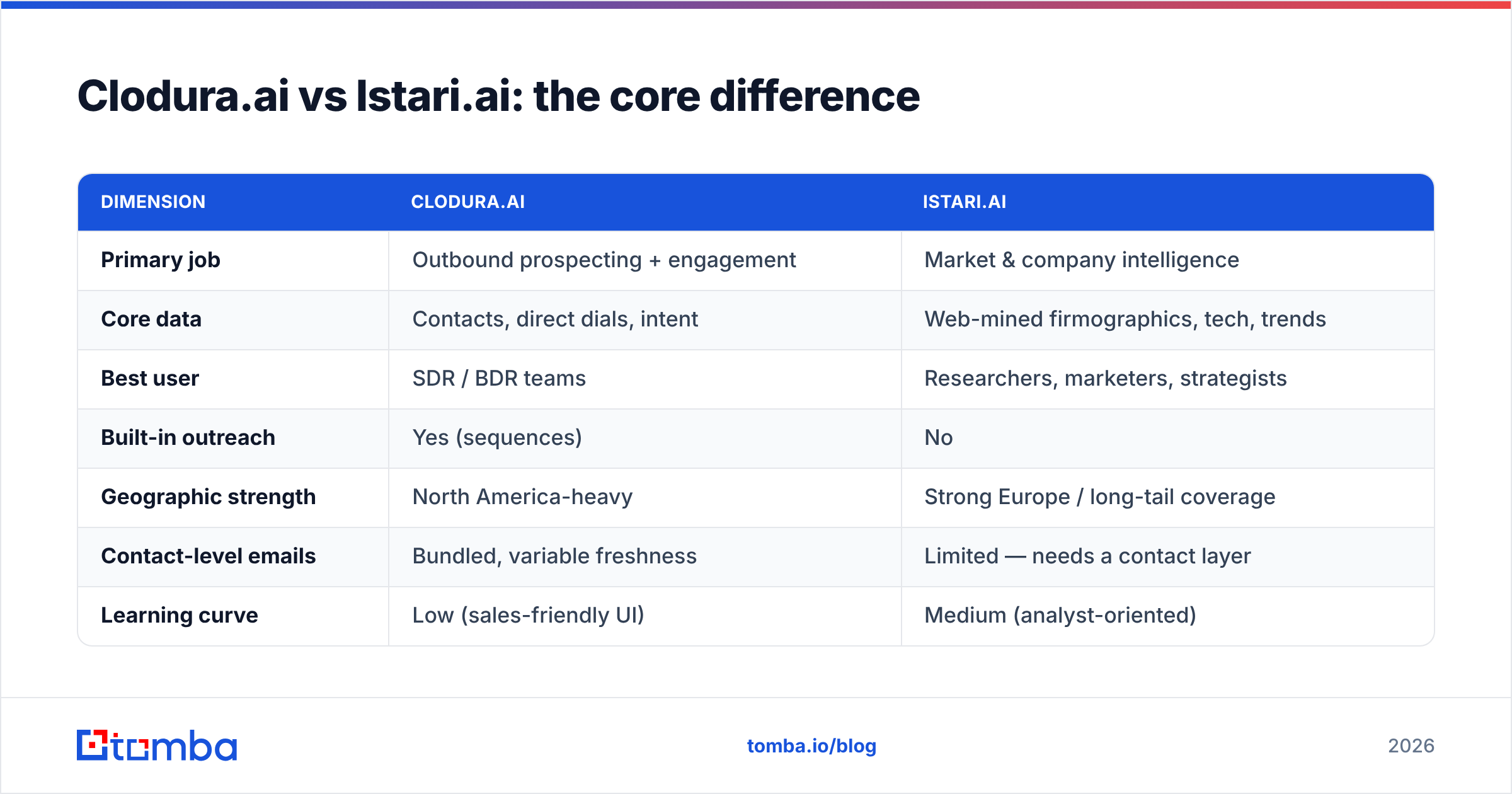
Here is the cloduraai vs istariai distinction in one line. Clodura answers "who do I contact?" Istari answers "what is this market made of?" Confuse the two and you will overpay for a tool that does not fit your motion.
| Dimension | Clodura.ai | Istari.ai |
|---|---|---|
| Primary job | Outbound prospecting + engagement | Market & company intelligence |
| Core data | Contacts, direct dials, intent | Web-mined firmographics, tech, trends |
| Best user | SDR / BDR teams | Researchers, marketers, strategists |
| Built-in outreach | Yes (sequences) | No |
| Geographic strength | North America-heavy | Strong Europe / long-tail coverage |
| Contact-level emails | Bundled, variable freshness | Limited — needs a contact layer |
| Learning curve | Low (sales-friendly UI) | Medium (analyst-oriented) |
| Typical pricing model | Per-seat SaaS tiers | Custom / data-volume based |
Are you an SDR who needs 200 verified emails this week? Then Clodura is closer to your need. Are you sizing a vertical or building a target list in a market no database covers? Then Istari is the better engine. Many teams that can afford both use Istari to define the account universe and a contact tool to reach it.
How do they compare on data accuracy?#
Accuracy is where the "vs" gets honest. Both platforms derive contact data from aggregation and web mining. And both decay the same way every database does. People change jobs, companies rebrand, and email patterns shift. Independent reviews on G2 show the same thing: no bundled database holds bounce rates as low as a dedicated verifier.
A few realities to plan around:
- Bundled "verified" emails are not always fresh. A contact marked verified six months ago can be a hard bounce today. Re-verify at send time, not at export time.
- Web-mined firmographics (Istari's strength) age slower than personal contact data. Company descriptions and tech stacks change less often than someone's inbox.
- Catch-all domains break both tools. Many corporate domains accept everything at the SMTP layer, so a "valid" result is meaningless without a catch-all verifier.
This is the single biggest reason to keep a focused verification step in your pipeline. It holds no matter which platform wins your evaluation. Protecting your sender reputation matters more than any database's headline contact count.
Pricing: Clodura.ai vs Istari.ai vs a focused stack#
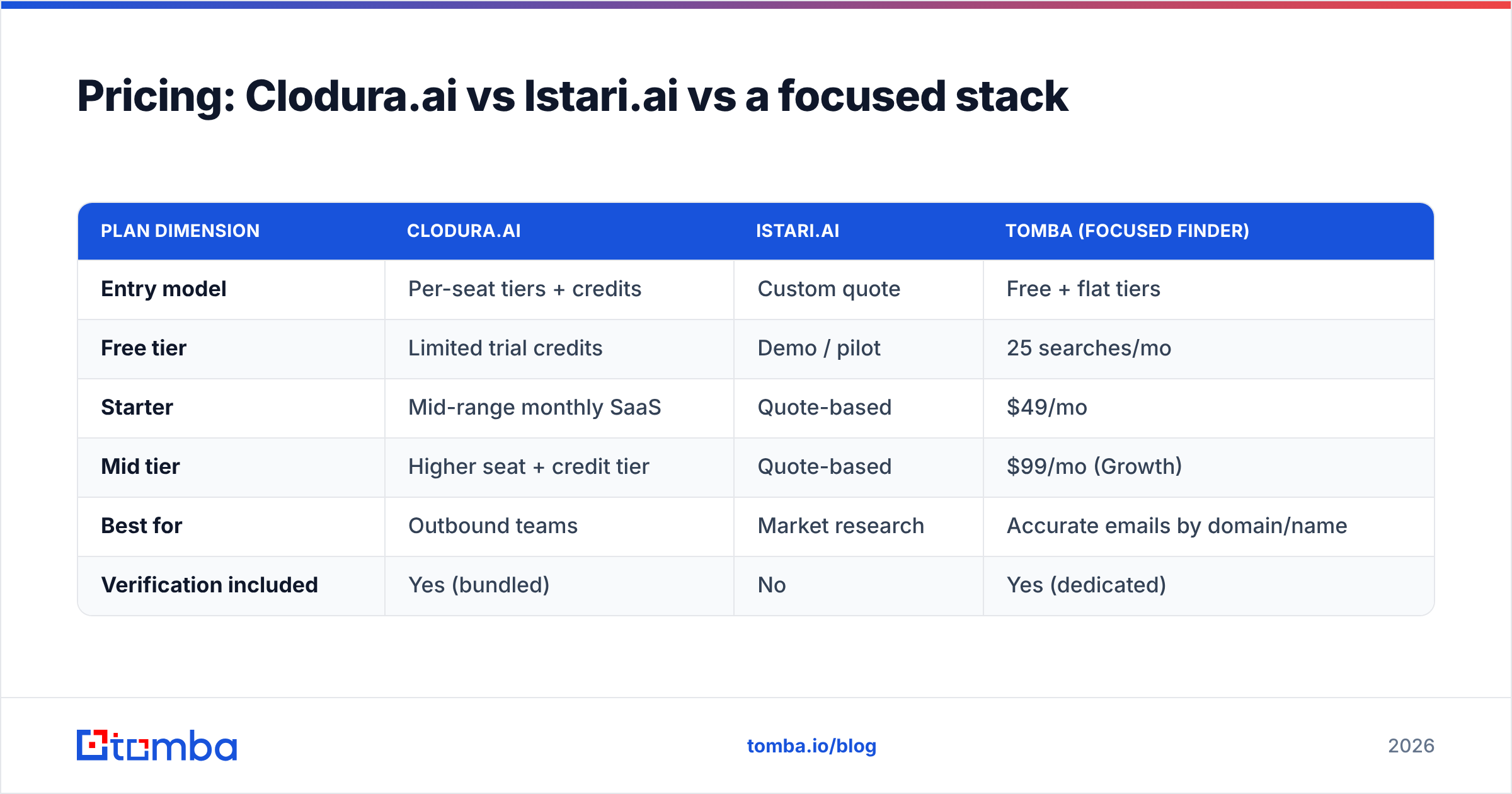
Pricing is the messiest part of this comparison. The two vendors price on different axes. Clodura sells per-seat SaaS tiers with credit allowances. Istari prices closer to a data contract, sized by volume and scope and usually quoted on request. That makes a clean apples-to-apples table impossible. So treat the figures below as directional and confirm current numbers on each vendor's site.
| Plan dimension | Clodura.ai | Istari.ai | Tomba (focused finder) |
|---|---|---|---|
| Entry model | Per-seat tiers + credits | Custom quote | Free + flat tiers |
| Free tier | Limited trial credits | Demo / pilot | 25 searches/mo |
| Starter | Mid-range monthly SaaS | Quote-based | $49/mo |
| Mid tier | Higher seat + credit tier | Quote-based | $99/mo (Growth) |
| Best for | Outbound teams | Market research | Accurate emails by domain/name |
| Verification included | Yes (bundled) | No | Yes (dedicated) |
Most teams miss one pattern. You rarely need a heavyweight all-in-one and a market-intelligence contract and a verifier. A cheaper architecture is simpler. Use one platform for its real strength and bolt on a specialist for contacts. You can see transparent Tomba pricing without a sales call, which is a useful benchmark against quote-only vendors.
For a deeper outbound stack, Clodura competes more directly with tools in the Apollo alternative space than with Istari at all — another sign these two are not真 substitutes.
Which should you choose?#
Pick based on the job you are actually hiring the tool to do.
Choose Clodura.ai if:
- Your primary motion is outbound and you want database plus sequencer in one bill.
- Your market is North America-heavy and well covered by mainstream databases.
- Your SDRs value a low learning curve over deep analytical control.
- Intent signals and org charts directly drive your prioritization.
Choose Istari.ai if:
- You need to map or size a market, especially in Europe or a long-tail vertical.
- Your team is research- or strategy-led, not a high-volume sending operation.
- You want web-mined firmographics and technology data over personal contacts.
- Account discovery matters more than account engagement right now.
Choose a focused finder + verifier if:
- Your bottleneck is simply getting accurate, send-ready emails.
- You already have a CRM and sequencer you like and only need the contact layer.
- You want predictable, transparent pricing and no annual lock-in.
How does Tomba fit into this comparison?#
Tomba is not trying to be Clodura or Istari. It deliberately does one layer extremely well: turning a domain or a name into a deliverable email address. That focus is the point. When your whole job is contact accuracy, you do not want it buried inside a platform built for sequencing or market mapping.
Where Tomba slots in cleanly:
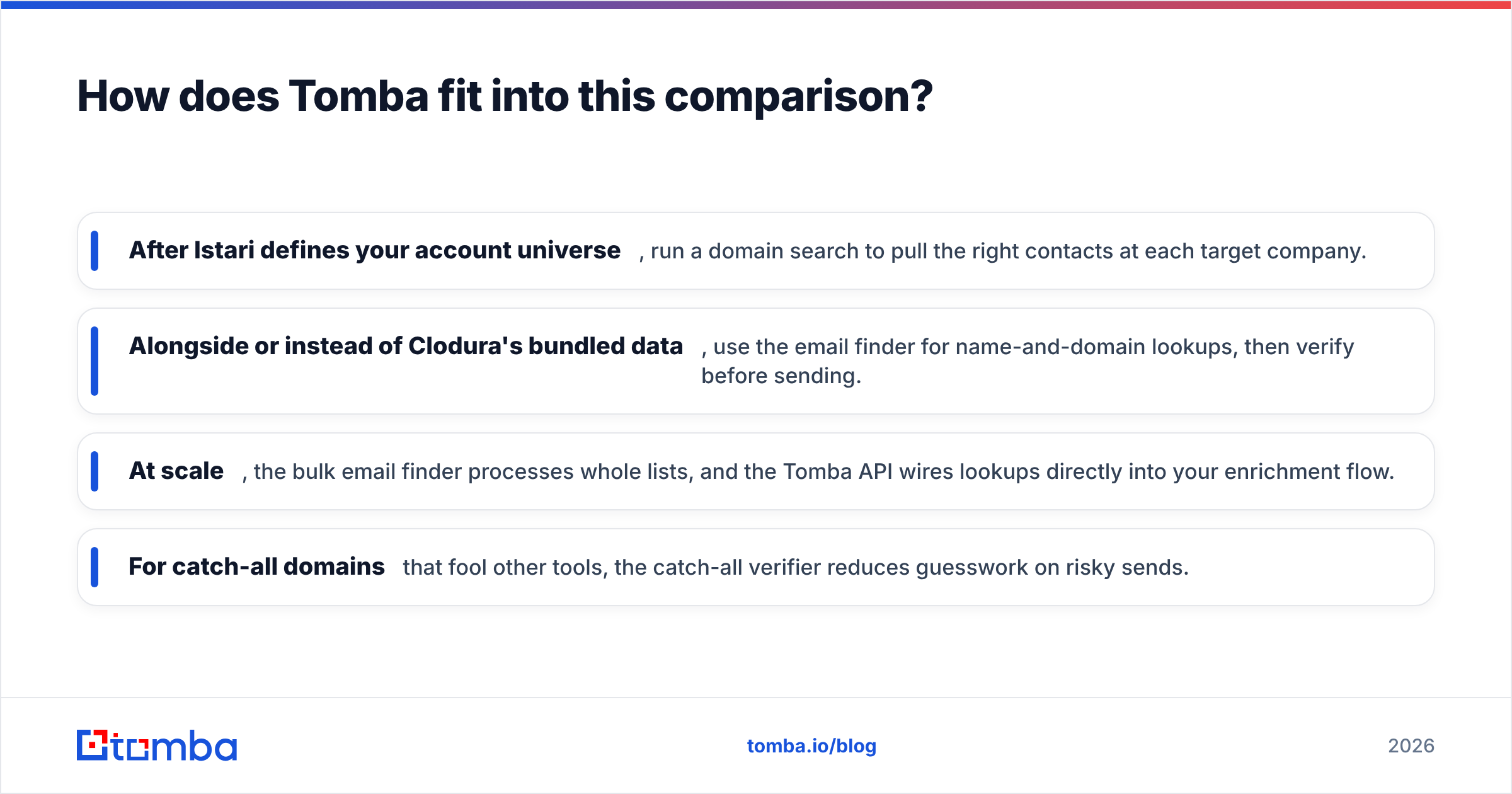
- After Istari defines your account universe, run a domain search to pull the right contacts at each target company.
- Alongside or instead of Clodura's bundled data, use the email finder for name-and-domain lookups, then verify before sending.
- At scale, the bulk email finder processes whole lists, and the Tomba API wires lookups directly into your enrichment flow.
- For catch-all domains that fool other tools, the catch-all verifier reduces guesswork on risky sends.
The honest framing: Clodura and Istari are platforms; Tomba is a precision instrument. Say you already own a platform but your bounce rate is climbing. The cheapest fix is almost never switching platforms. It is adding a dedicated verification and discovery layer underneath the one you have.
You can validate this with HubSpot's own deliverability guidance. It repeatedly stresses list hygiene over list size. A smaller, verified list out-performs a large unverified one on nearly every metric that matters.
Frequently asked questions#
Is Clodura.ai better than Istari.ai? Neither is universally better — they target different jobs. Clodura wins for outbound prospecting teams that want contacts plus sequences in one tool. Istari wins for market research and account discovery, especially in European or niche markets. Match the tool to your motion, not to a star rating.
Can Istari.ai replace an email finder? Not really. Istari classifies companies and markets from web data; it is not built to reliably return a specific person's verified email. Pair it with a dedicated finder and verifier for the contact layer.
Does Clodura.ai include email verification? Yes, verification is bundled. But bundled verification still ages between export and send, so re-verifying at send time with a specialist tool meaningfully lowers bounce rates.
What's the cheapest accurate option? For contact accuracy alone, a focused finder with a free tier and flat pricing — like Tomba's free 25 searches and $49/mo Starter — is usually cheaper than paying for an all-in-one platform you only half-use.
The bottom line#
The cloduraai vs istariai debate rarely comes down to the same dollar once you name the job. Clodura is the outbound engine. Istari is the market map. The mistake is buying either one and expecting precise, send-ready contact data as a byproduct. That is a separate, specialized job, and treating it casually is what wrecks deliverability.
If your real pain is accurate emails at a fair price, start with the layer that fixes it directly. Try the Tomba Email Finder — find professional emails by domain, name, or company, verify them before you send, and keep whichever platform you choose focused on what it does best. Your bounce rate, and your sender reputation, will thank you.
// get started
Find, verify and enrich your first contacts today
Start on the free plan with 25 searches a month, then scale when your team is ready.
Free plan · No credit card required · GDPR & CCPA
// about the author