Cloduraai vs Kipplo: Best B2B Prospecting Tool in 2026
Cloduraai vs Kipplo, head to head: data accuracy, pricing, intent signals, and which one actually fits your outbound motion in 2026 — plus where a dedicated email finder beats both.
You are choosing between two B2B sales intelligence platforms, and the marketing pages all blur together. This breakdown cuts through it: where Clodura.ai and Kipplo actually differ, who each one fits, and the cheaper, more accurate path most outbound teams overlook.
TL;DR#
- Clodura.ai is the heavier all-in-one: a large prebuilt B2B database, org charts, intent signals, and a built-in email sequencer. Best for teams that want one dashboard for find-and-send.
- Kipplo is the leaner, sequencing-first option with multichannel outreach and a lower entry price. Best for small teams that already have a list and want to run cadences.
- Neither wins on raw email accuracy. Bundled databases go stale fast; verification is often an afterthought, so bounce rates creep up.
- The smarter stack: pair a dedicated, real-time finder like Tomba Email Finder with whatever sequencer you prefer. You get fresher contacts and protect your sender reputation.
- Skip to the comparison table if you just want the verdict.
What are Clodura.ai and Kipplo?#
Think of these two as different-sized Swiss Army knives for outbound sales. Both promise to take you from "I have a target market" to "I have replies in my inbox," but they pack different blades.
Clodura.ai is a sales prospecting platform built around a large prebuilt contact database (the vendor markets hundreds of millions of records), layered with org charts, technographic data, buyer intent signals, and a native email sequencing engine. It positions itself as a one-stop GTM tool: research, build the list, and send — without leaving the app. You can read the full feature set on the Clodura.ai homepage.
Kipplo is a leaner sales engagement and outreach platform. Its center of gravity is multichannel sequencing — email plus LinkedIn touches and tasks — with prospecting data attached rather than the other way around. It tends to appeal to smaller teams and founders who want to launch cadences quickly without enterprise-level pricing. The Kipplo site lays out its outreach-first pitch.
The simplest way to frame it: Clodura.ai leads with data, Kipplo leads with sending. That single difference drives almost everything below.

How do Clodura.ai and Kipplo compare feature by feature?#
Here is the side-by-side most buyers are actually looking for. Treat vendor-published database sizes as marketing figures, not verified counts — they change constantly and rarely reflect how many records are accurate today.
| Feature | Clodura.ai | Kipplo |
|---|---|---|
| Primary strength | Prebuilt B2B database + intent | Multichannel sequencing |
| Contact database | Large, vendor-claimed 600M+ | Smaller, outreach-attached |
| Email sequencing | Built in | Built in (core feature) |
| LinkedIn / multichannel | Limited | Yes, central |
| Buyer intent signals | Yes | Limited / no |
| Org charts & technographics | Yes | No |
| Entry price | Higher mid-market tier | Lower, SMB-friendly |
| Free option | Limited free plan | Free trial |
| Best fit | Mid-market outbound teams | Founders & small teams |
| Email verification depth | Basic, bundled | Basic, bundled |
The pattern is clear. Clodura.ai gives you more inputs (data, signals, org structure); Kipplo gives you a cleaner outbound engine at a lower price. Where they converge — and where both underwhelm — is email quality. Bundled verification on platforms like these is usually a checkbox feature, not a specialty.
Which one has better data accuracy?#
Neither is built primarily as an accuracy engine, and that is the catch.
Here is the everyday analogy: a giant warehouse database is like a phone book printed two years ago. It is impressively thick, but a chunk of the numbers have changed. B2B contact data decays roughly 2–3% per month as people switch jobs, companies rebrand, and domains migrate — so a static database that looked great at signup degrades quietly in the background.
Clodura.ai's advantage is breadth: more records, more firmographic and intent context. The risk is freshness. The bigger the prebuilt store, the more aggressively it has to be re-verified, and re-verification on bundled platforms is rarely real-time at the moment you export.
Kipplo's smaller footprint can actually mean tighter data in narrow niches, but it leans on the same fundamental weakness: emails are pulled from a store and sent, with verification treated as a light pre-send pass rather than a deep SMTP-level check.
That gap is exactly why dedicated tools exist. A real-time email verifier checks deliverability at the moment you need it — syntax, MX records, SMTP response, and catch-all detection — instead of trusting a record that was "valid" whenever it last got crawled. If you are running outbound at volume, that difference shows up directly in your bounce rate and your sender reputation.

Is Clodura.ai or Kipplo better for cold email deliverability?#
Deliverability lives or dies on list hygiene, and that is where both platforms ask you to trust their bundled data.
Run the math. Send 1,000 cold emails off a list that is 90% deliverable and you eat 100 bounces. Mailbox providers read high bounce rates as a spam signal, so your inbox placement drops for everyone on that send — even the valid addresses. Two or three bad campaigns and your domain reputation needs weeks to recover.
- Clodura.ai: large database means more raw addresses, but a higher statistical share of stale ones unless you verify before sending. Its native sequencer will happily mail an unverified list.
- Kipplo: smaller list, lighter verification, same core risk. The multichannel angle (LinkedIn touches) can soften the blow if email lands poorly, but it does not fix the underlying hygiene problem.
The professional move is to decouple finding from verifying. Whatever sequencer sends your mail, scrub the list first. Tomba's bulk email finder and verifier lets you upload a list, find missing addresses, and remove undeliverable ones in one pass before a single email goes out. Cleaner list in, better placement out.
What does each tool cost in 2026?#
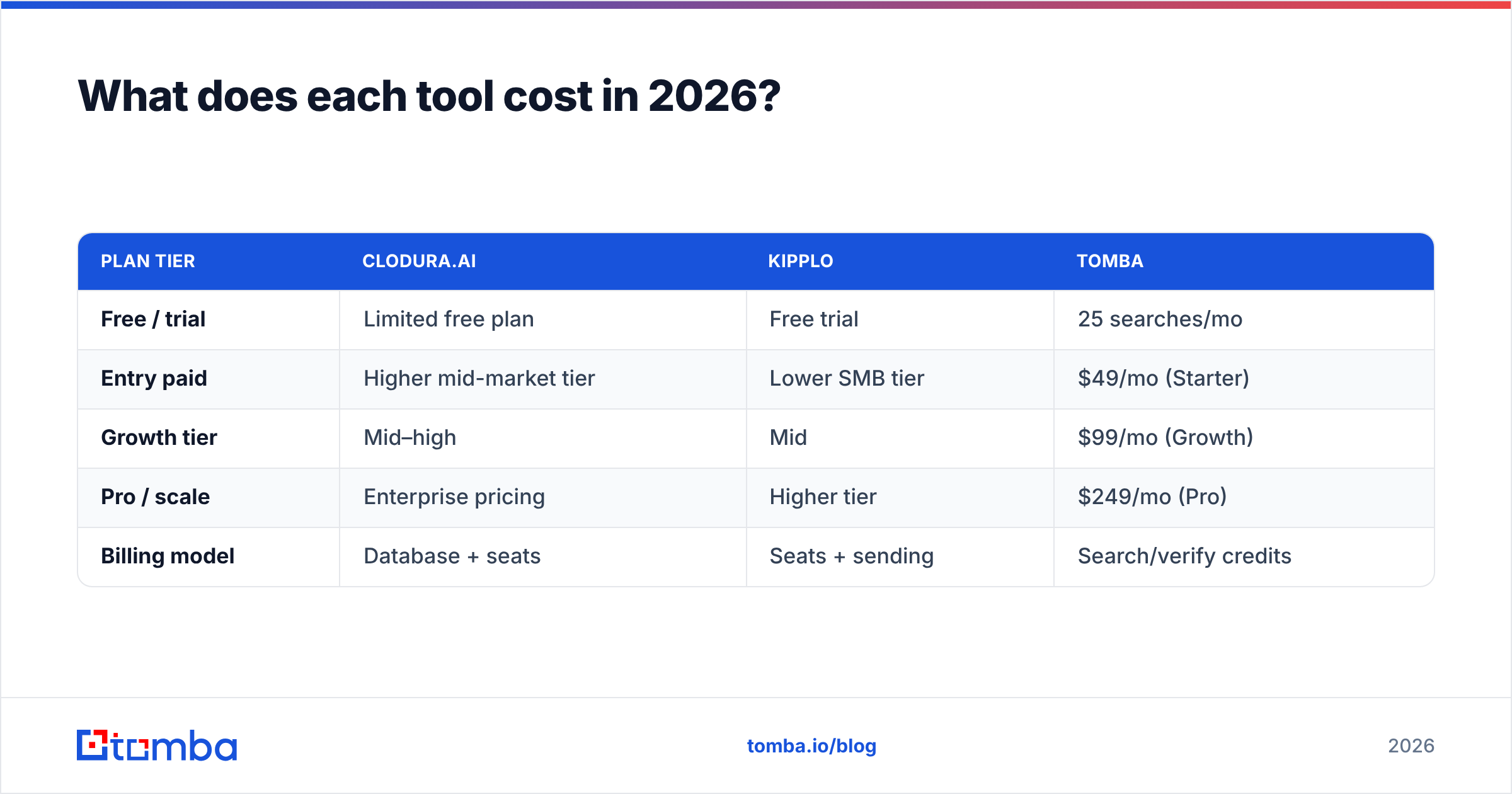
Pricing is where the two diverge most sharply, and where a third option quietly wins on cost-per-valid-contact.
| Plan tier | Clodura.ai | Kipplo | Tomba |
|---|---|---|---|
| Free / trial | Limited free plan | Free trial | 25 searches/mo |
| Entry paid | Higher mid-market tier | Lower SMB tier | $49/mo (Starter) |
| Growth tier | Mid–high | Mid | $99/mo (Growth) |
| Pro / scale | Enterprise pricing | Higher tier | $249/mo (Pro) |
| Billing model | Database + seats | Seats + sending | Search/verify credits |
Two things to notice. First, Clodura.ai's all-in-one bundle means you pay for data, intent, and sequencing whether or not you use all three — fine if you do, wasteful if you only need contacts. Second, Kipplo's lower entry price is attractive for founders, but you are buying a sequencer with attached data rather than a deep data engine.
If your real bottleneck is getting accurate contact details, a credit-based finder is the most efficient spend. You can see the full breakdown on the Tomba pricing page — a free tier to test accuracy, then $49/mo when you scale, with no obligation to buy a sequencer you may not want.
When should you pick a dedicated email finder instead?#
Choose a specialist when accuracy is the job-to-be-done — which, for most outbound teams, it is.
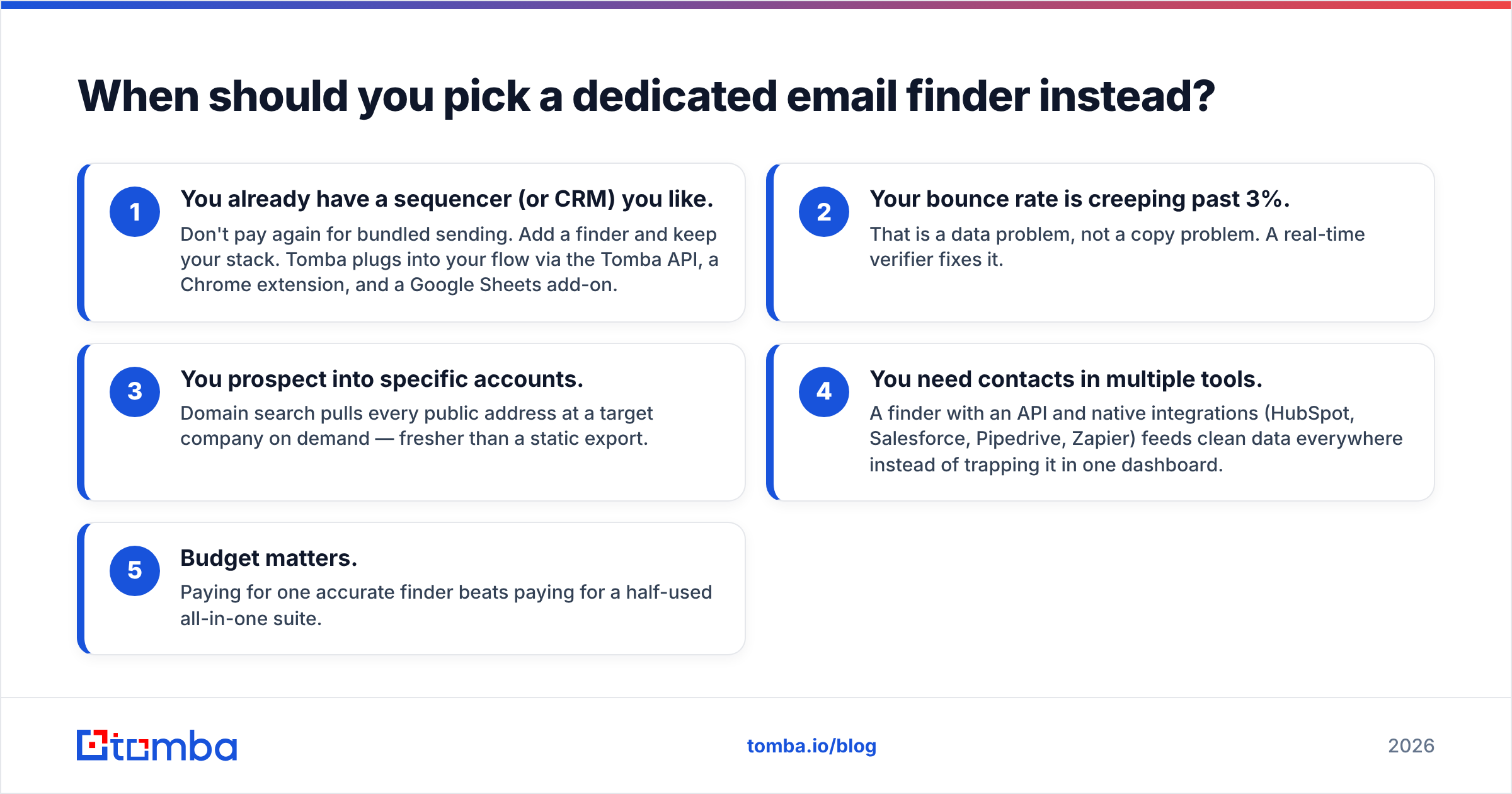
Here is the decision in five quick checks:
- You already have a sequencer (or CRM) you like. Don't pay again for bundled sending. Add a finder and keep your stack. Tomba plugs into your flow via the Tomba API, a Chrome extension, and a Google Sheets add-on.
- Your bounce rate is creeping past 3%. That is a data problem, not a copy problem. A real-time verifier fixes it.
- You prospect into specific accounts. Domain search pulls every public address at a target company on demand — fresher than a static export.
- You need contacts in multiple tools. A finder with an API and native integrations (HubSpot, Salesforce, Pipedrive, Zapier) feeds clean data everywhere instead of trapping it in one dashboard.
- Budget matters. Paying for one accurate finder beats paying for a half-used all-in-one suite.
This is also why "Clodura.ai vs Kipplo" is often the wrong question. The two are competing on bundling — how much do you want under one roof — while the metric that actually moves reply rates is data freshness. A focused tool wins that fight because accuracy is its entire reason to exist, not a bundled extra. If you are weighing all-in-one suites generally, our roundup of Apollo alternatives covers the same trade-off in more depth.
How do you build the best stack around either tool?#
Use the platform for what it is good at, and bolt on a specialist for accuracy. You do not have to pick one winner — you pick the right tool for each job.
A practical, vendor-neutral stack looks like this:
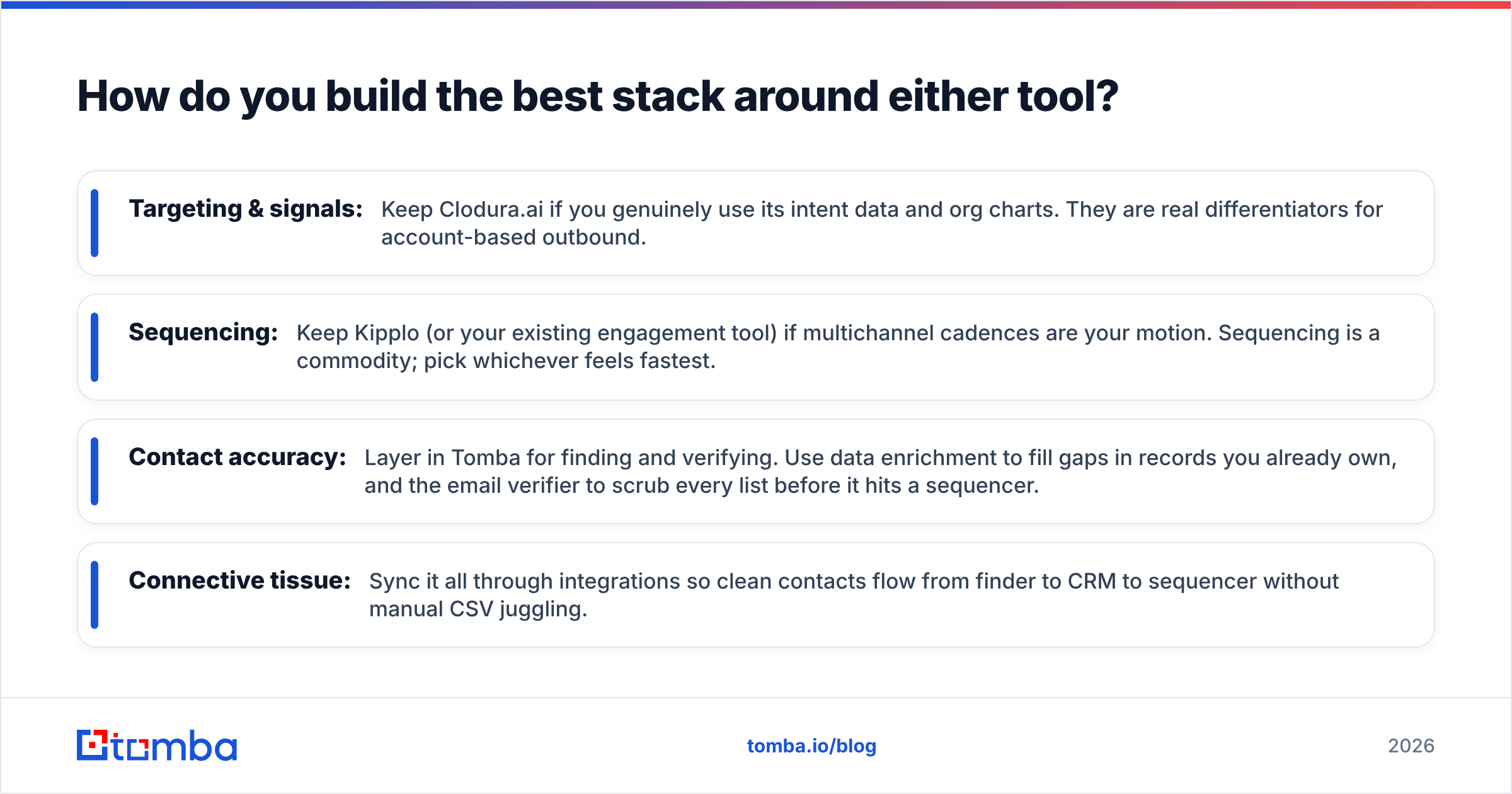
- Targeting & signals: Keep Clodura.ai if you genuinely use its intent data and org charts. They are real differentiators for account-based outbound.
- Sequencing: Keep Kipplo (or your existing engagement tool) if multichannel cadences are your motion. Sequencing is a commodity; pick whichever feels fastest.
- Contact accuracy: Layer in Tomba for finding and verifying. Use data enrichment to fill gaps in records you already own, and the email verifier to scrub every list before it hits a sequencer.
- Connective tissue: Sync it all through integrations so clean contacts flow from finder to CRM to sequencer without manual CSV juggling.
Independent reviews are worth a look before you commit. Compare current user ratings on G2 and Capterra — pay attention specifically to comments about data accuracy and bounce rates, since that is the dimension marketing pages gloss over.
The bottom line: Clodura.ai vs Kipplo#
Pick Clodura.ai if you want a data-rich, all-in-one platform and you will actually use the intent signals and org charts. Pick Kipplo if you are a small team that mainly needs affordable multichannel sequencing and you are bringing your own list.
But understand what you are really buying: both bundle email data as a feature, not a specialty, and that is where outbound campaigns leak. Bounces, spam folders, and wasted credits all trace back to stale contacts.
So before you commit to either suite, prove out the accuracy layer first. Start free with the Tomba Email Finder — 25 searches a month, real-time verification, and an API that drops into whichever sequencer you choose. Find the right people, confirm they are reachable, and let Clodura.ai or Kipplo do the sending. Your reply rate will thank you.
// get started
Find, verify and enrich your first contacts today
Start on the free plan with 25 searches a month, then scale when your team is ready.
Free plan · No credit card required · GDPR & CCPA
// about the author