Clodura.ai vs LakeB2B 2026: Which B2B Data Tool Wins?
Clodura.ai vs LakeB2B compared head-to-head on data accuracy, pricing, coverage, and workflow fit — plus where a verification-first stack beats both for cold outreach in 2026.
Choosing between Clodura.ai and LakeB2B comes down to a single question: do you want a self-serve sales prospecting platform with built-in intent signals, or a managed B2B data vendor that sells you custom lists? They solve the same surface problem — get more qualified contacts into your pipeline — but they go about it in opposite ways, and that difference decides which one is right for your team.
This guide breaks down both tools on accuracy, pricing, coverage, and workflow fit, then shows where a verification-first stack outperforms either when your real goal is cold email that actually lands.
TL;DR#
- Clodura.ai is a self-serve sales intelligence and prospecting platform — direct dials, verified emails, org charts, and buyer-intent signals inside one dashboard. Best for SDR teams that want to research and build lists themselves.
- LakeB2B is a managed data provider — you brief them, they deliver custom contact lists across niche industries (healthcare, technology, education). Best for one-off campaigns and hard-to-source verticals.
- Accuracy is the deciding factor. Both sell large databases, but database size means nothing if the emails bounce. Verify every record before you send.
- Pricing models differ. Clodura runs on monthly SaaS tiers with credits; LakeB2B quotes per-project list purchases. Neither is cheap at scale.
- The smarter play in 2026 is to source contacts where you already work, then run them through a dedicated email verifier so your sender reputation survives the campaign.
What is Clodura.ai?#
Clodura.ai is an all-in-one sales prospecting platform aimed at outbound teams. Think of it as a research desk that never sleeps: it gives you a searchable database of company and contact records, layered with technographic data, org charts, and buyer-intent signals that flag accounts showing buying behavior. You filter, build a list, pull verified emails and direct dials, then push them into a sequence — sometimes without leaving the tool, since Clodura bundles a basic email cadence feature.
Its pitch is breadth plus signal. You're not just getting a name and an email; you're getting context — who reports to whom, what tech a company runs, and whether the account is "in-market." For an SDR trying to prioritize 500 accounts down to the 50 worth a call today, that intent layer is the headline feature. You can read more about how buyer intent fits into revenue operations in modern GTM motions.
What is LakeB2B?#
LakeB2B is a managed B2B data and marketing services provider, not a self-serve tool. You don't log into a dashboard and run searches — you brief a sales rep on your ideal customer profile, and LakeB2B's team assembles a custom contact list and hands it back, usually as a file you import into your CRM.
Its strength is verticals. LakeB2B has built a reputation around hard-to-source industries — healthcare practitioners, technology decision-makers, education, and other niches where generic databases run thin. If you need 10,000 verified NPI-matched physician contacts for a single campaign, a managed provider like LakeB2B is built for exactly that, where a self-serve credit-based tool would choke. The trade-off: you're buying a snapshot, and B2B data decays fast — roughly 2-3% of records go stale every month as people change jobs.
Clodura.ai vs LakeB2B: how do they compare?#
Here's the head-to-head on the attributes that actually change your results.
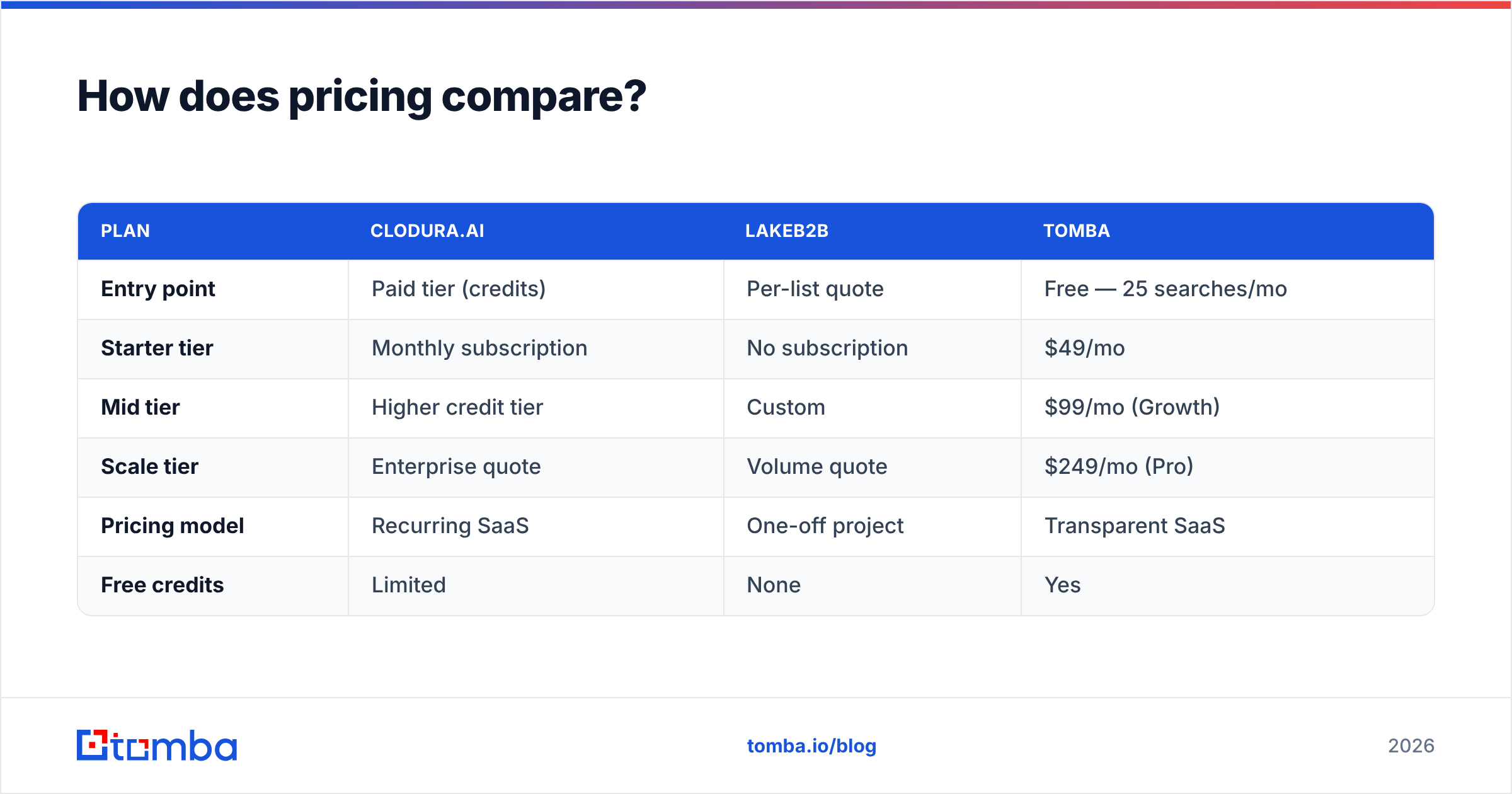
| Attribute | Clodura.ai | LakeB2B |
|---|---|---|
| Model | Self-serve SaaS platform | Managed list provider |
| Core data | Emails, direct dials, org charts, intent | Custom-built contact lists |
| Best for | SDR teams researching accounts | One-off campaigns, niche verticals |
| Intent signals | Yes, built-in | Limited / add-on |
| Pricing | Monthly tiers + credits | Per-project quote |
| Free option | Limited free plan | No |
| Verification | In-platform, varies | Provider-verified at delivery |
| Data freshness | Continuously updated | Snapshot at purchase |
| Workflow fit | Dashboard + light sequencing | Export to CRM/CSV |
The pattern is clear: Clodura wins on ongoing, self-directed prospecting; LakeB2B wins on outsourced, vertical-specific list builds. Neither is strictly "better" — they're built for different buyers. A 12-rep outbound team that prospects daily will get more from a platform. A demand-gen marketer running two big quarterly pushes into healthcare may prefer a managed list.
But both share the same Achilles' heel.
Which one has more accurate data?#
Neither database is accurate enough to send to without verification — and that's true of every B2B data vendor, not just these two. This is the single most important thing to understand before you spend a dollar.
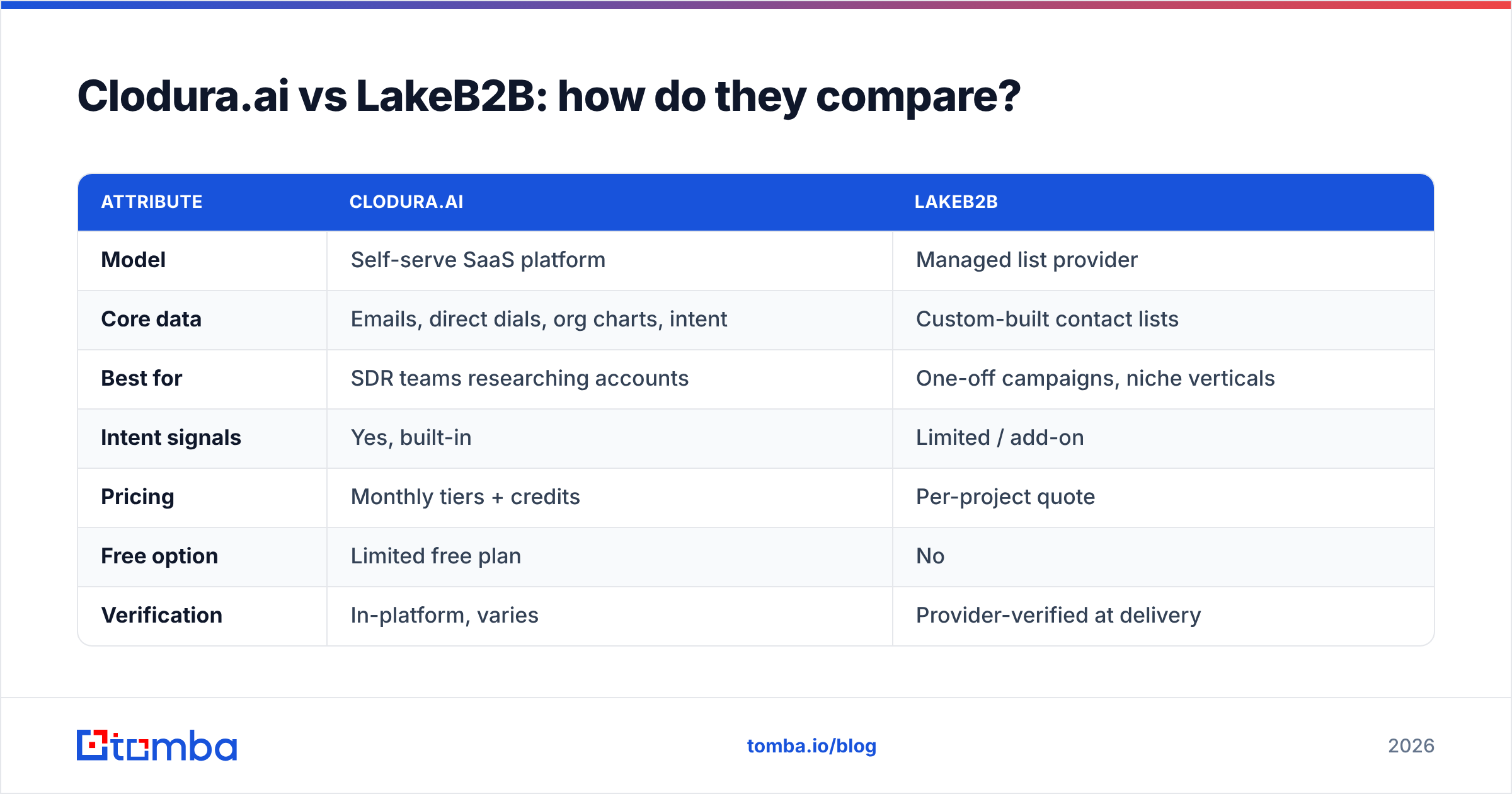
Vendors compete on database size: "200 million contacts," "300 million verified profiles." Those numbers are marketing. What matters is the bounce rate on your slice of the data on the day you send. A record verified six months ago when the person was at Company A is now wrong because they moved to Company B. Send to it and you get a hard bounce — and hard bounces are what wreck your sender reputation and push you into spam folders.
)
Independent accuracy tends to cluster lower than the marketing claims. Treat any "98% accurate" badge as a starting point, not a guarantee, and run your own check. The practical rule: whatever list you build in Clodura or buy from LakeB2B, pipe it through an independent email verifier before the first send. Tomba's verifier checks MX records, SMTP response, and catch-all status, and flags risky addresses so you can keep your bounce rate under the 2% threshold that mailbox providers watch. You can validate tricky domains with the catch-all verifier too, which is where most "verified" lists quietly fail.
For a sanity check on any single address before you commit, the free email checker gives you an instant read.
How does pricing compare?#
The pricing models are different enough that a straight dollar comparison misleads.
Clodura.ai runs on monthly SaaS tiers with credit allocations for revealing emails and phone numbers. You pay a recurring fee whether or not you use all your credits, and overages cost extra. This rewards teams that prospect consistently and punishes seasonal usage.
LakeB2B quotes per project. You tell them volume and targeting; they price the list. There's no recurring commitment, but there's also no free tier and no self-serve transparency — you negotiate.
Here's how a verification-first stack stacks up against both on cost predictability:
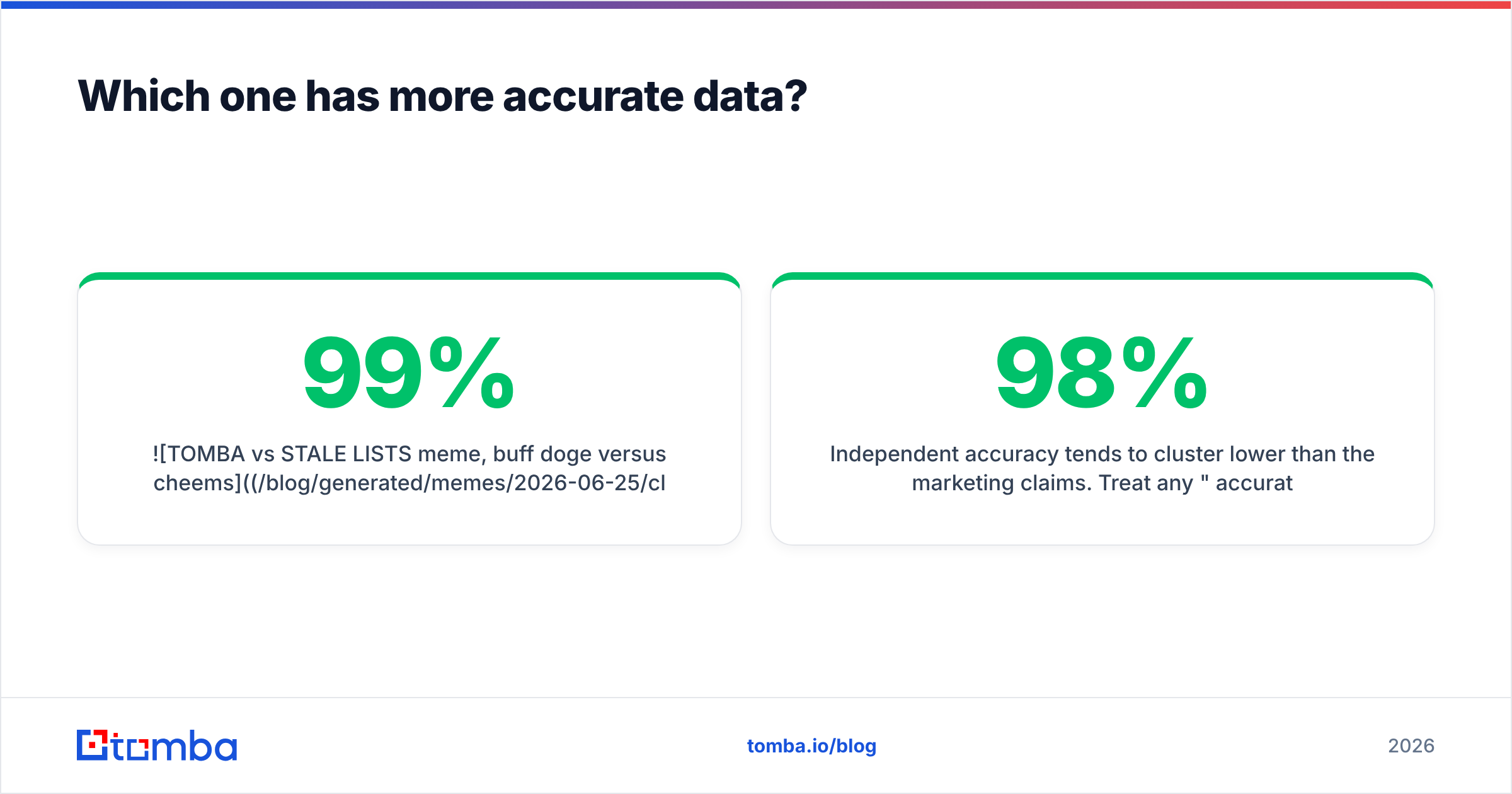
| Plan | Clodura.ai | LakeB2B | Tomba |
|---|---|---|---|
| Entry point | Paid tier (credits) | Per-list quote | Free — 25 searches/mo |
| Starter tier | Monthly subscription | No subscription | $49/mo |
| Mid tier | Higher credit tier | Custom | $99/mo (Growth) |
| Scale tier | Enterprise quote | Volume quote | $249/mo (Pro) |
| Pricing model | Recurring SaaS | One-off project | Transparent SaaS |
| Free credits | Limited | None | Yes |
Tomba's pricing is published, starts free, and scales in clear steps — no sales call to learn what you'll pay. For teams that want to control spend, transparent per-credit pricing beats both a "use it or lose it" subscription and an opaque quote.
Which fits your workflow better?#
Match the tool to how your team actually works, not to the longest feature list.
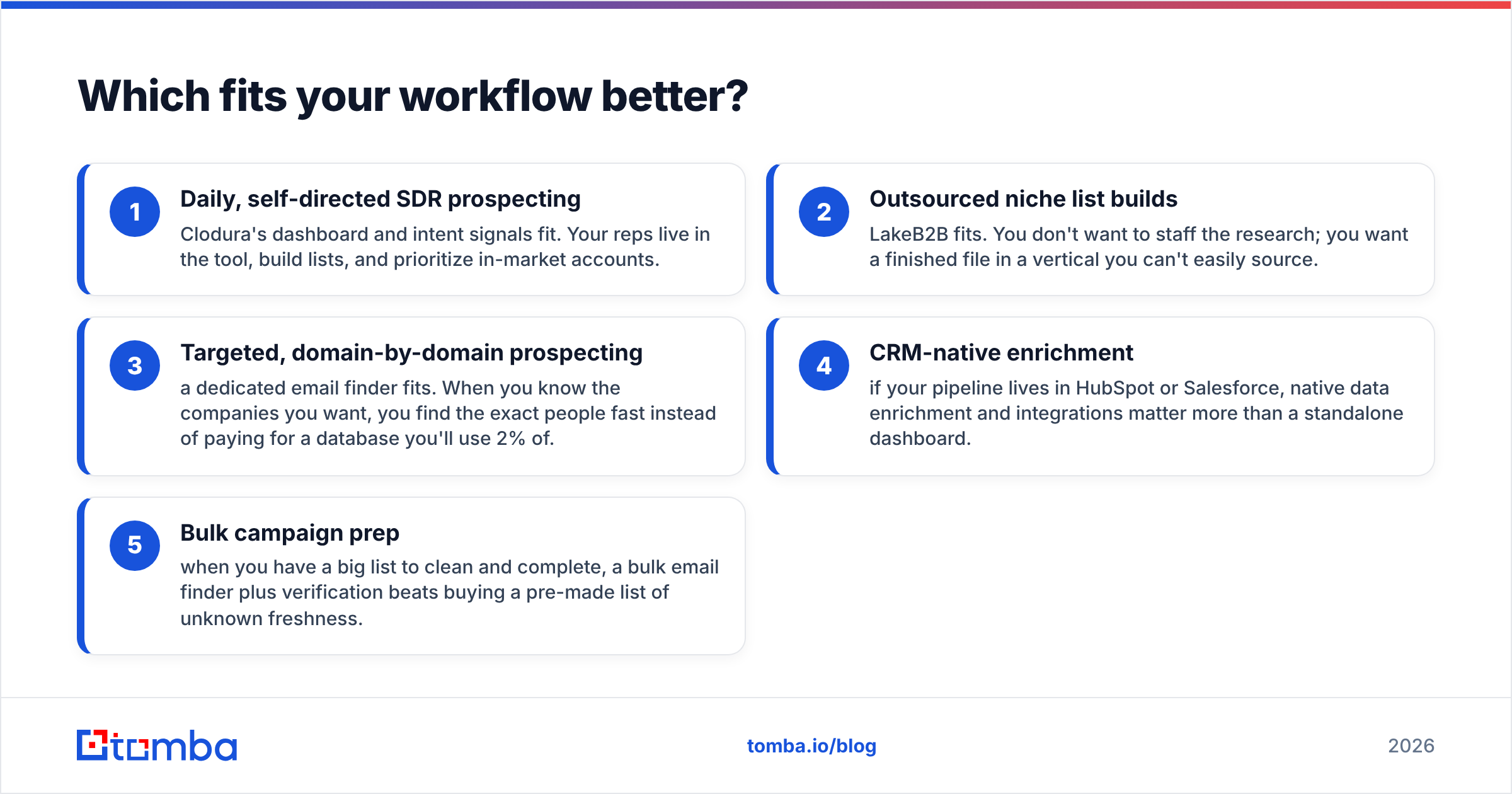
- Daily, self-directed SDR prospecting — Clodura's dashboard and intent signals fit. Your reps live in the tool, build lists, and prioritize in-market accounts.
- Outsourced niche list builds — LakeB2B fits. You don't want to staff the research; you want a finished file in a vertical you can't easily source.
- Targeted, domain-by-domain prospecting — a dedicated email finder fits. When you know the companies you want, you find the exact people fast instead of paying for a database you'll use 2% of.
- CRM-native enrichment — if your pipeline lives in HubSpot or Salesforce, native data enrichment and integrations matter more than a standalone dashboard.
- Bulk campaign prep — when you have a big list to clean and complete, a bulk email finder plus verification beats buying a pre-made list of unknown freshness.
Most teams discover their real bottleneck isn't finding contacts — it's keeping the ones they find from bouncing. That's a verification and deliverability problem, and no amount of database size solves it.
)
Are there better alternatives to both?#
For most outbound teams in 2026, yes — and the reason is focus. Clodura bundles prospecting, intent, and light sequencing; LakeB2B bundles data with managed services. Bundles charge you for breadth you may not use. A focused stack lets you pay for exactly the job you need done and swap any piece out.
A modern, accuracy-first alternative looks like this:
- Find contacts where you already work. Use domain search to pull every email pattern at a target company, or the LinkedIn finder to convert profiles you've already qualified into verified work emails.
- Verify before you send, every time. Run the email verification step as a hard gate, not an afterthought. This is the difference between a 0.5% and a 6% bounce rate.
- Enrich and dial. Add direct numbers with the phone finder when you need a multichannel touch.
- Automate it. Wire the whole flow through the Tomba API or native HubSpot integration so enrichment and verification happen on autopilot inside your CRM.
This isn't anti-platform; it's anti-waste. If you're evaluating the broader category, our roundups of Apollo alternatives and RocketReach alternatives cover where each bundled tool earns its price and where it doesn't.
For independent ratings on any of these vendors, G2 and Capterra are worth cross-checking before you buy — real reviews surface the data-quality complaints that vendor sites never mention. And if you're new to the discipline of keeping lists clean, HubSpot's guide to email deliverability is a solid primer on why verification matters more than volume.
Clodura.ai vs LakeB2B: the verdict#
Pick Clodura.ai if you want a self-serve platform your SDRs can prospect in every day, with intent signals to prioritize accounts. Pick LakeB2B if you need a managed partner to build niche, vertical-specific lists for occasional campaigns. They're genuinely different products, and the wrong fit wastes money fast.
But here's the part both vendors won't lead with: the tool you source from matters less than the verification step you add after. A pristine list from any vendor decays the moment it's delivered. The teams that win at cold email in 2026 aren't the ones with the biggest database — they're the ones whose every send clears the inbox because they verified first.
That's where Tomba fits. Find the exact people you want with the Tomba Email Finder, verify every address before it ever hits your sequence, and keep your sender reputation — and your reply rate — intact. Start on the free tier with 25 searches a month, no sales call required, and scale only when the pipeline does.
// get started
Find, verify and enrich your first contacts today
Start on the free plan with 25 searches a month, then scale when your team is ready.
Free plan · No credit card required · GDPR & CCPA
// about the author