Clodura.ai vs Lead Carrot 2026: Which Lead Tool Wins?
Clodura.ai vs Lead Carrot, compared on data accuracy, pricing, sequencing, and fit. See which B2B lead-gen platform deserves your 2026 budget — and where a dedicated email finder beats both.
Clodura.ai vs Lead Carrot: The 2026 B2B Lead-Gen Showdown
Choosing between Clodura.ai and Lead Carrot comes down to one question: are you scaling outbound across enterprise accounts, or filling a pipeline of local and SMB businesses fast? Both promise a database plus outreach, but they serve very different buyers — and neither is the best tool for every job.
TL;DR#
- Clodura.ai is a sales-intelligence platform: a large B2B contact database, intent signals, org charts, and a built-in email sequencer aimed at mid-market and enterprise outbound teams.
- Lead Carrot is a lighter, agency-friendly lead-gen tool built around pulling local-business and niche lists fast, with simpler enrichment and outreach.
- Pricing: Clodura runs free-to-mid-tier with credit caps; Lead Carrot leans flat monthly subscription for agencies and SMB closers.
- Data accuracy is the deciding factor for both — and it's where a dedicated verifier matters more than the database brand.
- If your core need is accurate emails by domain or name, a focused tool like the Tomba Email Finder often beats bundling that job into a broader platform.
What is Clodura.ai?#
Clodura.ai is a sales-intelligence and engagement platform. Think of it as a phone book that also tells you which companies are about to buy. It combines a B2B contact database (the vendor cites hundreds of millions of contacts), buyer-intent data, technographics, organizational charts, and a native email sequencer so reps can prospect and send from one screen.
The buyer is usually a mid-market or enterprise SDR team that wants account-based targeting: filter by industry, headcount, tech stack, and intent, then push contacts straight into sequences. Clodura positions itself against tools like Apollo and Lusha — you can read more about that category on G2.
Its strength is breadth. Its weakness is the same thing every large-database vendor fights: keeping records fresh. Database size is a vanity metric if 20% of the emails bounce.
)
What is Lead Carrot?#
Lead Carrot is a lead-generation tool built for speed and for a different audience: agencies, local-service businesses, and solo closers who need lists now. Instead of an enterprise intent engine, it focuses on pulling business listings, contact details, and website/tech signals for a defined niche or geography, then handing you an exportable, outreach-ready list.
The everyday analogy: Clodura is a research library; Lead Carrot is a fast food drive-through. One is for deep account planning, the other is for volume and turnaround. Lead Carrot's flat-rate model appeals to agencies reselling lead-gen as a service, where predictable cost beats per-credit metering.
The tradeoff is depth. You get reach into local and SMB segments quickly, but you won't find the same intent scoring, org charts, or enterprise coverage that Clodura offers.
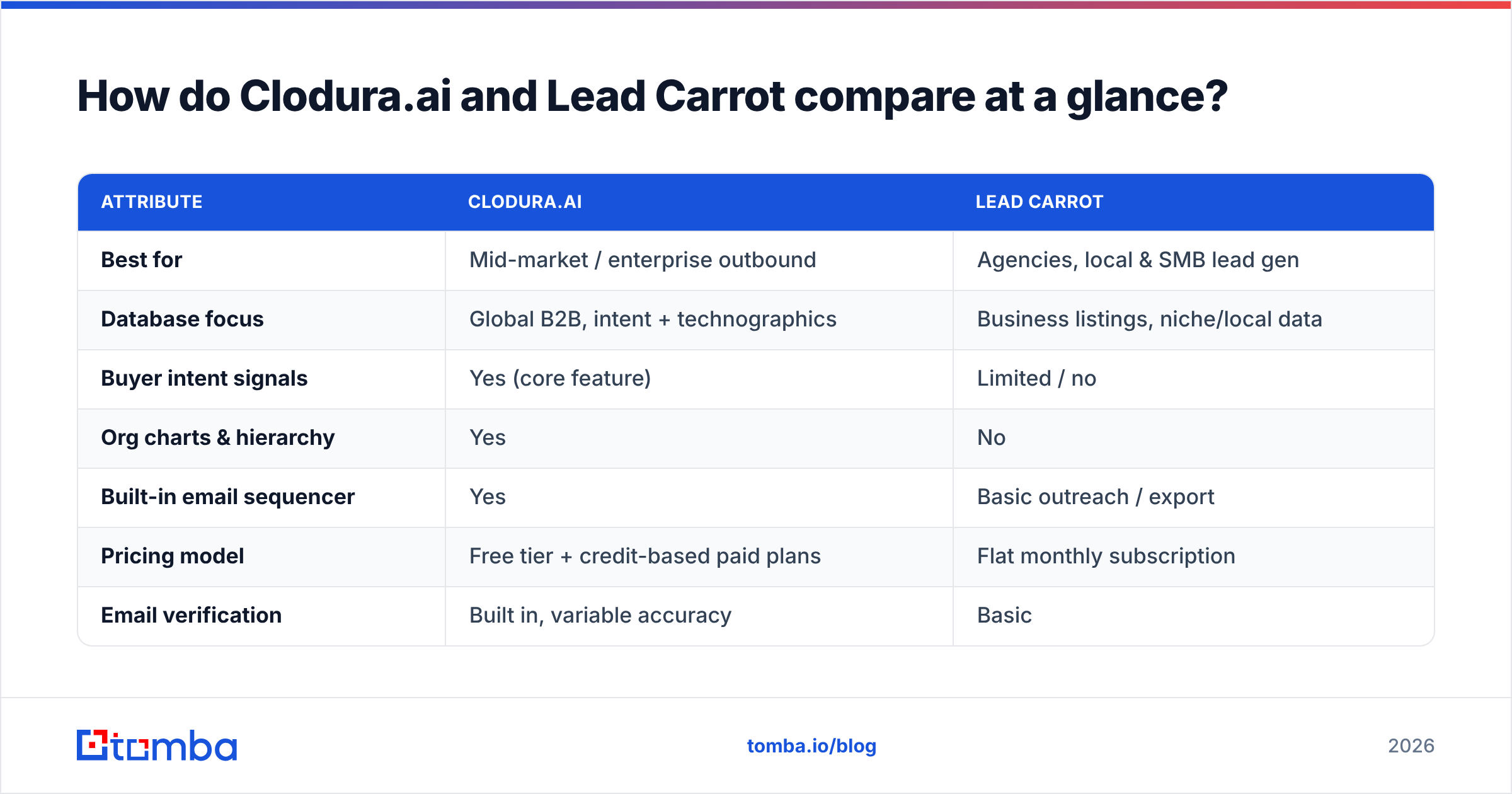
How do Clodura.ai and Lead Carrot compare at a glance?#
Here is the head-to-head on the attributes that actually change your results:
| Attribute | Clodura.ai | Lead Carrot |
|---|---|---|
| Best for | Mid-market / enterprise outbound | Agencies, local & SMB lead gen |
| Database focus | Global B2B, intent + technographics | Business listings, niche/local data |
| Buyer intent signals | Yes (core feature) | Limited / no |
| Org charts & hierarchy | Yes | No |
| Built-in email sequencer | Yes | Basic outreach / export |
| Pricing model | Free tier + credit-based paid plans | Flat monthly subscription |
| Email verification | Built in, variable accuracy | Basic |
| Learning curve | Moderate to steep | Light |
| Typical user | SDR / RevOps teams | Founders, agencies, closers |
Neither row settles the contest on its own. The pattern that matters: Clodura wins on depth and targeting, Lead Carrot wins on speed and predictable cost. Your motion decides the winner.
Which one has better data accuracy?#
Accuracy is the whole ballgame, and it's where both platforms get judged hardest by their own users.
Large databases like Clodura's are powerful for discovery, but contact records decay fast — people change jobs roughly every two to three years, so a meaningful slice of any static database is wrong at any moment. Clodura verifies emails internally, but reported accuracy varies by region and seniority. Lead Carrot, pulling more from public listings, can surface generic or role-based addresses (info@, contact@) that hurt cold-email reply rates.
The practical fix is the same regardless of which platform you pick: verify before you send. Run any exported list through a dedicated email verifier to strip catch-alls, invalids, and risky addresses before they ever touch your sequencer. Bounce rates above 3–5% damage your sender reputation and quietly tank deliverability for your whole domain.
This is the single biggest reason teams pair a broad platform with a focused finder-and-verifier rather than trusting one bundled accuracy claim.
)
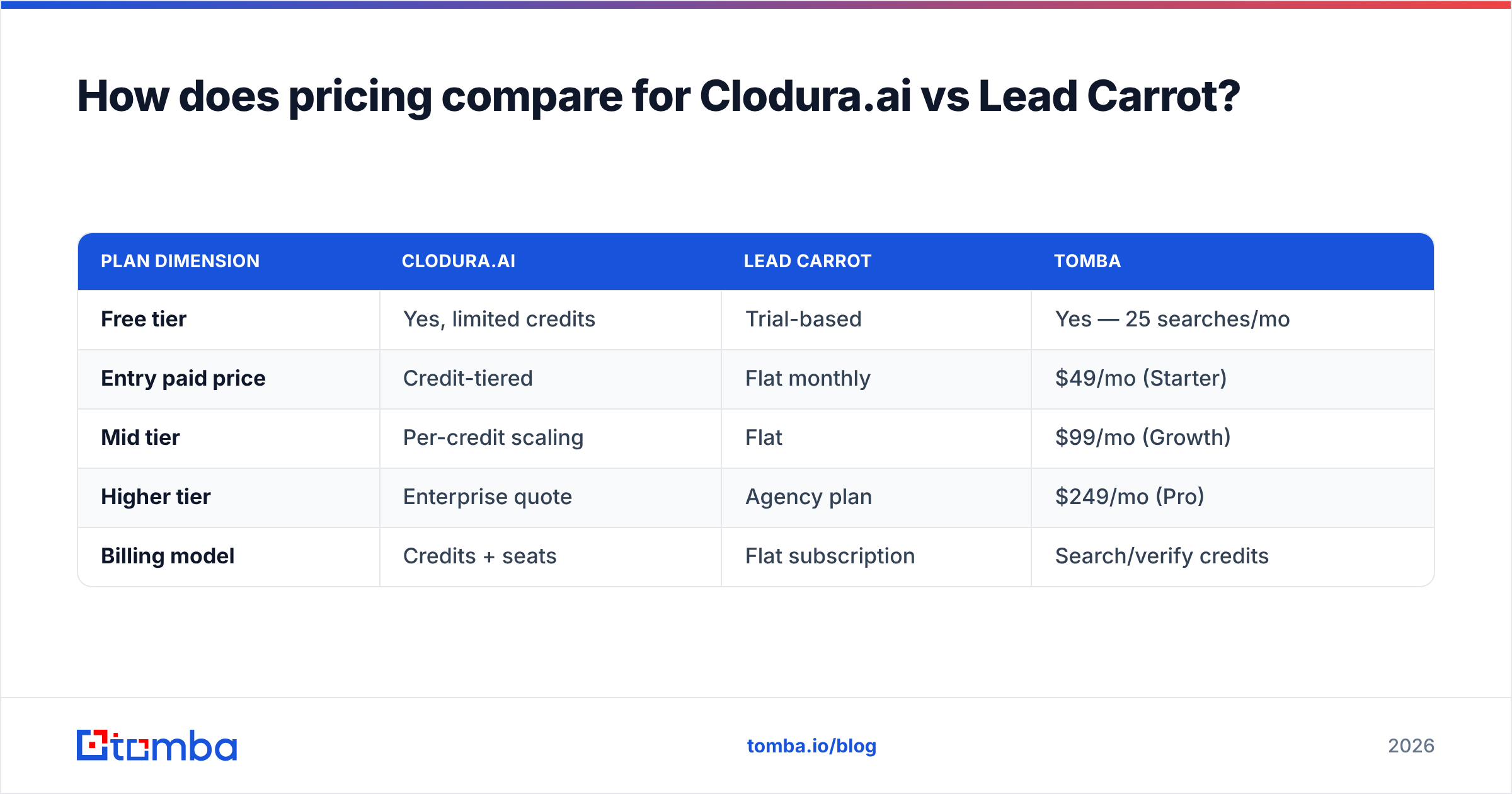
How does pricing compare for Clodura.ai vs Lead Carrot?#
The pricing philosophies are genuinely different, and that difference often decides the purchase more than features do.
- Clodura.ai offers a free tier with limited monthly credits, then scales through paid plans metered by contact/email credits and seats. Great if usage is predictable and you value targeting depth; frustrating if a big month blows past your credit cap.
- Lead Carrot leans on a flat monthly subscription. Predictable for agencies who need to quote clients a fixed cost, but you pay the same in slow months as in busy ones.
Here's how the structures stack up against a focused alternative:
| Plan dimension | Clodura.ai | Lead Carrot | Tomba |
|---|---|---|---|
| Free tier | Yes, limited credits | Trial-based | Yes — 25 searches/mo |
| Entry paid price | Credit-tiered | Flat monthly | $49/mo (Starter) |
| Mid tier | Per-credit scaling | Flat | $99/mo (Growth) |
| Higher tier | Enterprise quote | Agency plan | $249/mo (Pro) |
| Billing model | Credits + seats | Flat subscription | Search/verify credits |
For Tomba's full breakdown, see the Tomba pricing page. The takeaway: if you mostly need emails you can trust, paying for a sprawling intelligence suite to get them is overkill — a finder-plus-verifier covers the job at a fraction of the seat cost.
When should you choose Clodura.ai?#
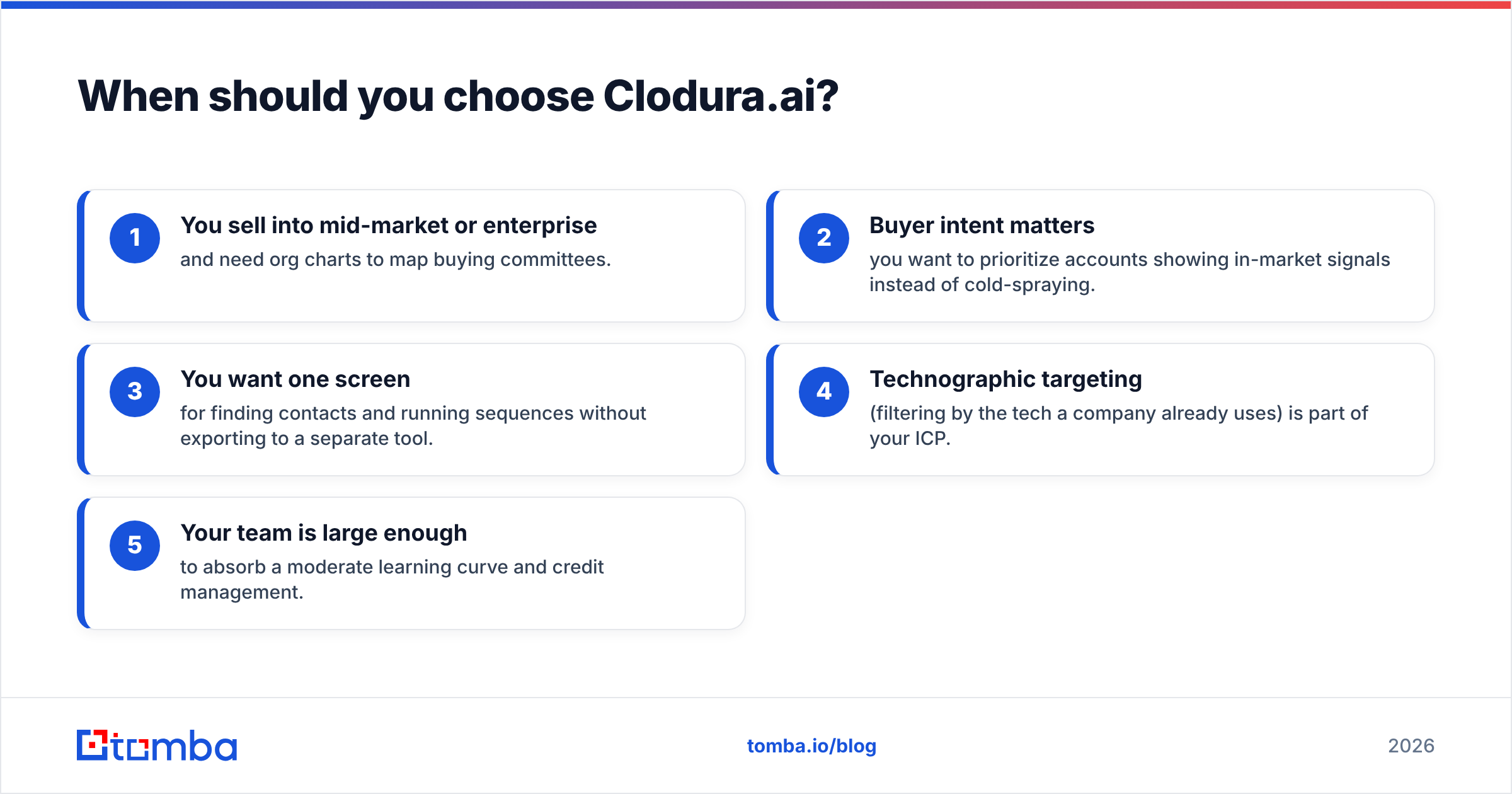
Pick Clodura.ai when your outbound motion is account-based and research-heavy. It's the stronger choice if:
- You sell into mid-market or enterprise and need org charts to map buying committees.
- Buyer intent matters — you want to prioritize accounts showing in-market signals instead of cold-spraying.
- You want one screen for finding contacts and running sequences without exporting to a separate tool.
- Technographic targeting (filtering by the tech a company already uses) is part of your ICP.
- Your team is large enough to absorb a moderate learning curve and credit management.
If you're a two-person startup chasing local clients, that horsepower is wasted. If you're a 15-rep SDR team running ABM, it earns its keep.
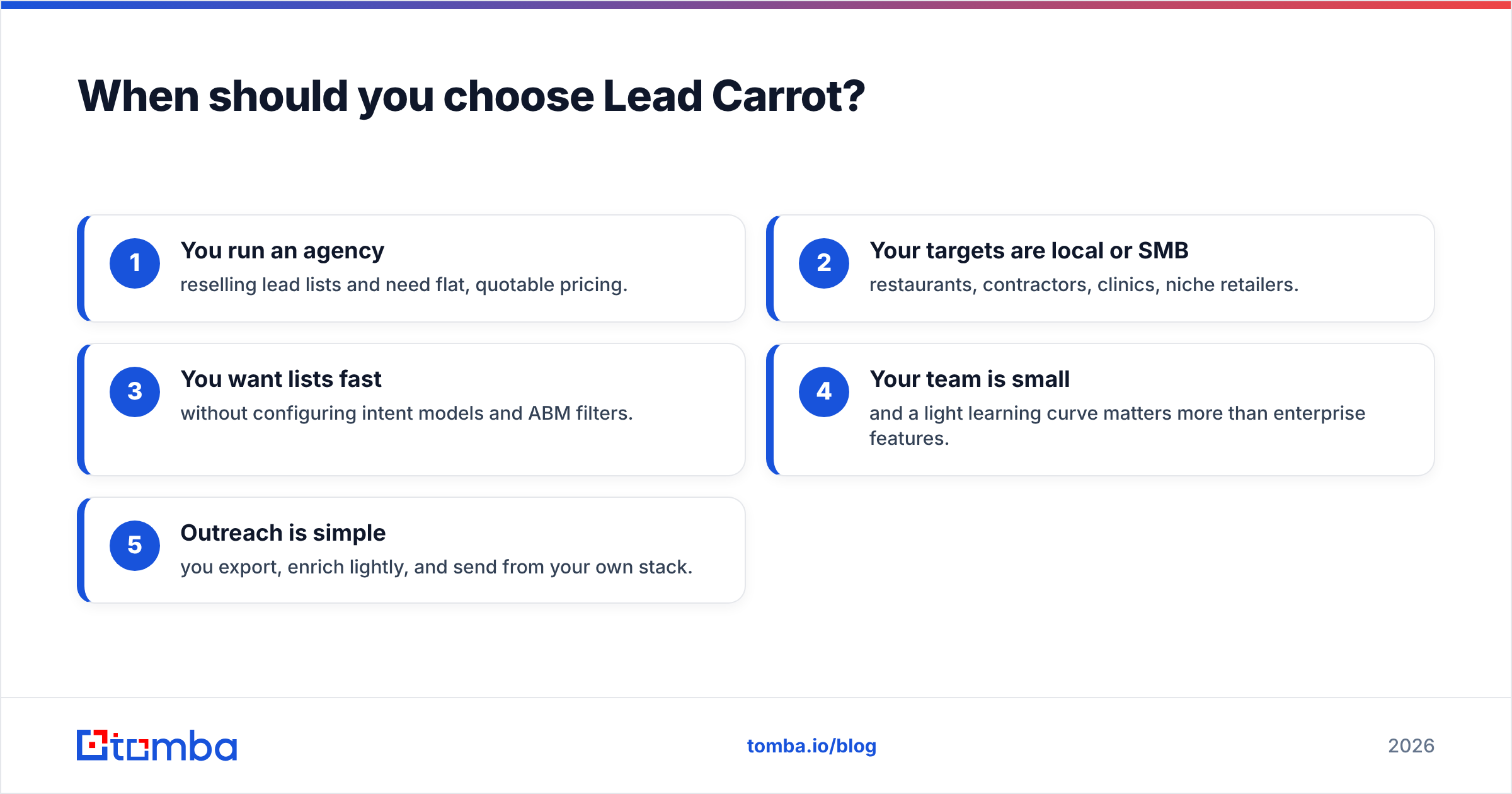
When should you choose Lead Carrot?#
Pick Lead Carrot when speed, simplicity, and predictable cost beat depth. It fits if:
- You run an agency reselling lead lists and need flat, quotable pricing.
- Your targets are local or SMB — restaurants, contractors, clinics, niche retailers.
- You want lists fast without configuring intent models and ABM filters.
- Your team is small and a light learning curve matters more than enterprise features.
- Outreach is simple — you export, enrich lightly, and send from your own stack.
Lead Carrot is honest about what it is: a fast on-ramp to volume in segments the big intelligence platforms cover thinly.
Where does a dedicated email finder beat both?#
Both platforms bundle email-finding into a bigger product — and that's exactly where a specialist tool pulls ahead. When your bottleneck is getting the right address for a known person or company, you don't need intent graphs or org charts. You need accuracy and a clean workflow.
That's the gap tools like Tomba fill:
- Find by domain or name. Drop a company domain into domain search and pull every public professional email with its confidence score and source.
- Verify in the same flow. Every result can be checked against the email verifier, including a catch-all verifier for domains that accept everything.
- Scale with bulk. Upload a list to the bulk email finder instead of burning platform credits one record at a time.
- Automate it. The Tomba API drops finding and verification into your CRM, sequencer, or enrichment pipeline directly.
The point isn't that Tomba replaces a full sales-intelligence suite — it's that you shouldn't pay enterprise database prices to solve a finder-and-verifier problem. Many teams run Clodura or Lead Carrot for discovery, then route the actual contact-finding and validation through a dedicated tool to keep bounce rates low and costs honest.
What about deliverability after you get the data?#
Finding contacts is only half the battle; landing in the inbox is the other half. Whichever platform you choose, your results live or die on email deliverability. Three habits protect it:
- Verify every list before import — no exceptions. A clean list is the cheapest deliverability upgrade you can buy.
- Authenticate your domain with SPF, DKIM, and DMARC. Check your setup with a free SPF checker before any campaign.
- Warm up new sending domains gradually instead of blasting cold from day one.
A platform with great data and a wrecked sender reputation still gets you nowhere. Treat data quality and deliverability as one system, not two separate checkboxes.
Clodura.ai vs Lead Carrot: the verdict#
There's no universal winner — there's a winner for your motion. Use this to decide fast:
| If you are... | Lean toward... |
|---|---|
| Enterprise/mid-market ABM team | Clodura.ai |
| Agency selling local lead lists | Lead Carrot |
| Intent-driven outbound | Clodura.ai |
| Small team, predictable budget | Lead Carrot |
| Mostly need verified emails | Dedicated finder + verifier |
Clodura.ai is the deeper, more strategic platform. Lead Carrot is the faster, leaner, agency-friendly option. But both share the same Achilles' heel — data decay — and both are best paired with a focused verification step rather than trusted blindly.
For broader context on the category and pricing benchmarks, compare notes on Capterra and check vendor claims against real user reviews before you commit a budget.
Get accurate emails without the enterprise price tag#
If the real job is finding and verifying business emails — not buying a six-figure intelligence stack — start with the Tomba Email Finder. Search by domain, name, or company, get a confidence score and source on every result, and verify in the same workflow so your bounce rate stays under control. The free tier gives you 25 searches a month to test accuracy on your own ICP, and paid plans start at $49/mo with bulk and API access when you're ready to scale. Pair it with Clodura.ai or Lead Carrot for discovery, and let a specialist handle the part that actually decides whether your emails land.
// get started
Find, verify and enrich your first contacts today
Start on the free plan with 25 searches a month, then scale when your team is ready.
Free plan · No credit card required · GDPR & CCPA
// about the author