Cloduraai vs Manyreach 2026: Which Outbound Tool Wins?
Clodura.ai is a sales-intelligence database; Manyreach is an unlimited cold-email sender. We break down pricing, data, deliverability, and where each one actually fits in your 2026 outbound stack.
You are comparing two tools that barely overlap. That is the first thing to understand about Clodura.ai vs Manyreach — one is a B2B data and sales-intelligence platform, the other is a cold-email sending engine. Picking between them as if they were rivals is like choosing between a fuel supplier and an engine. This guide settles which job each one does well, where they collide, and what you still need to bolt on to run outbound that actually books meetings in 2026.
TL;DR#
- Clodura.ai is a sales-intelligence database: contact discovery, org charts, intent signals, and a built-in (lightweight) sequencer. You buy it for data and targeting.
- Manyreach is a cold-email infrastructure tool built around unlimited sending, inbox rotation, and pay-per-feature pricing. You buy it for sending volume.
- They are complementary, not interchangeable — Clodura feeds the list, Manyreach (or any sender) ships the emails.
- Neither tool's email data is best-in-class for verification. Pair your stack with a dedicated email verifier to protect deliverability.
- If your real pain is finding and validating decision-maker emails, a focused finder like Tomba beats paying for a bundled database you half-use.
What is Clodura.ai?#
Clodura.ai is a sales-prospecting platform built on a proprietary B2B database. Its pitch is "find the right accounts and contacts, then reach them" inside one tool. The core modules are contact and company search, direct-dial and email discovery, org-chart mapping, buyer-intent signals, technographics, and a basic email sequencer with deliverability tooling layered on top.
The platform leans toward mid-market SDR and demand-gen teams who want a single subscription that replaces a separate database, an email finder, and a light sequencer. Its database size is the headline number, but as with every aggregated dataset, the question that matters is not "how many contacts" but "how many correct, reachable contacts for your ICP." Coverage of US tech and SaaS tends to be solid; coverage thins out in EMEA, niche verticals, and SMB.

Where Clodura gets interesting is intent. It surfaces companies showing buying signals — hiring, funding, tech installs — so your reps prioritize accounts that are actually in-market. That is genuinely useful and is the main reason teams pay a database premium instead of stitching together free tools.
What is Manyreach?#
Manyreach is cold-email sending infrastructure. The product exists to send a high volume of outbound email reliably: connect unlimited sending mailboxes, rotate inboxes to spread risk, manage campaigns and sequences, and track replies. Its differentiator is pricing philosophy — it leans toward generous or "unlimited" sending tiers and pay-as-you-go add-ons rather than a per-seat SaaS license that punishes you for scaling.
Manyreach does not try to be your data source. It assumes you arrive with a list — scraped, exported, or pulled from a tool like Clodura — and it gets that list into inboxes. Think of it as the email deliverability and throughput layer of your stack, not the targeting layer.
That focus is a strength. Tools that try to do data and sending usually do one of them poorly. Manyreach picks sending and goes deep: inbox rotation, warmup compatibility, campaign analytics, and the kind of volume controls agencies and lead-gen shops need.
Clodura.ai vs Manyreach: how do they actually differ?#
Here is the side-by-side. Read it as "what each tool is for," not "which one is better" — because they answer different questions.
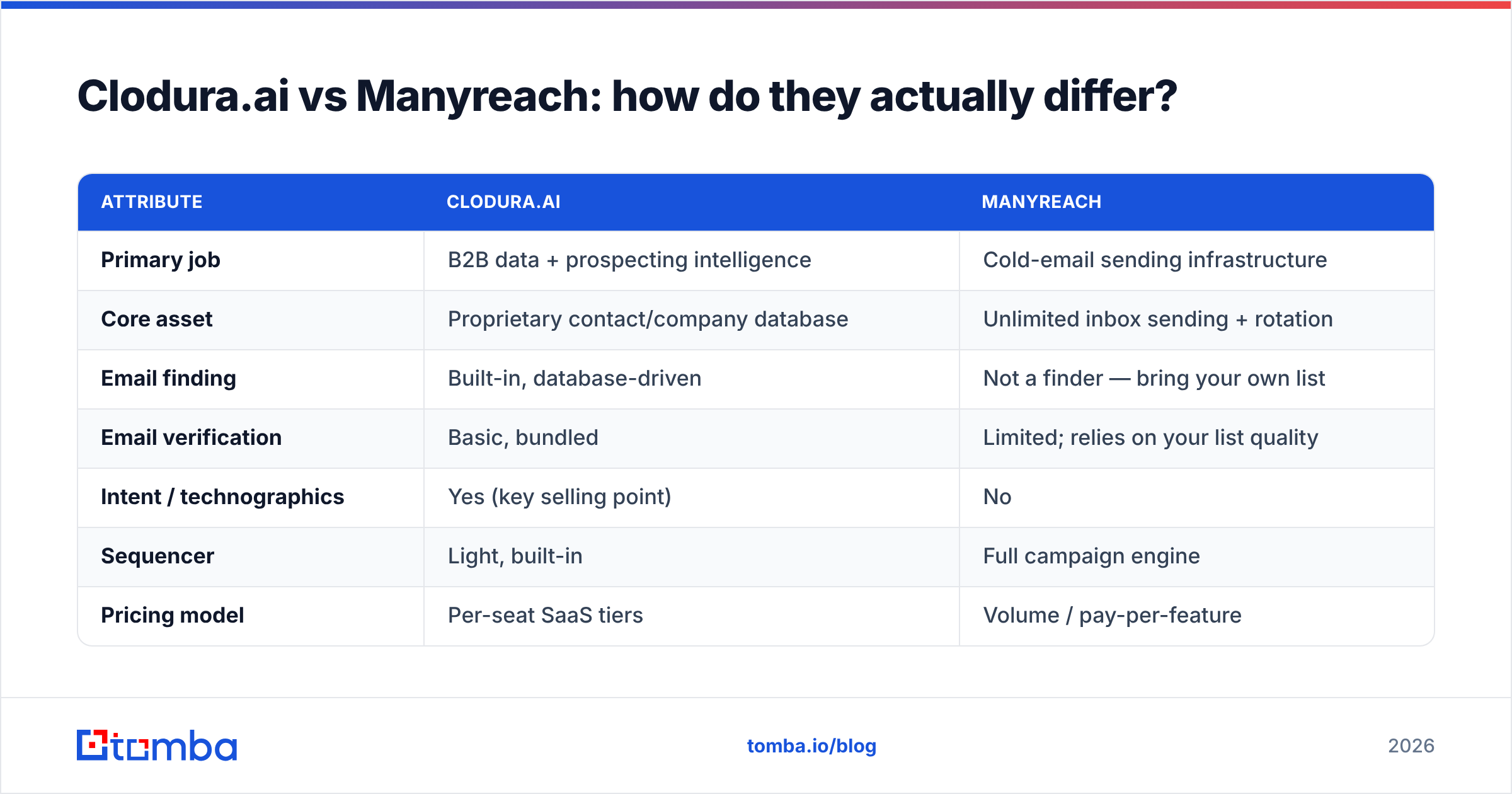
| Attribute | Clodura.ai | Manyreach |
|---|---|---|
| Primary job | B2B data + prospecting intelligence | Cold-email sending infrastructure |
| Core asset | Proprietary contact/company database | Unlimited inbox sending + rotation |
| Email finding | Built-in, database-driven | Not a finder — bring your own list |
| Email verification | Basic, bundled | Limited; relies on your list quality |
| Intent / technographics | Yes (key selling point) | No |
| Sequencer | Light, built-in | Full campaign engine |
| Pricing model | Per-seat SaaS tiers | Volume / pay-per-feature |
| Best for | SDRs needing targeted lists + signals | Agencies/teams sending at scale |
| Weak spot | Sending at scale, data freshness | No data, no targeting |
The pattern is clear: Clodura owns targeting, Manyreach owns throughput. A serious outbound motion usually needs both capabilities — the only real question is whether you buy them as one bundle, two specialists, or a finder-plus-sender combo that costs less than either platform's premium tier.
Wait — that image is a placeholder; the real one is below. Let me get to the part that decides most stacks: data quality.
Which has better data and accuracy?#
Neither tool should be your final word on email accuracy — and that matters more than any feature checklist. Clodura's database gives you breadth and intent, but aggregated B2B data decays fast: people change jobs every ~24 months, and even a well-maintained database carries a meaningful slice of stale or guessed addresses. Manyreach has no data layer at all, so accuracy there is entirely a function of the list you import.
If you send to unverified addresses, you pay for it twice: wasted sends and, worse, a damaged sender reputation that drags down your good emails too. A high bounce rate is the fastest way to land in spam folders. This is why verification is non-negotiable regardless of which platform you choose.
This is exactly the gap a dedicated finder-and-verifier fills. Tomba's approach is to find professional addresses by domain, name, or company and then validate them before they ever hit your sequencer. A focused tool that does one thing — accurate, verified contact discovery — tends to beat a database's bundled "good enough" data and a sender's "we assume your list is clean" model. You can check format and validity in bulk, scrub catch-all domains with a catch-all verifier, and keep your bounce rate under the 2–3% threshold that protects sender reputation.
The practical takeaway: use Clodura (or any database) for discovery and intent, but run every address through verification before Manyreach sends it. Otherwise Manyreach's unlimited sending becomes an unlimited way to burn domains.
How does pricing compare?#
Pricing is where the two tools diverge philosophically, and where buyers get tripped up.
Clodura.ai uses tiered per-seat SaaS pricing with a free tier and paid plans that unlock more credits, intent data, and sequencing volume. The cost scales with seats and data usage, so a five-rep team pays meaningfully more than a solo founder. You are paying for the database access and signals.
Manyreach prices around sending and features — its model rewards high volume because adding mailboxes doesn't multiply a per-seat fee the way classic SaaS does. For agencies running many campaigns across many domains, this can be dramatically cheaper than seat-based sequencers.
Here is a rough framing (always confirm live pricing on each vendor's site, since plans shift):
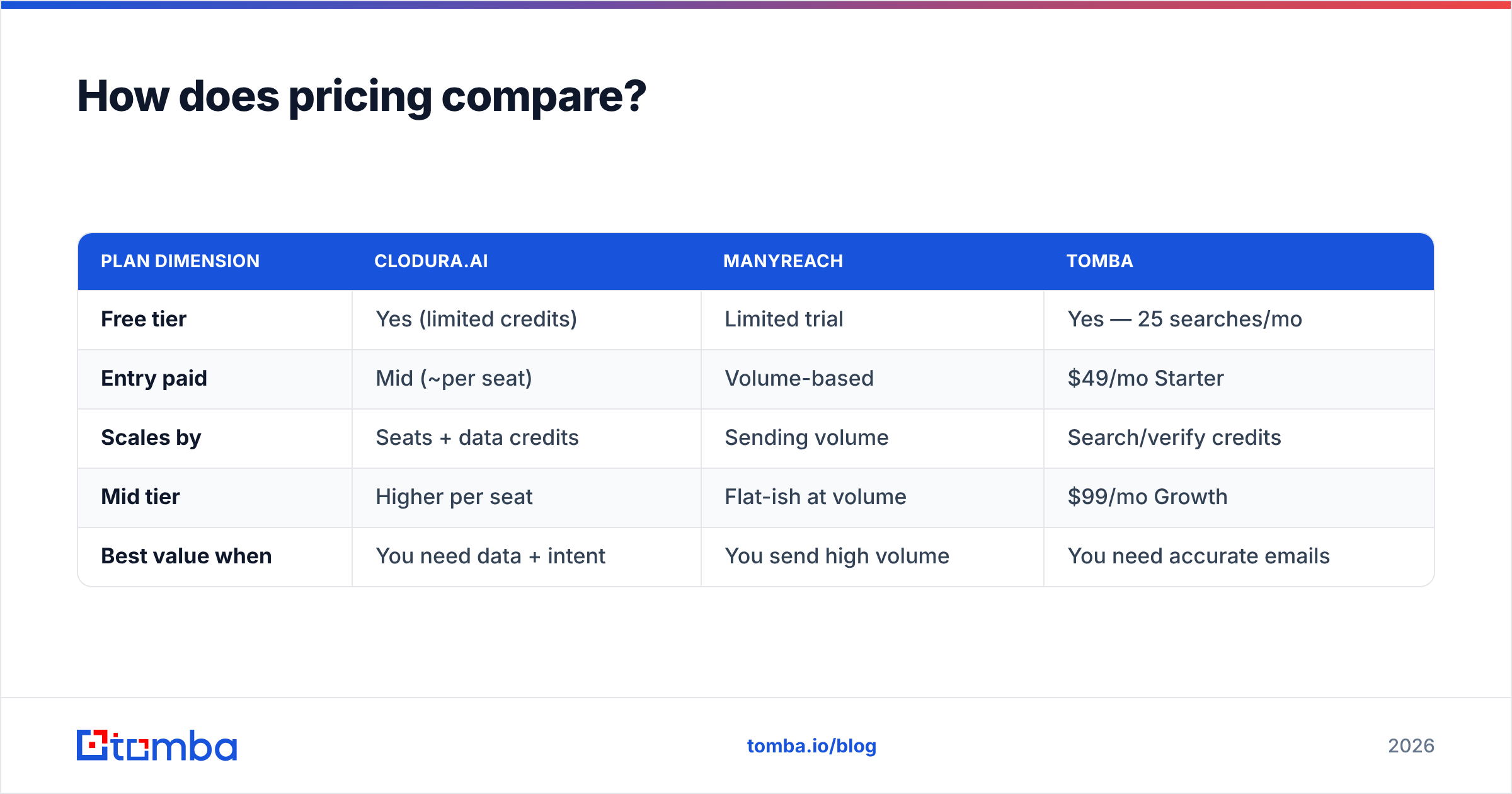
| Plan dimension | Clodura.ai | Manyreach | Tomba |
|---|---|---|---|
| Free tier | Yes (limited credits) | Limited trial | Yes — 25 searches/mo |
| Entry paid | Mid (~per seat) | Volume-based | $49/mo Starter |
| Scales by | Seats + data credits | Sending volume | Search/verify credits |
| Mid tier | Higher per seat | Flat-ish at volume | $99/mo Growth |
| Best value when | You need data + intent | You send high volume | You need accurate emails |
The honest reading: if you only need clean, findable emails and a basic outreach flow, paying for Clodura's full intelligence suite or Manyreach's sending engine may be overkill. A focused finder at a transparent $49/mo Starter on Tomba pricing covers the discovery-and-verification job that both other tools either bundle loosely or skip entirely.
Is Clodura.ai or Manyreach better for cold email?#
It depends on which half of "cold email" you mean.
For building the list and choosing who to email, Clodura.ai wins outright — Manyreach has no targeting capability. Clodura's intent signals let you prioritize in-market accounts, which lifts reply rates more than any subject-line trick.
For actually sending at scale without torching deliverability, Manyreach wins — inbox rotation and volume tooling are what keep you out of spam when you're sending thousands of emails a week. Clodura's built-in sequencer is fine for low volume but isn't designed to be your primary sending engine.
So the "better for cold email" answer is: you probably want both functions, and you should not expect either tool to cover the other's job. What ties them together is the connective tissue most teams forget — verified data and proper authentication (SPF, DKIM, DMARC). Run an SPF checker before any campaign, warm your domains, and verify every address.
What's the smartest stack in 2026?#
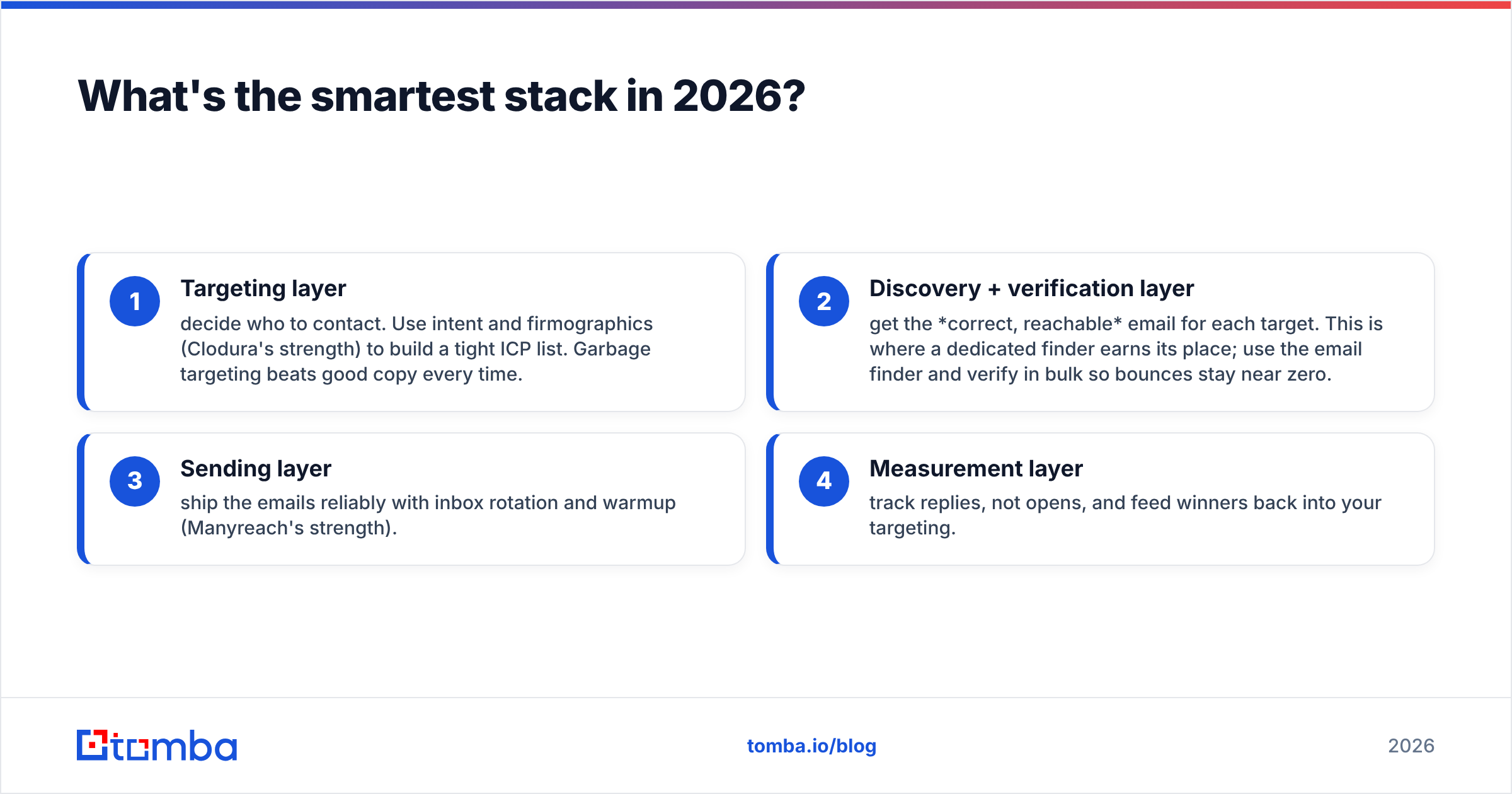
Stop thinking "Clodura or Manyreach." Think in layers:
- Targeting layer — decide who to contact. Use intent and firmographics (Clodura's strength) to build a tight ICP list. Garbage targeting beats good copy every time.
- Discovery + verification layer — get the correct, reachable email for each target. This is where a dedicated finder earns its place; use the email finder and verify in bulk so bounces stay near zero.
- Sending layer — ship the emails reliably with inbox rotation and warmup (Manyreach's strength).
- Measurement layer — track replies, not opens, and feed winners back into your targeting.
The reason to separate these layers is resilience. When you bundle everything into one platform, a weakness in any layer (usually data freshness or sending limits) caps the whole motion. Modular stacks let you swap the weakest component without ripping out your CRM.
For teams that want fewer vendors, the pragmatic combo is: a real data/intent source for accounts, a precise finder-and-verifier like Tomba for emails, and a sending tool like Manyreach for volume. That's three specialists each doing one job well, which almost always outperforms two generalists each doing one job adequately. If you're consolidating, you can also pull contacts straight into your CRM via Tomba's HubSpot integration or Salesforce integration instead of juggling CSV exports.
What are the pros and cons?#
Clodura.ai — pros: strong intent data, org charts, all-in-one for SDR teams, free tier to test. Cons: per-seat pricing scales fast, data freshness varies by region/vertical, sequencer is light, bundled verification isn't a substitute for a dedicated one.
Manyreach — pros: built for volume, inbox rotation, agency-friendly pricing, deep sending controls. Cons: no data layer at all, deliverability depends entirely on your list quality, useless on its own without a targeting and verification source.
The shared gap: both lean on you to supply clean data. Clodura provides data but not verification rigor; Manyreach provides neither. That gap is the single biggest determinant of campaign ROI, and it's exactly the thing a focused tool solves cheaply. See where the underlying data sources come from when accuracy is the priority.
How should you decide?#
Run this quick test:
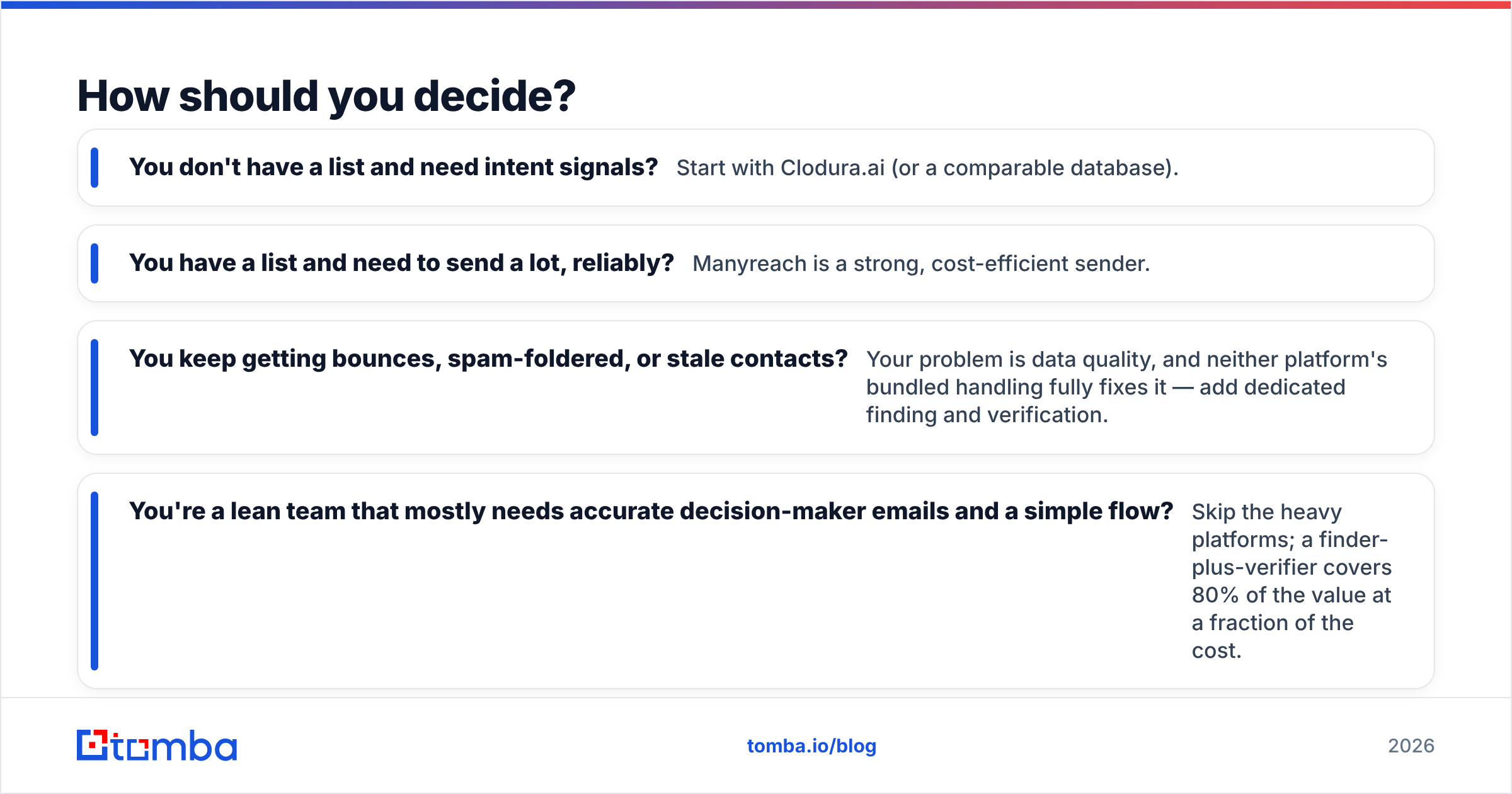
- You don't have a list and need intent signals? Start with Clodura.ai (or a comparable database).
- You have a list and need to send a lot, reliably? Manyreach is a strong, cost-efficient sender.
- You keep getting bounces, spam-foldered, or stale contacts? Your problem is data quality, and neither platform's bundled handling fully fixes it — add dedicated finding and verification.
- You're a lean team that mostly needs accurate decision-maker emails and a simple flow? Skip the heavy platforms; a finder-plus-verifier covers 80% of the value at a fraction of the cost.
For deeper benchmarking on tooling categories, third-party review sites like G2 and Capterra are worth scanning for current user sentiment, and HubSpot's sales blog has solid neutral primers on outbound process. Cross-reference vendor claims against real reviews before you commit a budget.
The bottom line#
Clodura.ai and Manyreach aren't competitors — they're two layers of the same machine. Clodura finds and prioritizes accounts; Manyreach delivers volume. The layer both leave exposed is accurate, verified contact data, and that layer decides whether your sends convert or bounce.
If your core need is finding and validating professional emails before they ever reach a sequencer, start with the Tomba Email Finder. Find addresses by domain, name, or company, verify them in bulk, and feed a clean list into whatever sending engine you choose — for free on the 25-search tier, then $49/mo when you scale. Clean data in, meetings out. Everything else is just plumbing.
// get started
Find, verify and enrich your first contacts today
Start on the free plan with 25 searches a month, then scale when your team is ready.
Free plan · No credit card required · GDPR & CCPA
// about the author