Cloduraai vs VerifiedEmail: Full 2026 Comparison and Verdict
Clodura.ai bundles prospecting data while VerifiedEmail focuses on list hygiene. Here is an honest, side-by-side breakdown of accuracy, pricing, and which tool actually fits your workflow.
The Cloduraai vs VerifiedEmail choice is like comparing a Swiss Army knife to a scalpel. One tool wants to be your whole prospecting engine. The other does just one job. It checks whether an email address is real. Buy the wrong one and you lose either way. You overpay for features you never touch, or you plug one hole while the boat still leaks.
This comparison cuts through the marketing. You will see what each tool actually does, where the accuracy numbers land, what you pay, and where a focused alternative like Tomba fits into the picture.
TL;DR — Clodura.ai vs VerifiedEmail at a glance#
- Clodura.ai is a B2B sales-intelligence platform: a contact database, email finder, sequences, and buyer-intent signals bundled together. Best if you want prospecting and outreach in one login.
- VerifiedEmail is a single-purpose email verification service. It cleans lists and cuts bounce rates, but it does not find new contacts.
- They solve different problems. Clodura sources data; VerifiedEmail validates it. Many teams end up needing both jobs done.
- Accuracy is the deciding factor. A big database means nothing if the emails bounce, and a verifier means nothing if you have no leads to check.
- Tomba covers both jobs — finding professional emails and verifying them — with transparent pricing starting at $49/mo, which is why it keeps showing up as the middle path.
What is Clodura.ai?#
Clodura.ai is an all-in-one sales-intelligence and prospecting platform aimed at outbound teams. Instead of doing one thing, it stacks several: a B2B contact database (the company advertises hundreds of millions of contacts), an email finder, direct-dial phone numbers, buyer-intent and technographic data, plus a built-in email-sequencing tool so you can prospect and send from the same place.
The pitch is consolidation. If you are tired of paying for a database tool, a finder, and a sequencer separately, Clodura wants to be the single subscription that replaces all three. That breadth is genuinely useful for a full-cycle SDR who lives inside one dashboard all day.
The trade-off is depth. When a platform spreads across database, dialer, intent, and sending, no single feature is usually best-in-class. Verification, in particular, is a feature inside Clodura rather than its core competency — which matters when you care about bounce rates.

What is VerifiedEmail?#
VerifiedEmail does the opposite of Clodura: it goes narrow and deep on one task. You upload a list of email addresses, and it tells you which ones are valid, invalid, risky, or catch-all. That is the whole product, and there is nothing wrong with that.
A good verifier runs a chain of checks — syntax, domain and MX records, and an SMTP handshake — to predict whether a message will actually land. The output is a cleaner list and a lower bounce rate, which protects your sender reputation and keeps you out of spam folders.
What VerifiedEmail does not do is find anyone. It has no database and no discovery engine. If your CRM is empty, a verifier has nothing to work on. It is the last mile of data hygiene, not the first mile of prospecting.

Cloduraai vs VerifiedEmail: the core difference#
Here is the Cloduraai vs VerifiedEmail answer in one line: Clodura finds contacts and VerifiedEmail checks them. You are not choosing between two versions of the same tool. You are deciding which half of the problem you need solved.
Think of it like building a house. Clodura is the lumber yard: it supplies the raw material (leads) in bulk. VerifiedEmail is the building inspector: it walks through and flags what is up to code (valid) and what will collapse (bounce). A lumber yard with no inspector ships you rotten boards. An inspector with no lumber yard has nothing to inspect.
- Data sourcing — Clodura only. VerifiedEmail has no discovery layer.
- Email verification — VerifiedEmail's specialty; a secondary feature in Clodura.
- Outreach/sequencing — Clodura only. VerifiedEmail is not a sending tool.
- Intent and technographics — Clodura only.
- List hygiene at scale — VerifiedEmail's strongest use case.
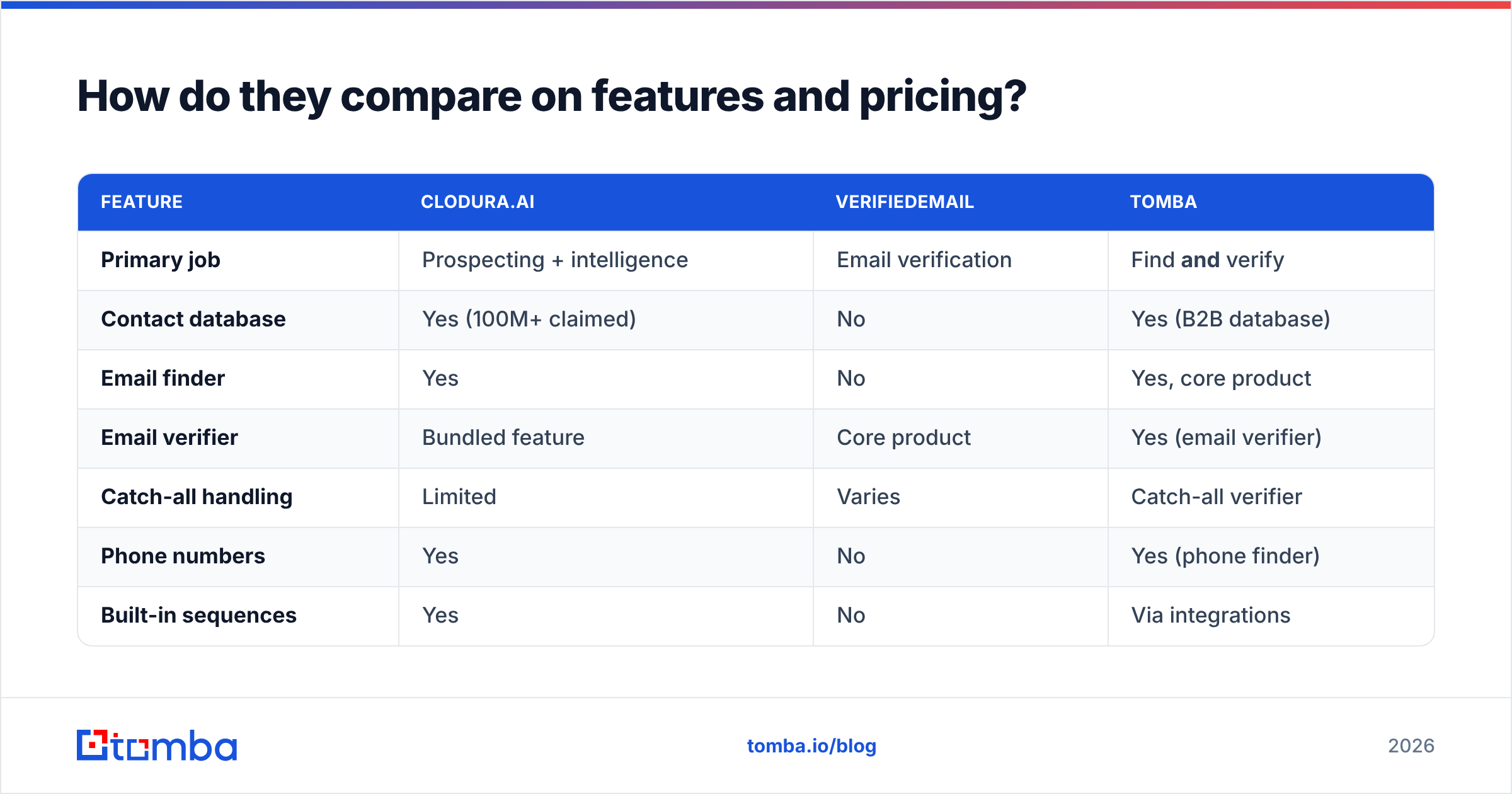
How do they compare on features and pricing?#
Pricing for both tools shifts with contract terms and credit volume, so treat the figures below as directional rather than a locked quote. The point is the shape of each offer, not the exact cents.
| Feature | Clodura.ai | VerifiedEmail | Tomba |
|---|---|---|---|
| Primary job | Prospecting + intelligence | Email verification | Find and verify |
| Contact database | Yes (100M+ claimed) | No | Yes (B2B database) |
| Email finder | Yes | No | Yes, core product |
| Email verifier | Bundled feature | Core product | Yes (email verifier) |
| Catch-all handling | Limited | Varies | Catch-all verifier |
| Phone numbers | Yes | No | Yes (phone finder) |
| Built-in sequences | Yes | No | Via integrations |
| Free tier | Limited free plan | Trial credits | 25 searches/mo |
| Entry paid price | Mid-tier SaaS pricing | Low, per-credit | $49/mo Starter |
| Best for | Full-cycle outbound teams | List cleaning | Accurate finding + hygiene |
Read the table and the split is obvious. Clodura wins on breadth — database, phones, sequences, intent, all under one roof. VerifiedEmail wins on being cheap and singularly good at hygiene. Neither one is designed to be a great finder plus verifier on its own, which is the exact gap most cold-outreach teams actually feel.
If you want to sanity-check what a full platform costs versus a focused finder, the transparent Tomba pricing page is a useful yardstick because there are no per-seat surprises.
Which tool is more accurate?#
Accuracy is where this whole decision gets decided, so be precise about what "accurate" means for each tool.
For VerifiedEmail, accuracy means correctly labeling an address as valid or invalid. The hard cases are catch-all domains — servers that accept mail for any address, so an SMTP check comes back "maybe." How a verifier scores catch-alls is the real test of its quality, and it is worth running a known sample list before you trust any vendor's headline percentage.
For Clodura, accuracy means two things: is the email it found correct, and is the contact still at that company? Large databases decay fast — people change jobs constantly — so a "100M+ contacts" claim tells you about size, not freshness. A stale record that passes verification today can still reach someone who left last quarter.
This is why pairing a finder with a verifier matters. You want the finder to source the address and confirm it in the same pass. Tomba's approach is to score every result and expose where the data comes from, so you are not trusting a black box. Industry review sites like G2 are a good neutral place to cross-check accuracy claims before committing budget.

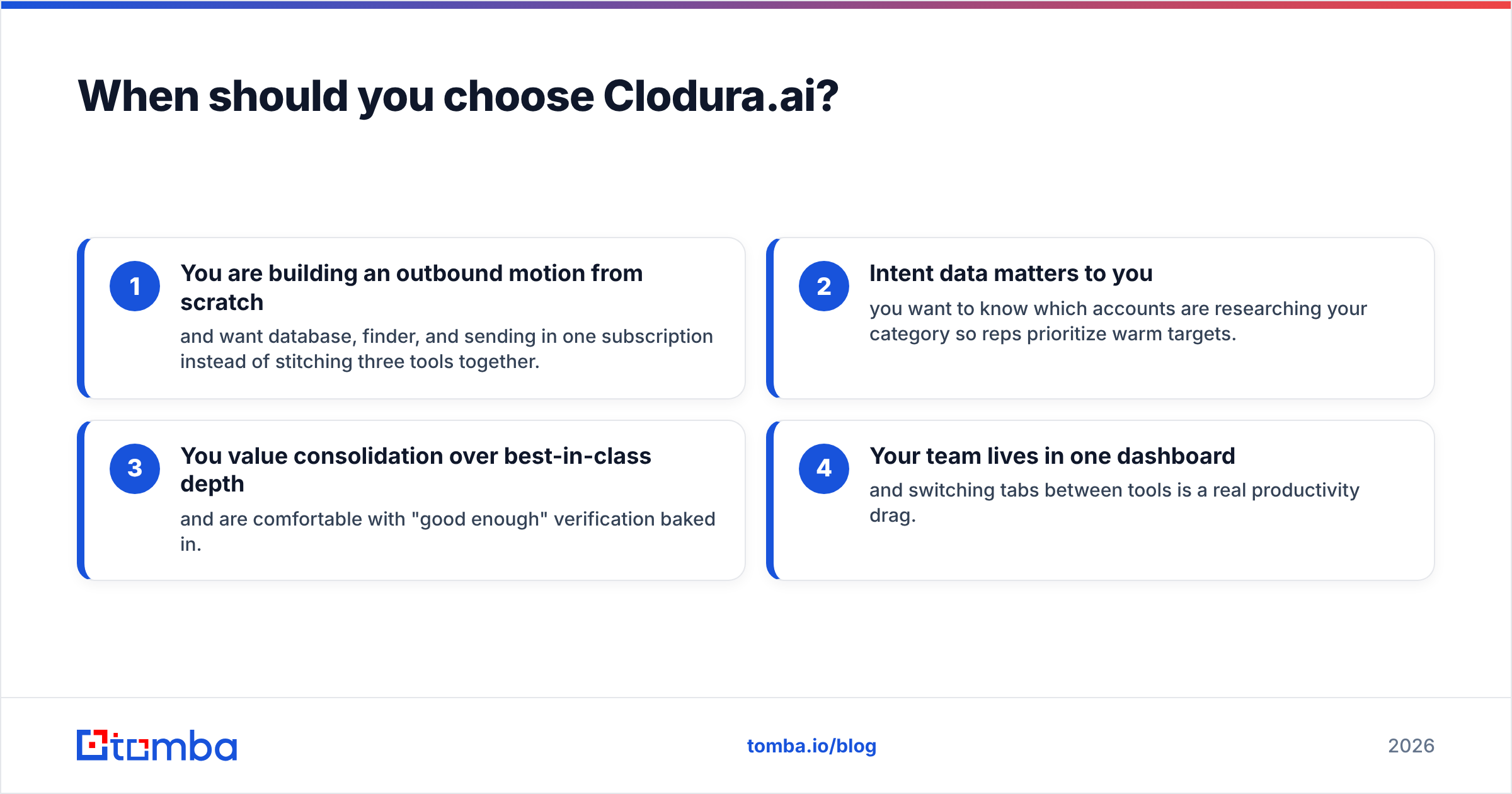
When should you choose Clodura.ai?#
Pick Clodura.ai if you match this profile:
- You are building an outbound motion from scratch and want database, finder, and sending in one subscription instead of stitching three tools together.
- Intent data matters to you — you want to know which accounts are researching your category so reps prioritize warm targets.
- You value consolidation over best-in-class depth and are comfortable with "good enough" verification baked in.
- Your team lives in one dashboard and switching tabs between tools is a real productivity drag.
Where Clodura frustrates people: costs climb as you add seats and credits, database freshness varies by region and industry, and the bundled verification is not as rigorous as a dedicated engine. If deliverability is your top pain, a bundle rarely fixes it.
When should you choose VerifiedEmail?#
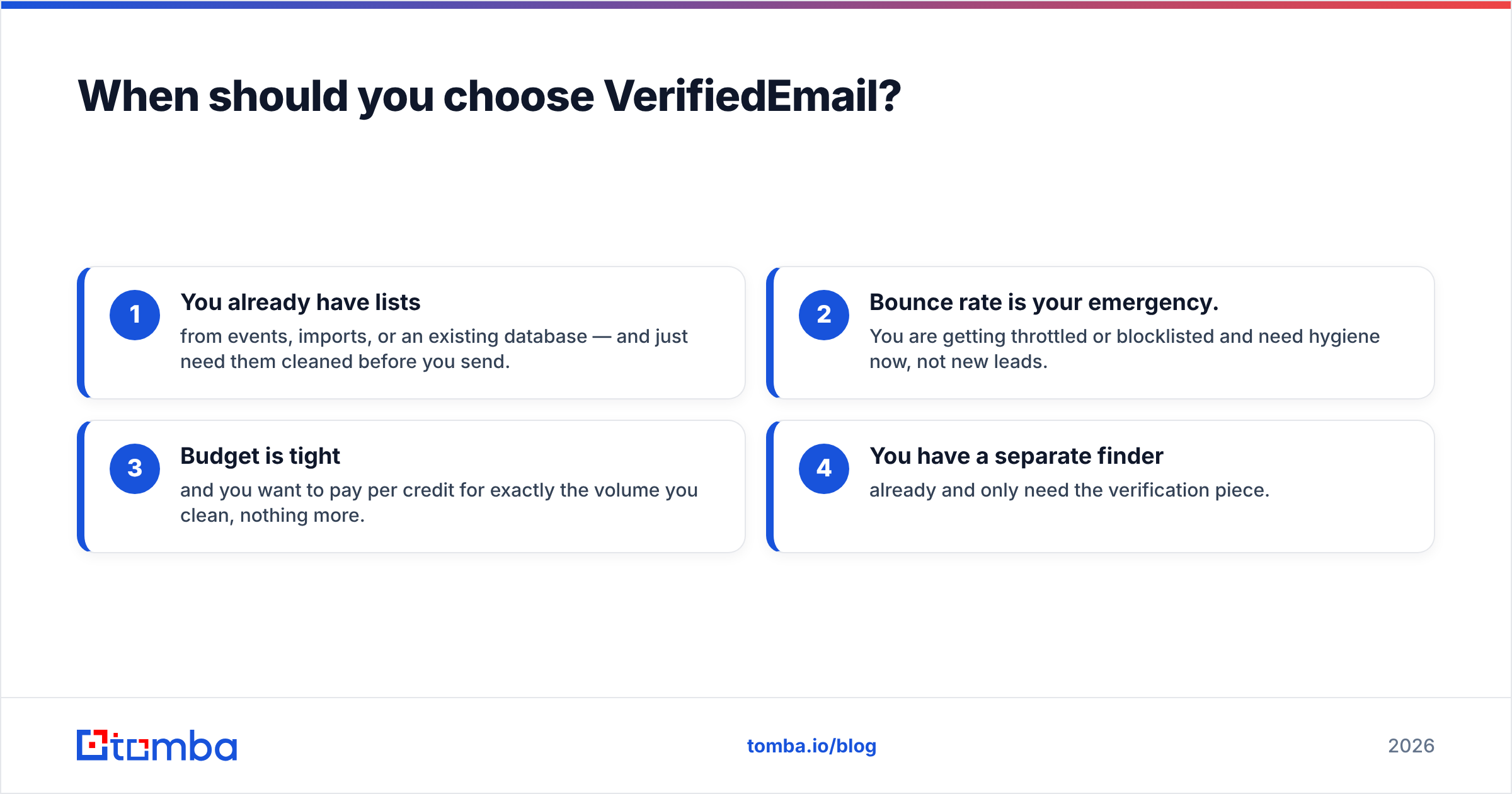
Pick VerifiedEmail if:
- You already have lists — from events, imports, or an existing database — and just need them cleaned before you send.
- Bounce rate is your emergency. You are getting throttled or blocklisted and need hygiene now, not new leads.
- Budget is tight and you want to pay per credit for exactly the volume you clean, nothing more.
- You have a separate finder already and only need the verification piece.
Where VerifiedEmail falls short: it cannot grow your pipeline. The moment you need new contacts, you are back to shopping for a finder or a database — and now you are managing two vendors, two logins, and two bills.
Where does Tomba fit between them?#
Tomba sits in the exact spot both tools leave open: it finds professional emails and verifies them in the same workflow, without forcing you into a heavy all-in-one contract.
Practically, that means you can run a domain search to pull every reachable contact at a target company, let the email verifier confirm each one, and handle the tricky catch-all verifier cases that trip up lighter tools — all before a single message goes out. For scale, the bulk email finder processes lists in one pass rather than one lookup at a time.
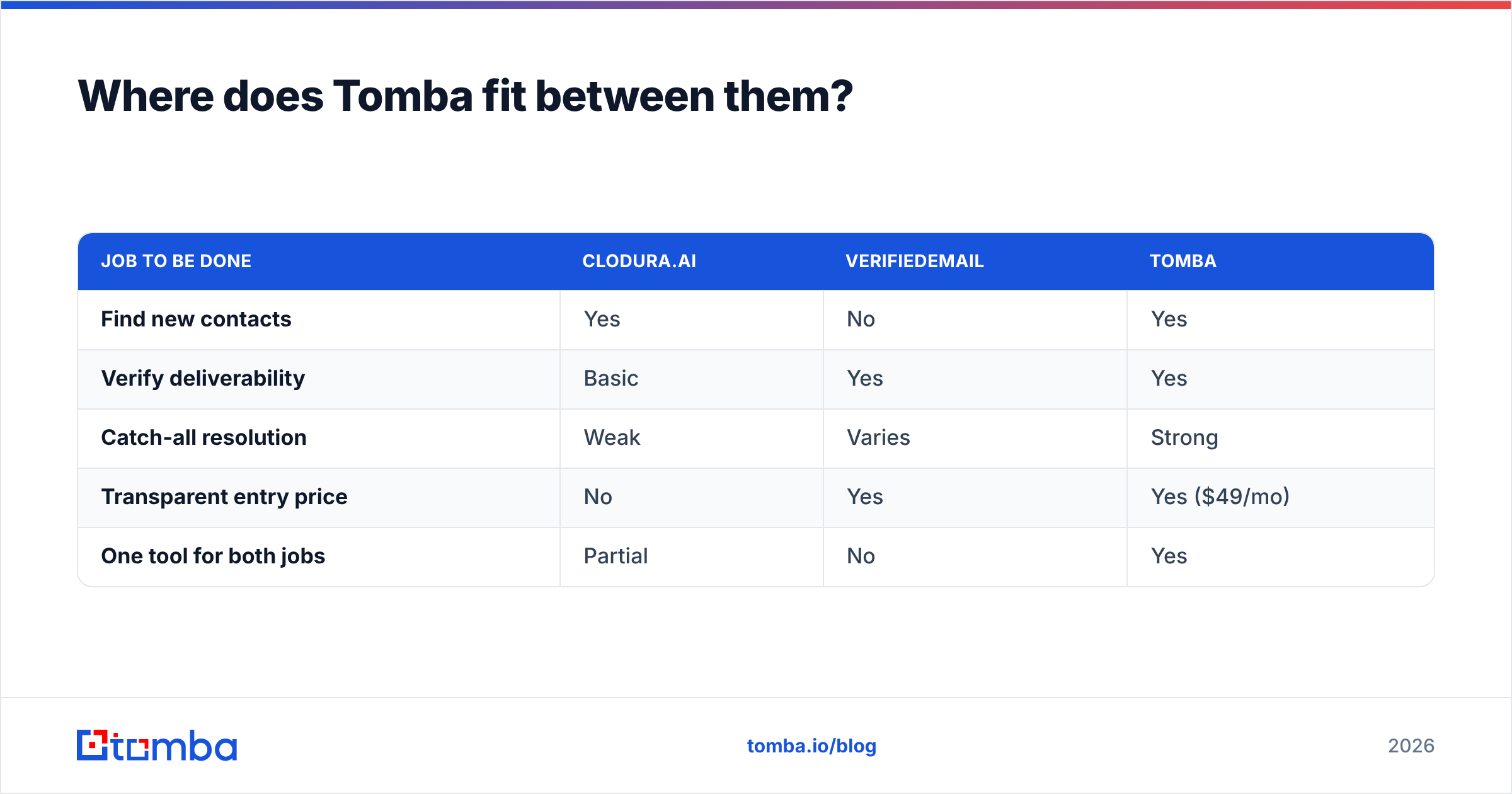
| Job to be done | Clodura.ai | VerifiedEmail | Tomba |
|---|---|---|---|
| Find new contacts | Yes | No | Yes |
| Verify deliverability | Basic | Yes | Yes |
| Catch-all resolution | Weak | Varies | Strong |
| Transparent entry price | No | Yes | Yes ($49/mo) |
| One tool for both jobs | Partial | No | Yes |
You do not have to take that on faith. Tomba's free tier gives you 25 searches a month, so you can run your own toughest test list and compare hit rate and bounce rate against whatever you use today. Neutral directories like Capterra list all three vendors side by side if you want more outside opinions before deciding.
The honest verdict#
The Cloduraai vs VerifiedEmail matchup has no universal winner. The two tools are not really competitors. They are two stages of the same pipeline.
- Choose Clodura.ai if you want a broad prospecting platform and accept that verification is a bundled extra.
- Choose VerifiedEmail if your only problem is dirty lists and you already source leads elsewhere.
- Choose Tomba if you want the finding and the verifying handled together, with pricing you can read off a page and accuracy you can test for free.
Most teams discover they needed both jobs done all along. That realization is exactly why a combined tool tends to win on total cost and simplicity.
Ready to test the accurate middle path?#
Stop paying for half a solution twice. The Tomba Email Finder finds professional email addresses by name, domain, or company and verifies them in the same step, so the addresses you export are the addresses that land. Start on the free plan with 25 searches, run your hardest list, and let the bounce rate settle the argument. When you are ready to scale, Tomba pricing starts at $49/mo — no per-seat surprises, no hidden verification upsell.
Related guides#
// get started
Find, verify and enrich your first contacts today
Start on the free plan with 25 searches a month, then scale when your team is ready.
Free plan · No credit card required · GDPR & CCPA
// about the author