Cognism vs DealSignal (2026): Which B2B Data Platform Wins?
Cognism and DealSignal both sell B2B contact data, but they price, verify, and scale very differently. Here's an honest breakdown of which one fits your team.
Choosing between Cognism and DealSignal comes down to one question most vendors won't answer directly: are you paying for a premium phone-verified database with strict compliance, or a flexible on-demand data engine you can point at any segment? Both are legitimate B2B data platforms. They just solve slightly different problems, and the wrong pick will burn your budget fast.
This is a neutral breakdown for sales, marketing, and RevOps teams evaluating both in 2026. No affiliation with either brand. Where Tomba is a smarter fit for a specific job, we say so and explain why.
TL;DR — Cognism vs DealSignal at a glance#
- Cognism wins on phone-verified mobile numbers, EU/GDPR compliance ("Diamond Data" verified cell phones), and intent data baked in. Best for outbound teams that live on the phone in Europe and North America.
- DealSignal wins on on-demand data discovery and freshness — it re-verifies records at request time and covers hard-to-reach segments, with usage-based pricing that scales by record rather than seat.
- Pricing is opaque on both. Expect annual contracts, seat minimums, and four- to five-figure commitments. Neither publishes a public per-record price.
- Accuracy is comparable on core email/company data; the real difference is Cognism's phone depth vs DealSignal's re-verification model.
- If your core need is finding and verifying business emails at a transparent price, a focused tool like Tomba's email finder covers that job from $49/mo — without the enterprise contract.
What is Cognism?#
Cognism is a sales-intelligence platform built around a large, compliance-first B2B contact database. Its headline feature is Diamond Data — mobile phone numbers that are human- or phone-verified, which materially lifts connect rates for cold callers. It layers in sales intent signals (via Bombora), technographics, and a browser extension that pulls contacts off LinkedIn and company sites.
Cognism leans hard into European coverage and GDPR/CCPA compliance, including notification workflows and a "do not call" list scrub for the DACH region. That compliance posture is a genuine differentiator if your reps are dialing prospects in the EU, where sloppy data sourcing is a legal risk, not just a deliverability one.
The trade-off: Cognism is an enterprise product with enterprise pricing and annual commitments. You buy seats and credits, and you talk to a sales rep to get a number.
What is DealSignal?#
DealSignal is a B2B data platform that emphasizes on-demand freshness. Instead of shipping you a static database dump, it re-verifies records at the point of export — running email validation, phone checks, and enrichment when you pull the list — so the data leaving the platform is verified close to real time. It advertises high coverage of contacts and accounts, with configurable persona and account targeting.
DealSignal's model appeals to teams that build very specific segments (niche titles, specific industries, hard-to-source regions) and want the confidence that the export is fresh rather than months stale. Pricing is usage-based and quote-driven, which can work in your favor if your volume is spiky rather than constant.
The trade-off: it's less of a "phone-first" tool than Cognism, and — like most enterprise data vendors — the real cost only surfaces after a sales conversation.
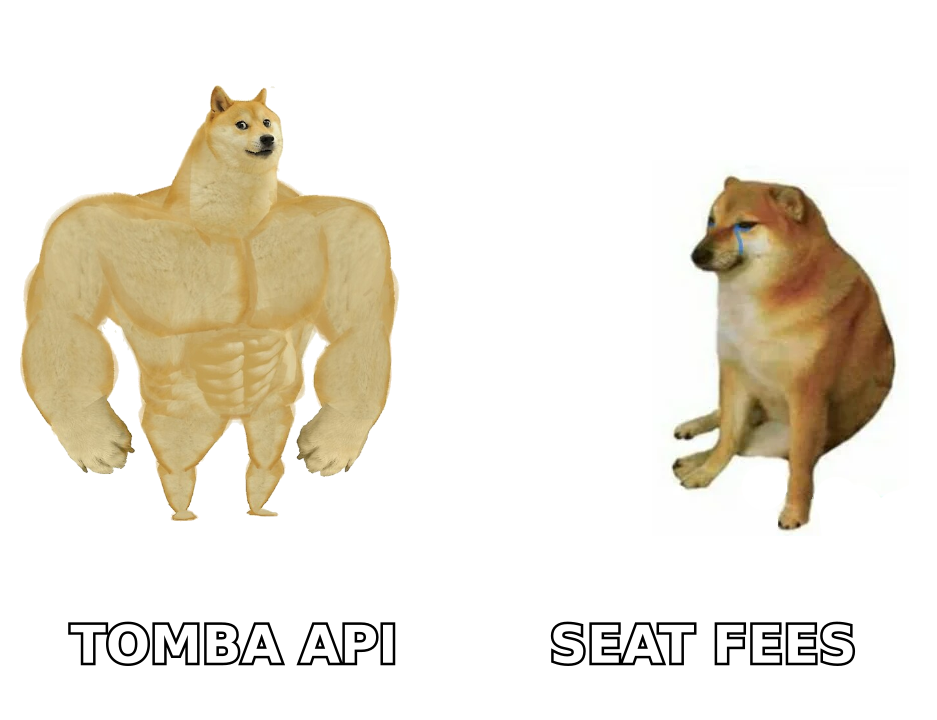
Cognism vs DealSignal: the core comparison table#
| Attribute | Cognism | DealSignal |
|---|---|---|
| Primary strength | Phone-verified mobiles (Diamond Data) | On-demand, re-verified records |
| Intent data | Built in (Bombora) | Available / add-on |
| Compliance focus | Strong (GDPR, DACH DNC scrub) | Standard compliance |
| Data model | Curated verified database | Verify-at-export engine |
| Pricing model | Seats + credits, annual | Usage / record-based, quote |
| Public pricing | No | No |
| Best for | EU + NA outbound calling | Niche, high-freshness segments |
| Free tier | No | No |
| Typical buyer | Mid-market to enterprise | Data-driven demand gen / ops |
The pattern here is consistent across the B2B data intelligence category: premium platforms bundle phone, intent, and enrichment into one contract, then price by seat and credit. That bundling is powerful if you use every module — and expensive if you only need one.
Is Cognism better than DealSignal?#
It depends entirely on whether your motion is phone-led. If your reps' number-one metric is connect rate and they're dialing mobiles across the EU and North America, Cognism's Diamond Data is hard to beat, and the compliance layer removes real legal risk. That's the scenario where paying the premium is defensible.
If your motion is list-driven — you build targeted account and persona lists, push them into a sequencer, and care most that the emails and titles are current at export — DealSignal's re-verification model is the better philosophical match. You're not paying for a phone team's connect rate; you're paying for freshness on demand.
Neither is "better" in the abstract. The mistake teams make is buying the phone-heavy platform when 90% of their outreach is email, then wondering why the ROI never materializes.
How accurate is the data, really?#
Both vendors claim high accuracy, and both are credible on core firmographic and email data. The honest nuance:
- Email accuracy is broadly comparable across serious vendors — the differentiator is how recently each record was verified, not the headline percentage. DealSignal's verify-at-export approach directly targets this.
- Phone accuracy is where Cognism pulls ahead, specifically on mobile numbers, because it invests in human verification for its Diamond tier.
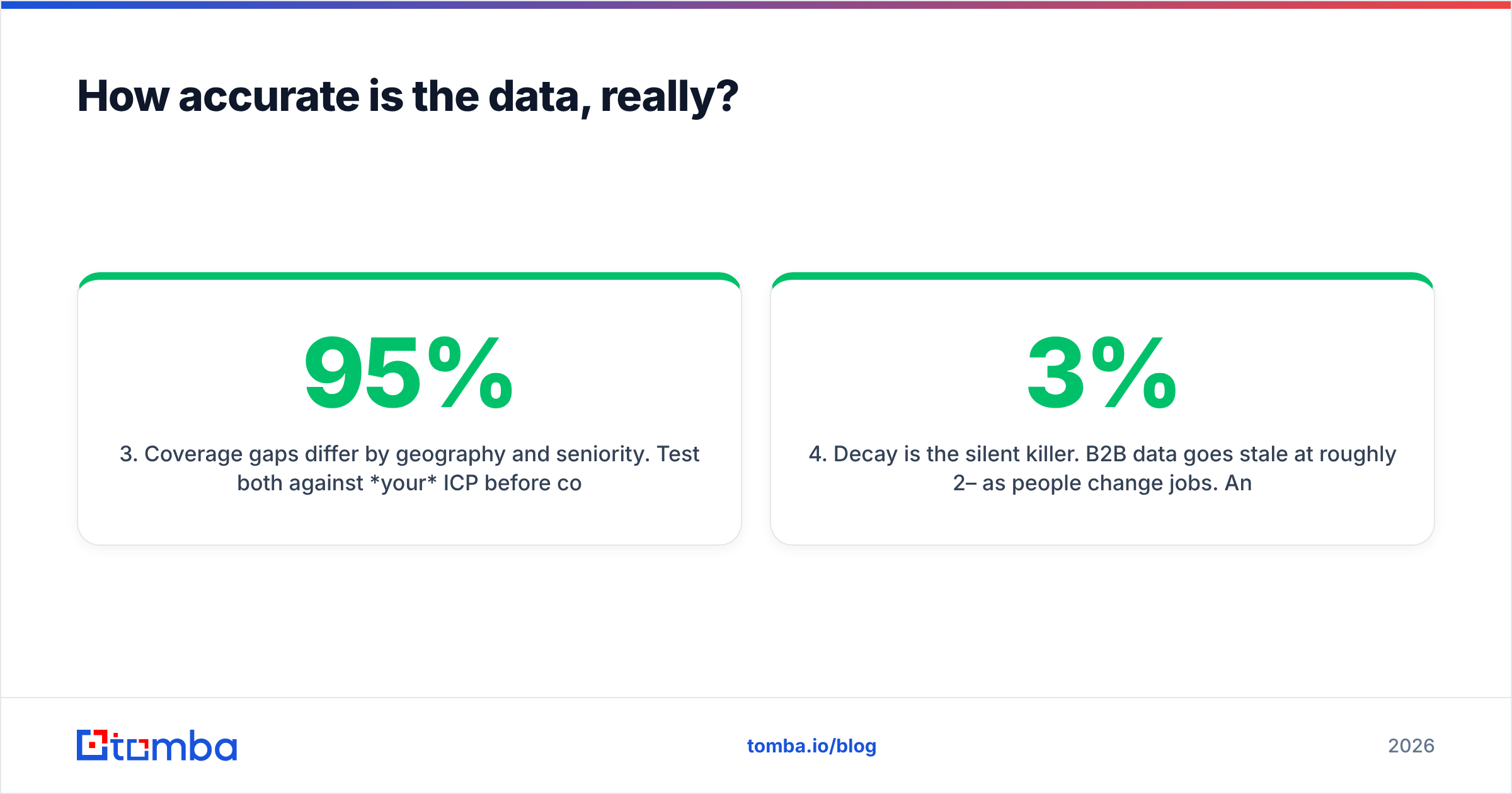
- Coverage gaps differ by geography and seniority. Test both against your ICP before committing — a vendor that's 95% accurate globally can be 60% accurate on your specific niche.
- Decay is the silent killer. B2B data goes stale at roughly 2–3% per month as people change jobs. Any static list you bought last quarter is already partly wrong, which is why re-verification matters more than the number on the sales deck.
This is also why an independent email verifier belongs in your stack regardless of which platform you choose. Verifying a list right before you send protects your sender reputation and keeps bounce rates low — something no database subscription fully solves on its own. You can cross-check third-party data with tools like G2's category reviews to see how real users rate each vendor's accuracy over time.
What does Cognism vs DealSignal actually cost?#
Neither publishes public pricing, and both require annual contracts negotiated with a sales rep. From market reporting and buyer accounts, expect:
- Cognism: typically a four- to five-figure annual commitment, priced by platform access plus per-seat licensing, often with unrestricted-view credits at higher tiers. Entry points commonly start in the low thousands per year and climb quickly with seats and add-ons like intent.
- DealSignal: usage/record-based quotes, which can be cheaper for spiky volume and pricier for always-on high volume. Also annual in most cases.
The uncomfortable reality: with either platform you're signing a contract before you know your true cost per usable record. If your actual need is "find and verify business emails for outreach," that's a lot of overhead to carry.

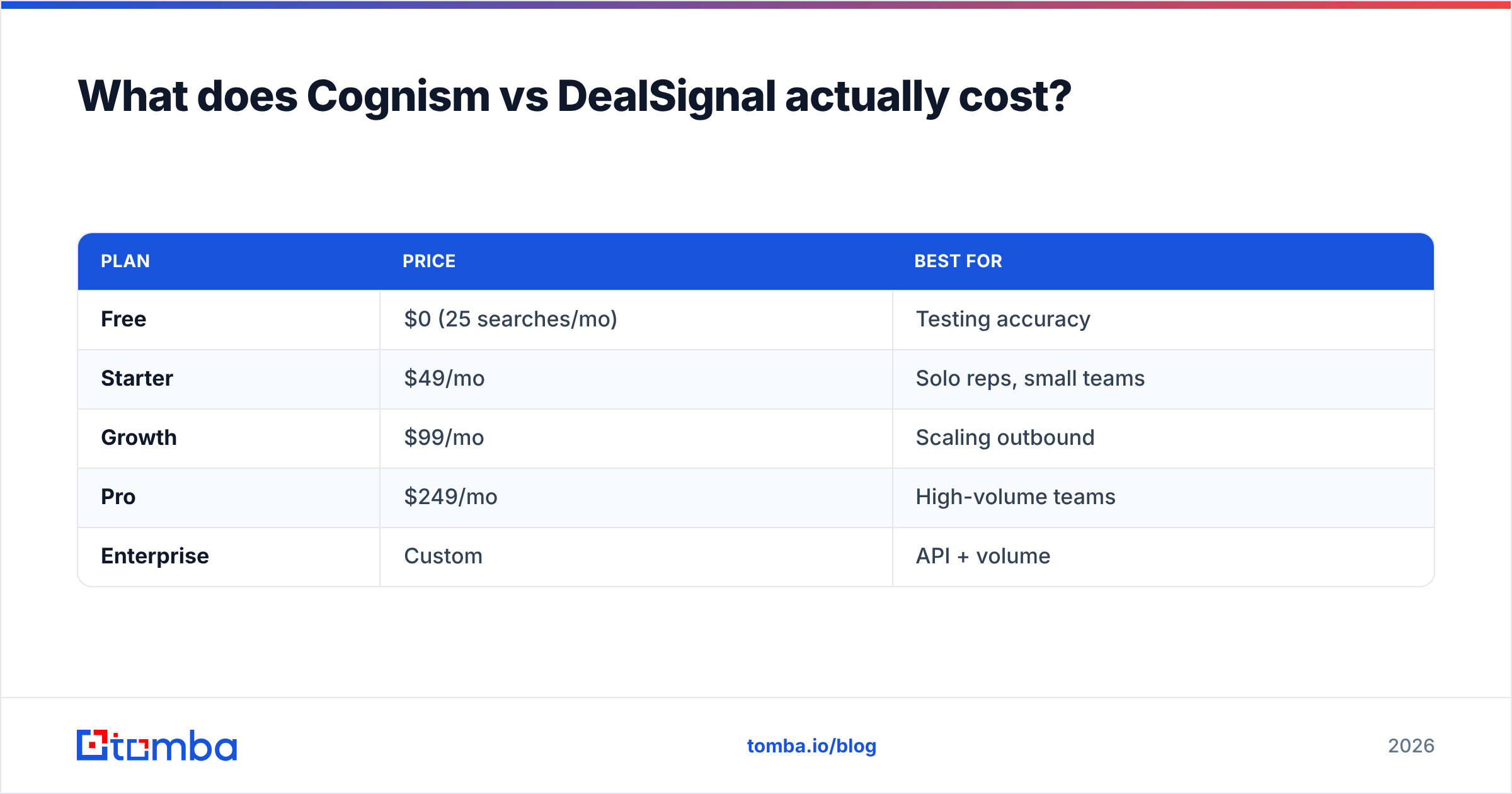
This is where a transparent, self-serve option changes the math. Tomba publishes its pricing openly:
| Plan | Price | Best for |
|---|---|---|
| Free | $0 (25 searches/mo) | Testing accuracy |
| Starter | $49/mo | Solo reps, small teams |
| Growth | $99/mo | Scaling outbound |
| Pro | $249/mo | High-volume teams |
| Enterprise | Custom | API + volume |
No seat minimums, no annual lock-in to start, and a free tier to validate accuracy against your own list before you pay anything. For teams whose primary job-to-be-done is email discovery and verification, that transparency alone often decides the evaluation.
Who should choose which?#
- Choose Cognism if you're a mid-market or enterprise team running phone-heavy outbound, especially in Europe, and you need verified mobiles plus a compliance safety net. The premium is worth it when connect rate is your north star.
- Choose DealSignal if you're a data-driven demand-gen or ops team building niche segments and you value freshness-at-export over a bundled phone database. The usage model rewards precision over volume.
- Choose a focused finder + verifier stack (like Tomba) if your real need is business email discovery, domain search, and verification at a predictable price — with an email finder API you can wire into your own workflows instead of buying someone else's suite.
Many teams end up running a hybrid: a premium platform for phone-led enterprise motions, plus a lightweight finder for the long tail of email prospecting where a full enterprise contract is overkill. There's nothing wrong with that — it's usually cheaper than forcing every use case into one expensive tool.
How to run a fair Cognism vs DealSignal trial#
Don't evaluate on the demo dataset — vendors curate those. Instead:
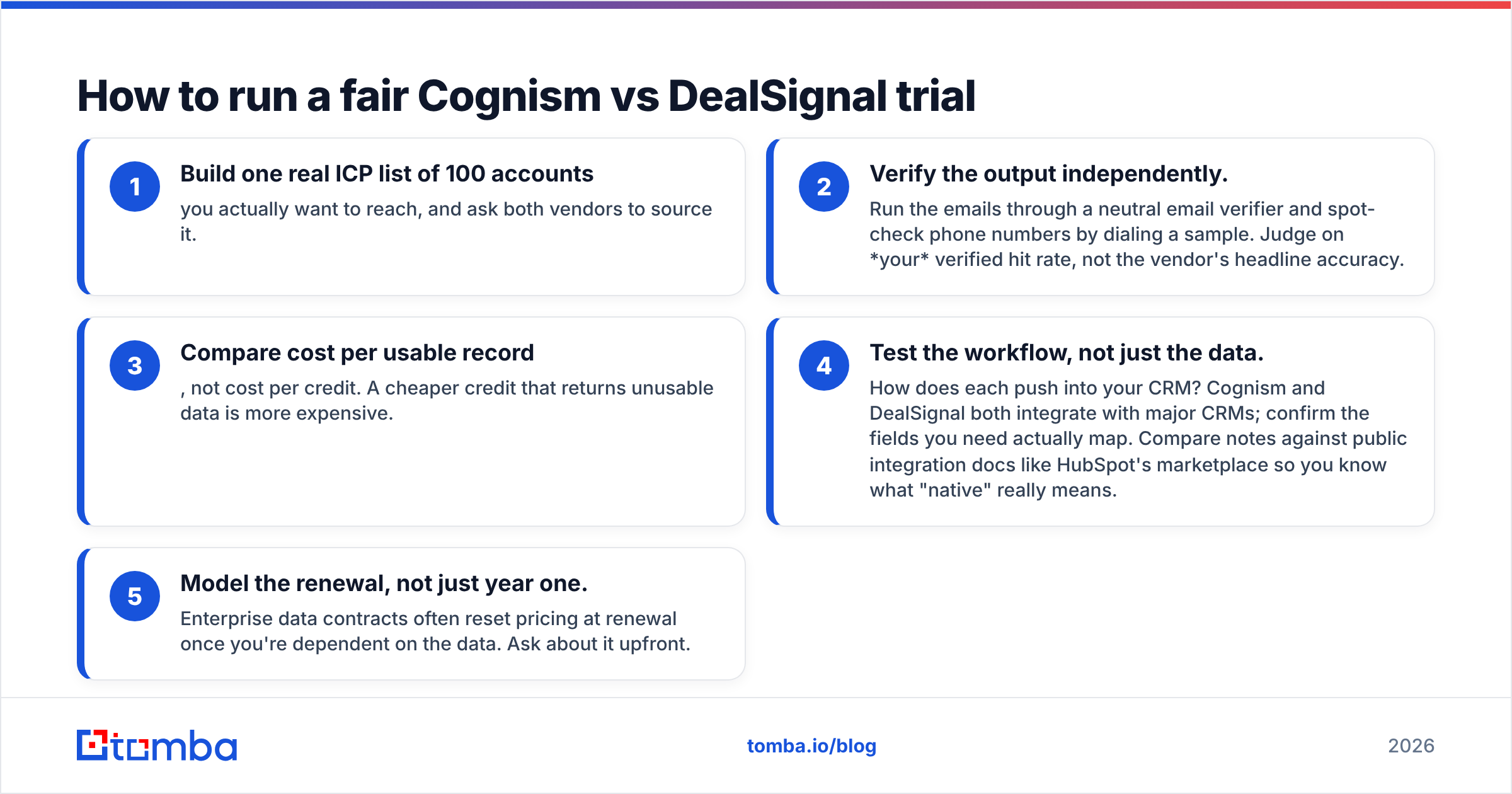
- Build one real ICP list of 100 accounts you actually want to reach, and ask both vendors to source it.
- Verify the output independently. Run the emails through a neutral email verifier and spot-check phone numbers by dialing a sample. Judge on your verified hit rate, not the vendor's headline accuracy.
- Compare cost per usable record, not cost per credit. A cheaper credit that returns unusable data is more expensive.
- Test the workflow, not just the data. How does each push into your CRM? Cognism and DealSignal both integrate with major CRMs; confirm the fields you need actually map. Compare notes against public integration docs like HubSpot's marketplace so you know what "native" really means.
- Model the renewal, not just year one. Enterprise data contracts often reset pricing at renewal once you're dependent on the data. Ask about it upfront.
Run that process and the right answer usually reveals itself — often it's "we need less platform than we thought."
The bottom line#
Cognism and DealSignal are both strong B2B data platforms, and neither is a mistake for the buyer they're built for. Cognism owns phone-verified, compliance-first outbound; DealSignal owns on-demand, freshly re-verified segments. Pick based on whether your motion is phone-led or list-led — and always validate against your own ICP before signing an annual deal.
But if you strip the evaluation down to what most teams actually do all day — find a person's business email, confirm it's real, and reach out — you may not need an enterprise contract at all. Tomba's Email Finder gives you verified professional emails by name, company, or domain, with a free tier to test accuracy and plans from $49/mo — no seat minimums, no annual lock-in. Start free, verify against your own list, and only pay for what actually moves pipeline.
Related guides#
// get started
Find, verify and enrich your first contacts today
Start on the free plan with 25 searches a month, then scale when your team is ready.
Free plan · No credit card required · GDPR & CCPA
// about the author