Cognism vs Getro (2026): B2B Data, Recruiting & Which Fits
Cognism finds B2B contacts for sales; Getro builds talent networks and job boards. They solve different problems—here's how to pick, plus a cheaper way to get verified emails.
Most people who type "Cognism vs Getro" into Google are comparing two tools that were never really built to do the same job. That confusion is the whole point of this post: once you see what each platform is actually for, the "winner" becomes obvious for your use case in about thirty seconds.
TL;DR#
- Cognism is a B2B sales-intelligence and prospecting database — phone numbers, verified emails, and firmographic data for outbound sales teams.
- Getro is a talent-network and job-board platform — it powers job boards for VC portfolios, communities, and accelerators, and connects members to open roles.
- They overlap only at the edges (both touch "people data"), so the real question is sales prospecting vs community/recruiting infrastructure, not "which is better."
- Cognism is enterprise-priced with annual contracts and seat licensing; Getro is priced per network/community with tiered plans.
- If your actual goal is finding and verifying business emails at a fraction of enterprise pricing, a focused tool like the Tomba Email Finder does that specific job for far less.
What is Cognism?#
Cognism is a sales-intelligence platform. Its job is to hand outbound sales and marketing teams a clean list of who to contact and how to reach them: work emails, mobile numbers (its "Diamond Data" phone-verified mobiles are the headline feature), job titles, company size, tech stack, and intent signals.
Think of Cognism as a premium contact rolodex that refreshes itself. You filter by industry, seniority, geography, and revenue, then export contacts into your CRM or sequencing tool. Its big selling points are GDPR/CCPA compliance, a phone-verified mobile database, and strong European (EMEA) coverage where many US-first databases go thin.
Who it's for: mid-market and enterprise SDR teams, demand-gen marketers, and RevOps leaders who need volume, coverage, and compliance documentation more than they need a low price. You can read reviews from real buyers on G2 and see the product itself on cognism.com.
What is Getro?#
Getro is a completely different animal. It builds and runs talent networks and job boards — most commonly for venture-capital firms, startup accelerators, professional communities, and alumni networks.
The everyday analogy: Getro is less a "sales database" and more a jobs marketplace-in-a-box. A VC firm uses Getro to aggregate every open role across its portfolio companies into one branded job board, then routes candidates from its community to those roles. Its products (GetroJobs and GetroConnect) automate job scraping from portfolio company career pages, keep listings fresh, and let community managers make warm intros between members and hiring teams.
Who it's for: community managers, VC platform teams, ecosystem builders, and anyone whose "product" is a network of people looking for or offering opportunities. You're not buying Getro to cold-email 5,000 CFOs — you're buying it to run infrastructure for a community. See it at getro.com.

Cognism vs Getro: how do they actually compare?#
Because these platforms live in different categories, a spec-by-spec table matters more than usual — it makes the mismatch visible.
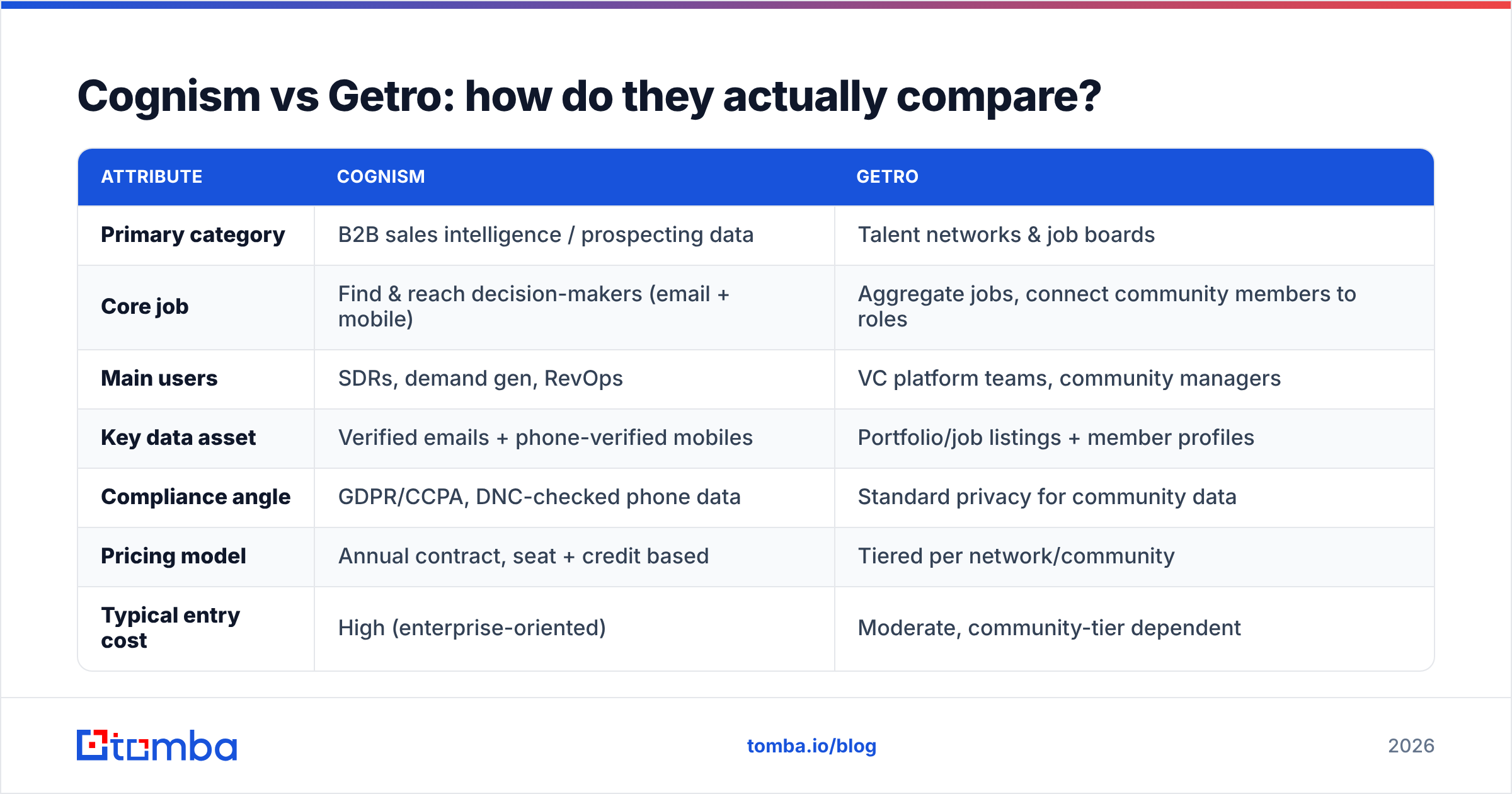
| Attribute | Cognism | Getro |
|---|---|---|
| Primary category | B2B sales intelligence / prospecting data | Talent networks & job boards |
| Core job | Find & reach decision-makers (email + mobile) | Aggregate jobs, connect community members to roles |
| Main users | SDRs, demand gen, RevOps | VC platform teams, community managers |
| Key data asset | Verified emails + phone-verified mobiles | Portfolio/job listings + member profiles |
| Compliance angle | GDPR/CCPA, DNC-checked phone data | Standard privacy for community data |
| Pricing model | Annual contract, seat + credit based | Tiered per network/community |
| Typical entry cost | High (enterprise-oriented) | Moderate, community-tier dependent |
| Best for | Outbound sales pipeline | Recruiting & ecosystem building |
The honest takeaway: if two tools land in different rows on "core job," you don't have a head-to-head — you have a routing decision. Pick Cognism when your KPI is meetings booked. Pick Getro when your KPI is a thriving talent network or a full job board.
Which one should you choose?#
Use this quick decision list instead of a scorecard, because the "better" tool depends entirely on the outcome you're paying for.
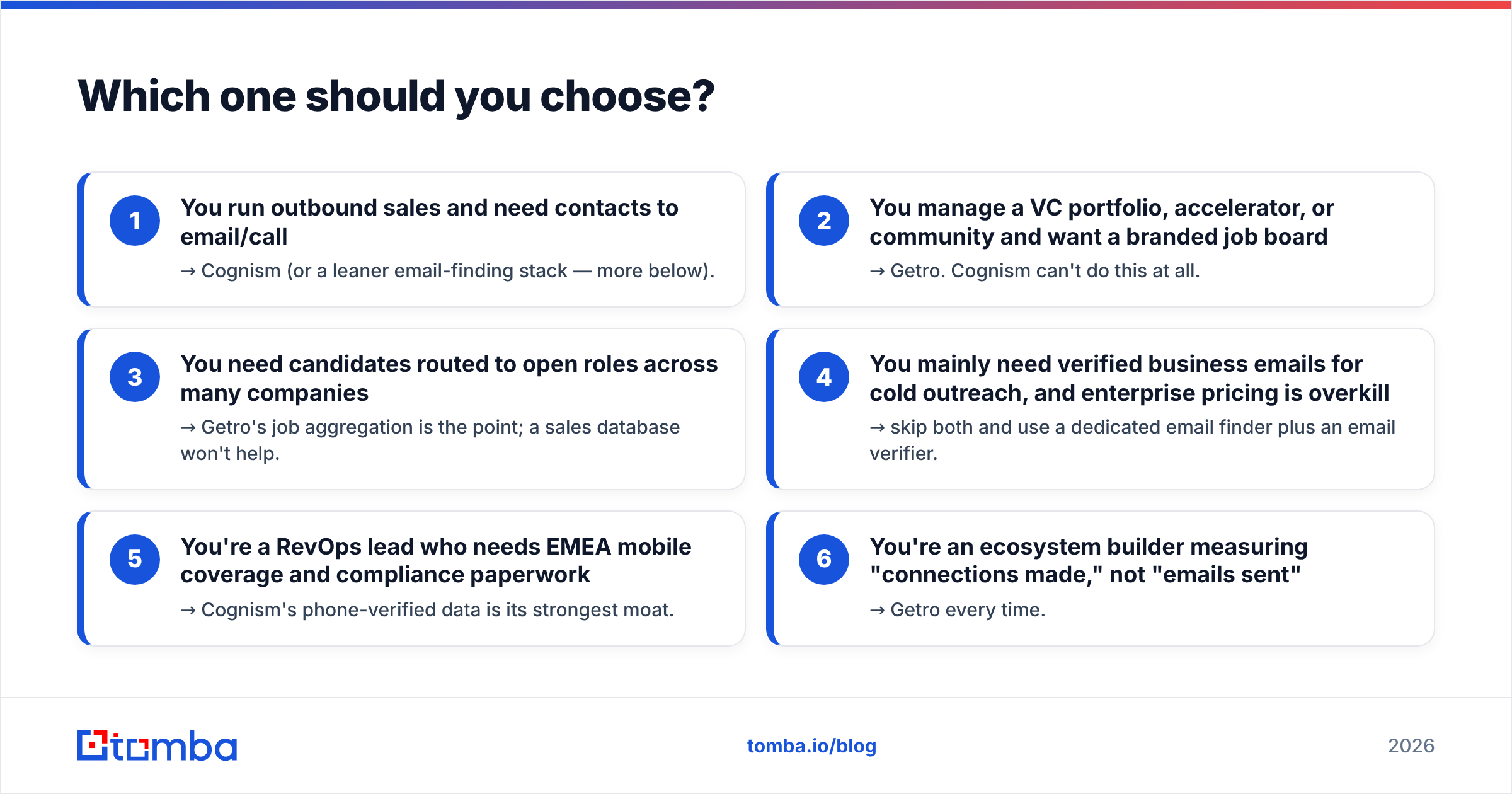
- You run outbound sales and need contacts to email/call → Cognism (or a leaner email-finding stack — more below).
- You manage a VC portfolio, accelerator, or community and want a branded job board → Getro. Cognism can't do this at all.
- You need candidates routed to open roles across many companies → Getro's job aggregation is the point; a sales database won't help.
- You mainly need verified business emails for cold outreach, and enterprise pricing is overkill → skip both and use a dedicated email finder plus an email verifier.
- You're a RevOps lead who needs EMEA mobile coverage and compliance paperwork → Cognism's phone-verified data is its strongest moat.
- You're an ecosystem builder measuring "connections made," not "emails sent" → Getro every time.
Notice that in only one of these six scenarios are the two tools even competing. That's why "Cognism vs Getro" is usually the wrong search — the right search is "what's the cheapest reliable way to get verified emails" or "how do I run a talent network."
Where does Tomba fit in this comparison?#
Here's the part most comparison posts bury: a large share of people evaluating Cognism don't need a full enterprise sales-intelligence suite at all. They need accurate work emails, verified, at a sane price — and they're pricing a $10k+ annual Cognism contract for what is essentially an email-finding job.
If that's you, an email-first platform closes the gap without the enterprise commitment. Tomba focuses on the exact slice of the workflow that turns a company or a name into a reachable contact:
- Email finder — turn a name + domain into a verified professional email.
- Domain search — pull every discoverable email pattern for a company in one query.
- Email verifier — SMTP-check and score deliverability before you send, so bounces don't wreck your sender reputation.
- Bulk email finder — run a whole prospect list through finding + verification at once.
None of that replaces Getro (different universe) and it won't give you Cognism's phone-verified mobile database. But for the email portion of prospecting, it's a targeted, far cheaper alternative.

Pricing reality check#
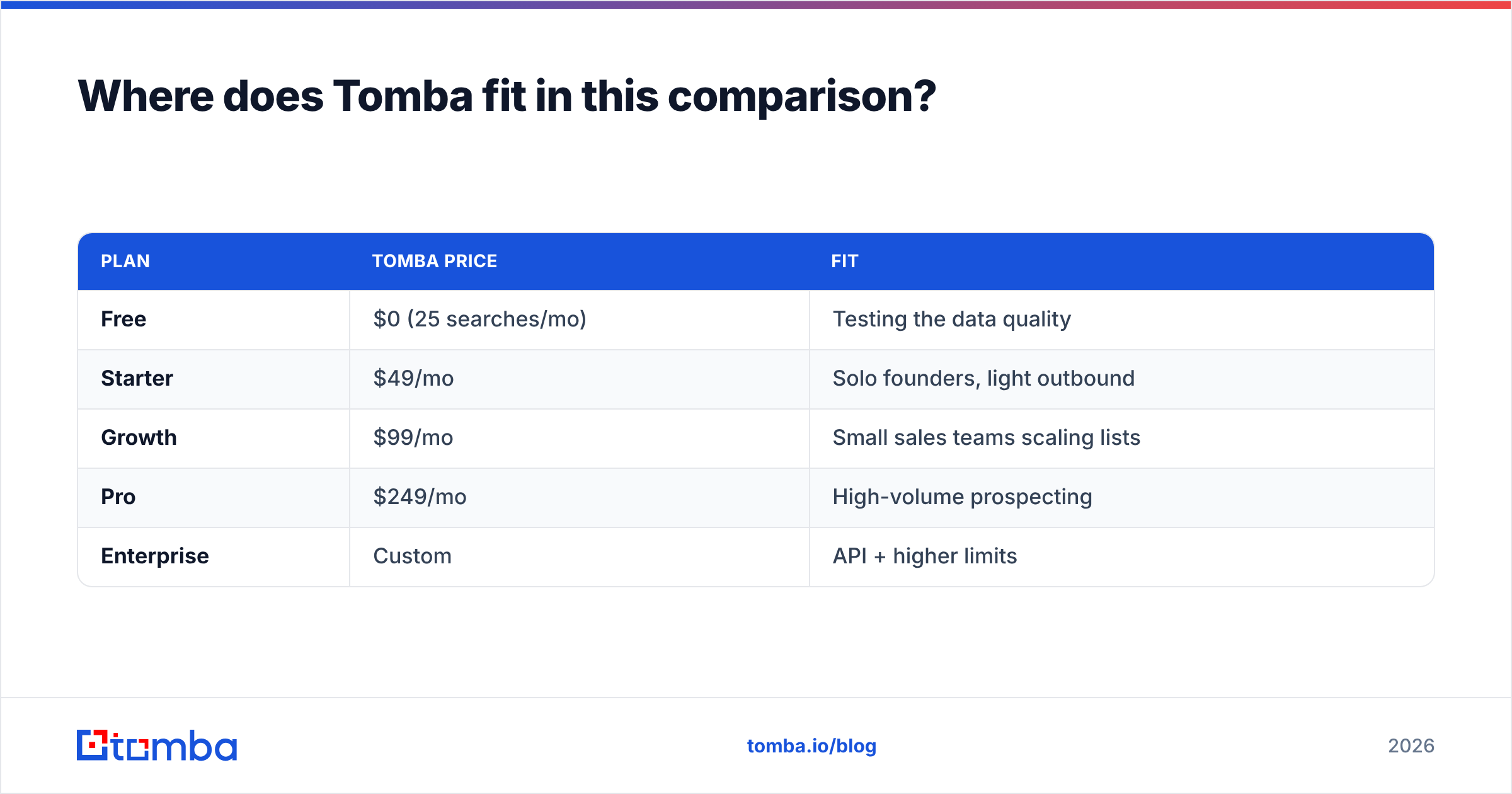
Cognism doesn't publish flat pricing; it quotes annual contracts based on seats, data volume, and modules, and buyers routinely report five-figure commitments. Getro is more accessible but still scales with your network tier. Compare that with transparent, monthly plans:
| Plan | Tomba price | Fit |
|---|---|---|
| Free | $0 (25 searches/mo) | Testing the data quality |
| Starter | $49/mo | Solo founders, light outbound |
| Growth | $99/mo | Small sales teams scaling lists |
| Pro | $249/mo | High-volume prospecting |
| Enterprise | Custom | API + higher limits |
You can see full Tomba pricing without a sales call. The point isn't that Tomba beats Cognism at everything — it doesn't try to. It's that if the reason you were considering Cognism was "I need good emails," you were about to overpay for a database when a scalpel would do.
Is Cognism worth it over building your own stack?#
Cognism earns its price in three situations: you need verified mobile numbers at scale, you sell into EMEA and need strong regional coverage, or your legal team demands documented GDPR/CCPA compliance on every record. Those are real, hard-to-replicate strengths.
Outside those three, the math gets shakier. Many teams stitch together a cheaper stack: a focused email finder for contacts, a data enrichment step for firmographics, and a dedicated dialer for phones. You lose the single-pane-of-glass convenience and the compliance paperwork, but you often cut cost by 60–80% and gain flexibility.
The trade-off in one sentence: Cognism sells convenience and coverage; a modular stack sells price and flexibility. Match that to your team size and risk tolerance.
Common questions#
Are Cognism and Getro competitors? Not really. Cognism is sales-prospecting data; Getro is talent-network and job-board software. They only appear in the same search because both deal with "people data." A team almost never chooses between them — they need one or the other, rarely both.
Can Getro find email addresses for cold outreach? No. Getro isn't built for outbound prospecting. If you need to find and verify emails, that's the job of an email finder plus a verifier, not a job-board platform.
Is there a cheaper alternative to Cognism for emails? Yes — if you only need verified business emails (not phone-verified mobiles or compliance modules), a dedicated email finder is a fraction of the cost. Tools like Tomba start at $49/mo with a free tier to test accuracy first.
Does Cognism include phone numbers? Yes, phone-verified mobile numbers ("Diamond Data") are one of its strongest features and a key reason enterprise buyers choose it over email-only tools.
Which should a startup founder pick? If you're doing outbound sales on a budget, start with an email finder and verifier and add data as you scale. If you're running an accelerator or community and want a job board, that's a Getro decision, not a Cognism one.
The verdict#
There's no universal winner in "Cognism vs Getro" because they aren't playing the same game. Cognism wins for outbound sales teams that need verified emails, mobile numbers, and compliance at enterprise scale. Getro wins for VCs, accelerators, and community builders who need a branded talent network and job board. Comparing them directly is like comparing a delivery truck to a warehouse — both move goods, neither replaces the other.
The one place buyers do overlap is this: people shopping Cognism who really just need accurate, verified business emails without the enterprise contract. If that describes you, put your budget where the job actually is.
Start with the Tomba Email Finder — find verified professional emails by name, company, or domain, with a free tier (25 searches/month) so you can benchmark accuracy before you spend a dollar. Pair it with the built-in verifier, and you've covered the email side of prospecting for $49/mo instead of a five-figure annual contract.
Related guides#
// get started
Find, verify and enrich your first contacts today
Start on the free plan with 25 searches a month, then scale when your team is ready.
Free plan · No credit card required · GDPR & CCPA
// about the author