Cognism vs Gigasheet (2026): Which B2B Data Tool Wins?
Cognism and Gigasheet solve very different data problems. One sells verified B2B contacts; the other lets you wrangle giant spreadsheets in a browser. Here's which fits your workflow in 2026 — and where each one leaves gaps.
Most "Cognism vs Gigasheet" searches start from a wrong assumption: that these two tools compete. They mostly don't. One is a B2B sales-intelligence database that sells you verified contact data. The other is a browser-based spreadsheet built to open and clean files too big for Excel. Understanding that gap is the whole decision.
This guide breaks down what each tool actually does, where they overlap, what they cost, and how to pair them (or replace part of the stack with something cheaper) so you stop paying enterprise prices for problems you don't have.
TL;DR: Cognism vs Gigasheet at a glance#
- Cognism is a sales-intelligence platform: phone-verified mobile numbers, GDPR/CCPA-aware contact data, intent signals, and CRM integrations. You buy access to data.
- Gigasheet is a no-code big-data spreadsheet: open 10M-row CSVs in a browser, filter, dedupe, enrich, and export. You buy a way to work with data you already have.
- They solve different halves of the same job — sourcing contacts (Cognism) vs cleaning and analyzing lists (Gigasheet).
- Pricing is opaque on both. Cognism is quote-only and typically lands in the four-to-five-figure annual range; Gigasheet has a free tier and self-serve plans, but heavy enrichment gets pricey.
- If your real need is finding and verifying professional emails at a predictable price, a focused tool like Tomba's email finder covers that slice for a fraction of a Cognism seat.
What is Cognism and who is it for?#
Cognism is a premium B2B sales intelligence provider. Its pitch is data quality: a proprietary "Diamond Data" set of human- and phone-verified mobile numbers, plus company firmographics, technographics, and buying-intent signals sourced through a Bombora partnership.
The typical buyer is a mid-market or enterprise sales team that lives in Salesforce or HubSpot and needs to dial verified mobiles across the US and Europe. Cognism leans hard into compliance — it screens against Do-Not-Call lists in several regions and markets itself as GDPR-friendly, which matters if you're prospecting into the EU.
What you're really paying for:
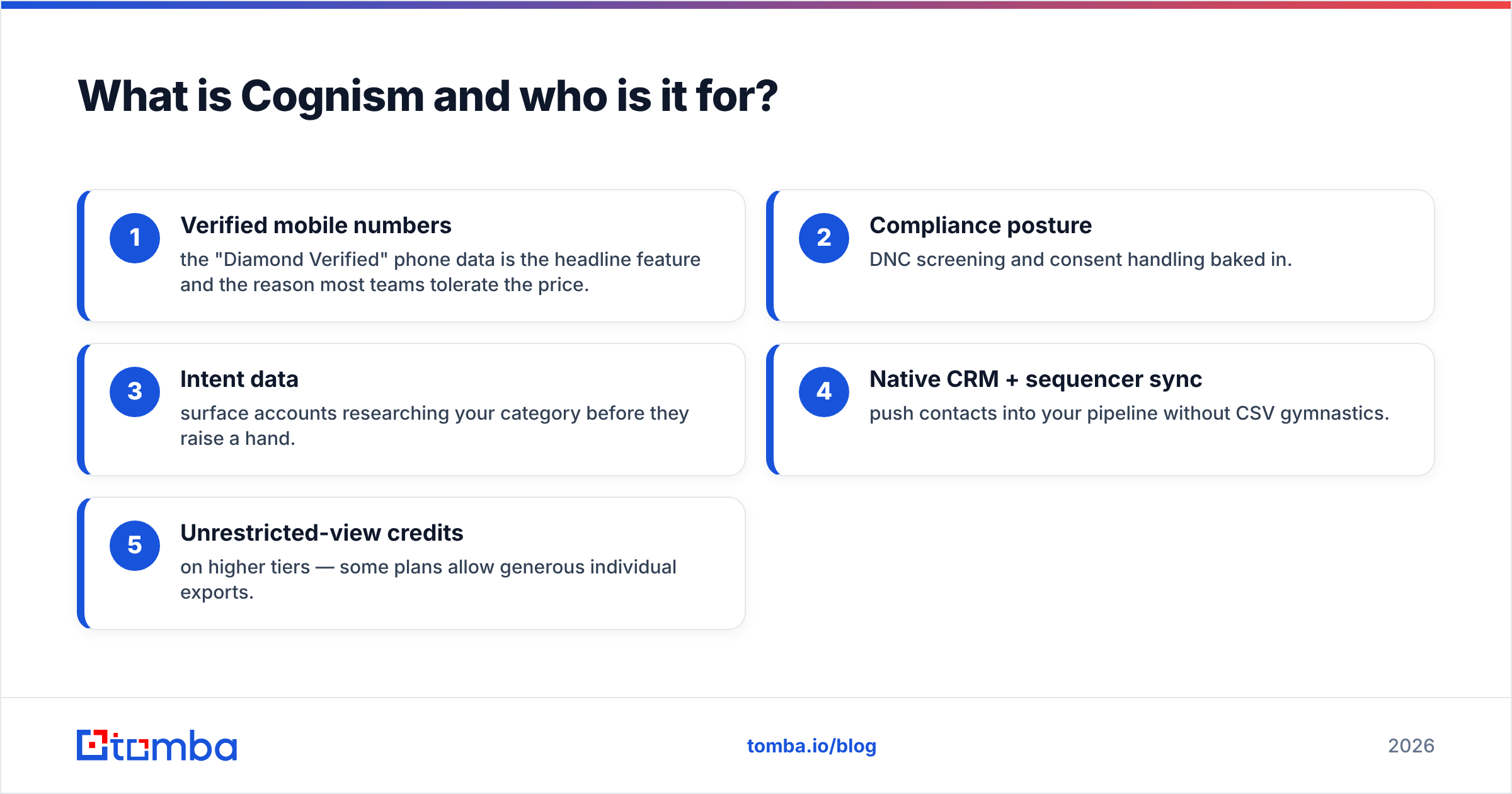
- Verified mobile numbers — the "Diamond Verified" phone data is the headline feature and the reason most teams tolerate the price.
- Compliance posture — DNC screening and consent handling baked in.
- Intent data — surface accounts researching your category before they raise a hand.
- Native CRM + sequencer sync — push contacts into your pipeline without CSV gymnastics.
- Unrestricted-view credits on higher tiers — some plans allow generous individual exports.
The catch is cost and contract friction. Cognism is annual, quote-only, and sold through a sales motion. You won't find a public price, and there's rarely a meaningful free trial. For a small team or a founder doing outbound, that's a heavy commitment.

What is Gigasheet and who is it for?#
Gigasheet is a browser-based spreadsheet built for datasets that break Excel and Google Sheets. Think tens of millions of rows, gigabyte CSVs, log exports, and messy scraped lists. You upload a file, and Gigasheet handles it with database-grade performance behind a familiar spreadsheet UI — no SQL, no data-engineering ticket.
The typical buyer here is an analyst, RevOps person, or ops-minded marketer who already has data and needs to make it usable: dedupe a 4M-row export, join two lists, filter by dozens of conditions, or clean a scrape before it hits the CRM. Gigasheet also offers built-in enrichment (append company or contact fields) and integrations, but enrichment is an add-on to its core value, not the core itself.
What Gigasheet is genuinely good at:
- Opening files Excel chokes on — no row limits that matter for most business data.
- No-code cleanup — group, pivot, dedupe, and filter without formulas or scripts.
- Combining sources — stack and join exports from different tools.
- Sharing — collaborative, cloud-based, link-shareable sheets.
What it is not: a source of net-new contacts. Gigasheet doesn't hand you a database of verified mobiles or emails to prospect. It makes the data you bring cleaner and more analyzable. If your list is empty, Gigasheet has nothing to clean.
Cognism vs Gigasheet: the core difference#
Here's the one-sentence version: Cognism gives you contacts; Gigasheet helps you manage contacts. A useful analogy — Cognism is the grocery store where you buy ingredients, and Gigasheet is the industrial kitchen where you prep them at scale. You can shop without a big kitchen, and you can have a big kitchen with nothing to cook. Most teams eventually want both, or a cheaper substitute for each.
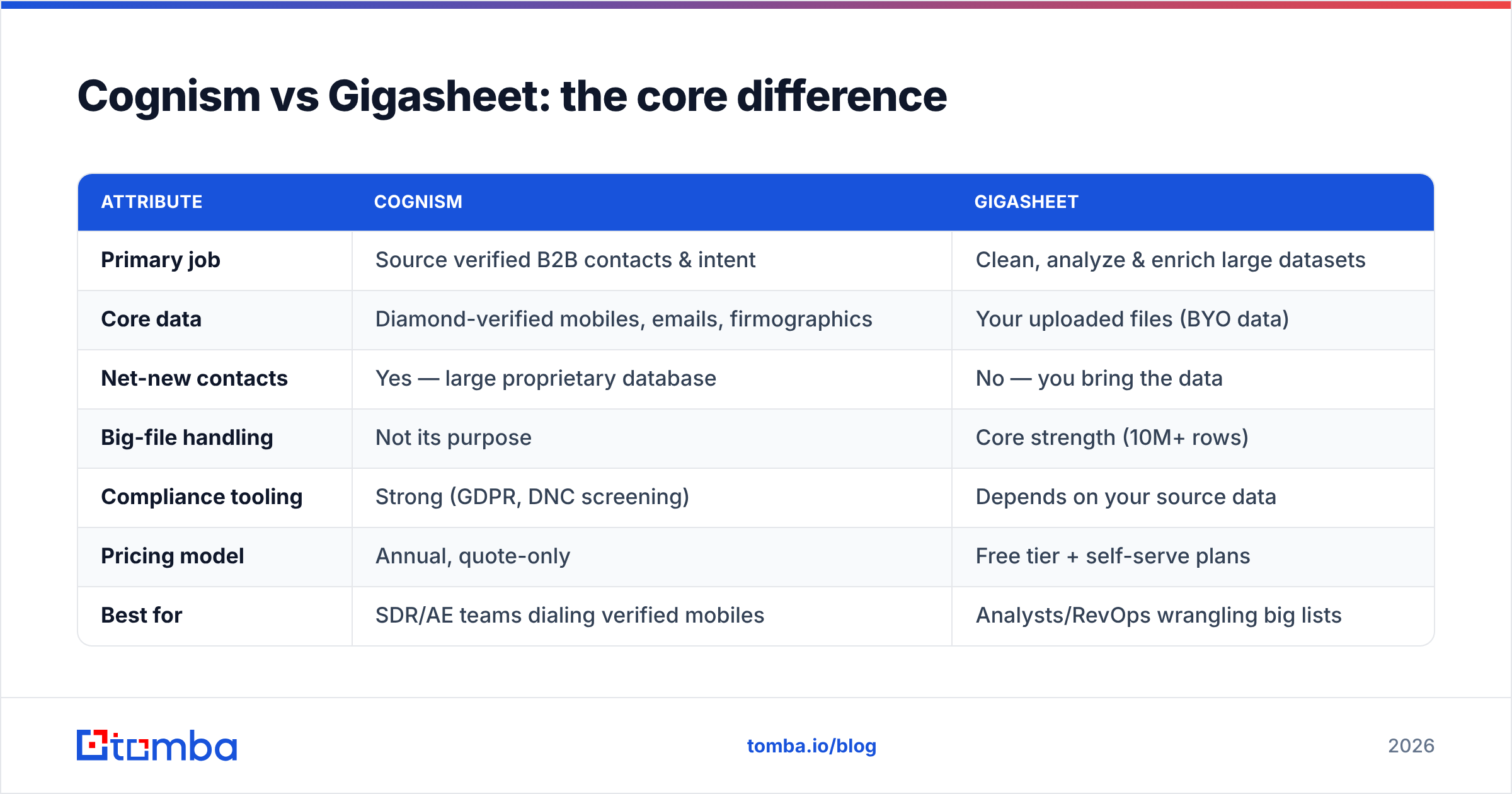
| Attribute | Cognism | Gigasheet |
|---|---|---|
| Primary job | Source verified B2B contacts & intent | Clean, analyze & enrich large datasets |
| Core data | Diamond-verified mobiles, emails, firmographics | Your uploaded files (BYO data) |
| Net-new contacts | Yes — large proprietary database | No — you bring the data |
| Big-file handling | Not its purpose | Core strength (10M+ rows) |
| Compliance tooling | Strong (GDPR, DNC screening) | Depends on your source data |
| Pricing model | Annual, quote-only | Free tier + self-serve plans |
| Best for | SDR/AE teams dialing verified mobiles | Analysts/RevOps wrangling big lists |
| Learning curve | Low (CRM-native) | Low–medium (spreadsheet UI) |
The overlap is thin. It only appears in Gigasheet's enrichment feature and Cognism's export-to-CSV flow — both touch "contact data in a spreadsheet," but from opposite ends.
How do Cognism and Gigasheet pricing compare?#
Both keep numbers close to the chest, which is its own signal.
Cognism publishes no pricing. Deals are annual and quote-based, structured around your team size and which data packages (Diamond phone data, intent, etc.) you want. Public reports and review sites like G2 consistently place it in the higher end of the market — often five figures annually for a real team. There's usually a platform fee plus per-seat licensing, and credit/view limits vary by tier.
Gigasheet is friendlier for self-serve. It offers a free tier for smaller files and paid plans that scale with data size, row counts, and enrichment usage. You can start without talking to sales. The gotcha is that enrichment credits and larger workloads add up, so a "cheap" plan can inflate once you lean on appended data.
For teams whose actual bottleneck is email discovery and verification — not intent data, not billion-row analytics — neither pricing model is efficient. That's where a purpose-built tool wins on cost. Compare either quote against transparent Tomba pricing: a Free tier with 25 searches, Starter at $49/mo, Growth at $99/mo, and Pro at $249/mo, with no annual lock-in required to start.
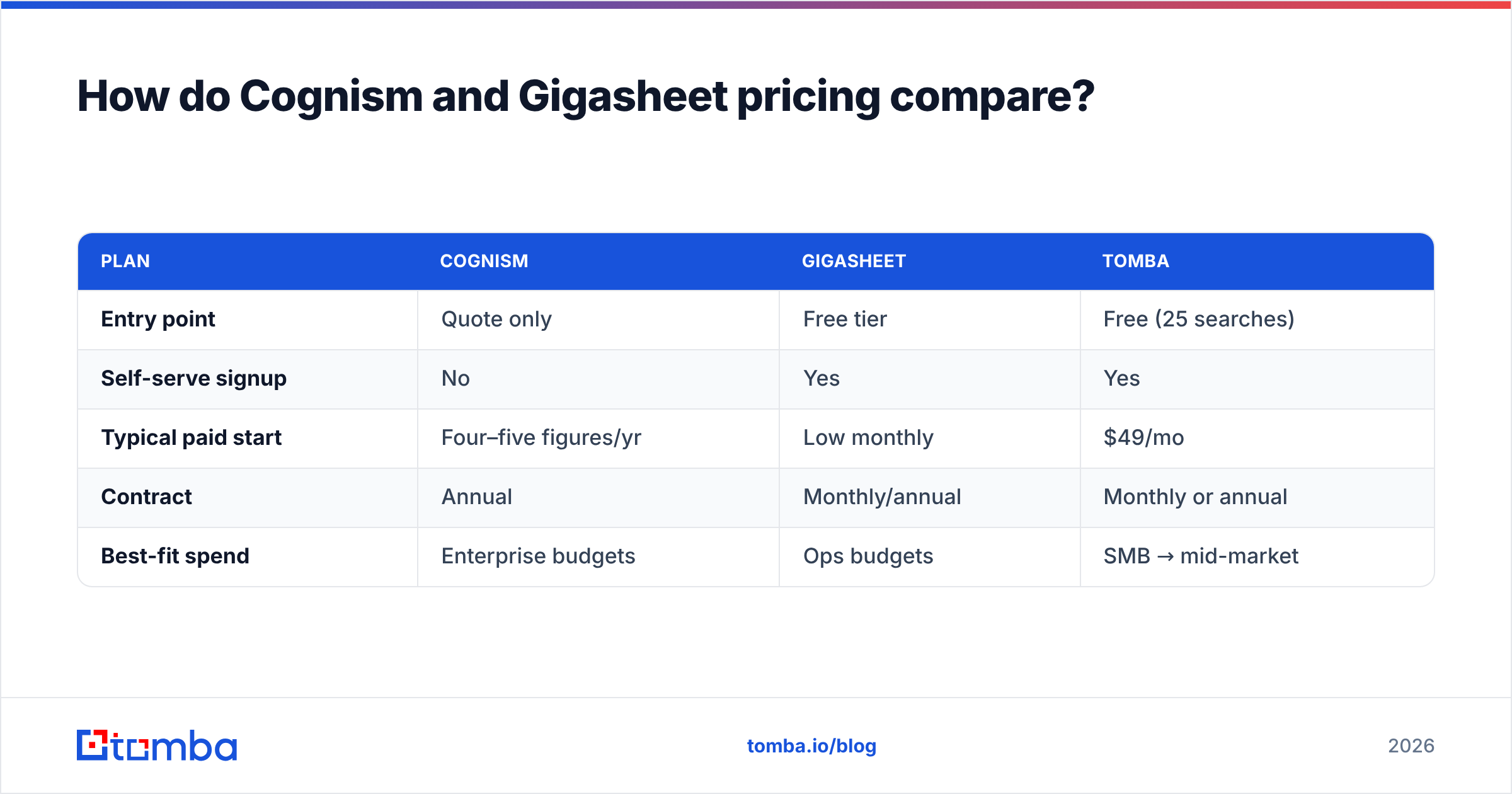
| Plan | Cognism | Gigasheet | Tomba |
|---|---|---|---|
| Entry point | Quote only | Free tier | Free (25 searches) |
| Self-serve signup | No | Yes | Yes |
| Typical paid start | Four–five figures/yr | Low monthly | $49/mo |
| Contract | Annual | Monthly/annual | Monthly or annual |
| Best-fit spend | Enterprise budgets | Ops budgets | SMB → mid-market |
Which tool should you actually choose?#
Choose based on the job in front of you, not the brand.
Pick Cognism if: you're an outbound team that dials, you need verified EU/US mobile numbers, compliance is a board-level concern, and you have budget for an annual contract. Cognism's phone data is genuinely strong — that's what you're paying the premium for.
Pick Gigasheet if: you already generate or buy large lists and your pain is processing them — deduping millions of rows, joining exports, cleaning scrapes. It's the right tool when your data exists but is unwieldy.
Pick neither (or add a third tool) if: your core need is finding and verifying professional emails by name, company, or domain. That's a distinct job both tools do awkwardly. Cognism bundles it into an expensive suite; Gigasheet only enriches lists you already have. A focused email finder plus an email verifier does that slice better and cheaper — and you can scale it with a bulk email finder when you have hundreds of domains to work through.

Can you use Cognism and Gigasheet together?#
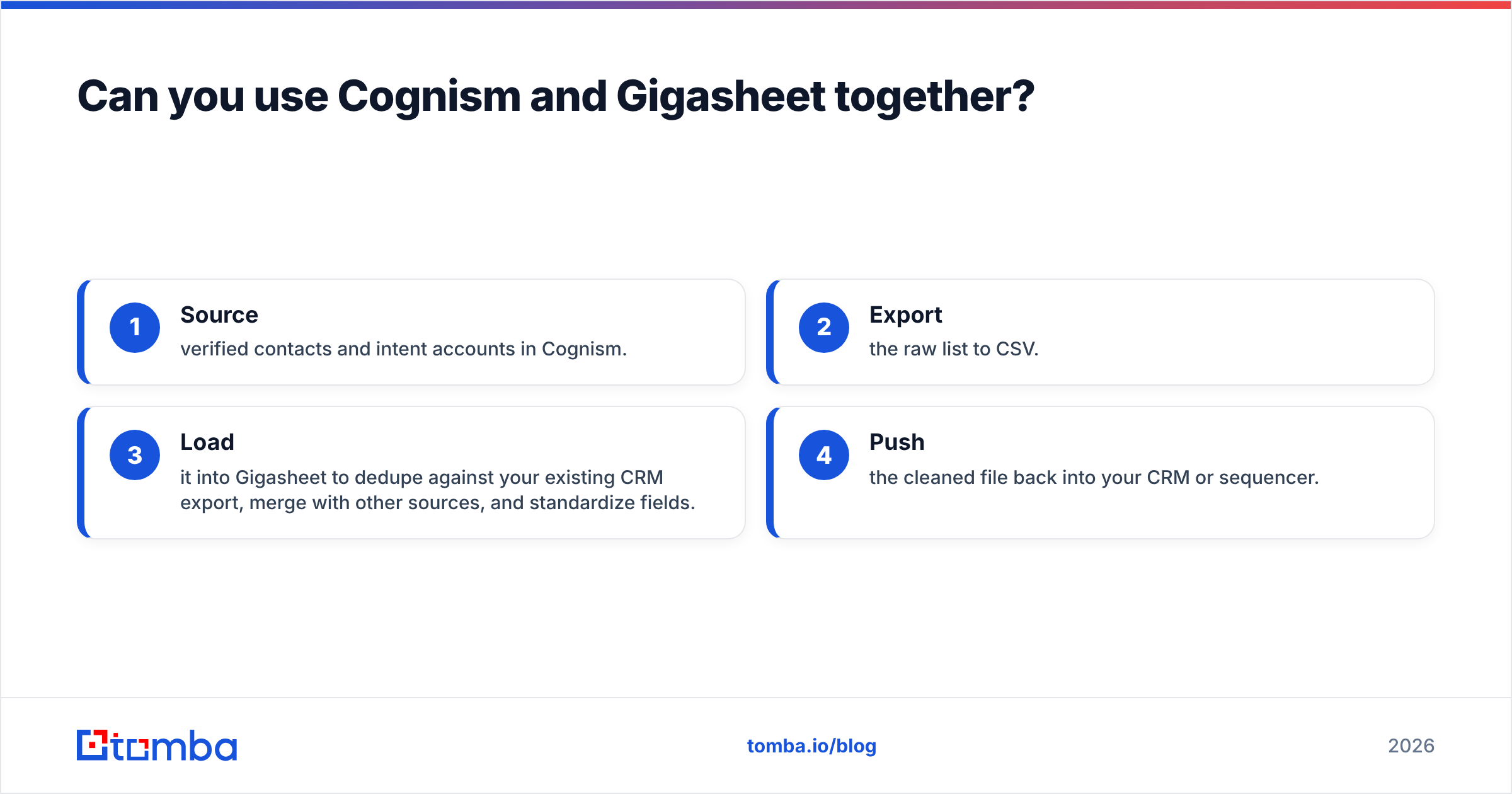
Yes, and for larger teams the combination makes sense. A common workflow:
- Source verified contacts and intent accounts in Cognism.
- Export the raw list to CSV.
- Load it into Gigasheet to dedupe against your existing CRM export, merge with other sources, and standardize fields.
- Push the cleaned file back into your CRM or sequencer.
That pipeline works, but it's expensive and involves two heavyweight subscriptions plus manual CSV shuffling. Many teams get 80% of the value by replacing the "source verified emails" step with a targeted tool and reserving big-data spreadsheets only for genuine multi-million-row jobs.
For example, domain search pulls every discoverable email at a company in one query, data enrichment appends the missing fields on a list you already have, and the results export straight to your CRM or spreadsheet. You skip the annual contract and only pay for the exact capability you use. If you do need to eyeball a 5M-row export afterward, that's when a Gigasheet-style tool earns its keep — not before.
What do users say about each tool?#
Patterns from public reviews across Cognism's G2 profile and Gigasheet's own product site:
- Cognism praise: mobile-number accuracy, EU coverage, compliance confidence, clean CRM sync.
- Cognism gripes: price, forced annual contracts, credit limits, and US email data that some reviewers find less complete than the phone data.
- Gigasheet praise: handles enormous files effortlessly, low learning curve, genuinely useful for cleanup and dedup, generous free tier.
- Gigasheet gripes: enrichment costs stack up, it's not a prospecting source, and power users occasionally want deeper spreadsheet functions.
Notice the shape: complaints about Cognism are about cost and commitment, complaints about Gigasheet are about scope. Neither is "bad data" — they're just priced and scoped for specific buyers.
The bottom line on Cognism vs Gigasheet#
They aren't rivals; they're two different aisles. Cognism sells you verified contacts and belongs in a funded outbound team's stack. Gigasheet gives you a big-data spreadsheet and belongs wherever unwieldy lists pile up. If you were choosing between them, you were probably comparing the wrong axis — decide first whether you need new contacts or cleaner data.
And if your honest answer is "I just need accurate professional emails, verified, without an enterprise contract," neither tool is the efficient pick. Start with Tomba's Email Finder to source verified addresses by name, company, or domain, layer in the email verifier to keep bounce rates low, and use transparent, month-to-month Tomba plans that begin free and scale to $49/mo — so you spend on results, not seats. When your list genuinely outgrows a spreadsheet, add a big-data tool then. Until it does, keep the stack lean.
Related guides#
// get started
Find, verify and enrich your first contacts today
Start on the free plan with 25 searches a month, then scale when your team is ready.
Free plan · No credit card required · GDPR & CCPA
// about the author