Cognism vs GrowMeOrganic (2026): Which B2B Data Tool Wins?
Cognism sells enterprise-grade compliant data at enterprise prices. GrowMeOrganic bundles cheap scraping and outreach. Here is the honest breakdown of which one fits your team and budget in 2026.
Choosing between Cognism and GrowMeOrganic feels like choosing between a Swiss bank and a flea market. Both hand you B2B contact data, but they solve very different problems, charge very different prices, and attract very different buyers. This guide cuts through the marketing on both sites and tells you which one earns your money in 2026 — and where a lighter, pay-as-you-go tool beats them both.
TL;DR — Cognism vs GrowMeOrganic in 30 seconds#
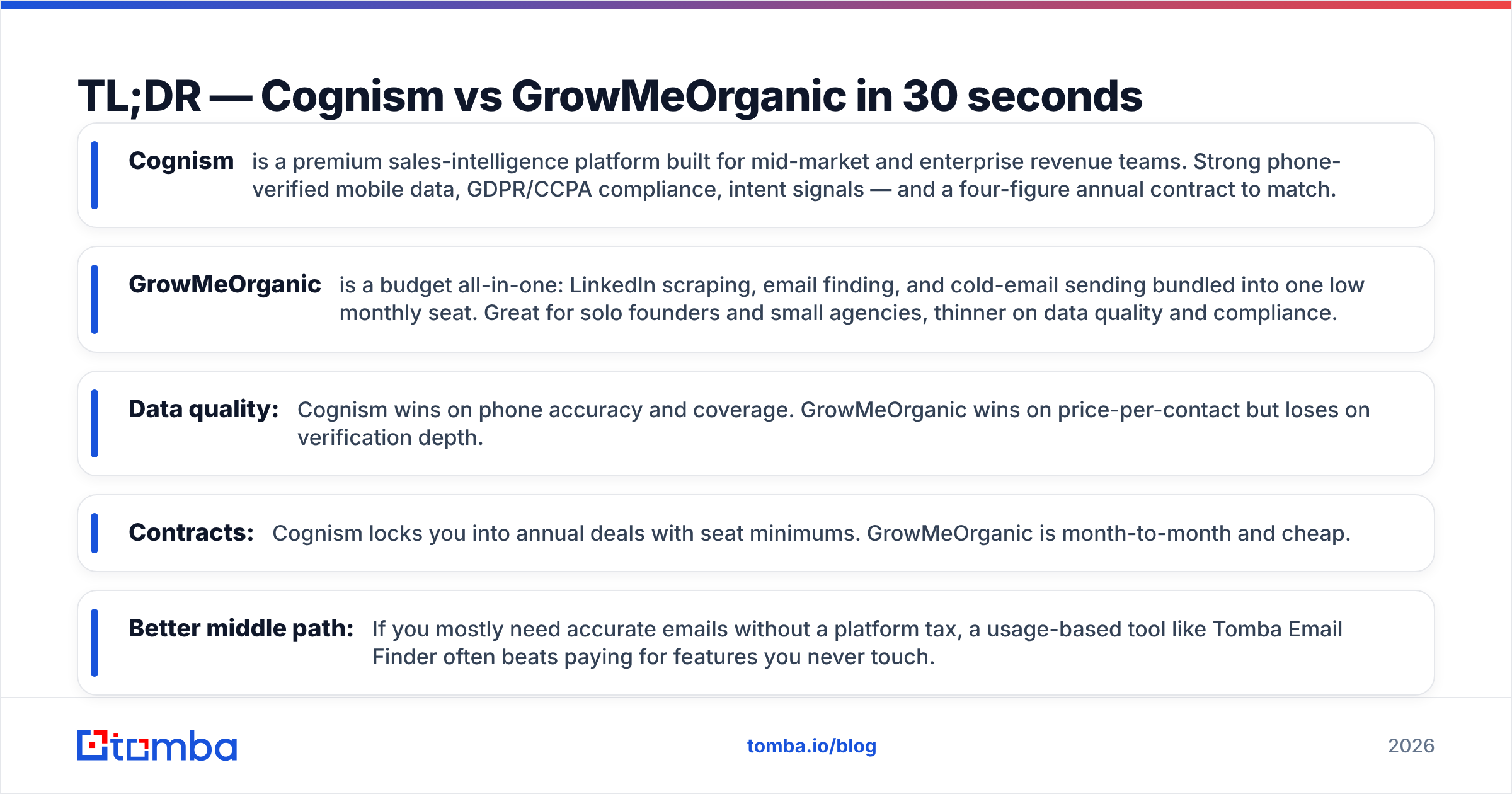
- Cognism is a premium sales-intelligence platform built for mid-market and enterprise revenue teams. Strong phone-verified mobile data, GDPR/CCPA compliance, intent signals — and a four-figure annual contract to match.
- GrowMeOrganic is a budget all-in-one: LinkedIn scraping, email finding, and cold-email sending bundled into one low monthly seat. Great for solo founders and small agencies, thinner on data quality and compliance.
- Data quality: Cognism wins on phone accuracy and coverage. GrowMeOrganic wins on price-per-contact but loses on verification depth.
- Contracts: Cognism locks you into annual deals with seat minimums. GrowMeOrganic is month-to-month and cheap.
- Better middle path: If you mostly need accurate emails without a platform tax, a usage-based tool like Tomba Email Finder often beats paying for features you never touch.
What is Cognism?#
Cognism is a sales-intelligence platform, not just an email tool. Its pitch is "premium, compliant, phone-verified B2B data" for teams that live and die by outbound. The headline features are Diamond Data (mobile numbers a human actually dialed and confirmed), intent data through a Bombora partnership, and technographic and firmographic filters deep enough to build precise account lists.
The catch is the go-to-market model. Cognism sells annual contracts with per-seat pricing and usually a platform fee on top. You talk to a rep, you get a quote, and you commit for a year. That works beautifully for a 20-rep SDR org in EMEA that needs verified mobiles and clean consent records. It works poorly for a two-person startup that just wants 500 emails this month.
You can read Cognism's own positioning on their homepage, and independent buyer reviews on G2 paint a consistent picture: excellent European mobile coverage, real compliance rigor, and pricing that makes finance ask questions.
What is GrowMeOrganic?#
GrowMeOrganic is an all-in-one prospecting and outreach suite aimed at the opposite buyer. For one flat monthly price you get a LinkedIn/Sales Navigator scraper, an email finder, an email verifier, and a cold-email sending engine with sequences. It is the "everything in one dashboard" play for founders, freelancers, and small agencies who cannot justify separate subscriptions for data and sending.
The trade-off is depth. GrowMeOrganic's data is aggregated and scraped rather than continuously phone-verified, so accuracy varies by geography and seniority. Its sending engine is fine for low-volume campaigns but is not a replacement for a dedicated deliverability stack. And because everything is bundled, you pay for a scraper and a sender even if all you wanted was clean email data.
Where GrowMeOrganic shines is total cost of ownership for tiny teams: it replaces three or four tools with one affordable seat, and the month-to-month billing means no annual handcuffs.
Cognism vs GrowMeOrganic: the core differences#
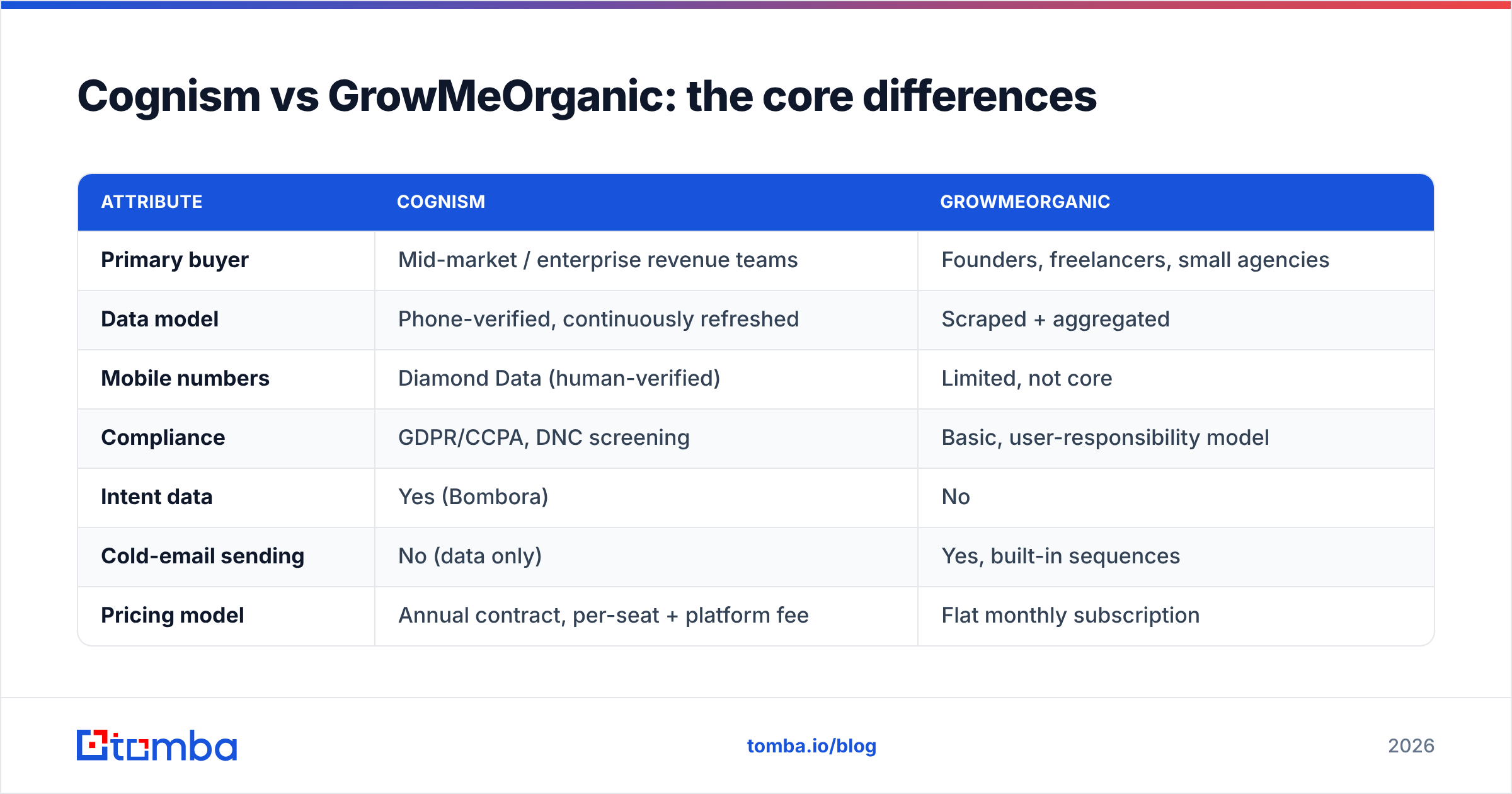
The two products barely compete on the same axis. Here is the honest side-by-side.
| Attribute | Cognism | GrowMeOrganic |
|---|---|---|
| Primary buyer | Mid-market / enterprise revenue teams | Founders, freelancers, small agencies |
| Data model | Phone-verified, continuously refreshed | Scraped + aggregated |
| Mobile numbers | Diamond Data (human-verified) | Limited, not core |
| Compliance | GDPR/CCPA, DNC screening | Basic, user-responsibility model |
| Intent data | Yes (Bombora) | No |
| Cold-email sending | No (data only) | Yes, built-in sequences |
| Pricing model | Annual contract, per-seat + platform fee | Flat monthly subscription |
| Entry cost | High four figures / year | Low double-digit / month |
| Contract | Annual, seat minimums | Month-to-month |
| Best for | Verified EMEA/US outbound at scale | All-in-one prospecting on a budget |
The takeaway: Cognism sells trust and verification; GrowMeOrganic sells breadth and affordability. Neither is "better" in the abstract — they are priced for different companies.
Is Cognism worth the price?#
Cognism is worth it when three things are true at once: you run outbound at real volume, you dial mobile phones (not just email), and you operate in a market where compliance actually matters — think regulated industries or EU-heavy sales. In that scenario the phone-verified numbers alone can pay for the contract by cutting wasted dial time.
It is not worth it when you are early-stage, email-only, or unsure of your monthly volume. Paying a platform fee plus per-seat annual pricing for a tool you use in bursts is how prospecting budgets get torched. Many teams also over-buy seats to hit a minimum and then leave most of them idle.
If your core need is verified contact data rather than the full intelligence suite, it is worth comparing per-contact economics before signing. Tools focused purely on finding and verifying contacts — see how data enrichment and email verification can be bought à la carte — often deliver the 20% of Cognism you actually use for a fraction of the cost.

Is GrowMeOrganic good enough for serious outbound?#
GrowMeOrganic is good enough when your volume is modest, your ICP is not niche, and you value one login over best-in-class accuracy. A solo founder booking 10 meetings a month from LinkedIn scrapes and cold emails can run their entire motion inside it and spend less than a single Cognism seat.
It starts to strain in three places. First, data accuracy on senior or non-US contacts — scraped data ages fast and GrowMeOrganic does not verify mobiles at Cognism's depth. Second, deliverability at scale — the built-in sender is convenient but a serious cold-email program benefits from dedicated warmup, inbox rotation, and monitoring that a bundled tool rarely matches. Third, compliance — the responsibility for lawful processing sits more heavily on you.
For a small team, none of these are dealbreakers. For a 15-rep SDR floor pushing thousands of touches a week, they become real risks.
How accurate is the data, really?#
Data accuracy is where the two tools separate most clearly, and it is worth being specific instead of trusting either vendor's marketing number.
Cognism's advantage is process: numbers and emails are run through verification and, for Diamond Data, human dialing. That drives down bounce and wrong-number rates, especially in EMEA. GrowMeOrganic's advantage is volume-for-price, but scraped data inevitably includes more stale records, so you should expect to verify before you send.

The practical lesson applies no matter which platform you pick: never send to unverified data. A quick verification pass protects your sender reputation and your email deliverability. Whether you route lists through Cognism, GrowMeOrganic, or a standalone email verifier, the bounce rate you tolerate should be under 3%. Feeding a mailbox provider dirty lists is the fastest way to land in spam regardless of how premium your data source claims to be.
Pricing: what you actually pay#
Neither vendor publishes a simple public price for its full feature set, which itself tells you something about their sales motions.
- Cognism is quote-based. Expect an annual commitment, per-seat licensing, and often a platform fee. Real-world entry points land in the high four figures per year and climb with seats, intent data, and enrichment add-ons.
- GrowMeOrganic publishes tiered monthly plans that are an order of magnitude cheaper, billed month-to-month or annually, with credit limits on finds and sends.
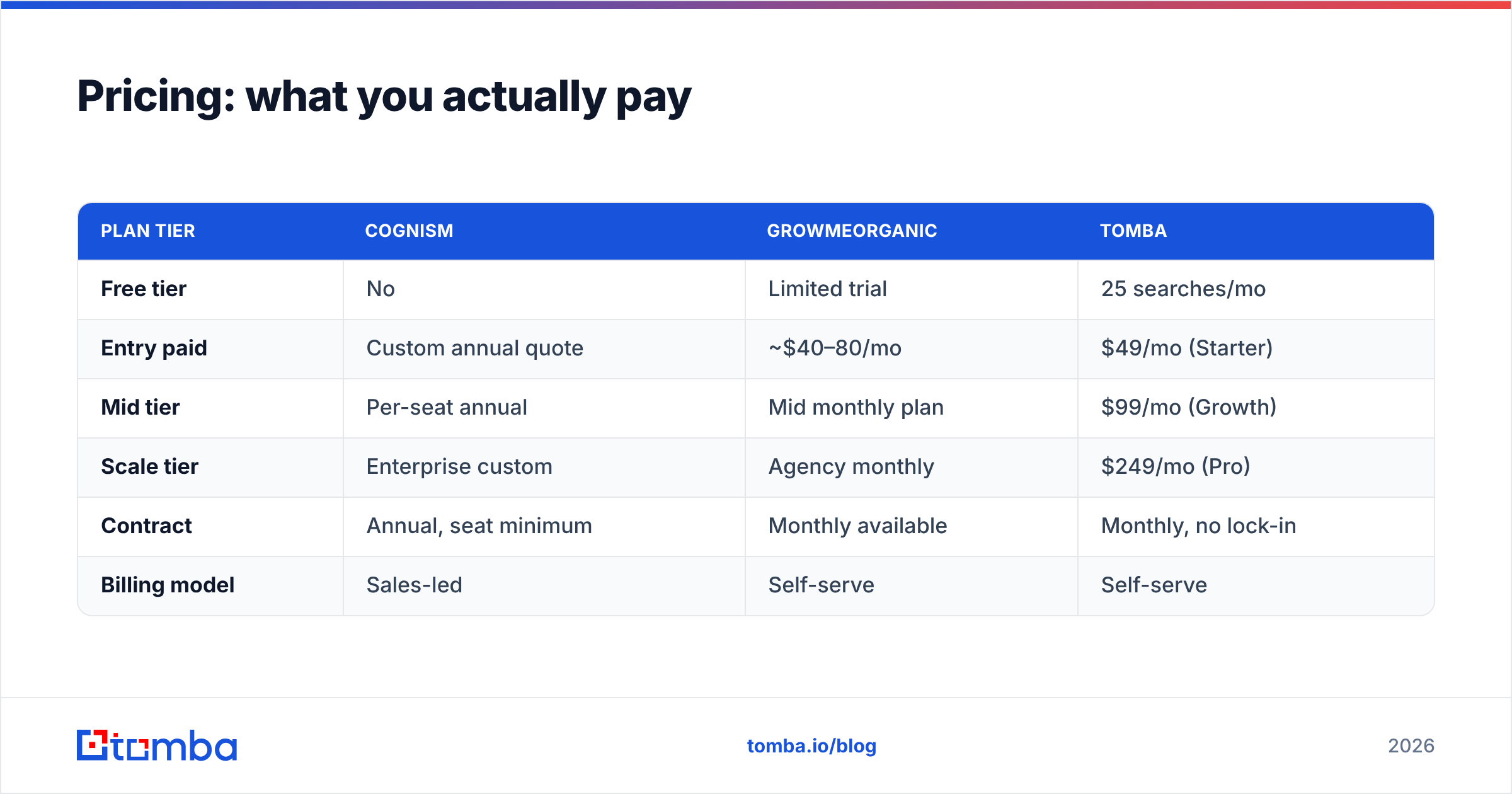
Here is how the money shakes out against a lean, usage-based alternative:
| Plan tier | Cognism | GrowMeOrganic | Tomba |
|---|---|---|---|
| Free tier | No | Limited trial | 25 searches/mo |
| Entry paid | Custom annual quote | ~$40–80/mo | $49/mo (Starter) |
| Mid tier | Per-seat annual | Mid monthly plan | $99/mo (Growth) |
| Scale tier | Enterprise custom | Agency monthly | $249/mo (Pro) |
| Contract | Annual, seat minimum | Monthly available | Monthly, no lock-in |
| Billing model | Sales-led | Self-serve | Self-serve |
If predictable monthly spend and no annual lock-in matter to you, the self-serve tiers win. You can compare the full Tomba pricing breakdown to see how usage-based credits stack against a bundled seat or an enterprise contract.
Which should you choose?#
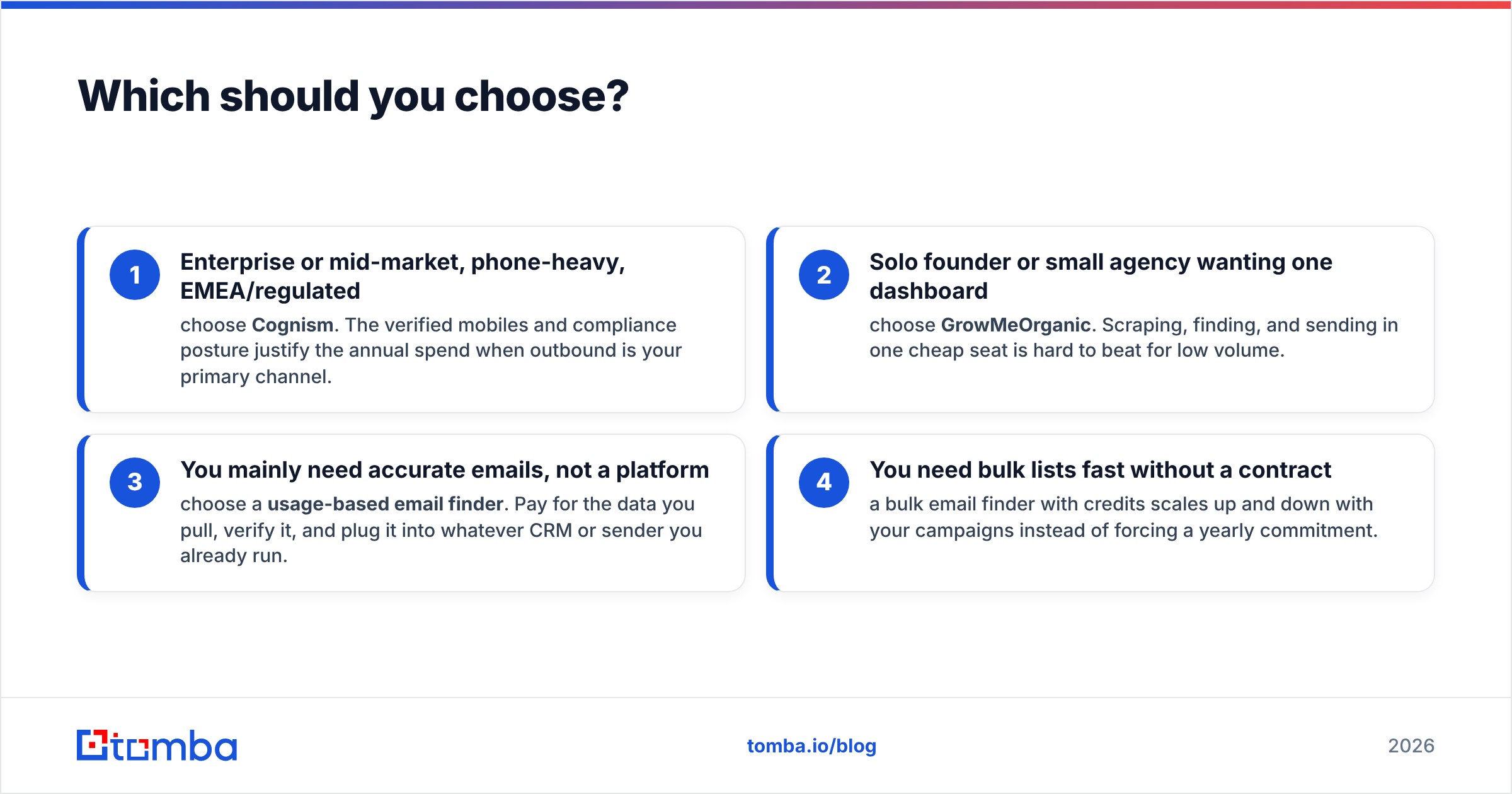
Match the tool to your situation rather than the loudest review.
- Enterprise or mid-market, phone-heavy, EMEA/regulated — choose Cognism. The verified mobiles and compliance posture justify the annual spend when outbound is your primary channel.
- Solo founder or small agency wanting one dashboard — choose GrowMeOrganic. Scraping, finding, and sending in one cheap seat is hard to beat for low volume.
- You mainly need accurate emails, not a platform — choose a usage-based email finder. Pay for the data you pull, verify it, and plug it into whatever CRM or sender you already run.
- You need bulk lists fast without a contract — a bulk email finder with credits scales up and down with your campaigns instead of forcing a yearly commitment.
The most common mistake is buying a full sales-intelligence platform to solve an email-finding problem, or bundling a weak sender because it came free with cheap data. Separate the jobs: source accurate contacts, verify them, then send from a stack you trust.
The middle path: buy data, skip the platform tax#
Most teams comparing Cognism and GrowMeOrganic are really asking one question: how do I get contact data that converts without overpaying? You do not have to answer that with a five-figure contract or a jack-of-all-trades bundle.
A focused workflow looks like this: find verified professional emails by name or company with an email finder, run a domain search to map an entire company's contacts, verify everything before sending, and enrich the records that matter. You keep your existing CRM and outreach tools, you pay only for what you pull, and you avoid annual handcuffs entirely. For developers, the same data is available through the Tomba API so you can wire enrichment straight into your pipeline.
That à la carte approach is exactly why teams stuck between an enterprise contract and a budget bundle keep landing in the middle. Start free with 25 searches a month on Tomba Email Finder, test the accuracy against your own known contacts, and scale to a $49/mo Starter plan only when the numbers prove out — no rep call, no annual lock-in, no paying for features you will never open.
Related guides#
// get started
Find, verify and enrich your first contacts today
Start on the free plan with 25 searches a month, then scale when your team is ready.
Free plan · No credit card required · GDPR & CCPA
// about the author