Cognism vs Hithorizons (2026): B2B Data Platform Compared
Cognism sells phone-verified GDPR sales intelligence; Hithorizons sells global company registry data. Here's which one fits your GTM motion in 2026 — and where a leaner stack beats both.
Choosing between Cognism and Hithorizons feels like an apples-to-oranges problem because it mostly is. Both call themselves B2B data providers, but they solve different jobs: Cognism is a sales-intelligence platform built for outbound teams that need phone-verified contacts, and Hithorizons is a global company-data engine built on business registries and firmographics. Picking the wrong one means paying enterprise money for data your team can't action.
This comparison breaks down what each tool actually does, where the data comes from, how pricing works, and which motion each one fits. It also covers where a lighter, pay-as-you-grow stack outperforms both for teams that mostly need accurate email addresses and contact data.
TL;DR: Cognism vs Hithorizons at a glance#
- Cognism is a premium sales-intelligence platform: mobile numbers ("Diamond Data"), intent signals, GDPR/CCPA compliance, and CRM integrations — priced for funded sales teams, usually on annual contracts.
- Hithorizons is a company-intelligence and firmographic database sourced from official business registries across 180+ countries — strong for enrichment, screening, and market mapping, weaker for ready-to-dial contacts.
- They rarely compete head-to-head. Cognism wins for outbound SDR teams that live on the phone; Hithorizons wins for RevOps, compliance, and total-addressable-market analysis.
- Both are heavy for SMB budgets. If your core need is finding and verifying professional emails, a self-serve tool like the Tomba Email Finder covers 80% of the job at a fraction of the cost.
- No single vendor is complete. Most teams end up layering a contact finder, a verifier, and an enrichment source — so buy for your primary motion, not the feature checklist.
What is Cognism?#
Cognism is a sales-intelligence platform aimed at outbound and revenue teams. Its pitch is straightforward: give reps accurate, compliant contact data — especially mobile phone numbers — so they spend less time dialing dead lines and more time in real conversations.
The headline feature is Diamond Data, phone numbers that Cognism claims are human-verified for accuracy. For teams running a heavy cold-calling motion, that verification is the whole value proposition. On top of contacts, Cognism layers intent data (via Bombora), technographics, and sales-trigger events like funding rounds and job changes.
Compliance is a core selling point. Cognism markets itself hard on GDPR and CCPA alignment, with notified-jurisdiction checks against Do-Not-Call lists in Europe. For teams selling into the EU and UK, that reduces legal risk in a way US-first databases often don't. You can read more about how they position this on the Cognism website.
Where Cognism gets criticized: price and contract structure. It's an annual-commitment, sales-led purchase, and credit limits on contact exports frustrate smaller teams. Reviews on G2 consistently praise data quality while flagging cost and rigid packaging.
What is Hithorizons?#
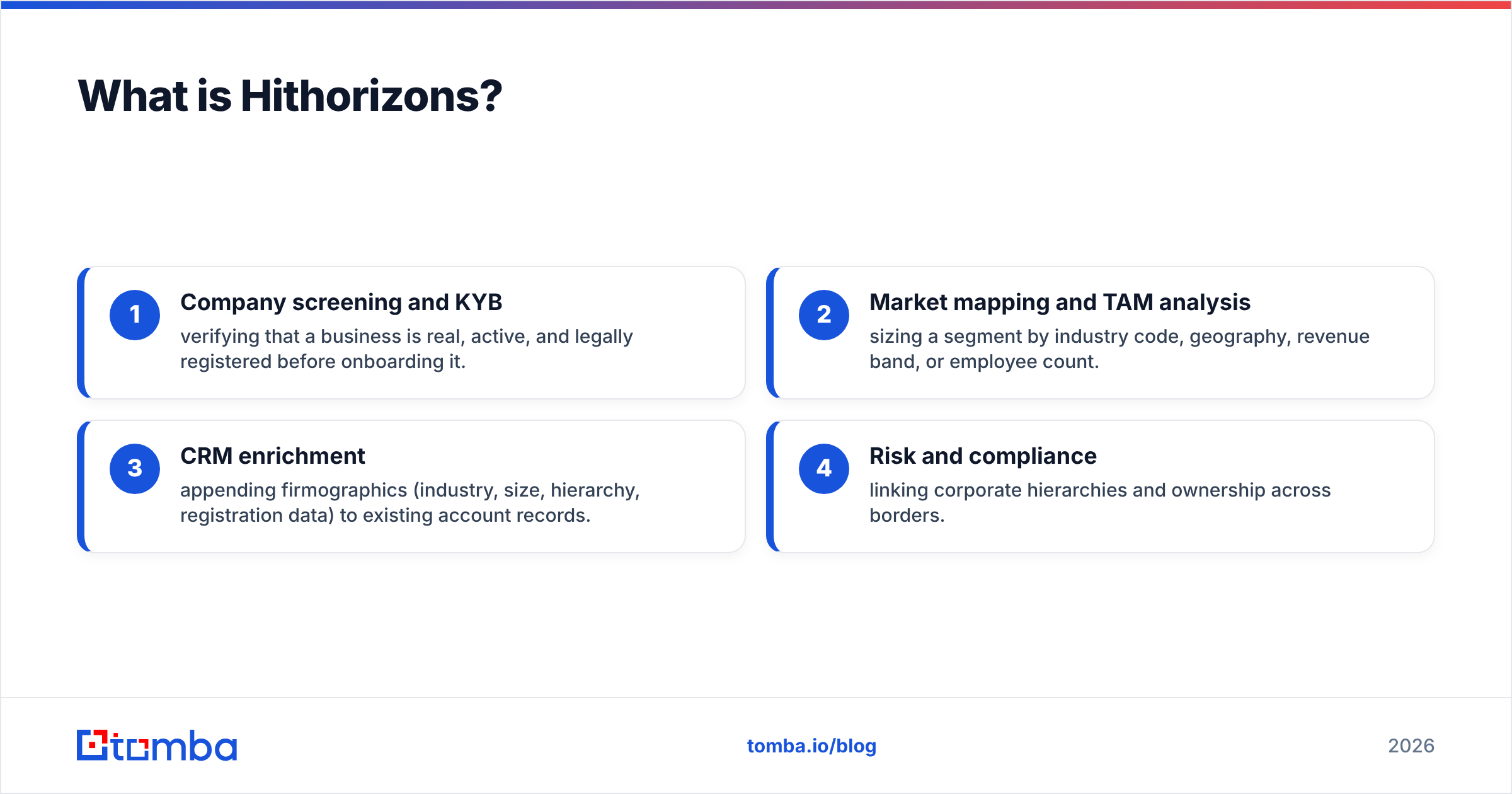
Hithorizons is a company-data provider built on a different foundation entirely: official business registries. Instead of crowdsourced or scraped contacts, it aggregates firmographic and financial data on more than 180 million companies worldwide, tied back to authoritative government and registry sources.
That makes Hithorizons strong for jobs that have nothing to do with dialing a prospect:
- Company screening and KYB — verifying that a business is real, active, and legally registered before onboarding it.
- Market mapping and TAM analysis — sizing a segment by industry code, geography, revenue band, or employee count.
- CRM enrichment — appending firmographics (industry, size, hierarchy, registration data) to existing account records.
- Risk and compliance — linking corporate hierarchies and ownership across borders.
The gap is contacts. Hithorizons excels at company-level intelligence but is not built to hand your SDRs a verified mobile number and a personalized email. If your workflow is "identify the account, then reach a specific human," you'll still need a contact-finding layer on top. Their capabilities are documented on the Hithorizons site.
Cognism vs Hithorizons: side-by-side comparison#
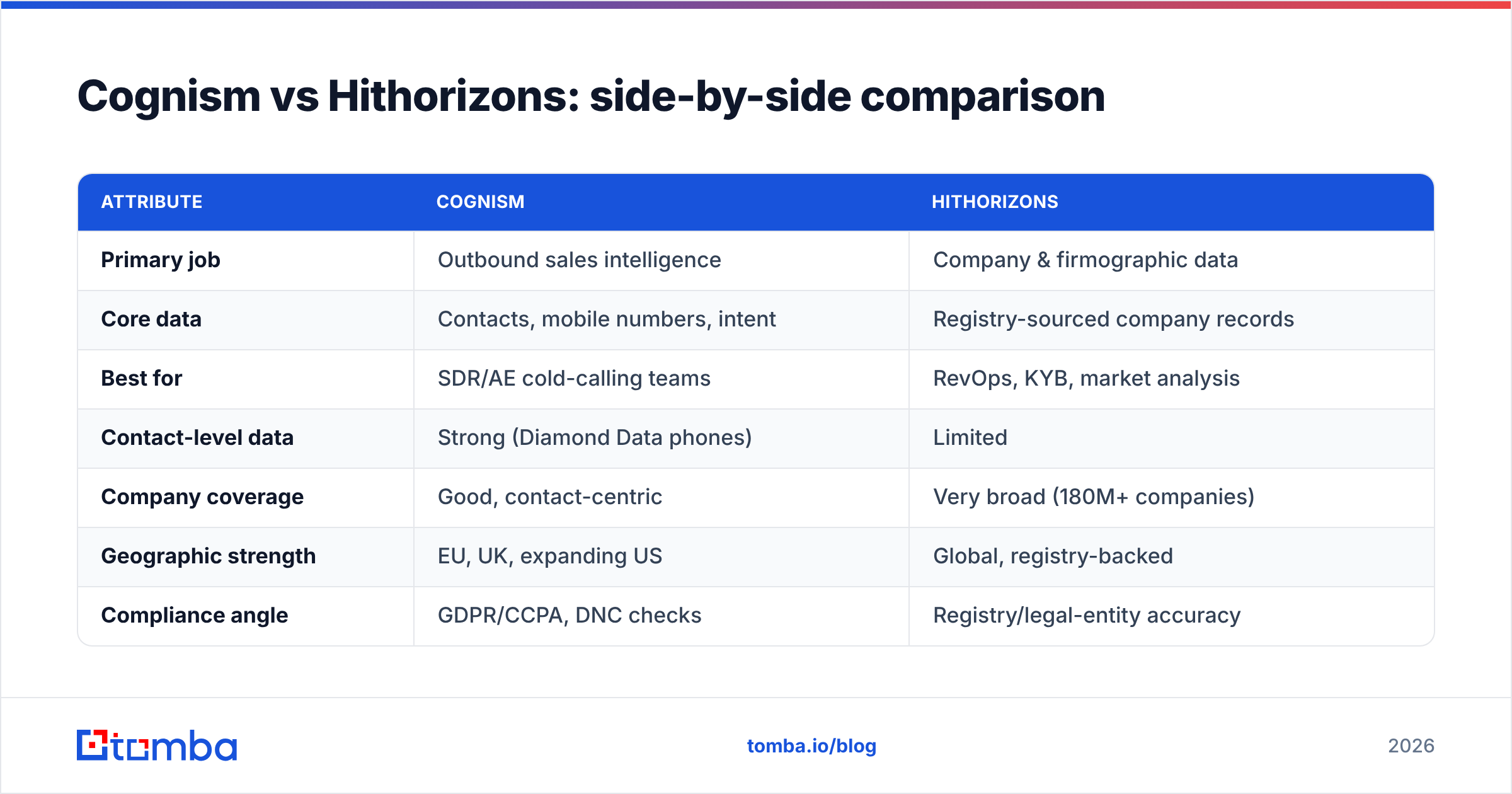
Here's the practical breakdown. Note how little overlap there is in primary use case — that's the real story.
| Attribute | Cognism | Hithorizons |
|---|---|---|
| Primary job | Outbound sales intelligence | Company & firmographic data |
| Core data | Contacts, mobile numbers, intent | Registry-sourced company records |
| Best for | SDR/AE cold-calling teams | RevOps, KYB, market analysis |
| Contact-level data | Strong (Diamond Data phones) | Limited |
| Company coverage | Good, contact-centric | Very broad (180M+ companies) |
| Geographic strength | EU, UK, expanding US | Global, registry-backed |
| Compliance angle | GDPR/CCPA, DNC checks | Registry/legal-entity accuracy |
| Pricing model | Annual, sales-led, credit-based | Custom, API/data-license |
| Free self-serve tier | No | No |
| Typical buyer | VP Sales / SDR leader | RevOps / Data / Compliance |
The takeaway: if a vendor comparison feels forced, it's because these two rarely land on the same shortlist. You're usually deciding what problem you're solving first, not which of these two is better.
Is Cognism better than Hithorizons?#
Cognism is better if your bottleneck is reaching people. A team of SDRs burning hours on wrong numbers will feel the difference from phone-verified data almost immediately. The intent and trigger layers also help prioritize which accounts to call this week. If outbound revenue is your growth engine and you sell into Europe, Cognism is the stronger fit.
Hithorizons is better if your bottleneck is understanding companies. RevOps teams cleaning a messy CRM, compliance teams running KYB, or strategy teams sizing a market don't need mobile numbers — they need accurate, structured, registry-grade firmographics across borders. Cognism can't match that depth of legal-entity data.
So "better" depends entirely on the job. What both share is a heavyweight commercial model: custom quotes, annual contracts, and pricing that assumes a funded team. Neither offers a genuine self-serve on-ramp, which is exactly where smaller teams get stuck.

Where does an email finder fit in this stack?#
Here's the practical reality most guides skip: a large share of teams evaluating Cognism or Hithorizons don't actually need a full platform. They need to find the right person's email, confirm it's deliverable, and move on.
That's a narrower, cheaper problem. A dedicated email-finding and verification stack solves it without an annual commitment:
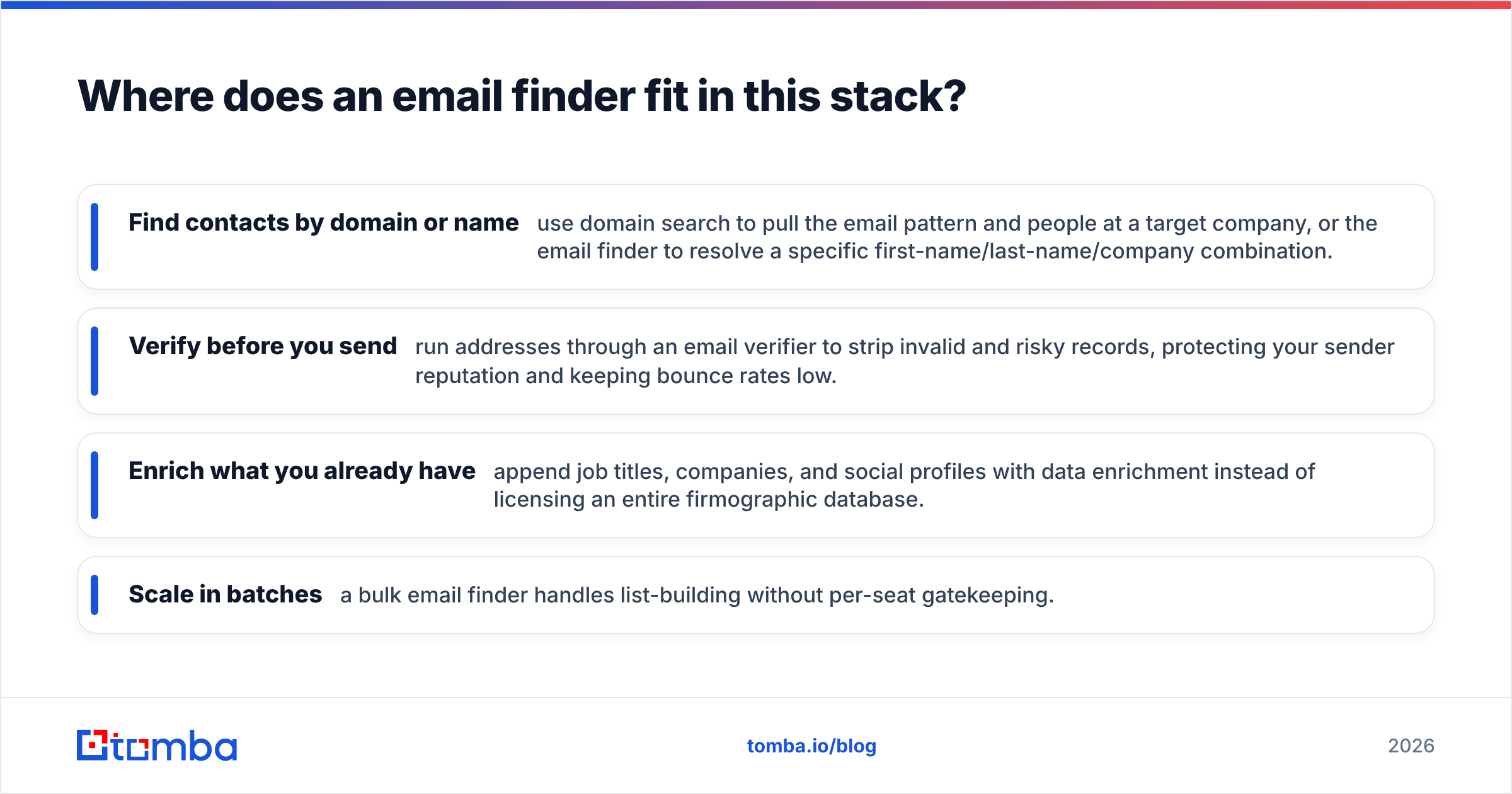
- Find contacts by domain or name — use domain search to pull the email pattern and people at a target company, or the email finder to resolve a specific first-name/last-name/company combination.
- Verify before you send — run addresses through an email verifier to strip invalid and risky records, protecting your sender reputation and keeping bounce rates low.
- Enrich what you already have — append job titles, companies, and social profiles with data enrichment instead of licensing an entire firmographic database.
- Scale in batches — a bulk email finder handles list-building without per-seat gatekeeping.
This layer doesn't replace Cognism's phone verification or Hithorizons' registry depth. But for the majority of outbound and lead-gen work — which is email-first — it delivers the actionable output both platforms wrap in far more expensive packaging.
How does pricing compare?#
Both Cognism and Hithorizons keep pricing behind a sales conversation, which is itself a signal about the buyer they want. Cognism is widely reported to start in the low five figures annually and scale with seats and data credits. Hithorizons is typically licensed by data volume or API usage for enrichment and screening.
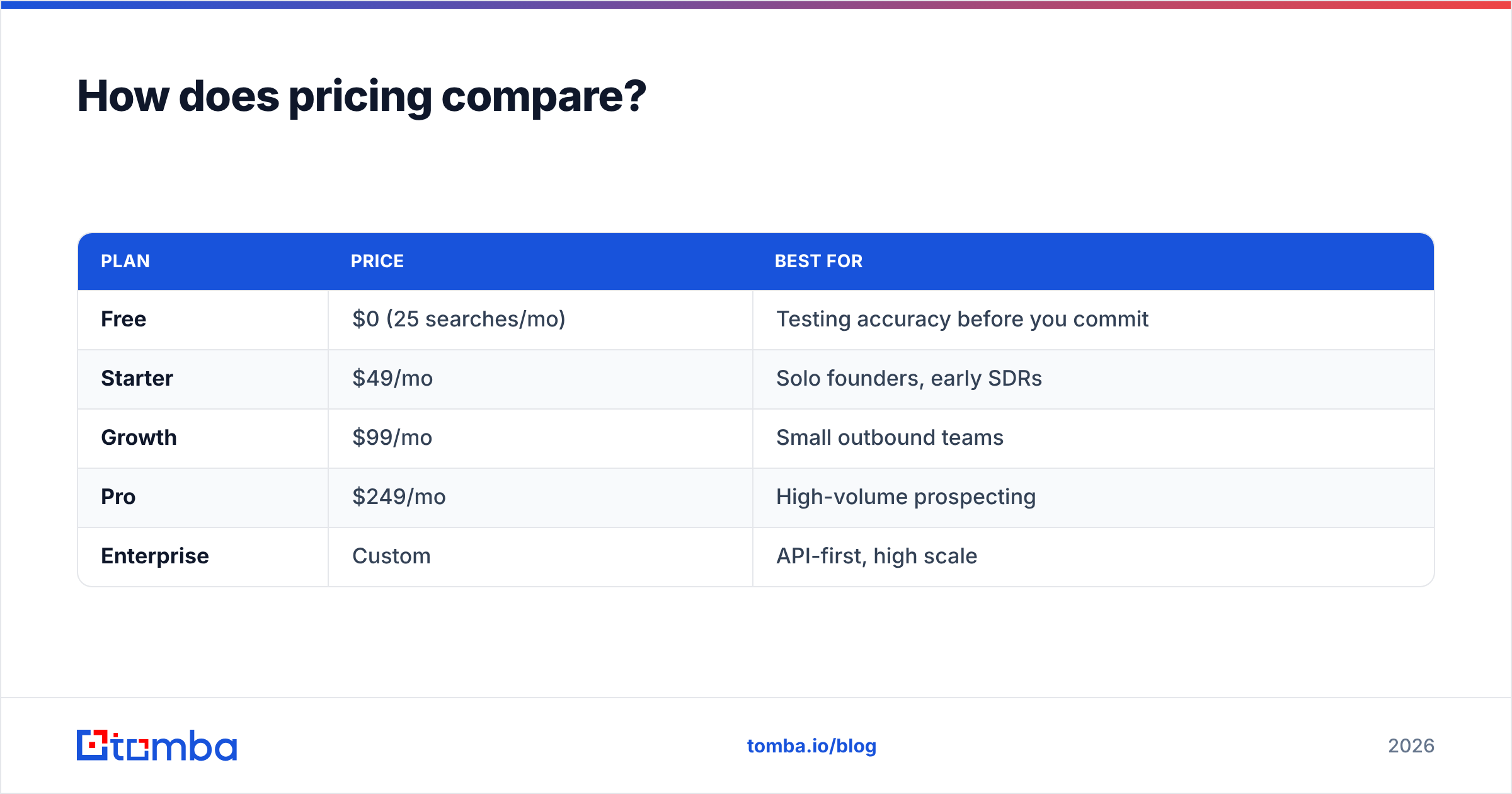
Compare that to a transparent, self-serve model where you can start free and upgrade only when volume demands it:
| Plan | Price | Best for |
|---|---|---|
| Free | $0 (25 searches/mo) | Testing accuracy before you commit |
| Starter | $49/mo | Solo founders, early SDRs |
| Growth | $99/mo | Small outbound teams |
| Pro | $249/mo | High-volume prospecting |
| Enterprise | Custom | API-first, high scale |
You can see the full breakdown on the Tomba pricing page. The point isn't that cheaper is always better — it's that paying enterprise rates only makes sense when you'll actually use enterprise features like verified mobile dialing or global registry screening. If you won't, a credit-based or subscription contact tool is the rational buy.
Which should you choose in 2026?#
Match the tool to your primary motion, not the longest feature list:
- Heavy cold-calling into EU/UK, funded team → Cognism. The phone verification and compliance posture justify the spend when dialing is your core channel.
- RevOps, KYB, compliance, or TAM analysis → Hithorizons. Registry-grade company data is its moat, and nothing on Cognism's roadmap replaces it.
- Email-first outbound, lead gen, or a lean budget → a dedicated finder-plus-verifier stack. Start with the Tomba Email Finder, verify before sending, and add enrichment as you grow.
- All of the above at scale → layer them. Use registry data for account selection, a contact tool for reachable emails, and reserve premium phone data for your highest-value segments.
The mistake to avoid is buying a platform for a capability you won't operationalize. A verified mobile number you never dial and a firmographic license you query twice a quarter are both just expensive shelfware.
Frequently asked questions#
Is Cognism a direct competitor to Hithorizons? Not really. Cognism focuses on contact-level sales intelligence (emails, phones, intent), while Hithorizons focuses on registry-sourced company data. They overlap only at the edges of enrichment.
Does Hithorizons provide email addresses and phone numbers? Its strength is company-level firmographic and registry data, not ready-to-contact personal emails or verified mobile numbers. For contacts, you'll typically add a finder like Tomba on top.
Which is more GDPR-friendly? Both take compliance seriously in different ways — Cognism through DNC checks and notified-jurisdiction sourcing, Hithorizons through authoritative legal-entity records. Your own consent and processing practices still matter most.
Is there a cheaper alternative to both? Yes, if your core need is finding and verifying professional emails. A self-serve tool with a free tier lets you test accuracy first and pay only for the volume you use.
The bottom line#
Cognism and Hithorizons aren't really rivals — they're specialists. Cognism arms outbound teams with phone-verified, compliant contacts; Hithorizons arms data and compliance teams with registry-grade company intelligence. Choose based on whether your bottleneck is reaching people or understanding companies, and don't pay for the half you won't use.
If your day-to-day is simpler than either platform assumes — you mostly need accurate emails you can actually send to — start lean. Try the Tomba Email Finder free, verify your list before the first send, and scale into heavier tooling only when your motion demands it. That's how you keep your data stack matched to the revenue it produces, instead of the other way around.
Related guides#
// get started
Find, verify and enrich your first contacts today
Start on the free plan with 25 searches a month, then scale when your team is ready.
Free plan · No credit card required · GDPR & CCPA
// about the author