Cognism vs Leadrocks (2026): Which B2B Data Tool Wins?
Cognism sells enterprise-grade compliance and phone data; Leadrocks sells cheap lifetime LinkedIn lists. We compare pricing, accuracy, coverage, and fit so you pick the right B2B data tool in 2026.
Choosing between Cognism and Leadrocks feels like choosing between a corporate jet and a used sedan. Both move you forward, but the price tags, the passengers they fit, and the fuel bills are nowhere close. This guide cuts through the marketing so you can match the tool to your actual pipeline and budget in 2026 — not to a sales demo.
TL;DR — Cognism vs Leadrocks in 30 seconds#
- Cognism is enterprise sales intelligence: phone-verified mobile data, strong EU/GDPR compliance, and CRM-native workflows — priced for funded teams (typically four to five figures a year, quote-only).
- Leadrocks is a budget B2B contact database built around LinkedIn-sourced leads, often sold with lifetime deals — cheap, simple, but thinner on coverage and freshness.
- Accuracy gap: Cognism's phone data ("Diamond Data") is its moat; Leadrocks trades verification depth for price.
- Best for Cognism: outbound teams that live on the phone, sell into Europe, and need compliance cover.
- Best for Leadrocks: solo founders and small teams who want a one-time-payment email list without a subscription.
- Cheaper middle path: if you mostly need accurate emails on demand, a pay-as-you-go email finder like Tomba covers the same job at a fraction of either.
What is Cognism?#
Cognism is a sales intelligence platform aimed at mid-market and enterprise revenue teams. Its pitch is quality over quantity: mobile numbers that are human-verified, an international database with heavy European coverage, and built-in compliance checks against DNC (do-not-call) lists and GDPR requirements.
The product bundles contact data, company data, intent signals, and technographics, then pushes them into Salesforce, HubSpot, and Outreach so reps never leave their workflow. That depth is why Cognism commands premium annual contracts — you can read verified user reviews on G2 to see how buyers rate that trade-off.
The headline feature is Diamond Data: phone numbers Cognism claims are verified by a live team, boosting connect rates for cold callers. If your motion is phone-heavy and you sell across borders, that verification is the reason to look past the price.
What is Leadrocks?#
Leadrocks is a lightweight B2B contact database that leans on LinkedIn-sourced profiles. You search by job title, industry, company size, or location, then export emails and other contact fields to CSV or your CRM.
Its differentiator is pricing model, not data depth. Leadrocks frequently appears on lifetime-deal marketplaces, letting a small team pay once and keep access to a fixed credit pool. For a bootstrapped founder building a first outbound list, that removes the recurring-subscription anxiety entirely. You can see the current tiers on the Leadrocks site.
The catch is what you'd expect at that price: smaller total coverage, less frequent re-verification, and thinner phone data. It's a starter database, not an enterprise intelligence engine.

Cognism vs Leadrocks: the core comparison#
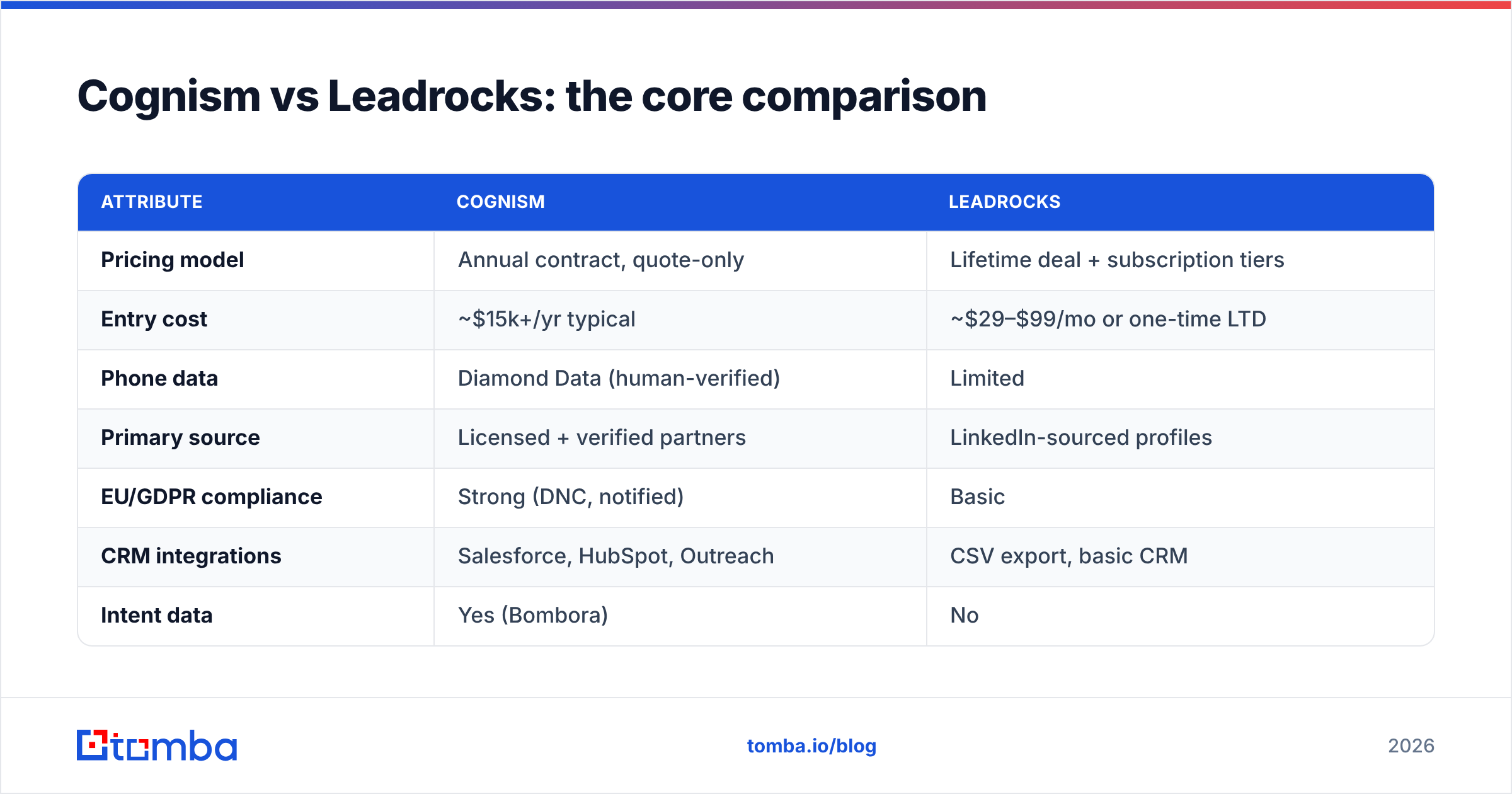
Here's the side-by-side on the attributes that actually change a buying decision. Prices reflect publicly reported ranges as of 2026 — Cognism is quote-only, so treat its figures as directional.
| Attribute | Cognism | Leadrocks |
|---|---|---|
| Pricing model | Annual contract, quote-only | Lifetime deal + subscription tiers |
| Entry cost | ~$15k+/yr typical | ~$29–$99/mo or one-time LTD |
| Phone data | Diamond Data (human-verified) | Limited |
| Primary source | Licensed + verified partners | LinkedIn-sourced profiles |
| EU/GDPR compliance | Strong (DNC, notified) | Basic |
| CRM integrations | Salesforce, HubSpot, Outreach | CSV export, basic CRM |
| Intent data | Yes (Bombora) | No |
| Best fit | Enterprise outbound teams | Solo founders, small teams |
| Free/trial | Demo only | Limited free credits |
The pattern is clear: Cognism wins on depth, verification, and compliance; Leadrocks wins on upfront cost and simplicity. Neither is "better" in the abstract — they're built for different buyers.
Is Cognism's data more accurate than Leadrocks?#
Yes, on phone data especially — but you pay for it. Cognism's human verification layer is the single biggest reason enterprise teams tolerate its contract minimums. When your SDRs dial hundreds of numbers a week, a few extra connects per hundred dials pays for the platform.

Email accuracy is a closer race. Both tools surface work emails, but any database — premium or budget — decays. People change jobs every few years, and even a verified email today can bounce next quarter. That's why the smartest teams treat any static list as a starting point and run addresses through an email verifier before a send. Verification catches the decay a database can't, no matter which vendor you picked.
Leadrocks is honest about being a value tool. Its LinkedIn-sourced records are fine for building a first list, but the re-verification cadence is slower, so you'll want to clean exports more aggressively before loading a sequence.
How does pricing really compare?#
This is where the two tools stop being comparable at all.
Cognism is a considered, annual purchase. You'll book a demo, get scoped, and negotiate a contract that typically starts in the five-figure range and scales with seats and data volume. There's real value there for large teams — but it's a procurement decision, not a credit-card signup.
Leadrocks flips the model. Lifetime deals mean one payment and no monthly bill, which is genuinely attractive for a founder validating an outbound channel. The ceiling is the credit cap and coverage — you may outgrow it as your ICP widens.

If neither the enterprise contract nor the fixed lifetime cap fits, there's a third shape worth knowing: usage-based email finding. Instead of buying a database, you look up contacts on demand and pay for what you use. That's the model Tomba runs — a free tier of 25 searches a month, then Starter at $49/mo and Growth at $99/mo. Full Tomba pricing is public, no demo required.
Where does an email finder fit alongside these tools?#
Think of it this way: Cognism and Leadrocks sell you a warehouse of contacts. An email finder is a precision tool — you already know the company or person and you need the right address, verified, right now.
Those jobs overlap but aren't identical. Sales-intelligence platforms shine when you're building large target lists from filters (industry, headcount, tech stack). A dedicated finder shines when your workflow is account-based: you've got a list of target companies and you need decision-maker emails and phone numbers for each.
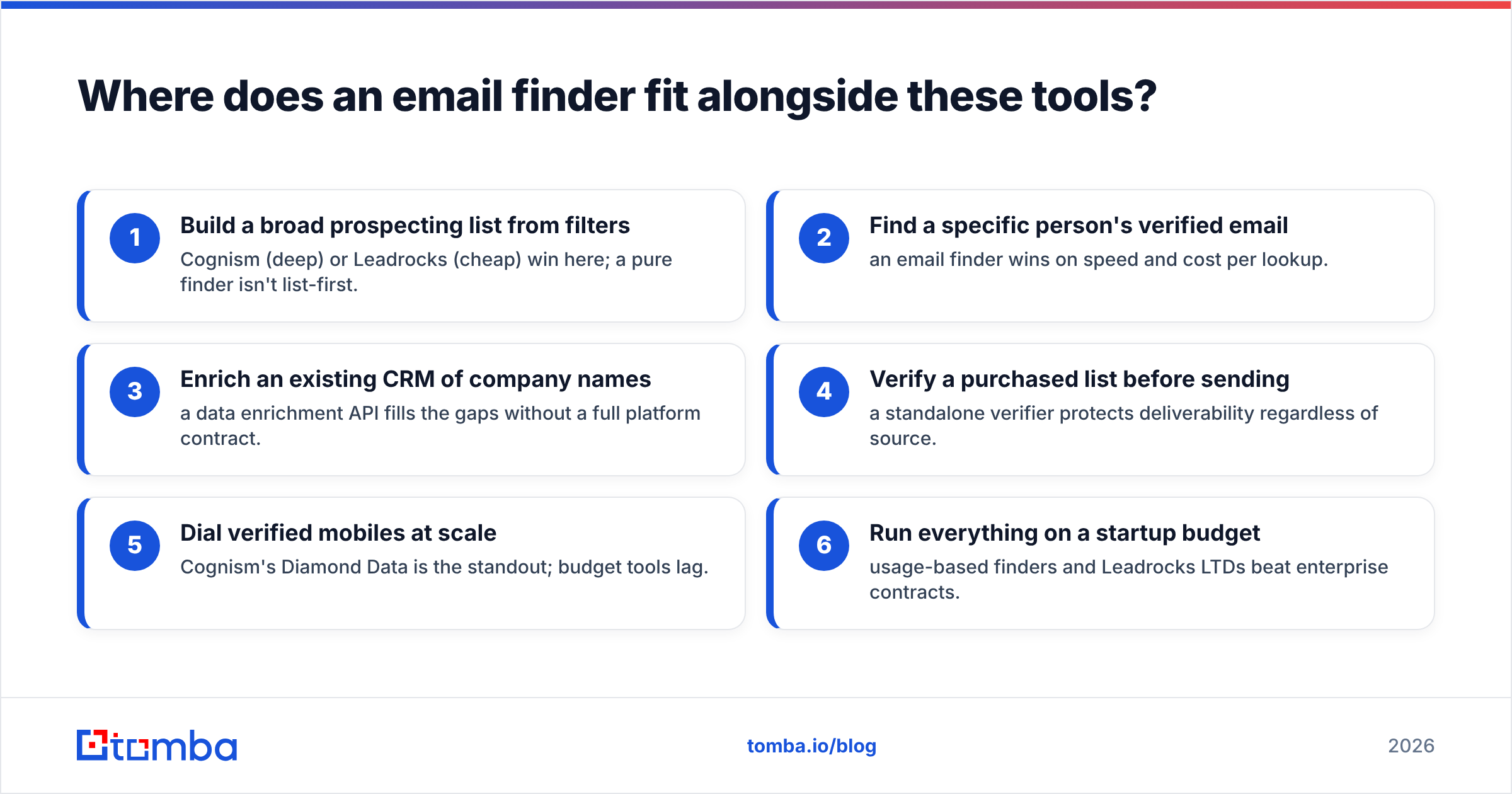
Here's how the three approaches line up on the jobs teams actually hire them for:
- Build a broad prospecting list from filters — Cognism (deep) or Leadrocks (cheap) win here; a pure finder isn't list-first.
- Find a specific person's verified email — an email finder wins on speed and cost per lookup.
- Enrich an existing CRM of company names — a data enrichment API fills the gaps without a full platform contract.
- Verify a purchased list before sending — a standalone verifier protects deliverability regardless of source.
- Dial verified mobiles at scale — Cognism's Diamond Data is the standout; budget tools lag.
- Run everything on a startup budget — usage-based finders and Leadrocks LTDs beat enterprise contracts.
Most teams end up combining two of these, not betting everything on one platform.
Which should you choose in 2026?#
Match the tool to your motion, not the hype.
Pick Cognism if: you're a funded mid-market or enterprise team, you sell into Europe, phone connects drive your pipeline, and compliance sign-off matters to legal. The contract is real money, but so is the verified mobile data — and G2 reviewers consistently rate that data as the reason they renew.
Pick Leadrocks if: you're a founder or small team who wants a usable B2B list without a subscription, you're comfortable cleaning exports yourself, and a one-time payment fits your cash flow better than a monthly bill.
Pick a usage-based email finder if: your workflow is account-based, you want accurate emails and phones without buying a whole database, and you'd rather pay for what you use. You can start on Tomba's free tier and scale only when your outbound does — and pair it with a domain search to pull every contact at a target company.
The honest answer for many teams is a stack, not a single winner: a database for breadth, a finder-and-verifier layer for precision and hygiene. The two solve different halves of the pipeline problem.
Frequently asked questions#
Is Leadrocks a real alternative to Cognism? For budget-conscious small teams, partly — Leadrocks covers the "cheap B2B list" job. But it doesn't replace Cognism's verified phone data, intent signals, or compliance tooling. They compete on price, not on depth.
Does Cognism offer a free trial? No self-serve free trial. Cognism is demo-and-quote only, which is standard for enterprise sales-intelligence platforms.
Can I use an email finder instead of either? If your need is verified emails and phones on demand rather than a giant filtered list, yes. A pay-as-you-go finder like Tomba does that job cheaper, and you can layer verification on top to keep bounce rates down.
Which has better data accuracy? Cognism leads on phone verification. On email, both decay over time, so verify before you send regardless of the source.
The bottom line#
Cognism and Leadrocks aren't really rivals — they're two answers to different budgets. Cognism is the enterprise choice when verified phone data and compliance justify a five-figure contract. Leadrocks is the founder's choice when a cheap, one-time list beats another subscription.
But if what you actually need is accurate, verified contact data on demand — without a procurement cycle or a lifetime-deal gamble — start with the Tomba Email Finder. Find decision-maker emails by name, company, or domain, verify them in the same workflow, and only pay for what you use. Spin up 25 free searches this month and see how far precision beats volume before you commit a dollar to either platform.
Related guides#
Ready to find emails that actually work?
Join 150,000+ professionals who stopped guessing and started sending. Free credits on signup — no credit card required.
Get the Tomba newsletter
Practical outbound tactics and product updates — once every two weeks.
About the author