Cold Calls vs Cold Emails: Which Wins More Deals in 2026?
Cold calls vs cold emails: which channel books more meetings in 2026? A data-backed breakdown of cost, reply rates, scale, and when to blend both for maximum pipeline.
Cold Calls vs Cold Emails: Which Wins More Deals in 2026?
You have a quota, a finite number of hours, and a list of names. Do you pick up the phone or open your sequencer? The cold calls vs cold emails debate gets treated like a religious war, but it is really a resource-allocation question — and the answer changes with your motion, your market, and the quality of your data.
Here is the short version, then the evidence.
TL;DR#
- Cold email wins on scale and cost per touch. One rep can reach 500+ prospects a day; a caller reaches maybe 60–80 dials.
- Cold calling wins on conversation quality and speed to "yes." A connected call gets you an answer — objection, interest, or hang-up — in seconds, not days.
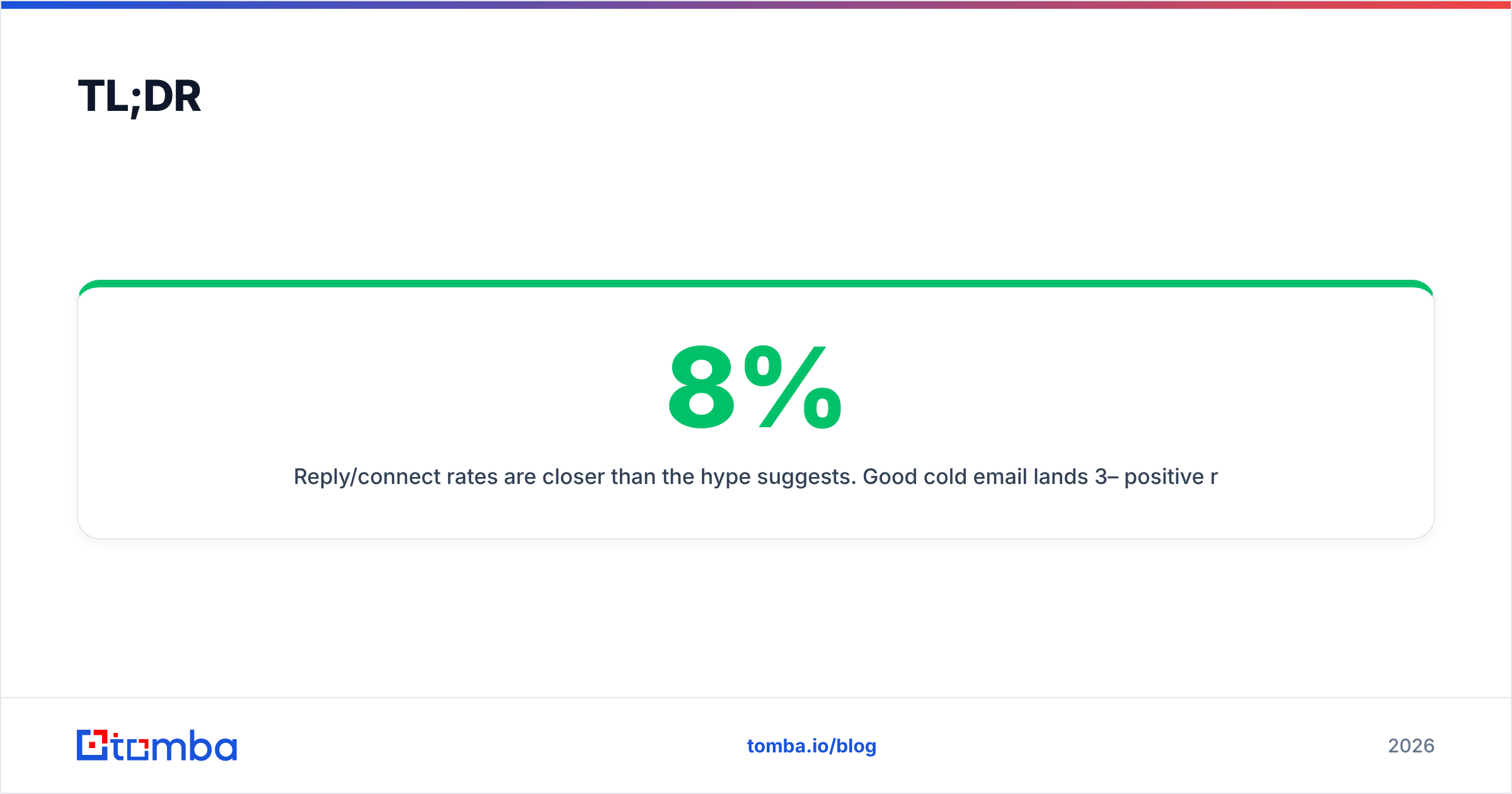
- Reply/connect rates are closer than the hype suggests. Good cold email lands 3–8% positive replies; cold calls connect 5–10% of dials with 1–3% booking meetings.
- The winner is almost always "both, sequenced." Multi-touch plays that combine email, phone, and LinkedIn beat any single channel.
- Data quality decides everything. A verified email and a direct dial turn both channels from spam into pipeline. Bad data sinks both.
What is the real difference between cold calls and cold emails?#
Think of cold email as fishing with a net and cold calling as fishing with a spear. The net covers water you could never reach by hand — but you catch whatever swims in, and a lot slips through. The spear demands you be in exactly the right spot at the right moment, and when you connect, you land the fish immediately.
Cold email is asynchronous and scalable. You write once, personalize with variables, and send to hundreds. Prospects reply on their schedule. The cost per additional contact is nearly zero, which is why outbound teams lean on it for volume.
Cold calling is synchronous and high-signal. You get tone, hesitation, and real-time objection handling. You cannot "batch" a conversation, so it does not scale the way email does — but a single 4-minute call can accomplish what an 8-email thread never will.
Both start from the same raw material: an accurate name, company, role, and a way to reach the person. That is where most outbound quietly fails — not on the script or the subject line, but on the contact data underneath.
Which channel has better response rates?#
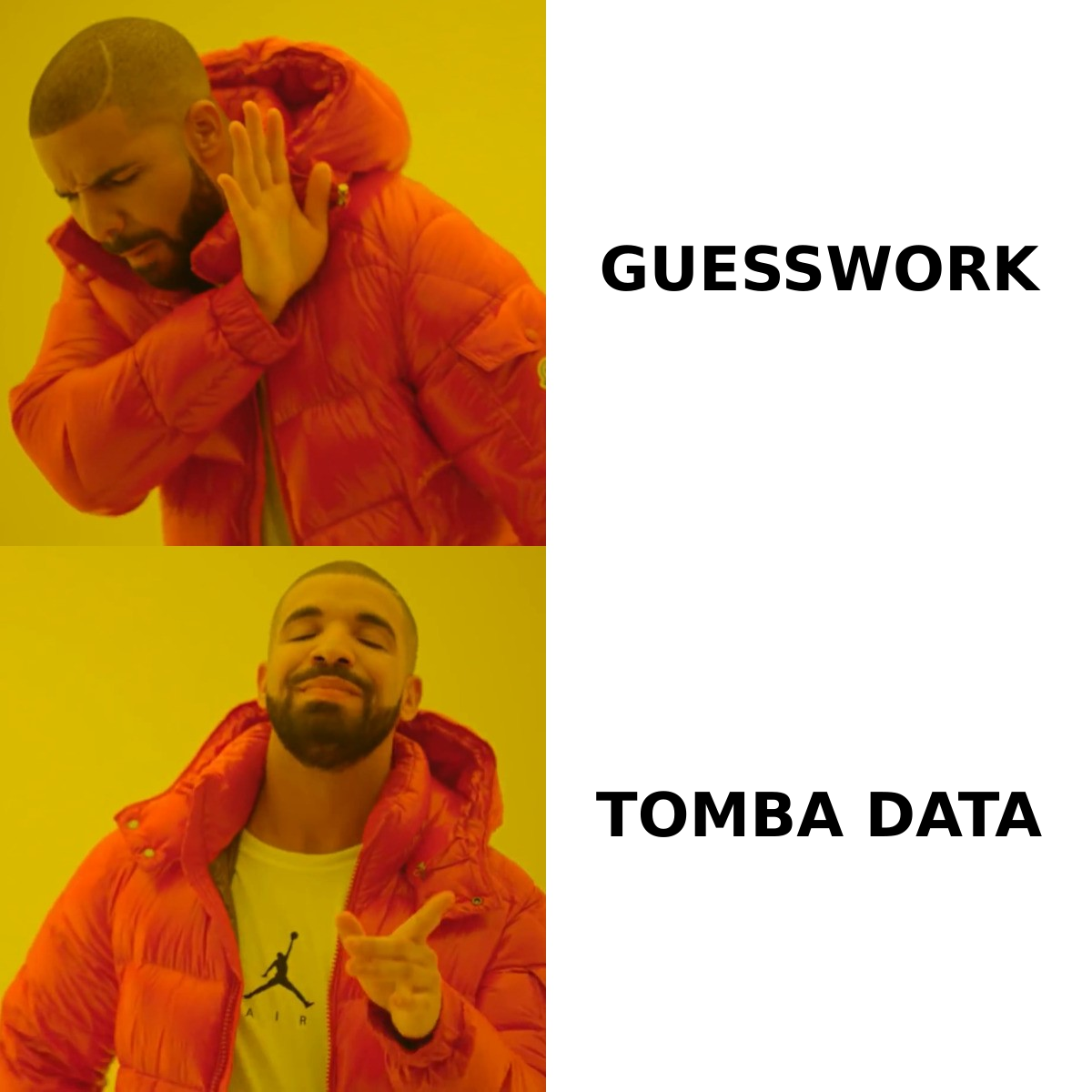
Neither channel has a single "true" number — rates swing wildly with list quality, targeting, and offer. But here are defensible 2026 benchmarks for well-run B2B outbound:
| Metric | Cold Email | Cold Calling |
|---|---|---|
| Touches per rep/day | 300–600 | 50–80 dials |
| Connect / open rate | 35–55% open | 5–12% connect |
| Positive reply / interest | 3–8% | 1–3% meetings booked |
| Cost per meeting | Low ($) | Higher ($$) |
| Time to a clear answer | Days | Seconds |
| Personalization ceiling | High (research + variables) | Highest (live) |
| Best for | Volume, top-of-funnel | Enterprise, high ACV |
Read that table carefully: cold email produces more raw pipeline per hour because of sheer volume, while cold calling produces higher-intent conversations per contact. According to HubSpot's sales research, a large share of buyers still prefer email for first contact — but decision-makers at high-value accounts are far more likely to engage on a call once a relationship starts.
The mistake is comparing the two on a single metric. A 4% email reply rate and a 2% call-to-meeting rate are not competitors; they are two funnels you can run in parallel off the same list.
Is cold calling dead in 2026?#
No — but "smile and dial" through a bad list is dead. What changed is the cost of being wrong. Buyers screen unknown numbers aggressively, and a wasted dial burns more rep time than a wasted email ever could.
Modern cold calling works when three things are true:
- The number is a direct dial, not a gatekeeper switchboard. Reaching a receptionist is not "connecting."
- You have a reason to call this person now — a trigger event, a role change, a funding round.
- The call is one touch in a sequence, not a cold open with no prior context.
That last point matters. A prospect who has seen two of your emails and a LinkedIn view is not truly "cold" when you call — they half-recognize your name, and connect-to-conversation rates climb accordingly. This is why teams that pull accurate B2B phone numbers and pair them with email sequences outperform pure dialers. The phone is not the problem; disconnected, gatekept, or wrong numbers are.
Is cold email better for scale?#
Yes, and it is not close on pure volume. This is the channel's structural advantage: marginal cost per contact approaches zero. Once your infrastructure is set up, sending to your 400th prospect costs the same effort as your 40th.
But scale is a trap without three guardrails:
- Deliverability. Blast a cold list from an unwarmed domain and you land in spam, not inboxes. Sender reputation, SPF/DKIM alignment, and gradual volume ramp decide whether your email is even seen. Review email deliverability fundamentals before you scale a single campaign.
- List hygiene. Sending to invalid or catch-all addresses spikes your bounce rate and tanks your domain reputation. Run every address through an email verifier first — a 2% bounce ceiling is the difference between the inbox and the blocklist.
- Personalization at volume. "Hi {{first_name}}" is not personalization. Reference the company, the role, a specific pain. This is where accurate enrichment data pays off.
Get those right and cold email becomes the highest-leverage prospecting activity a rep owns. Get them wrong and you are scaling your way onto a blocklist.
Cold calls vs cold emails: which is cheaper?#
Cold email wins on cost per touch, but total cost of ownership is closer than it looks.
Cold email costs are mostly tooling and data: a sequencer, inbox/domain infrastructure, warmup, and an email-finding plus verification budget. A rep can run hundreds of touches a day, so cost per contact is low. The hidden cost is domain risk — one bad campaign can force you to rebuild sender reputation for weeks.
Cold calling costs are mostly time and telephony: a dialer, direct-dial data, and — the big one — rep hours. If a rep makes 70 dials to book 1–2 meetings, that is a full afternoon per meeting. At loaded SDR salaries, calling is the more expensive channel per meeting in most funnels.
The lever that moves both numbers is data accuracy. Every dial to a wrong number and every email to a dead address is pure waste. Cheap or scraped lists feel free until you price in the rep hours they burn. This is why teams increasingly centralize sourcing through a single verified pipeline — find, verify, and enrich in one pass, then split the output across phone and email. See how Tomba pricing structures find-plus-verify credits so you are not paying twice for the same contact.
When should you use cold calling vs cold email?#
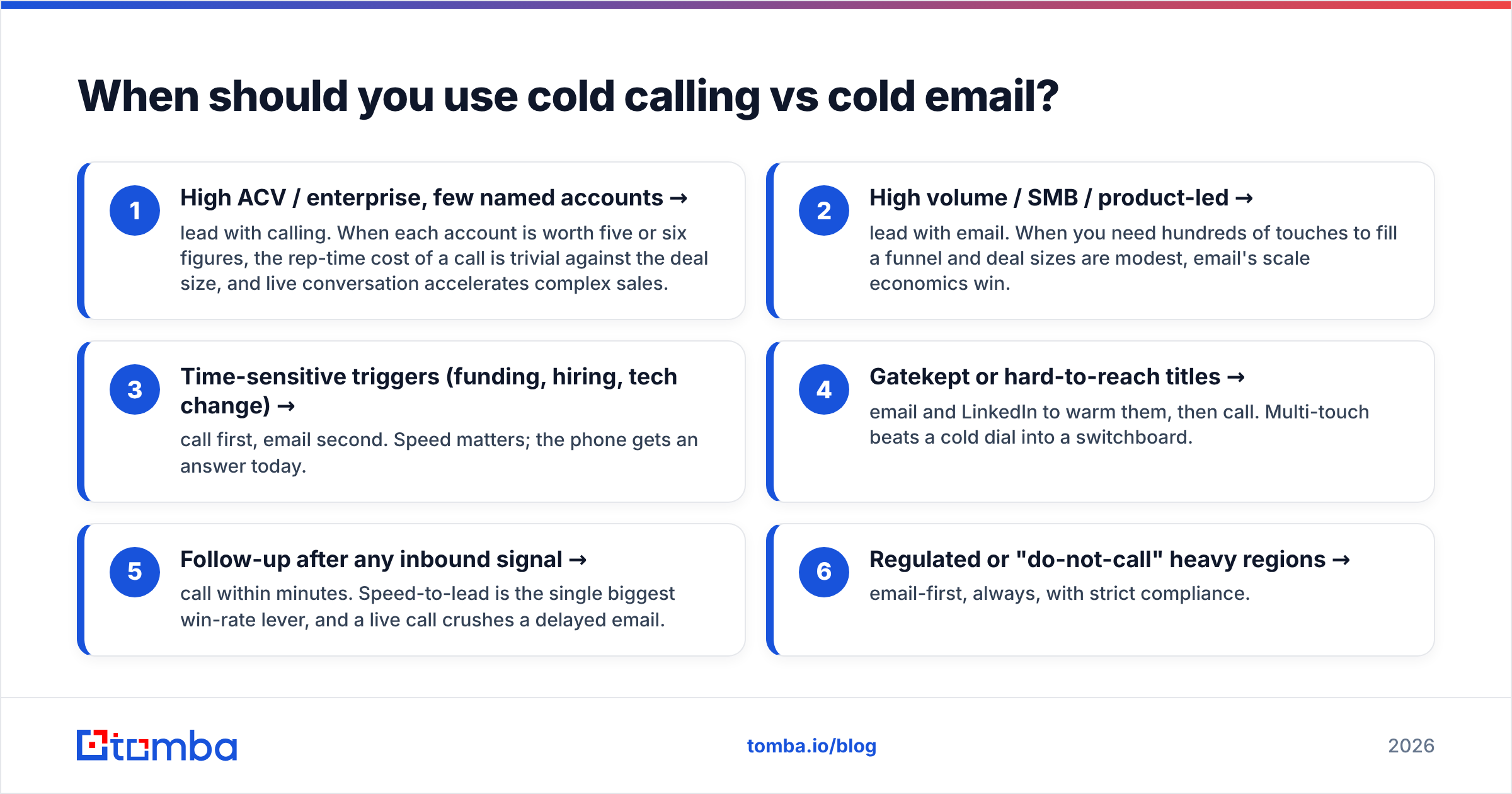
Match the channel to the deal, not to your personal preference. Here is a practical decision framework:
- High ACV / enterprise, few named accounts → lead with calling. When each account is worth five or six figures, the rep-time cost of a call is trivial against the deal size, and live conversation accelerates complex sales.
- High volume / SMB / product-led → lead with email. When you need hundreds of touches to fill a funnel and deal sizes are modest, email's scale economics win.
- Time-sensitive triggers (funding, hiring, tech change) → call first, email second. Speed matters; the phone gets an answer today.
- Gatekept or hard-to-reach titles → email and LinkedIn to warm them, then call. Multi-touch beats a cold dial into a switchboard.
- Follow-up after any inbound signal → call within minutes. Speed-to-lead is the single biggest win-rate lever, and a live call crushes a delayed email.
- Regulated or "do-not-call" heavy regions → email-first, always, with strict compliance.
Notice how many of these say "and," not "or." That is the point.
How do you combine both channels for the best results?#
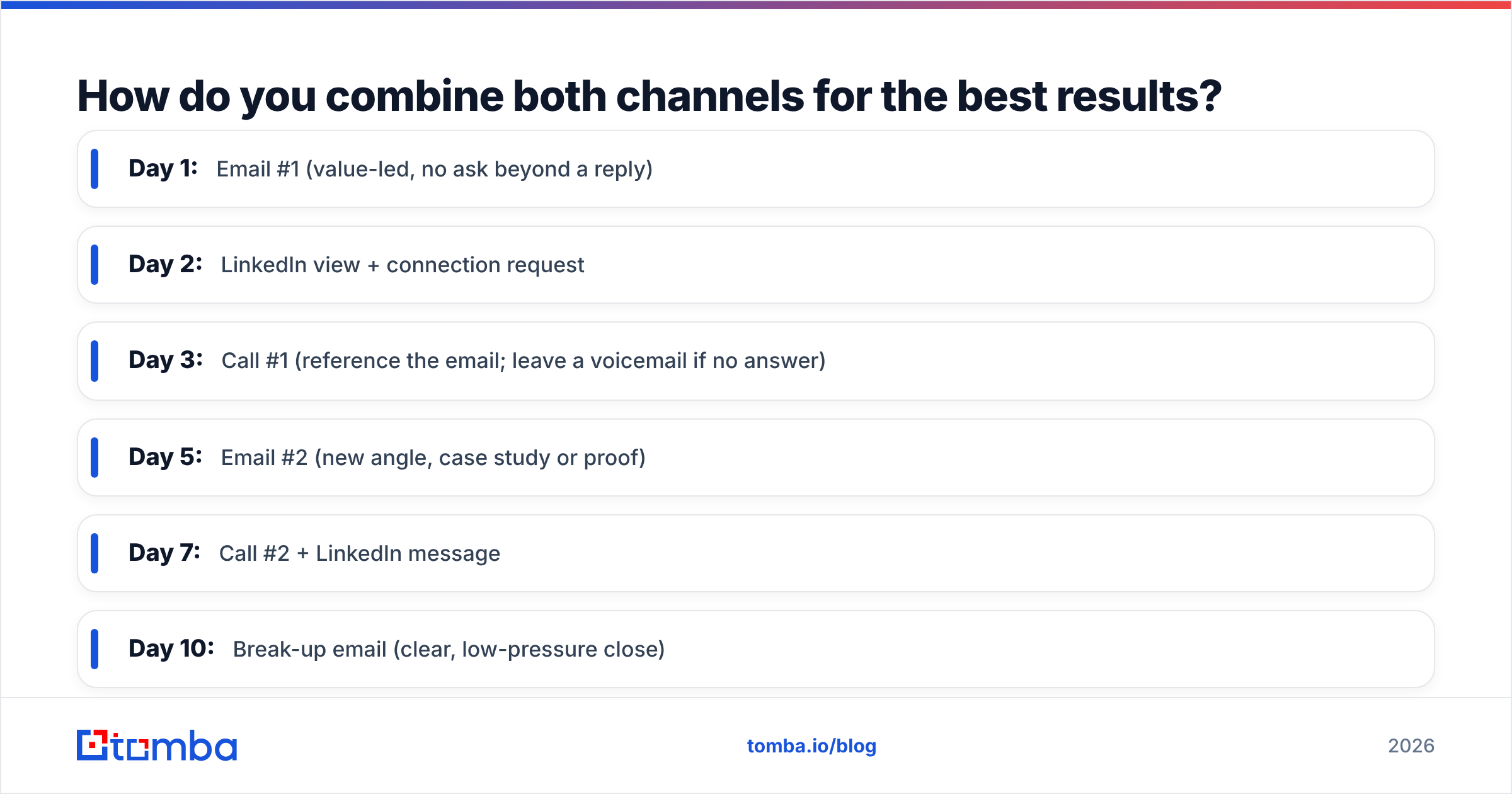
Stop treating this as cold calls vs cold emails and start treating it as one orchestrated sequence. The highest-performing outbound cadences interleave channels so each touch reinforces the last. A proven 10-business-day play:
- Day 1: Email #1 (value-led, no ask beyond a reply)
- Day 2: LinkedIn view + connection request
- Day 3: Call #1 (reference the email; leave a voicemail if no answer)
- Day 5: Email #2 (new angle, case study or proof)
- Day 7: Call #2 + LinkedIn message
- Day 10: Break-up email (clear, low-pressure close)
By Day 3, the prospect has seen your name three times, so the call is not truly cold. By Day 10, you have touched them across three channels without being annoying on any single one. Salesforce's outbound guidance echoes this: multi-channel sequences consistently outperform single-channel outreach on reply and meeting rates.
The engine underneath every step is the same contact record. Pull the verified email and the direct dial together, enrich with role and company context, and feed that one record into every touch. When your data is unified, blending channels costs almost nothing extra — the same data enrichment pass that powers your email variables also gives your caller the context to open strong.
What do the channels have in common?#
Both cold calls and cold emails live or die on the same three inputs, which is exactly why the "vs" framing misleads people:
- Accuracy of contact data. A perfect script and a perfect subject line are worthless aimed at the wrong person or a dead address. Verified emails and direct dials are the non-negotiable foundation.
- Relevance of the message. Whether spoken or written, the touch has to answer "why me, why now?" Generic outreach fails on every channel.
- Persistence across touches. Most replies and connects come after the first attempt. Single-touch outreach — one email, one dial — leaves the majority of pipeline on the table.
Fix the data, sharpen the relevance, and stay persistent, and both channels perform. Neglect any of the three, and no channel choice will save you.
The verdict: which wins?#
The honest answer to cold calls vs cold emails is that the channel loses the argument to the data underneath it. Ranked by pure efficiency for most B2B teams in 2026:
- Best for pipeline volume and cost: cold email — provided deliverability and list hygiene are handled.
- Best for high-value, complex deals: cold calling — provided you have direct dials and a reason to call.
- Best overall win rate: a sequenced blend of both, run off one verified contact record.
If you are forced to pick one to start, start with email for scale — then layer calling onto your most promising accounts. But the teams beating their number are not picking; they are orchestrating.
Build the foundation both channels need#
Whichever channel you favor, it runs on accurate contact data — and that is the part you control before you write a single word or make a single dial. Use the Tomba Email Finder to source verified professional emails by name, domain, or company, pull matching direct dials, and enrich each record with the role and company context that makes both your emails and your calls land. Start on the free tier (25 searches a month), and scale to Starter at $49/mo once the pipeline proves out. Fix the data first, and the cold calls vs cold emails debate stops mattering — because both start working.
Related guides#
// get started
Find, verify and enrich your first contacts today
Start on the free plan with 25 searches a month, then scale when your team is ready.
Free plan · No credit card required · GDPR & CCPA
// about the author