Cold Email Outreach Alternative: 7 Channels Worth Testing
Cold email still works, but it is no longer the only door. Here are seven cold email outreach alternatives ranked by reply rate, cost per touch, and how fast they produce a real meeting.
TL;DR
- Cold email is not dead, but a single-channel cold email motion is fragile. Google and Microsoft's 2024 bulk-sender rules made inbox placement a permanent tax on volume.
- The seven real alternatives: LinkedIn outreach, cold calling, warm intros, website visitor identification, community-led outbound, direct mail, and paid retargeting to a known-contact list.
- No channel beats email on cost per touch. Several beat it on reply rate — cold calling (4–6% connect-to-meeting) and warm intros (30%+ reply) lead.
- Every alternative still runs on the same input: accurate contact data. Swapping channels does not save you from a bad list.
- The realistic answer for most teams is not "replace email" — it is "stop making email carry 100% of the load."
Why are you looking for a cold email outreach alternative?#
Because the reply rate chart went down and to the right, and nobody on your team can explain why.
Here is the honest diagnosis. In most cases the channel is not broken — the operating conditions changed. Since February 2024, Google and Yahoo enforce bulk-sender requirements: authenticated domains, one-click unsubscribe, and a spam-complaint rate under 0.3%. Microsoft followed with similar thresholds for Outlook. What used to be a volume game became a reputation game overnight.
That means the teams complaining loudest about cold email are usually the ones who never adjusted. They kept the same 3,000-sends-a-week cadence and watched placement collapse. Meanwhile, disciplined senders with clean lists and warmed domains report roughly the same 1–5% reply rates they got in 2021.
So the useful question is not "what replaces cold email?" It is "which channels earn a place next to it, and what do they actually cost?"
What are the real cold email outreach alternatives?#
Seven, and each one solves a different failure mode.
- LinkedIn outreach — Connection requests, InMail, and engagement-first DMs. Solves the deliverability problem entirely because there is no inbox provider to appease. Costs you a Sales Navigator seat and hard weekly limits (roughly 100–200 connection requests per week before LinkedIn throttles you).
- Cold calling — Still the highest-intent channel per touch. Solves the "did they even see it?" problem. Costs you the most expensive input in the building: rep hours.
- Warm introductions — Asking a mutual connection to broker the conversation. Highest reply rate of anything on this list. Does not scale, and the ask itself burns social capital.
- Website visitor identification — De-anonymizing companies that already visited your pricing page, then reaching out. Solves the timing problem: these people are already in-market.
- Community-led outbound — Showing up in Slack groups, subreddits, and industry forums where your buyer already argues about the problem. Slow, compounding, and nearly unbeatable on trust.
- Direct mail — Physical packages to a tight list of named accounts. Absurd cost per touch ($20–$150) and a response rate that occasionally justifies it for enterprise deals.
- Paid retargeting on a known-contact list — Uploading matched contacts to LinkedIn or Meta and running ads so your name is familiar before any human touch. Not outreach; a multiplier on outreach.
Notice what none of these do: none of them let you skip building an accurate contact list. LinkedIn outreach needs the right profile. Cold calling needs a mobile number that connects. Retargeting needs a matchable email. The list is upstream of every channel.
How do the channels actually compare?#
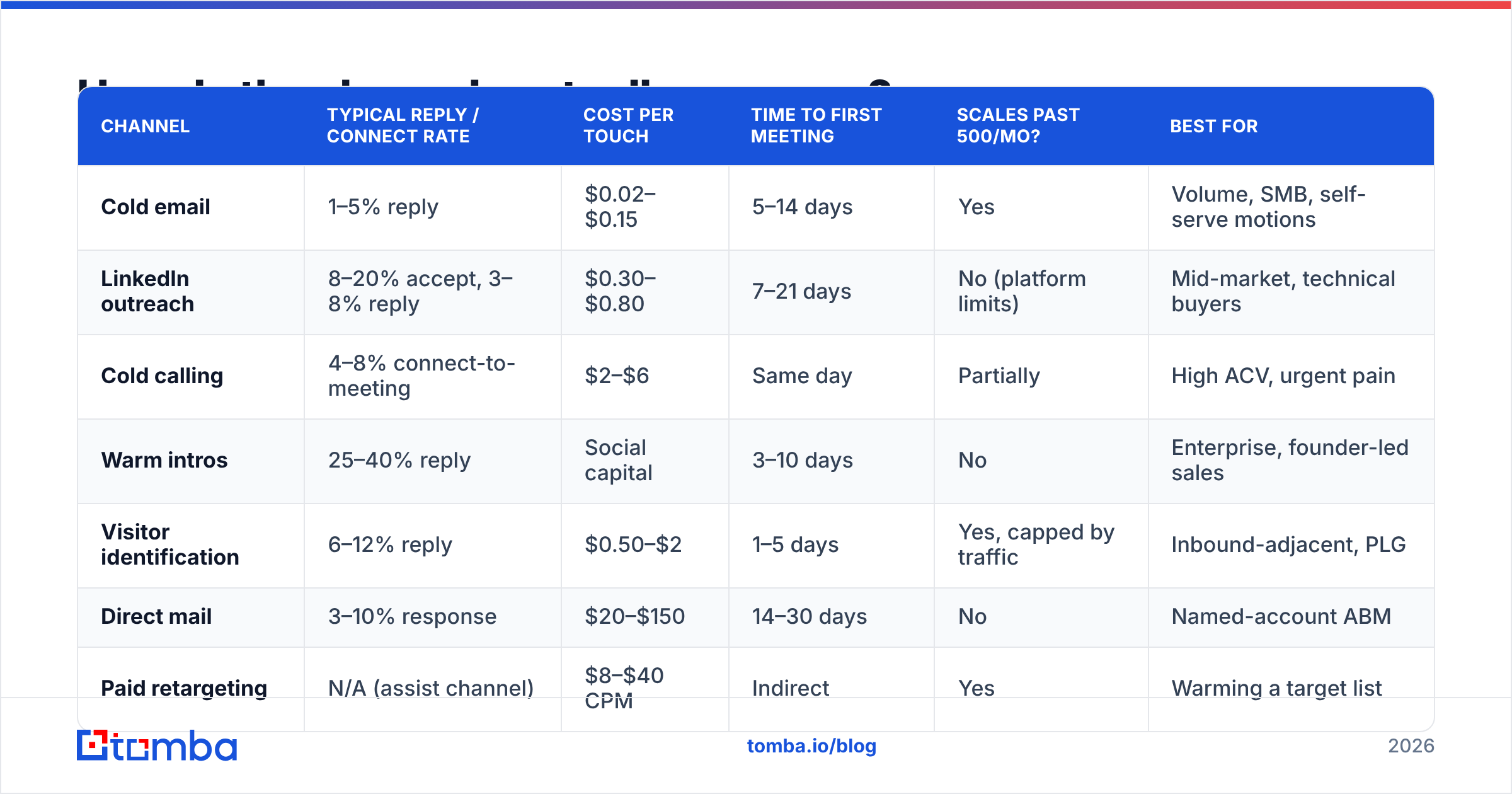
Here is the comparison most vendor blogs will not publish, because it does not flatter any single tool.
| Channel | Typical reply / connect rate | Cost per touch | Time to first meeting | Scales past 500/mo? | Best for |
|---|---|---|---|---|---|
| Cold email | 1–5% reply | $0.02–$0.15 | 5–14 days | Yes | Volume, SMB, self-serve motions |
| LinkedIn outreach | 8–20% accept, 3–8% reply | $0.30–$0.80 | 7–21 days | No (platform limits) | Mid-market, technical buyers |
| Cold calling | 4–8% connect-to-meeting | $2–$6 | Same day | Partially | High ACV, urgent pain |
| Warm intros | 25–40% reply | Social capital | 3–10 days | No | Enterprise, founder-led sales |
| Visitor identification | 6–12% reply | $0.50–$2 | 1–5 days | Yes, capped by traffic | Inbound-adjacent, PLG |
| Direct mail | 3–10% response | $20–$150 | 14–30 days | No | Named-account ABM |
| Paid retargeting | N/A (assist channel) | $8–$40 CPM | Indirect | Yes | Warming a target list |
Read the "cost per touch" column twice. Cold email is 20× cheaper than LinkedIn and 100× cheaper than a call. That is why it refuses to die. A 2% reply rate at $0.05 a touch produces cheaper meetings than a 6% reply rate at $4 a touch — the math is not close.
The alternatives win on different axes: speed (calling, visitor ID), trust (warm intros, community), and reachability (LinkedIn, when the inbox is a dead end).
Is LinkedIn outreach actually better than cold email?#
It is better at getting seen and worse at getting scale. Both things are true.
LinkedIn's advantage is structural: there is no spam filter deciding whether your message lands. If you send it, it arrives. Acceptance rates on connection requests to well-targeted profiles run 8–20%, and a message sent to an accepted connection is read at rates the inbox cannot approach.
The ceiling is the problem. LinkedIn's own guidance plus observed enforcement puts a practical cap around 100–200 connection requests per week per seat before restrictions kick in. Ten seats gets you maybe 2,000 touches a month. A single warmed email domain does that in a week.
The teams getting real results run both. They find a contact's work email, verify it, and simultaneously locate the matching LinkedIn profile so the sequence can alternate: connection request on day 1, email on day 3, LinkedIn message on day 6, call on day 9. If you are stitching that together, a LinkedIn finder that maps profiles to verified work emails removes the manual copy-paste step that kills most multichannel experiments before week three.
One caution: automation tools that log into LinkedIn on your behalf are against the platform's user agreement. Account restrictions are real and recovery is slow. Treat LinkedIn as a manual-effort channel with tooling that prepares the data, not tooling that pretends to be you.
Does cold calling still work in 2026?#
Yes, and the data is less depressing than the discourse.
HubSpot's sales research has consistently found that a majority of buyers accept calls from new vendors, and connect rates in the 4–8% range translate to a meeting when the rep has a reason to call. The reason matters more than the script. "I saw your team posted three SDR roles this month" outperforms "I wanted to see if you're the right person" by a margin that makes the channel viable.
The bottleneck is not willingness. It is phone numbers. Direct dials are the single most decayed data type in B2B — people change roles, companies switch VoIP providers, and mobile numbers are the hardest field to source legally. A rep dialing a switchboard is a rep wasting an afternoon.
If you are standing up a calling motion as a cold email outreach alternative, budget for two things: a direct-dial data source such as a phone finder, and a validation pass before the list hits the dialer. Bad numbers do not just waste time — high invalid-number rates can flag your outbound caller ID for spam labeling on carrier networks, which is the telephony equivalent of a blocked domain.
Calling also pairs badly with high volume and beautifully with high value. Below roughly $15k ACV, the rep-hour math stops working. Above it, calling is often the fastest path to a first meeting on this entire list.
What about website visitor identification and warm intros?#
These two are the highest-conversion plays available, and both are supply-constrained.
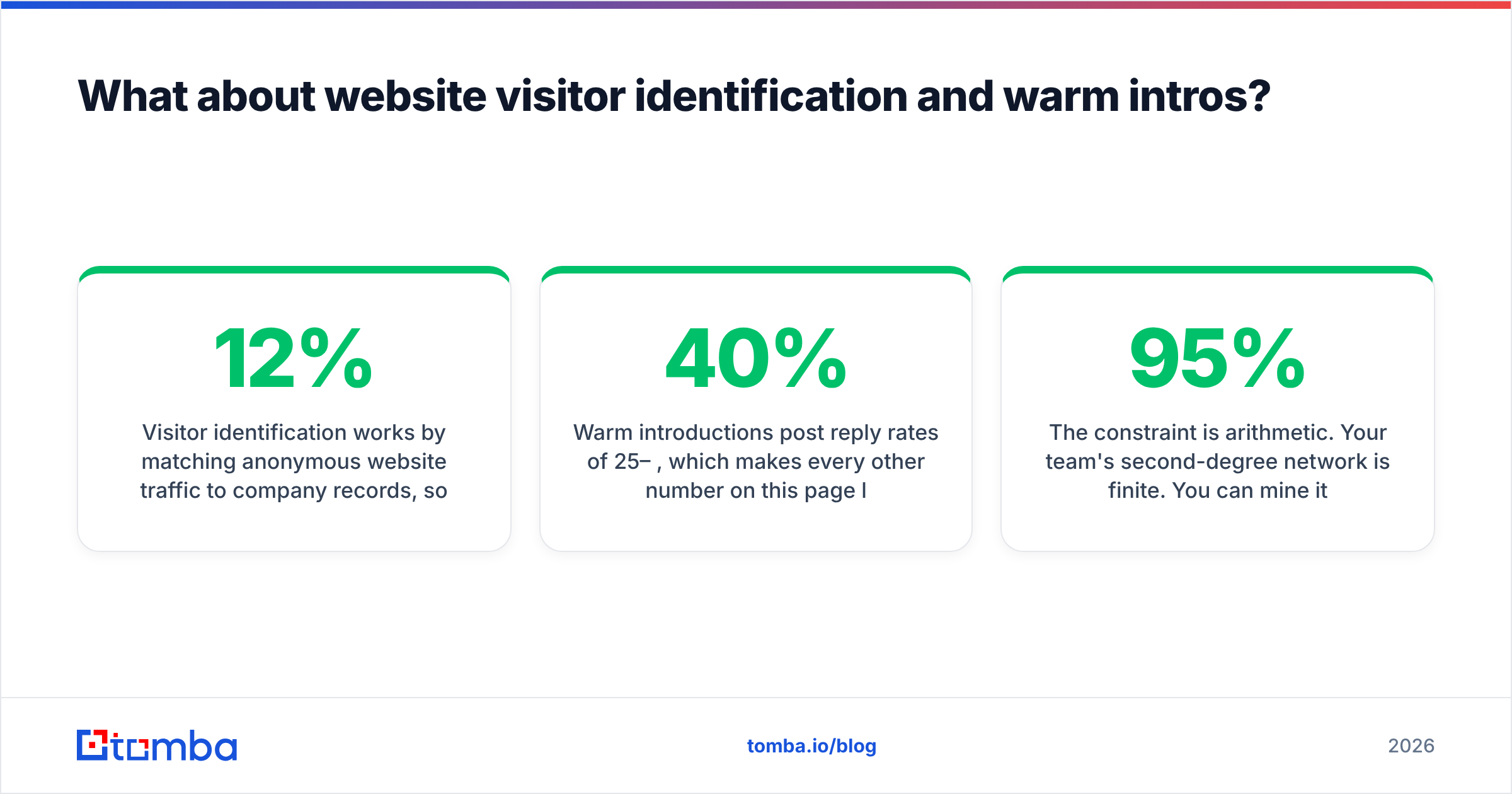
Visitor identification works by matching anonymous website traffic to company records, so you can reach out to accounts that already showed intent. Someone who read your pricing page twice this week is a fundamentally different prospect from a name pulled off a job title filter. Reply rates in the 6–12% range are common because the timing is right, not because the copy is better.
The constraint is obvious: you can only identify visitors you already have. If your site gets 800 visits a month, visitor identification gives you a very good list of maybe 60 companies — not a pipeline strategy on its own. It is a force multiplier on whatever demand you are already generating.
Warm introductions post reply rates of 25–40%, which makes every other number on this page look sad. Gartner's research on B2B buying repeatedly finds that buyer trust in a vendor is largely established before the first sales conversation, and a trusted intermediary short-circuits that entirely.
The constraint is arithmetic. Your team's second-degree network is finite. You can mine it — export connections, cross-reference against your ICP, and ask for five intros a month — but you cannot manufacture more of it this quarter. Treat warm intros as the first pass on any target account list and cold channels as the fallback for the 95% where no path exists.
Which alternative fits your motion?#
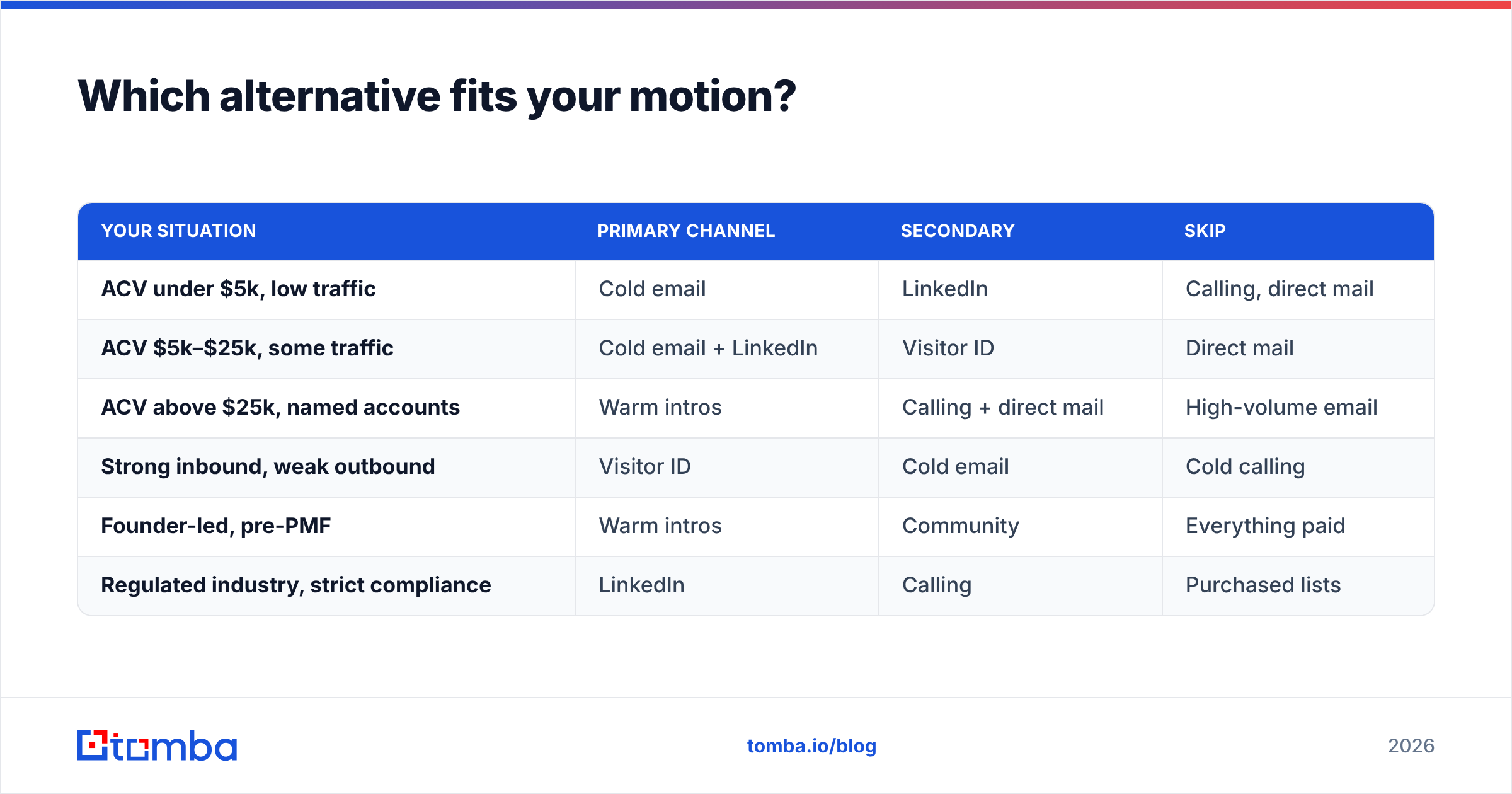
Pick by average contract value and traffic, not by what sounds fresh on LinkedIn.
| Your situation | Primary channel | Secondary | Skip |
|---|---|---|---|
| ACV under $5k, low traffic | Cold email | Calling, direct mail | |
| ACV $5k–$25k, some traffic | Cold email + LinkedIn | Visitor ID | Direct mail |
| ACV above $25k, named accounts | Warm intros | Calling + direct mail | High-volume email |
| Strong inbound, weak outbound | Visitor ID | Cold email | Cold calling |
| Founder-led, pre-PMF | Warm intros | Community | Everything paid |
| Regulated industry, strict compliance | Calling | Purchased lists |
Two notes on that last row. In regulated markets and under GDPR, the legal basis for cold email is narrower than most US-based playbooks assume — legitimate interest for B2B contacts in most EU jurisdictions, but with a real obligation to honor opt-outs and document sourcing. LinkedIn sidesteps some of this because the platform mediates consent.
And on data sourcing generally: whether you buy a list from a provider like BookYourData, pull from a self-serve database, or enrich contacts one domain at a time, you own the accuracy problem. A vendor's stated accuracy rate is a claim about their aggregate; your bounce rate is a fact about your segment. Verify before you send, every time. Running a list through an email verifier before a campaign is the cheapest insurance in outbound — a 3% bounce rate is survivable, a 12% bounce rate ends the domain.
How do you run more than one channel without doubling the work?#
Sequence them against a single, shared contact record. That is the whole trick.
The failure pattern is running channels as separate silos: the SDR has a call list, the AE has a LinkedIn list, marketing has an ad audience, and none of the three know the others touched the same person. The prospect experiences it as noise. Your team experiences it as three channels each producing mediocre numbers.
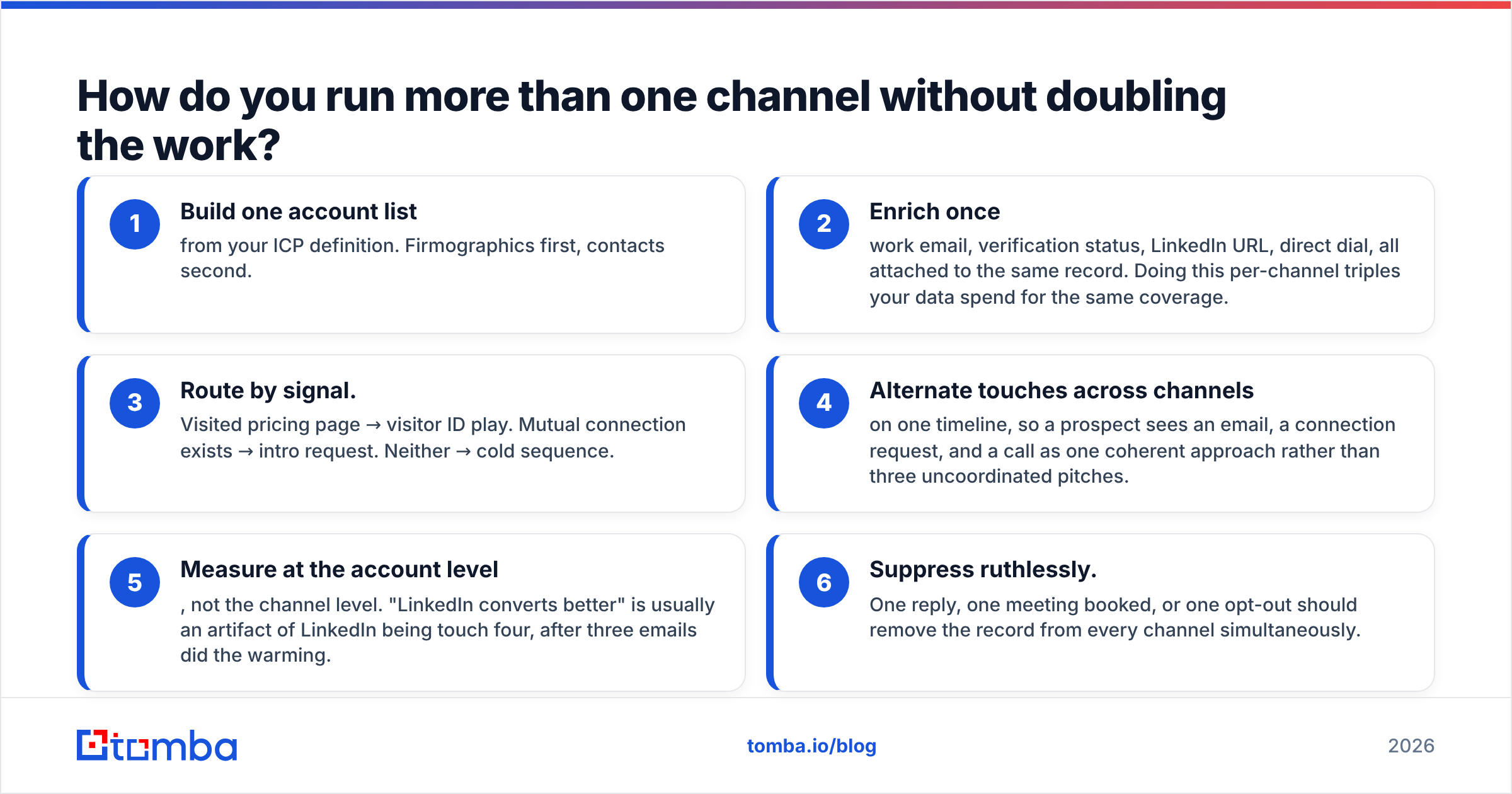
The working pattern:
- Build one account list from your ICP definition. Firmographics first, contacts second.
- Enrich once — work email, verification status, LinkedIn URL, direct dial, all attached to the same record. Doing this per-channel triples your data spend for the same coverage.
- Route by signal. Visited pricing page → visitor ID play. Mutual connection exists → intro request. Neither → cold sequence.
- Alternate touches across channels on one timeline, so a prospect sees an email, a connection request, and a call as one coherent approach rather than three uncoordinated pitches.
- Measure at the account level, not the channel level. "LinkedIn converts better" is usually an artifact of LinkedIn being touch four, after three emails did the warming.
- Suppress ruthlessly. One reply, one meeting booked, or one opt-out should remove the record from every channel simultaneously.
Step two is where most teams quietly lose. If your enrichment covers email but not phone, your calling motion never starts. If it covers phone but not LinkedIn, your multichannel sequence has a hole in it. Consolidating data enrichment into one pass — email, phone, social, company — is the difference between a sequence you can actually run and a spreadsheet with gaps you keep meaning to fill.
So should you replace cold email?#
No. Rebalance it.
Cold email remains the cheapest way to reach a stranger at scale, and the 2024–2025 deliverability rules punished sloppiness, not the channel. The teams that adapted — smaller sends, verified lists, authenticated domains, real personalization — are fine. The teams looking for a cold email outreach alternative because their 5,000-a-week blast stopped working will find that LinkedIn, calling, and direct mail all punish the same behavior, just faster and more expensively.
Add channels for what they uniquely give you: calling for speed, LinkedIn for reachability, warm intros for trust, visitor ID for timing. Keep email as the volume backbone. And fix the input layer first, because every one of these channels degrades in exactly the same way when the contact data underneath it is wrong.
Start with the list. If you need verified work emails to feed any of these seven channels — email, LinkedIn, or the dialer — the Tomba Email Finder covers domain search, name-based lookup, and bulk enrichment, with a free tier of 25 searches a month and paid plans starting at $49/mo. Check the Tomba pricing page for the tier that matches your send volume, and run the free tier against fifty of your current target accounts before you commit to anything. If the coverage holds on your ICP, the channel mix is the easy part.
Related guides#
Ready to find emails that actually work?
Join 150,000+ professionals who stopped guessing and started sending. Free credits on signup — no credit card required.
Get the Tomba newsletter
Practical outbound tactics and product updates — once every two weeks.
About the author