Cold Email vs Spam: The Legal and Practical Difference
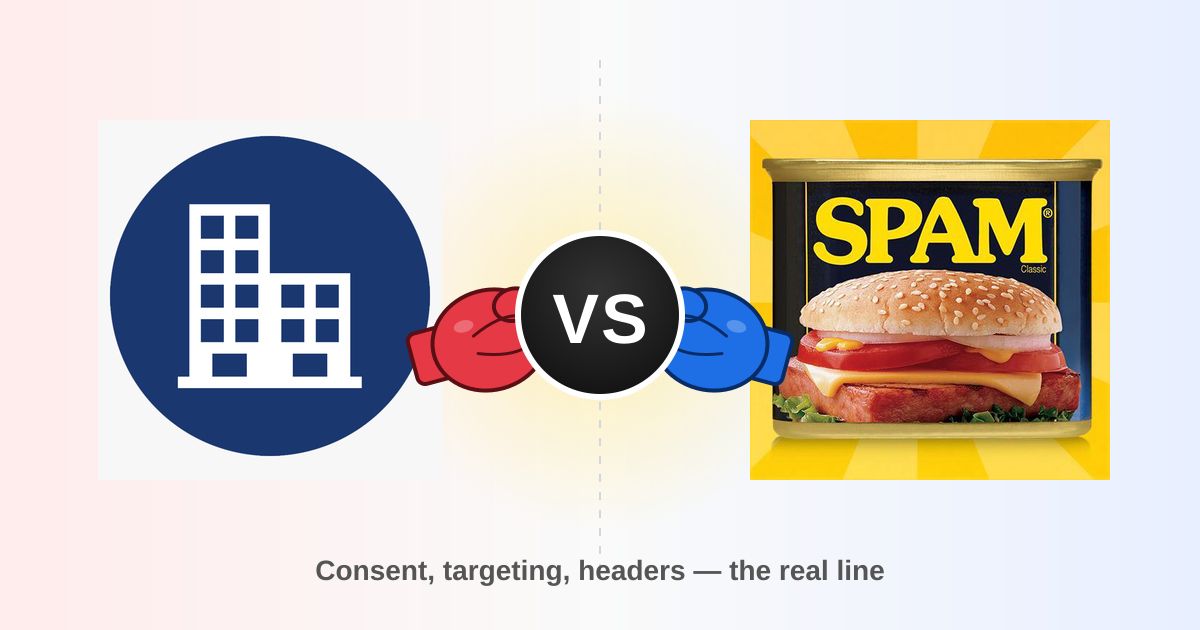
Cold email is legal in most of the world. Spam is not. The difference isn't tone or design — it's consent basis, targeting, and honest headers. Here's exactly where the line sits in 2026.
TL;DR
- Cold email is legal in the US and most of the world. Spam is a legal category defined by deception and non-compliance, not by whether the recipient asked for the message.
- The line is drawn by three things: a lawful basis for contacting the person, whether the message is genuinely relevant to their job, and whether your headers, sender identity, and opt-out are honest.
- Mailbox providers use a different rulebook than regulators. Google and Microsoft don't care about CAN-SPAM. They care about complaint rate, bounce rate, and authentication. You can be perfectly legal and still land in spam.
- GDPR does not ban cold email. It requires a legitimate interest assessment, a real B2B relevance test, and easy opt-out. Consent is only one of six lawful bases.
- The practical test: if you had to explain the message to the recipient's boss, would it sound like research or like a lottery ticket? That's the difference.
Salespeople ask "is cold email spam?" and get two useless answers: a lawyer saying "it depends," or a growth guru saying "just send 5,000 a day." Both are wrong in ways that cost money.
Here's the actual answer. Cold email and spam are not points on a spectrum where you're safe if you stay on the polite end. They're separated by specific, testable conditions — consent basis, targeting rigor, and header honesty. Meet those conditions and you're a legitimate B2B sender. Fail any one of them and you're a spammer, no matter how well-written the email is.
What legally counts as spam?#
Spam has a statutory definition, and it's narrower than most people assume.
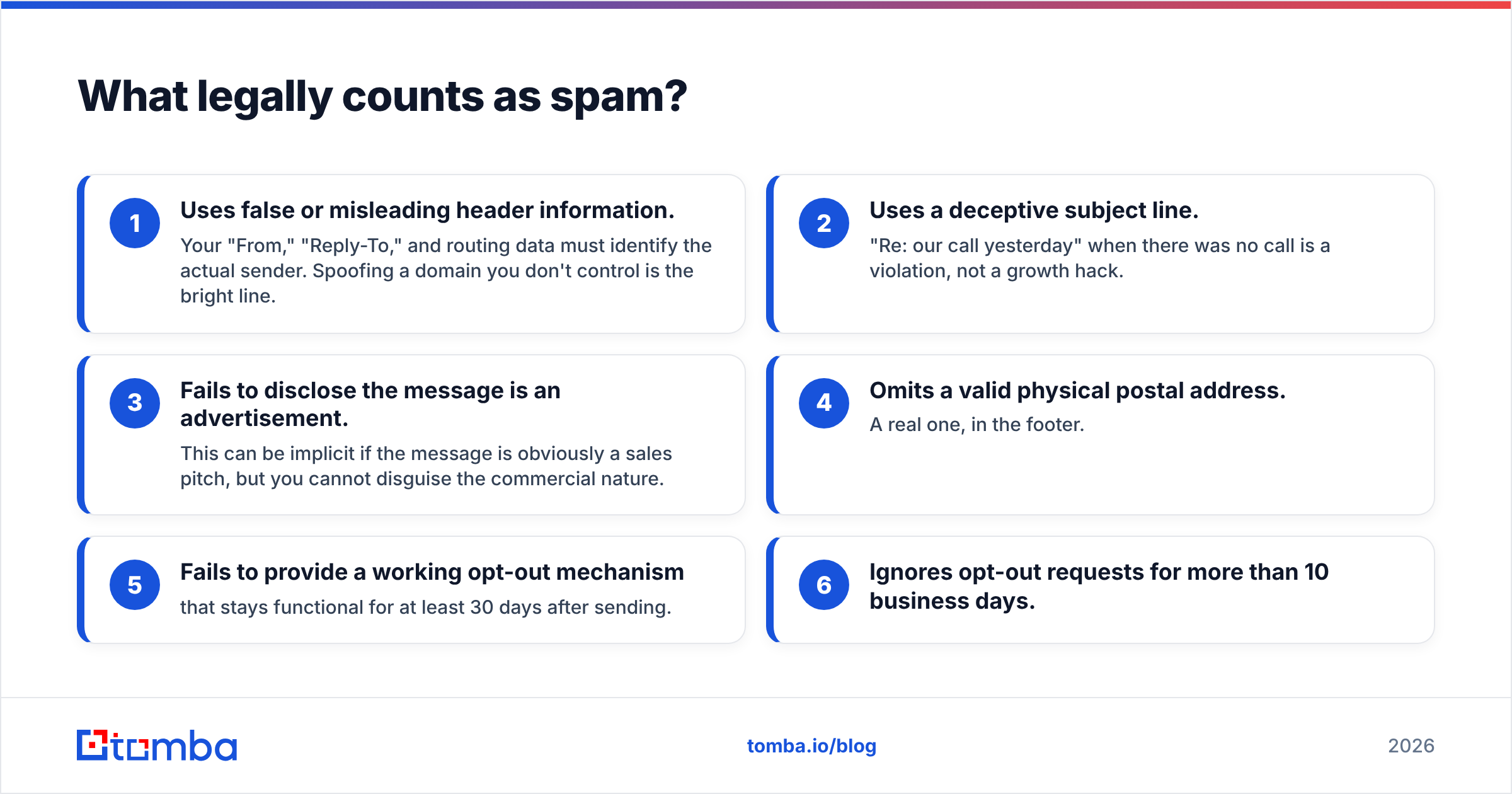
Under the US CAN-SPAM Act, a commercial email becomes unlawful when it does any of the following:
- Uses false or misleading header information. Your "From," "Reply-To," and routing data must identify the actual sender. Spoofing a domain you don't control is the bright line.
- Uses a deceptive subject line. "Re: our call yesterday" when there was no call is a violation, not a growth hack.
- Fails to disclose the message is an advertisement. This can be implicit if the message is obviously a sales pitch, but you cannot disguise the commercial nature.
- Omits a valid physical postal address. A real one, in the footer.
- Fails to provide a working opt-out mechanism that stays functional for at least 30 days after sending.
- Ignores opt-out requests for more than 10 business days.
Notice what is not on that list: prior consent. CAN-SPAM is an opt-out regime. You may email a person who has never heard of you, provided you're honest about who you are and you honor their request to stop. The penalty for getting it wrong is up to $53,088 per email — per email, not per campaign.
Europe works differently but not in the way that panics most SDRs. Under GDPR, processing a business contact's data requires a lawful basis, and Article 6(1)(f) — legitimate interest — is explicitly available for direct marketing. Recital 47 of the GDPR text states plainly that "the processing of personal data for direct marketing purposes may be regarded as carried out for a legitimate interest." What you owe in exchange is a documented balancing test: does your interest in contacting this person outweigh their reasonable expectation of privacy?
For a message sent to a CTO's work address about infrastructure monitoring, the answer is usually yes. For a message sent to a hairdresser's personal Gmail about enterprise SIEM, it is obviously no. The relevance of the message is the legal argument.
How is cold email actually different from spam?#
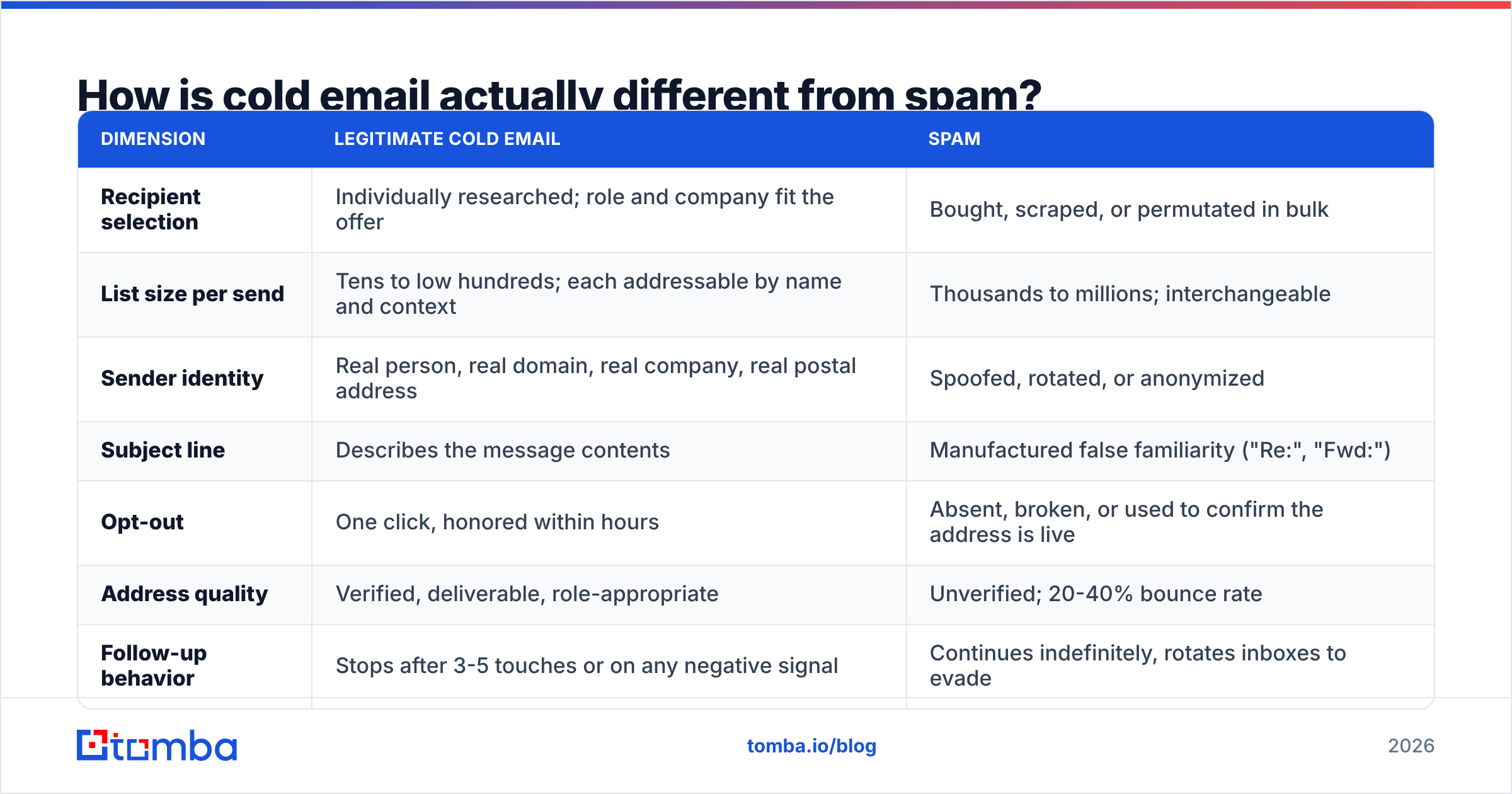
Strip away the vibes and there are six concrete axes.
| Dimension | Legitimate cold email | Spam |
|---|---|---|
| Recipient selection | Individually researched; role and company fit the offer | Bought, scraped, or permutated in bulk |
| List size per send | Tens to low hundreds; each addressable by name and context | Thousands to millions; interchangeable |
| Sender identity | Real person, real domain, real company, real postal address | Spoofed, rotated, or anonymized |
| Subject line | Describes the message contents | Manufactured false familiarity ("Re:", "Fwd:") |
| Opt-out | One click, honored within hours | Absent, broken, or used to confirm the address is live |
| Address quality | Verified, deliverable, role-appropriate | Unverified; 20-40% bounce rate |
| Follow-up behavior | Stops after 3-5 touches or on any negative signal | Continues indefinitely, rotates inboxes to evade |
| What the recipient thinks | "Not right now, but this person did their homework" | "How did they get this?" |
The single most diagnostic row is the first. Spam is a volume business — its economics require that the cost of contacting one more person approaches zero, which means research is impossible by definition. Cold email is a research business. If you cannot say, in one sentence, why this specific person received this specific message, you are running a spam operation with better copywriting.
The second most diagnostic row is address quality. Bought lists carry 20-40% invalid addresses. Spam traps — recycled addresses that mailbox providers repurpose specifically to catch senders who never clean their data — sit inside those lists. Hitting three or four in a week is enough to poison a domain. This is why running addresses through an email verifier before the first send is not a nice-to-have; it's the mechanical difference between a campaign and a domain incident.
Does GDPR ban cold email in Europe?#
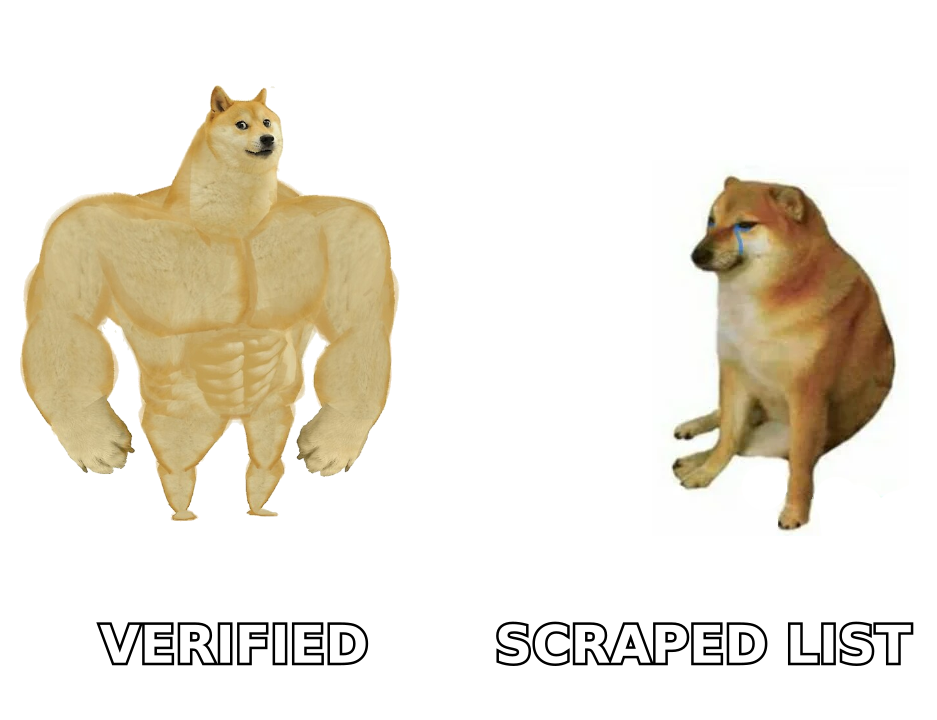
No. This is the single most expensive misconception in B2B outbound, because it causes teams to either abandon a legal channel or to "comply" by doing something worse.
What GDPR requires for cold outreach to EU business contacts:
- A documented lawful basis. Legitimate interest, in practice. Write the assessment down before the campaign, not after the complaint.
- A genuine B2B relevance connection. The person's professional role must plausibly involve the problem you're addressing. Seniority alone is not relevance.
- Transparency at first contact. Say who you are, where you got the contact data, and how to stop hearing from you. "I found your details on your company's engineering blog" is a complete answer.
- Immediate, free, frictionless opt-out. No login. No "reply STOP and we'll process it in 30 days."
- Data minimization. Don't store their birthday because an enrichment vendor threw it in.
Then there's ePrivacy, which sits on top and varies by member state. Germany and Italy are strict — Germany's UWG effectively requires prior consent even for B2B in many readings. Ireland, the Netherlands, and the UK permit B2B cold email to corporate addresses with an opt-out. The UK's PECR explicitly exempts corporate subscribers from the consent requirement that applies to individuals.
The operational conclusion: role-based and corporate addresses are meaningfully safer than personal ones, and country of recipient matters more than country of sender. Segment your EU list by jurisdiction before you send. If that sounds tedious, it is less tedious than a supervisory authority inquiry.
Why do legitimate cold emails still land in spam?#
Because regulators and mailbox providers are running two entirely different tests, and only one of them can put you in the junk folder.
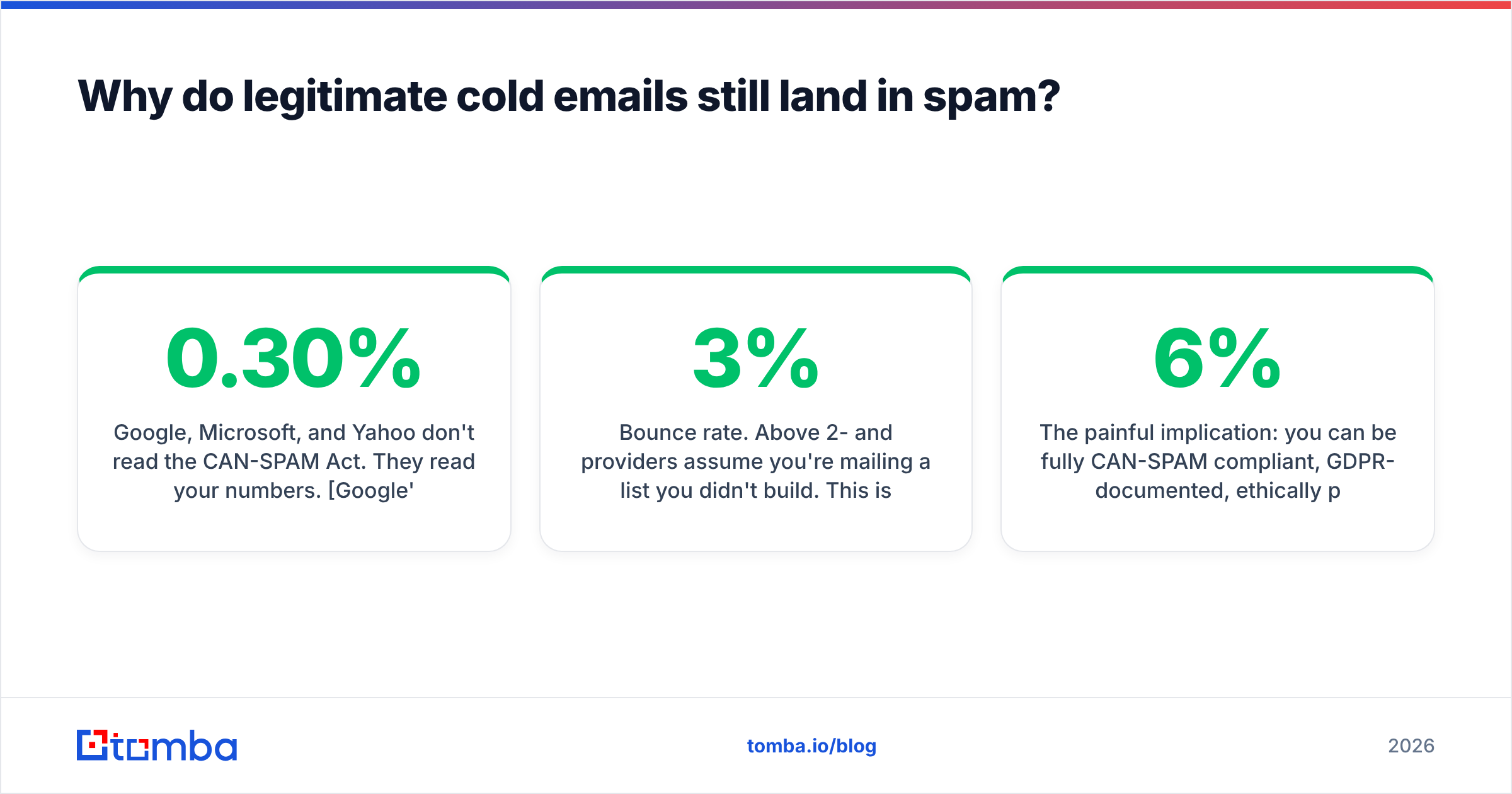
Google, Microsoft, and Yahoo don't read the CAN-SPAM Act. They read your numbers. Google's bulk sender guidelines set the thresholds explicitly: keep spam complaint rate below 0.30% (and ideally under 0.10%), authenticate with SPF, DKIM, and DMARC, and provide one-click unsubscribe if you send more than 5,000 messages a day to Gmail.
Your email deliverability is determined by signals you mostly can't see:
- Complaint rate. The kill shot. One "Report spam" per 350 sends and you're on the wrong side of Google's threshold.
- Bounce rate. Above 2-3% and providers assume you're mailing a list you didn't build. This is entirely fixable before you send.
- Sender reputation. Domain-level and IP-level. Built slowly, destroyed in a week.
- Engagement. Opens are noisy post-MPP, but replies, stars, and moves-out-of-spam are strong positive signals. Deletes-without-open are negative.
- Authentication alignment. SPF pass, DKIM signature on your sending domain, DMARC policy published. Missing any of these in 2026 means filtered by default.
- Content and link patterns. Tracking pixels on a cold first touch, link shorteners, and image-heavy HTML all correlate with spam in provider models — because they correlate with spam in reality.
The painful implication: you can be fully CAN-SPAM compliant, GDPR-documented, ethically pristine — and still sit in the promotions tab because your bounce rate was 6% in week one. Legality buys you the right to send. Reputation buys you the right to be read. Run your copy through a spam checker before launch, but understand that content is maybe 20% of the picture. Data quality is most of the rest.
What does the line look like in practice?#
Take one scenario and run it both ways.
The setup: You sell an observability tool. You want to reach engineering leaders at Series B SaaS companies.
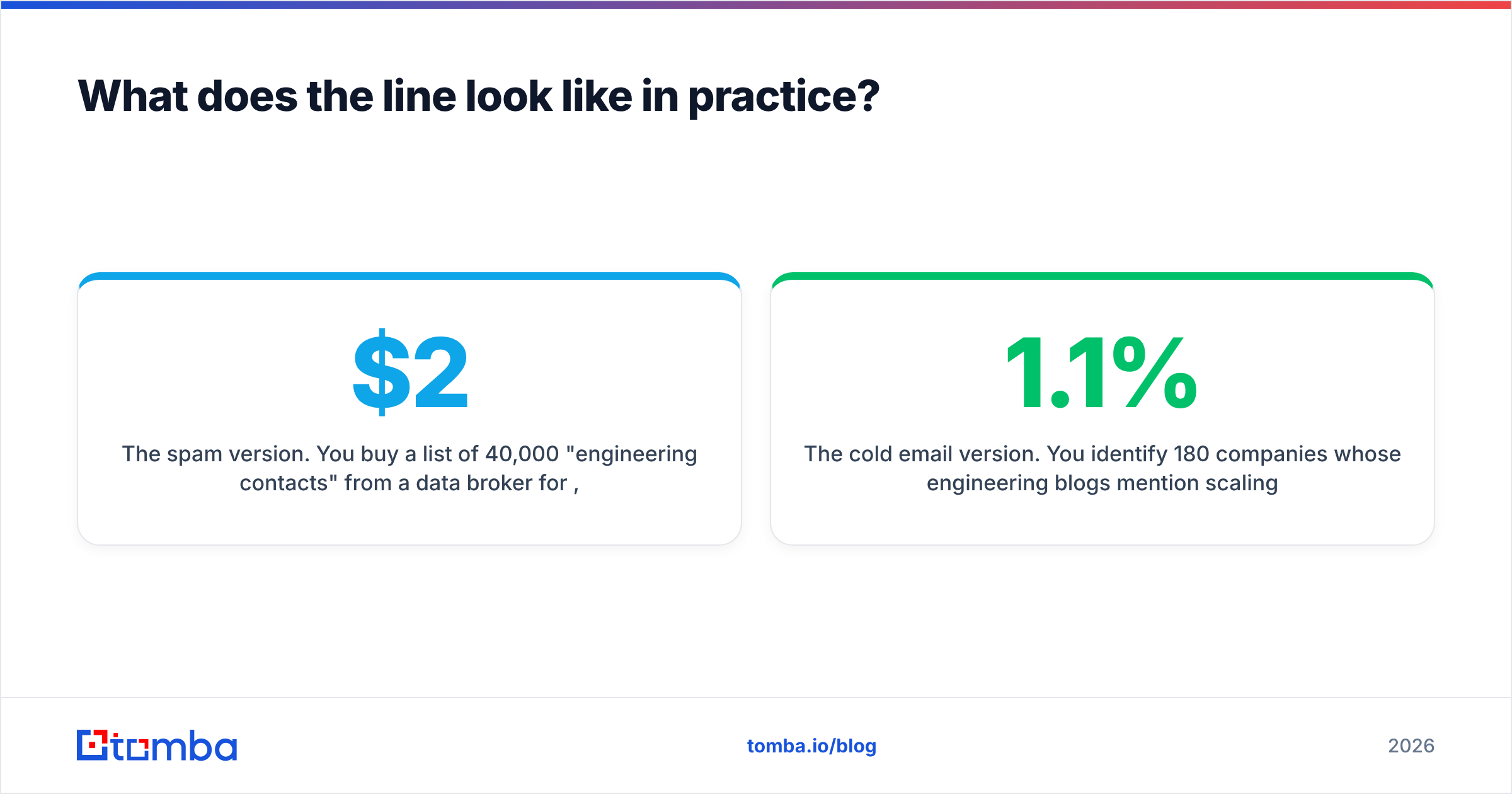
The spam version. You buy a list of 40,000 "engineering contacts" from a data broker for $2,000. You import them into a sequencer, spin up eight throwaway domains, and send a four-touch sequence with the subject line "Re: your infrastructure." The first email opens with "I noticed you're using AWS." Bounce rate hits 31%. Complaint rate hits 0.9%. Two of your domains are blacklisted inside ten days. You booked four meetings, three of which no-showed, and burned $2,000 plus the domains.
The cold email version. You identify 180 companies whose engineering blogs mention scaling incidents in the last twelve months. You find the VP of Engineering or Head of Platform at each — that's 180 named humans, not 40,000 rows. You use an email finder to source verified addresses at those specific domains, verify them, and drop anything risky or catch-all-unverifiable. You send from your real domain, signed and authenticated. Your subject line is "your Nov 4 incident writeup." Your first line references what they actually wrote. Bounce rate is 1.1%. Complaint rate is 0.02%. You book eleven meetings.
Same channel. Same product. The second one is legal, deliverable, and profitable. The first one is none of those. Nothing about "tone" separated them — the difference was made before a single word of copy was written, at the moment you decided how the list was built.
This is where honest tooling comparison matters. Bulk data platforms like Apollo and ZoomInfo optimize for coverage — millions of records, sold on volume. Precision providers like BookYourData, which sells verified, filterable B2B contacts on a pay-as-you-go model, and Tomba, which finds and verifies addresses at domains you've already chosen, optimize for the opposite: fewer contacts, higher confidence, lower bounce risk. Neither approach is morally superior. But only one of them is compatible with the targeting standard that keeps you out of the spam folder and out of a regulator's inbox.
What checklist should you run before every campaign?#
Before your next send, confirm all of the following:
- Every address is verified. Bounce rate under 2%. If a meaningful share of your list sits on catch-all domains, treat those as a separate, lower-volume segment rather than assuming they're valid.
- SPF, DKIM, and DMARC pass on the exact domain in your From header. Check with a real test send, not a config screenshot.
- Your From name is a human at your company. Not "Sales Team," not "no-reply."
- Your subject line describes the email. If removing the subject line wouldn't change what the recipient expects to find inside, rewrite it.
- Your footer contains a physical postal address and a working unsubscribe that requires zero clicks beyond the link itself.
- You can state, per recipient, why they were selected. If the answer is "they matched a filter," tighten the filter until the answer becomes a sentence.
- Your EU contacts are segmented by jurisdiction, and you have a written legitimate interest assessment on file.
- Sequence length is capped and negative signals stop it immediately. Any reply, including a hostile one, removes the contact.
Miss items 1, 2, or 5 and you have a compliance problem. Miss item 6 and you have a business problem — the campaign will underperform whether or not anyone reports it.
Is cold email still worth it in 2026?#
Yes, but only in the precision form. The economics of volume outbound collapsed the moment Google and Yahoo made authentication mandatory and complaint thresholds enforceable. Spray-and-pray now has a hard ceiling: you cannot send enough mail to overcome a 0.3% complaint rate, because the mailbox provider stops delivering it.
What survived is what always worked — a small number of well-targeted, individually justified messages, sent from a real domain to verified addresses, offering something the recipient's job makes relevant. That is a research discipline wearing an email interface.
The lever with the highest return is not copy. It's the list. A campaign of 150 verified, correctly targeted addresses will out-earn 15,000 scraped ones on every metric that matters, and it will do so without putting your domain at risk. Everything downstream — sequencing, timing, personalization — multiplies whatever quality your list already has. Multiply a bad list and you get a bigger bad number.
Start by building the list you can defend. Use Tomba Email Finder to source verified professional addresses at the specific domains you've researched, with confidence scoring on every result so you know what you're sending to before you send it. The free tier gives you 25 searches a month to test the workflow; the Starter plan runs $49/mo when you're ready to scale it. See Tomba pricing for the full breakdown. Build a list you'd be comfortable explaining, and the cold-email-versus-spam question stops being a question at all.
Related guides#
Ready to find emails that actually work?
Join 150,000+ professionals who stopped guessing and started sending. Free credits on signup — no credit card required.
Get the Tomba newsletter
Practical outbound tactics and product updates — once every two weeks.
About the author