Cold Outreach Agency: When to Hire One and When to Build In-House
A cold outreach agency can fill your pipeline fast — or drain your budget on generic spray-and-pray. Here's how the model really works, what it costs, and when building in-house wins.
Hiring a cold outreach agency looks like the fastest way to skip the grind: hand over your ICP, get meetings on the calendar, and keep selling. Sometimes that's exactly what happens. Just as often, you pay a five-figure retainer for a rented SDR, a generic template, and a burned domain. This guide breaks down how the model actually works, what it costs, where it beats in-house, and how to avoid the failure modes that quietly kill campaigns.
TL;DR#
- A cold outreach agency runs prospecting, list-building, copy, sending infrastructure, and reply-handling on your behalf — usually on a monthly retainer plus setup.
- Expect $2,000–$8,000/month for managed email programs, more for multichannel (email + LinkedIn + calling). Pay-per-meeting and performance deals exist but shift risk in ways that change behavior.
- Agencies win on speed, deliverability infrastructure, and volume. In-house wins on product knowledge, message control, and long-term cost.
- The single biggest variable isn't the agency — it's data quality. Bad lists sink good copy every time.
- The best setup for most teams is a hybrid: own your data and offer, rent execution capacity while you learn what converts.
What is a cold outreach agency?#
A cold outreach agency is a done-for-you service that plans and executes outbound campaigns to contacts who have never heard of you. Think of it like hiring a catering company instead of cooking for a party: they bring the kitchen, the staff, and the recipes, and you tell them who's coming and what you want served.
A typical engagement covers five jobs:
- Targeting — defining your ideal customer profile and building a contact list that matches it.
- Infrastructure — buying and warming secondary sending domains and inboxes so your primary domain stays safe.
- Copywriting — writing the sequences, subject lines, and follow-ups.
- Sending — running the campaigns through a sending tool at volume, with rotation and throttling.
- Reply handling — sorting responses, booking meetings, and passing qualified leads to your reps.
The output you actually care about is booked meetings or qualified leads landing in your calendar or CRM. Everything else is plumbing.
How much does a cold outreach agency cost?#
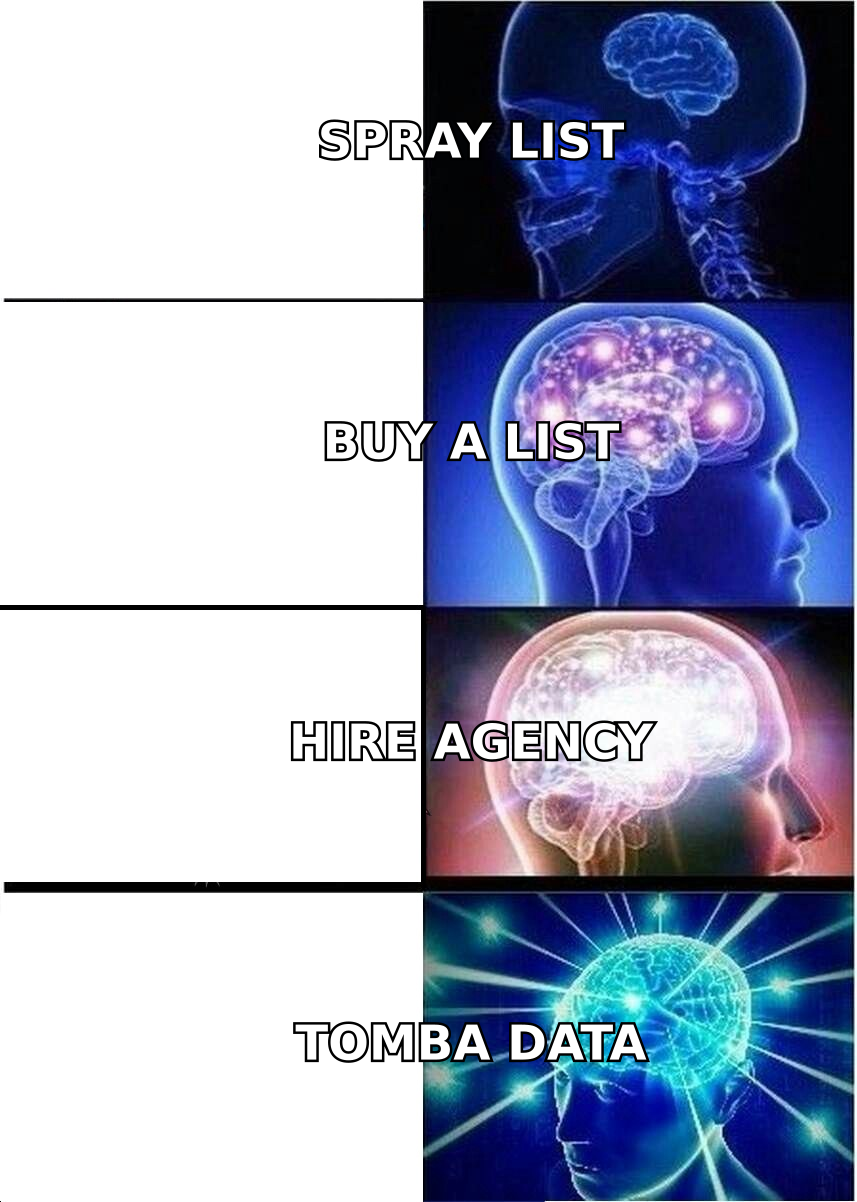
Pricing clusters into three models, and each one changes how the agency behaves.
| Pricing model | Typical range | What you get | Hidden risk |
|---|---|---|---|
| Monthly retainer | $2,000–$8,000/mo | Managed email program, fixed volume, dedicated strategist | Pay whether or not meetings land |
| Pay-per-meeting | $150–$500 per meeting | Only pay for booked calls | Agency loosens qualification to hit quota |
| Performance / rev-share | Base + % of pipeline or deals | Aligned incentives | Rare, needs long sales cycle trust |
| Hourly / project | $75–$200/hr | One-off list build or copy audit | No ownership of results |
Two costs hide underneath the headline number. First, tooling: sending platforms, data credits, and warmup often get passed through or marked up. Second, your time: someone on your side still has to answer positive replies fast, or the meetings evaporate. Budget for both before you sign.
For comparison, an in-house SDR in North America runs roughly $60,000–$85,000 in base salary plus tooling and management overhead — so a mid-tier retainer and a junior rep land in the same ballpark on paper. The difference is what you own at the end of twelve months.
Is a cold outreach agency better than building in-house?#
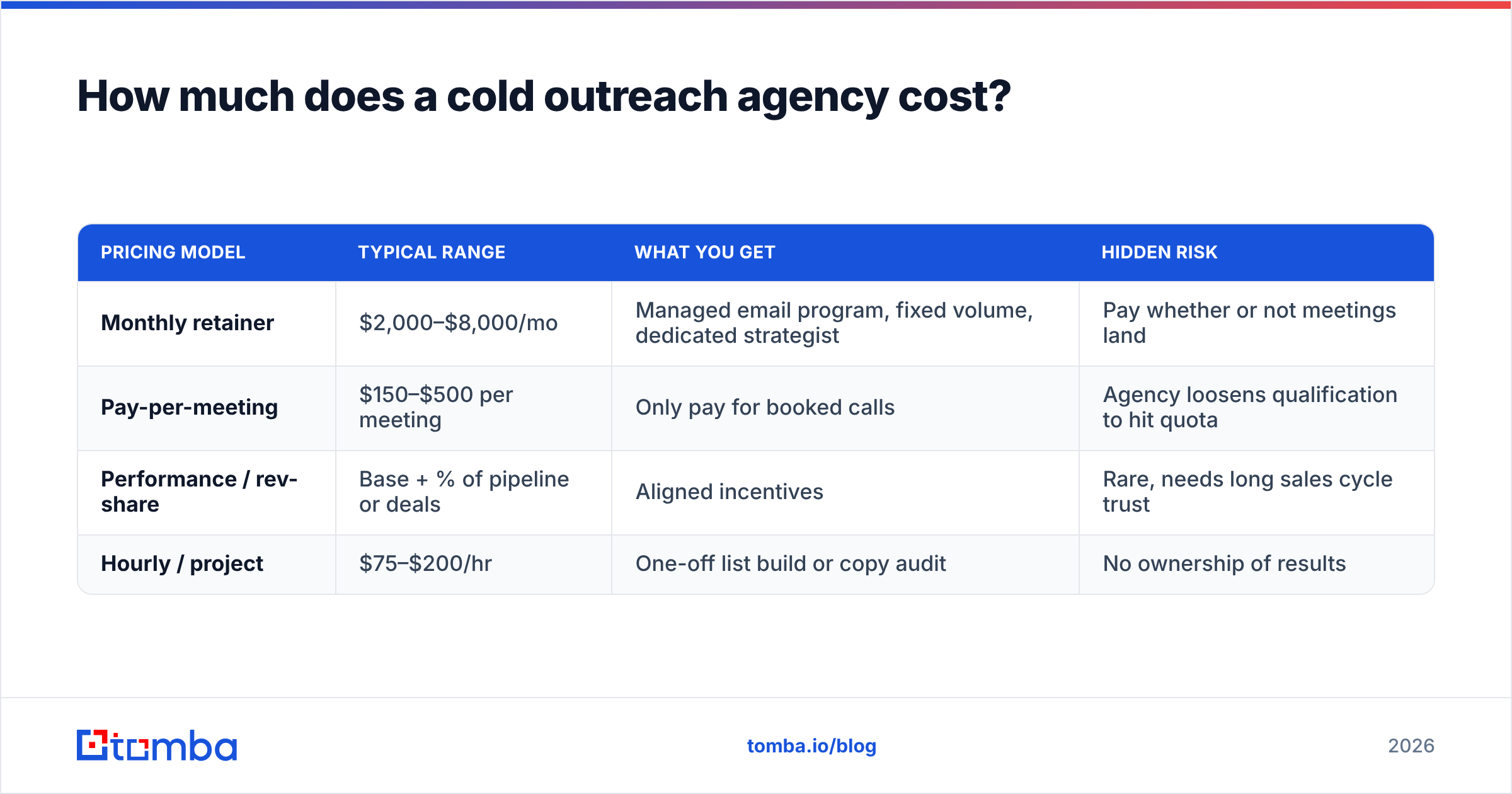
Neither is universally better — it depends on which constraint is hurting you most: time, expertise, or budget.
| Factor | Cold outreach agency | In-house team |
|---|---|---|
| Time to first campaign | 2–4 weeks | 2–3 months |
| Deliverability expertise | High (their core skill) | Must be learned |
| Product/domain knowledge | Low at first | High |
| Message iteration speed | Slower (through account manager) | Instant |
| Cost at 12 months | Retainer × 12, nothing owned | Salary + tools, process owned |
| Scaling volume | Fast (they add infrastructure) | Slow (hire, train, ramp) |
| Data ownership | Often rented, leaves with them | Yours permanently |
Go with an agency when you need pipeline this quarter, have no outbound muscle internally, and want to validate that a market responds before you hire. Build in-house when outbound is a core, permanent channel, your product needs nuanced explanation, or you're optimizing cost over a multi-year horizon.
The trap is treating this as permanent either way. Many strong teams start with an agency to learn what messaging and segments convert, then bring it in-house once the playbook is proven. That's a smart sequence, not indecision.
What separates a good agency from a bad one?#
The gap between a great and a terrible cold outreach agency is enormous, and it rarely shows up in the sales pitch. Watch for these signals.
- They ask about your data before they pitch. A serious agency wants to know your ICP, your list sources, and your verification process. If they promise results without discussing where contacts come from, they're planning to spray a bought list.
- They separate your sending domains. Good agencies never blast from your primary domain. They register lookalike domains, warm them for weeks, and rotate inboxes. Ask exactly how, and listen for specifics.
- They talk about deliverability, not just volume. "We'll send 50,000 emails a month" is a red flag. "We'll send controlled volume across warmed inboxes and watch spam placement" is the answer you want. Deliverability is the whole game — review the fundamentals of email deliverability before your first call so you can tell the difference.
- They show you the copy. You should approve sequences before anything sends. Templated garbage recycled across a hundred clients gets flagged and tanks your sender reputation.
- They report on pipeline, not opens. Open rates are vanity, especially post-Apple Mail Privacy Protection. Ask for replies, positive replies, and meetings held.
Verify claims independently. Check the agency's reviews on G2 or Capterra, ask for two references in your industry, and request anonymized campaign results — not a logo wall.

Why does data quality decide everything?#
You can hire the best cold outreach agency on earth and still fail if the underlying list is junk. Deliverability, reply rate, and reputation all trace back to who you're actually emailing.
Here's the chain reaction a bad list sets off. Invalid addresses drive up bounces. High bounce rates tell mailbox providers you're a spammer. Your inbox placement collapses. Even your valid, well-targeted prospects stop seeing you. One bad list can poison an entire warmed domain in days.
This is why controlling your own data — even when an agency runs execution — is the highest-leverage decision you'll make. When you supply verified contacts instead of renting a mystery list, you cap your bounce rate before the first send.
A clean data workflow looks like this:
- Find the right people with an accurate email finder that pulls professional addresses by name, company, or domain.
- Verify every address with an email verifier to strip invalids and reduce bounces before they happen.
- Enrich contacts with role, seniority, and company data so segmentation and personalization are possible at all.
- Handle catch-alls deliberately with a catch-all verifier instead of guessing.
Own steps one and two and you've de-risked the campaign no matter who presses send. If you're running volume, a bulk email finder lets you build and verify entire segments in one pass rather than one contact at a time.
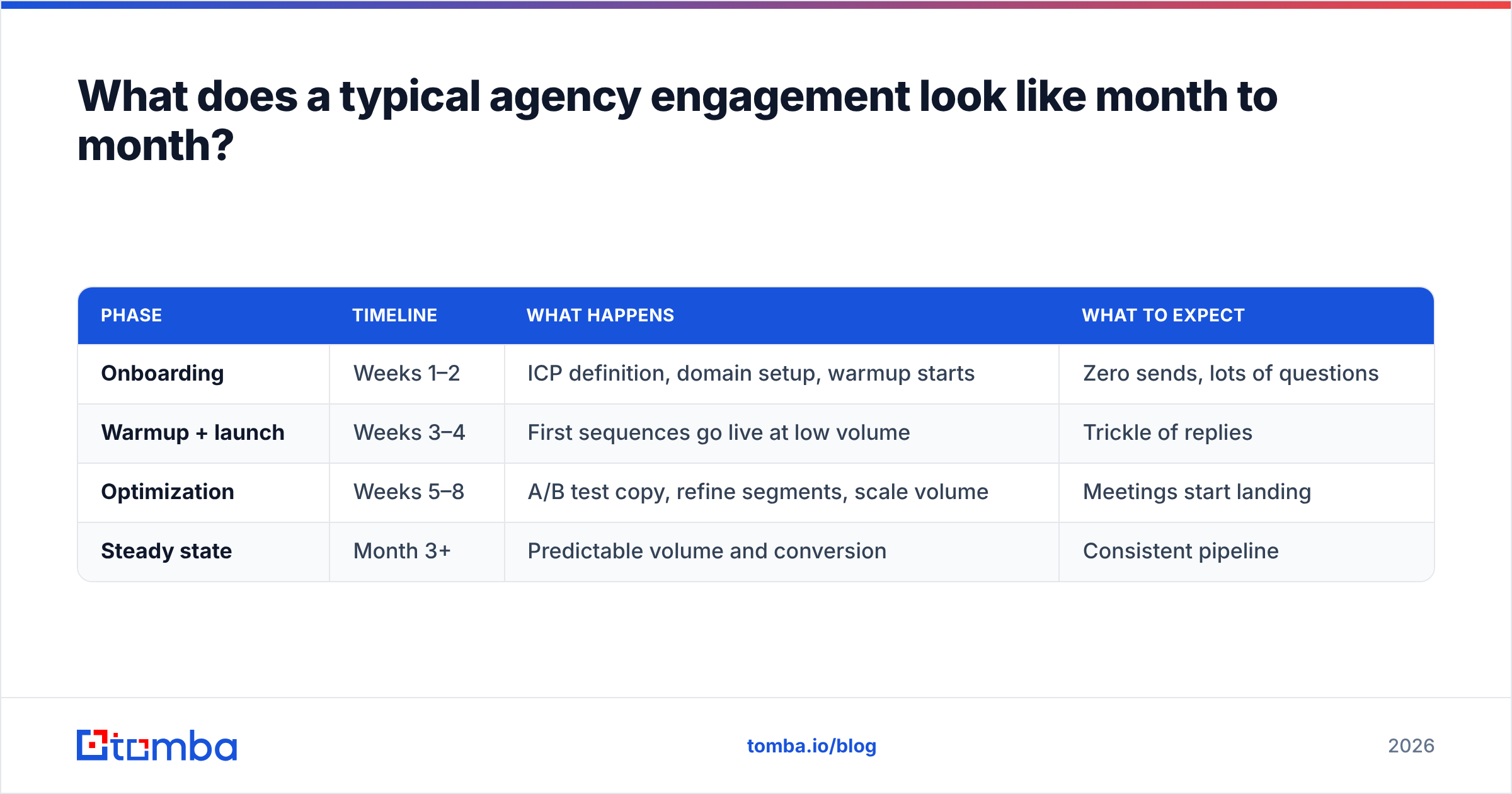
What does a typical agency engagement look like month to month?#
Setting expectations prevents the classic "why no meetings yet?" panic in week two. Cold outreach compounds; it doesn't spike.
| Phase | Timeline | What happens | What to expect |
|---|---|---|---|
| Onboarding | Weeks 1–2 | ICP definition, domain setup, warmup starts | Zero sends, lots of questions |
| Warmup + launch | Weeks 3–4 | First sequences go live at low volume | Trickle of replies |
| Optimization | Weeks 5–8 | A/B test copy, refine segments, scale volume | Meetings start landing |
| Steady state | Month 3+ | Predictable volume and conversion | Consistent pipeline |
If an agency promises a full calendar in week one, they're either spraying an unwarmed domain or setting you up to churn. Real programs need a warmup runway. Providers like HubSpot publish extensive benchmarks on outbound cadence and reply timing worth reading before you set targets.
What are the biggest risks, and how do you avoid them?#
Four failure modes account for most disappointing agency relationships.
- Domain damage. The worst outcome is a burned primary domain that hurts every email you send, including to customers. Mitigation: insist on separate sending domains and confirm your SPF record and DNS are configured before launch.
- Generic, recycled copy. If the same template hits ten clients, spam filters learn it fast. Mitigation: approve every sequence and demand messaging specific to your offer.
- Vanity metric reporting. Opens and "delivered" counts hide the truth. Mitigation: contract on meetings held and positive reply rate from day one.
- No handoff of assets. Some agencies keep the lists, domains, and inbox logins, so you leave with nothing. Mitigation: negotiate ownership of data, domains, and campaign assets upfront, and keep your contact records syncing into your own CRM.
Notice the pattern: the fixes are all about control and ownership. You're renting execution, not surrendering your outbound function.
Can you get agency-level results without an agency?#
Increasingly, yes — the tooling gap that used to justify agencies has narrowed. The infrastructure that once required a specialist (multi-domain sending, warmup, verification, enrichment) is now available as self-serve software. What agencies still sell is expertise and capacity, not secret access.
If you have one motivated person internally, a modern stack can replicate most of the value:
- Accurate contact discovery and verification instead of bought lists — this is where data enrichment and a reliable finder replace the "we have a database" pitch.
- A sending tool with built-in warmup and inbox rotation.
- A tight, human-written sequence you iterate weekly.
- A phone finder to layer calls onto email for multichannel follow-up.
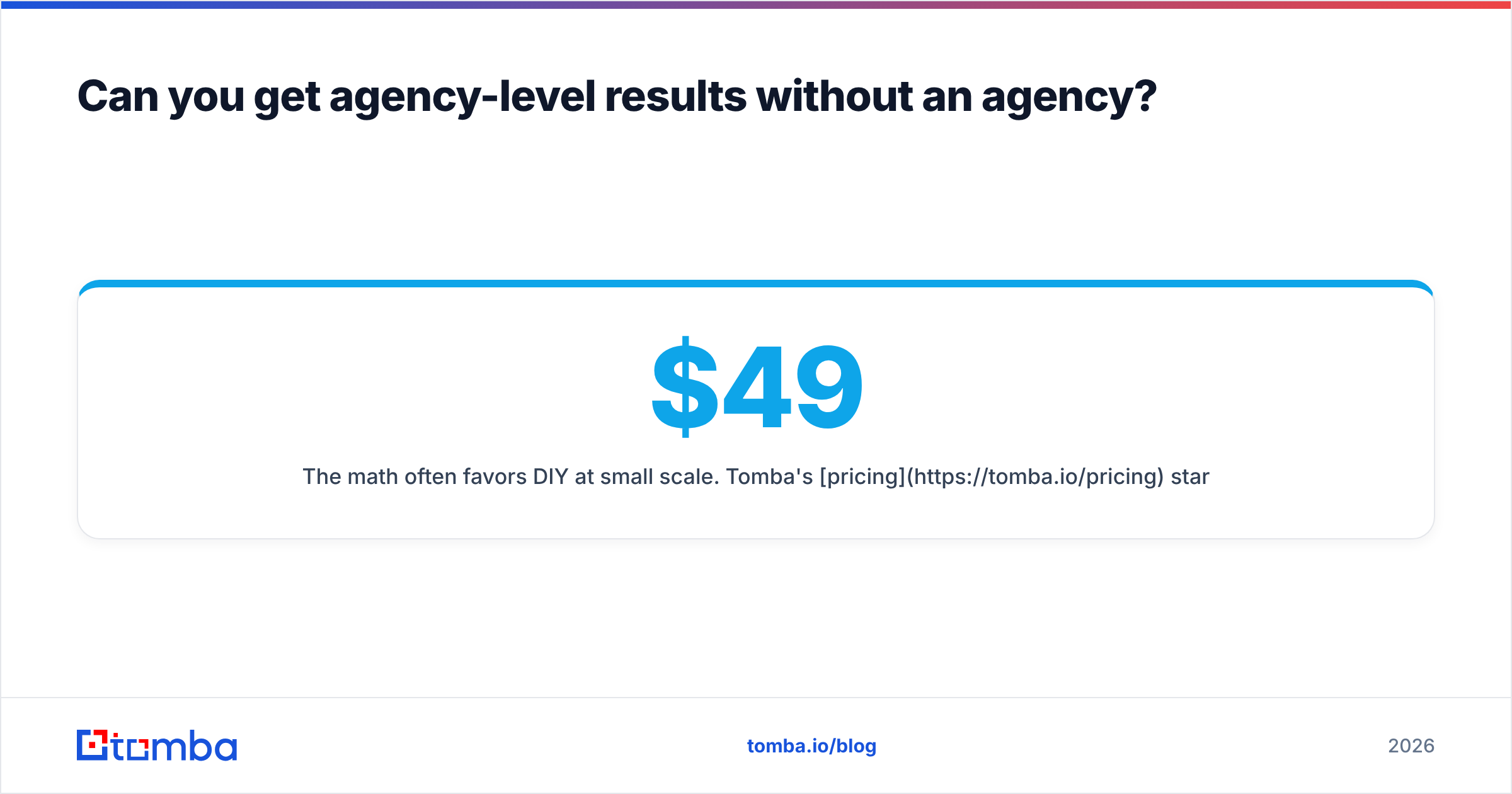
The math often favors DIY at small scale. Tomba's pricing starts free with 25 searches a month, then $49/mo for the Starter plan and $99/mo for Growth — a rounding error next to a $5,000 retainer. You trade the agency's hands-on management for keeping every dollar of learning and every row of data in-house. For teams doing outbound sales as a core motion, that ownership compounds.
So which should you choose?#
Decide by your honest answer to one question: is outbound a temporary experiment or a permanent channel?
- Experiment / need speed: Hire an agency, but keep your data and domains. Use them to learn what converts, then reassess in 90 days.
- Permanent channel / cost-sensitive: Build in-house on self-serve tooling. Slower to start, cheaper and fully owned by month three.
- Both / most teams: Own your data layer, rent execution capacity. Feed the agency verified, enriched contacts so their skill is amplified, not wasted on a bad list.
Whatever you choose, the constraint that actually moves your reply rate isn't the agency's copy or cadence — it's whether you're reaching real, verified people who fit your ICP. Fix that first and every other decision gets easier.
Start with the data an agency can't sell you#
Before you sign a retainer or hire a rep, control the one input that determines outbound success: accurate, verified contact data. Tomba Email Finder finds professional email addresses by name, company, or domain, verifies them to keep your bounce rate low, and enriches them so segmentation and personalization are actually possible. Start free with 25 searches a month, and whether you go agency, in-house, or hybrid, you'll be building on a foundation you own — not a list you rented. Give your outreach the data quality it deserves and let the campaign do the rest.
Related guides#
Ready to find emails that actually work?
Join 150,000+ professionals who stopped guessing and started sending. Free credits on signup — no credit card required.
Get the Tomba newsletter
Practical outbound tactics and product updates — once every two weeks.
About the author