Cold Outreach Frameworks: The 2026 Guide to Booking Meetings
Winging cold email is why your reply rate is stuck at 1%. Here are the cold outreach frameworks top reps use to structure messages, sequences, and targeting that actually book meetings in 2026.
Most cold outreach fails for a boring reason: there is no structure behind it. A rep opens their inbox, freestyles a message, hits send 40 times, and calls it a day. Reply rates sit at 1-2%, everyone blames "the market," and nothing changes.
The teams that consistently book meetings do the opposite. They run repeatable cold outreach frameworks — proven skeletons for the message, the sequence, and the targeting — so every send is a small experiment inside a system, not a fresh gamble. This guide breaks down the frameworks worth knowing in 2026, when to use each, and the data foundation that makes any of them work.
TL;DR#
- A cold outreach framework is a repeatable structure for your message, cadence, and targeting — it removes guesswork so you can test and improve.
- The best-known message frameworks are AIDA, PAS, BAB, the 3-sentence rule, and "before-after-bridge" openers; each fits a different buyer and channel.
- Frameworks fail on bad data. A perfect PAS email sent to a wrong or unverified address is still spam that hurts your domain.
- Multichannel sequences (email + LinkedIn + phone) outperform single-channel by a wide margin, but only when each touch adds value.
- Start with one framework, one segment, and one clear metric (reply rate). Change one variable at a time.
What is a cold outreach framework?#
A cold outreach framework is a reusable template for how you approach a stranger — the order of ideas in a message, the number and timing of follow-ups, and the rules for who you contact in the first place. Think of it like a recipe. A recipe does not make you a chef, but it stops you from throwing random ingredients in a pan and hoping. You still season to taste, but the structure is proven.
Frameworks operate at three levels, and confusing them is where most reps go wrong:
- Message frameworks — the internal structure of a single email or DM (AIDA, PAS, BAB).
- Sequence frameworks — how many touches, on which channels, over how many days.
- Targeting frameworks — the ICP rules and data quality standards that decide who even receives the message.
You need all three. A brilliant message sent to the wrong list is wasted, and a perfect list emailed with a rambling pitch is also wasted.

Which message frameworks actually work in 2026?#
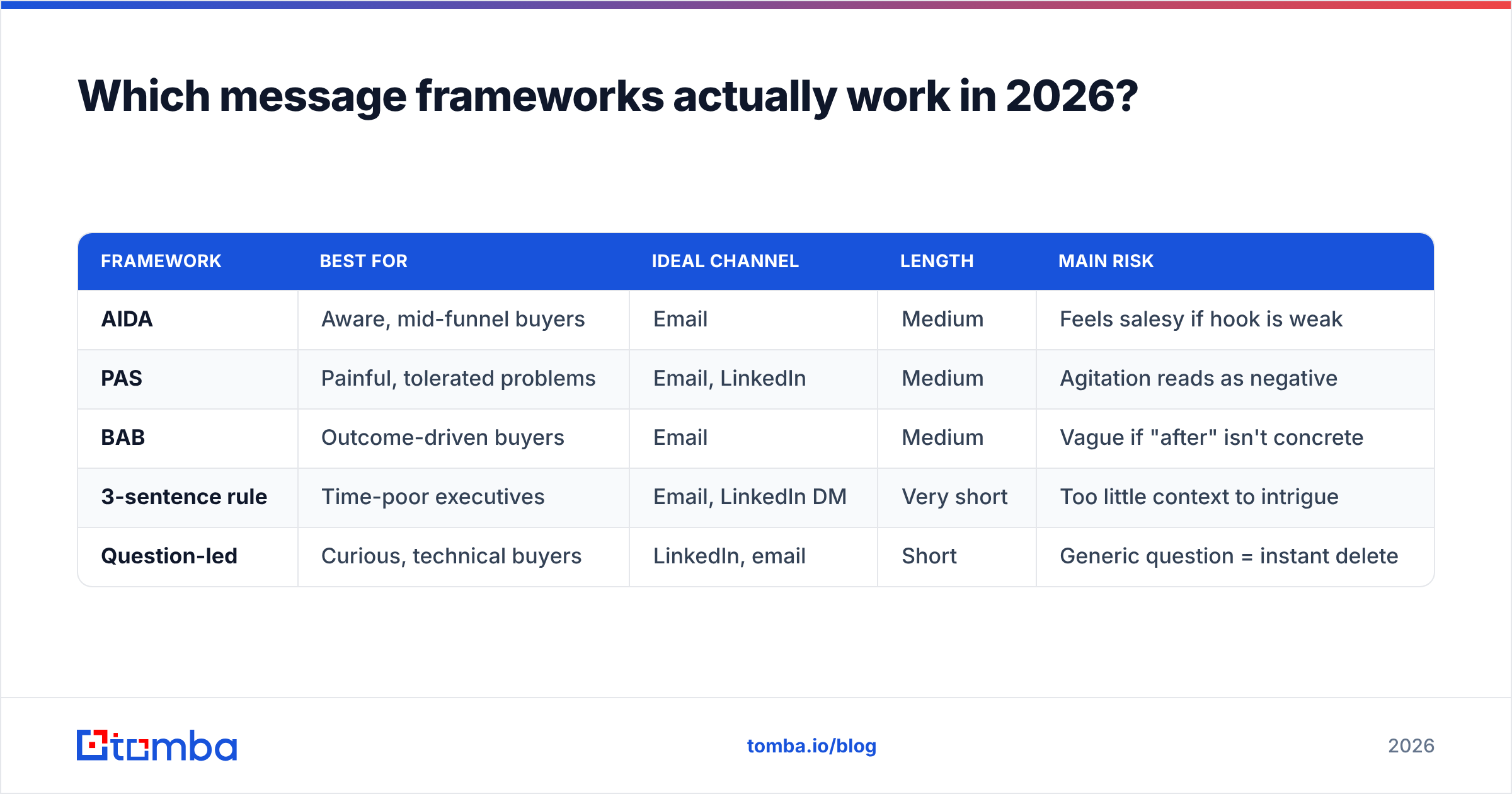
Here are the five message frameworks that still earn replies, with the buyer and channel each fits best.
- AIDA (Attention, Interest, Desire, Action) — The classic. Grab attention with a relevant hook, build interest with a specific insight, create desire with a concrete outcome, and end with one clear ask. Best for warm-ish prospects who already feel the problem. See the AIDA model for its marketing origins.
- PAS (Problem, Agitate, Solution) — Name a pain, twist the knife a little by showing its cost, then present your fix. Works well for pains the buyer is aware of but has been tolerating.
- BAB (Before, After, Bridge) — Paint their current state, paint the improved state, then position your product as the bridge. Great for outcome-driven buyers who care about the "after" more than the mechanics.
- The 3-sentence rule — One sentence of relevance, one sentence of value, one sentence of ask. Ruthless brevity. Best for senior executives who skim on mobile.
- Question-led opener — Lead with a specific, researched question that only applies to them. High risk, high reward; it dies instantly if the question is generic.
How the message frameworks compare#
| Framework | Best for | Ideal channel | Length | Main risk |
|---|---|---|---|---|
| AIDA | Aware, mid-funnel buyers | Medium | Feels salesy if hook is weak | |
| PAS | Painful, tolerated problems | Email, LinkedIn | Medium | Agitation reads as negative |
| BAB | Outcome-driven buyers | Medium | Vague if "after" isn't concrete | |
| 3-sentence rule | Time-poor executives | Email, LinkedIn DM | Very short | Too little context to intrigue |
| Question-led | Curious, technical buyers | LinkedIn, email | Short | Generic question = instant delete |
The takeaway is not "pick the best one." It is "match the framework to the buyer." A CFO gets the 3-sentence rule. A frustrated ops manager who has lived with a broken process for a year gets PAS.
Is a message framework enough on its own?#
No — and this is the mistake that quietly kills most campaigns. A message framework decides what you say. It does nothing about who receives it or whether the address even exists.
Deliverability is downstream of data quality. If 20% of your list bounces because the emails were guessed or scraped from a stale database, mailbox providers notice, your sender reputation drops, and even your perfectly structured AIDA email lands in spam. At that point the framework is irrelevant because nobody sees the message.
This is why targeting and data sit inside the framework, not beside it. Before you send, you should be able to answer:
- Does this contact match my ICP? Title, company size, industry, trigger event.
- Is the email address real and safe to send to? Not "probably" — verified.
- Is this the right channel for this person? Some buyers never open cold email but reply on LinkedIn within an hour.
Tools solve the first two. You can build a targeted list with a domain search to pull the right contacts at a company, use an email finder to get their professional address, and run every address through an email verifier before a single message goes out. That sequence protects your domain and keeps your framework's math honest.

What does a good sequence framework look like?#
A single email is a coin flip. A well-built sequence is a system. The best sequences in 2026 are multichannel, spaced out, and value-additive on every touch — meaning each follow-up gives the prospect a reason to care, not just a "bumping this to the top of your inbox."
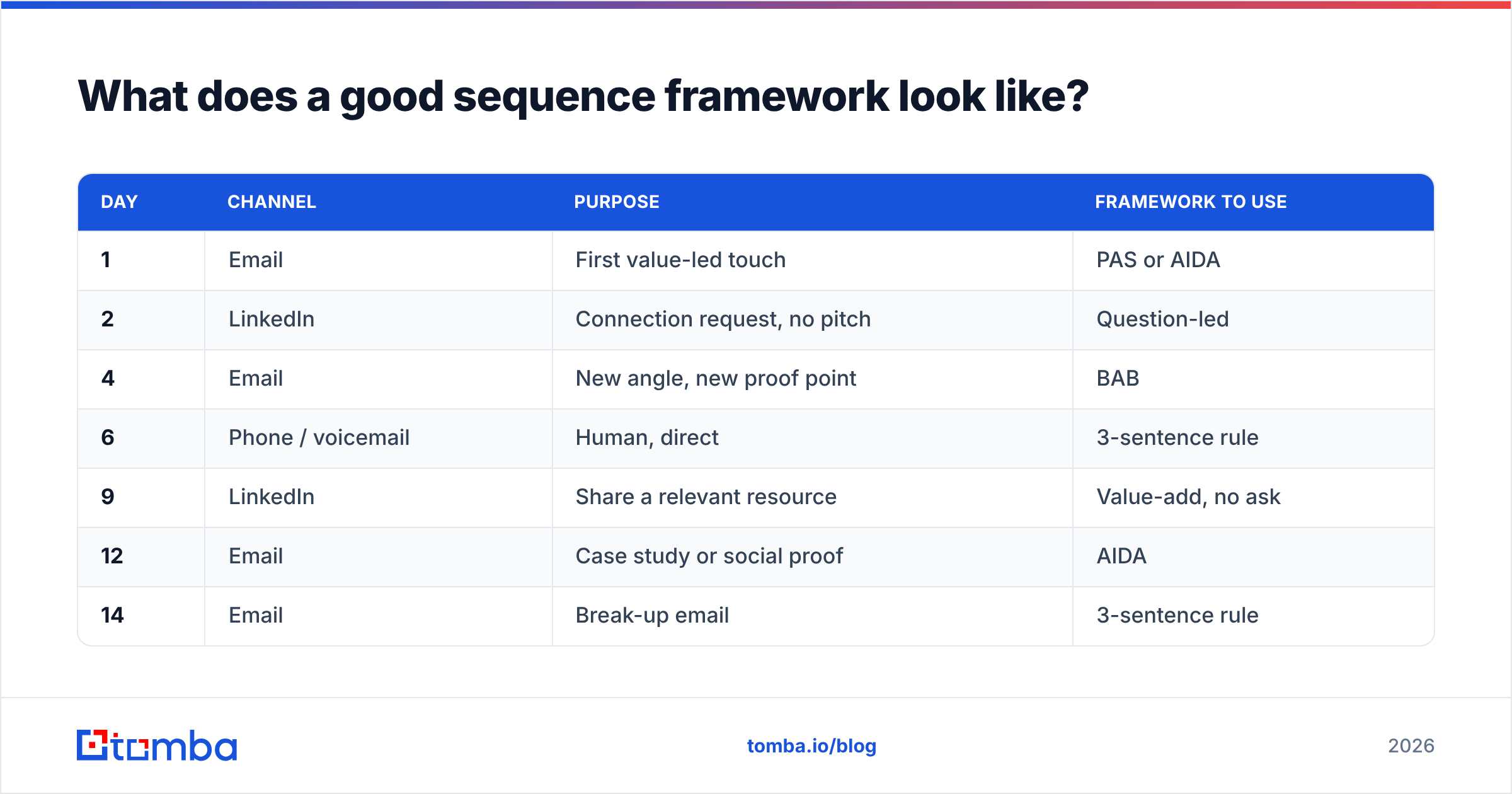
Here is a proven 14-day multichannel structure you can adapt:
| Day | Channel | Purpose | Framework to use |
|---|---|---|---|
| 1 | First value-led touch | PAS or AIDA | |
| 2 | Connection request, no pitch | Question-led | |
| 4 | New angle, new proof point | BAB | |
| 6 | Phone / voicemail | Human, direct | 3-sentence rule |
| 9 | Share a relevant resource | Value-add, no ask | |
| 12 | Case study or social proof | AIDA | |
| 14 | Break-up email | 3-sentence rule |
Notice two things. First, no two touches repeat the same message — each one reframes the value. Second, the channels reinforce each other: a prospect who ignores email may accept your LinkedIn request, then recognize your name when you call. According to research summarized by HubSpot's sales team, persistence across multiple touches is one of the strongest predictors of booked meetings, yet most reps stop after one or two.
The break-up email on day 14 is deceptively powerful. "It sounds like this isn't a priority right now — I'll close your file. If that's wrong, just reply and I'll follow up." It converts because it removes pressure and triggers loss aversion.
How do you choose the right framework for your team?#
Match the framework to three variables: your buyer's seniority, the awareness level of the problem you solve, and your primary channel. Here is a simple decision guide.
- Selling to executives? Default to the 3-sentence rule on email and LinkedIn. They skim, they decide fast, and long emails get archived.
- Solving a painful, well-known problem? Use PAS. The agitation step does the selling for you because they already feel it.
- Selling a better outcome for a process they tolerate? Use BAB so the contrast between "before" and "after" becomes obvious.
- Selling something technical to curious buyers? Lead with a sharp, researched question. Engineers and product leaders reward specificity.
- Running high-volume outbound? Start with AIDA as your control, because it is the most balanced and easiest to A/B test against.
Whatever you pick, commit to it for at least a few hundred sends before judging it. Swapping frameworks after 20 emails tells you nothing — the sample is too small to separate signal from noise.
What metrics tell you a framework is working?#
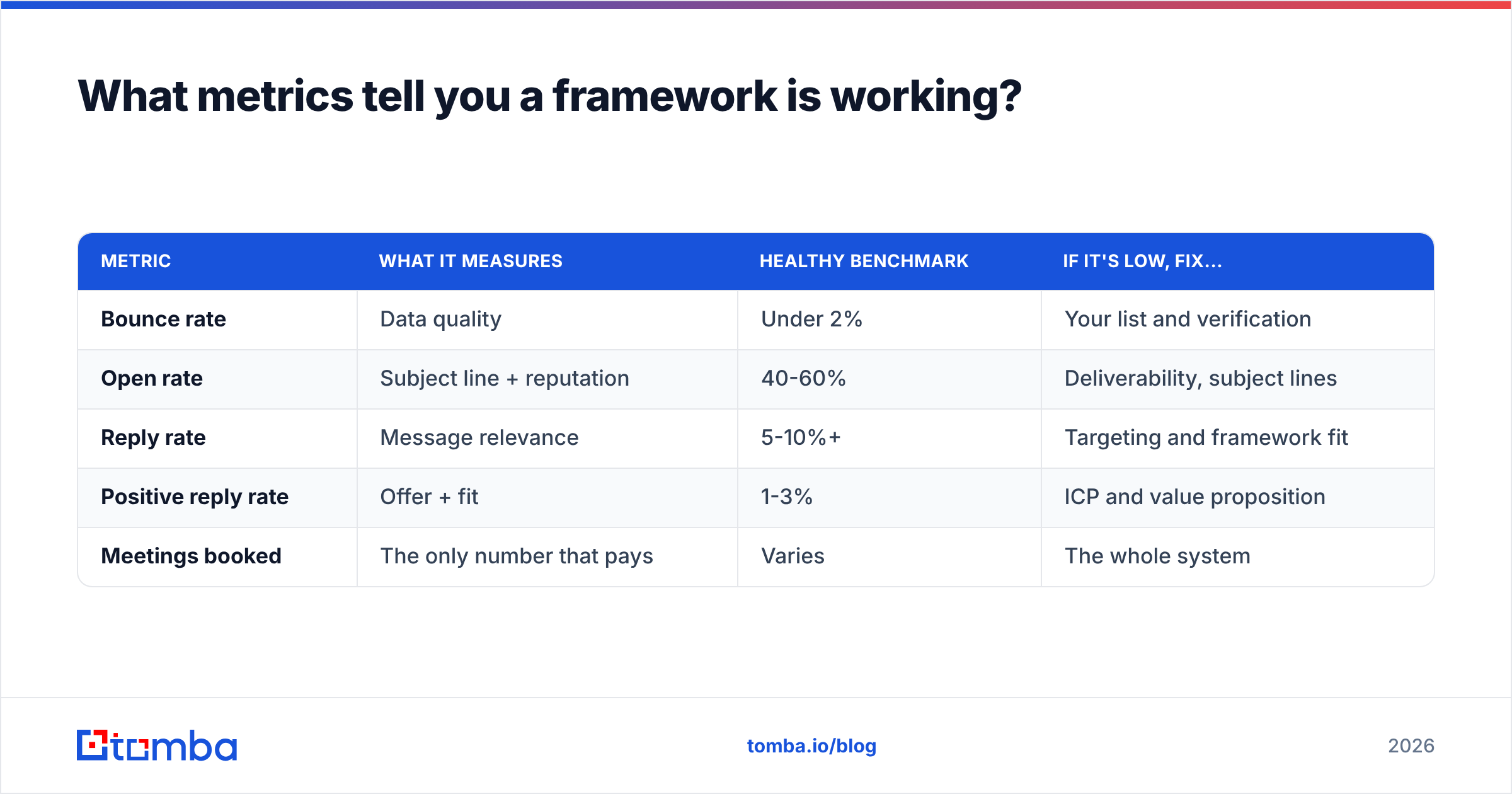
Track the funnel, not just the vanity number at the top.
| Metric | What it measures | Healthy benchmark | If it's low, fix... |
|---|---|---|---|
| Bounce rate | Data quality | Under 2% | Your list and verification |
| Open rate | Subject line + reputation | 40-60% | Deliverability, subject lines |
| Reply rate | Message relevance | 5-10%+ | Targeting and framework fit |
| Positive reply rate | Offer + fit | 1-3% | ICP and value proposition |
| Meetings booked | The only number that pays | Varies | The whole system |
Read the funnel top-down. A high bounce rate means your data is the problem, and no framework can save it — go back to verification. Good opens but low replies mean your targeting is fine but your message structure is off, so test a different framework. Good replies but no meetings means your offer or ICP is wrong.
This diagnostic order matters because reps waste weeks rewriting copy when the real issue is a list full of dead addresses. Fix the foundation first.
How does data quality change everything?#
Reframe cold outreach as a multiplication problem. Your results are roughly: list quality × message quality × persistence. If any factor is near zero, the product is near zero.
A framework improves the "message quality" term. But a scraped, unverified list drives "list quality" toward zero, and the best copy in the world cannot rescue it. That is why the highest-leverage move for most teams is not learning a sixth framework — it is cleaning up the inputs.
Practically, that means:
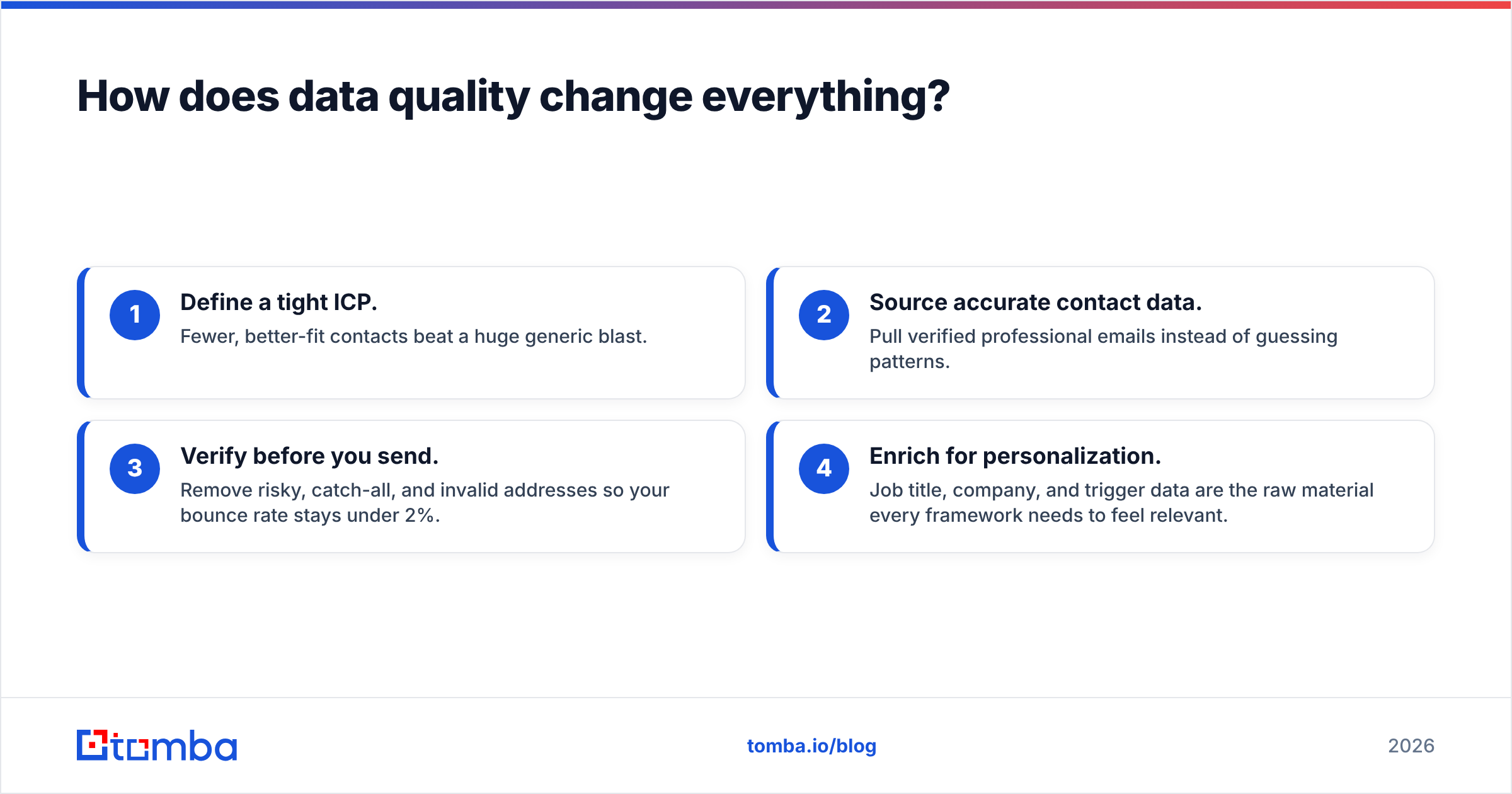
- Define a tight ICP. Fewer, better-fit contacts beat a huge generic blast.
- Source accurate contact data. Pull verified professional emails instead of guessing patterns.
- Verify before you send. Remove risky, catch-all, and invalid addresses so your bounce rate stays under 2%.
- Enrich for personalization. Job title, company, and trigger data are the raw material every framework needs to feel relevant.
You can compare vendors and plans — for example, review the Tomba pricing tiers against your volume — but the principle holds regardless of tool: clean data is the framework behind all the other frameworks. For a broader view of the category, buyer-review sites like G2 are useful for cross-checking accuracy claims before you commit.
What are the most common cold outreach mistakes?#
Even with a solid framework, these errors sink campaigns:
- Sending before verifying. One bad batch can tank your domain reputation for weeks.
- Personalizing the wrong thing. "I saw you went to State University" is creepy, not relevant. Personalize on the business problem.
- One channel only. Email-only leaves 40%+ of repliers on the table who would have answered on LinkedIn or the phone.
- No clear next step. Every message needs exactly one ask. "Let me know your thoughts" is not an ask.
- Giving up too early. Most positive replies come after the third touch, yet most reps quit at two.
- Changing everything at once. If you rewrite the subject, body, and target segment together, you learn nothing when results move.
Putting it together#
A cold outreach framework is not a magic script. It is a system that turns random sends into a repeatable, improvable process. Pick one message framework that fits your buyer, wrap it in a multichannel sequence, and — most importantly — feed it clean, verified data so every send actually reaches a real person who fits your ICP.
Structure your message and your cadence, but start with the list. The most sophisticated AIDA email is worthless if it bounces. Build a targeted, accurate contact list first with the Tomba Email Finder — find verified professional emails by name, domain, or company, then run them through verification before your sequence goes live. Get the data right, and every framework you layer on top starts to compound. Start free with 25 searches and see how a clean list changes your reply rate.
Related guides#
Ready to find emails that actually work?
Join 150,000+ professionals who stopped guessing and started sending. Free credits on signup — no credit card required.
Get the Tomba newsletter
Practical outbound tactics and product updates — once every two weeks.
About the author