The Cold Outreach Strategy That Books Meetings in 2026
Most cold outreach fails because it starts with volume, not targeting. Here's a step-by-step cold outreach strategy for 2026 that earns replies instead of spam complaints.
Cold outreach still works in 2026 — but the version that works looks almost nothing like the mass-blast playbook most teams are running. Inboxes are stricter, buyers are more skeptical, and a bad list will torch your domain before it books a single meeting. The good news: a disciplined cold outreach strategy beats a bigger send every time.
TL;DR#
- Targeting beats volume. A tight list of 200 well-researched accounts outperforms 5,000 scraped contacts almost every time.
- Deliverability is a prerequisite, not a bonus. Verified data, warmed domains, and authentication (SPF/DKIM/DMARC) decide whether your emails are ever seen.
- Multichannel wins. Email + LinkedIn + phone in a coordinated sequence lifts reply rates far above email alone.
- Personalization must be at scale. Relevance per prospect, not a merge tag with
{{first_name}}. - Measure the right metric. Positive reply rate and meetings booked matter; open rate is mostly noise in 2026.
What is a cold outreach strategy?#
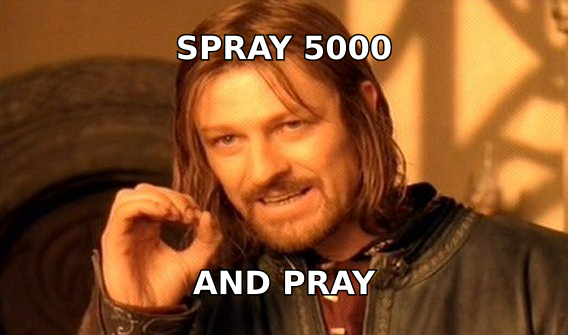
A cold outreach strategy is your repeatable system for turning a defined audience into booked conversations — before those people have ever raised their hand. Think of it like fishing: spray-and-pray is throwing dynamite in the lake and hoping something floats up (it doesn't, and you get fined). A real strategy is knowing which fish you want, where they swim, what bait they bite, and casting with intent.
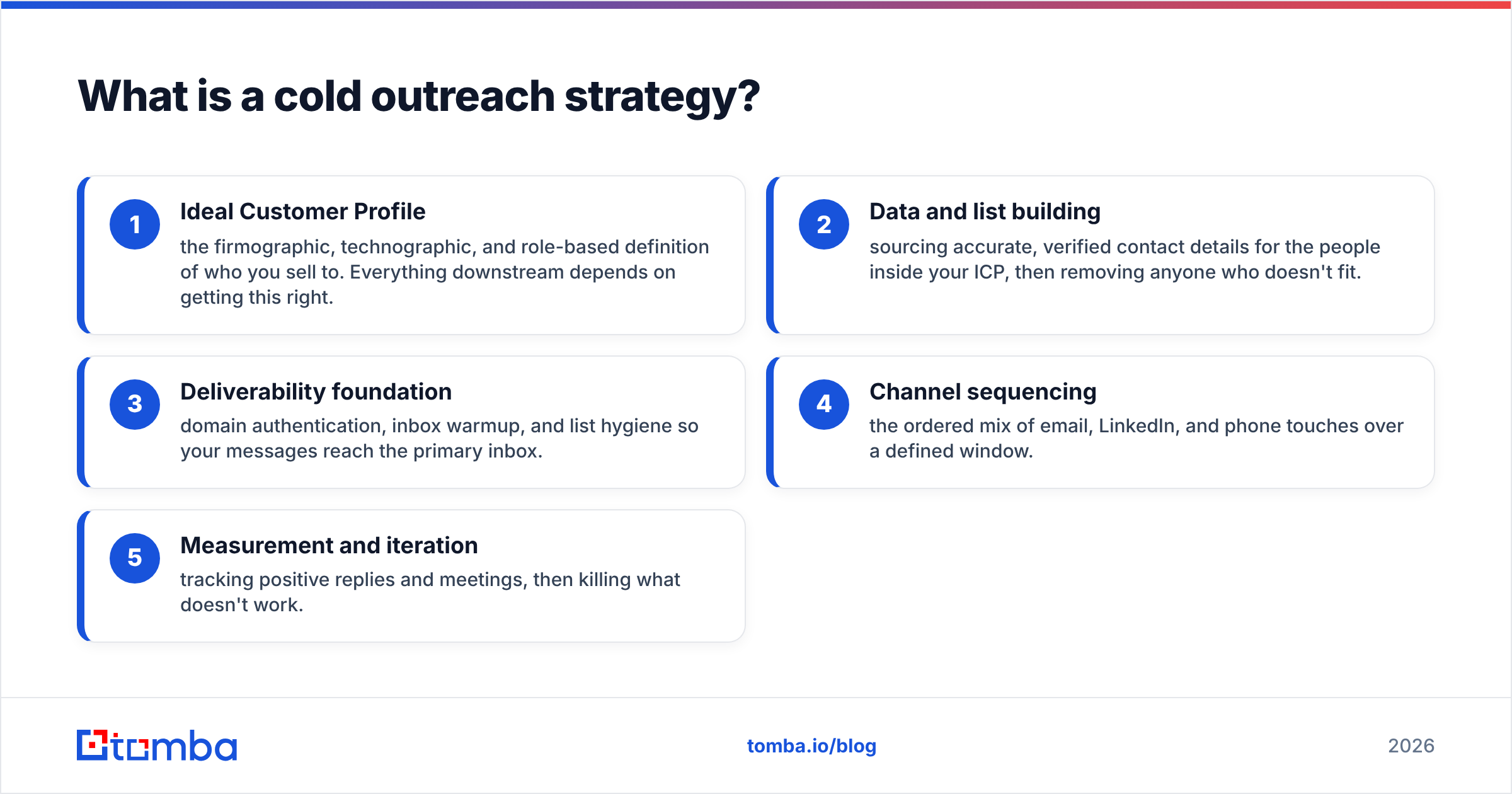
Technically, it's the combination of five moving parts: an Ideal Customer Profile (ICP), a clean contact list, a deliverability foundation, channel sequencing, and measurement. Skip any one and the whole thing leaks. Most teams obsess over copy (part four) while ignoring the list and the infrastructure (parts one through three) that actually determine whether the copy ever lands.
Here are the core building blocks, in the order they matter:
- Ideal Customer Profile — the firmographic, technographic, and role-based definition of who you sell to. Everything downstream depends on getting this right.
- Data and list building — sourcing accurate, verified contact details for the people inside your ICP, then removing anyone who doesn't fit.
- Deliverability foundation — domain authentication, inbox warmup, and list hygiene so your messages reach the primary inbox.
- Channel sequencing — the ordered mix of email, LinkedIn, and phone touches over a defined window.
- Measurement and iteration — tracking positive replies and meetings, then killing what doesn't work.
Why does most cold outreach fail in 2026?#
Because it optimizes for the wrong thing: send volume. When your only lever is "email more people," you inevitably buy or scrape a bloated list, skip verification, and hammer a cold domain until mailbox providers flag it. The result is a spiral — low deliverability leads to low replies, which tempts you to send even more, which further wrecks your reputation.
Three failure modes show up again and again:
- Dirty data. Invalid and catch-all addresses inflate bounce rates. A bounce rate above ~2-3% signals to Gmail and Outlook that you're a spammer. One bad list can suppress every future campaign from that domain.
- No authentication. Missing or misconfigured SPF, DKIM, and DMARC records send you straight to spam regardless of copy quality. Google and Yahoo now effectively require them for bulk senders.
- Generic messaging. "I'd love to show you our platform" reads as a template because it is one. Buyers pattern-match and delete in under two seconds.
If you want to go deeper on the infrastructure side, our primer on email deliverability breaks down the signals mailbox providers actually score. The short version: fix the plumbing before you scale the send.
How do you build a cold outreach strategy step by step?#
Step 1 — Define a painfully specific ICP#
Vague ICPs create vague lists. "B2B SaaS companies" is not an ICP; "Series A–B SaaS companies, 50–200 employees, using HubSpot, with a VP of Sales hired in the last 12 months" is. The tighter your definition, the more relevant your outreach can be, because relevance is a function of how well you understand a narrow segment.
Write down the firmographics (industry, size, geography), technographics (tools they use), and trigger events (funding, hiring, product launches) that make someone a fit right now. Trigger events are the difference between "cold" and "cold but timely."
Step 2 — Build a clean, verified list#
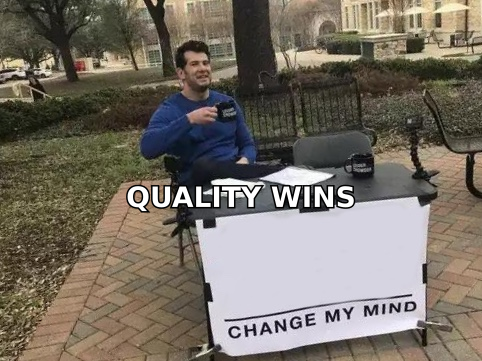
This is where most of your leverage lives. You want accurate contact data for real people inside your ICP — and nothing else. Start with domain search to pull the right contacts at a target company, then confirm each address with an email verifier before it ever enters a sequence. Verifying up front protects your bounce rate, which protects your domain reputation, which protects every future campaign.
For net-new accounts at scale, a bulk email finder lets you enrich a list of companies into verified, role-matched contacts in one pass instead of one-off lookups. Quality of list, not size of list, is the number that moves revenue.
Step 3 — Fix your deliverability foundation#
Before you send a single cold email:
- Authenticate your sending domain with SPF, DKIM, and DMARC.
- Send from a separate domain (e.g.,
getyourcompany.com) so a mistake never damages your primary brand domain. - Warm up each mailbox for 2–4 weeks, ramping volume gradually.
- Keep daily volume conservative — 20–40 cold emails per mailbox, not hundreds.
Step 4 — Sequence across channels#
Email alone leaves replies on the table. A coordinated sequence — a LinkedIn view and connection, then a first email, then a relevant follow-up, then a call — compounds because each touch makes the next one feel less cold. Space touches out over 2–3 weeks and stop the moment someone replies.
Step 5 — Measure what matters and iterate#
Track positive reply rate and meetings booked as your north stars. Deprioritize open rate — with Apple Mail Privacy Protection and image pre-fetching, opens are largely unreliable in 2026. Run one variable at a time (subject, first line, offer) so you actually learn something.
Which channels belong in your sequence?#
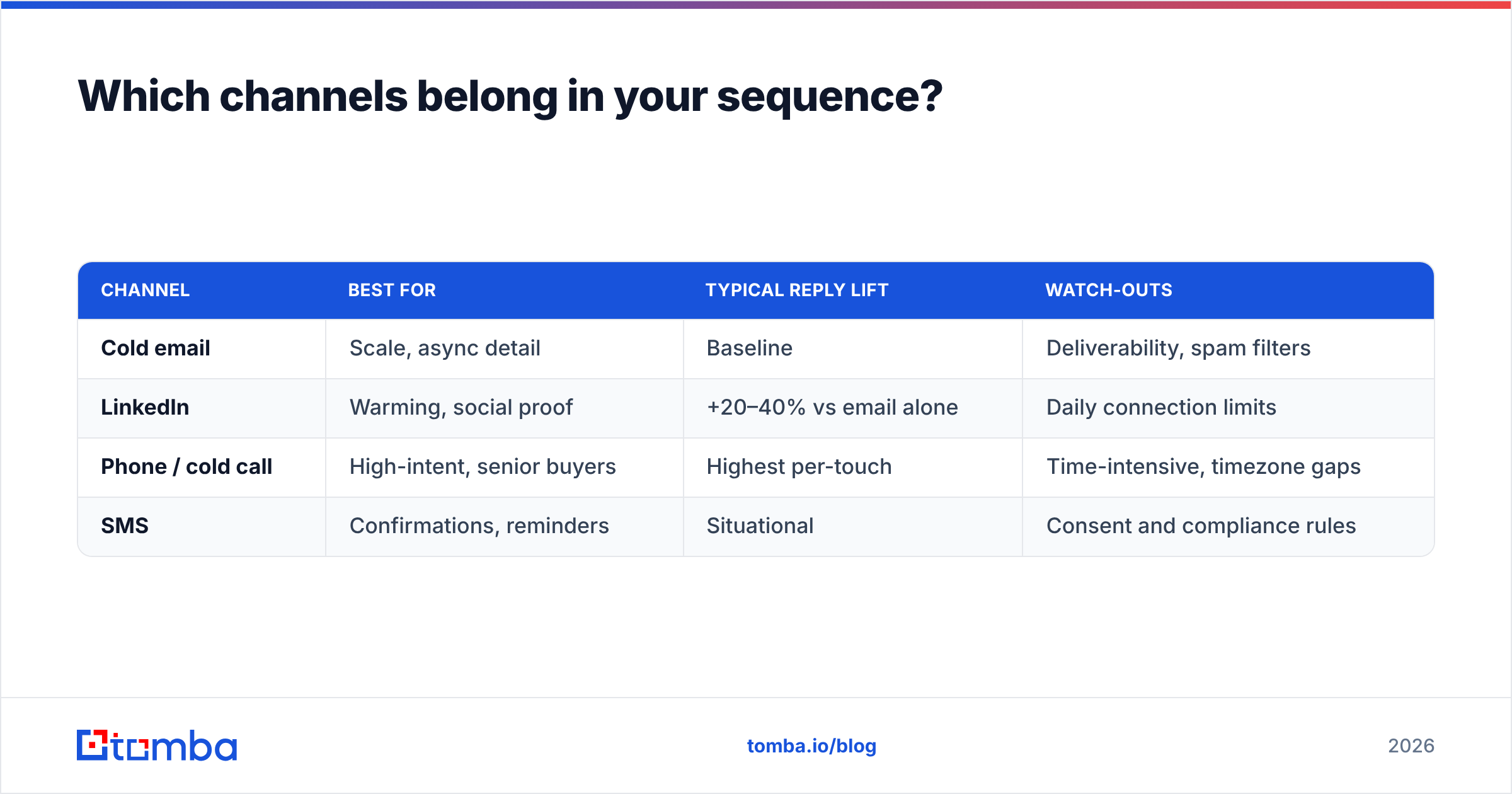
No single channel is enough on its own. The right mix depends on your motion, but the multichannel principle is constant: meet buyers where they already are, and let each channel reinforce the others.
| Channel | Best for | Typical reply lift | Watch-outs |
|---|---|---|---|
| Cold email | Scale, async detail | Baseline | Deliverability, spam filters |
| Warming, social proof | +20–40% vs email alone | Daily connection limits | |
| Phone / cold call | High-intent, senior buyers | Highest per-touch | Time-intensive, timezone gaps |
| SMS | Confirmations, reminders | Situational | Consent and compliance rules |
Email is your workhorse for reach and detail. LinkedIn adds a face and credibility — a profile view before your first email measurably lifts response. The phone is your highest-conversion channel per touch but doesn't scale the same way, so reserve it for accounts that show intent. If phone is part of your motion, sourcing accurate numbers with a phone finder keeps your dialer productive instead of chasing dead lines. For the social side, our guide to LinkedIn outreach covers connection-request framing that doesn't feel like a pitch.
How do you personalize cold outreach at scale?#
Personalization at scale sounds like a contradiction, but it isn't — it just means building relevance systematically instead of by hand. The trick is separating the research (which can be templated by segment) from the hook (which must feel one-to-one).
A workable model:
- Segment-level relevance: Group prospects by trigger event or pain, and write a message template per segment. Ten sharp templates beat one "personalized" template with a name variable.
- Prospect-level hook: Open with one specific, verifiable observation — a recent hire, a product launch, a post they wrote. One genuine line of relevance outperforms three paragraphs of flattery.
- Enrichment fuels both: Pull the firmographic and role data that lets you segment and reference accurately. Contact data enrichment turns a bare email into a profile you can actually write to.
The test for any cold email: could you copy-paste it to a different prospect without changing anything? If yes, it's not personalized — it's a template wearing a costume.
Cold email vs. LinkedIn vs. cold calling: which is best?#
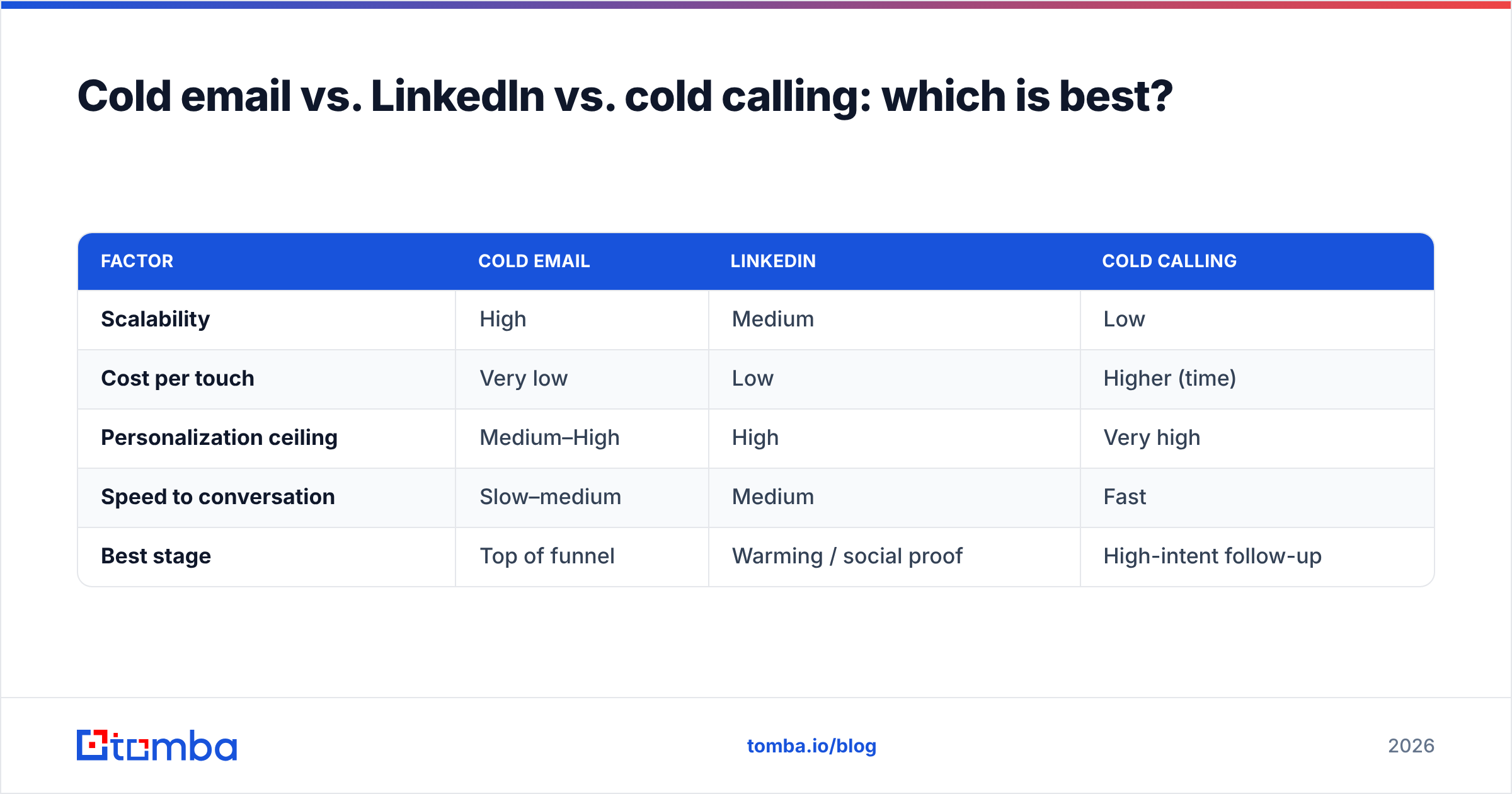
None of them individually — that's the point. But knowing each channel's economics helps you weight your sequence correctly.
| Factor | Cold Email | Cold Calling | |
|---|---|---|---|
| Scalability | High | Medium | Low |
| Cost per touch | Very low | Low | Higher (time) |
| Personalization ceiling | Medium–High | High | Very high |
| Speed to conversation | Slow–medium | Medium | Fast |
| Best stage | Top of funnel | Warming / social proof | High-intent follow-up |
Cold email wins on scale and cost, which is why it anchors most sequences. LinkedIn wins on trust-building and works beautifully as the "before" and "between" touches. Cold calling wins on immediacy and depth — nothing converts a warm-but-quiet prospect faster than a well-timed call. A strong 2026 cold outreach strategy uses all three in sequence, not in isolation, and lets replies on any channel pause the rest.
What tools do you need for a cold outreach strategy?#
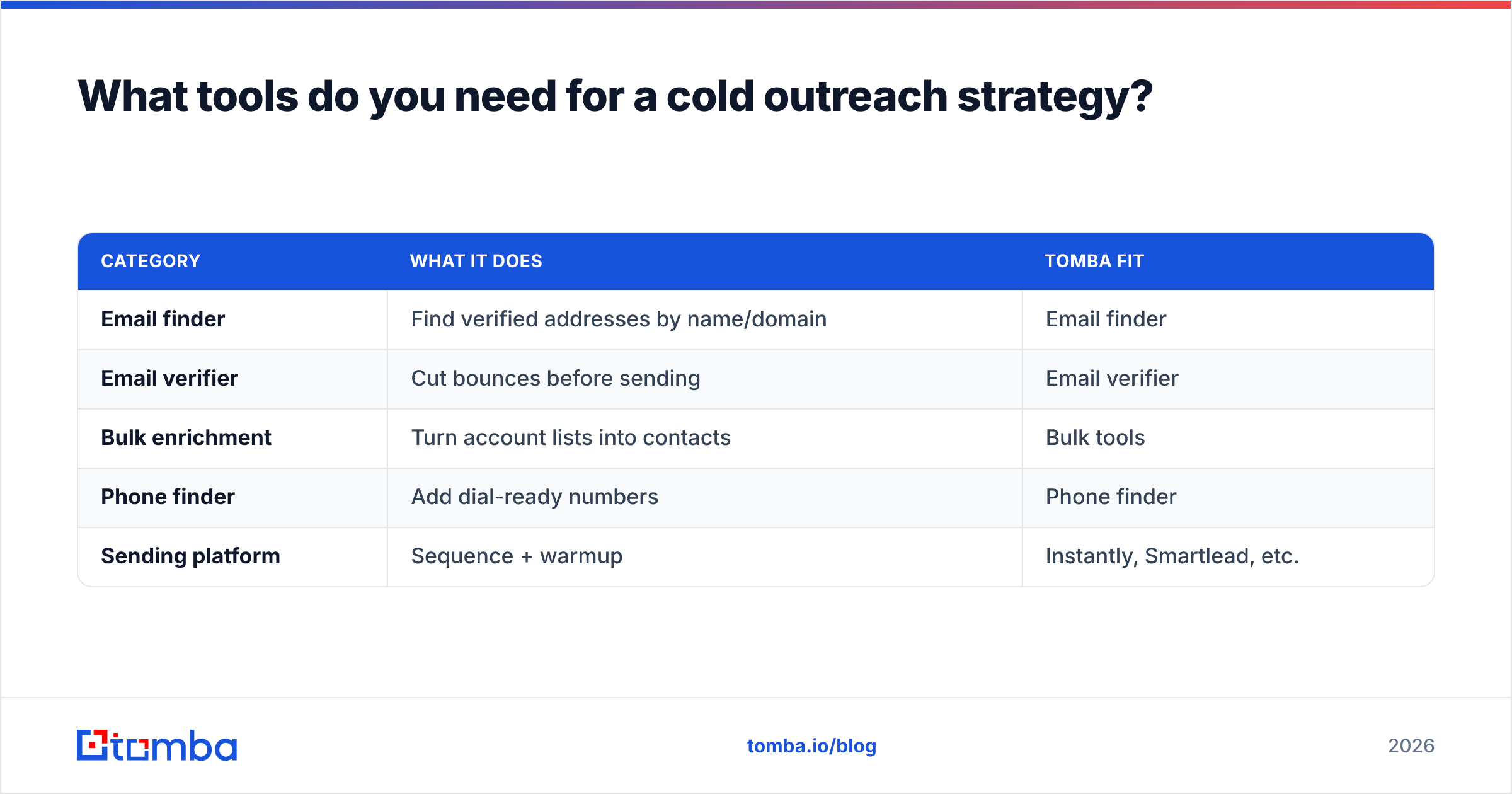
You need three categories of tooling: data (find and verify contacts), sending (sequence and deliver), and tracking (measure and route). Many teams over-invest in fancy sequencing software and under-invest in data quality — which is backwards, because the best sequencer in the world can't fix a bad list.
| Category | What it does | Tomba fit |
|---|---|---|
| Email finder | Find verified addresses by name/domain | Email finder |
| Email verifier | Cut bounces before sending | Email verifier |
| Bulk enrichment | Turn account lists into contacts | Bulk tools |
| Phone finder | Add dial-ready numbers | Phone finder |
| Sending platform | Sequence + warmup | Instantly, Smartlead, etc. |
On pricing, most data tools charge per credit or per verified contact. Tomba's plans start with a free tier (25 searches/mo) and scale through Starter at $49/mo and Growth at $99/mo — you can compare the tiers on the Tomba pricing page. Pair a data tool for the top of the funnel with a dedicated sending platform for warmup and sequencing; they solve different problems and the combination is what performs.
For authoritative background on multichannel sequencing benchmarks, HubSpot's sales research and peer reviews on G2 are useful sanity checks against any vendor's own claims.
Common cold outreach mistakes to avoid#
- Sending before warming up. A brand-new domain blasting 200 emails on day one is a reputation suicide note.
- Skipping verification. Every unverified send is a coin flip on your bounce rate.
- Writing about yourself. Buyers care about their problem, not your feature list. Lead with their world.
- No clear ask. "Let me know your thoughts" converts far worse than "Open to a 15-minute call Thursday?"
- Ignoring follow-ups. The majority of replies come after the first email. Two to three well-spaced follow-ups are non-negotiable.
- Chasing volume when replies drop. Falling replies mean fix the list or the copy — not send more.
How do you measure cold outreach success?#
Set your scoreboard before you launch, and weight it toward outcomes rather than vanity signals. The metrics that actually predict pipeline:
- Positive reply rate — the share of sends that produce an interested response. This is your true quality signal.
- Meetings booked — the only number that reliably ties to revenue.
- Bounce rate — keep it under ~2% to protect deliverability; a spike means your data hygiene slipped.
- Sequence-to-meeting conversion — how many touches it takes to book, which tells you where to trim.
Notice open rate isn't on the priority list. In 2026, privacy protections make opens noisy and easy to misread. Optimize for replies and meetings, and let the softer metrics be diagnostic rather than a target.
Put your cold outreach strategy into motion#
A winning cold outreach strategy in 2026 isn't about sending more — it's about sending right: a razor-sharp ICP, a verified list, a clean deliverability foundation, a multichannel sequence, and honest measurement. Get those five right and a modest volume will out-book any spray-and-pray campaign ten times its size.
The fastest place to start is the list, because everything else compounds off data quality. Use the Tomba Email Finder to build a verified, ICP-matched contact list, confirm each address before it enters your sequence, and start every campaign on solid ground. Better targeting in, better meetings out — that's the whole game.
Related guides#
Ready to find emails that actually work?
Join 150,000+ professionals who stopped guessing and started sending. Free credits on signup — no credit card required.
Get the Tomba newsletter
Practical outbound tactics and product updates — once every two weeks.
About the author