Cold Prospecting in 2026: A Practical Playbook That Works
Cold prospecting still works in 2026 — if you skip the spray-and-pray. Here's the data-first playbook: targeting, clean contact data, multichannel sequences, and the metrics that matter.
Cold prospecting is not dead — but the lazy version of it is. If your idea of outbound is buying a list, blasting 5,000 identical emails, and hoping ten people reply, you are already losing to teams that treat prospecting as a research problem first and a volume problem second.
This guide breaks down what actually works in 2026: how to pick the right accounts, source contact data that doesn't wreck your deliverability, build sequences across email, phone, and social, and measure the numbers that tell you whether to double down or change course.
TL;DR#
- Cold prospecting is proactive outreach to people who have never engaged with you — but in 2026 it only works when it's targeted and personalized, not mass-blasted.
- Data quality beats data quantity. A verified list of 200 right-fit contacts outperforms 5,000 scraped guesses every time.
- Multichannel wins. Email + phone + LinkedIn touches book far more meetings than any single channel alone.
- Protect your domain. Verify every address before you send, warm up your inboxes, and keep bounce rates under 2%.
- Measure reply rate and meetings booked, not emails sent. Activity is not progress.
What is cold prospecting?#
Cold prospecting is the process of identifying and reaching out to potential buyers who have had no prior contact with your company. Think of it like knocking on doors in a neighborhood where nobody knows your name yet — you have about three seconds to prove you're worth listening to before the door closes.
It differs from warm prospecting, where the person already downloaded your ebook, visited your pricing page, or met you at an event. Cold means you're starting from zero trust. That's harder, but it's also how most B2B pipelines get built, because you can't wait around for inbound leads to fill your quota.
The modern version has three non-negotiable ingredients:
- A tight ICP (ideal customer profile) — the exact company size, industry, and role you serve best.
- Accurate contact data — real names, verified emails, and direct phone numbers.
- A relevant reason to reach out — a trigger event, a specific pain, or a role-based observation, not "I'd love to hop on a call."
Miss any one of these and your campaign turns into spam.
Why does most cold prospecting fail?#
Most outreach fails for boring, fixable reasons — not because the channel is broken. Here are the usual suspects:
- Bad targeting. You emailed a 12-person startup a solution built for 5,000-seat enterprises. No amount of clever copy fixes a fit problem.
- Dirty data. Guessed email addresses bounce, tank your sender reputation, and land future emails in spam.
- Generic messaging. "I hope this email finds you well" tells the reader you sent the exact same thing to 900 other people.
- Single-channel dependence. Email-only sequences ignore that many buyers respond faster to a LinkedIn note or a well-timed call.
- No follow-up. Roughly half of replies come after the first message. One-and-done outreach leaves most of your pipeline on the table.
The fix isn't working harder — it's fixing the inputs. Clean data and sharp targeting quietly solve most of these before you write a single line of copy.
How do you build a cold prospecting list that converts?#
Start narrow. A list is only as good as the fit behind each name. Here's the workflow that consistently produces booked meetings:
1. Define your ICP with real filters. Pick 3–5 firmographic filters: industry, headcount, region, tech stack, and funding stage. If you can't describe your best customer in one sentence, you're not ready to prospect yet.
2. Find the accounts. Use B2B databases, LinkedIn Sales Navigator, or intent-data tools to build an account list that matches your ICP.
3. Identify the right people. Map the buying committee — champion, economic buyer, and blocker. Don't just email the CEO of a 2,000-person company and expect a reply.
4. Get verified contact data. This is where most teams cut corners and pay for it later. Use a dedicated email finder to pull accurate business addresses, then confirm each one with an email verifier before you send. If you're working from a company domain instead of names, a domain search surfaces every public address at that company in seconds.
5. Enrich and segment. Add role, seniority, and a personalization hook to each row so your sequence can speak to each segment differently.
The goal is a list where every contact is real, reachable, and a genuine fit. Two hundred rows like that beat two thousand scraped guesses.
Which channels work best for cold prospecting?#
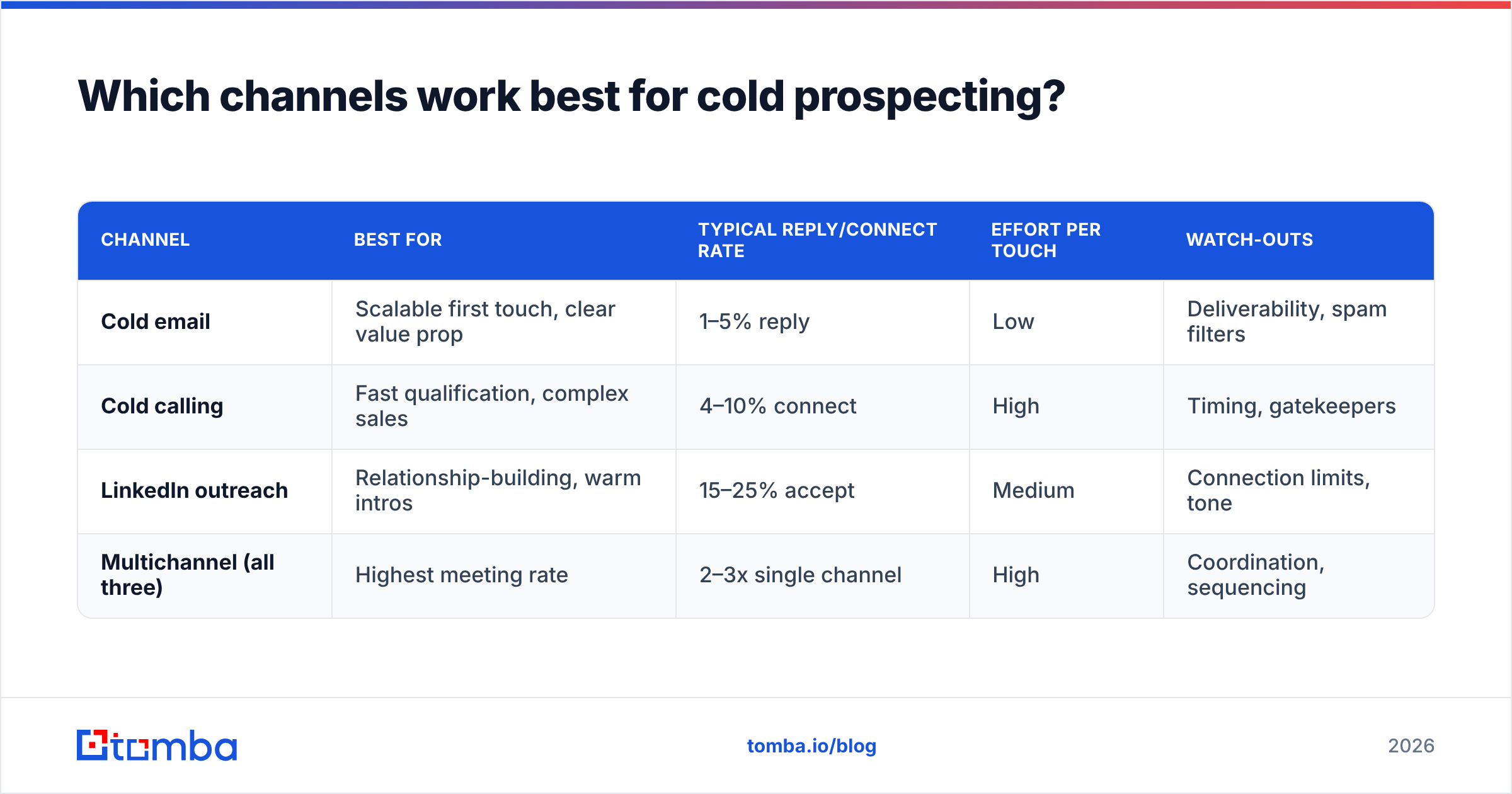
No single channel wins alone in 2026. Buyers are spread across inbox, phone, and social, and the teams that book the most meetings meet them in more than one place. Here's how the main channels stack up:
| Channel | Best for | Typical reply/connect rate | Effort per touch | Watch-outs |
|---|---|---|---|---|
| Cold email | Scalable first touch, clear value prop | 1–5% reply | Low | Deliverability, spam filters |
| Cold calling | Fast qualification, complex sales | 4–10% connect | High | Timing, gatekeepers |
| LinkedIn outreach | Relationship-building, warm intros | 15–25% accept | Medium | Connection limits, tone |
| Multichannel (all three) | Highest meeting rate | 2–3x single channel | High | Coordination, sequencing |
The takeaway: layer them. A common winning cadence is a personalized email on day 1, a LinkedIn connection on day 3, a call on day 5, and a follow-up email on day 8. Each channel reinforces the others, so by the time you call, your name already looks familiar in their inbox and feed.
For direct dials to pair with your email touches, a phone finder pulls verified B2B numbers so your calling list isn't a graveyard of disconnected lines.
How do you write cold emails that get replies?#
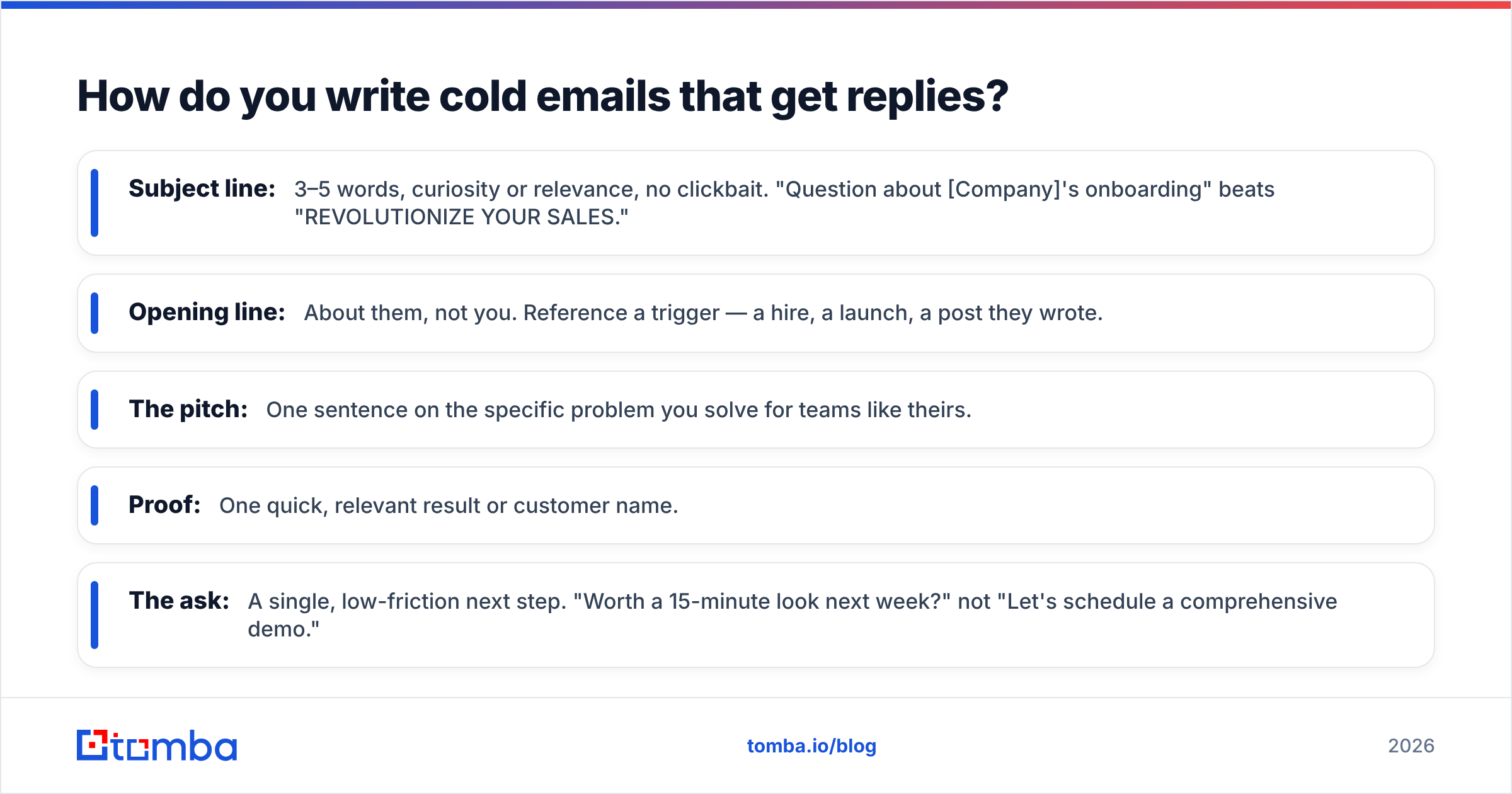
Write like a human who did their homework. The best cold emails are short, specific, and easy to say yes to. Follow this structure:
- Subject line: 3–5 words, curiosity or relevance, no clickbait. "Question about [Company]'s onboarding" beats "REVOLUTIONIZE YOUR SALES."
- Opening line: About them, not you. Reference a trigger — a hire, a launch, a post they wrote.
- The pitch: One sentence on the specific problem you solve for teams like theirs.
- Proof: One quick, relevant result or customer name.
- The ask: A single, low-friction next step. "Worth a 15-minute look next week?" not "Let's schedule a comprehensive demo."
Keep it under 120 words. If you need a starting point, browse cold email templates and adapt them to your voice — never send them verbatim, because prospects have seen the popular ones a hundred times.
How do you protect deliverability while prospecting cold?#
Your domain reputation is the single most fragile asset in cold prospecting, and you can destroy it in a week of sloppy sending. Treat email deliverability as a prerequisite, not an afterthought.
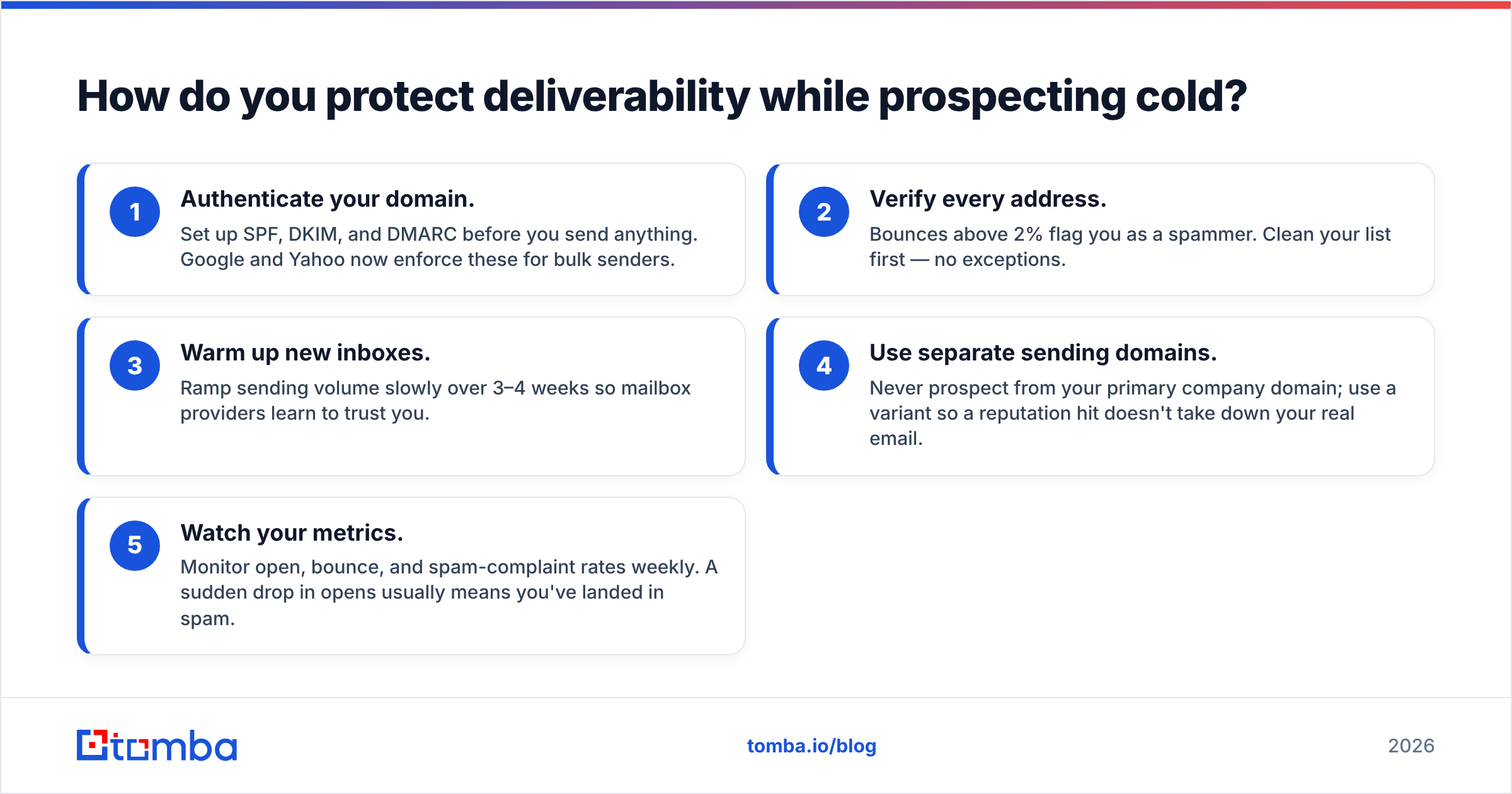
The essentials:
- Authenticate your domain. Set up SPF, DKIM, and DMARC before you send anything. Google and Yahoo now enforce these for bulk senders.
- Verify every address. Bounces above 2% flag you as a spammer. Clean your list first — no exceptions.
- Warm up new inboxes. Ramp sending volume slowly over 3–4 weeks so mailbox providers learn to trust you.
- Use separate sending domains. Never prospect from your primary company domain; use a variant so a reputation hit doesn't take down your real email.
- Watch your metrics. Monitor open, bounce, and spam-complaint rates weekly. A sudden drop in opens usually means you've landed in spam.
According to Google's Postmaster guidelines, keeping spam complaint rates below 0.3% is critical to staying in the inbox. Verification and warmup are how you get there. Skipping them is the fastest way to make every future campaign invisible.
What tools do you actually need?#
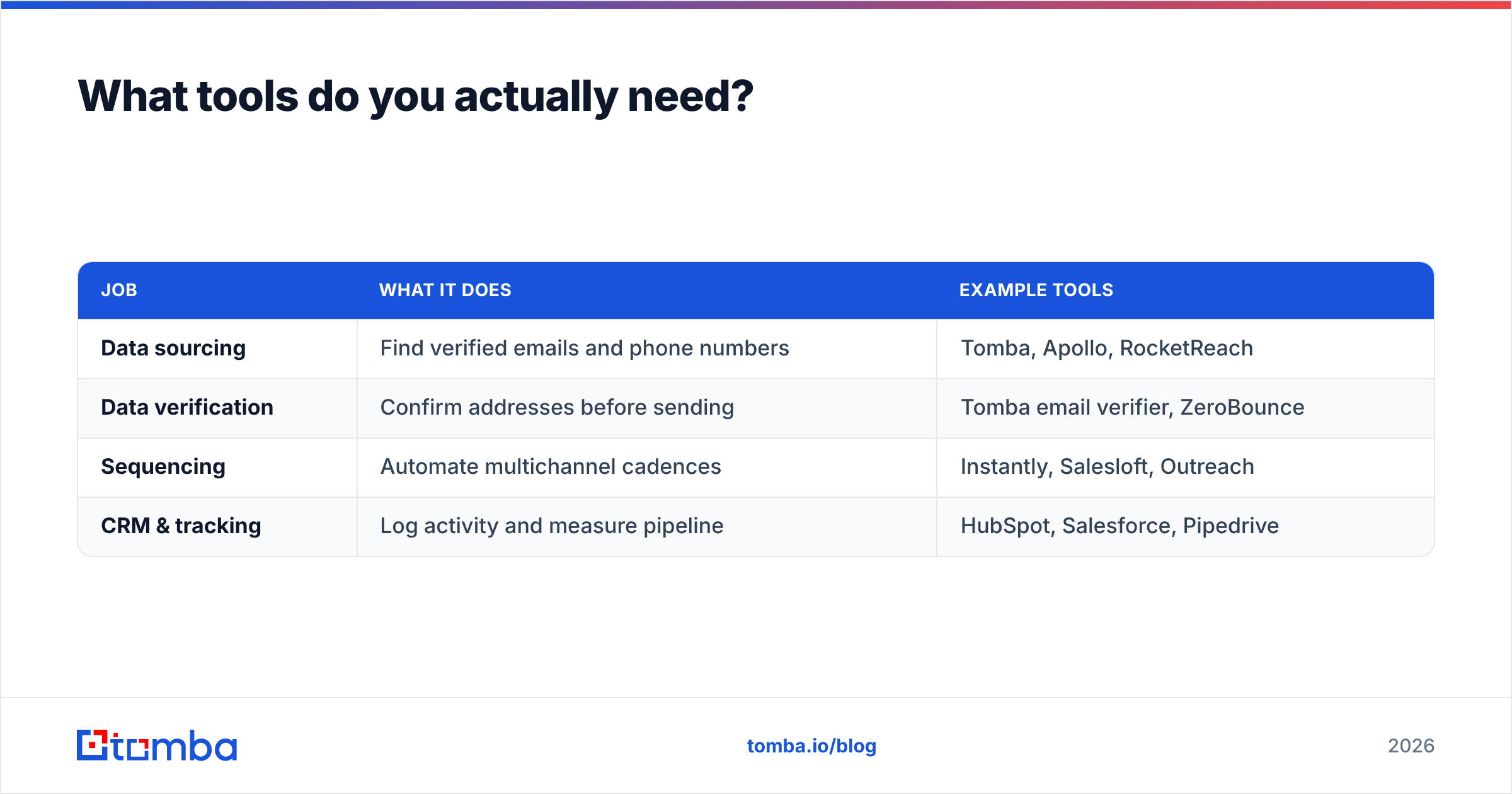
You don't need a 15-tool stack. You need coverage across four jobs: find data, verify data, sequence outreach, and track results. Here's a lean setup and where each piece fits.
| Job | What it does | Example tools |
|---|---|---|
| Data sourcing | Find verified emails and phone numbers | Tomba, Apollo, RocketReach |
| Data verification | Confirm addresses before sending | Tomba email verifier, ZeroBounce |
| Sequencing | Automate multichannel cadences | Instantly, Salesloft, Outreach |
| CRM & tracking | Log activity and measure pipeline | HubSpot, Salesforce, Pipedrive |
Two practical notes. First, sourcing and verification are often the same vendor — doing both in one place keeps your data clean without extra API glue. Second, whatever you pick should integrate with your CRM so reps aren't copy-pasting between tabs. If you want a deeper build-vs-buy comparison, G2's sales intelligence category is a solid neutral starting point.
For scale, running a bulk email finder against an uploaded account list lets you enrich hundreds of contacts at once instead of searching one by one.
How do you measure cold prospecting success?#
Measure outcomes, not activity. "I sent 500 emails" is not a result — it's a to-do list. Track the metrics that connect effort to revenue:
- Reply rate: Percentage of contacts who respond. Healthy cold email sits at 5–10% with good targeting.
- Positive reply rate: Of those replies, how many are interested? This filters out "unsubscribe" from "tell me more."
- Meetings booked: The number that actually predicts pipeline.
- Meeting-to-opportunity rate: How many meetings become qualified deals.
- Bounce rate: Keep it under 2% or your data (and deliverability) needs work.
Review these weekly and change one variable at a time — subject line, target segment, or opening hook — so you know what moved the needle. Prospecting is a testing loop, not a fixed script.
Cold prospecting mistakes to avoid#
Even good reps fall into these traps. Skim the list before your next campaign:
- Sending before verifying. Every unverified send is a coin flip on your reputation.
- Personalizing at the wrong scale. Deep-researching 10 accounts a day beats lightly touching 500 you'll never remember.
- Ignoring the phone. Email-only teams leave the fastest-closing conversations untapped.
- Giving up after one email. Build at least a 4–6 touch sequence across channels.
- Optimizing for volume metrics. More sends with worse data is a step backward, not forward.
Frequently asked questions#
Is cold prospecting still legal in 2026? Yes, B2B cold outreach is legal in most regions when you follow rules like CAN-SPAM (US) and legitimate-interest provisions under GDPR (EU). Always include an opt-out, use business contact data, and honor unsubscribe requests immediately.
How many touches does it take to book a meeting? Most booked meetings come from 5–8 touches across channels. Single-touch outreach converts far lower, so build sequences, not one-off sends.
What's a good reply rate for cold email? With verified data and tight targeting, 5–10% is realistic. Below 2% usually signals a data, targeting, or deliverability problem — not a copy problem.
Should I buy prospecting lists? Avoid pre-built purchased lists. They're stale, shared across dozens of buyers, and full of dead addresses. Build your own from your ICP and verify it instead.
Start with clean, verified data#
Cold prospecting rewards preparation. The teams winning in 2026 aren't sending more — they're targeting better, personalizing more, and sending to real, verified people across multiple channels.
That all starts with your list. Before you write a single sequence, use the Tomba Email Finder to pull accurate, verified business emails for your ICP, then confirm them so every send lands in a real inbox. Check the Tomba pricing — the free tier gives you 25 searches a month to test it against your current data, and paid plans start at $49/mo when you're ready to scale. Fix the inputs, and the outbound takes care of itself.
Related guides#
Ready to find emails that actually work?
Join 150,000+ professionals who stopped guessing and started sending. Free credits on signup — no credit card required.
Get the Tomba newsletter
Practical outbound tactics and product updates — once every two weeks.
About the author