Cold Selling in 2026: The Complete Guide to Doing It Right
Cold selling still closes deals in 2026 — if you swap spray-and-pray for accurate data, sharp targeting, and relevance. Here's the exact playbook.
Cold selling is not dead. Lazy cold selling is dead. The difference in 2026 comes down to whether you reach the right person, with the right message, at an address that actually receives it.
If your open rates are cratering and your reps hate the phone, the problem usually isn't the channel — it's the inputs. This guide breaks down what cold selling actually is today, why most teams get it wrong, and the exact process that still books meetings.
TL;DR#
- Cold selling is proactively reaching prospects who have no prior relationship with you — by email, phone, or social — to start a sales conversation.
- It still works in 2026, but only when built on accurate contact data, tight targeting, and genuine relevance. Volume alone gets you flagged as spam.
- The biggest hidden killer is bad data: bounced emails and wrong numbers wreck both deliverability and rep morale.
- A repeatable stack — clean list → verified contacts → personalized multichannel sequence → measured follow-up — outperforms raw send volume every time.
- Tools like Tomba Email Finder exist to fix the data layer so your outreach lands where it should.
What is cold selling?#
Cold selling is the practice of initiating a sales conversation with someone who hasn't asked to hear from you and has no existing relationship with your company. Think of it like knocking on a stranger's door versus visiting a friend who invited you over — the friend (a warm inbound lead) already expects you; the stranger doesn't.
The "cold" part is the lack of prior context. The "selling" part is that you're not just marketing at scale — you're trying to open a one-to-one dialogue that moves toward a deal.
Cold selling spans three main channels:
- Cold email — the workhorse of B2B outbound, cheap to scale but easy to ruin with bad data.
- Cold calling — still highly effective for high-ticket or complex sales where a live conversation shortcuts weeks of back-and-forth.
- Social selling — using LinkedIn and other networks to warm up prospects before or alongside direct outreach. If you want the fundamentals, start with social selling.
The channel matters less than the fundamentals underneath it: are you reaching a real person who fits your ideal customer profile, and do you have a reason to be in their inbox?
Is cold selling still worth it in 2026?#
Yes — cold selling remains one of the most cost-effective ways to generate pipeline, provided you treat it as a precision instrument rather than a numbers cannon.
Here's the honest case for and against:
| Factor | The reality in 2026 |
|---|---|
| Cost per lead | Still far cheaper than paid ads for B2B; a good list plus a sender costs less than one PPC click campaign |
| Deliverability | Harder than ever — Google and Microsoft aggressively filter bulk senders, so clean lists are non-negotiable |
| Personalization bar | Raised sharply; generic "Hi {FirstName}" templates get ignored or reported |
| Buyer fatigue | Real — buyers get more outreach, so relevance beats volume decisively |
| Multichannel lift | High — email + LinkedIn + a well-timed call outperforms any single channel |
The teams complaining that "cold outreach is dead" are almost always the ones blasting purchased lists to unverified addresses. They get spam complaints, their domain reputation tanks, and their genuinely good messages never reach the inbox. That's a self-inflicted wound, not proof the channel is broken.
Why does most cold selling fail?#
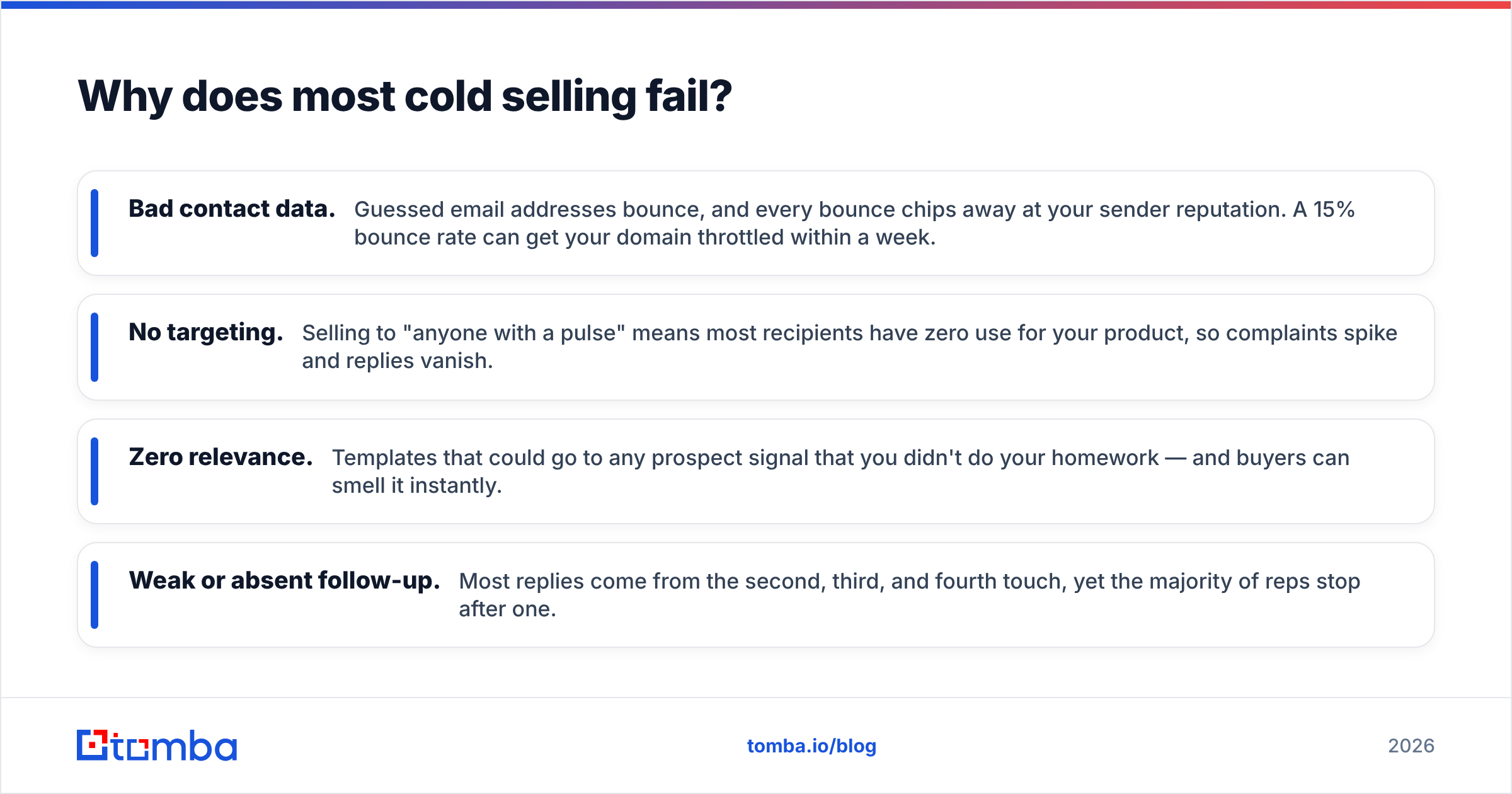
Most cold selling fails at the data layer, long before anyone judges the copy. You can write the sharpest email in your industry, but if it bounces or lands in front of the wrong person, none of it matters.
The four most common failure points:
- Bad contact data. Guessed email addresses bounce, and every bounce chips away at your sender reputation. A 15% bounce rate can get your domain throttled within a week.
- No targeting. Selling to "anyone with a pulse" means most recipients have zero use for your product, so complaints spike and replies vanish.
- Zero relevance. Templates that could go to any prospect signal that you didn't do your homework — and buyers can smell it instantly.
- Weak or absent follow-up. Most replies come from the second, third, and fourth touch, yet the majority of reps stop after one.
Notice that three of these four are fixable with process and data, not talent. That's good news — it means cold selling performance is engineerable.
The data problem, specifically#
When your list is wrong, the damage compounds. Bounces hurt deliverability. Wrong-fit contacts hurt reply rates. Duplicate or stale records waste rep hours. This is why serious outbound teams verify before they send — running addresses through an email verifier to strip out invalids and catch-alls before the first message ever goes out.
How do you build a cold selling process that works?#
Build your cold selling engine in five stages, in order. Skipping the early stages to "just start sending" is exactly what breaks most programs.
- Define the ICP. Nail down company size, industry, geography, and the specific job titles that feel your pain. A tight ideal customer profile makes every later step easier.
- Source the contacts. Use domain search to pull the right people at target accounts, or a bulk email finder to build lists at scale from a set of companies.
- Verify everything. Clean the list. Remove invalids, role addresses you don't want, and risky catch-alls. This single step protects your deliverability more than any warmup trick.
- Sequence across channels. Combine email, a LinkedIn touch, and — for high-value accounts — a phone call. Space the touches out and vary the angle.
- Measure and iterate. Track reply rate and meetings booked, not just opens. Kill what doesn't work; double down on what does.
Cold email vs. cold calling vs. social selling#
Each channel earns its place for different deal types. Here's how they compare:
| Channel | Best for | Speed to reach volume | Personalization effort | Typical response window |
|---|---|---|---|---|
| Cold email | Scalable top-of-funnel, mid-market | Fast | Medium | 1–5 days |
| Cold calling | High-ticket, complex, enterprise | Slow | High | Immediate |
| Social selling | Relationship-led, long sales cycles | Medium | High | Days to weeks |
The best-performing teams don't pick one — they layer them. A LinkedIn view and connection request before your email arrives makes the email feel less cold. A short call referencing your earlier email lands better than a pure cold dial. The response rate climbs when a prospect has seen your name more than once.
What tools do you need for modern cold selling?#
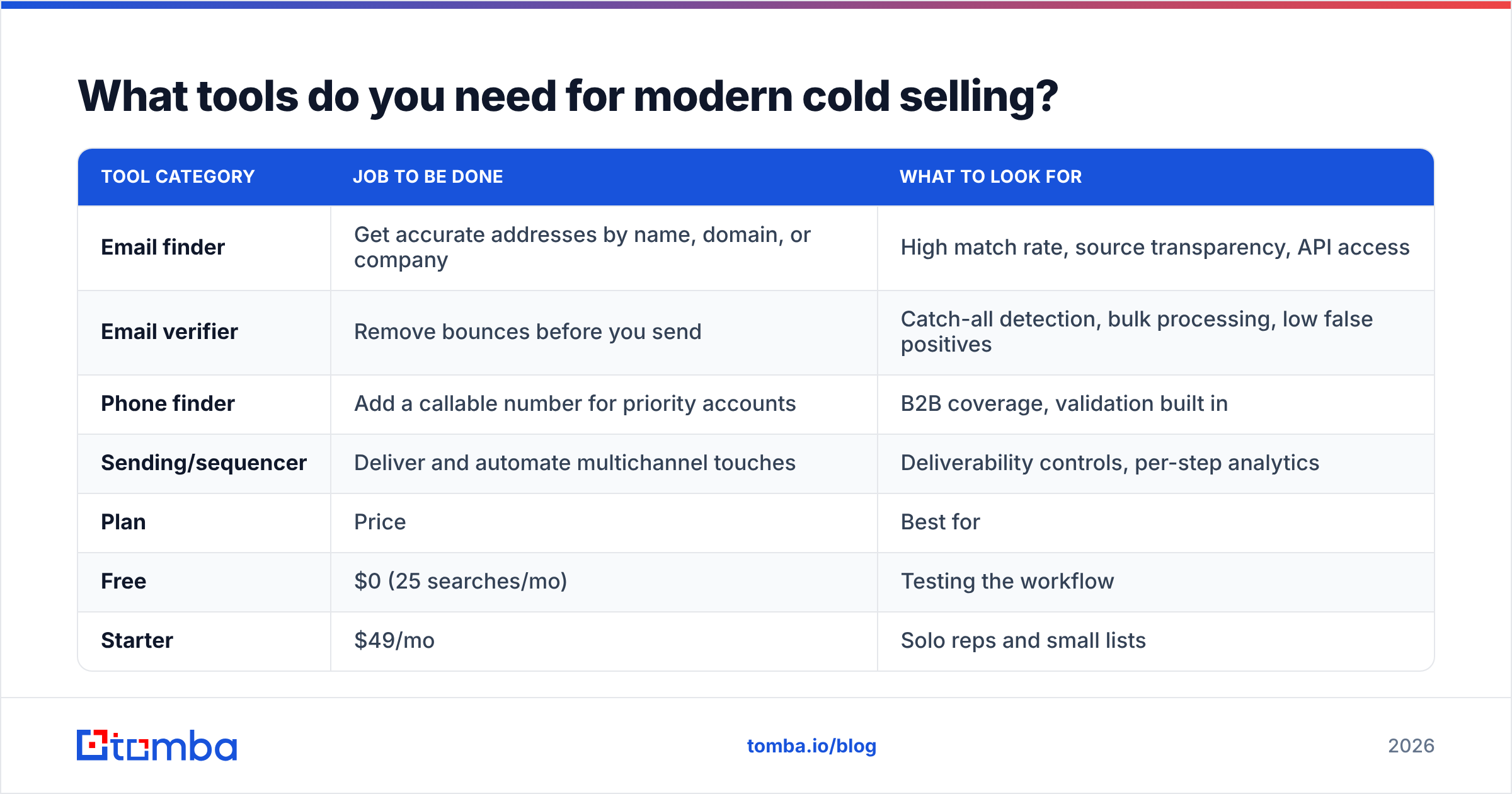
You need three categories of tooling: something to find contacts, something to verify them, and something to send and sequence. Many reps overspend on the third and underspend on the first two — which is backwards, because the first two decide whether the third even works.
| Tool category | Job to be done | What to look for |
|---|---|---|
| Email finder | Get accurate addresses by name, domain, or company | High match rate, source transparency, API access |
| Email verifier | Remove bounces before you send | Catch-all detection, bulk processing, low false positives |
| Phone finder | Add a callable number for priority accounts | B2B coverage, validation built in |
| Sending/sequencer | Deliver and automate multichannel touches | Deliverability controls, per-step analytics |
For the data layer, Tomba covers finding, verifying, and enriching in one place. Its Tomba API lets you wire lookups directly into your CRM or outbound tool, so reps never touch a spreadsheet of guessed addresses. If you also work priority accounts by phone, the phone finder adds validated B2B numbers to the same record.
On the sending side, you'll compare platforms like Instantly, Apollo, and others — but remember, none of them fix a bad list. Deliverability tooling only preserves the quality of the data you feed it.
How much does the data layer cost?#
Pricing scales with volume, and the data layer is usually the cheapest part of your stack relative to the pipeline it protects. Tomba's plans give you a realistic sense of what accurate contact data costs a small-to-mid team:
| Plan | Price | Best for |
|---|---|---|
| Free | $0 (25 searches/mo) | Testing the workflow |
| Starter | $49/mo | Solo reps and small lists |
| Growth | $99/mo | Active outbound teams |
| Pro | $249/mo | High-volume, multi-rep prospecting |
| Enterprise | Custom | Large orgs with API-driven pipelines |
Full Tomba pricing is public, so you can map credits to your actual send volume before committing.
How do you write cold outreach that gets replies?#
Write to one person about one problem, and earn the reply before you ask for the meeting. The reps who win aren't better writers — they're more relevant.
A few rules that consistently lift reply rates:
- Lead with them, not you. Your first line should reference their world — a role, a trigger event, a company change — not your product.
- Keep it short. Under 90 words for a first email. If they have to scroll, you've lost.
- One clear ask. A single, low-friction call to action ("Worth a 15-minute look?") beats a menu of options.
- No fake personalization. Merge fields aren't personalization. A specific, true observation is.
- Follow up with new value. Each follow-up should add an angle, not just "bumping this to the top of your inbox."
If you want a starting point, grab a few cold email templates and rewrite them in your own voice — never send them verbatim, because your competitors are sending the same ones.
For authoritative, ongoing guidance on outreach that respects the inbox, HubSpot's sales blog and G2's buyer reviews are both worth bookmarking — the first for tactics, the second for vetting the tools you'll rely on.
What metrics tell you cold selling is working?#
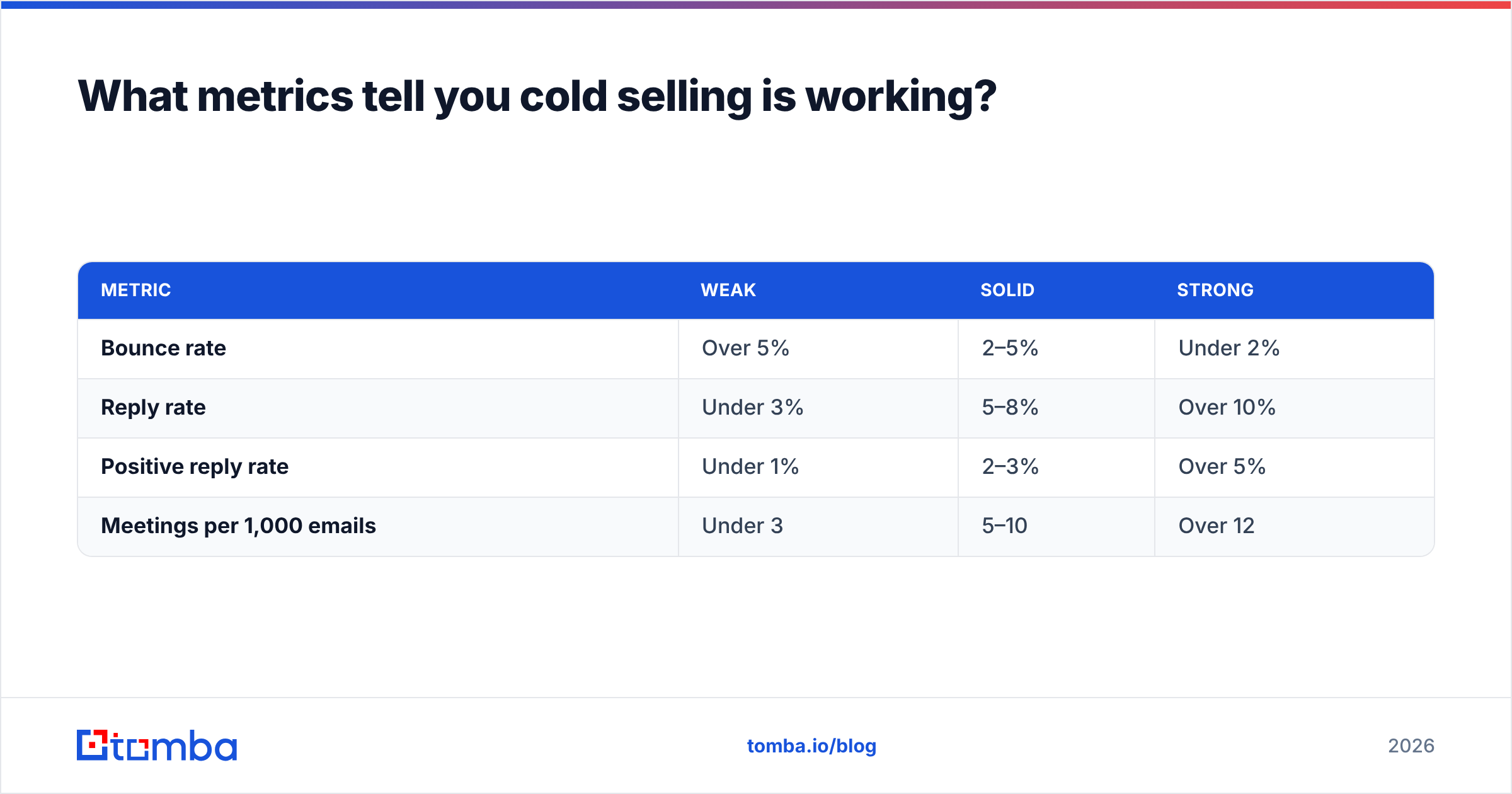
Track reply rate and meetings booked as your north-star metrics — opens and clicks are increasingly unreliable and easy to fake yourself into feeling good.
A healthy modern benchmark set:
| Metric | Weak | Solid | Strong |
|---|---|---|---|
| Bounce rate | Over 5% | 2–5% | Under 2% |
| Reply rate | Under 3% | 5–8% | Over 10% |
| Positive reply rate | Under 1% | 2–3% | Over 5% |
| Meetings per 1,000 emails | Under 3 | 5–10 | Over 12 |
If your bounce rate is high, stop everything and fix your data — that number poisons every other metric downstream. Clean lists routinely pull bounce rates under 2%, which keeps your domain trusted and your good emails delivered. This is exactly where verification pays for itself.
Common cold selling mistakes to avoid#
Avoid these and you'll already be ahead of most outbound teams:
- Buying scraped lists. They're stale, over-mailed, and full of spam traps. Build targeted lists instead.
- Skipping verification. Sending to unverified addresses is the fastest way to a burned domain.
- Sending from your main domain. Use a dedicated sending domain so a mistake doesn't torch your primary reputation.
- One-and-done outreach. No follow-up means leaving most of your meetings on the table.
- Ignoring the phone entirely. For high-value accounts, a live conversation still converts better than any email chain.
The bottom line#
Cold selling in 2026 rewards precision and punishes laziness. The channel works — the spray-and-pray approach to it doesn't. Get your ICP tight, your list clean, your message relevant, and your follow-up disciplined, and cold outreach remains one of the highest-ROI plays in B2B.
Everything starts with reaching a real person at a real address. Before you write another sequence, fix the data layer: use Tomba Email Finder to source accurate, verified contacts by name, domain, or company — then send with confidence knowing your best messages will actually land. Start free with 25 searches and see the difference clean data makes to your reply rate.
Related guides#
Ready to find emails that actually work?
Join 150,000+ professionals who stopped guessing and started sending. Free credits on signup — no credit card required.
Get the Tomba newsletter
Practical outbound tactics and product updates — once every two weeks.
About the author