Business Cold Email: The 2026 Playbook That Books Meetings
A no-fluff 2026 guide to writing business cold emails that actually get replies — structure, templates, deliverability, and the data that makes it work.
Business Cold Email: The 2026 Playbook That Books Meetings
Cold email is not dead — sloppy cold email is. In 2026, inboxes are filtered harder, buyers are more skeptical, and the gap between a 1% reply rate and a 12% reply rate comes down to a handful of decisions you make before you ever hit send.
This guide breaks down what a modern business cold email actually looks like: the structure, the data that feeds it, the deliverability rules you can't ignore, and templates you can adapt today.
TL;DR#
- A business cold email wins on relevance and accuracy, not volume — bad data sinks campaigns before copy ever matters.
- Keep it under 120 words, lead with the prospect (not your company), and ask for one small commitment.
- Deliverability is half the battle: verified addresses, warmed domains, and proper authentication keep you out of spam.
- A 3–4 email sequence outperforms a single send by 2–3x; most replies come from follow-ups.
- Tools like a reliable email finder and email verifier protect your sender reputation and lift reply rates.
What is a business cold email?#
A business cold email is an unsolicited but targeted message sent to a professional contact you have no prior relationship with, for a specific business reason — booking a demo, opening a partnership, recruiting, or starting a sales conversation.
Think of it like knocking on the right door at the right time with a reason the person actually cares about. A spam blast is knocking on every door on the street yelling the same sentence. The first gets invited in; the second gets the police called.
The legal distinction matters too. A legitimate business cold email is permitted under CAN-SPAM and GDPR's "legitimate interest" basis when it's relevant, identifies you clearly, and offers an easy opt-out. A scraped, irrelevant blast is not.
Why do most cold emails fail?#
Most cold emails fail before the copy is even read. Here are the failure points, in order of how often they kill a campaign:
- Bad data. You emailed the wrong person, a role that left the company, or an address that bounces. Every bounce damages your sender reputation.
- No relevance. The message is about you ("We're the leading platform for...") instead of the reader's problem.
- Wrong ask. You requested 30 minutes from a stranger instead of a one-line reply.
- Deliverability issues. The email landed in spam because your domain wasn't authenticated or warmed up.
- No follow-up. You sent once and gave up. Most positive replies arrive on email two or three.
)
Notice that two of the top four reasons are data problems, not writing problems. You can have flawless copy and still fail if half your list bounces. That's why serious senders fix their data layer first — and it's where most "cold email doesn't work" complaints actually originate.
What does the anatomy of a high-reply business cold email look like?#
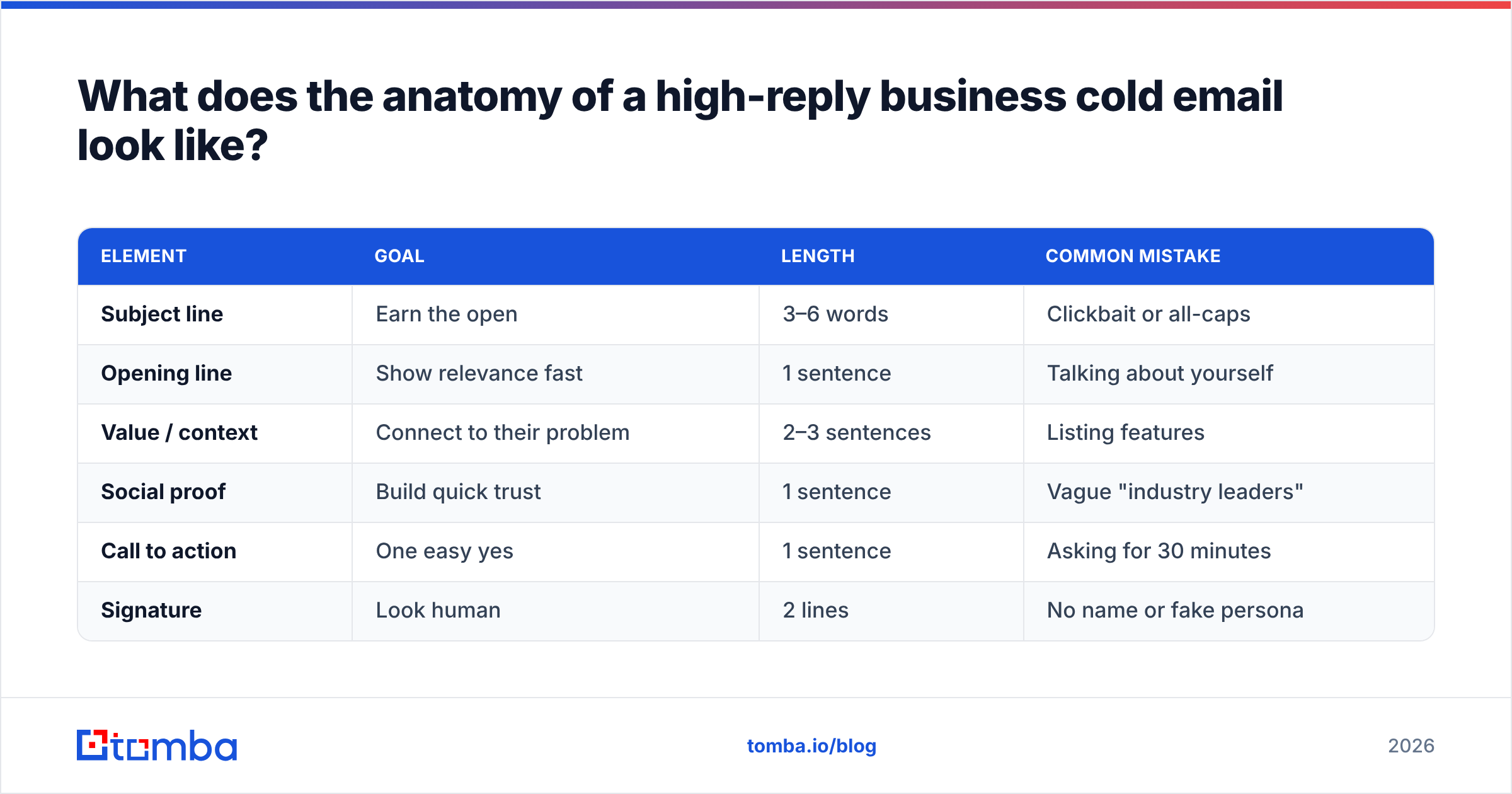
Every email that consistently books meetings shares the same skeleton. Here's the breakdown with word-count targets:
| Element | Goal | Length | Common mistake |
|---|---|---|---|
| Subject line | Earn the open | 3–6 words | Clickbait or all-caps |
| Opening line | Show relevance fast | 1 sentence | Talking about yourself |
| Value / context | Connect to their problem | 2–3 sentences | Listing features |
| Social proof | Build quick trust | 1 sentence | Vague "industry leaders" |
| Call to action | One easy yes | 1 sentence | Asking for 30 minutes |
| Signature | Look human | 2 lines | No name or fake persona |
The order matters. Lead with them, earn the right to talk about you, then make the next step almost effortless. If your first sentence contains the word "I" or your company name, rewrite it.
Subject lines that get opened#
Short and specific beats clever. Aim for 3–6 words that read like an internal note, not a marketing campaign:
- "Quick question about {{company}} hiring"
- "{{competitor}} comparison for your team"
- "Idea for Q3 pipeline"
Avoid spam triggers like "free," "guarantee," "act now," and excessive punctuation. Run drafts through a free subject line generator if you're stuck, then A/B test two variants per campaign.
How do you write the body? (with templates)#
Keep the whole email scannable on a phone — most are opened on mobile. Here are two templates that hold up across industries.
Template 1 — The problem-trigger opener
Subject: Quick question about {{company}}'s onboarding
Hi {{first_name}},
Saw {{company}} just opened three new CS roles — usually a sign onboarding volume is climbing fast.
We help teams like {{similar_company}} cut new-customer ramp time by about 30% without adding headcount.
Worth a quick look? Happy to send a 2-minute video — no call needed.
{{your_name}}
Template 2 — The direct value ask
Subject: Idea for {{company}}'s outbound
Hi {{first_name}},
Most outbound teams I talk to lose 20–30% of their list to bad email data before a single reply comes in.
We fixed that for {{similar_company}} and their reply rate doubled in six weeks.
Open to me sending the one-page breakdown?
{{your_name}}
Both follow the same logic: a relevant trigger, a quantified outcome, light proof, and a low-friction ask. Personalize the first line and the company reference — those two fields drive most of the lift. For more reusable structures, browse a library of cold email templates and adapt rather than copy verbatim.
Why does data accuracy decide your reply rate?#
Your reply rate is capped by your data quality, full stop. If 25% of your list bounces, you've not only wasted those sends — you've signaled to mailbox providers that you're a careless sender, which pushes your good emails toward spam too.
Here's the chain reaction: high bounce rate → damaged sender reputation → more emails filtered → lower deliverability → lower reply rate across the entire campaign. One bad list poisons the well.
This is why the smartest move in 2026 isn't a cleverer hook — it's clean, verified contact data sourced the right way. Find the correct decision-maker with a domain search, then confirm each address is live with an email verifier before it enters your sequence.
)
A practical rule: never send to an address you haven't verified, and re-verify any list older than 90 days. People change jobs constantly, and a contact that was valid last quarter may bounce today.
Which tools do you actually need?#
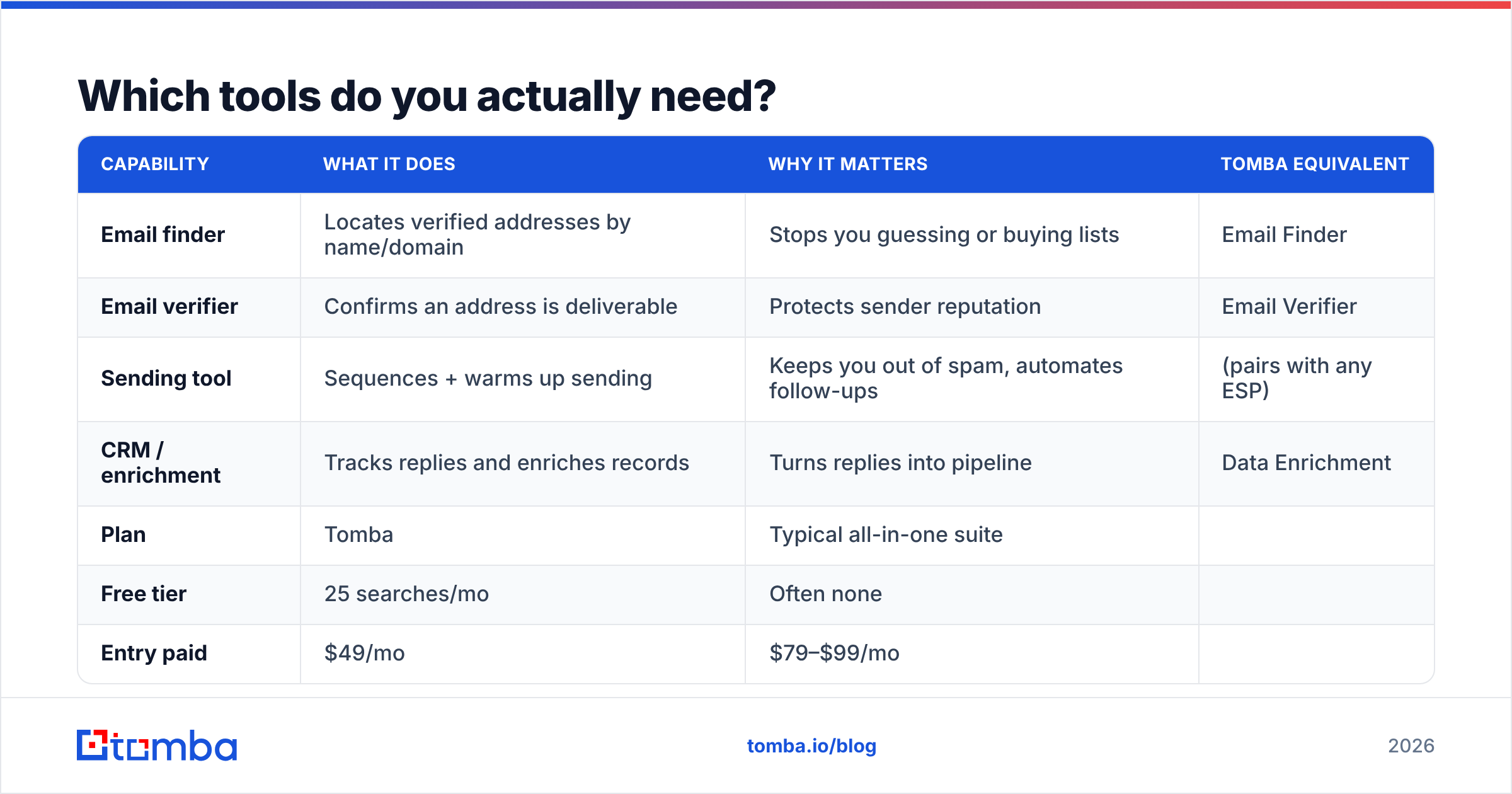
You don't need a 12-tool stack. A lean business cold email operation runs on four capabilities. Here's how the core categories compare:
| Capability | What it does | Why it matters | Tomba equivalent |
|---|---|---|---|
| Email finder | Locates verified addresses by name/domain | Stops you guessing or buying lists | Email Finder |
| Email verifier | Confirms an address is deliverable | Protects sender reputation | Email Verifier |
| Sending tool | Sequences + warms up sending | Keeps you out of spam, automates follow-ups | (pairs with any ESP) |
| CRM / enrichment | Tracks replies and enriches records | Turns replies into pipeline | Data Enrichment |
For data accuracy specifically, here's how Tomba's plans line up against the kind of all-in-one platforms teams often overpay for:
| Plan | Tomba | Typical all-in-one suite |
|---|---|---|
| Free tier | 25 searches/mo | Often none |
| Entry paid | $49/mo | $79–$99/mo |
| Mid tier | $99/mo (Growth) | $149+/mo |
| Verification included | Yes | Sometimes add-on |
| API access | Yes, all paid plans | Higher tiers only |
You can see the full breakdown on the Tomba pricing page. The point isn't that cheaper is always better — it's that you should pay for accuracy and verification, not for bundled features you'll never open.
How do you keep cold emails out of spam?#
Deliverability is the unglamorous half of cold email, and it's where most beginners lose. You can master copy and still never get read if mailbox providers don't trust your domain.
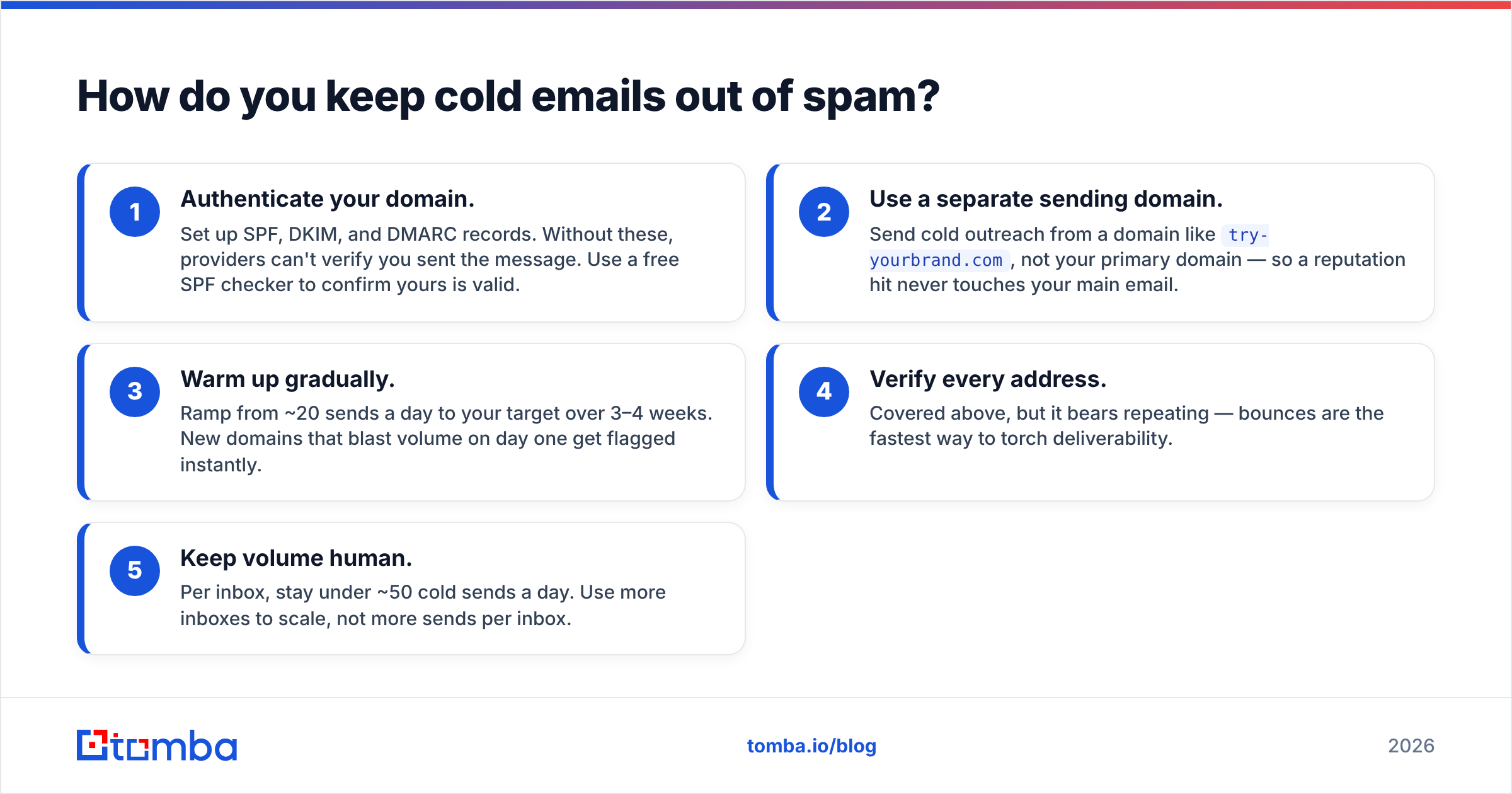
The non-negotiable checklist:
- Authenticate your domain. Set up SPF, DKIM, and DMARC records. Without these, providers can't verify you sent the message. Use a free SPF checker to confirm yours is valid.
- Use a separate sending domain. Send cold outreach from a domain like
try-yourbrand.com, not your primary domain — so a reputation hit never touches your main email. - Warm up gradually. Ramp from ~20 sends a day to your target over 3–4 weeks. New domains that blast volume on day one get flagged instantly.
- Verify every address. Covered above, but it bears repeating — bounces are the fastest way to torch deliverability.
- Keep volume human. Per inbox, stay under ~50 cold sends a day. Use more inboxes to scale, not more sends per inbox.
Google and Yahoo's bulk sender requirements made authentication mandatory, not optional. If you're sending without DMARC in 2026, you're already losing inbox placement.
How long should a cold email sequence be?#
Three to four emails, spaced 3–4 business days apart, is the sweet spot. The data is consistent across years of outbound: the majority of positive replies come after the first email.
A reliable cadence:
- Email 1 — The pitch. Your strongest, most personalized message.
- Email 2 (day 4) — The angle shift. Same problem, new framing or a piece of proof.
- Email 3 (day 8) — The short nudge. Two lines. "Worth exploring, or should I close this out?"
- Email 4 (day 14) — The breakup. Polite exit that often triggers a reply on its own.
Don't just resend the same email. Each touch should add something — a case study, a different pain point, a relevant news trigger. And always stop the sequence the moment someone replies; nothing kills trust like a "just following up" after a person already answered.
How do you measure if it's working?#
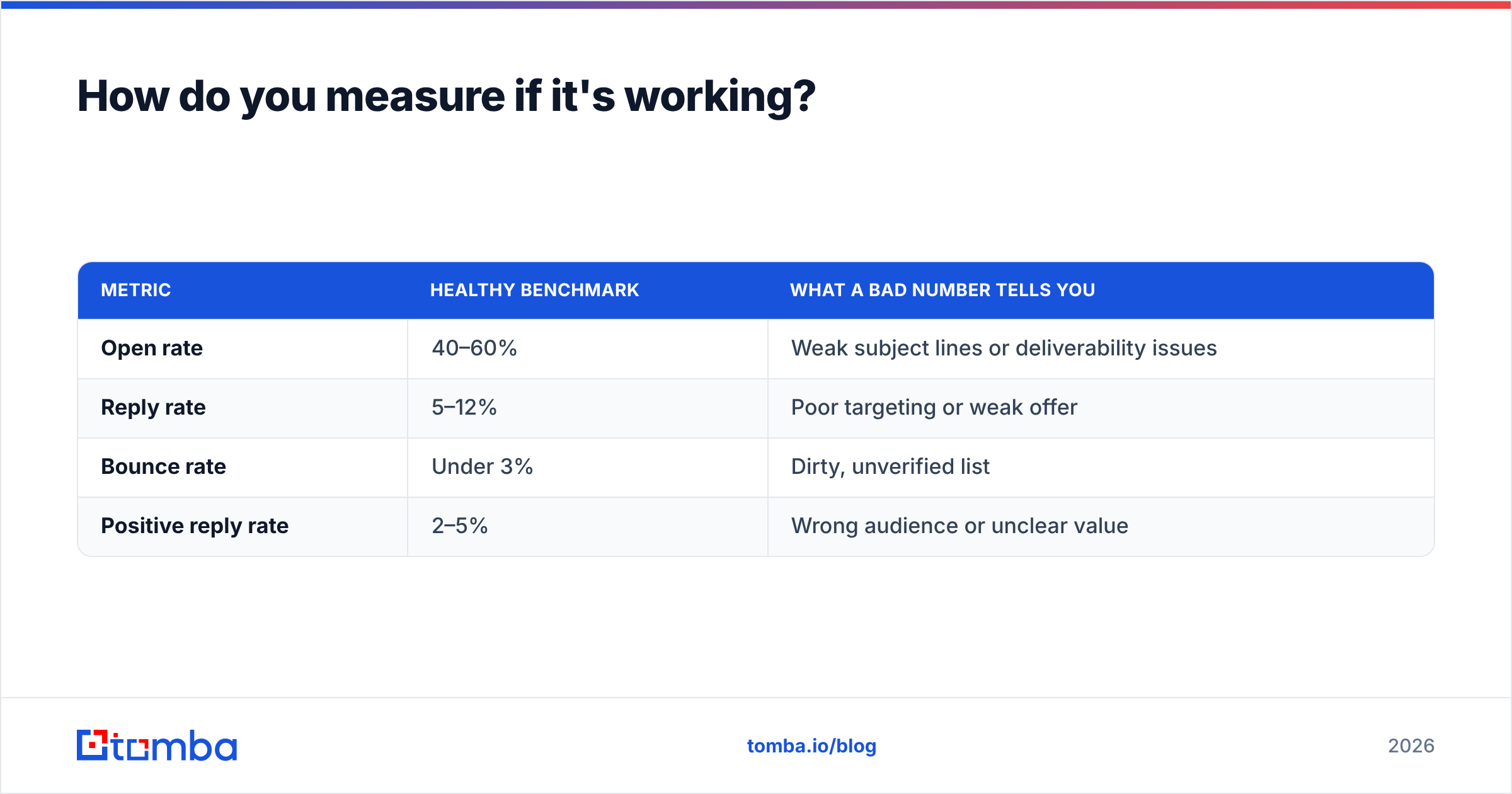
Track these four numbers per campaign and you'll know exactly where to fix:
| Metric | Healthy benchmark | What a bad number tells you |
|---|---|---|
| Open rate | 40–60% | Weak subject lines or deliverability issues |
| Reply rate | 5–12% | Poor targeting or weak offer |
| Bounce rate | Under 3% | Dirty, unverified list |
| Positive reply rate | 2–5% | Wrong audience or unclear value |
If your bounce rate is above 3%, stop everything and clean your list — that's the highest-priority fix because it's hurting every other metric. A high open rate but low reply rate points at your offer, not your data. Diagnosing in this order saves weeks of guessing.
What's the biggest mistake in 2026?#
Treating cold email as a volume game. The teams winning right now send fewer, better-targeted emails to verified contacts, with sharp personalization and disciplined follow-up. The spray-and-pray crowd is getting filtered into oblivion as AI spam detection gets smarter every quarter.
Relevance scales worse than volume — and that's exactly why it works. When most senders automate away their personalization, the ones who keep it stand out by contrast. Quality of data and quality of message are now your only durable advantages.
Start with the data layer#
The fastest improvement you can make to your business cold email program isn't a new template — it's accurate contact data. Before you obsess over subject lines, make sure you're emailing the right person at a verified address.
Tomba's Email Finder locates verified professional emails by name, domain, or company, and pairs with built-in verification so dead addresses never reach your sequence. That means lower bounce rates, stronger sender reputation, and reply rates that reflect your message — not your list's decay. Start free with 25 searches a month, then scale on a plan that fits when your pipeline does. Fix the data, and the copy finally gets a fair shot.
// get started
Find, verify and enrich your first contacts today
Start on the free plan with 25 searches a month, then scale when your team is ready.
Free plan · No credit card required · GDPR & CCPA
// about the author