Cold Texting in 2026: The Complete B2B Sales Playbook
Cold texting can out-reply cold email—but one wrong move gets you a TCPA complaint. Here's how B2B teams run compliant, high-converting SMS outreach in 2026.
Cold texting is the practice of sending sales or outreach messages by SMS to prospects you have not spoken with before. It gets read faster than any email you will ever send — and it can get you fined faster too. This guide shows you how to run it the right way.
TL;DR#
- Cold texting = SMS outreach to prospects who haven't replied yet. Open rates sit near 98%, and most texts are read within three minutes — numbers cold email cannot touch.
- Consent is the whole game. In the US, the TCPA and 10DLC registration rules mean texting without a lawful basis can cost you $500–$1,500 per message. This is the single biggest difference from cold email.
- B2B has more room than B2C, but "business number" is not a free pass. You still need a defensible opt-in or an existing business relationship.
- Copy rules are inverted from email: short, one idea, one link, clear opt-out, and a real human name. 160 characters is your canvas.
- Texting works best as a follow-up channel, layered onto verified email and phone data — not as a cold-from-scratch blast.
What Is Cold Texting?#
Cold texting is sending a text message to someone who has not opted into hearing from you, with the goal of starting a sales conversation. Think of it like knocking on a door instead of mailing a letter: the person answers almost immediately, but they also notice the interruption a lot more.
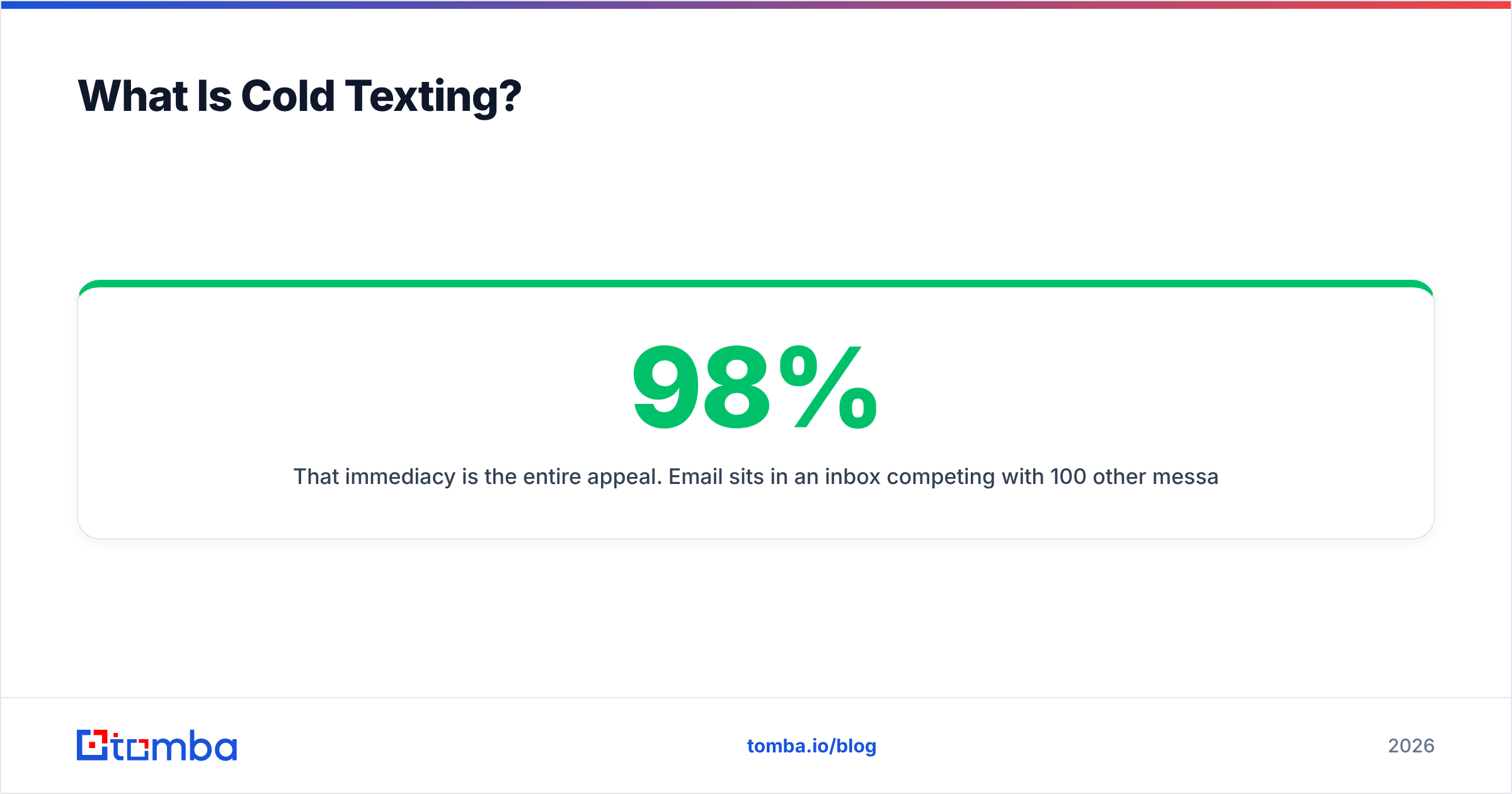
That immediacy is the entire appeal. Email sits in an inbox competing with 100 other messages. A text buzzes in a pocket. According to widely cited industry data, SMS open rates hover around 98% versus roughly 20% for cold email, and reply rates can run 5–8x higher. When you have a genuinely relevant offer and a warm-ish list, that gap is enormous.
The catch is that texting is a permission-based channel by law in most markets, while cold email operates under a lighter "opt-out" regime (CAN-SPAM in the US). So the tactics that make cold email cheap and scalable — buy a list, blast it, sort the replies — are exactly the tactics that turn cold texting into legal exposure.
How Is Cold Texting Different From Cold Email?#
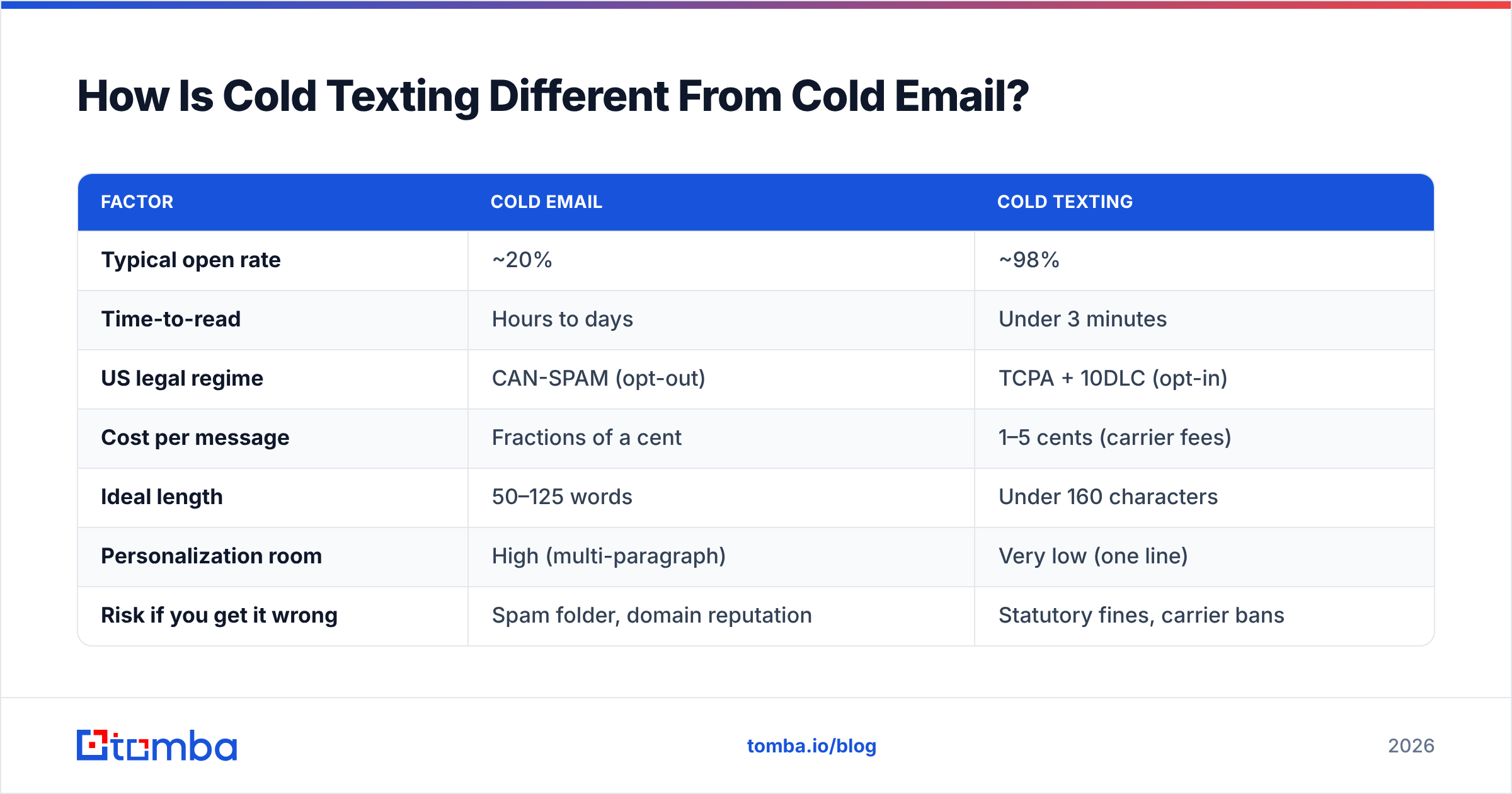
The two channels look similar on a spreadsheet — a contact, a message, a CTA — but they behave differently in almost every dimension that matters.
| Factor | Cold Email | Cold Texting |
|---|---|---|
| Typical open rate | ~20% | ~98% |
| Time-to-read | Hours to days | Under 3 minutes |
| US legal regime | CAN-SPAM (opt-out) | TCPA + 10DLC (opt-in) |
| Cost per message | Fractions of a cent | 1–5 cents (carrier fees) |
| Ideal length | 50–125 words | Under 160 characters |
| Personalization room | High (multi-paragraph) | Very low (one line) |
| Risk if you get it wrong | Spam folder, domain reputation | Statutory fines, carrier bans |
The practical takeaway: cold email forgives volume, cold texting punishes it. You can send 500 cold emails and the worst realistic outcome is a burned sending domain. Send 500 non-compliant cold texts and you can trigger a class-action-shaped problem. That risk profile should shape everything about how you build the program.
It also means the two channels are complements, not substitutes. The strongest outbound plays use email and phone to establish contact and consent, then use SMS to accelerate the conversation once there's a thread of engagement. If you want to see how the channels stack in a full sequence, our breakdown of LinkedIn outreach covers the multi-touch logic that texting plugs into.
Is Cold Texting Legal?#
Short answer: it can be, but only with a lawful basis — and "I found their number" is not one. This is the part most people get wrong, so read it carefully and then talk to your own counsel.
In the United States, the Telephone Consumer Protection Act (TCPA) governs texts sent using automated systems. The Federal Communications Commission treats SMS as a form of "call" under the statute. Damages are $500 per message, trebled to $1,500 for willful violations. On top of that, carriers enforce 10DLC (10-digit long code) registration through The Campaign Registry — unregistered or misbehaving traffic gets filtered or blocked outright.
For B2B specifically, the picture is more permissive than B2C but not open season:
- Existing business relationship — if the prospect gave you their number in a business context (a demo request, a downloaded whitepaper with a phone field, a trade-show badge scan), you generally have a stronger footing.
- Prior express consent — an explicit opt-in ("text me pricing") is the gold standard and the only thing that fully protects you for promotional content.
- Publicly listed business numbers — a main office line published for the purpose of being contacted carries less risk than a personal cell, but courts have gone both ways, so treat it as yellow-light, not green.
- Always include an opt-out — every message needs a clear "Reply STOP to opt out," and you must honor it instantly and permanently.
You can read the FCC's own summary of TCPA rules on the FCC consumer site, and the Federal Trade Commission publishes guidance on marketing-message compliance. Both are worth bookmarking before you send message one.
What Does a Good Cold Text Look Like?#
A good cold text respects the medium: it is short, human, and single-purpose. You are not trying to close in a text — you are trying to earn a reply.
Here's the anatomy of a message that works:
- Name the person and yourself, fast. "Hi Dana, this is Sam from Northwind." No mystery numbers.
- One relevant reason, one sentence. Reference a trigger — a funding round, a job posting, a tool they use — not a generic pitch.
- One question or one link, never both. A single call to action. "Worth a quick look?" beats a paragraph of options.
- A visible opt-out. "Reply STOP to opt out." Non-negotiable, every time.
- Real send times. Business hours in the recipient's timezone. A 7 a.m. Sunday text is a complaint waiting to happen.
Compare two versions:
Weak: "Hi! We help companies grow revenue with our all-in-one platform. Do you have 15 minutes this week to hop on a call to learn more about how we can 10x your pipeline?? Book here: [link]"
Strong: "Hi Dana, Sam at Northwind here — saw you're hiring 3 SDRs. We cut ramp time for teams doing the same. Worth a 2-line reply? (Reply STOP to opt out.)"
The strong version is under 160 characters, references a real signal, asks for almost nothing, and stays compliant. That's the bar. If you want templates to adapt, our library of cold email templates translates cleanly to SMS when you trim them to a single line.
How Do You Build a Cold Texting List the Right Way?#
The quality of your program is decided before you send anything — at the data layer. Garbage phone data means wrong numbers, disconnected lines, and personal cells you had no business dialing. That's how you generate complaints instead of conversations.
A defensible workflow looks like this:
- Start from verified professional identity, not scraped cells. Build your target list from company and role data, then attach contact points you can source and document.
- Enrich with business phone numbers, and log where each number came from. Provenance is your defense if anyone challenges the outreach. Tomba's phone finder is built to return business numbers tied to a verified contact, not random mobile digits.
- Validate every number before you send. A dead or misformatted number wastes a carrier-metered message and can hurt your 10DLC standing. Run the list through a phone validator first.
- Layer email as the consent bridge. Use a verified email touch to invite opt-in, so the text itself lands on someone who's already raised a hand. Pair the email finder with an email verifier to keep that first touch clean.
- Deduplicate and suppress. Remove anyone who opted out, anywhere, and scrub duplicates so nobody gets the same message twice.
The point is that cold texting is only as safe as the data underneath it. If you can't say where a number came from and why you're allowed to text it, you shouldn't send. Clean, sourced data enrichment is what separates a program that books meetings from one that books lawsuits.
What Metrics Actually Matter in Cold Texting?#
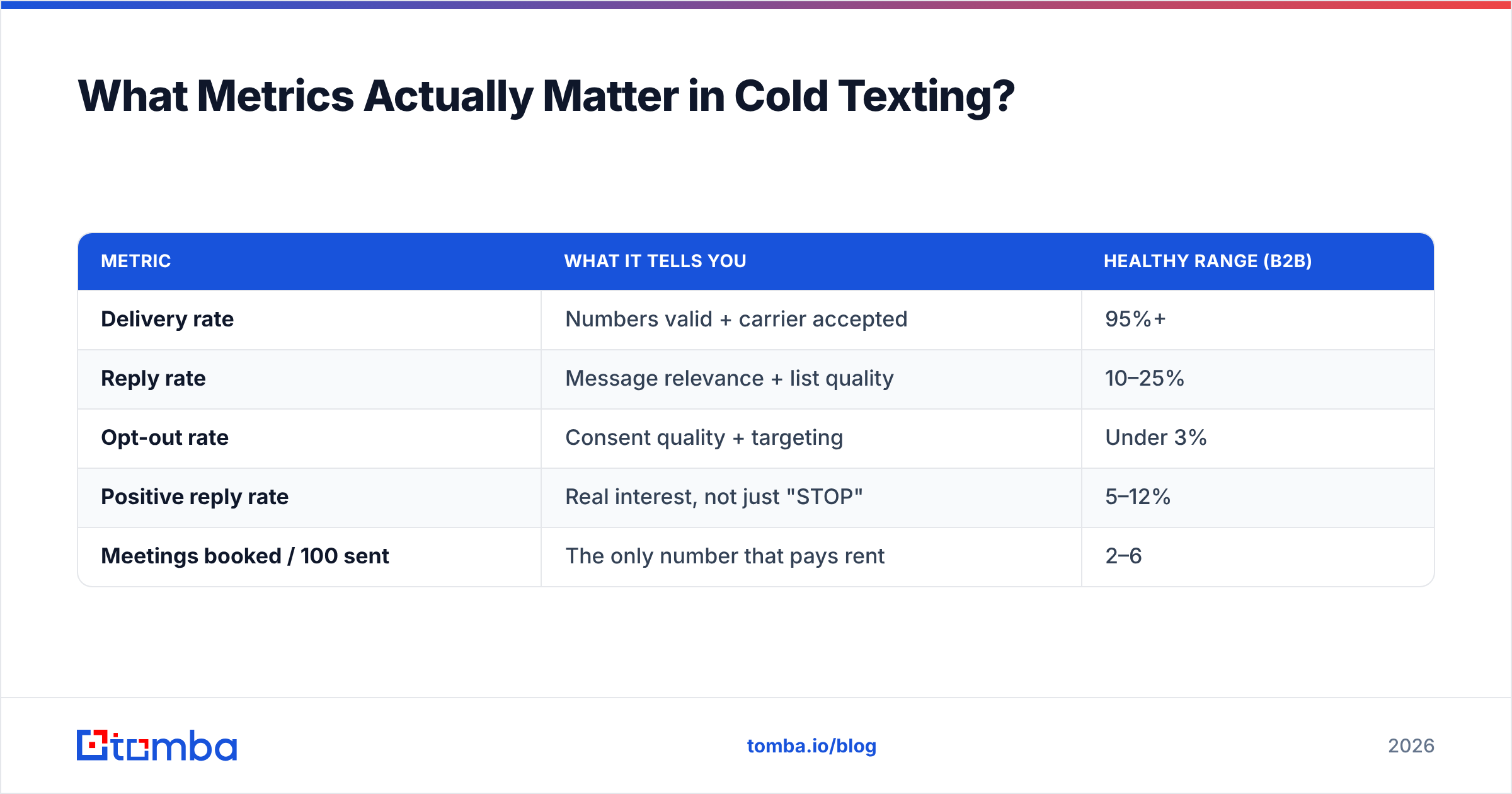
Because SMS is metered and permission-based, you optimize for a different set of numbers than email.
| Metric | What it tells you | Healthy range (B2B) |
|---|---|---|
| Delivery rate | Numbers valid + carrier accepted | 95%+ |
| Reply rate | Message relevance + list quality | 10–25% |
| Opt-out rate | Consent quality + targeting | Under 3% |
| Positive reply rate | Real interest, not just "STOP" | 5–12% |
| Meetings booked / 100 sent | The only number that pays rent | 2–6 |
Watch opt-out rate like a hawk. It's your early-warning system. A spike means your list has people who never consented, or your copy reads as spam. Either way, stop and fix it before a carrier does it for you. Reply rate without a low opt-out rate is a vanity number — you can juice replies by being aggressive, but you'll pay for it in blocked traffic and complaints.
When Should You Use Cold Texting — and When Not?#
Cold texting shines in specific situations and backfires in others. Match the channel to the moment.
Good fits:
- Speed-to-lead. Someone filled out a form 90 seconds ago. A text ("Got your request, want the pricing now or a quick call?") converts far better than an email that sits unread.
- Reviving stalled deals. A prospect who ghosted your last three emails may answer a short, respectful text.
- Event and timing plays. Trade-show follow-ups, renewal windows, or a trigger event where minutes matter.
- Confirmations and reminders once consent exists — meeting nudges, no-show recovery.
Poor fits:
- Pure cold, no relationship, personal cells. This is the legal minefield. Don't.
- Complex, high-consideration pitches that need context a 160-character message can't carry.
- Regions with strict rules (much of the EU under GDPR/ePrivacy, where prior consent is mandatory for marketing texts). Check local law first.
Think of texting as the accelerant, not the fuel. It works best bolted onto an outbound engine that already runs on verified email and phone data, where the text is the third or fourth touch — not the first cold contact from a number nobody recognizes.
How Does Cold Texting Fit Into a Multi-Channel Sequence?#
The highest-performing outbound teams in 2026 don't pick a single channel — they orchestrate several, and let each do what it's best at. A representative sequence:
- Day 1 — Email. A verified, personalized email that introduces you and plants a reason to reply.
- Day 3 — LinkedIn. A connection or a light comment to build familiarity.
- Day 5 — Email follow-up with a soft opt-in ask ("Want me to text you the one-pager?").
- Day 7 — SMS, but only to prospects who engaged or asked. Now the text lands warm.
- Day 10 — Phone. A quick call referencing the thread.
Notice that the text comes after engagement, not before. That ordering is what keeps you compliant and keeps reply rates high. Managing this across channels is where a real B2B database and enrichment stack earns its keep — you need one clean record per person, with sourced email, phone, and consent status all in one place.
Cold Texting vs. Other Outbound Channels: The Honest Scorecard#
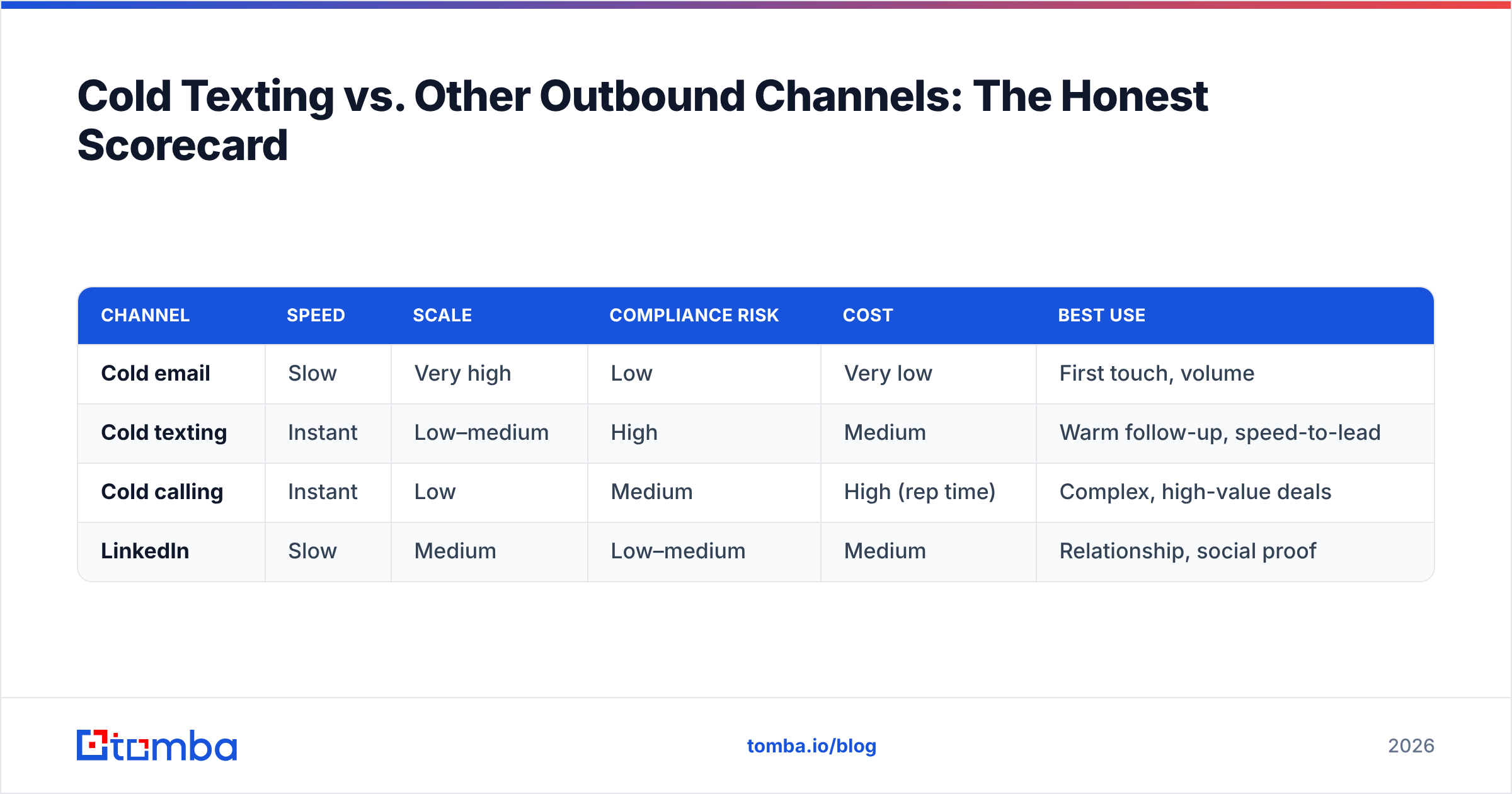
No channel wins on every axis. Here's how texting stacks up so you can weight your mix.
| Channel | Speed | Scale | Compliance risk | Cost | Best use |
|---|---|---|---|---|---|
| Cold email | Slow | Very high | Low | Very low | First touch, volume |
| Cold texting | Instant | Low–medium | High | Medium | Warm follow-up, speed-to-lead |
| Cold calling | Instant | Low | Medium | High (rep time) | Complex, high-value deals |
| Slow | Medium | Low–medium | Medium | Relationship, social proof |
The winning move is rarely "go all-in on texting." It's "add texting as a precision instrument to a sequence that's already built on clean data." When your email is verified, your phone numbers are sourced and validated, and your consent is documented, texting turns into one of the highest-ROI touches you have. When any of those are shaky, it turns into your biggest liability.
Frequently Asked Questions#
Is cold texting the same as SMS marketing? Not quite. SMS marketing usually assumes an opted-in subscriber list. Cold texting reaches prospects who haven't subscribed, which raises the compliance bar significantly. The techniques overlap, but the legal footing is different.
Can I buy a list of cell numbers and text them? You can, but you almost certainly shouldn't. Purchased consumer cell lists are the classic TCPA trap. If you can't document a lawful basis for each number, treat texting it as off-limits.
How many cold texts can I send per day? Carrier throughput under 10DLC depends on your registered campaign tier, not on ambition. Start small, keep opt-outs under 3%, and grow volume only as your sender reputation earns it.
Does B2B texting really need opt-in? Business context gives you more latitude than consumer marketing, but the safest and most effective programs still secure an opt-in or a clear existing relationship. Don't rely on "it's a business number" as your only defense.
Start With Data You Can Defend#
Cold texting rewards precision and punishes spray-and-pray harder than any other channel. The teams that win with it in 2026 all share one habit: they start from verified, sourced, provenance-tracked contact data, then add SMS as a warm, well-timed touch — never a cold blast to numbers they can't account for.
That foundation begins with knowing exactly who you're reaching and how you found them. Use the Tomba Email Finder to build your target list on verified professional identities, layer in sourced business phone numbers, and open the conversation on the channel your prospect actually invited. Explore the full toolkit and Tomba pricing — including a free tier with 25 searches a month — and build an outbound engine that's fast, personal, and defensible.
Related guides#
Ready to find emails that actually work?
Join 150,000+ professionals who stopped guessing and started sending. Free credits on signup — no credit card required.
Get the Tomba newsletter
Practical outbound tactics and product updates — once every two weeks.
About the author