Cold Email Subject Lines That Get Replies: 2026 Playbook
The subject line decides whether your cold email gets opened or trashed. Here is a 2026 framework, real formulas, and an A/B testing system that lifts open rates.
Your prospect decides whether to open your cold email in about three seconds, using two pieces of text: the sender name and the subject line. Everything you wrote in the body — the offer, the proof, the call to action — never gets read if the subject line fails. Yet most reps spend an hour on the pitch and four seconds on the line that controls whether anyone sees it.
This is a working guide to cold email subject lines in 2026: the psychology, the formulas that still convert, the ones that now trigger spam filters, and a testing loop that compounds over time.
TL;DR#
- Clarity beats cleverness. Lowercase, specific, 1–5 words. Subject lines that read like a coworker wrote them outperform marketing copy almost every time.
- Personalization is the multiplier. A line referencing the prospect's company, role, or a recent trigger event can double open rates versus a generic template.
- Spam words and fake urgency hurt deliverability, not just opens. "FREE," "guarantee," "act now," and ALL CAPS get you filtered before a human sees you.
- Test in matched cohorts. A/B test one variable at a time against similar segments, with at least ~100 sends per variant before you trust the winner.
- The subject line is downstream of your list. A perfect line sent to an unverified address bounces — fix the data first, then optimize the copy.
Why do cold email subject lines matter so much?#
Think of the subject line as the headline on a newspaper rack. Nobody buys the paper for the headline, but nobody opens the paper without one. The body of your email is the article; the subject line is the only thing competing for attention in a crowded inbox.
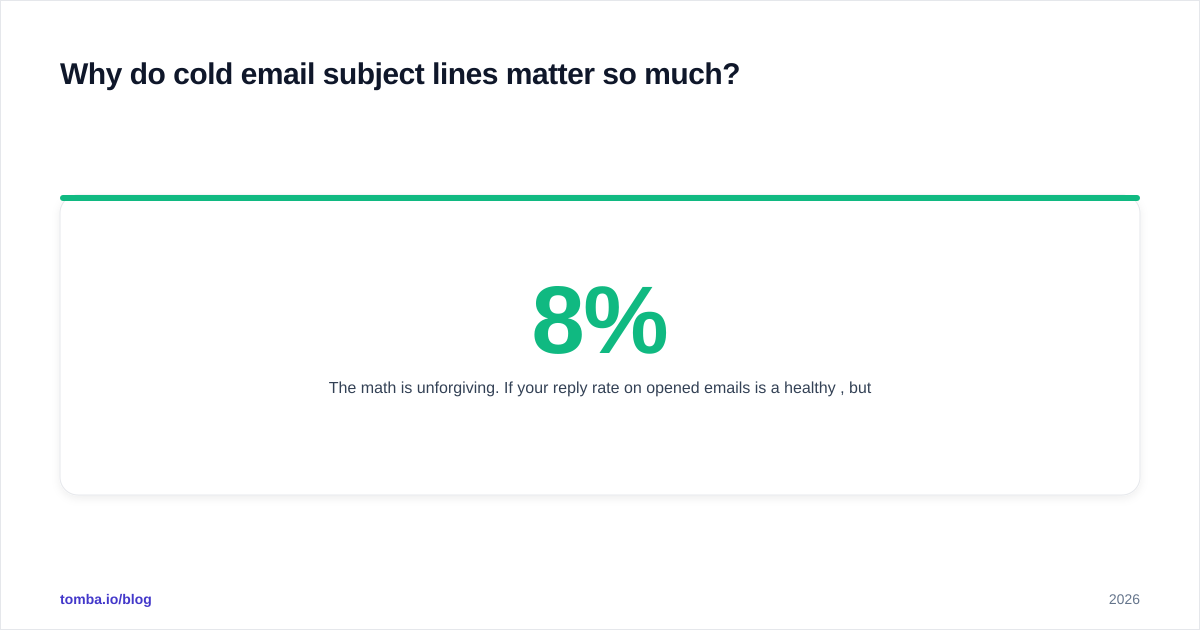
The math is unforgiving. If your reply rate on opened emails is a healthy 8%, but your open rate drops from 50% to 30%, you lose nearly half your pipeline before the prospect reads a single word of your offer. Open rate is a ceiling on every other metric downstream.
In 2026 the inbox is more hostile than ever. Apple Mail Privacy Protection inflates open-rate reporting, Gmail and Outlook tab emails aggressively, and AI-assisted spam filters score subject-line language in real time. The result: the lines that worked in 2020 ("Quick question," "Re: our call") are now pattern-matched as bulk outreach. The bar has moved.
What makes a cold email subject line actually get opened?#
Five attributes separate openers from ignored mail. None of them involve being clever.
1. Relevance. Does the line signal that the email is about the recipient, not about you? "Cutting onboarding time at Acme" beats "Our onboarding platform."
2. Specificity. Vague lines read as mass mail. Numbers, names, and concrete nouns read as research. "3 ways your competitors handle returns" outperforms "Improve your returns process."
3. Brevity. Mobile clients truncate at roughly 30–40 characters. If your value lands after the cutoff, it doesn't exist. Aim for 1–5 words.
4. Curiosity without bait. A small open loop works ("noticed something on your pricing page"). Clickbait that the body doesn't pay off destroys trust and trains the prospect to ignore you.
5. Native tone. It should look like internal email. Lowercase, no emoji, no marketing punctuation. The moment it looks designed, it reads as a campaign.
Which subject line formulas work in 2026?#
Below are formula categories that consistently test well, with fill-in-the-blank patterns. Treat them as starting points, not scripts — the best line is the one specific to your prospect.
The personalized observation#
{{first_name}}, noticed {{specific_thing}}question about {{company}}'s {{process}}saw your post on {{topic}}
The pattern interrupt#
bad idea?probably not for youshould I stop emailing?
The value-forward#
cut {{metric}} by {{number}}%{{competitor}} uses this — you?idea for {{department}} this quarter
The mutual-connection / trigger#
{{referrer}} suggested I reach outcongrats on the {{round/launch}}re: {{recent_company_news}}
A practical workflow: draft 5–10 candidates with a tool like the subject line generator, then score them before sending with a subject line tester to catch length and spam-word problems. Pair the winning line with proven body copy from a cold email templates library so the whole message stays consistent.
What kills a cold email subject line?#
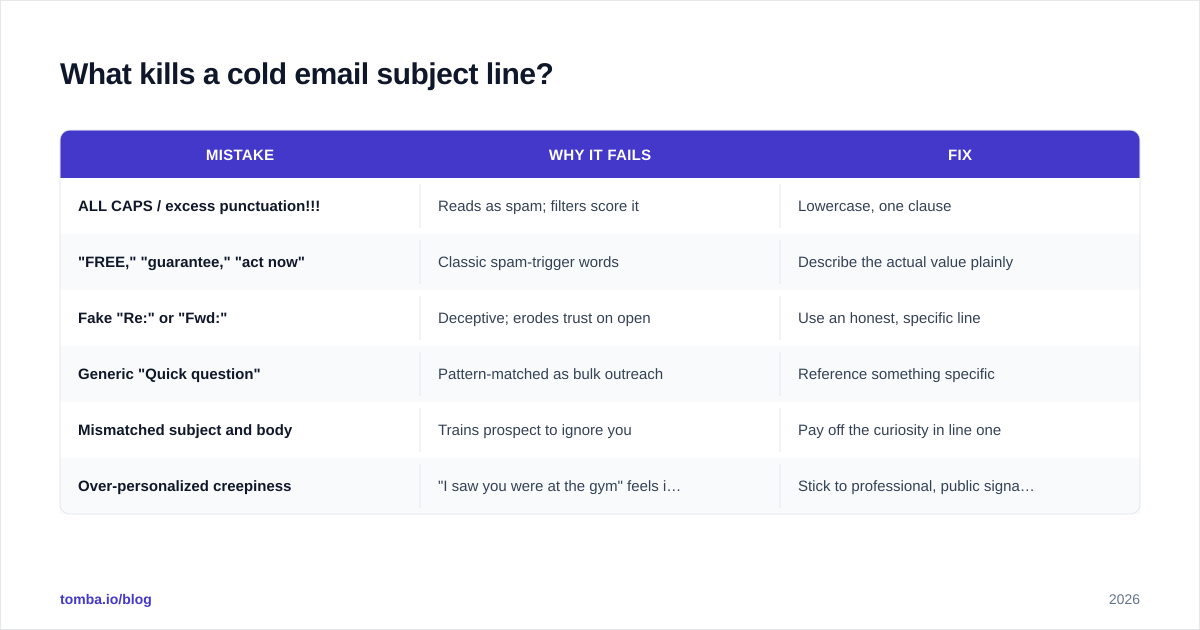
Some patterns don't just lower open rates — they hurt your sender reputation and push future emails to spam. According to HubSpot's email research, trigger language and deceptive framing are among the fastest ways to get filtered.
| Mistake | Why it fails | Fix |
|---|---|---|
| ALL CAPS / excess punctuation!!! | Reads as spam; filters score it | Lowercase, one clause |
| "FREE," "guarantee," "act now" | Classic spam-trigger words | Describe the actual value plainly |
| Fake "Re:" or "Fwd:" | Deceptive; erodes trust on open | Use an honest, specific line |
| Generic "Quick question" | Pattern-matched as bulk outreach | Reference something specific |
| Mismatched subject and body | Trains prospect to ignore you | Pay off the curiosity in line one |
| Over-personalized creepiness | "I saw you were at the gym" feels invasive | Stick to professional, public signals |
The deeper issue: deliverability and subject lines are linked. Spammy language increases your spam-complaint rate, which lowers sender reputation, which sends even your good emails to the junk folder. Optimizing copy while ignoring this is like polishing the hood of a car with a dead battery.
How do you A/B test cold email subject lines?#
Conclusion first: test one variable at a time, against matched cohorts, with enough volume to mean something. Most "winning subject line" advice is noise from samples of 40 sends.
Here is a disciplined loop.
Step 1 — Isolate one variable. Personalization vs. none. Question vs. statement. Short vs. medium. If you change three things, you learn nothing about which one moved the needle.
Step 2 — Split matched segments. Don't test "SaaS founders" against "enterprise IT." Same persona, same offer, randomly split. Otherwise the segment, not the line, explains the result.
Step 3 — Hit minimum volume. Aim for ~100+ sends per variant before reading the result. With Apple's open-rate inflation, lean on reply rate as your real signal where possible, not just opens.
Step 4 — Account for deliverability noise. A variant can "win" on opens simply because it landed in the inbox while the other hit Promotions. Check placement before declaring a copy winner.
Step 5 — Log and reuse. Keep a running sheet of winners by persona and industry. Over a quarter you build a private swipe file worth more than any blog post.
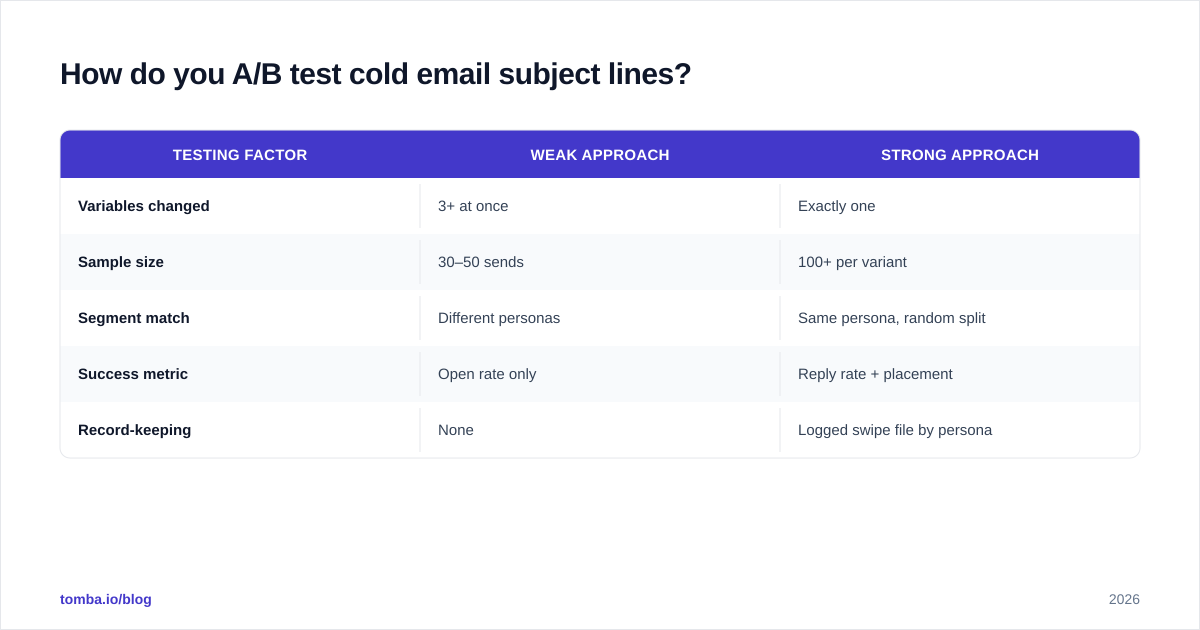
| Testing factor | Weak approach | Strong approach |
|---|---|---|
| Variables changed | 3+ at once | Exactly one |
| Sample size | 30–50 sends | 100+ per variant |
| Segment match | Different personas | Same persona, random split |
| Success metric | Open rate only | Reply rate + placement |
| Record-keeping | None | Logged swipe file by persona |
For benchmarks, G2's email marketing category and your own historical response rate give you a realistic baseline. A typical cold open rate sits between 30–55% depending on list quality and industry; if you're below 20%, the problem is almost always data or deliverability, not wording.
Should subject lines be personalized or templated?#
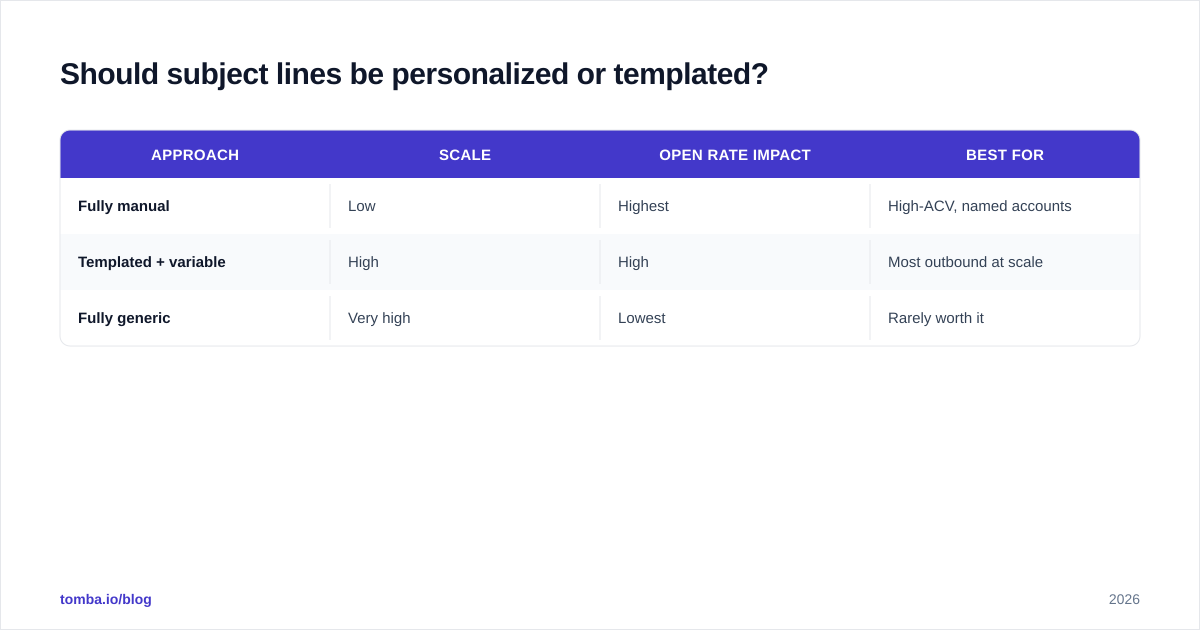
Both — in layers. A fully manual line for every prospect doesn't scale; a fully generic one doesn't convert. The answer is a templated structure with a personalized variable.
For example: idea for {{company}}'s {{department}} is a template, but the variables make each send specific. The structure is reusable across thousands of prospects; the merge fields make each one feel researched.
This only works if your data is clean. Personalization tokens that misfire — idea for {{company}} rendering as idea for {first_name} — are worse than no personalization at all. That's a list problem, and it's where most "great copy, terrible results" campaigns actually break.
| Approach | Scale | Open rate impact | Best for |
|---|---|---|---|
| Fully manual | Low | Highest | High-ACV, named accounts |
| Templated + variable | High | High | Most outbound at scale |
| Fully generic | Very high | Lowest | Rarely worth it |
Where does data fit into subject line performance?#
The uncomfortable truth: the best subject line in the world sent to a wrong or unverified address earns a bounce, and bounces wreck your sender reputation faster than any spam word. Subject-line optimization is the last 10% — the first 90% is reaching a real person at a real, deliverable address.
That's why list hygiene comes before copywriting. Before you A/B test a single line, you want verified emails and accurate merge data. Tools like a email finder surface the correct address and the contact's name, role, and company — the exact fields your personalized subject lines depend on. Get the data right, and even an average line performs; get it wrong, and a brilliant line never gets the chance.
There's a compounding effect here. Clean data → lower bounce rate → stronger sender reputation → better inbox placement → higher real open rate. The subject line rides on top of that stack. Optimize the stack, and the copy gains do the rest.
A quick subject-line checklist before you hit send#
- Is it under ~40 characters so it survives mobile truncation?
- Does it reference something specific to this prospect?
- Does it avoid spam triggers, ALL CAPS, and fake "Re:"?
- Does the body actually pay off whatever the line promises?
- Are your merge fields populated and verified, with no
{{broken_token}}? - Did you test one variable against a matched cohort, not a guess?
Run that list and you've already beaten most of the cold email landing in your prospect's inbox today.
The bottom line#
Cold email subject lines reward restraint. Short, specific, lowercase, honestly curious — written like a colleague, not a campaign. Clever loses to clear. Then build a testing loop that isolates one variable at a time, and protect the deliverability foundation underneath it all, because a great line is wasted on a bad address.
Start with the data. If your subject lines depend on the prospect's real name, company, and a verified email — and they do — use Tomba's Email Finder to build a list of accurate, deliverable contacts before you write a single line. You can pull the first contacts on the free tier (25 searches a month), then scale into the Starter plan at $49/mo when your outbound starts working. Clean data first, sharp copy second — that's the order that actually fills a pipeline.
// get started
Find, verify and enrich your first contacts today
Start on the free plan with 25 searches a month, then scale when your team is ready.
Free plan · No credit card required · GDPR & CCPA
Get the Tomba newsletter
Product and data updates
// about the author