Common Sales Objections in 2026 and How to Overcome Them
The same handful of objections kill most B2B deals: no budget, no time, no trust. Here's a field-tested playbook with word-for-word rebuttals that actually move buyers.
Every rep hears the same five words on repeat: "Now isn't a good time." The specific wording changes, but the underlying objection almost never does. Once you can name the pattern, you can prepare for it — and preparation is the whole game.
This guide breaks down the most common objections in B2B sales, why buyers actually raise them, and the exact language that turns a stall into a next step. No scripts you'd be embarrassed to say out loud. Just repeatable moves.
TL;DR#
- Most objections are one of six patterns — budget, timing, authority, need, trust, or competitor. Learn the six and you've covered ~90% of what you'll hear.
- An objection is a request for information, not a rejection. "Too expensive" usually means "I don't yet see the value," not "go away."
- The best rebuttal is prevention. Tight targeting and clean data stop half of these objections before they start.
- Acknowledge, then reframe, then ask. Never argue. Loop the conversation back to a question that keeps momentum.
- Track which objections you lose to. The pattern in your CRM tells you whether it's a messaging problem or a targeting problem.
What counts as a common objection?#
A sales objection is any reason a prospect gives for not moving forward right now. It's a conclusion first, reasoning second: think of it like a bouncer at a club. The "you're not on the list" line isn't personal — it's a gate, and every gate has a way through if you know the door policy.
Objections split cleanly into two buckets. Genuine objections are real constraints: the budget truly is frozen, the contract truly renews in Q3. Reflexive objections are the verbal equivalent of "just looking" to a shop assistant — a default brush-off before the buyer has engaged their brain. The skill is telling them apart fast, because they need opposite responses.
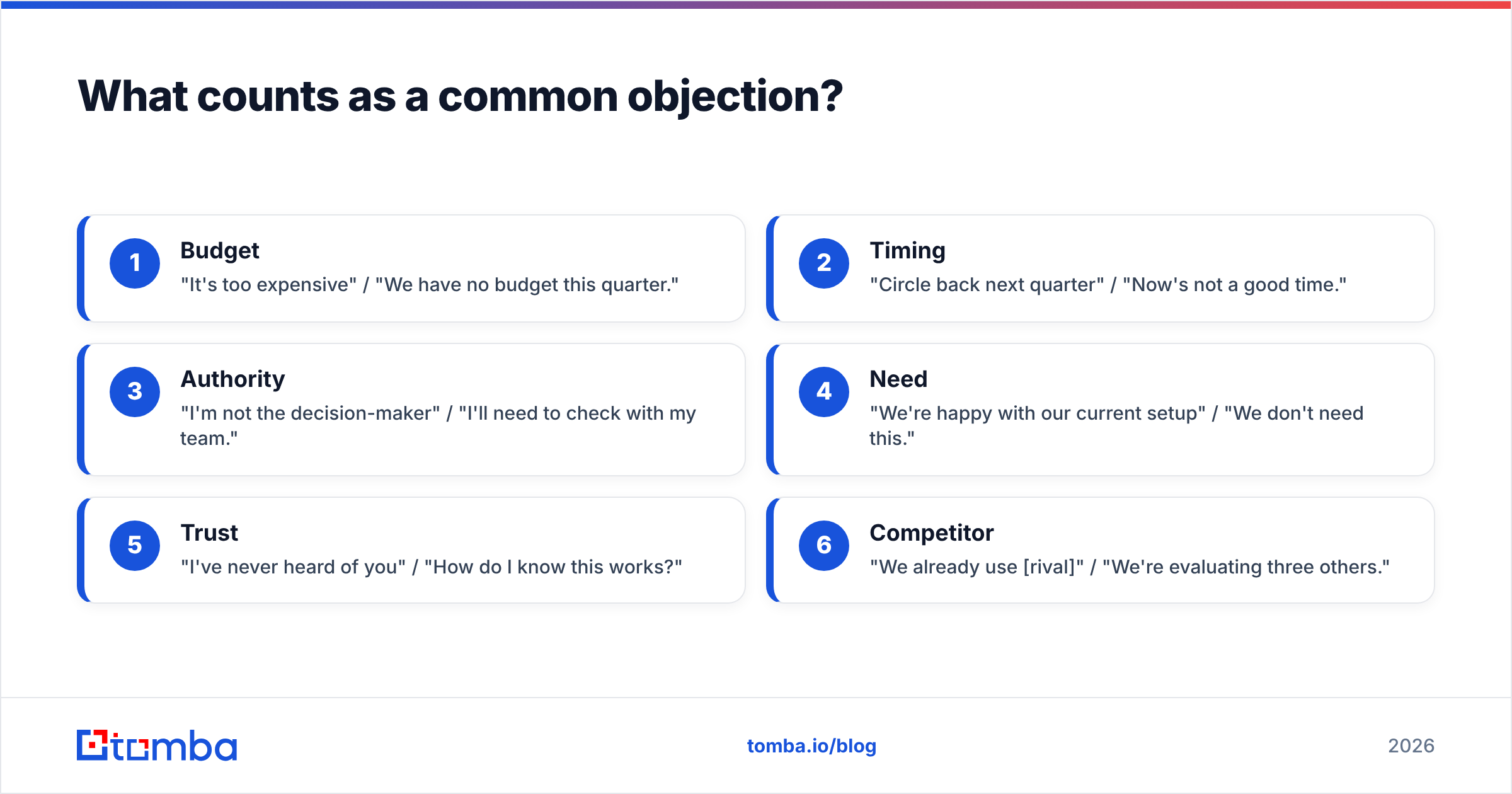
Here are the six patterns nearly every B2B objection collapses into:
- Budget — "It's too expensive" / "We have no budget this quarter."
- Timing — "Circle back next quarter" / "Now's not a good time."
- Authority — "I'm not the decision-maker" / "I'll need to check with my team."
- Need — "We're happy with our current setup" / "We don't need this."
- Trust — "I've never heard of you" / "How do I know this works?"
- Competitor — "We already use [rival]" / "We're evaluating three others."

Why do prospects raise objections in the first place?#
Because buying is risky and doing nothing is safe. Ninety percent of the objections you hear are a proxy for one unspoken fear: "If I say yes and this goes wrong, it's my name on it." According to HubSpot's sales research, buyers cite trust and perceived risk as leading reasons deals stall — far more often than raw price.
That reframe changes everything. You're not overcoming resistance; you're de-risking a decision. When you hear "send me some information," the buyer isn't asking for a PDF. They're asking you to make the next step feel small and reversible.
The other reason objections surface: you reached the wrong person, at the wrong time, with the wrong message. That's not a rebuttal problem — it's a targeting problem, and no clever script fixes it. This is where your pre-call work matters more than your talk track.
How do you handle the six most common objections?#
The universal framework is three beats: Acknowledge → Reframe → Ask. Validate what they said so they feel heard, reframe the concern around value or risk, then ask a question that keeps the conversation moving. You never want to end on a statement — statements invite "okay, thanks, bye."
Here's how that plays out across the six patterns.
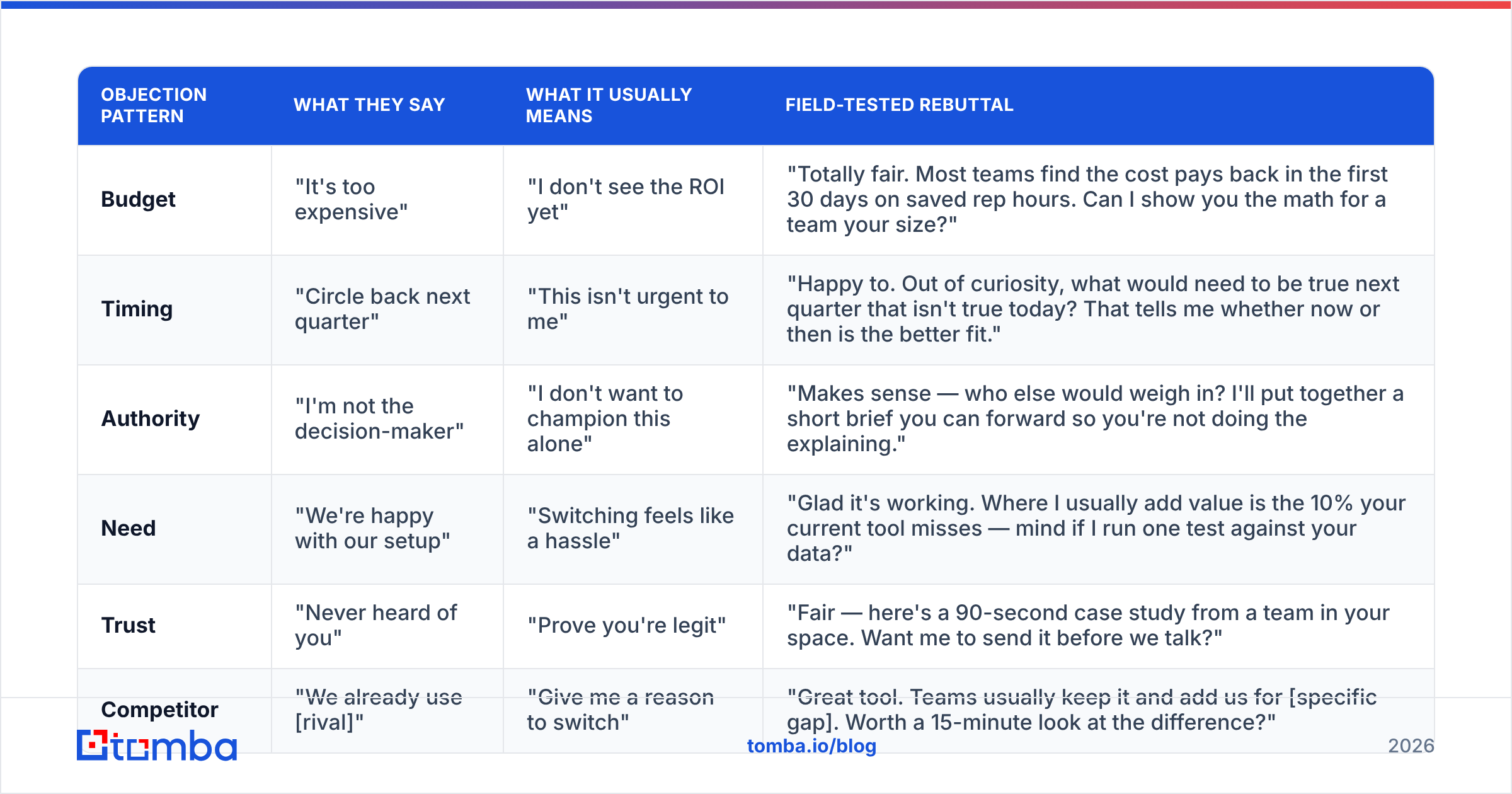
| Objection pattern | What they say | What it usually means | Field-tested rebuttal |
|---|---|---|---|
| Budget | "It's too expensive" | "I don't see the ROI yet" | "Totally fair. Most teams find the cost pays back in the first 30 days on saved rep hours. Can I show you the math for a team your size?" |
| Timing | "Circle back next quarter" | "This isn't urgent to me" | "Happy to. Out of curiosity, what would need to be true next quarter that isn't true today? That tells me whether now or then is the better fit." |
| Authority | "I'm not the decision-maker" | "I don't want to champion this alone" | "Makes sense — who else would weigh in? I'll put together a short brief you can forward so you're not doing the explaining." |
| Need | "We're happy with our setup" | "Switching feels like a hassle" | "Glad it's working. Where I usually add value is the 10% your current tool misses — mind if I run one test against your data?" |
| Trust | "Never heard of you" | "Prove you're legit" | "Fair — here's a 90-second case study from a team in your space. Want me to send it before we talk?" |
| Competitor | "We already use [rival]" | "Give me a reason to switch" | "Great tool. Teams usually keep it and add us for [specific gap]. Worth a 15-minute look at the difference?" |
Notice every rebuttal ends in a question. That's not an accident — a question hands the next move back to the buyer while keeping you in the driver's seat.
The budget objection#
Price objections are the most misread. "Too expensive" compared to what? Usually it's compared to nothing — the buyer hasn't priced the cost of the status quo. Your job is to make the cost of inaction concrete: hours wasted, deals missed, bad data cleaned by hand. Anchor against that, not against your competitor's sticker price. And if you're genuinely cheaper, say so plainly — check the Tomba pricing tiers and you'll see a free plan exists precisely to defuse this one.
The timing objection#
Timing is the graveyard of pipelines. "Next quarter" is where deals go to quietly die. The move isn't to pressure — it's to isolate the real trigger. Ask what specifically changes later. If they can't answer, the objection was reflexive and you can gently push for a small step now. If they can, you've just learned exactly when to follow up and why.
The trust objection#
Trust is earned with proof, not adjectives. Case studies, specific numbers, named customers, and a low-commitment first step do more than any superlative. A strong email response rate on your outreach usually correlates with how much proof you front-load before asking for time.
Can you prevent objections before they happen?#
Yes — and this is the highest-leverage move most reps skip. An objection you prevent costs you zero rebuttals.
Prevention comes down to three things:
- Targeting. If you only pitch people who fit your ICP, "we don't need this" nearly vanishes. Most "need" objections are really "you pitched the wrong person" in disguise.
- Reaching the right contact. The "I'm not the decision-maker" objection often means you emailed a generic inbox. Getting a verified, direct line to the actual owner removes the layer entirely — this is where a reliable email finder and a phone finder earn their keep.
- Warm, specific openers. A message that proves you did your homework rarely triggers the reflexive brush-off. Generic blasts trigger every objection at once.

The distinction matters. You can spend a career perfecting rebuttals for objections that better front-end work would have erased. Sharpening your list beats sharpening your comebacks. As Gong's conversation data repeatedly shows, top reps don't win by out-arguing buyers — they win by earning the right to the conversation before the pitch.
What's the difference between an objection and a brush-off?#
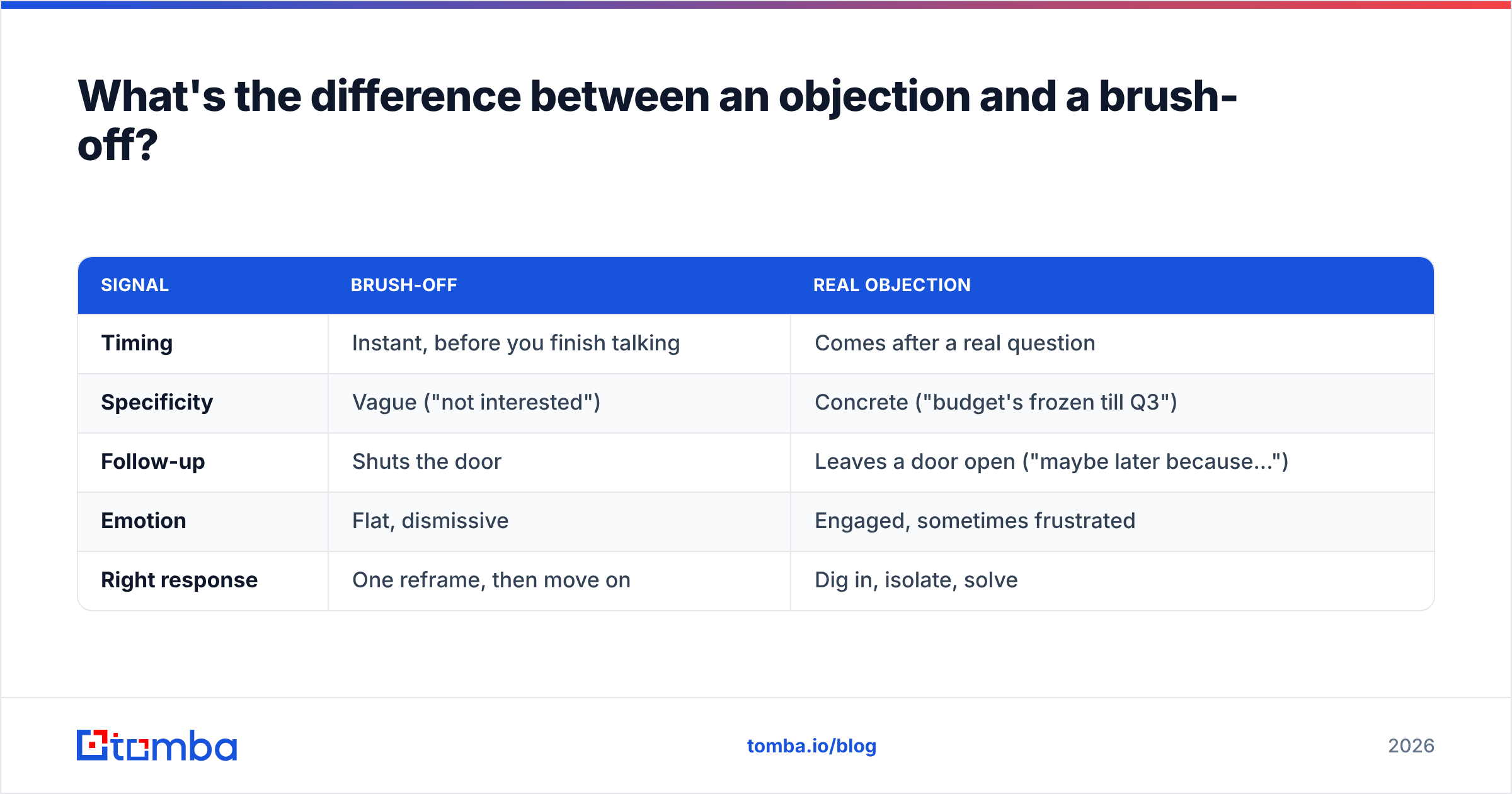
A brush-off is a reflex; an objection is a signal. Telling them apart saves you from two opposite mistakes: bulldozing someone who was genuinely engaged, or chasing someone who was never in the market.
| Signal | Brush-off | Real objection |
|---|---|---|
| Timing | Instant, before you finish talking | Comes after a real question |
| Specificity | Vague ("not interested") | Concrete ("budget's frozen till Q3") |
| Follow-up | Shuts the door | Leaves a door open ("maybe later because...") |
| Emotion | Flat, dismissive | Engaged, sometimes frustrated |
| Right response | One reframe, then move on | Dig in, isolate, solve |
The tell is specificity. "Not interested" with no detail is a reflex — meet it with one calm reframe and, if it holds, respect it and move on. Burning three follow-ups on a true brush-off just trains you to ignore the buyers who are raising real, solvable objections.
How should you track objections over time?#
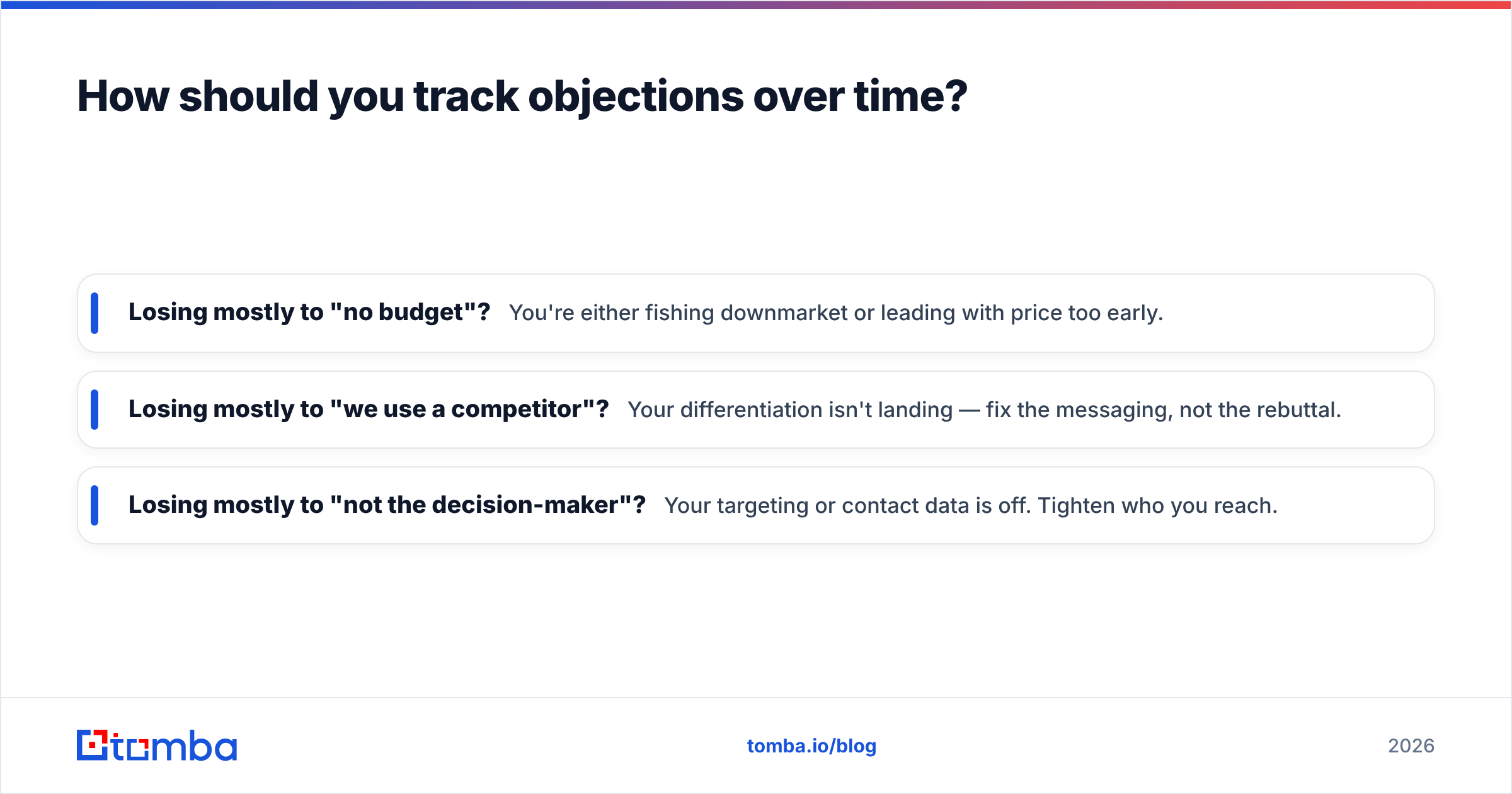
Log every objection in your CRM as a structured field, not a free-text note. When you can filter by objection type, patterns jump out fast:
- Losing mostly to "no budget"? You're either fishing downmarket or leading with price too early.
- Losing mostly to "we use a competitor"? Your differentiation isn't landing — fix the messaging, not the rebuttal.
- Losing mostly to "not the decision-maker"? Your targeting or contact data is off. Tighten who you reach.
This is the difference between a rep who "handles objections well" and a team that systematically reduces them. One is a talent; the other is a process. For outbound at scale, pairing clean contact data with tracked objections — you can even standardize your first-touch language using proven cold email templates — turns objection handling from an art into a measurable input. Salesforce's own State of Sales findings underline the same point: the highest-performing teams treat objections as data, not drama.
Which objections should you just walk away from?#
Not every objection deserves a fight. Chasing a hard "no" is the sales equivalent of texting an ex — the energy is better spent elsewhere. Walk away when:
- The prospect is genuinely outside your ICP and no reframe changes that.
- There's a true, immovable constraint (regulatory, contractual, headcount freeze) with no timeline.
- You've reframed twice and gotten nothing but flatter refusals.
Disqualifying fast is a superpower. Every hour you don't spend on a dead deal is an hour on a live one. The goal was never to win every objection — it's to win the right ones and cleanly release the rest.
The bottom line#
Common objections aren't roadblocks; they're the buyer telling you what they need to feel safe saying yes. Name the six patterns, acknowledge-reframe-ask your way through them, and — most importantly — do the front-end work that stops half of them from ever surfacing.
That front-end work starts with reaching the right person on the first try. If your objections skew toward "wrong contact" or "not the decision-maker," the fix isn't a better script — it's better data. Tomba's Email Finder gives you verified, direct addresses for the actual owner of the problem you solve, so your outreach lands with someone who can say yes. Start free with 25 searches, prove it on your own list, and watch how many objections quietly disappear when you're finally talking to the right buyer.
Related guides#
Ready to find emails that actually work?
Join 150,000+ professionals who stopped guessing and started sending. Free credits on signup — no credit card required.
Get the Tomba newsletter
Practical outbound tactics and product updates — once every two weeks.
About the author