Company Announcements Sales Outreach: The 2026 Playbook
Funding rounds, new hires, and product launches are all buying signals hiding in plain sight. Here's how to build a trigger-based sales outreach system that turns company announcements into booked meetings.
Company Announcements Sales Outreach: The 2026 Playbook
Most reps treat prospecting like weather: something that happens to them. The best reps treat it like surfing—they wait for the wave, then paddle hard. Company announcements are those waves. A funding round, a new VP of Sales, a product launch, or an office expansion each signals that a company's priorities, budget, or pain just shifted. Reach out in that window and you're relevant. Reach out cold on a random Tuesday and you're noise.
This guide shows you how to build a repeatable system for company announcements sales outreach: which signals matter, how fast you have to move, how to write messages that reference the news without sounding like a stalker, and how to source the contact data so the whole thing scales past a handful of manual lookups.
TL;DR#
- Company announcements are timed buying signals. Funding, hiring, leadership changes, product launches, M&A, and expansion each map to a specific pain you can solve.
- Speed beats polish. The reply-rate advantage of a trigger decays within days—act inside a 24–72 hour window.
- Reference the signal, not yourself. Open with the announcement and the implication for them, not your product.
- Data is the bottleneck. You need the right contact at the newly-relevant company, fast. That's a find-and-verify problem, not a copywriting problem.
- Systematize it. Watch feeds, enrich contacts, and route to a short sequence so signals never sit in a tab you forget to check.
What counts as a company announcement worth acting on?#
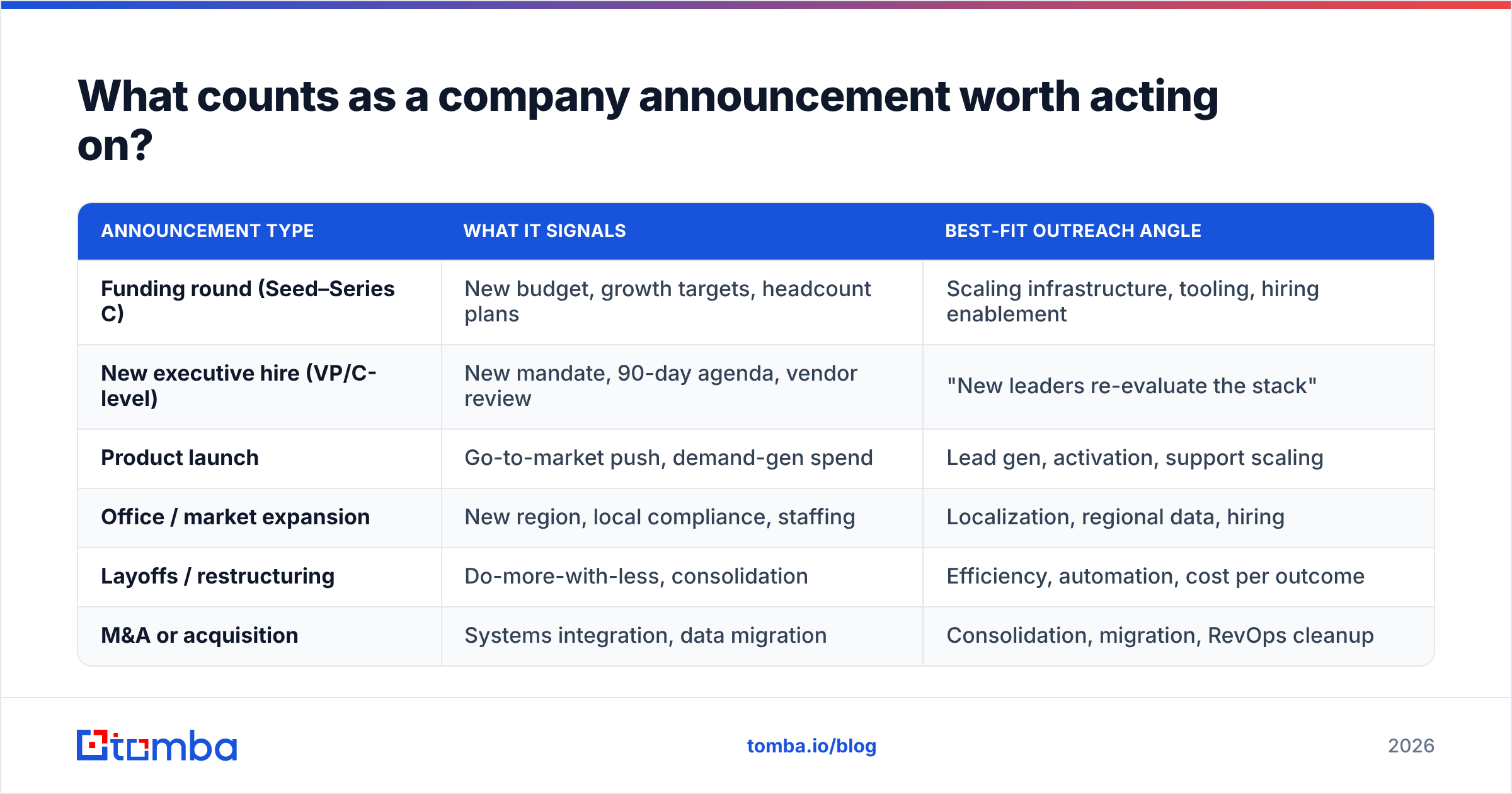
A useful announcement is one that changes what a company needs right now. Not every press release qualifies. A rebrand rarely creates urgency; a $40M Series B almost always does. Here's how the common signals map to the problem you can lead with.
| Announcement type | What it signals | Best-fit outreach angle |
|---|---|---|
| Funding round (Seed–Series C) | New budget, growth targets, headcount plans | Scaling infrastructure, tooling, hiring enablement |
| New executive hire (VP/C-level) | New mandate, 90-day agenda, vendor review | "New leaders re-evaluate the stack" |
| Product launch | Go-to-market push, demand-gen spend | Lead gen, activation, support scaling |
| Office / market expansion | New region, local compliance, staffing | Localization, regional data, hiring |
| Layoffs / restructuring | Do-more-with-less, consolidation | Efficiency, automation, cost per outcome |
| M&A or acquisition | Systems integration, data migration | Consolidation, migration, RevOps cleanup |
The pattern is the same across every row: the announcement creates a temporary gap between where the company is and where it just committed to going. Your outreach fills that gap. If you can't articulate the gap in one sentence, the signal isn't strong enough to lead with.
Why does timing matter so much for trigger-based outreach?#
Because relevance has a half-life. A funding announcement is front-page news inside the target company for about a week; after that, the new hires are onboarding, the budget is already being allocated, and three of your competitors have already emailed. According to HubSpot's sales research, the odds of connecting drop sharply the longer you wait after any triggering event, and buyers consistently rank timing and relevance above persistence.
Think of it like a job posting. The candidates who apply in the first 48 hours get read; the ones who apply three weeks later land in a folder no one opens. Your trigger email is the application. The company just "posted" a need by making the announcement—your job is to be early and specific.
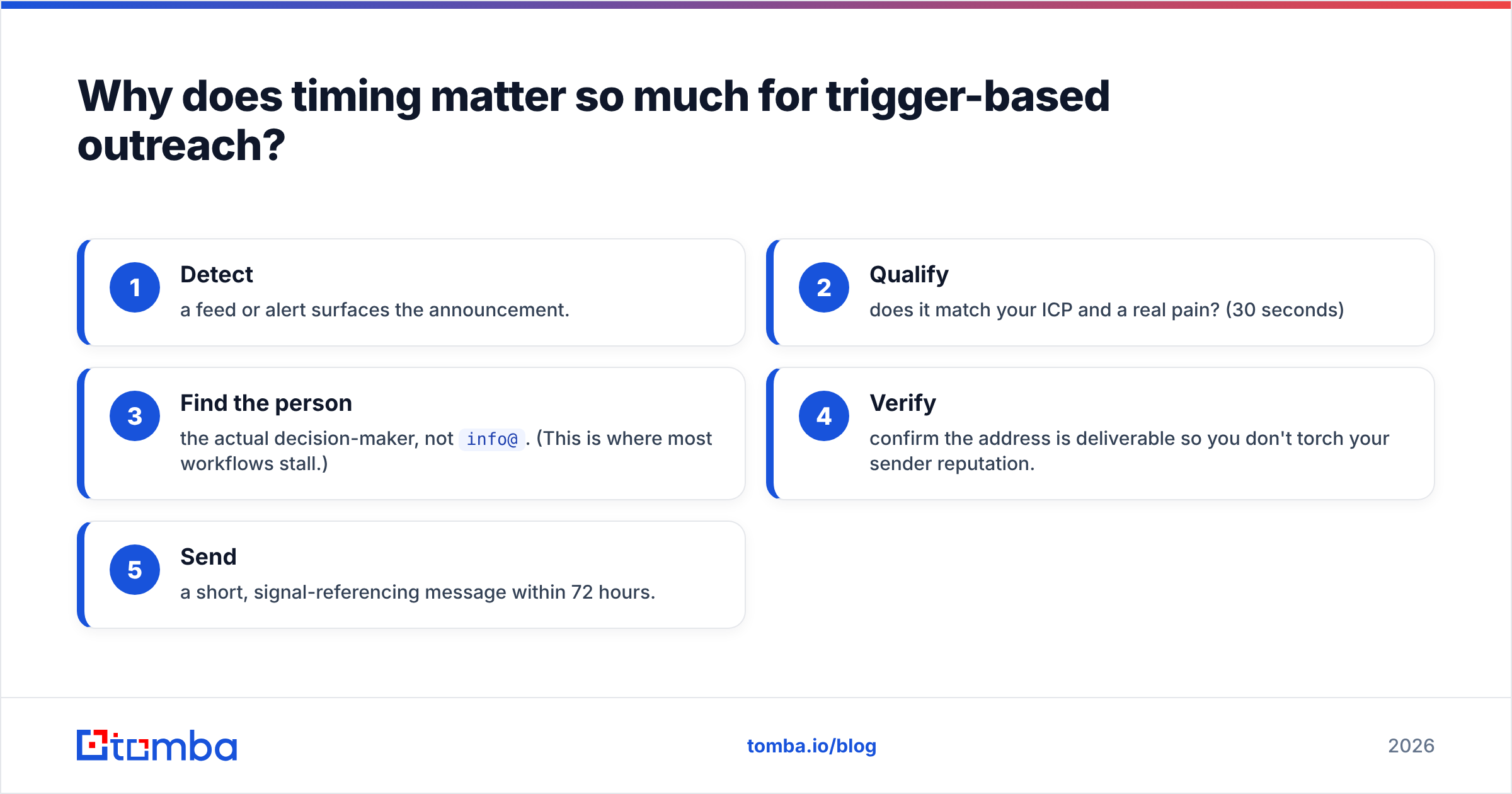
Practically, that means your system has to compress the gap between signal detected and message sent:
- Detect — a feed or alert surfaces the announcement.
- Qualify — does it match your ICP and a real pain? (30 seconds)
- Find the person — the actual decision-maker, not
info@. (This is where most workflows stall.) - Verify — confirm the address is deliverable so you don't torch your sender reputation.
- Send — a short, signal-referencing message within 72 hours.
Steps 3 and 4 are the ones that quietly kill trigger-based programs. You spot ten great signals, then spend an hour hunting emails, and by the time you've found five the wave has passed. Fixing the data step is what turns a nice idea into a channel.
How do you find the right contact after an announcement?#
Fast, and at the individual level. A press release names a company; your quota needs a person with an inbox. Once you know the company domain, an email finder resolves a name and domain into a verified professional address, so a Crunchbase headline like "Acme raises $25M" becomes jordan@acme.com in seconds rather than a manual permutation guessing game.
A repeatable sourcing flow looks like this:
- Start from the domain. Use domain search to pull the people and email patterns at the announcing company, then filter to the roles the announcement made relevant (RevOps after funding, regional leads after expansion).
- Enrich the shortlist. Data enrichment fills in title, seniority, and company metadata so you can prioritize the two or three contacts who actually own the new initiative.
- Verify before you send. Run every address through an email verifier so bounces don't drag down your deliverability during the exact week you're sending your highest-intent messages.
- Catch inbound intent too. If the announcement drives traffic to your site, website visitor reveal tells you which target accounts are already looking, so you can prioritize the warmest ones.
The point isn't to add tools for their own sake—it's that trigger outreach lives or dies on getting an accurate contact before the window closes. Manual lookups don't scale to 20 signals a day; a find-verify pipeline does.
What does a good trigger email actually say?#
Lead with their news, name the implication, make one small ask. That's the whole formula. The most common mistake is treating the announcement as a throwaway icebreaker ("Congrats on the raise!") and then pivoting straight into a generic pitch. The announcement isn't the hook—it's the entire reason the email is relevant, so it should shape the whole message.
Compare the two openers:
Weak (announcement as decoration):
"Congrats on the Series B! I wanted to reach out because [Product] helps sales teams close more deals. Do you have 15 minutes Thursday?"
Strong (announcement as thesis):
"Saw the Series B—usually the next 90 days means doubling the SDR team. The teams we work with hit a wall around then: new reps, no clean contact data, ramp slows. We fixed exactly that for [similar company] after their raise. Worth a quick look at how?"
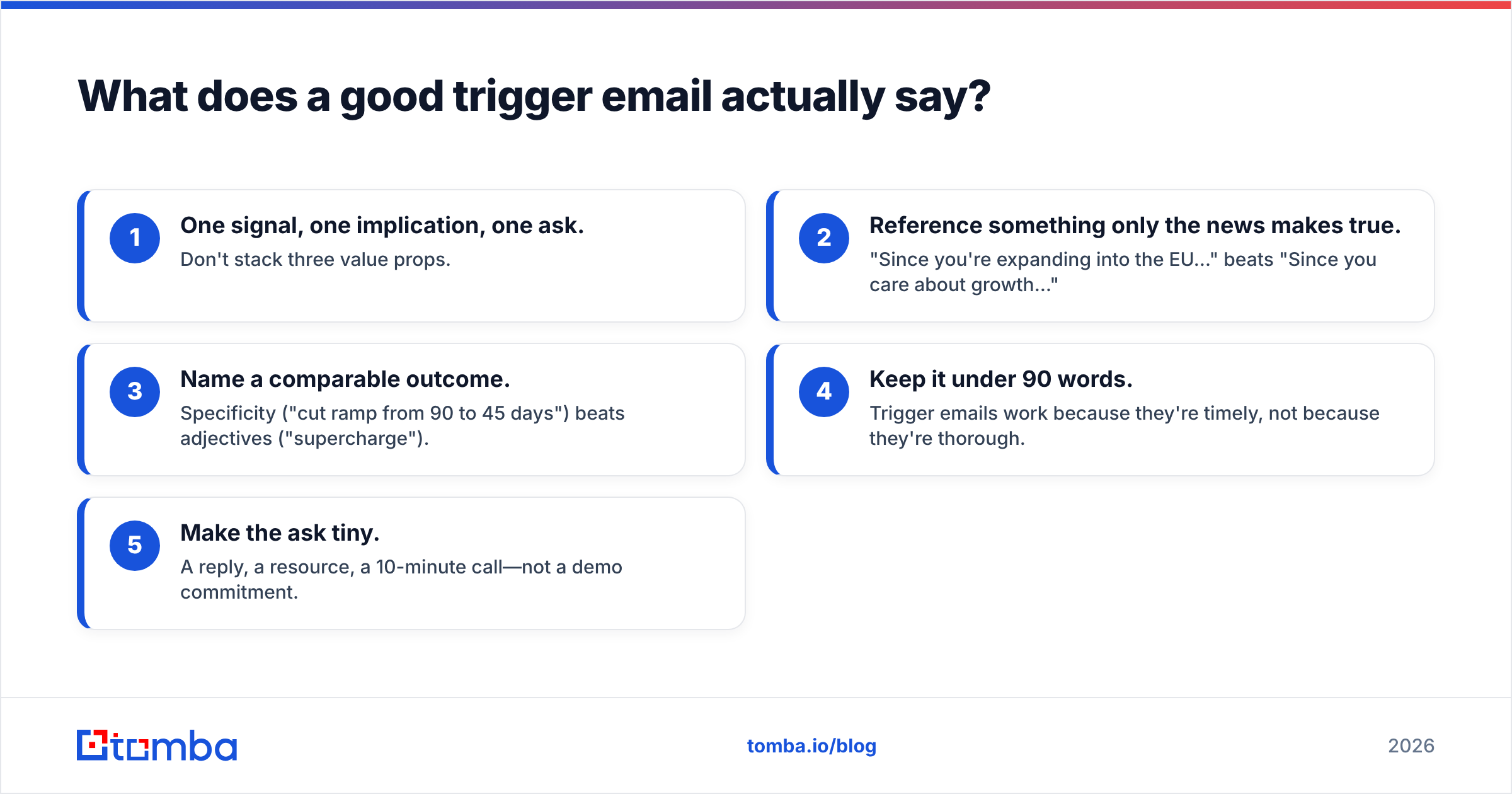
The second one earns the reply because it demonstrates you understand what the announcement causes, not just that it happened. A few rules that hold up across signal types:
- One signal, one implication, one ask. Don't stack three value props.
- Reference something only the news makes true. "Since you're expanding into the EU…" beats "Since you care about growth…"
- Name a comparable outcome. Specificity ("cut ramp from 90 to 45 days") beats adjectives ("supercharge").
- Keep it under 90 words. Trigger emails work because they're timely, not because they're thorough.
- Make the ask tiny. A reply, a resource, a 10-minute call—not a demo commitment.
If writing these from scratch every time is the friction, pull from a starting library like these cold email templates and swap the signal-specific line per prospect.
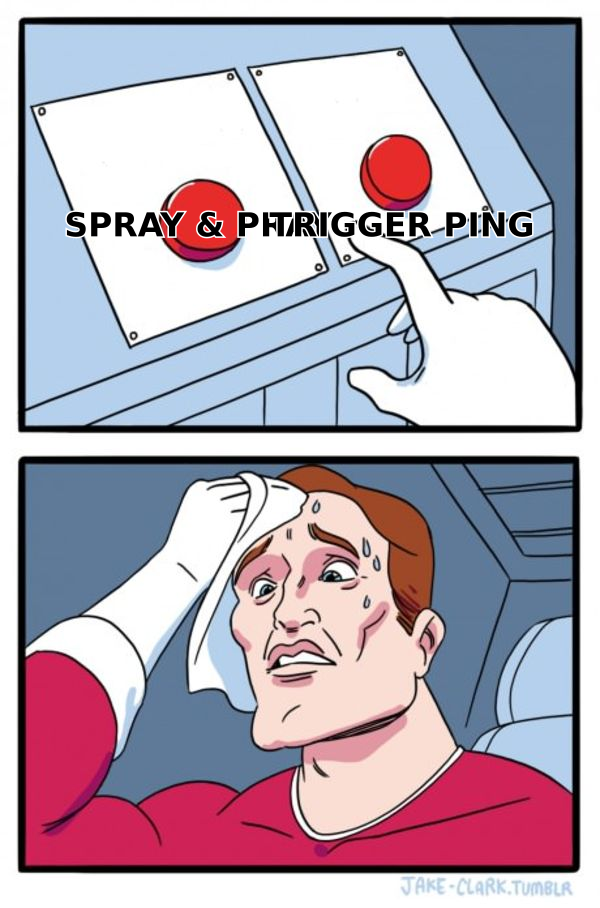
How is this different from spray-and-pray outreach?#
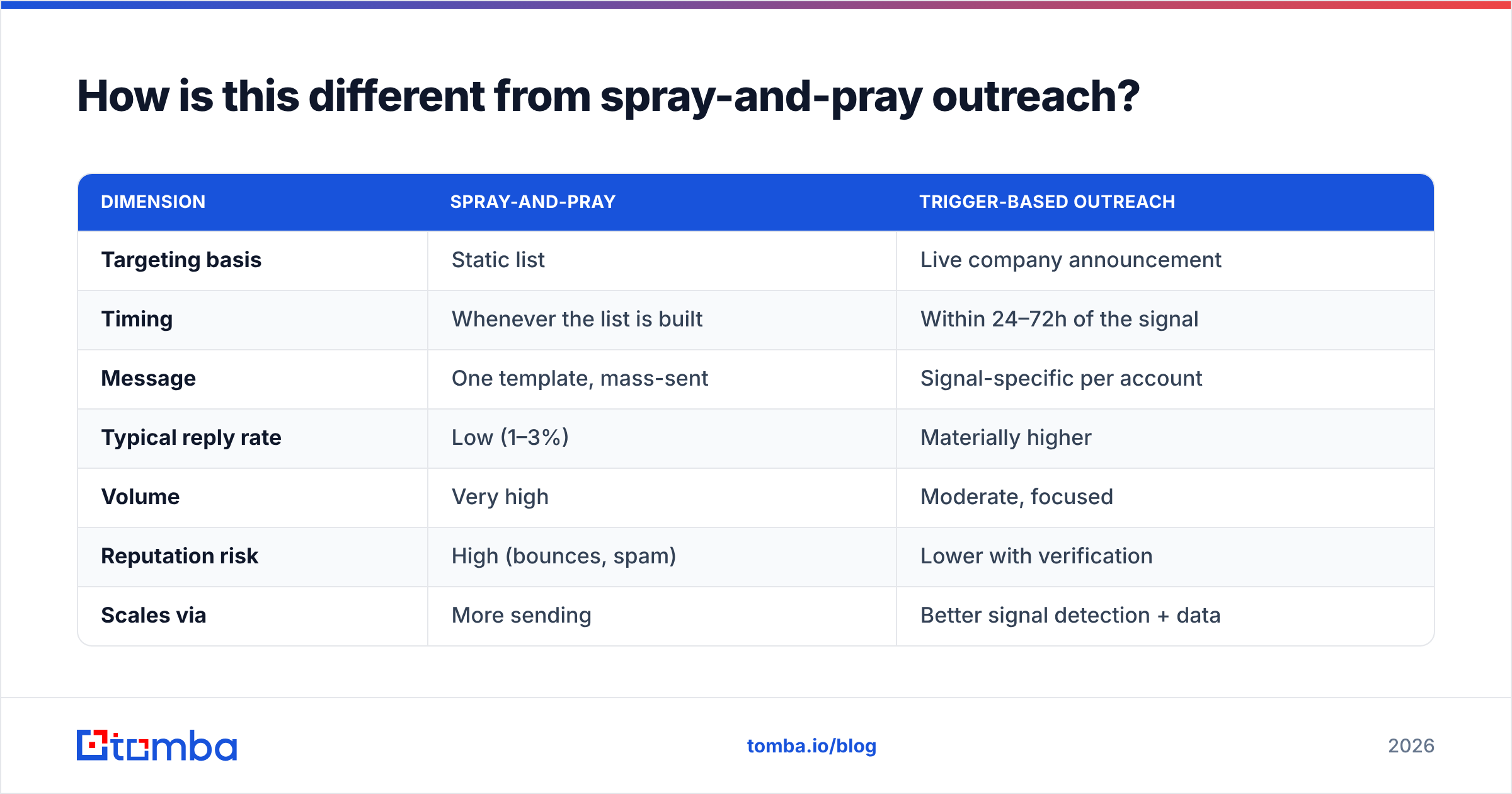
It trades volume for relevance, and relevance is what still gets replies in 2026. Buyers have been trained to ignore untargeted email; industry analysts at Gartner have documented how B2B buyers now spend the majority of their journey in self-directed research and tune out generic vendor outreach entirely. A signal-triggered message survives that filter because it arrives when the buyer's own actions created the need.
| Dimension | Spray-and-pray | Trigger-based outreach |
|---|---|---|
| Targeting basis | Static list | Live company announcement |
| Timing | Whenever the list is built | Within 24–72h of the signal |
| Message | One template, mass-sent | Signal-specific per account |
| Typical reply rate | Low (1–3%) | Materially higher |
| Volume | Very high | Moderate, focused |
| Reputation risk | High (bounces, spam) | Lower with verification |
| Scales via | More sending | Better signal detection + data |
Trigger outreach isn't "less outreach." Done right, it's the same or more pipeline from far fewer, better-aimed sends. The lever you pull to scale isn't sending volume—it's how many high-quality signals you can detect and act on per week. You can validate vendor claims like these yourself on peer-review sites such as G2 before committing budget.
How do you build a system so signals don't slip through?#
Turn it into a pipeline with owners, not a habit that depends on someone remembering to check the news. A workable stack:
- Sources: funding databases, job boards, LinkedIn, news alerts, and product-launch feeds for your ICP. Set alerts by keyword and industry.
- Detection: a daily digest or automation that collects new announcements matching your criteria, so qualification is a 10-minute morning ritual, not a scavenger hunt.
- Enrichment + verification: feed qualified companies through a find-and-verify step so every signal produces a deliverable contact. For volume, a bulk email finder processes a whole day's list at once.
- Sequencing: route contacts into a short, 3-touch sequence where touch one references the signal directly. Keep the trigger cohort separate from your evergreen list so you can measure it.
- Measurement: track reply rate and meetings by signal type. You'll find one or two triggers (often funding and executive hires) outperform the rest—double down there.
Wire the data steps into where you already work using the tools you have; a domain feeding straight into an email finder API or the Chrome extension removes the copy-paste tax that makes people abandon trigger programs after two weeks.
The failure mode to design against is silent drop-off: a signal gets spotted, no one owns the follow-through, and it dies in a Slack channel. Assign each source an owner and a same-day SLA, and the system holds.
Which announcement types should you start with?#
Start with funding and leadership changes—they carry the clearest budget and mandate signals, and the data is easy to source. Funding rounds tell you money just landed and growth is expected. New executives arrive with a 90-day plan and an explicit license to change vendors, which is the single most reliable window for displacing an incumbent. Once those two channels are producing meetings, layer in product launches and expansions, which take slightly more craft to connect to your value.
Whatever you start with, resist the urge to chase every signal at once. One well-run trigger, measured honestly for a month, will teach you more than five half-run ones.
Turn announcements into pipeline with the right data#
Trigger-based outreach only works when you can move from "company X just made news" to "verified contact in my sequence" before the window closes. That's a data problem first and a copywriting problem second. Tomba's Email Finder turns a company domain and a name into a verified, deliverable email in seconds, with domain search, enrichment, and verification alongside it so your whole signal-to-send pipeline runs in one place. Plans start free with 25 searches a month and scale from $49/mo—see full Tomba pricing to match a tier to your signal volume. Start with the free tier, wire one trigger source into it this week, and let timing do the heavy lifting your subject lines used to.
Related guides#
Ready to find emails that actually work?
Join 150,000+ professionals who stopped guessing and started sending. Free credits on signup — no credit card required.
Get the Tomba newsletter
Practical outbound tactics and product updates — once every two weeks.
About the author