Competitive Landscape Analysis: A 2026 Framework for B2B Teams
A competitive landscape analysis tells you who you're really up against, where the gaps are, and how to win them. Here's a repeatable 2026 framework, template, and data sources.
Most "competitor research" is a slide deck someone builds once, presents once, and never opens again. A real competitive landscape analysis is different: it's a living map of who competes for your buyer's budget, how they position, where they're weak, and what that means for your next quarter. Done right, it changes what you build, how you price, and the words your reps use on calls.
This guide gives you a repeatable framework, a fill-in template, and the data sources that keep the analysis honest instead of anecdotal.
TL;DR#
- A competitive landscape analysis maps every player fighting for your buyer's attention and budget — direct, indirect, and "do nothing" — plus their positioning, pricing, and gaps.
- Skip the one-off deck. Treat it as a living system you refresh quarterly against real signals (pricing pages, review sites, hiring, funding).
- The four steps: define the arena, gather intelligence, map on axes that matter, turn findings into moves.
- Ground every claim in evidence. Opinions about competitors age badly; verified data — including accurate contact and company data — does not.
- The output isn't a report. It's decisions: positioning, pricing, roadmap bets, and battlecards your reps actually use.
What is a competitive landscape analysis?#
A competitive landscape analysis is a structured assessment of the companies, products, and alternatives that compete for the same customers you do — and how each one is positioned relative to you.
Think of it like a coach scouting an entire league, not just the next opponent. You're not only asking "how do we beat Competitor X?" You're asking "who's in this market, how do they group, where are the open lanes, and which lane is ours to own?" That wider view is what separates a landscape analysis from a simple head-to-head comparison.
The output answers three questions for your go-to-market team:
- Who do we actually compete with? (Often not who leadership assumes.)
- How are we differentiated — really? (Not the marketing claim, the buyer-perceived reality.)
- Where are the gaps we can win? (Underserved segments, unmet needs, weak positioning.)
If your analysis doesn't produce a decision, it wasn't an analysis. It was a book report.

Why does competitive landscape analysis matter in 2026?#
Because the number of "competitors" for any B2B buyer's budget has exploded. Your buyer isn't choosing between you and two obvious rivals. They're weighing you against a vertical point solution, a horizontal platform bundling your feature for free, an in-house build, and the status quo of doing nothing. According to Gartner research on B2B buying, buyers spend the majority of their journey researching independently — long before they talk to a rep. If your positioning doesn't already account for the full landscape, you lose deals you never knew you were in.
Three shifts make this urgent:
- Bundling pressure. Platforms increasingly absorb single-feature tools. If your whole product is someone else's checkbox feature, you need to know now.
- Faster launches. New entrants ship in weeks, not years. A landscape mapped a year ago is a landscape you no longer recognize.
- Buyer-led research. With most vetting happening on review sites like G2 and Capterra before a sales conversation, your competitive position is being set by third-party data you don't control.
You can't manage a market you can't see. And you can't see it with a stale deck.
What are the types of competitors to map?#
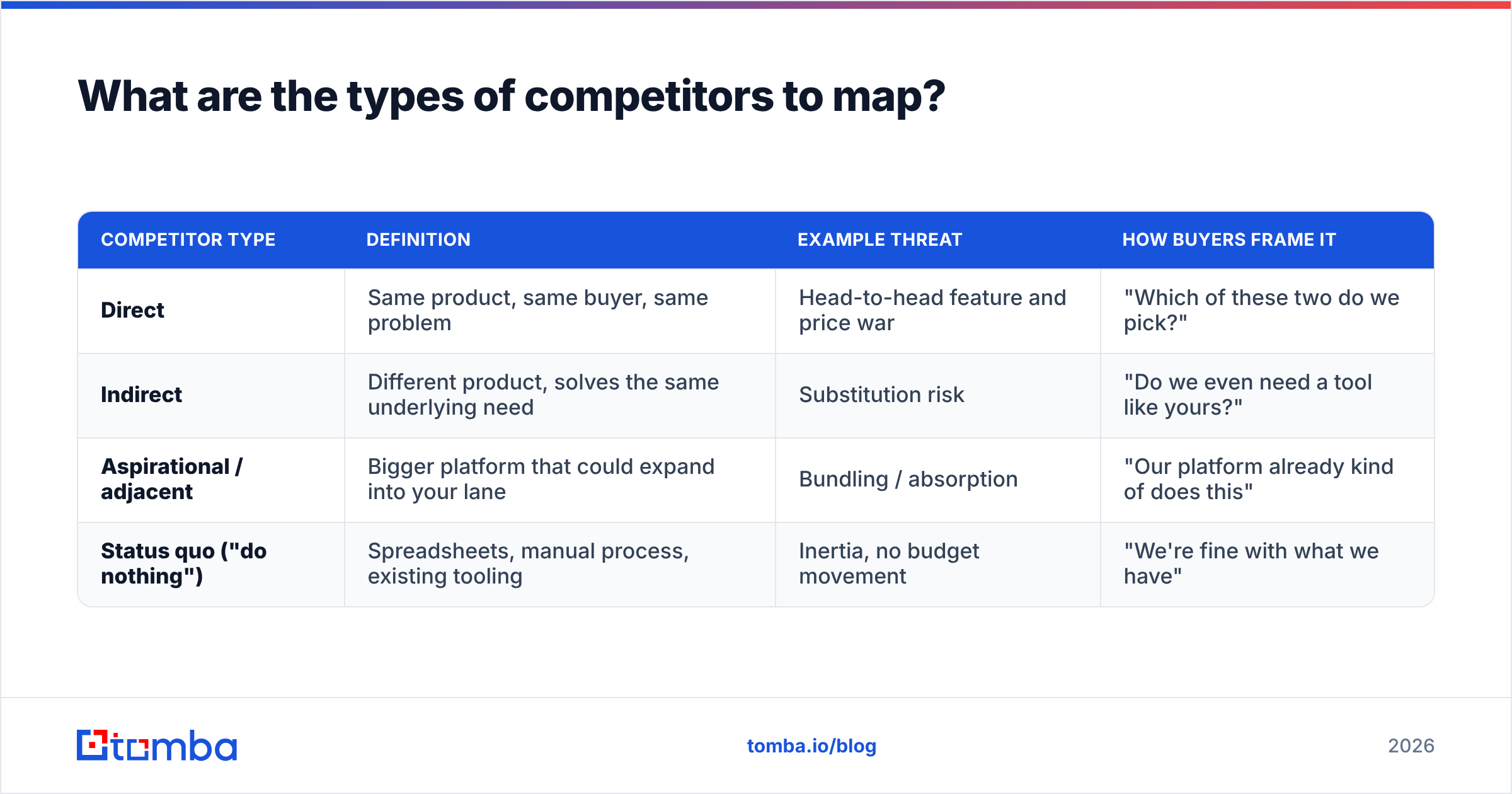
The most common failure is scoping too narrowly. Map four tiers, not one:
| Competitor type | Definition | Example threat | How buyers frame it |
|---|---|---|---|
| Direct | Same product, same buyer, same problem | Head-to-head feature and price war | "Which of these two do we pick?" |
| Indirect | Different product, solves the same underlying need | Substitution risk | "Do we even need a tool like yours?" |
| Aspirational / adjacent | Bigger platform that could expand into your lane | Bundling / absorption | "Our platform already kind of does this" |
| Status quo ("do nothing") | Spreadsheets, manual process, existing tooling | Inertia, no budget movement | "We're fine with what we have" |
Most teams obsess over the direct tier and get killed by the other three. The "do nothing" competitor wins more B2B deals than any named rival — and you beat it with ROI proof, not feature lists.
How do you run a competitive landscape analysis? (4 steps)#
Here's the repeatable framework. Run it quarterly for fast markets, twice a year for slower ones.
Step 1 — Define the arena#
Before you research anyone, define the boundary of the market you're analyzing. Write a one-sentence market definition: "Tools that help B2B sales teams find and verify contact data." Everything inside that sentence is in scope; everything outside is noise. Then list the buyer persona and the specific job-to-be-done — because two products can look identical on a feature grid and serve completely different buyers.
Step 2 — Gather intelligence (from evidence, not memory)#
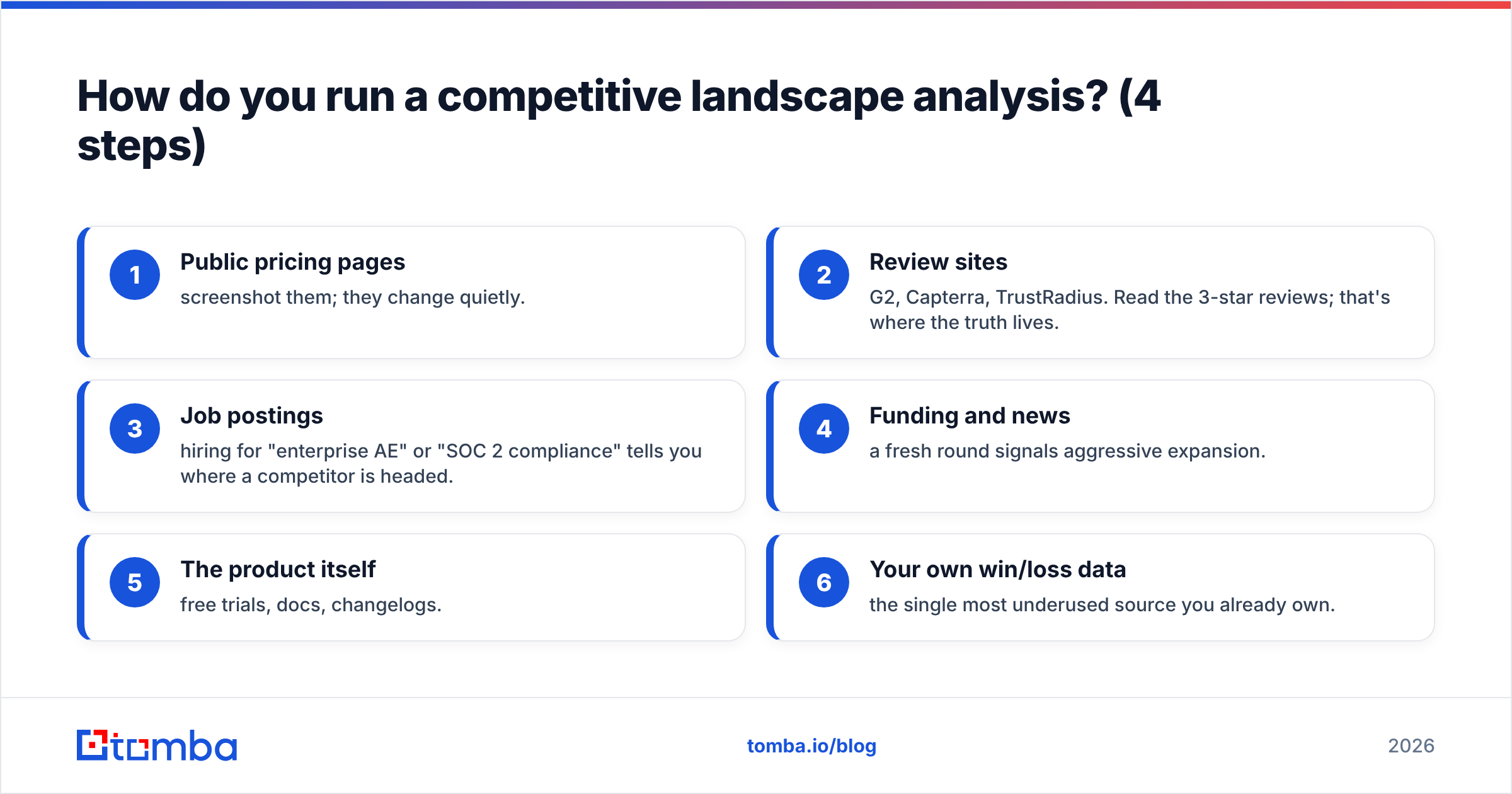
This is where most analyses go wrong: they run on what a rep thinks a competitor does. Pull from primary sources instead:
- Public pricing pages — screenshot them; they change quietly.
- Review sites — G2, Capterra, TrustRadius. Read the 3-star reviews; that's where the truth lives.
- Job postings — hiring for "enterprise AE" or "SOC 2 compliance" tells you where a competitor is headed.
- Funding and news — a fresh round signals aggressive expansion.
- The product itself — free trials, docs, changelogs.
- Your own win/loss data — the single most underused source you already own.
For the company- and contact-level layer of this research — who's on the buying committee, which firms fit your ICP, how to reach the right decision-maker — a reliable B2B database and data enrichment layer keeps your map accurate instead of anecdotal. Bad data doesn't just waste outreach; it corrupts the strategic conclusions you draw from it.
Step 3 — Map on axes that matter#
Don't map on vanity axes. Map on the two dimensions your buyer actually trades off. For a data tool that might be coverage vs. accuracy; for a CRM it might be ease-of-use vs. depth. Plot each competitor. Clusters reveal crowded lanes; empty quadrants reveal opportunity. This is your positioning map, and it's worth more than any 40-slide teardown.
Step 4 — Turn findings into moves#
Every finding gets a "so what." A competitor drops their price? Decide: match, hold and justify, or reframe the comparison. A rival can't verify catch-all domains? That's a battlecard line for your reps. The deliverable is a short list of decisions — positioning tweaks, pricing responses, roadmap bets, and sales talk tracks — with an owner on each.

What should a competitive landscape template include?#
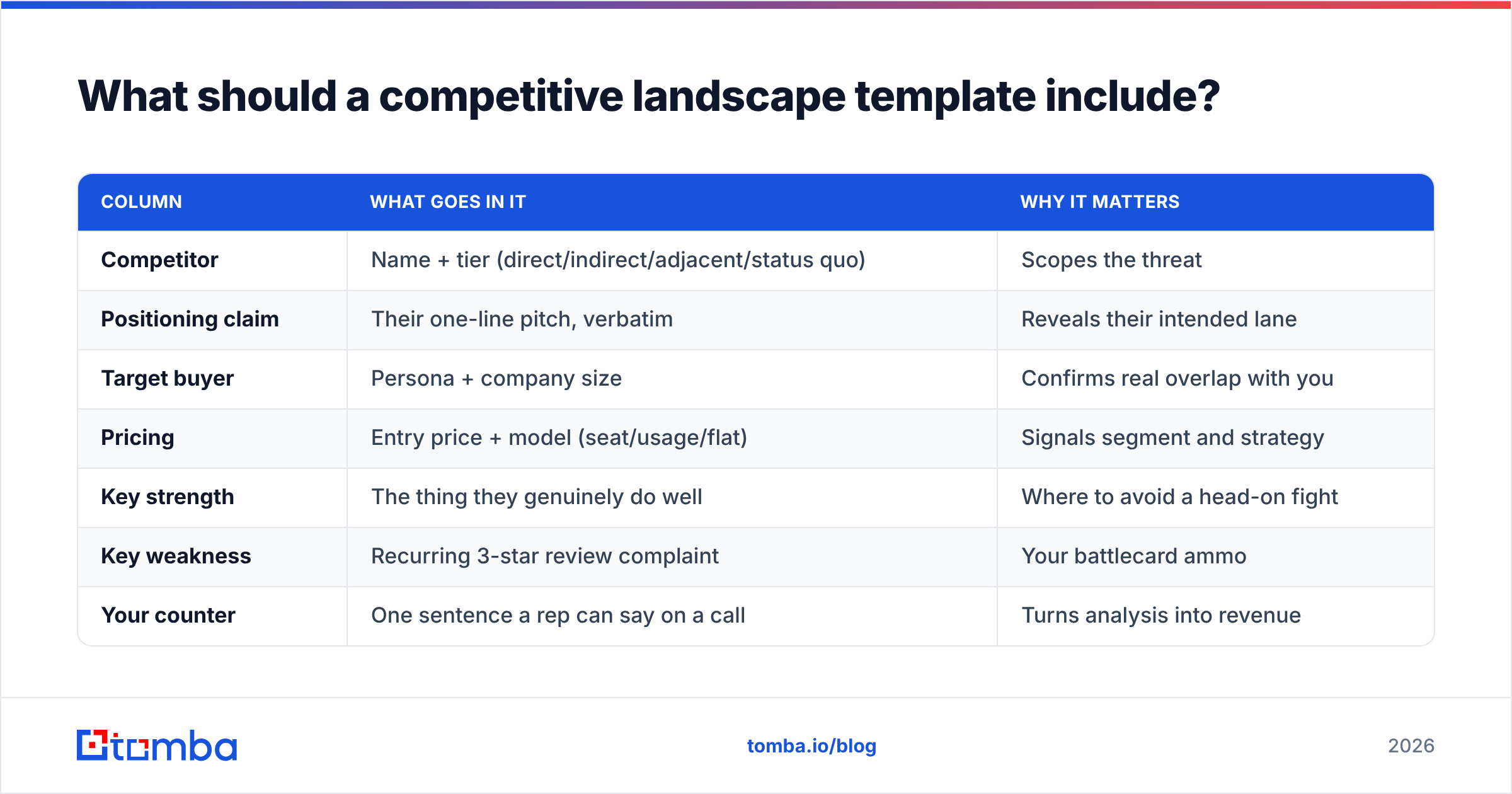
A good template is short enough that you'll actually maintain it. One row per competitor, these columns:
| Column | What goes in it | Why it matters |
|---|---|---|
| Competitor | Name + tier (direct/indirect/adjacent/status quo) | Scopes the threat |
| Positioning claim | Their one-line pitch, verbatim | Reveals their intended lane |
| Target buyer | Persona + company size | Confirms real overlap with you |
| Pricing | Entry price + model (seat/usage/flat) | Signals segment and strategy |
| Key strength | The thing they genuinely do well | Where to avoid a head-on fight |
| Key weakness | Recurring 3-star review complaint | Your battlecard ammo |
| Your counter | One sentence a rep can say on a call | Turns analysis into revenue |
Notice what's not here: a 30-feature checklist. Feature grids feel thorough and change decisions almost never. Positioning, pricing, and weaknesses change decisions constantly.
How does this fit into your broader GTM motion?#
A competitive landscape analysis isn't a standalone artifact — it feeds three downstream systems:
- Product / revenue operations: open quadrants on your map become roadmap and segment bets.
- Marketing: your differentiation becomes the spine of your messaging and comparison pages.
- Sales: competitor weaknesses become battlecards, and accurate targeting starts with knowing which accounts fit the lane you've chosen to own.
That last point is where execution lives. Once the analysis tells you which segment to attack, you still have to reach the right people inside it. Pairing your strategy with tools to find email addresses and run a clean domain search on target accounts turns a positioning map into an actual pipeline. The strategy sets direction; verified contact data moves the needle.
What are the most common mistakes?#
- Analyzing once, then filing it. Markets move; a dead map misleads. Schedule the refresh.
- Only mapping direct competitors. You lose to "do nothing" and to bundlers, not to the rival you obsess over.
- Confusing features with differentiation. Buyers don't buy feature counts; they buy outcomes and trust.
- Running on opinion. "I heard they're expensive" is not data. Screenshot the pricing page.
- No owner, no decisions. If nothing changes after the analysis, you spent hours to feel informed. That's a hobby, not strategy.
A neutral note on the field: some data providers, like BookYourData, lead with pre-built list volume, while tools like HubSpot win on native CRM workflow. Neither is "better" in the abstract — the point of the landscape map is to see clearly where each one wins so you can position deliberately against all of them.
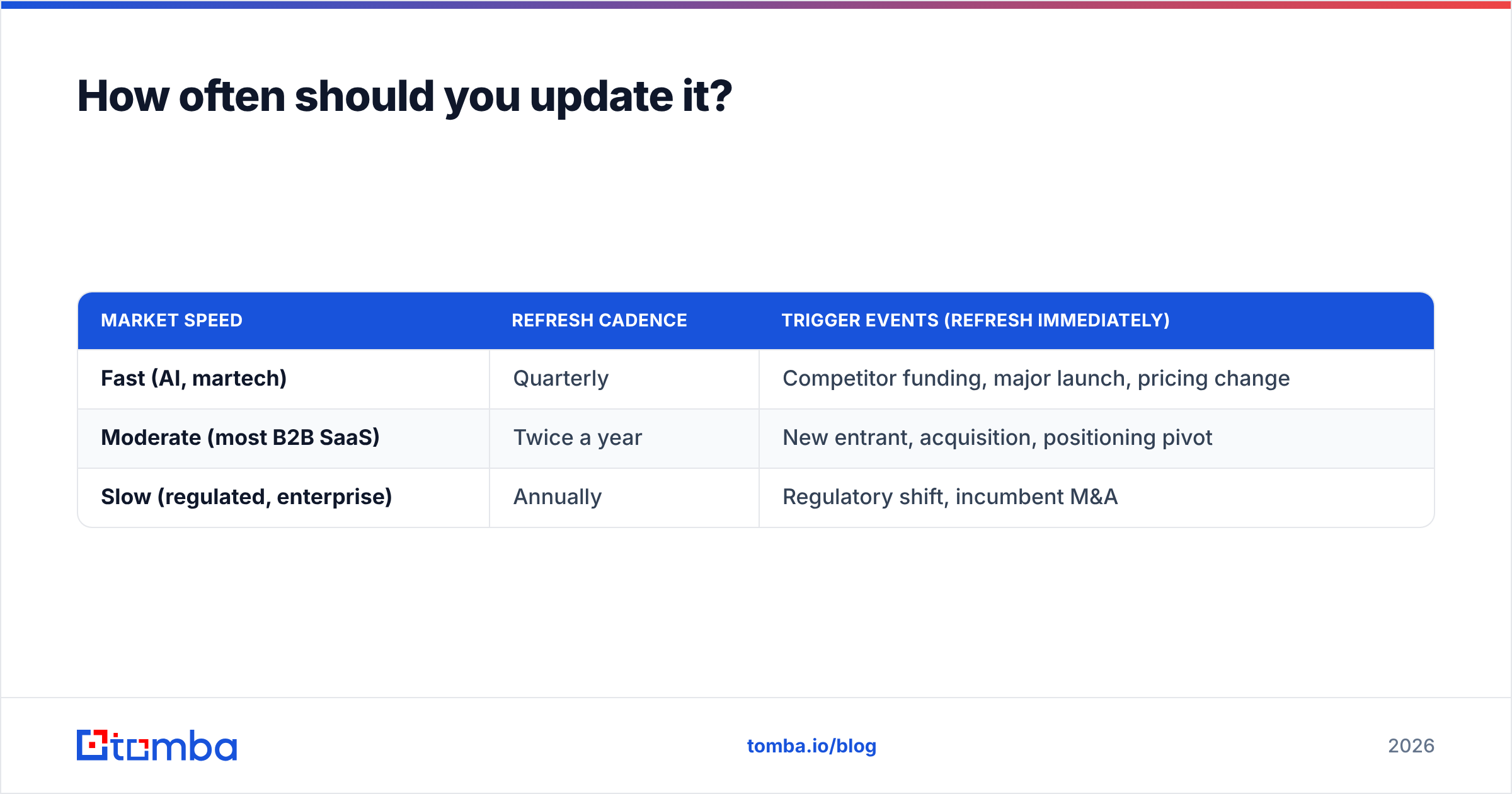
How often should you update it?#
Match the cadence to your market's speed:
| Market speed | Refresh cadence | Trigger events (refresh immediately) |
|---|---|---|
| Fast (AI, martech) | Quarterly | Competitor funding, major launch, pricing change |
| Moderate (most B2B SaaS) | Twice a year | New entrant, acquisition, positioning pivot |
| Slow (regulated, enterprise) | Annually | Regulatory shift, incumbent M&A |
The trigger column matters more than the calendar. A competitor's Series B or a sudden pricing overhaul should reset your map the week it happens — not at the next scheduled review.
Ground your competitive map in accurate data#
A competitive landscape analysis is only as good as the evidence under it. Positioning claims, pricing, and reviews tell you how competitors present themselves — but to act on your findings, you need to reach the real accounts and decision-makers in the lanes you've chosen to own. That's where clean contact data turns strategy into pipeline.
Use the Tomba Email Finder to find and verify professional emails for the target accounts your analysis surfaces — by name, company, or domain — so the segment you decided to win is one you can actually reach. Start free with 25 searches a month, and scale on a Tomba plan ($49/mo Starter) when your outbound motion is ready to move. The map tells you where to go; verified data gets you there.
Related guides#
Ready to find emails that actually work?
Join 150,000+ professionals who stopped guessing and started sending. Free credits on signup — no credit card required.
Get the Tomba newsletter
Practical outbound tactics and product updates — once every two weeks.
About the author