Competitive Selling in 2026: How to Win Head-to-Head Deals
Competitive selling is how you win deals when a buyer is evaluating you against three other vendors. Here's the framework, the battlecards, and the data plays that decide who signs.
Competitive Selling in 2026: How to Win Head-to-Head Deals
Competitive selling is the discipline of winning a deal when the buyer is actively evaluating you against other vendors. It is not "pitch harder." It is a structured way to shape the buyer's decision criteria, expose where rivals are weak, and prove you are the lowest-risk choice — without ever descending into a feature-list shouting match.
If most of your pipeline now shows up already comparing three or four options, this guide is for you.
TL;DR#
- Competitive selling means influencing the buyer's decision criteria early, not reacting to a rival's pitch late. The rep who defines "what good looks like" usually wins.
- Battlecards, discovery traps, and proof beat mud-slinging. Naming a competitor to trash them backfires; naming their weakness through a buyer's own pain point works.
- Data is the quiet differentiator. Knowing the account, the stakeholders, and the incumbent contract lets you tailor the whole play — that starts with clean contact and account intelligence.
- Win rate, not activity, is the scoreboard. Track competitive win rate per rival so you know which deals to lean into and which to qualify out.
- Tomba's email finder and data enrichment help you map the full buying committee before the competitor does — the earlier you reach the economic buyer, the more you shape criteria.
What is competitive selling?#
Competitive selling is a sales approach used when a prospect is choosing between you and at least one alternative — a direct competitor, an incumbent tool, an in-house build, or "do nothing." The goal is not to win an argument. It is to make your solution the obvious, defensible choice by the time the buyer reaches a decision.
Think of it like a chess opening. Amateurs react move by move; strong players steer the board toward positions they already know how to win. Competitive selling is the same — you guide the buyer toward the evaluation criteria where you are strongest, long before procurement builds its scorecard.
The mistake reps make is treating every deal as a solo pitch. In 2026, they rarely are. According to Gartner research on B2B buying, buyers spend most of their journey researching independently and comparing vendors before a rep is ever involved. That means the competition is already in the room — you just can't see them.
Why does competitive selling matter more in 2026?#
Three shifts made head-to-head selling the default, not the exception.
- Category saturation. Almost every B2B category now has 10+ credible vendors. Buyers no longer ask "should we solve this?" — they ask "which of these five do we pick?"
- Buyer self-education. Review sites like G2 and analyst content mean prospects arrive with opinions, shortlists, and objections pre-loaded.
- Budget scrutiny. Tighter spend means more stakeholders, longer scorecards, and a bias toward the "safe" incumbent. You have to actively de-risk switching to you.
The upshot: if you are not deliberately selling against alternatives, you are losing to them by default. Reps who master competitive selling see it directly in their win rate — the single metric that separates a repeatable motion from luck.
What are the core plays of competitive selling?#
There are five plays that carry most competitive deals. You rarely need all five in one deal — you need to know which the situation calls for.
- Criteria shaping — Influence the buyer's requirements list early so it favors your strengths. This is the highest-leverage play and the most overlooked.
- Discovery traps — Ask questions that surface the pain a rival can't solve, letting the buyer conclude the gap themselves instead of hearing it from you.
- Battlecards — Internal one-pagers per competitor: their pricing, positioning, three landmines to plant, and honest counters to their strengths.
- Proof and de-risking — Reference customers, ROI math, security docs, and migration guarantees that make switching feel safe.
- Trap-setting on price — Reframe the conversation from sticker price to total cost and risk, so the cheaper rival looks expensive once hidden costs surface.
Notice none of these is "tell the buyer our competitor is bad." Direct disparagement reads as insecurity and often violates the buyer's trust. The strongest competitive move is a well-placed question.
How do you build a battlecard that actually gets used?#
A battlecard is a living reference your reps pull up mid-deal — not a marketing PDF that dies in a shared drive. The ones that get used are short, honest, and specific.
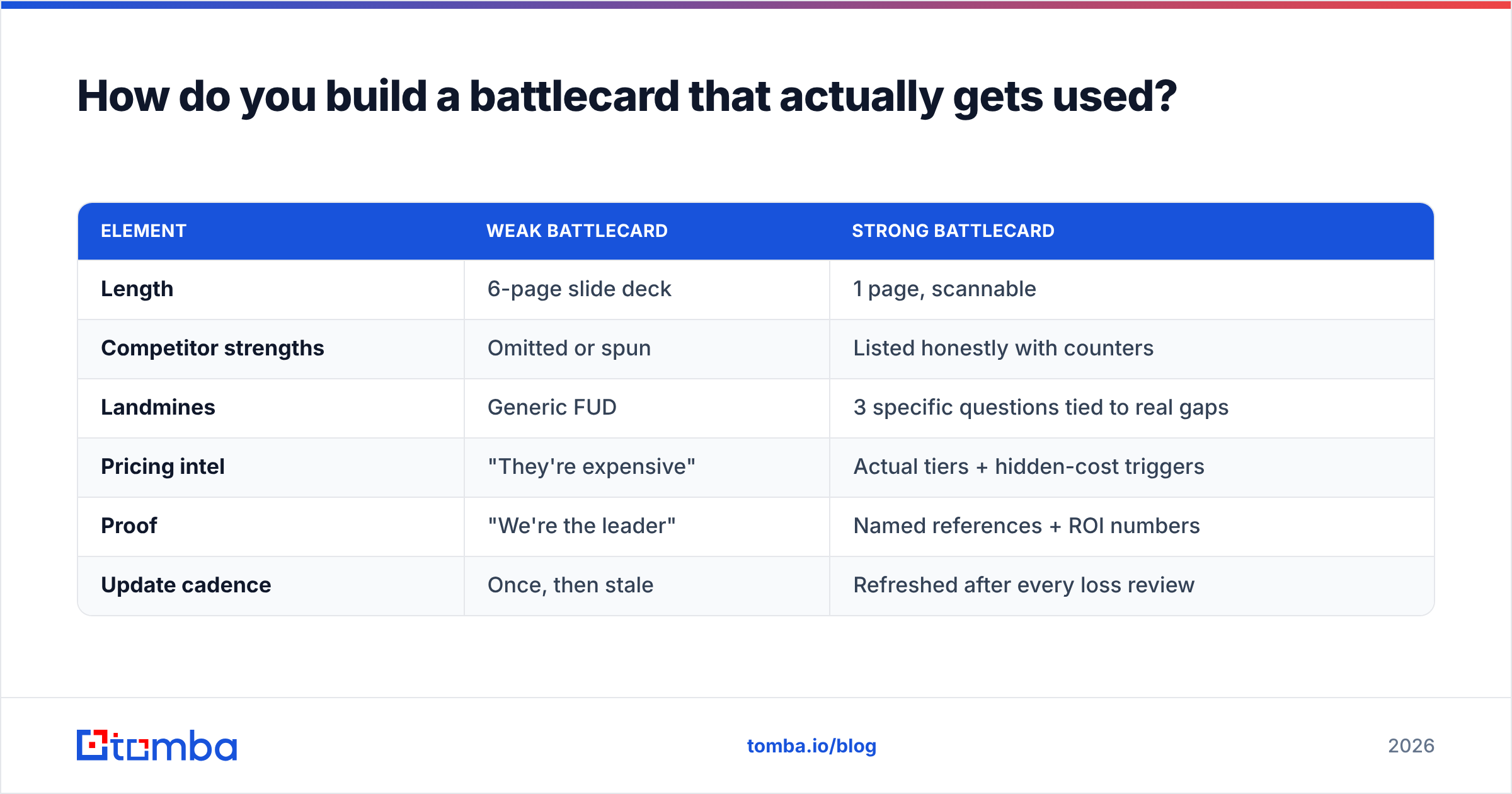
Here is a comparison of what separates a battlecard reps trust from one they ignore:
| Element | Weak battlecard | Strong battlecard |
|---|---|---|
| Length | 6-page slide deck | 1 page, scannable |
| Competitor strengths | Omitted or spun | Listed honestly with counters |
| Landmines | Generic FUD | 3 specific questions tied to real gaps |
| Pricing intel | "They're expensive" | Actual tiers + hidden-cost triggers |
| Proof | "We're the leader" | Named references + ROI numbers |
| Update cadence | Once, then stale | Refreshed after every loss review |
The honesty column matters most. A battlecard that pretends a competitor has no strengths trains reps to get ambushed. Acknowledge what the rival does well, then redirect: "They do have a strong X. The question is whether X matters more to you than Y — and here's why most teams in your position chose Y."
For the pricing-intelligence row, this is where good data pays off. Knowing a competitor's real deployed cost — not their list price — often comes from talking to the right people at the account. Reaching those people fast is a data problem before it's a selling problem.
How does data give you a competitive selling edge?#
Conclusion first: the rep with the better map of the account wins more competitive deals, because they shape criteria with more stakeholders before the rival does.
Competitive selling runs on three data layers:
- Contact coverage — Do you have every member of the buying committee, or just your champion? If a competitor reaches the CFO and you don't, they shape the budget conversation and you react to it. A domain search across the target company surfaces the roles you're missing.
- Account intelligence — Tech stack, headcount, funding, and incumbent tools tell you which competitor you're actually up against and where they're weak. Data enrichment turns a bare company name into that full picture.
- Reachability — Email plus a verified phone finder number means you can multithread the moment a deal goes quiet — the classic sign a rival is gaining ground.
When you can see the whole committee and reach them faster than the competition, criteria shaping stops being a hope and becomes a plan. This is the unglamorous half of competitive selling that separates consistent closers from reps who blame "the product" every time they lose.

What questions win competitive deals?#
Discovery is where competitive deals are quietly won or lost. The right questions plant doubt about the alternative without you saying a negative word. A few that consistently work:
- "When you looked at other options, what worried you about how they'd handle [specific edge case]?" — surfaces a rival's gap using the buyer's own concern.
- "How are you planning to migrate off [incumbent] — what's your rollback plan if it stalls?" — makes switching risk concrete, favoring whoever de-risks it best.
- "Which of these requirements is a genuine dealbreaker versus a nice-to-have?" — separates real criteria from noise a competitor may be padding your scorecard with.
- "Who else needs to sign off, and what does success look like for them?" — reveals stakeholders you can reach before the rival does.
Each question does double duty: it advances your understanding and it shapes the buyer's evaluation frame. That is the essence of competitive selling — the buyer reaches your conclusion, so it feels like theirs.
Competitive selling vs. traditional selling: what's the difference?#
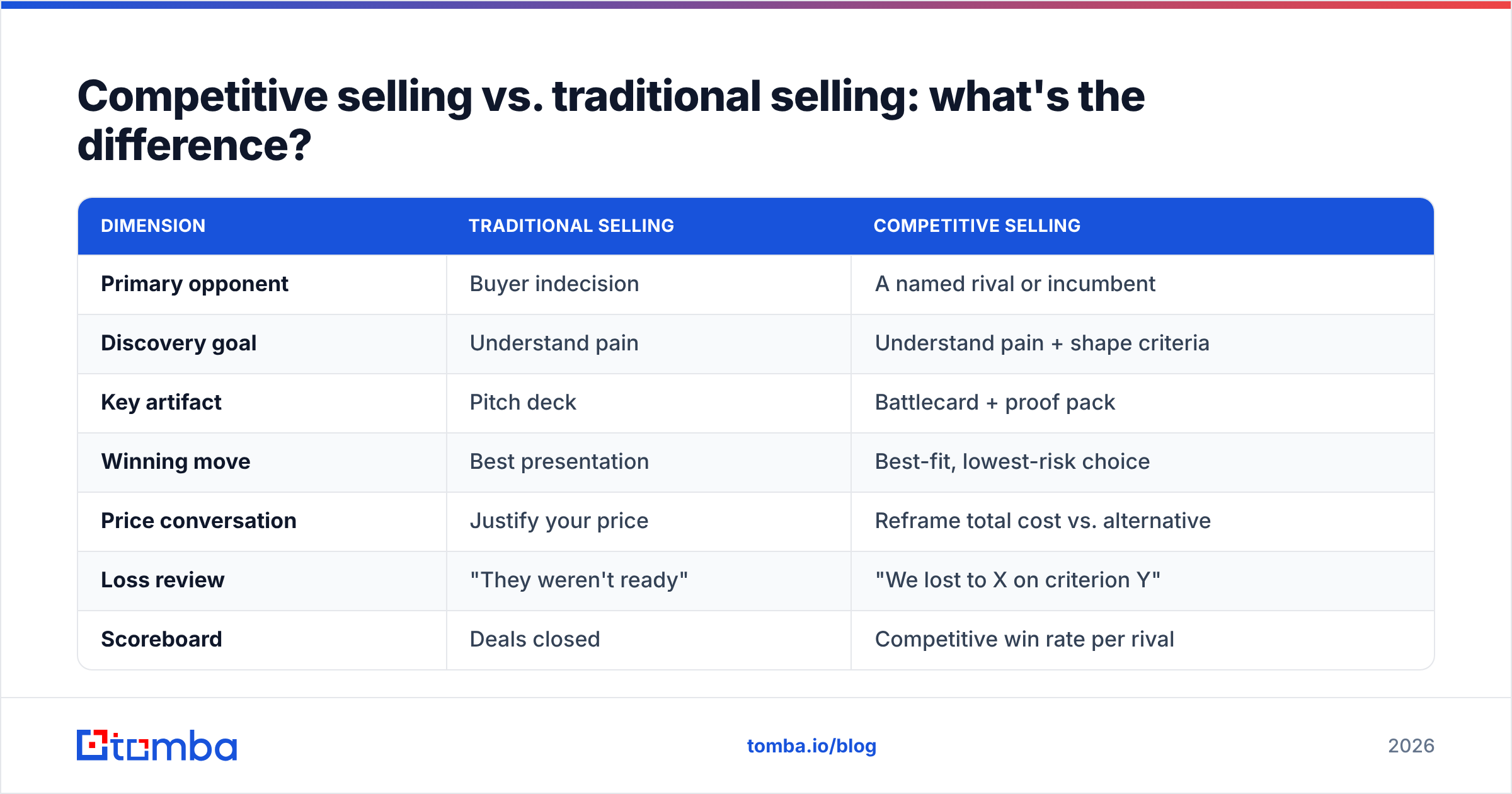
They share a foundation — discovery, qualification, value framing — but they diverge on where the effort goes.
| Dimension | Traditional selling | Competitive selling |
|---|---|---|
| Primary opponent | Buyer indecision | A named rival or incumbent |
| Discovery goal | Understand pain | Understand pain + shape criteria |
| Key artifact | Pitch deck | Battlecard + proof pack |
| Winning move | Best presentation | Best-fit, lowest-risk choice |
| Price conversation | Justify your price | Reframe total cost vs. alternative |
| Loss review | "They weren't ready" | "We lost to X on criterion Y" |
| Scoreboard | Deals closed | Competitive win rate per rival |
The last row is the operational core. If you're not running structured loss reviews and tracking which competitor beats you on which criteria, you're guessing. HubSpot's sales research consistently shows that teams with disciplined deal reviews forecast and win more predictably than teams that treat each loss as a one-off.
How do you handle the "you're more expensive" objection?#
Price is where competitive deals are most often lost — and most often lost badly, by discounting on reflex. The move is to reframe, not to fold.
- Separate price from cost. A cheaper tool with a six-week implementation, a required add-on, and a support gap is not cheaper. Walk the buyer through total cost of ownership over 12 months.
- Attach a number to risk. "If the migration slips a month, what does that delay cost your team?" Risk has a dollar value; make it visible.
- Anchor on outcome, not tier. Tie your price to the revenue or hours it protects, not to the competitor's line item.
- Hold the line with proof. A named reference who switched from the cheaper rival and quantified the payoff ends the argument faster than any discount.
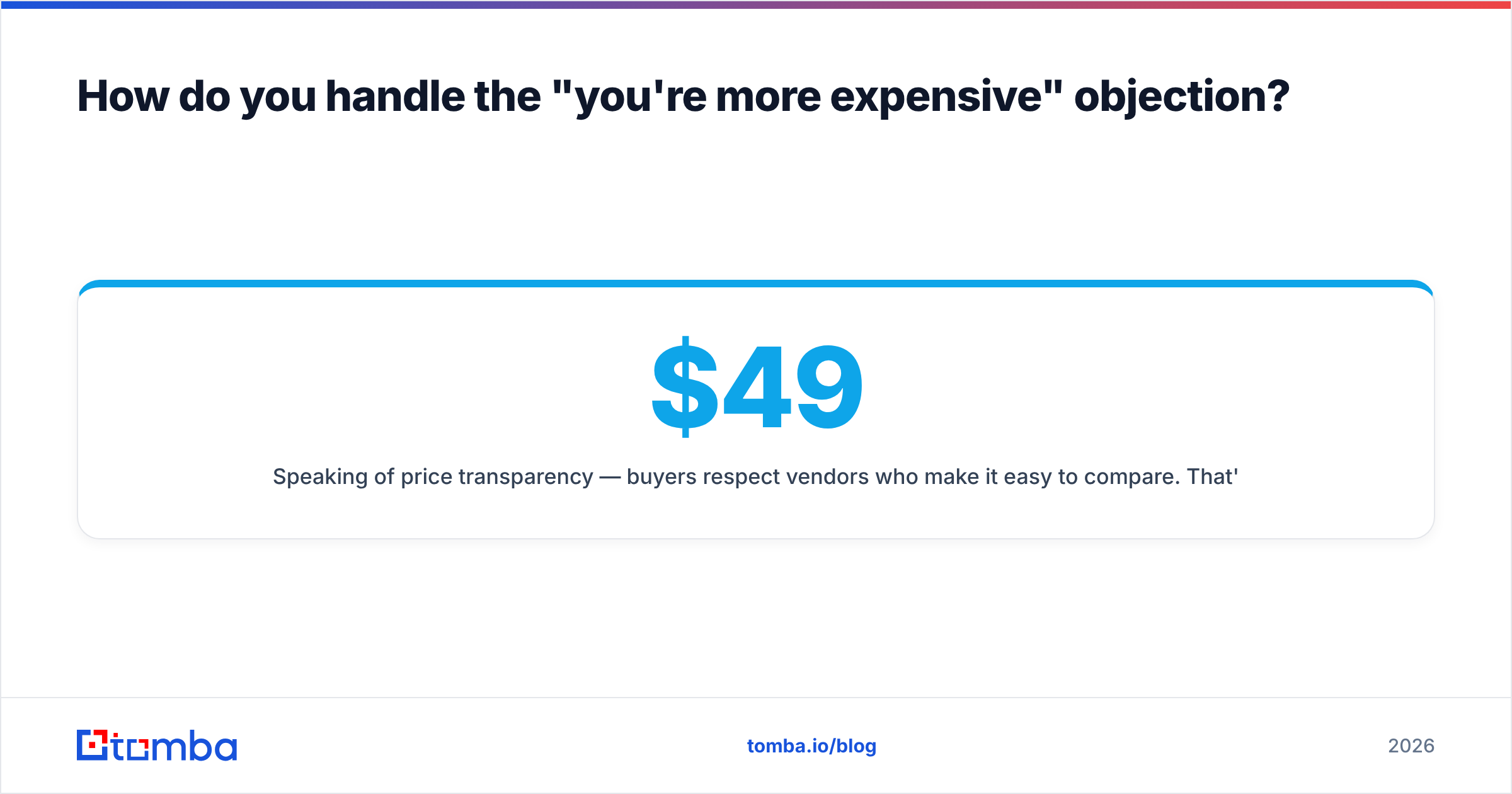
Speaking of price transparency — buyers respect vendors who make it easy to compare. That's part of why straightforward, published Tomba pricing (Free at 25 searches/mo, Starter at $49/mo, Growth at $99/mo, Pro at $249/mo) is itself a competitive advantage: there's no "call us" wall for the buyer to resent.
What metrics tell you if competitive selling is working?#
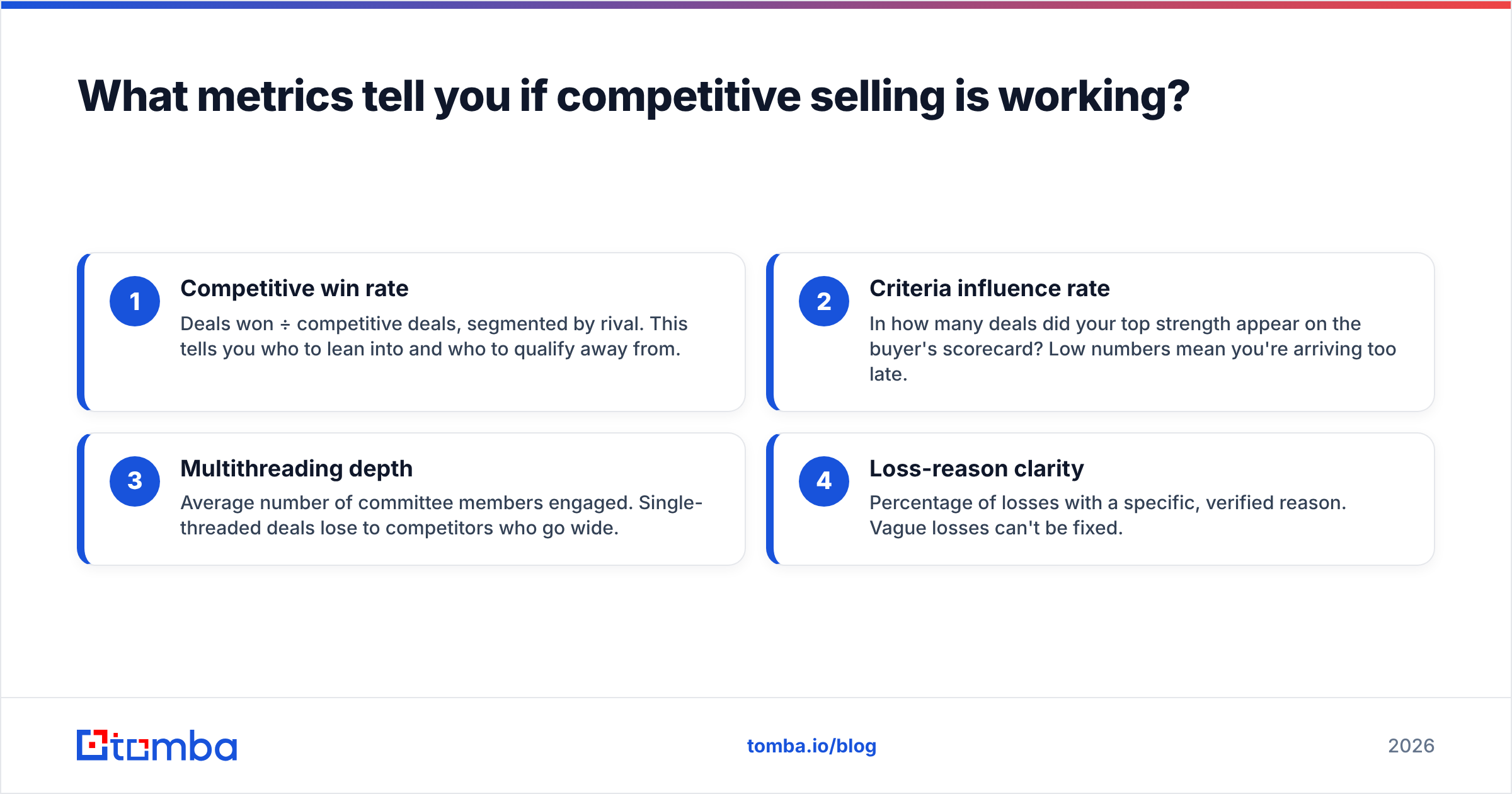
Track these four, per competitor where possible:
- Competitive win rate — Deals won ÷ competitive deals, segmented by rival. This tells you who to lean into and who to qualify away from.
- Criteria influence rate — In how many deals did your top strength appear on the buyer's scorecard? Low numbers mean you're arriving too late.
- Multithreading depth — Average number of committee members engaged. Single-threaded deals lose to competitors who go wide.
- Loss-reason clarity — Percentage of losses with a specific, verified reason. Vague losses can't be fixed.
If competitive win rate is climbing and losses have clear, actionable reasons, the motion is working. If not, the fix is almost always earlier engagement and wider coverage — both data problems as much as selling problems.
Common competitive selling mistakes to avoid#
- Trashing the competitor. It signals insecurity and damages trust. Let the buyer draw negative conclusions from your questions.
- Selling on features. Feature parity is table stakes; buyers decide on fit and risk. A feature war is a race to the bottom.
- Single-threading. One champion is a single point of failure. If the competitor reaches three stakeholders and you reach one, you lose.
- Skipping loss reviews. Every competitive loss is intelligence. Feed it back into the battlecard or you'll lose the same way twice.
- Reacting late. By the time you hear "we're also looking at X," criteria may already be set. Get in early enough to shape them.
Bring the data that wins competitive deals#
Competitive selling rewards the rep who sees the whole board first — every stakeholder, every account signal, every reason to switch made concrete. That map starts with knowing who's in the deal and how to reach them before your rival does.
Tomba's Email Finder finds verified professional emails by name, company, or domain, so you can multithread the full buying committee from day one — not just the contact who happened to fill out a form. Pair it with data enrichment to profile the account, spot the incumbent, and tailor your battlecard to the deal in front of you. Start free with 25 searches a month and see how much of the board you've been missing.
Win the deals where buyers are comparing — by knowing more, reaching wider, and shaping the criteria before anyone else does.
Related guides#
Ready to find emails that actually work?
Join 150,000+ professionals who stopped guessing and started sending. Free credits on signup — no credit card required.
Get the Tomba newsletter
Practical outbound tactics and product updates — once every two weeks.
About the author