Competitive Selling Strategies: How to Win More Deals in 2026
Losing deals to the same three rivals? This no-fluff guide breaks down the competitive selling strategies that actually move win rates in 2026 — trap-setting, framing, and data-backed differentiation.
Competitive selling is the discipline of winning a deal when the buyer is actively evaluating you against named alternatives. It is not a louder pitch or a bigger discount. It is the deliberate work of shaping the buyer's decision criteria, exposing where rivals are weak, and making your differentiation the yardstick everyone else gets measured against.
If you sell in a crowded category — email tools, CRM, cybersecurity, fintech — every serious opportunity is a bake-off. This guide gives you the competitive selling strategies that move win rates in 2026, without turning every deal into a race to the bottom.
TL;DR#
- Competitive selling starts before the RFP. Whoever sets the buyer's decision criteria usually wins the deal.
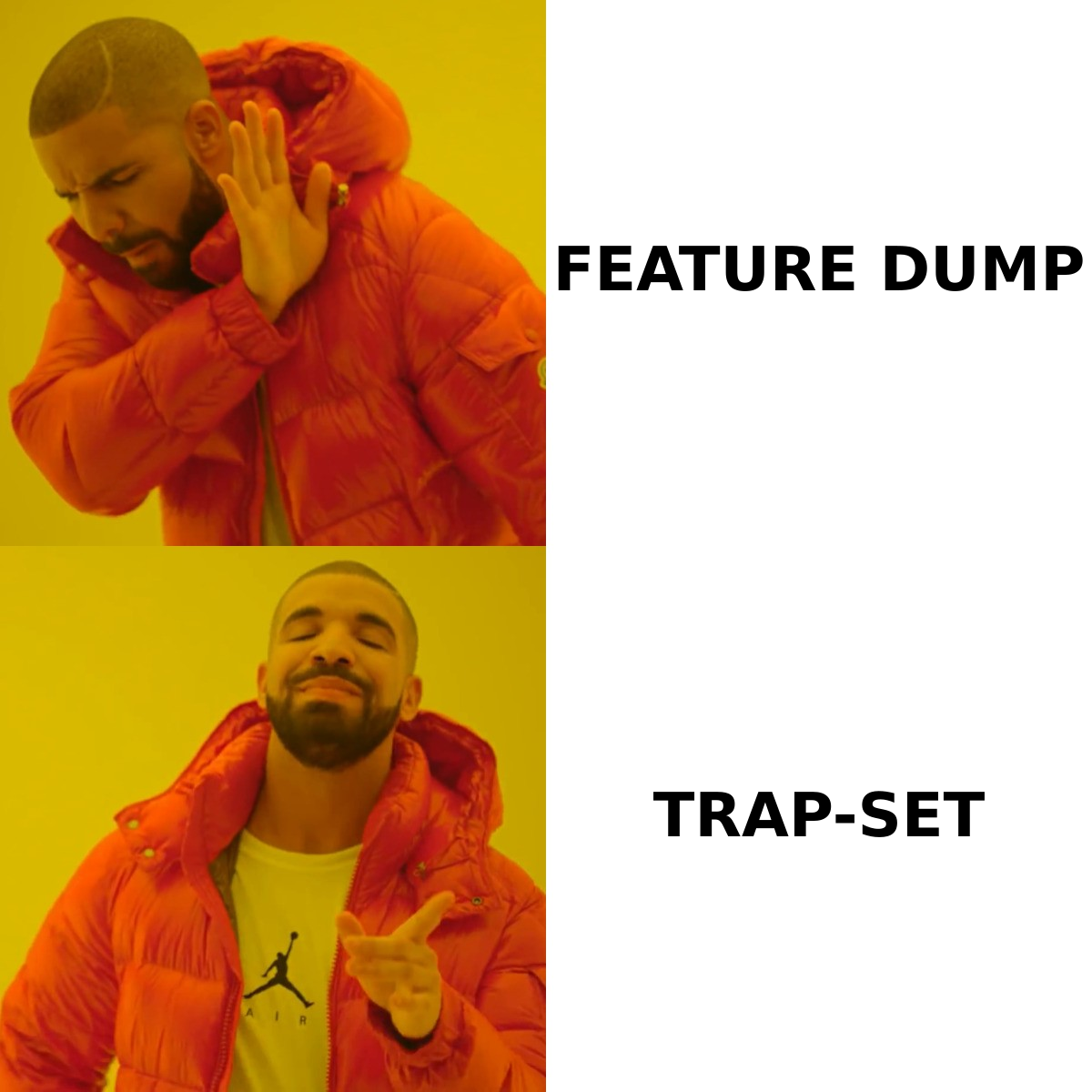
- Trap-setting beats feature-dumping. Plant questions the buyer will ask your competitor — questions only you answer cleanly.
- Discounting is the weakest competitive move. It signals your product can't win on value and trains buyers to squeeze you.
- Battlecards + fresh contact data are the operational backbone. You can't out-position a competitor if you're reaching the wrong stakeholder or reading a 2019 comparison sheet.
- Multi-threading is the highest-leverage habit. Single-threaded deals lose to a competitor's champion you never met.
What are competitive selling strategies?#
Competitive selling strategies are the repeatable plays a sales team uses to win deals where the buyer is choosing between two or more vendors. They operate on three levers at once: the criteria the buyer uses to decide, the perception of each vendor against those criteria, and the relationships that control the decision.
Think of it like a courtroom. The lawyer who wins isn't always the one with the strongest facts — it's the one who frames the case so the jury weighs the facts in their favor. In a competitive deal, your rivals are presenting the same "facts" (features, price, logos). Your job is to control the frame.
Most reps confuse product selling with competitive selling. Product selling answers "what does our tool do?" Competitive selling answers "why is our approach the right one, and why is the alternative a risk?" The second question is the one that actually closes contested deals.

(Ignore that placeholder — swap in your own product screenshot.)
Wait — that image doesn't belong here, so picture instead your CRM's deal-review board with the competitor field filled in on every open opportunity. That single habit, tracking who you're up against on every deal, is where competitive selling operationally begins.
Why do most sales teams lose competitive deals?#
Teams lose contested deals for reasons that have almost nothing to do with product quality. According to Gartner research on B2B buying, buyers spend only a fraction of the sales cycle actually talking to vendors — most of the decision forms in rooms you're not in. If you haven't shaped the criteria before those rooms convene, you're arguing against a scorecard someone else wrote.
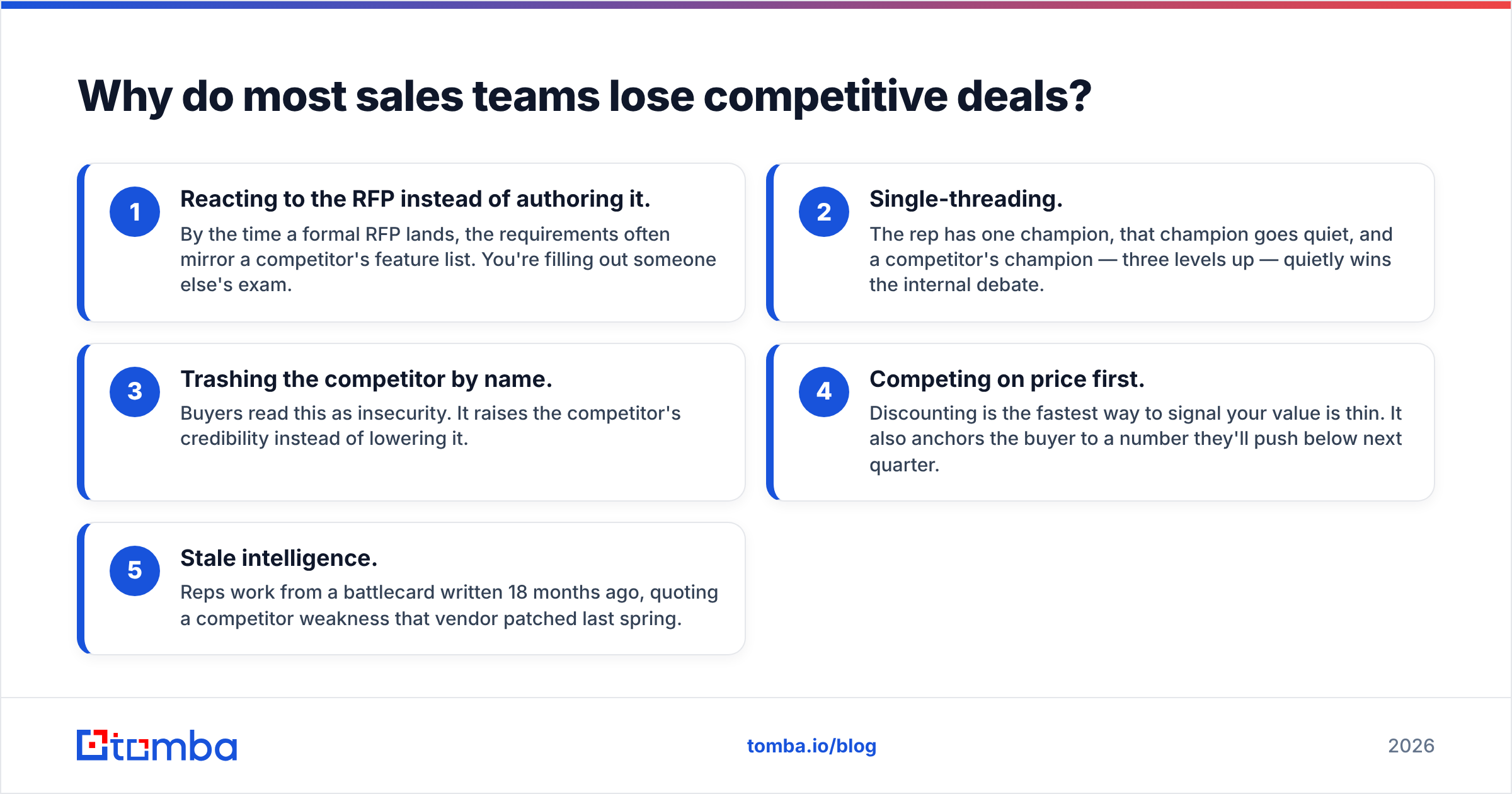
Here are the five failure patterns that show up again and again:
- Reacting to the RFP instead of authoring it. By the time a formal RFP lands, the requirements often mirror a competitor's feature list. You're filling out someone else's exam.
- Single-threading. The rep has one champion, that champion goes quiet, and a competitor's champion — three levels up — quietly wins the internal debate.
- Trashing the competitor by name. Buyers read this as insecurity. It raises the competitor's credibility instead of lowering it.
- Competing on price first. Discounting is the fastest way to signal your value is thin. It also anchors the buyer to a number they'll push below next quarter.
- Stale intelligence. Reps work from a battlecard written 18 months ago, quoting a competitor weakness that vendor patched last spring.
The common thread: reps let the competitor and the buyer set the terms of the fight. Competitive selling is about taking those terms back.
What is trap-setting, and why does it win?#
Trap-setting is planting a decision criterion — framed as a neutral, buyer-first question — that your solution answers cleanly and your competitor answers poorly. It is the single highest-leverage competitive selling technique because it works through the buyer, not against the competitor.
Here's the difference in practice. A feature-dumping rep says: "We have catch-all verification and they don't." A trap-setting rep says: "When you evaluate any provider, ask what their bounce rate is on catch-all domains — a lot of tools quietly skip those, and that's where deliverability dies. What does your current process do there?"
The second version does three things at once:
- It arms the buyer with a question to ask every vendor.
- It frames a criterion (catch-all handling) that favors you.
- It never names or attacks the competitor — the buyer discovers the gap themselves.
Good traps are honest. If you set a trap on a criterion where the competitor actually wins, you've handed them the deal. That's why trap-setting depends on real, current intelligence — which is why battlecards and fresh data matter so much (more on that below). When your traps are grounded in verified differences, buyers trust them; when they're bluffs, buyers catch you and your credibility collapses.
How do you build a competitive battlecard that reps actually use?#
A battlecard is a one-page reference that tells a rep exactly how to win against a specific competitor: where you're stronger, where you're weaker, the traps to set, and the objections to expect. The best ones are short, brutally honest, and updated every quarter.
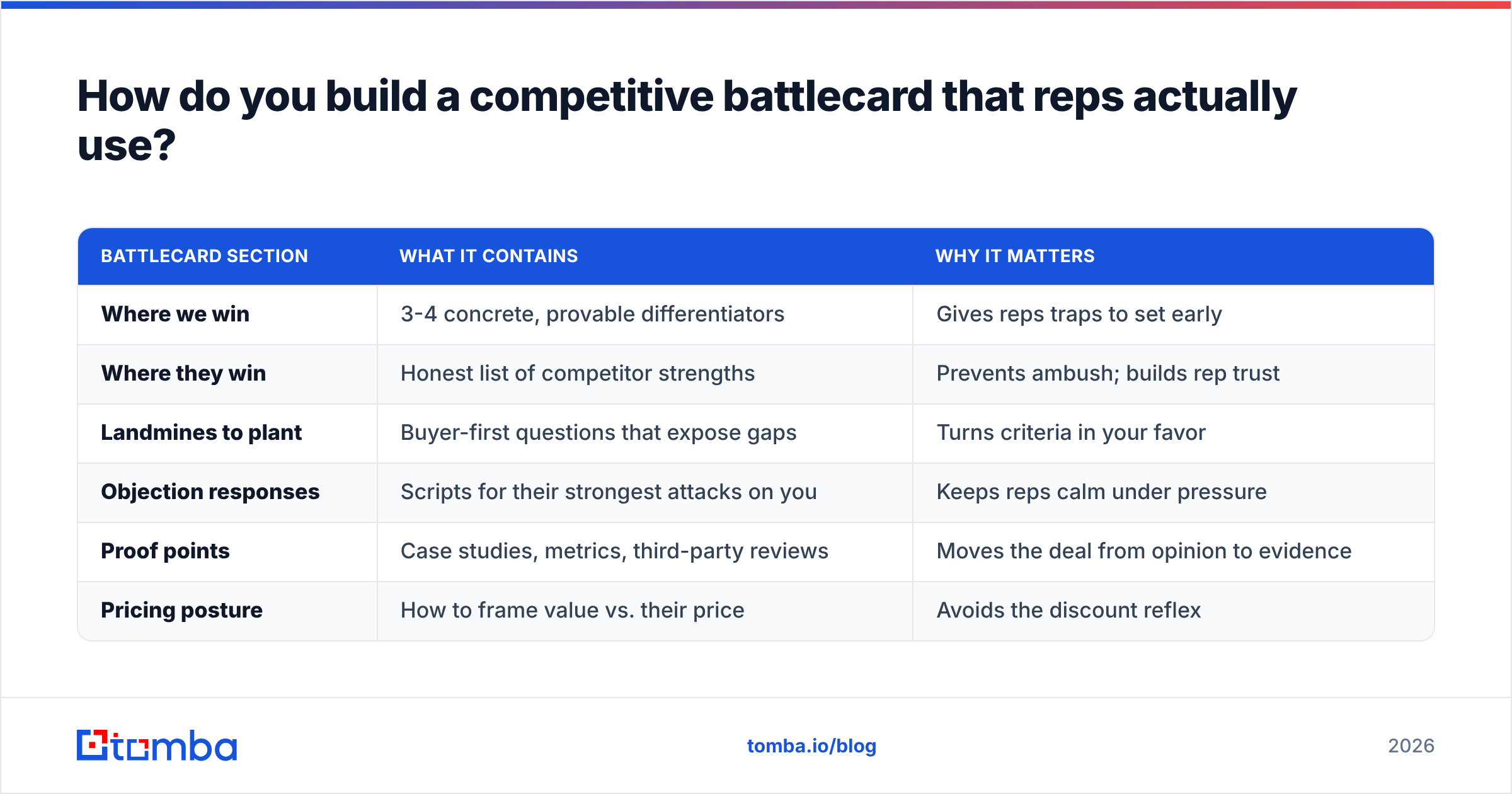
Most battlecards fail because they're marketing brochures in disguise — all strengths, no weaknesses, so reps don't trust them. A battlecard your team actually opens has these sections:
| Battlecard Section | What It Contains | Why It Matters |
|---|---|---|
| Where we win | 3-4 concrete, provable differentiators | Gives reps traps to set early |
| Where they win | Honest list of competitor strengths | Prevents ambush; builds rep trust |
| Landmines to plant | Buyer-first questions that expose gaps | Turns criteria in your favor |
| Objection responses | Scripts for their strongest attacks on you | Keeps reps calm under pressure |
| Proof points | Case studies, metrics, third-party reviews | Moves the deal from opinion to evidence |
| Pricing posture | How to frame value vs. their price | Avoids the discount reflex |
Point reps to third-party evidence rather than your own claims. A neutral G2 grid or a customer's own numbers carry far more weight in a competitive deal than a slide from your deck. When you cite a source the buyer already trusts, you borrow its credibility.
Battlecards go stale fast. A competitor ships a feature, changes pricing, or acquires a company, and half your card is wrong. Assign an owner, review quarterly, and pull real signals — win/loss interviews, lost-deal debriefs, and competitor changelogs — into every refresh.
Which competitive selling strategy should you use, and when?#
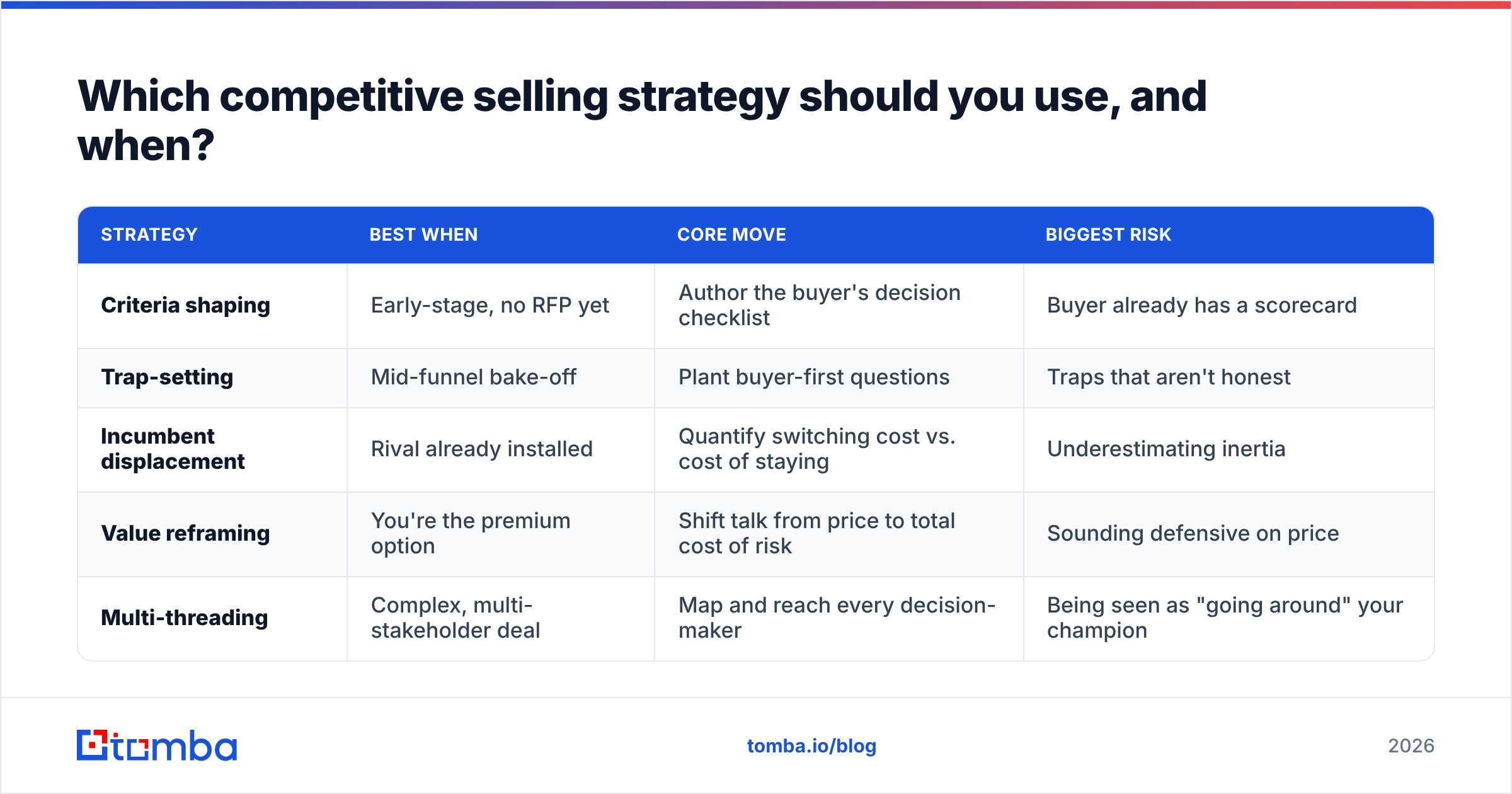
Different deals call for different plays. Forcing a "displace the incumbent" motion onto a greenfield buyer wastes everyone's time. Match the strategy to the situation:
| Strategy | Best When | Core Move | Biggest Risk |
|---|---|---|---|
| Criteria shaping | Early-stage, no RFP yet | Author the buyer's decision checklist | Buyer already has a scorecard |
| Trap-setting | Mid-funnel bake-off | Plant buyer-first questions | Traps that aren't honest |
| Incumbent displacement | Rival already installed | Quantify switching cost vs. cost of staying | Underestimating inertia |
| Value reframing | You're the premium option | Shift talk from price to total cost of risk | Sounding defensive on price |
| Multi-threading | Complex, multi-stakeholder deal | Map and reach every decision-maker | Being seen as "going around" your champion |
The through-line: none of these strategies is about your product's spec sheet. They're about who decides, what they decide on, and how they perceive the options. Reps who internalize that stop losing deals they should have won on merit.
How does data quality decide competitive deals?#
Fresh, accurate contact data is the operational foundation the entire competitive playbook sits on — and it's the part most teams neglect. You can have the sharpest battlecard in the industry, but if you're multi-threading into the wrong VP, or your champion left the company two months ago, the strategy never executes.
Two data problems quietly kill competitive deals:
- Reaching the wrong stakeholder. In a multi-threaded deal, the economic buyer is often someone your champion hasn't introduced you to. If your prospecting data is thin, you never find them — and a competitor who did get to them wins the internal vote.
- Working from decayed records. B2B contact data decays fast; people change roles constantly. A "current champion" in your CRM may already be gone, and you're nurturing a ghost while a rival builds the real relationship.
This is where accurate prospecting tooling stops being a nice-to-have. Building a complete map of the buying committee means finding verified contacts across the org, not just the one inbound lead. A reliable email finder lets you identify and reach every stakeholder who touches the decision, and running those addresses through an email verifier keeps your outreach out of the spam folder at the exact moment the deal is heating up. When you need to widen the map fast, domain search pulls the full roster of contacts at the target account so no decision-maker stays invisible.

Multi-threading backed by good data also protects you from the classic competitive ambush: the day your single champion goes silent. If you've already built relationships across three or four stakeholders, one quiet contact doesn't sink the deal. If you haven't, it usually does.
How do you win without discounting?#
You win without discounting by reframing the buyer's mental math from price to cost of the wrong decision. Price is what they pay you. Cost is what a bad choice does to their pipeline, their deliverability, their team's time, and their next twelve months. The premium vendor wins by making that second number impossible to ignore.
Concrete reframes that work:
- Cost of inaction. "Staying on your current setup isn't free — it's costing you X bounced sends and Y hours of manual cleanup every month."
- Cost of switching later. "The cheaper tool looks fine until you outgrow it in nine months and re-migrate. What does a second migration cost your team?"
- Cost of risk. "A 20% inaccuracy rate on a 10,000-contact campaign isn't a rounding error — it's a domain reputation problem."
Notice none of these attacks the competitor. They raise the stakes of the decision so your differentiation reads as insurance, not overhead. HubSpot's research on sales consistently shows that buyers who understand the full cost of a decision are far less price-sensitive — because they're no longer comparing line items, they're comparing outcomes.
When you do have to talk price, anchor to value first and let the number land second. A prospect who has internalized the cost of getting it wrong will accept your pricing as reasonable — because you've already sold them on what they're protecting.
What does a repeatable competitive process look like?#
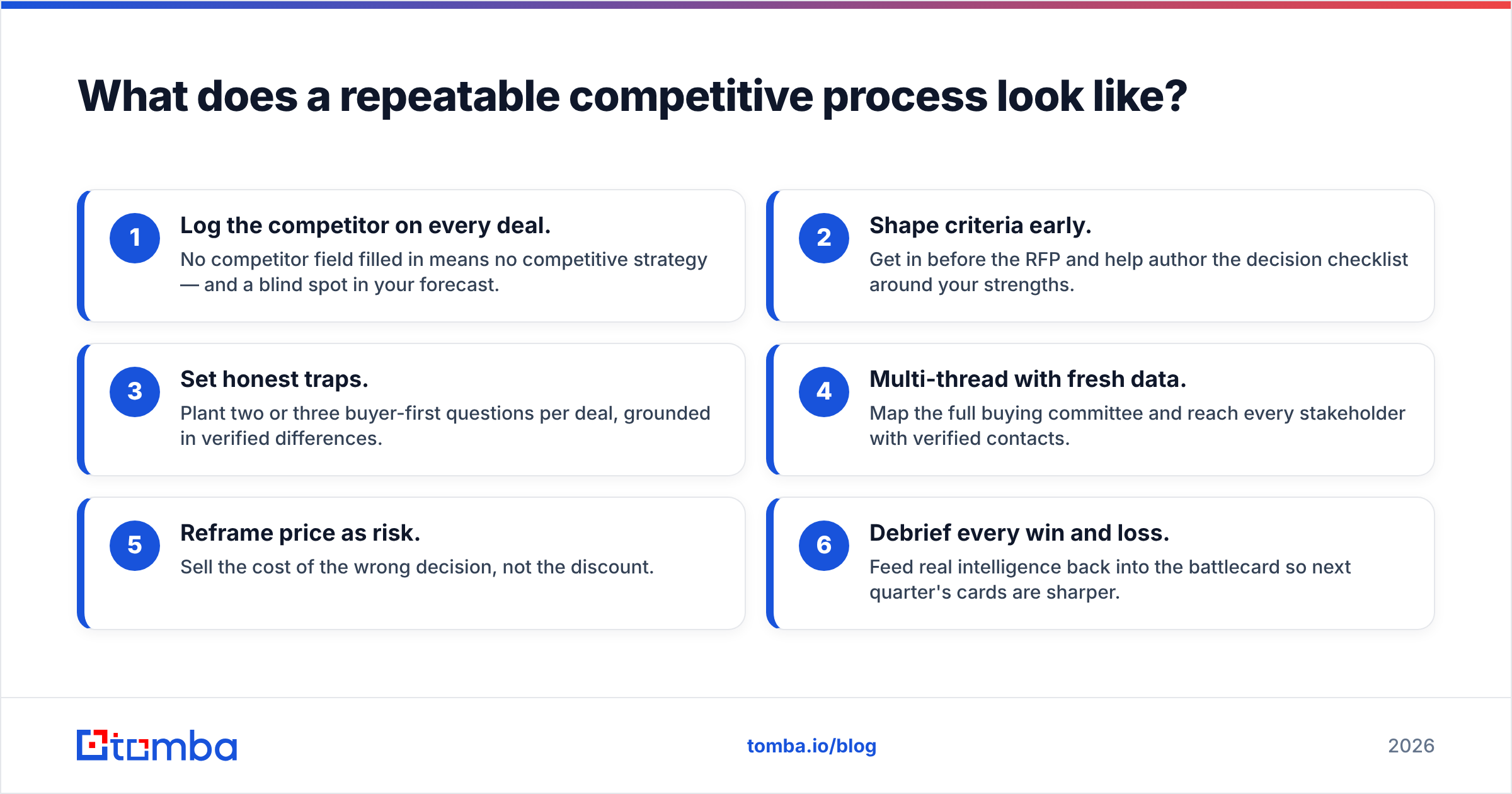
The teams that win consistently don't rely on a hero rep improvising in the room. They run a process. Here's the loop:
- Log the competitor on every deal. No competitor field filled in means no competitive strategy — and a blind spot in your forecast.
- Shape criteria early. Get in before the RFP and help author the decision checklist around your strengths.
- Set honest traps. Plant two or three buyer-first questions per deal, grounded in verified differences.
- Multi-thread with fresh data. Map the full buying committee and reach every stakeholder with verified contacts.
- Reframe price as risk. Sell the cost of the wrong decision, not the discount.
- Debrief every win and loss. Feed real intelligence back into the battlecard so next quarter's cards are sharper.
That final step — the debrief — is what compounds. Every lost deal that gets an honest post-mortem makes the next contested deal easier. Teams that skip it keep relearning the same lessons at full price.
The bottom line#
Competitive selling isn't about having the best feature list — it's about controlling the frame, the criteria, and the relationships before your rivals do. Trap-setting beats feature-dumping. Reframing beats discounting. And every play you run depends on reaching the right people with data you can trust.
That last part is where deals quietly slip. If your team is multi-threading into contested accounts, the difference between a mapped buying committee and a single fragile champion is often just having accurate, verified contact data at the moment it counts. Start free — 25 searches a month — and build the complete stakeholder map behind every competitive deal with the Tomba Email Finder. Win the deal, not the discount war.
Related guides#
Ready to find emails that actually work?
Join 150,000+ professionals who stopped guessing and started sending. Free credits on signup — no credit card required.
Get the Tomba newsletter
Practical outbound tactics and product updates — once every two weeks.
About the author