Competitive Takeout: How to Win Deals From Your Rivals in 2026
Competitive takeout is the deliberate play of winning customers who already use a rival vendor. Here's the trigger-based playbook, timing signals, and outreach that actually flips accounts in 2026.
TL;DR
- Competitive takeout is the deliberate strategy of winning customers who are already paying a rival vendor — not converting cold, unaware prospects.
- It works because switching triggers (price hikes, outages, contract renewals, leadership changes) create narrow windows where an incumbent is beatable.
- The hard part is not the pitch. It is timing and reach: knowing which accounts are in-window and getting the right buyer's direct contact fast.
- A repeatable takeout motion has five parts: target list, trigger monitoring, differentiated message, multithreaded outreach, and a low-friction switch offer.
- Accurate contact data is the multiplier. A great takeout play sent to the wrong inbox is a wasted trigger.
What is a competitive takeout in sales?#
A competitive takeout is when you win a customer away from a competitor they are actively using. Think of it like recruiting a season-ticket holder from a rival stadium: they already buy the category, they've already been sold on the value, and they have a vendor. Your job is not to teach them why they need the product — it's to give them a reason to leave the one they have.
That distinction changes everything about how you sell. In a normal outbound motion, you fight indifference ("I don't need this"). In a takeout, you fight inertia ("switching is a hassot"). Inertia is a very different — and often more beatable — enemy, because it's mostly about risk and effort, not value.
Takeouts matter more in 2026 because most B2B categories are saturated. Whether you sell CRM, security tooling, or a data platform, your total addressable market is mostly already buying from someone. According to Gartner's research on B2B buying, buyers spend the majority of their journey independently researching and validating — which means the incumbent's weaknesses are being felt long before you ever call. Takeout selling is simply catching that dissatisfaction at the right moment.

Why does competitive takeout beat cold prospecting?#
Because the buyer has already crossed the hardest line: they've accepted that the problem is worth paying to solve. Everything downstream is easier.
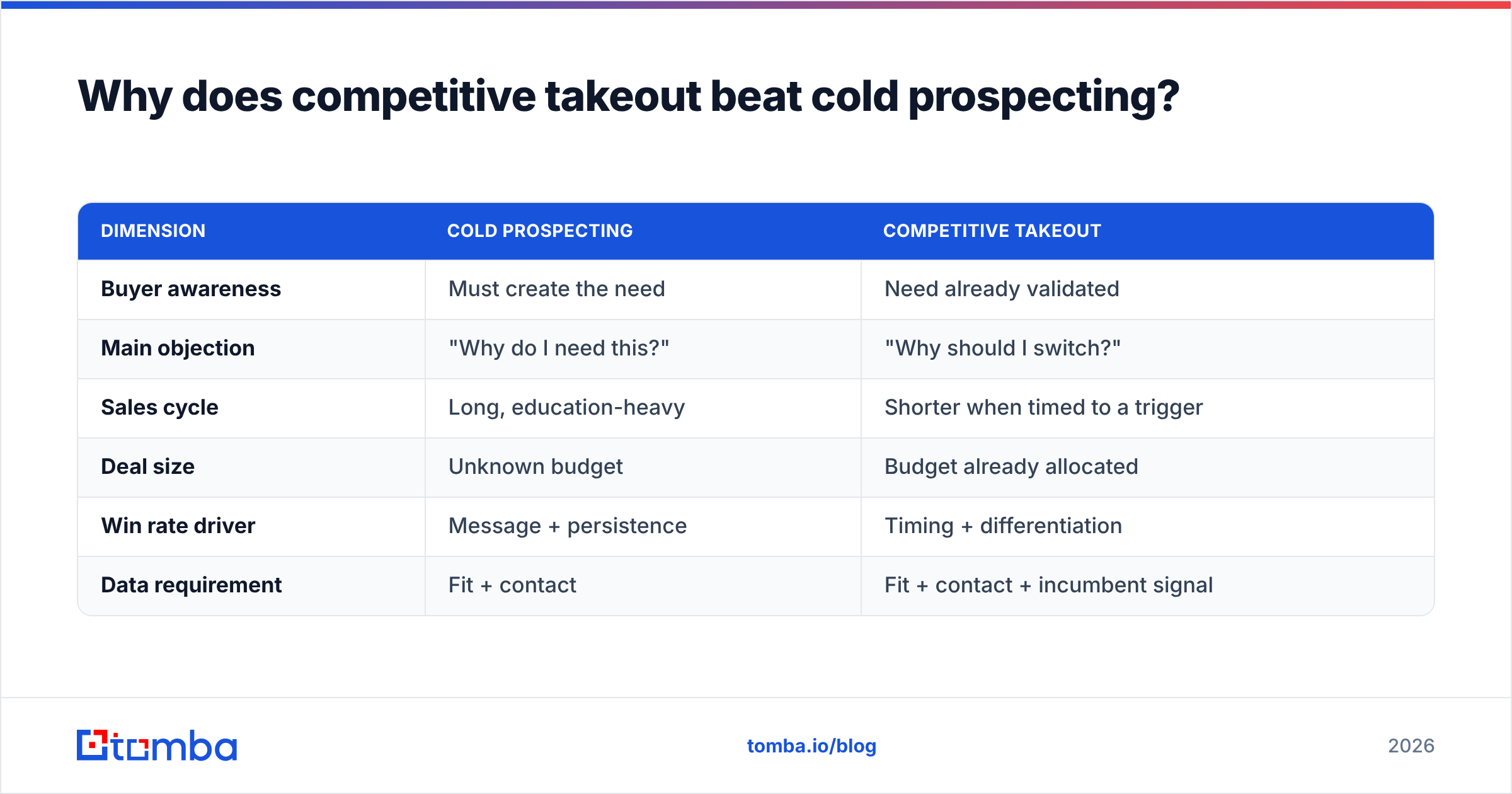
Here's the practical comparison between a standard cold motion and a takeout motion:
| Dimension | Cold prospecting | Competitive takeout |
|---|---|---|
| Buyer awareness | Must create the need | Need already validated |
| Main objection | "Why do I need this?" | "Why should I switch?" |
| Sales cycle | Long, education-heavy | Shorter when timed to a trigger |
| Deal size | Unknown budget | Budget already allocated |
| Win rate driver | Message + persistence | Timing + differentiation |
| Data requirement | Fit + contact | Fit + contact + incumbent signal |
Notice the last row. Takeout selling needs one extra ingredient that cold prospecting doesn't: knowing who the current vendor is, or at least having a strong signal. That signal is what turns a spray-and-pray sequence into a surgical one. Miss it, and you're just cold prospecting with extra steps.
The payoff is real, though. Deals sourced from a genuine trigger — a renewal window, a public complaint, a competitor's price increase — close faster and churn less, because the buyer left the incumbent for a specific, articulated reason. That reason becomes your onboarding story.
What triggers make an account beatable?#
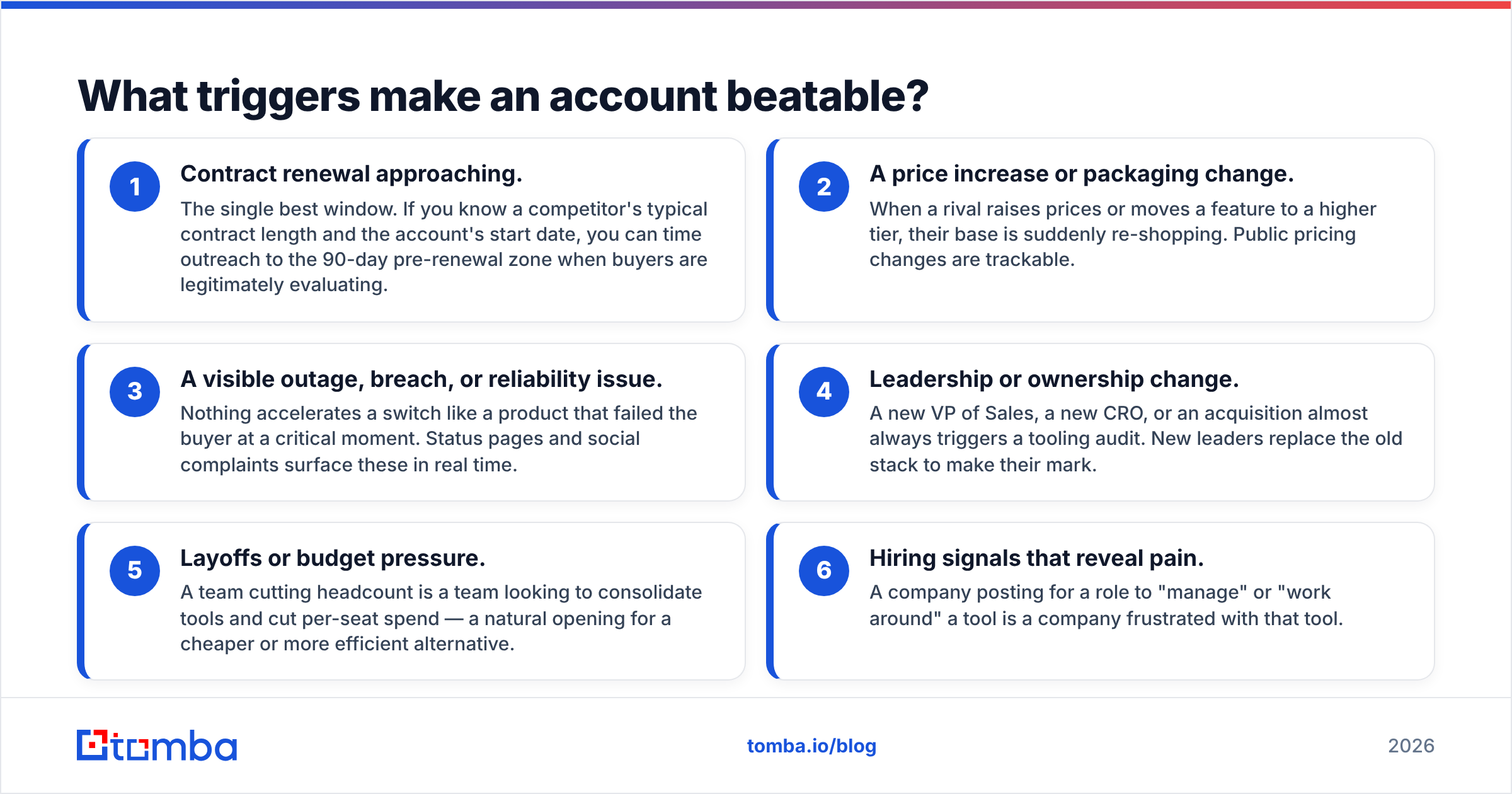
Not every rival customer is winnable. Chasing a happy, mid-contract account is how reps burn quarters. The skill is filtering for accounts in a switching window. These are the highest-signal triggers:
- Contract renewal approaching. The single best window. If you know a competitor's typical contract length and the account's start date, you can time outreach to the 90-day pre-renewal zone when buyers are legitimately evaluating.
- A price increase or packaging change. When a rival raises prices or moves a feature to a higher tier, their base is suddenly re-shopping. Public pricing changes are trackable.
- A visible outage, breach, or reliability issue. Nothing accelerates a switch like a product that failed the buyer at a critical moment. Status pages and social complaints surface these in real time.
- Leadership or ownership change. A new VP of Sales, a new CRO, or an acquisition almost always triggers a tooling audit. New leaders replace the old stack to make their mark.
- Layoffs or budget pressure. A team cutting headcount is a team looking to consolidate tools and cut per-seat spend — a natural opening for a cheaper or more efficient alternative.
- Hiring signals that reveal pain. A company posting for a role to "manage" or "work around" a tool is a company frustrated with that tool.
Score every target account against these. An account with two or more active triggers should jump to the top of your queue. To operationalize this, many teams layer in website visitor reveal so that when a rival's frustrated user quietly lands on your comparison page, you already know who they are.
How do you build a competitive takeout target list?#
Start with the segment where you win most against a specific competitor, then work backward. A tight, well-researched list of 200 in-window accounts beats a bloated list of 5,000 every time.
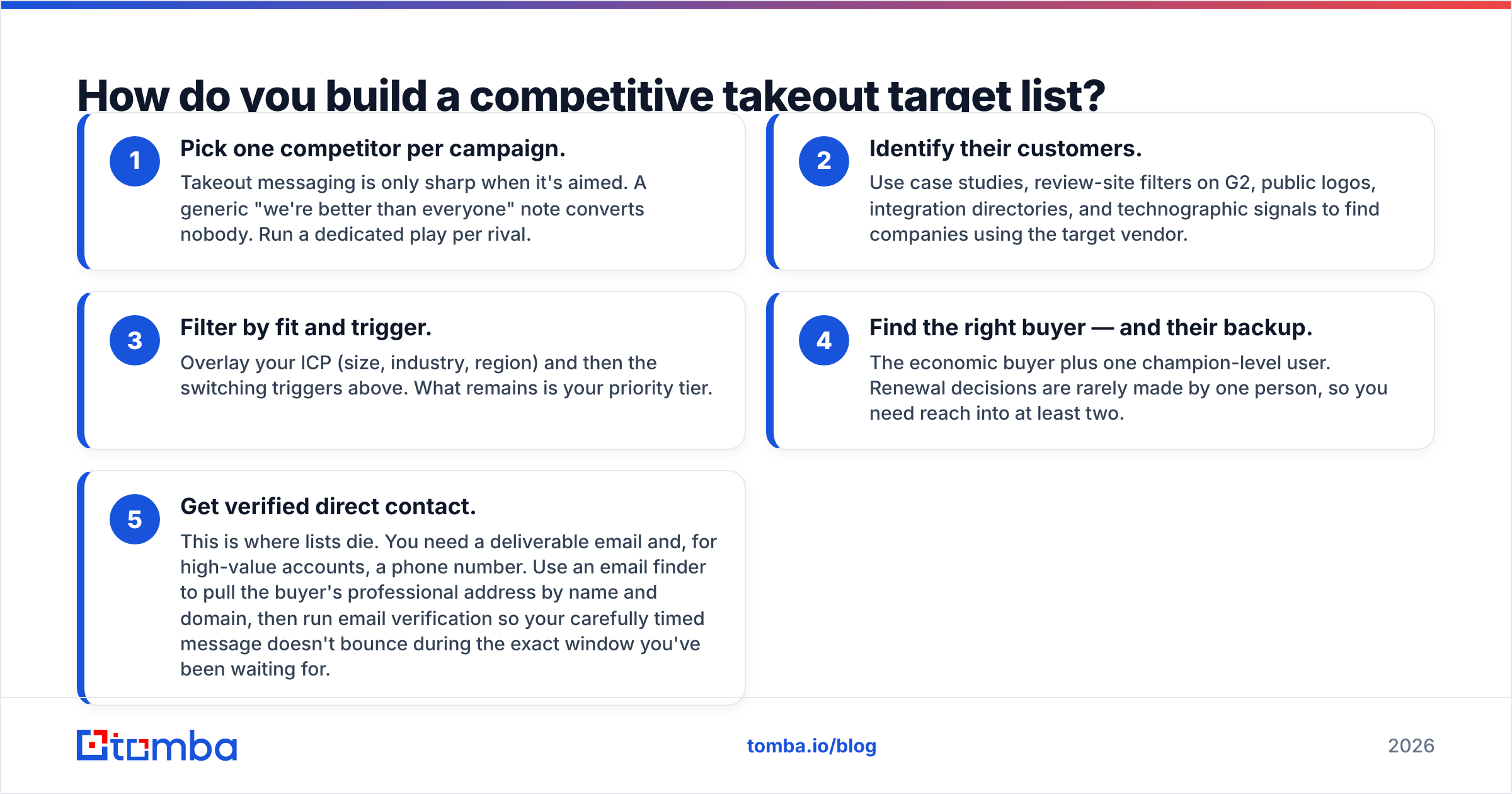
The five-step build:
- Pick one competitor per campaign. Takeout messaging is only sharp when it's aimed. A generic "we're better than everyone" note converts nobody. Run a dedicated play per rival.
- Identify their customers. Use case studies, review-site filters on G2, public logos, integration directories, and technographic signals to find companies using the target vendor.
- Filter by fit and trigger. Overlay your ICP (size, industry, region) and then the switching triggers above. What remains is your priority tier.
- Find the right buyer — and their backup. The economic buyer plus one champion-level user. Renewal decisions are rarely made by one person, so you need reach into at least two.
- Get verified direct contact. This is where lists die. You need a deliverable email and, for high-value accounts, a phone number. Use an email finder to pull the buyer's professional address by name and domain, then run email verification so your carefully timed message doesn't bounce during the exact window you've been waiting for.
That last point deserves emphasis. The entire value of a takeout play collapses if the message lands in a dead inbox. You did the research, you caught the trigger — and then a stale contact record wasted it.
What does a competitive takeout message look like?#
The message has one job: give the buyer a low-risk reason to open the door during their switching window. It is not a feature war. Reps who lead with a spec-by-spec teardown of the competitor come across as bitter and lose.
The structure that works:
- Open with their reality, not your product. Reference the trigger obliquely. "Saw [Rival] moved [feature] behind their enterprise tier" is a hundred times stronger than "Are you happy with your current vendor?"
- Name the switching cost honestly. Acknowledge migration is real. Buyers trust reps who don't pretend switching is free. Then de-risk it: migration support, parallel-run period, data import help.
- Differentiate on one axis, not ten. Pick the single dimension where you clearly beat the incumbent — price, a specific capability, support responsiveness — and anchor the whole conversation there.
- Make a small ask. Not a demo. A benchmark, a teardown of their current setup, a "worth a 15-minute comparison?" The switching buyer isn't ready to commit; they're ready to look.
Multithreading matters more here than in any other play. Renewal decisions involve finance, the tool's daily users, and often IT. Reaching only one contact means your message dies if that person is the one who championed the incumbent in the first place. Pull a second and third contact — a LinkedIn-sourced email for the user, a direct line via phone finder for the economic buyer — and you survive a single "no."
If you want a framework for sequencing these touches across channels, this primer on LinkedIn outreach pairs well with an email-first takeout cadence.
How is competitive takeout different from a competitive displacement?#
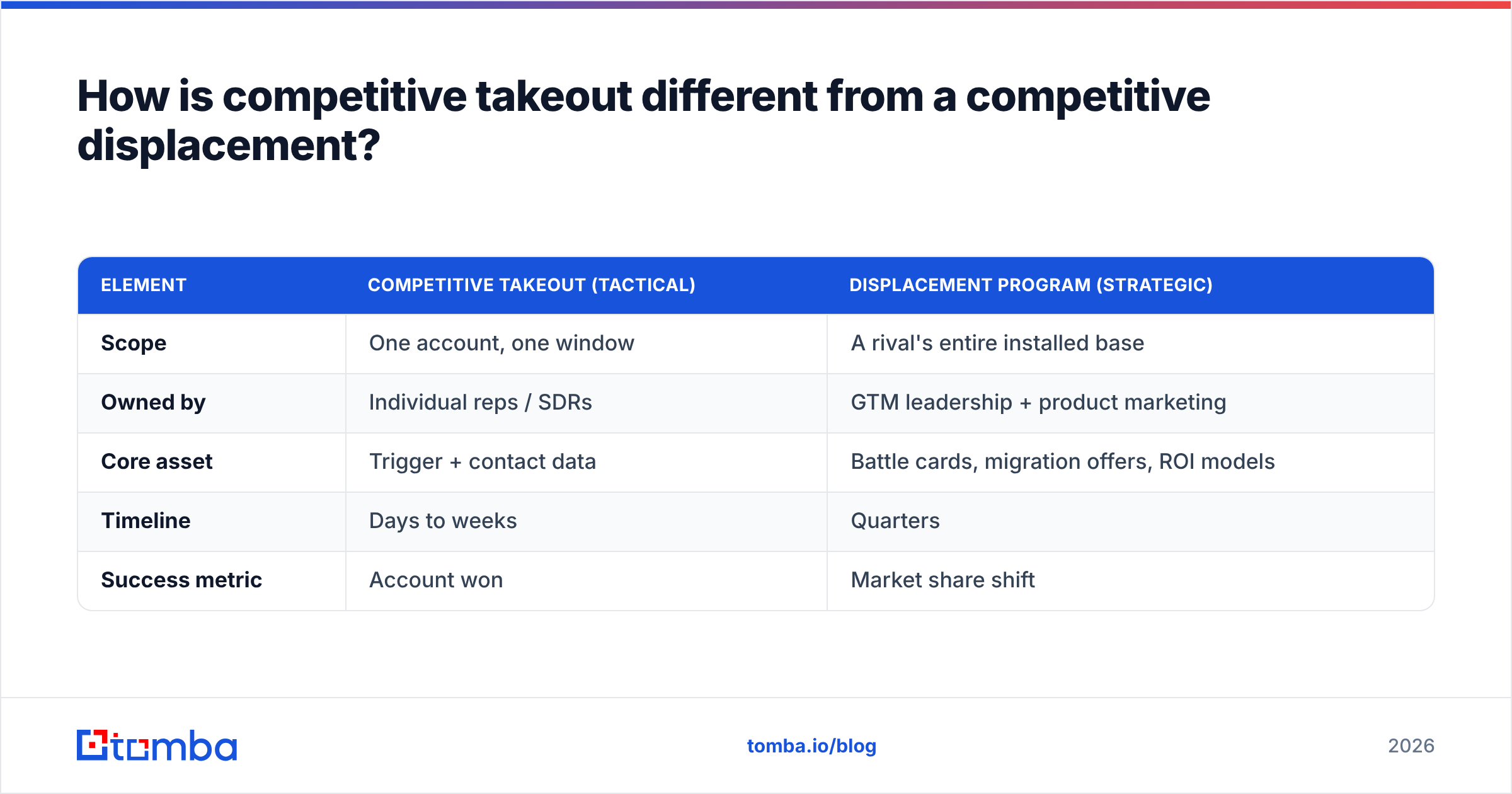
People use the terms interchangeably, but there's a useful nuance. A takeout is the act of winning one specific account from a rival. A displacement (or "rip and replace") usually describes the larger program of systematically going after a competitor's base, often with dedicated battle cards, pricing plays, and migration incentives.
| Element | Competitive takeout (tactical) | Displacement program (strategic) |
|---|---|---|
| Scope | One account, one window | A rival's entire installed base |
| Owned by | Individual reps / SDRs | GTM leadership + product marketing |
| Core asset | Trigger + contact data | Battle cards, migration offers, ROI models |
| Timeline | Days to weeks | Quarters |
| Success metric | Account won | Market share shift |
Most teams should master the tactical takeout first. Once reps can reliably flip in-window accounts, leadership can codify the patterns — which triggers convert, which objections recur, which migration incentive moves deals — into a full displacement program. The data foundation is identical either way: you cannot run either motion without accurate targeting and reachable contacts, which is why teams standardize on a single data enrichment source before scaling the play.
What are the most common competitive takeout mistakes?#
Even good reps torch winnable accounts. Watch for these:
- Bad-mouthing the incumbent. Trashing the rival makes the buyer defensive — they chose that vendor. Critique the situation, not their judgment.
- Ignoring the switching cost. Pretending migration is painless destroys credibility. Name it and solve it.
- Chasing out-of-window accounts. A happy customer 18 months from renewal is not a prospect; they're a "nurture." Spending your best cycles there is a queue-management failure.
- Single-threading. One contact, one point of failure. Renewal committees are plural.
- Stale or unverified data. The most preventable mistake. You caught the trigger, wrote the perfect note, and sent it to an address the person left two jobs ago. Deliverability, not eloquence, decides whether the play even starts.
That last one is worth measuring. Before every takeout campaign, run your list through verification and check your Tomba pricing tier against your volume so you're not rationing verifications during a time-sensitive window. A takeout campaign is one place where under-investing in data quality has an immediate, quantifiable cost: a missed switching window doesn't come back for another year.
How do you measure competitive takeout success?#
Track these four numbers per campaign, per competitor:
- In-window coverage — of the accounts showing a trigger, how many did you actually reach a verified buyer at? Low coverage means a data problem, not a messaging one.
- Reply rate on trigger-based sends vs. your baseline cold rate. A good takeout play should meaningfully outperform.
- Meeting-to-opportunity rate — takeout meetings should convert to pipeline at a higher rate than cold because budget already exists.
- Win rate against the named competitor — the ground truth. Break it down by trigger type to learn which windows are most winnable for your product.
If in-window coverage is your bottleneck, the fix is upstream: better sourcing and cleaner contact data, not a new email template. Most teams discover their message was fine all along — the leads simply never arrived.
Start your first competitive takeout play#
Competitive takeout rewards precision: the right account, in the right window, reached at the right inbox. The strategy is only as strong as the data underneath it — and that's the part most teams get wrong.
Build your first campaign around a single rival, filter for one or two active switching triggers, and make sure every message lands. Tomba's Email Finder lets you pull verified, professional email addresses for the exact buyers on your takeout list — by name, company, or domain — so your carefully timed play reaches a real inbox instead of a bounce. Start free with 25 searches, then scale into a Starter plan at $49/mo once your first campaign proves the motion. Catch the window while it's open.
Related guides#
Ready to find emails that actually work?
Join 150,000+ professionals who stopped guessing and started sending. Free credits on signup — no credit card required.
Get the Tomba newsletter
Practical outbound tactics and product updates — once every two weeks.
About the author