Competitor Buy Back Campaign: How to Win Rivals' Customers
A competitor buy back campaign targets your rivals' unhappy or renewing customers with a switch offer. Here's how to build one that actually converts in 2026.
TL;DR
- A competitor buy back campaign is a targeted outbound play that reaches your rivals' existing customers — usually near their renewal date or after a public pain point — with a compelling reason to switch.
- It converts far better than cold spray because you're talking to people who already understand the category and already pay for a solution.
- The four levers that decide success: who you target, when you hit them, what you offer, and how clean your contact data is.
- You need accurate decision-maker emails and phone numbers — guesswork tanks deliverability and wastes the offer budget.
- Build the target list with intent signals and firmographics, then enrich it with verified contacts before a single message goes out.
What is a competitor buy back campaign?#
A competitor buy back campaign is a focused outbound program that "buys back" market share by converting customers who currently pay a competitor. Instead of casting a wide net, you build a list of accounts already using a rival product, then reach out with a switch-specific offer: migration help, a discount that offsets their sunk cost, or a feature they've been asking their current vendor for.
Think of it like a moving company that watches for "For Sale" signs. Everyone on that street already owns a home — you're not convincing them to want housing, you're convincing them to move now, to you. That single shift in framing is why these campaigns punch above their weight.
The mechanics differ from generic lead generation in three ways:
- The audience is pre-qualified. They've already bought in the category, so you skip the education phase.
- Timing is everything. A switch is easiest at renewal, after a price hike, or following an outage or acquisition that shakes confidence.
- The offer is comparative. You're not selling in a vacuum; you're selling against a known incumbent with known weaknesses.
Why do buy back campaigns convert better than cold outreach?#
Because you're removing the two biggest reasons deals stall: "no budget" and "no need." A competitor's customer has both a budget line and an active use case. Your job narrows to displacement, not creation.
The economics back this up. Standard cold outbound to unqualified lists often sees reply rates in the low single digits. Switch-focused campaigns aimed at renewing accounts routinely double or triple that, because the message lands on someone who is actively evaluating whether to keep paying. According to research aggregated on G2, buyers spend a large share of the sales cycle doing independent research before they ever talk to a vendor — a buy back campaign simply intercepts that research at the right moment.
There's also a compounding effect. Every customer you pull off a competitor does double damage: you gain revenue and you remove it from their base, which weakens their own expansion math. In competitive categories, that swing matters more than a net-new logo.
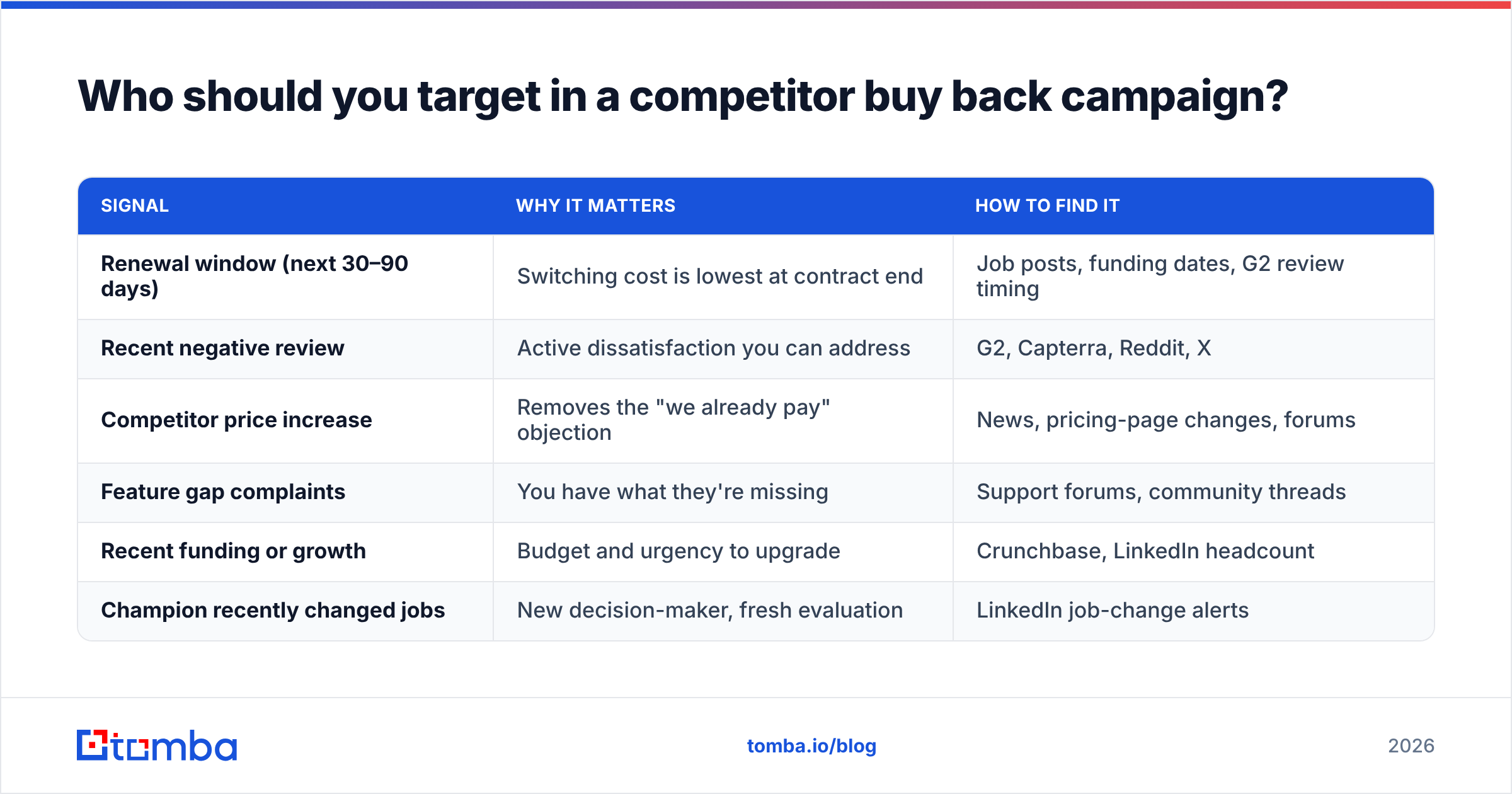
Who should you target in a competitor buy back campaign?#
Not every competitor customer is worth chasing. The best targets share a few traits, and your job is to score for them before you spend outreach effort.
| Signal | Why it matters | How to find it |
|---|---|---|
| Renewal window (next 30–90 days) | Switching cost is lowest at contract end | Job posts, funding dates, G2 review timing |
| Recent negative review | Active dissatisfaction you can address | G2, Capterra, Reddit, X |
| Competitor price increase | Removes the "we already pay" objection | News, pricing-page changes, forums |
| Feature gap complaints | You have what they're missing | Support forums, community threads |
| Recent funding or growth | Budget and urgency to upgrade | Crunchbase, LinkedIn headcount |
| Champion recently changed jobs | New decision-maker, fresh evaluation | LinkedIn job-change alerts |
Layer these signals rather than relying on one. A renewing account with a public complaint and fresh funding is a far better target than any single trigger alone. Once you've scored the account list, you still need the humans — the specific person who signs off on the tool and the champion who feels the pain daily.
That's where list quality becomes make-or-break. You can identify the perfect 200 accounts and still fail if you email info@ inboxes or guess at address formats. Use a domain search to pull every known contact at a target company, then narrow to the roles that matter.
How do you build the target list and get clean contact data?#
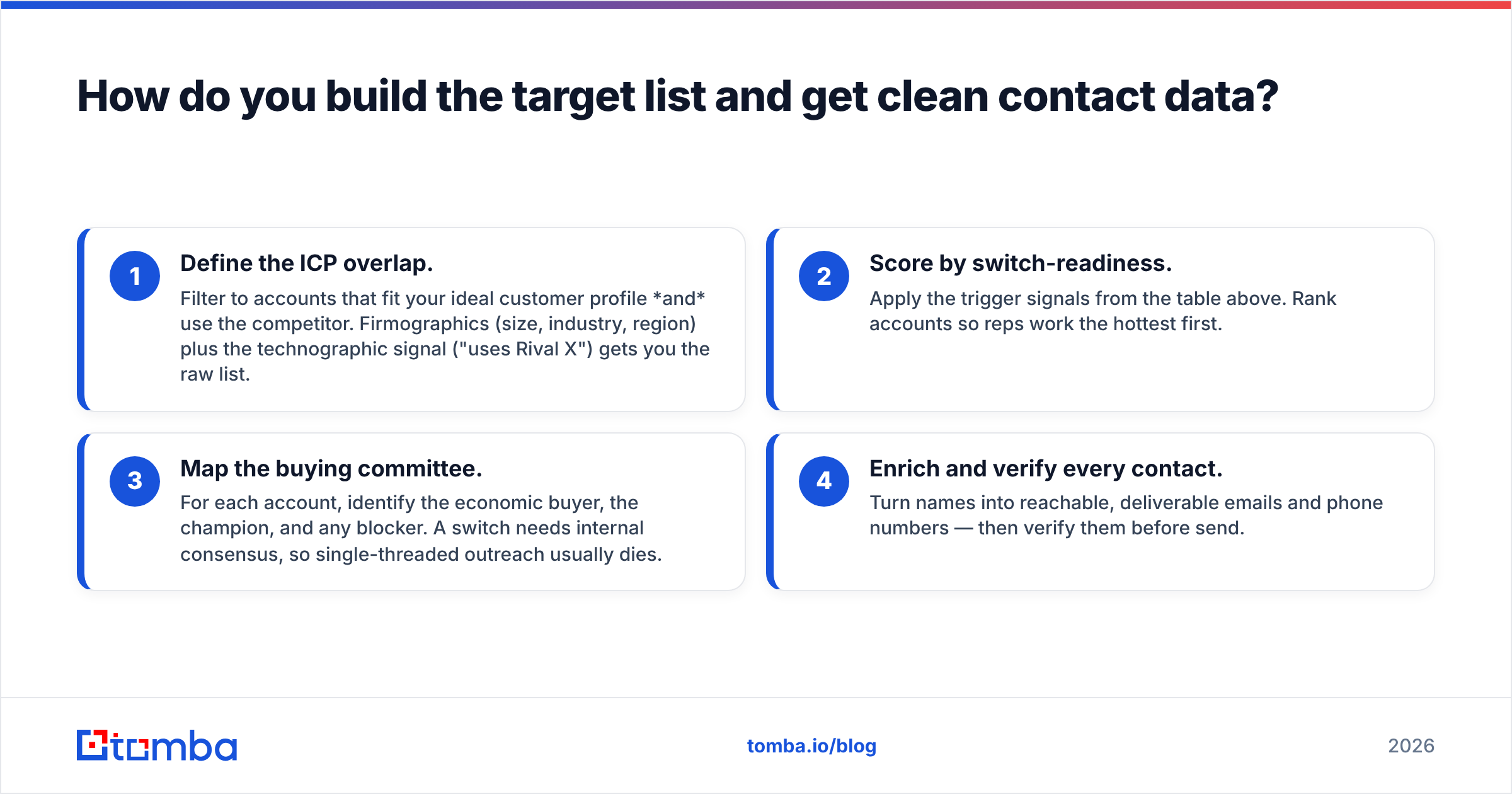
Break it into four steps. The first three are strategy; the fourth is the one teams skip and then wonder why their sequence flopped.
- Define the ICP overlap. Filter to accounts that fit your ideal customer profile and use the competitor. Firmographics (size, industry, region) plus the technographic signal ("uses Rival X") gets you the raw list.
- Score by switch-readiness. Apply the trigger signals from the table above. Rank accounts so reps work the hottest first.
- Map the buying committee. For each account, identify the economic buyer, the champion, and any blocker. A switch needs internal consensus, so single-threaded outreach usually dies.
- Enrich and verify every contact. Turn names into reachable, deliverable emails and phone numbers — then verify them before send.
Step four is non-negotiable. Bounces from a stale list hammer your sender reputation, and a wrecked reputation means even your good emails land in spam. Run every address through an email verifier first, and validate direct dials with a phone validator if you're pairing email with cold calls. For anything at scale, a bulk email finder turns a spreadsheet of companies and names into a clean, send-ready list in one pass.

What offer actually makes a competitor's customer switch?#
The offer has to beat inertia, not just the competitor's price. Switching means retraining a team, migrating data, and risking that the new tool underdelivers. Your offer must shrink that perceived risk to near zero.
The strongest buy back offers combine a financial nudge with a friction remover:
- Migration done for you. "We'll move your data and templates in 48 hours, free." This kills the biggest objection outright.
- Cost bridge. Credit the remaining months on their current contract so switching costs them nothing today.
- Proof of the gap. A side-by-side showing the specific feature or accuracy they're missing — concrete, not marketing fluff.
- Risk reversal. A no-questions 60-day out, so the downside of trying you is capped.
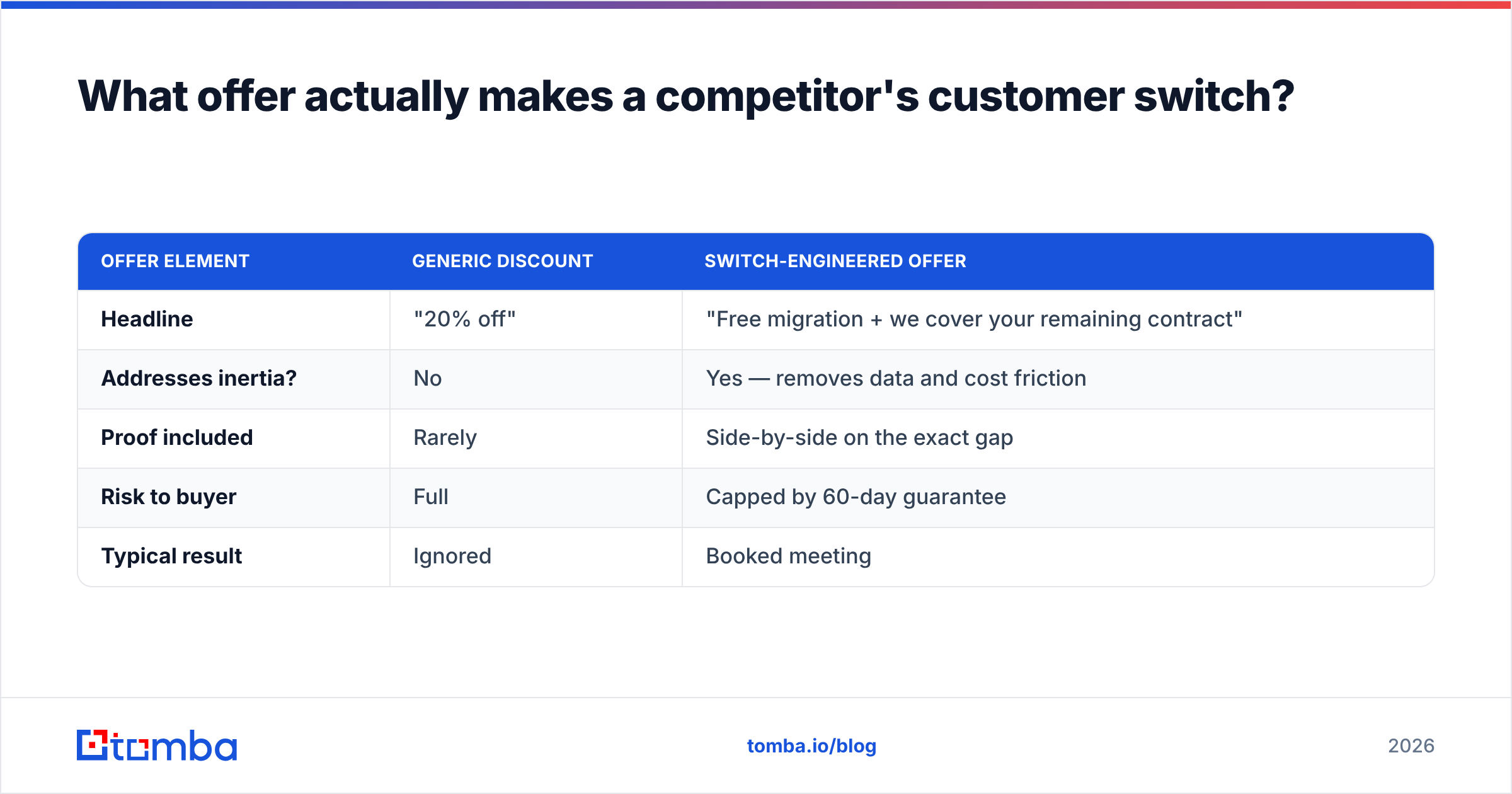
Here's how a generic discount stacks up against a switch-engineered offer:
| Offer element | Generic discount | Switch-engineered offer |
|---|---|---|
| Headline | "20% off" | "Free migration + we cover your remaining contract" |
| Addresses inertia? | No | Yes — removes data and cost friction |
| Proof included | Rarely | Side-by-side on the exact gap |
| Risk to buyer | Full | Capped by 60-day guarantee |
| Typical result | Ignored | Booked meeting |
Notice the discount alone barely moves anyone. The switch-engineered version wins because it names and neutralizes every reason to stay put.
How should you sequence the outreach?#
Multi-channel, multi-threaded, and paced around the renewal date. A single email to a single contact is how these campaigns quietly fail.
A workable eight-touch sequence over three weeks:
- Day 1 — Email to champion. Lead with the specific pain their team complained about publicly. No pitch yet.
- Day 2 — LinkedIn view + connect. Warm the name recognition.
- Day 4 — Email with the switch offer. Migration + cost bridge, one clear CTA.
- Day 6 — Cold call. Reference the email; book a 15-minute teardown.
- Day 9 — Email to economic buyer. Different angle: ROI and risk reversal.
- Day 12 — Case study. A company that switched from the same competitor.
- Day 16 — Breakup email. "Should I close this out?" — often the top reply-driver.
- Day 20 — Final LinkedIn message. Soft, value-led, leaves the door open.
Two rules keep this healthy. First, protect deliverability — warm your domain, keep volume sane, and never send to unverified addresses. If terms like email deliverability and sender reputation aren't second nature to your team, fix that before you scale. Second, personalize the first line of every email off a real signal, not a mail-merge token. "Saw your team flagged the CSV export limit on the community forum" beats "I hope this finds you well" every time.
For the calling leg, pair your verified emails with direct dials from a phone finder so reps aren't stuck in gatekeeper voicemail loops.
How do you measure a competitor buy back campaign?#
Track displacement, not just activity. Vanity metrics like emails sent tell you nothing about whether you're actually pulling customers off a rival.
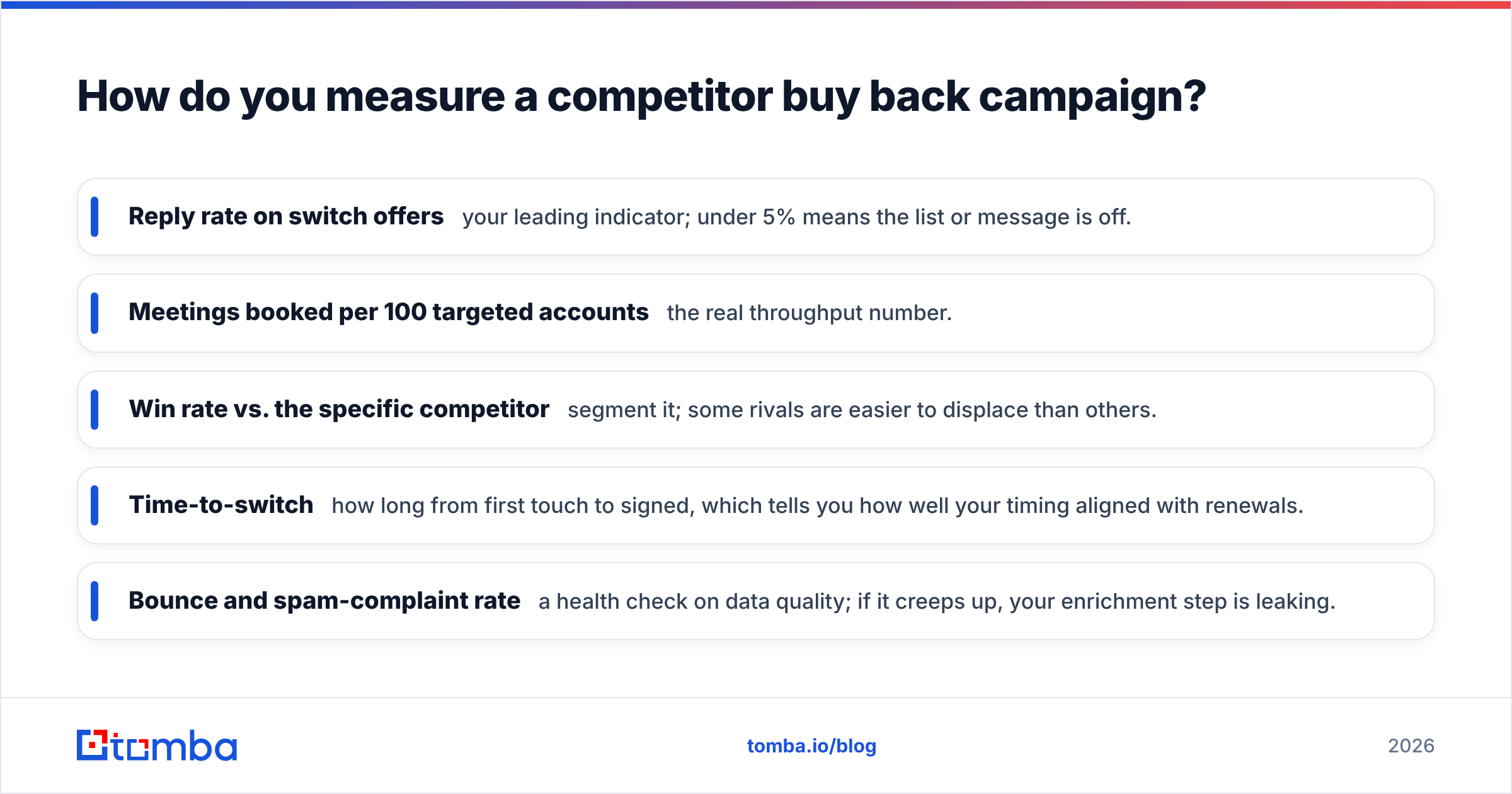
The metrics that matter:
- Reply rate on switch offers — your leading indicator; under 5% means the list or message is off.
- Meetings booked per 100 targeted accounts — the real throughput number.
- Win rate vs. the specific competitor — segment it; some rivals are easier to displace than others.
- Time-to-switch — how long from first touch to signed, which tells you how well your timing aligned with renewals.
- Bounce and spam-complaint rate — a health check on data quality; if it creeps up, your enrichment step is leaking.
Feed the wins back into targeting. If accounts that switched shared a trigger — say, a competitor price hike — double down on finding more accounts with that exact signal. To keep contact records fresh as you scale the winning motion, run ongoing data enrichment so titles, emails, and phone numbers don't rot between campaign waves.
What mistakes kill these campaigns?#
Most failures trace back to the same handful of errors. Avoid these and you're ahead of the field.
- Bashing the competitor. Trash-talk makes you look desperate and can trigger legal headaches. Contrast on facts, respect the incumbent, let the gap speak.
- Bad data. Guessed emails bounce, tank your reputation, and burn the offer. Verify first, always.
- Wrong timing. Hitting an account 10 months before renewal wastes the play. Prioritize the 30–90 day window.
- Single-threading. One contact leaves too much internal resistance unaddressed.
- A weak offer. "10% off" doesn't beat the pain of migrating. Engineer the offer around friction, not just price.
- No follow-through on switchers. A rough onboarding hands them right back to the competitor — or to a review site.
Compare your plan against Apollo, Outreach, or any tool-led motion and you'll notice the winners all share one trait: their targeting data is clean before the first message ships. The tactics are replicable; the data discipline is where teams separate.
Which tool should you use to power the campaign?#
Start where the campaign starts — the list. Every touch, offer, and follow-up depends on reaching the right person at the right company, and that begins with accurate contacts.
Tomba Email Finder turns your scored account list into verified, decision-maker emails, with a built-in email verifier, domain search, and phone finder so your buy back sequence lands in real inboxes and on real phones — not spam folders. The free tier gives you 25 searches a month to test the workflow; paid plans start at $49/mo, and you can scale to bulk enrichment as the campaign grows. See full Tomba pricing to match a plan to your target-list size.
Build the list, verify the data, then go win your rivals' customers — one clean, well-timed switch offer at a time.
Related guides#
Ready to find emails that actually work?
Join 150,000+ professionals who stopped guessing and started sending. Free credits on signup — no credit card required.
Get the Tomba newsletter
Practical outbound tactics and product updates — once every two weeks.
About the author