Concept Selling in 2026: The Complete Guide to Selling Ideas
Concept selling wins the deal before you ever pitch a feature. Here's how the method works, when to use it, and how to build a repeatable playbook that actually closes.
Most reps lose the deal in the first two minutes, and they never find out why. They open with a product, a price, and a feature list — before the buyer has agreed there's a problem worth solving. Concept selling flips that order. You sell the idea first, the change in how the buyer sees their own situation, and only then does the product become the obvious next step.
This guide breaks down what concept selling actually is, when it beats traditional feature-led selling, and how to run it as a repeatable process instead of a lucky improvisation.
TL;DR#
- Concept selling means selling the buyer a new way of seeing their problem before you sell any product, feature, or price.
- It works best for new categories, complex B2B deals, and "we've always done it this way" buyers who don't yet feel the pain.
- The method has four moves: frame the shift, quantify the gap, tie your solution to the concept, and let the buyer self-qualify.
- It's not a replacement for prospecting — you still need accurate contact data and a strong pipeline to run it at scale.
- Concept selling loses when the buyer already knows exactly what they want; there, speed and specs win.
What is concept selling?#
Concept selling is a sales approach where you sell an idea or a way of thinking before you sell a specific product. The "concept" is the mental model the buyer needs to adopt for your offer to make sense.
Think of it like a real estate agent who doesn't start with square footage. Instead they say, "Imagine hosting Sunday dinners here for the next twenty years." They sell the life, then the house becomes the vehicle for it. The concept is the emotional and logical frame; the product is the delivery mechanism.
In B2B, the concept is usually a shift in belief:
- From "cold email is a numbers game" to "cold email is a data-quality game."
- From "we track leads in spreadsheets" to "ungoverned lead data is silently costing us pipeline."
- From "any email list will do" to "bad data is why our reps burn hours on bounces."
Once the buyer accepts the concept, your product stops being one option among ten. It becomes the natural conclusion of an argument they now believe.

Why does concept selling work better than feature selling?#
Because buyers don't act on features — they act on a changed understanding of their own situation. Gartner research on B2B buying consistently shows that modern buyers are overwhelmed by information and "sameness" between vendors. When every tool lists the same features, features stop being a differentiator. The story you attach to them becomes the differentiator.
Feature selling assumes the buyer already agrees they have the problem you solve. That assumption is wrong more often than reps admit. A prospect who says "we're fine with our current setup" hasn't rejected your product — they've rejected your concept. They don't yet believe the problem is real, urgent, or theirs.
Concept selling fixes the sequence:
- Establish the problem exists (the concept).
- Quantify what it costs (the stakes).
- Position the product as the fix (the offer).
Skip step one and every objection sounds like "it's too expensive," when the real objection is "I don't believe I need this at all."
How is concept selling different from solution selling and product selling?#
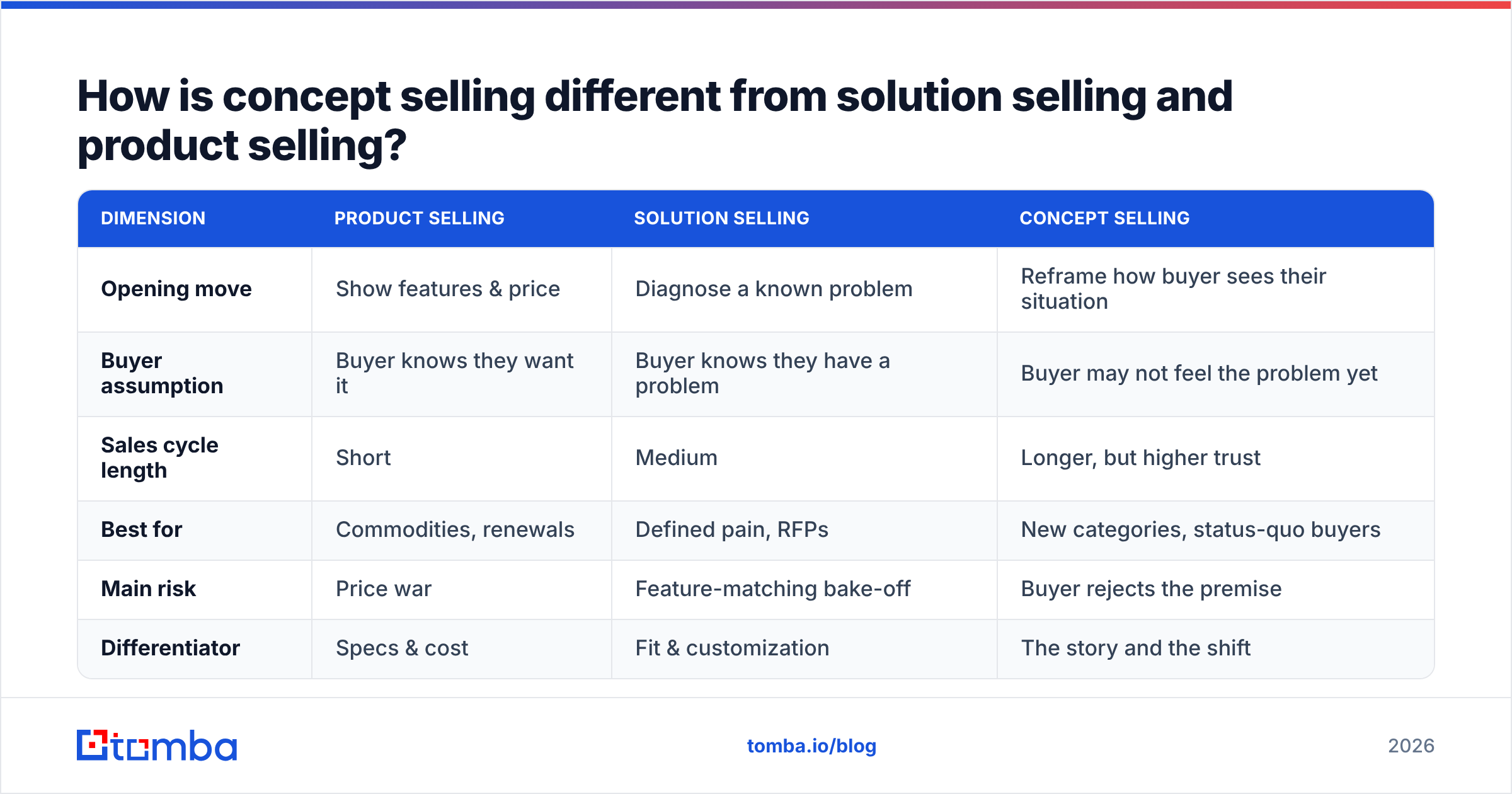
They live on a spectrum from "sell the thing" to "sell the idea." Solution selling — popularized by frameworks documented on HubSpot's sales blog and elsewhere — sits in the middle, focused on matching a defined problem to a tailored solution. Concept selling goes one level earlier: it creates the belief that the problem is worth solving in the first place.
| Dimension | Product selling | Solution selling | Concept selling |
|---|---|---|---|
| Opening move | Show features & price | Diagnose a known problem | Reframe how buyer sees their situation |
| Buyer assumption | Buyer knows they want it | Buyer knows they have a problem | Buyer may not feel the problem yet |
| Sales cycle length | Short | Medium | Longer, but higher trust |
| Best for | Commodities, renewals | Defined pain, RFPs | New categories, status-quo buyers |
| Main risk | Price war | Feature-matching bake-off | Buyer rejects the premise |
| Differentiator | Specs & cost | Fit & customization | The story and the shift |
The practical takeaway: you don't pick one forever. You pick based on where the buyer sits on the awareness curve. A buyer who has already written an RFP wants solution or product selling — reframing their premise there is annoying. A buyer who says "we don't really do outbound" needs the concept first.
What does a concept selling process look like?#
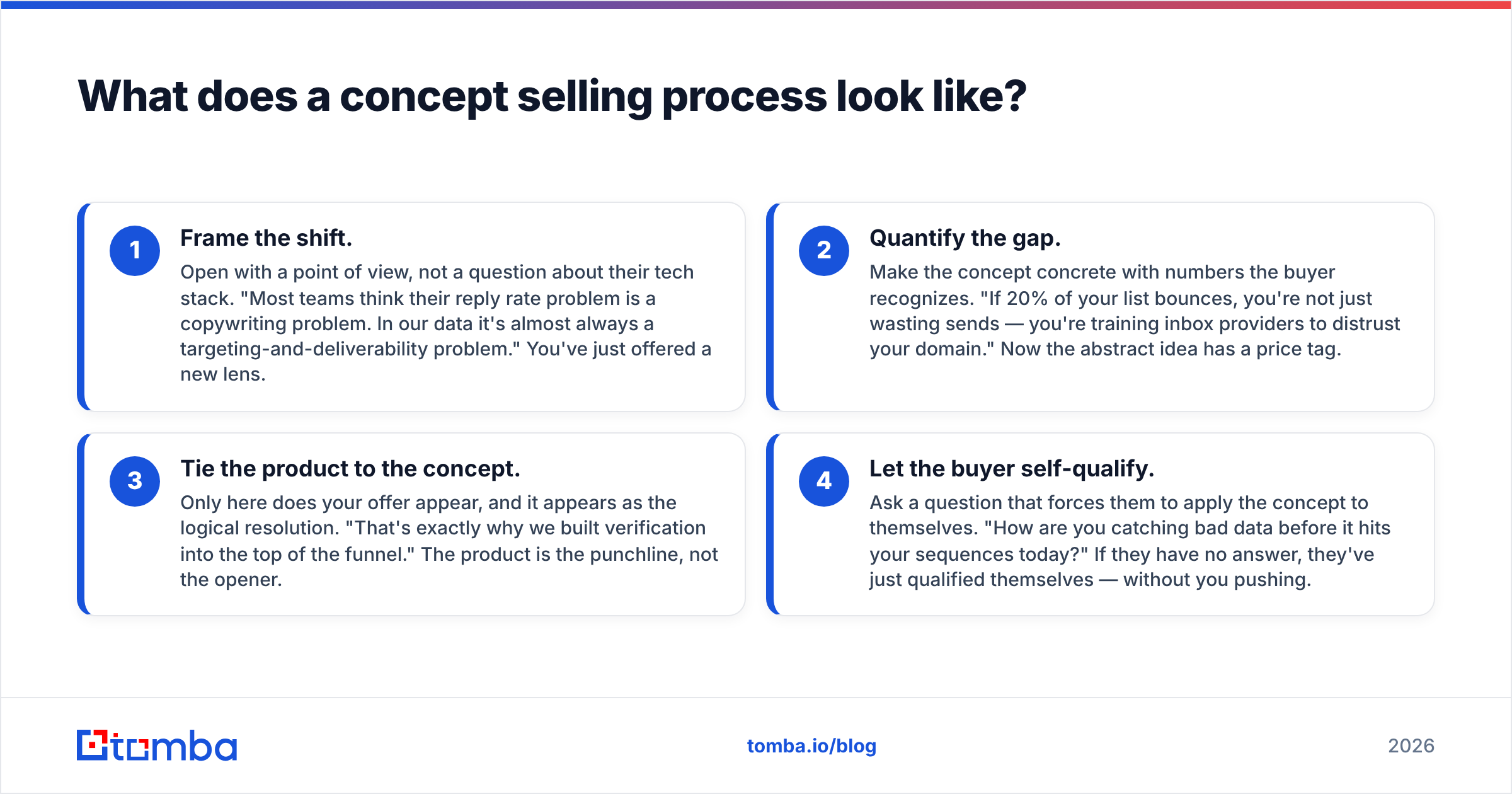
Here's the repeatable version — four moves you can run on any call instead of winging it.
- Frame the shift. Open with a point of view, not a question about their tech stack. "Most teams think their reply rate problem is a copywriting problem. In our data it's almost always a targeting-and-deliverability problem." You've just offered a new lens.
- Quantify the gap. Make the concept concrete with numbers the buyer recognizes. "If 20% of your list bounces, you're not just wasting sends — you're training inbox providers to distrust your domain." Now the abstract idea has a price tag.
- Tie the product to the concept. Only here does your offer appear, and it appears as the logical resolution. "That's exactly why we built verification into the top of the funnel." The product is the punchline, not the opener.
- Let the buyer self-qualify. Ask a question that forces them to apply the concept to themselves. "How are you catching bad data before it hits your sequences today?" If they have no answer, they've just qualified themselves — without you pushing.
Run those four moves and the buyer talks themselves into the next step. Push a feature deck instead and you're back to defending price.
When should you NOT use concept selling?#
Concept selling is a hammer, and not everything is a nail. Skip it — or dial it way down — when:
- The buyer already knows exactly what they want. A procurement team comparing three verifiers by price and API uptime doesn't want to be re-educated. Give them specs.
- The sales cycle is tiny and transactional. For a $19/month self-serve tool, a 20-minute concept conversation is overkill. Let the product page do the selling.
- You can't back the concept with proof. A reframe without data is just an opinion, and buyers smell it. If you don't have numbers, you're not concept selling — you're guessing out loud.
- The buyer is hostile to "vision" pitches. Some technical buyers explicitly want features and hate narrative. Read the room and switch to product mode.
The failure mode of concept selling is a rep who philosophizes for 40 minutes and never lets the buyer touch the product. The concept earns you the right to demo — it doesn't replace the demo.
How do you build the data foundation concept selling needs?#
Here's the part most "sell the vision" content skips: concept selling is worthless if you're pitching the wrong person. The most brilliant reframe in the world lands nowhere if it hits a shared inbox or a contact who left the company eight months ago.
Concept selling is a conversation-quality play. It only pays off when it's aimed at the right decision-maker with a working channel to reach them. That's a data-quality problem, and it's upstream of every clever pitch. This is exactly the "bad data is the real bottleneck" concept applied to your own funnel — you have to believe it before you'll fix it.

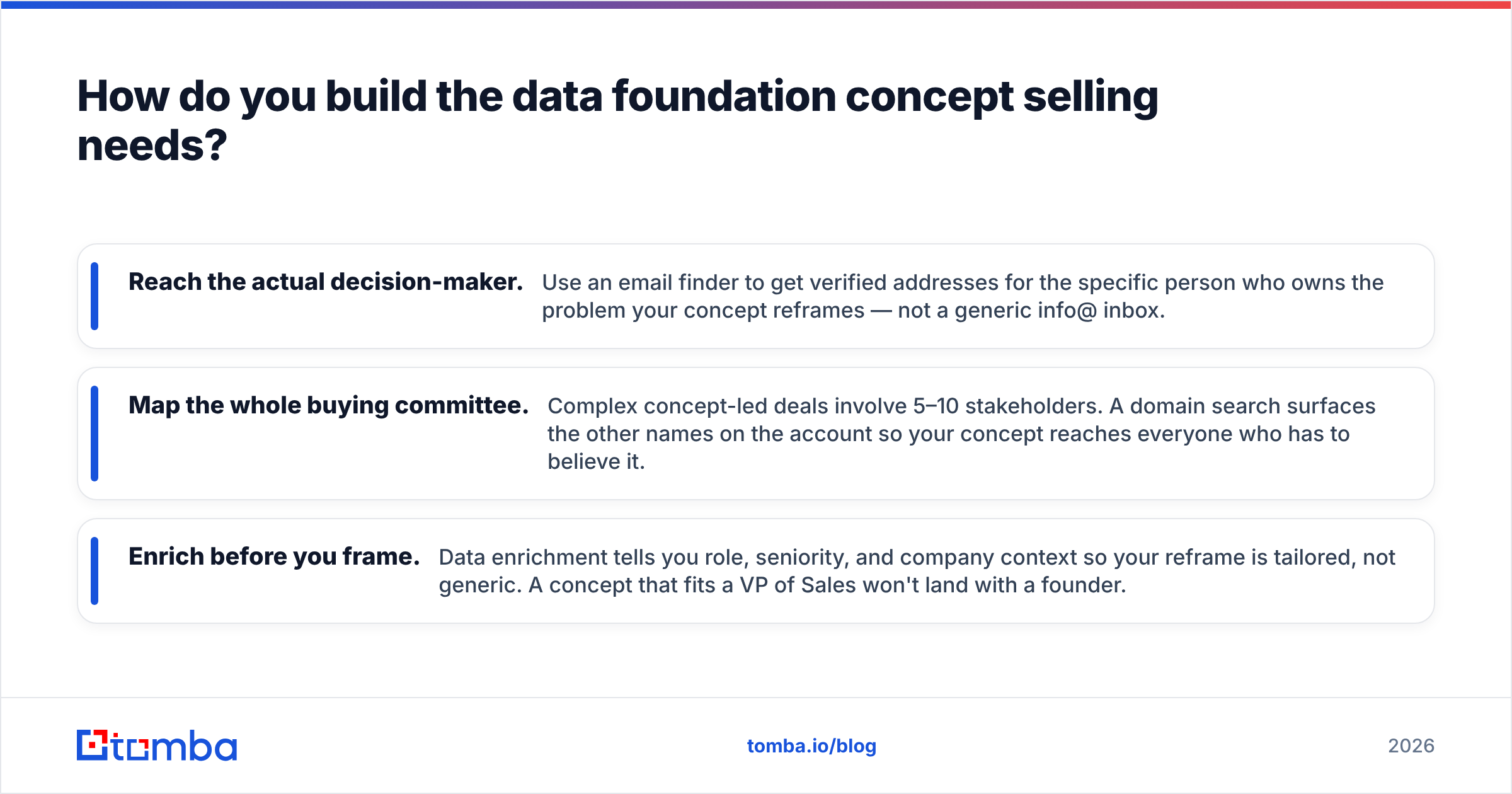
Before you run the four moves at scale, get three things right:
- Reach the actual decision-maker. Use an email finder to get verified addresses for the specific person who owns the problem your concept reframes — not a generic info@ inbox.
- Map the whole buying committee. Complex concept-led deals involve 5–10 stakeholders. A domain search surfaces the other names on the account so your concept reaches everyone who has to believe it.
- Enrich before you frame. Data enrichment tells you role, seniority, and company context so your reframe is tailored, not generic. A concept that fits a VP of Sales won't land with a founder.
Do this and your reply rate climbs for a boring reason: your best message is finally reaching people who can act on it.
What tools support a concept selling motion?#
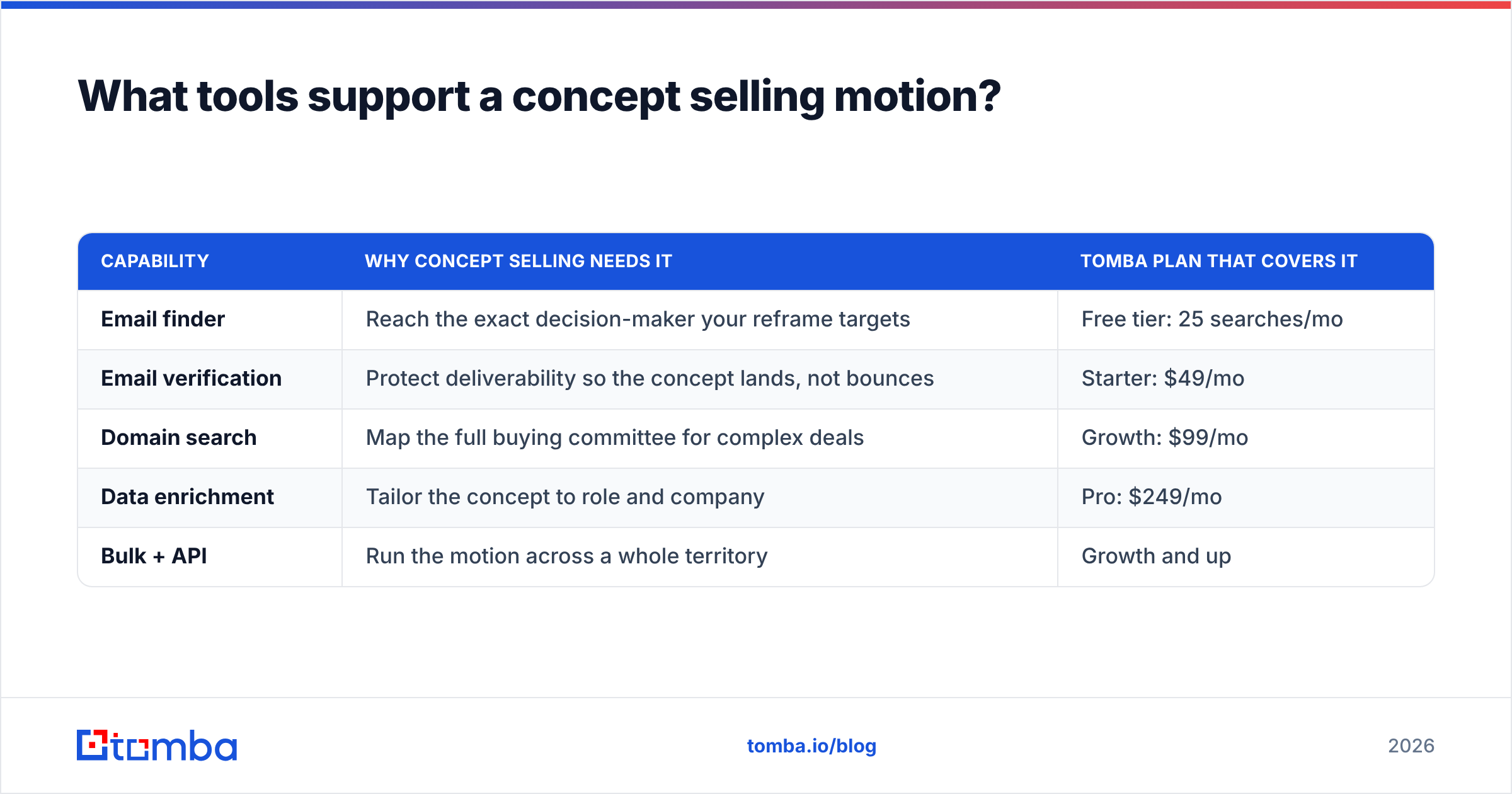
You need three capabilities: find the right people, verify you can reach them, and enrich so the message fits. Here's how the pieces map to a real workflow and what they cost.
| Capability | Why concept selling needs it | Tomba plan that covers it |
|---|---|---|
| Email finder | Reach the exact decision-maker your reframe targets | Free tier: 25 searches/mo |
| Email verification | Protect deliverability so the concept lands, not bounces | Starter: $49/mo |
| Domain search | Map the full buying committee for complex deals | Growth: $99/mo |
| Data enrichment | Tailor the concept to role and company | Pro: $249/mo |
| Bulk + API | Run the motion across a whole territory | Growth and up |
You can start on the free tier to test the motion on a handful of accounts, then scale. Full Tomba pricing breaks down credits per tier, but the honest advice is: don't overbuy. Prove the concept-led pitch converts on 20 well-targeted accounts before you buy volume.
A concrete example: reframing a "we're fine" buyer#
Say you sell to heads of sales who insist their outbound is "working fine."
Feature seller says: "Our tool finds emails with 95% accuracy and has a Chrome extension." The buyer nods and ghosts.
Concept seller says: "Quick question — when your reps say a campaign 'didn't work,' do you know how many of those emails actually reached a human? Most teams can't answer that, which means they're optimizing copy on top of a broken foundation. That's usually a bigger lever than the copy itself."
Notice what happened. The concept seller didn't mention a product. They planted a doubt — maybe our outbound isn't fine — and attached a cost to it. The buyer's next question is almost always "so how do you measure that?" And now you demo, on their invitation, with the frame already set in your favor.
That's the entire game: earn the demo by changing the belief, then let the product close what the concept opened.
Frequently asked questions#
Is concept selling the same as consultative selling? They overlap but aren't identical. Consultative selling emphasizes asking questions and advising. Concept selling emphasizes installing a specific point of view. You can be consultative in service of a concept — great reps do both.
How long does a concept selling cycle take? Usually longer up front than feature selling, because you're building belief before you pitch. But it tends to close at higher trust and lower discount, because the buyer isn't comparing you on price — they're comparing you on an idea only you framed.
Can concept selling work in cold outreach? Yes, and it's arguably where it shines. A cold email that leads with a genuine reframe ("here's a way to think about X you probably haven't") outperforms a feature dump. Just make sure it reaches the right inbox — see the data section above.
Does concept selling work for SMBs or only enterprise? Both, but the concept has to match the stakes. Enterprise buyers will sit through a longer reframe. SMB buyers want the concept in two sentences, then proof. Same method, different pacing.
Where to start#
Concept selling isn't a script — it's a sequence: change the belief, quantify the stakes, then let the product be the obvious answer. Master the four moves and you'll stop losing deals to "it's too expensive" that were really lost to "I never believed I had the problem."
But the cleverest reframe still needs to reach a real person who can act on it. Start by fixing the foundation: use the Tomba Email Finder to get verified, decision-maker-level contacts so your best pitch lands in the right inbox — every time. Spin up the free tier, target 20 accounts, and run the concept motion. Let the results, not the pitch, make your case.
Related guides#
Ready to find emails that actually work?
Join 150,000+ professionals who stopped guessing and started sending. Free credits on signup — no credit card required.
Get the Tomba newsletter
Practical outbound tactics and product updates — once every two weeks.
About the author