Creative Prospecting in 2026: Tactics That Actually Book Meetings
Reply rates on template sequences keep sliding. Creative prospecting — video, audio, gifts, custom assets, trigger-based plays — is what's still working in 2026, and here's exactly when each one pays off.
TL;DR
- Creative prospecting is not "send a cupcake." It's any outbound play that earns attention because the prospect can tell it could only have been sent to them.
- The plays that still work in 2026 — trigger-based outreach, custom mini-audits, short async video, peer-referral loops — share one trait: they cost you research time, not gimmick budget.
- Creative touches raise reply rate 2–5x on the right list and do almost nothing on the wrong one. Data quality gates everything downstream.
- Video and gifting have the worst effort-to-outcome ratio unless you reserve them for named accounts in an active buying window.
- Build a two-tier motion: a high-volume verified base layer, plus a creative layer aimed at 30–50 accounts you actually want.
Cold email reply rates have been quietly collapsing for three years. The template that pulled 8% in 2022 pulls 1.5% now, and the reason isn't your subject line — it's that every prospect gets the same "quick question, saw you're scaling the team" message forty times a week. Creative prospecting is the response to that collapse. Done right, it is the only reliable way to get a director-level buyer to stop scrolling. Done wrong, it's an expensive way to be ignored with a handwritten note.
This guide separates the two.
What is creative prospecting, really?#
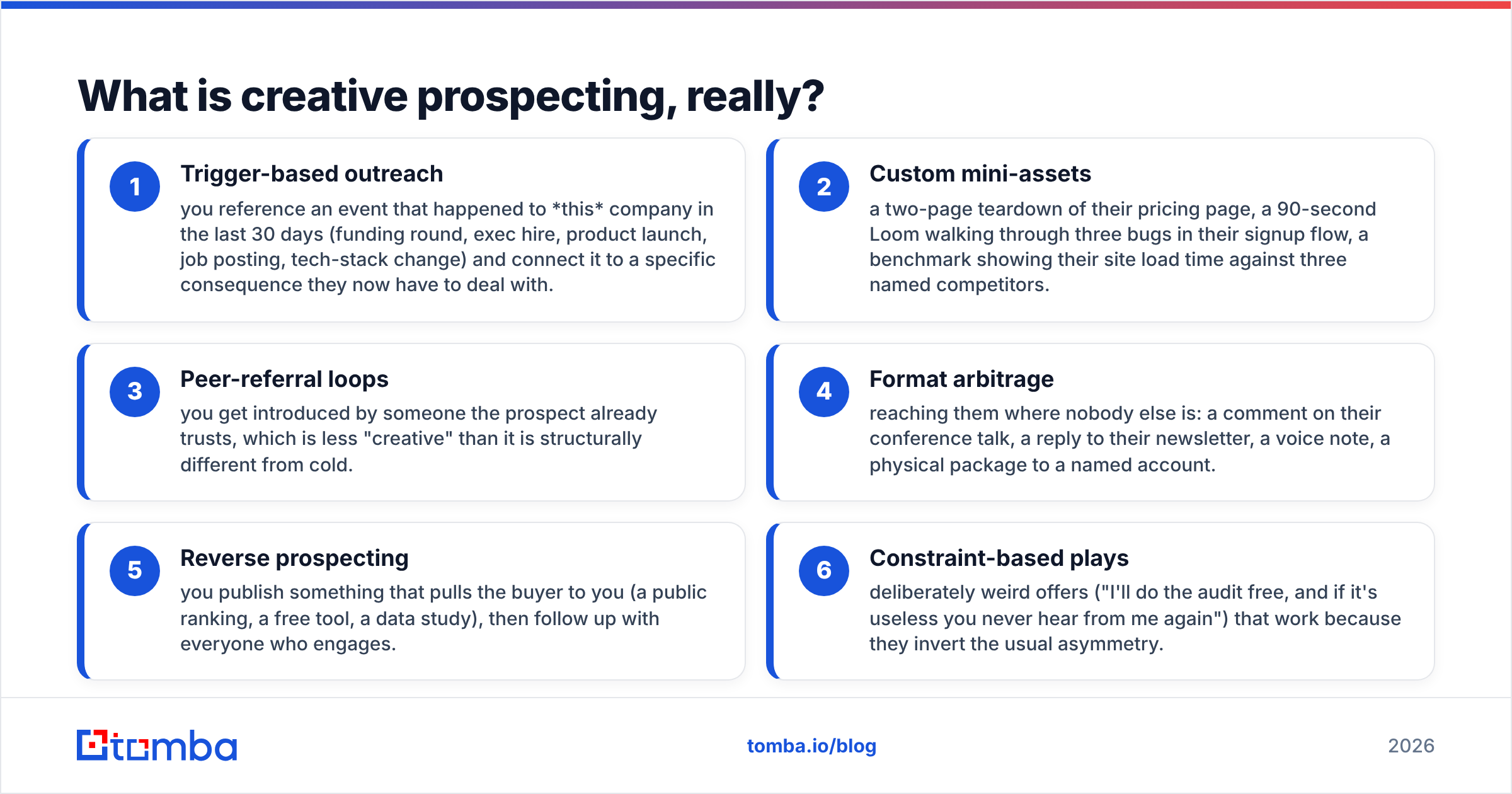
Creative prospecting is any outbound approach that earns a response because the recipient can tell the message was built specifically for them and could not be mass-sent to anyone else.
That definition matters, because it rules out most of what gets marketed as "creative." A GIF in your email is not creative prospecting — it's decoration. A first-line personalization token pulled from an LLM ("Loved your post about scaling!") is not creative prospecting — it's a template with a costume on. Prospects have been trained to spot both in under two seconds.
What passes the test:
- Trigger-based outreach — you reference an event that happened to this company in the last 30 days (funding round, exec hire, product launch, job posting, tech-stack change) and connect it to a specific consequence they now have to deal with.
- Custom mini-assets — a two-page teardown of their pricing page, a 90-second Loom walking through three bugs in their signup flow, a benchmark showing their site load time against three named competitors.
- Peer-referral loops — you get introduced by someone the prospect already trusts, which is less "creative" than it is structurally different from cold.
- Format arbitrage — reaching them where nobody else is: a comment on their conference talk, a reply to their newsletter, a voice note, a physical package to a named account.
- Reverse prospecting — you publish something that pulls the buyer to you (a public ranking, a free tool, a data study), then follow up with everyone who engages.
- Constraint-based plays — deliberately weird offers ("I'll do the audit free, and if it's useless you never hear from me again") that work because they invert the usual asymmetry.
Everything on that list costs research time. Nothing on it costs a gift budget. That's the tell.

Why do template sequences stop working?#
Three things happened at once.
First, sequencing tools got cheap and AI writing got free, so the volume of "personalized" outbound exploded. The marginal message is now worth roughly zero to the recipient, and buyers adjusted by pattern-matching harder. According to HubSpot's sales research, the majority of buyers now say they ignore cold outreach entirely unless it's clearly relevant to something they're currently working on — "currently working on" being the operative constraint.
Second, inbox providers tightened. Google and Yahoo's bulk-sender requirements pushed authentication and complaint-rate thresholds into hard gates. If your list has 12% bounces, you don't have a copy problem — you have a deliverability problem, and no amount of creativity fixes an email that never lands.
Third, and least discussed: creative tactics get copied and burn out. Video prospecting worked spectacularly in 2019 because it was rare. Now a Loom thumbnail in an inbox reads as "sales rep." The half-life of any creative channel is roughly 18 months from "nobody does this" to "everybody does this."
The implication is uncomfortable but useful: creativity is not a tactic you adopt, it's a posture you maintain. Whatever is working now stops working when it scales.
Which creative prospecting plays actually work in 2026?#
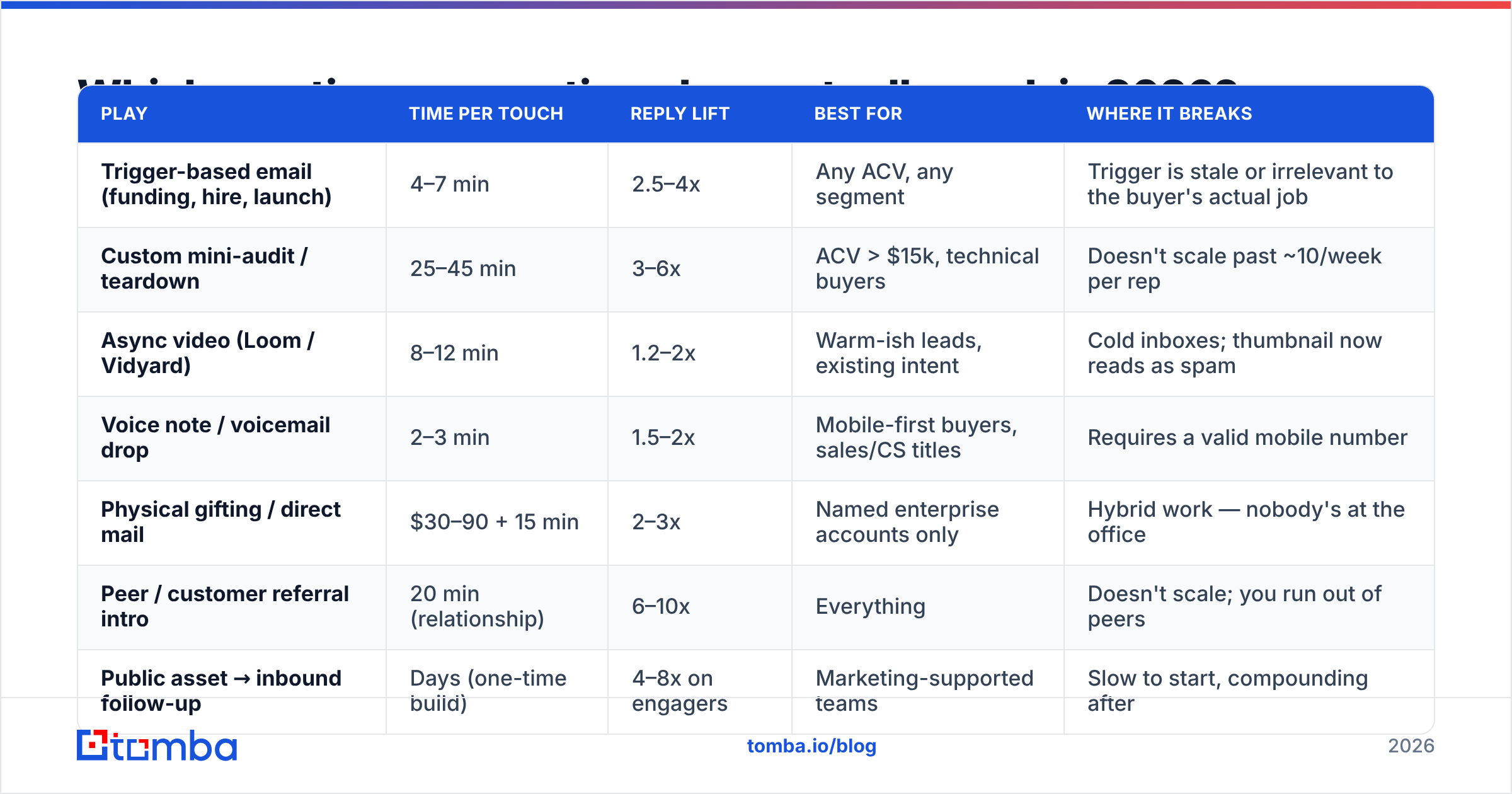
Here's the honest scoreboard. "Time per touch" assumes a rep who already has the account researched. "Reply lift" is relative to a well-written baseline template on the same verified list — not to zero.
| Play | Time per touch | Reply lift | Best for | Where it breaks |
|---|---|---|---|---|
| Trigger-based email (funding, hire, launch) | 4–7 min | 2.5–4x | Any ACV, any segment | Trigger is stale or irrelevant to the buyer's actual job |
| Custom mini-audit / teardown | 25–45 min | 3–6x | ACV > $15k, technical buyers | Doesn't scale past ~10/week per rep |
| Async video (Loom / Vidyard) | 8–12 min | 1.2–2x | Warm-ish leads, existing intent | Cold inboxes; thumbnail now reads as spam |
| Voice note / voicemail drop | 2–3 min | 1.5–2x | Mobile-first buyers, sales/CS titles | Requires a valid mobile number |
| Physical gifting / direct mail | $30–90 + 15 min | 2–3x | Named enterprise accounts only | Hybrid work — nobody's at the office |
| Peer / customer referral intro | 20 min (relationship) | 6–10x | Everything | Doesn't scale; you run out of peers |
| Public asset → inbound follow-up | Days (one-time build) | 4–8x on engagers | Marketing-supported teams | Slow to start, compounding after |
Two things jump out.
Referrals crush everything and always will. If you have a path to a warm intro, take it before you get clever. The only reason we're all doing cold outbound is that referral supply is capped.
Physical gifting is the most overrated play on the list. It costs 30x more than a trigger email for roughly the same lift, and post-2020 office attendance has gutted delivery reliability. Reserve it for the 10 accounts on your board's whiteboard, and stop pretending it's a channel.
How do you find the triggers worth acting on?#
A trigger is only useful if it creates a new problem for the person you're emailing. Sort your triggers by that test, not by how easy they are to scrape.
High-signal triggers (a real problem lands on a real desk):
- New VP/Director hire in your buyer's function — new leaders re-evaluate the stack in their first 90 days. This is the single best B2B trigger there is.
- Job posting for a role that implies your problem — three SDR reqs open means their outbound is about to double, which means their data spend is about to become someone's headache.
- Funding round in the last 60 days — budget exists and there's pressure to deploy it. Note the decay: by day 90 they're drowning in vendor emails.
- Competitor switch / tech-stack change — detectable from their site, job posts, or engineering blog. Implies active dissatisfaction.
Low-signal triggers (feel personalized, change nothing):
- Company birthday, prospect's work anniversary, a LinkedIn post they made about leadership.
- Generic "congrats on the growth" hooks derived from headcount data.
- Anything an LLM can infer from a company description — because it can, and so can everyone else's LLM.
Once you've got the trigger, you need the person and the contact route. This is the unglamorous part that determines whether any of the creative work ever gets seen. A trigger without a verified inbox is a diary entry. Use a domain search to map who's actually at the account, then run the addresses through an email verifier before a single creative minute gets spent. If the account is worth a 40-minute teardown, it's worth 40 seconds of verification first.
Is creative prospecting worth it at scale?#
Not everywhere. That's the whole point.
The mistake teams make is trying to make the creative layer scale — writing "personalization frameworks," buying AI tools that generate custom first lines at 500/day, and ending up with mass-produced pseudo-personalization that performs worse than an honest template. The prospect can tell.
Run a two-tier motion instead:
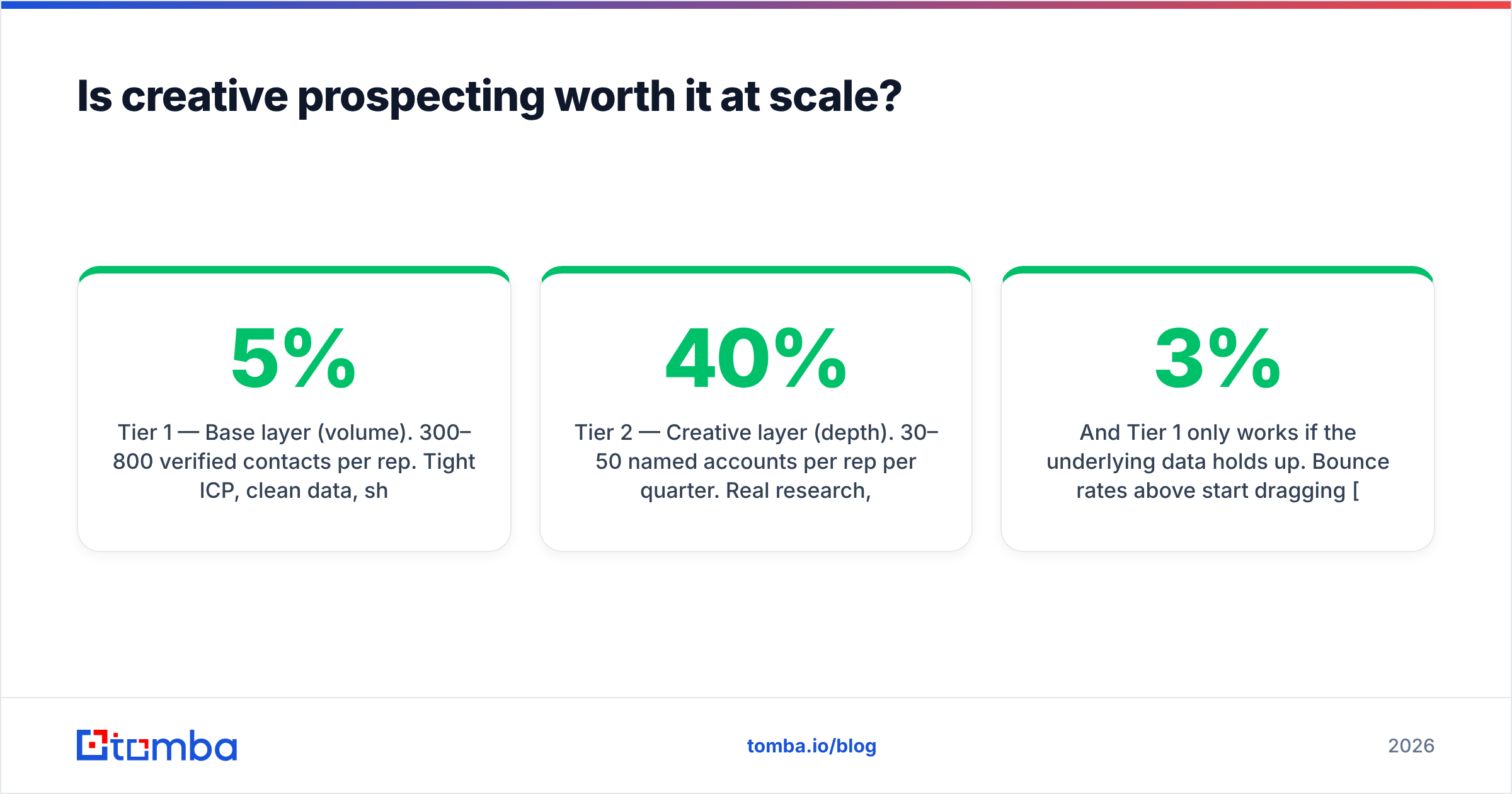
- Tier 1 — Base layer (volume). 300–800 verified contacts/month per rep. Tight ICP, clean data, short honest emails, no gimmicks. Target: 3–5% reply. This is your pipeline floor. It exists to keep the machine warm and catch buyers who happen to be in-market.
- Tier 2 — Creative layer (depth). 30–50 named accounts per rep per quarter. Real research, real assets, multi-threaded, multi-channel, 5–10 touches over six weeks. Target: 25–40% reply, 10–15% meeting rate. This is where your quota actually comes from.
The two tiers feed each other. Tier 1 tells you which accounts have a pulse (opens, clicks, a "not now" reply). Those graduate into Tier 2. Anyone who tries to run creative plays against a cold, unfiltered list is burning their most expensive resource — rep hours — on accounts that were never going to buy.
And Tier 1 only works if the underlying data holds up. Bounce rates above 3% start dragging sender reputation down, which quietly kills Tier 2 deliverability too. Your clever teardown email lands in spam and you never find out why.

What does a creative sequence actually look like?#
Here's a six-week Tier 2 sequence against a single named account, post-Series-B, where they just hired a new VP of Sales. Five touches, two humans, three channels.
Week 1, Touch 1 — Email to the new VP.
Subject: your first 90 days
Body: three sentences. You name the specific structural problem they inherited (their SDR team is 4 people, their CRM shows 200 sequences, their data source is X — you know because it's in their job postings). No pitch. One question: "Is data quality on your first-90 list, or is it further down?"
Week 1, Touch 2 — LinkedIn engagement. No connection request. Just a substantive comment on something they posted, adding a data point they didn't have. Visibility, not contact.
Week 2, Touch 3 — The asset. You send a two-page PDF: a sample of 100 contacts from their exact ICP, run through verification, showing what percentage of their current list is likely dead. This is the play. It costs you 30 minutes and it's undeniably about them. Tools like a bulk email finder make this kind of proof-of-concept cheap to produce.
Week 3, Touch 4 — Multi-thread. You email their Head of RevOps with a different angle: the operational cost of bad data (wasted rep hours, CRM hygiene, response rate drag). RevOps often has more urgency than the VP does.
Week 5, Touch 5 — The honest close. One paragraph to the VP: "I've sent you three things and heard nothing, which is a fine answer. If the timing's wrong, tell me when to come back and I'll disappear until then."
That last email is the highest-converting message in most sequences, and it's the one people skip. Giving the prospect a graceful exit is, counterintuitively, the most creative thing in the whole sequence.
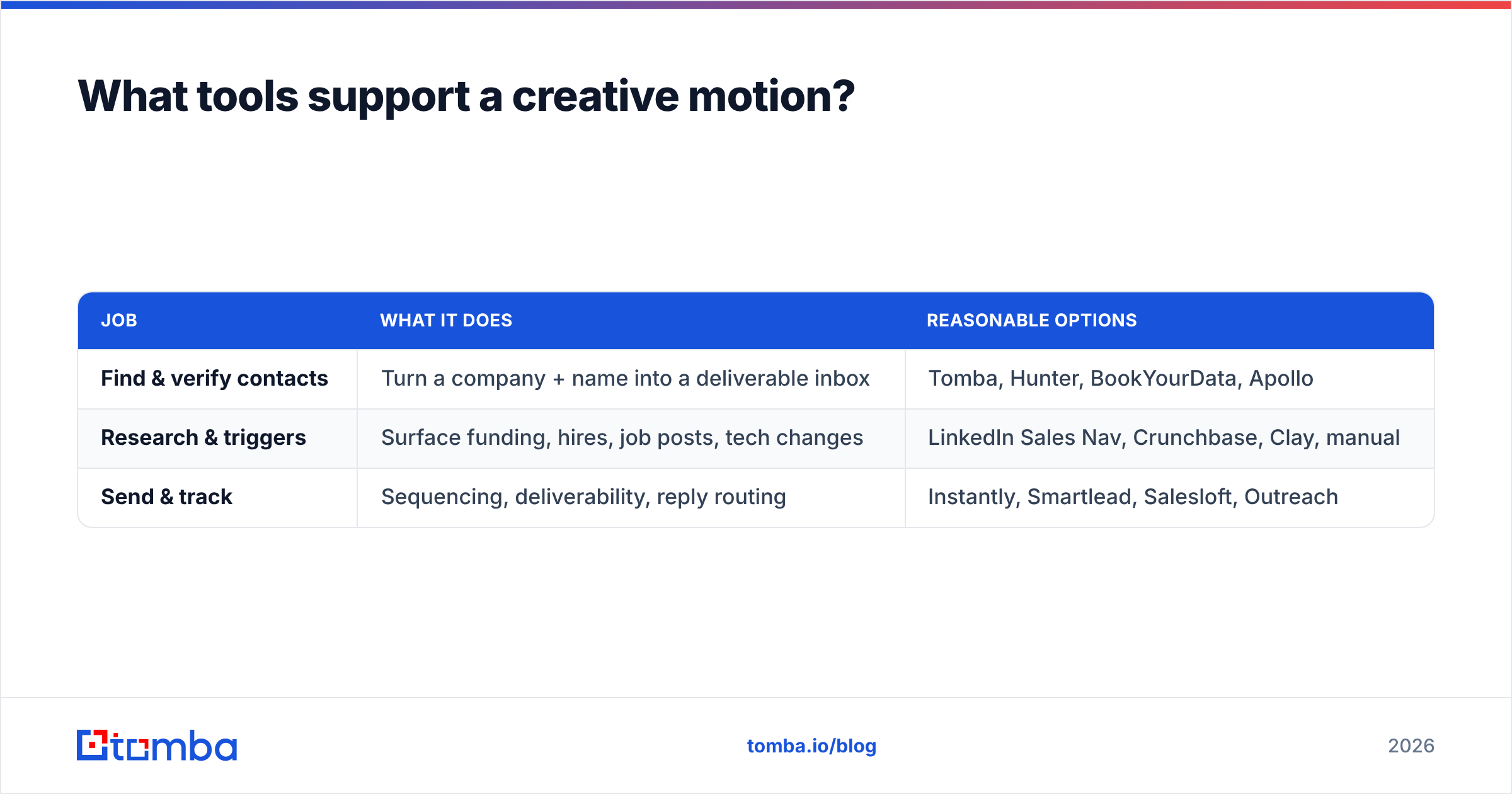
What tools support a creative motion?#
You need less than the vendor landscape implies. The stack breaks into three jobs.
| Job | What it does | Reasonable options |
|---|---|---|
| Find & verify contacts | Turn a company + name into a deliverable inbox | Tomba, Hunter, BookYourData, Apollo |
| Research & triggers | Surface funding, hires, job posts, tech changes | LinkedIn Sales Nav, Crunchbase, Clay, manual |
| Send & track | Sequencing, deliverability, reply routing | Instantly, Smartlead, Salesloft, Outreach |
On the first job — the one everything else depends on — the practical criteria are accuracy, transparent pricing, and an API you can wire into your research workflow. Tomba pricing runs a free tier at 25 searches/month, Starter at $49/mo, Growth at $99/mo, and Pro at $249/mo, with the Tomba API available across paid plans so you can enrich accounts inside whatever research script or Clay table you've built. BookYourData is a solid pick when you'd rather buy a pre-built list than run discovery yourself. Whichever you use, the rule holds: verify before you invest creative hours.
Two warnings on tooling.
Don't buy an "AI personalization" tool expecting it to produce Tier 2 work. It produces very good Tier 1 work — better first lines, better ICP fit — and that's genuinely valuable. But the thing that makes a teardown convert is that a human noticed something. LLMs are excellent at finding the raw material and poor at deciding what matters.
Don't over-invest in gifting platforms. Check the reviews on G2 before committing to a seat-based contract; the category has a well-documented gap between demo and reality once your recipients are all remote.
How do you measure whether it's working?#
Reply rate is a vanity metric on Tier 2, because your volume is too low for it to be statistically meaningful. Measure these instead:
- Meetings per 100 research-hours. The only number that compares creative work against volume work honestly. If Tier 2 isn't beating Tier 1 on this, your account selection is wrong — not your creativity.
- Account penetration. How many contacts inside a target account have you reached? Single-threaded creative outreach is fragile; if your champion leaves, the deal dies.
- Positive-negative ratio. Count "not now, ping me in Q3" as a win. Those convert at 20–30% when you actually ping them in Q3, which almost nobody does.
- Bounce rate, always. Above 3% and you're degrading everything else you send.
- Time-to-first-touch after a trigger. Funding round triggers decay fast. If you're emailing on day 45, you're the fortieth vendor. Day 5 and you're the first.
Track those for a quarter and you'll find that the "creative" bit contributes less than the selection bit. The reps who win aren't the ones with the cleverest Loom. They're the ones who picked 40 accounts that were actually in a buying window and then did unremarkable, careful work on all 40.
Where do most creative prospecting attempts go wrong?#
Four failure modes, in order of how often we see them:
- Creativity as a substitute for relevance. A funny GIF sent to someone with no problem you can solve is still a waste of their time. Relevance first, creativity second — never the reverse.
- Effort the prospect can't see. You spent four hours on research and then buried the insight in paragraph three. If the payload isn't in the first line, the effort didn't happen.
- Creative work on a dirty list. Forty minutes of teardown against an address that bounces. This is the most expensive mistake in outbound and it's entirely preventable with a verification step that costs cents.
- No graceful exit. Sequences that just stop, or worse, sequences that keep going. The "tell me to go away" email recovers 5–10% of dead threads.
The bottom line#
Creative prospecting works when it's an expression of research, not an expression of budget. The play is: pick fewer accounts, find a real trigger, verify you can actually reach the humans involved, build something that could only have been built for them, and give them an easy way to say no.
Everything else — the videos, the gifts, the clever subject lines — is downstream of whether you picked the right account and can actually land in their inbox.
Start with the second part. If you want the contact layer under your creative motion to hold up, the Tomba Email Finder gets you verified, deliverable addresses by domain, name, or company, with a free tier at 25 searches/month to test it against your own target list before you spend a dollar. Pull 40 accounts, verify them, and spend your creative hours only on the ones that come back clean. That single filter will do more for your reply rate than any gimmick in this post.
Related guides#
Ready to find emails that actually work?
Join 150,000+ professionals who stopped guessing and started sending. Free credits on signup — no credit card required.
Get the Tomba newsletter
Practical outbound tactics and product updates — once every two weeks.
About the author