Cufinder vs Mattermark (2026): Which B2B Data Tool Wins?
Cufinder and Mattermark both sell B2B data, but they solve different problems. Here's an honest breakdown of accuracy, coverage, pricing, and which one fits your GTM stack in 2026.
Choosing between Cufinder and Mattermark usually means you have a leaky top of funnel and a spreadsheet full of half-finished company records. Both tools promise to fix that, but they were built for different jobs, and picking the wrong one wastes budget you can't get back.
This is a neutral, hands-on comparison: what each tool actually does, where the data holds up, what you pay, and which one belongs in a modern outbound stack in 2026.
TL;DR — Cufinder vs Mattermark at a glance#
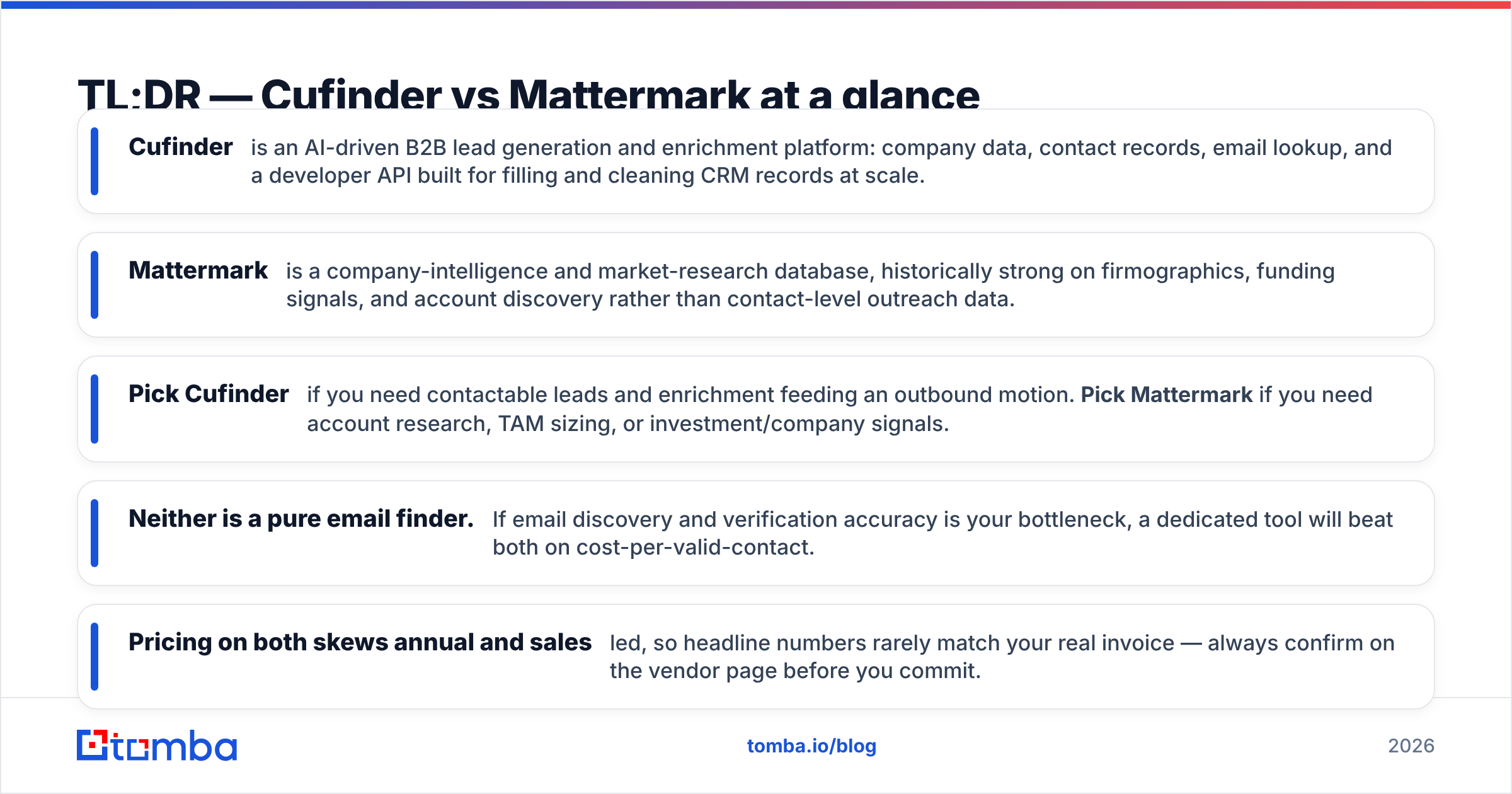
- Cufinder is an AI-driven B2B lead generation and enrichment platform: company data, contact records, email lookup, and a developer API built for filling and cleaning CRM records at scale.
- Mattermark is a company-intelligence and market-research database, historically strong on firmographics, funding signals, and account discovery rather than contact-level outreach data.
- Pick Cufinder if you need contactable leads and enrichment feeding an outbound motion. Pick Mattermark if you need account research, TAM sizing, or investment/company signals.
- Neither is a pure email finder. If email discovery and verification accuracy is your bottleneck, a dedicated tool will beat both on cost-per-valid-contact.
- Pricing on both skews annual and sales-led, so headline numbers rarely match your real invoice — always confirm on the vendor page before you commit.
What is Cufinder?#
Cufinder positions itself as an all-in-one B2B lead generation and data enrichment engine. You feed it a company name, domain, or a partial record, and it returns firmographic details, contact data, and email addresses. It leans heavily on AI matching to connect fragments — a domain here, a job title there — into a usable record.
The typical Cufinder user is a growth or RevOps person who lives in a CRM and needs three things: find new accounts that fit an ICP, attach decision-maker contacts to those accounts, and keep existing records from rotting. Its API and bulk workflows are the real draw, letting you enrich thousands of rows without manual lookups.
Where Cufinder gets criticized is the same place most broad platforms do: coverage is uneven by region and seniority, and email accuracy varies. Broad "everything" datasets tend to trade depth for reach.

What is Mattermark?#
Mattermark is a company-intelligence platform with roots in the venture and market-research world. It built its name aggregating firmographic and growth signals — headcount trends, funding rounds, web traffic momentum — into a searchable database analysts use to find and rank companies.
That heritage matters. Mattermark is optimized for discovering and evaluating accounts, not for handing a rep 50 verified mobile numbers before lunch. If you're building a target account list, sizing a market, or tracking which startups just raised, this is its wheelhouse. It reads more like a research terminal than an outbound sales tool.
The tradeoff: contact-level depth and email deliverability have never been Mattermark's core promise. You'll often finish a session with a great list of companies and still need a separate tool to reach the humans inside them.
Cufinder vs Mattermark: the core differences#
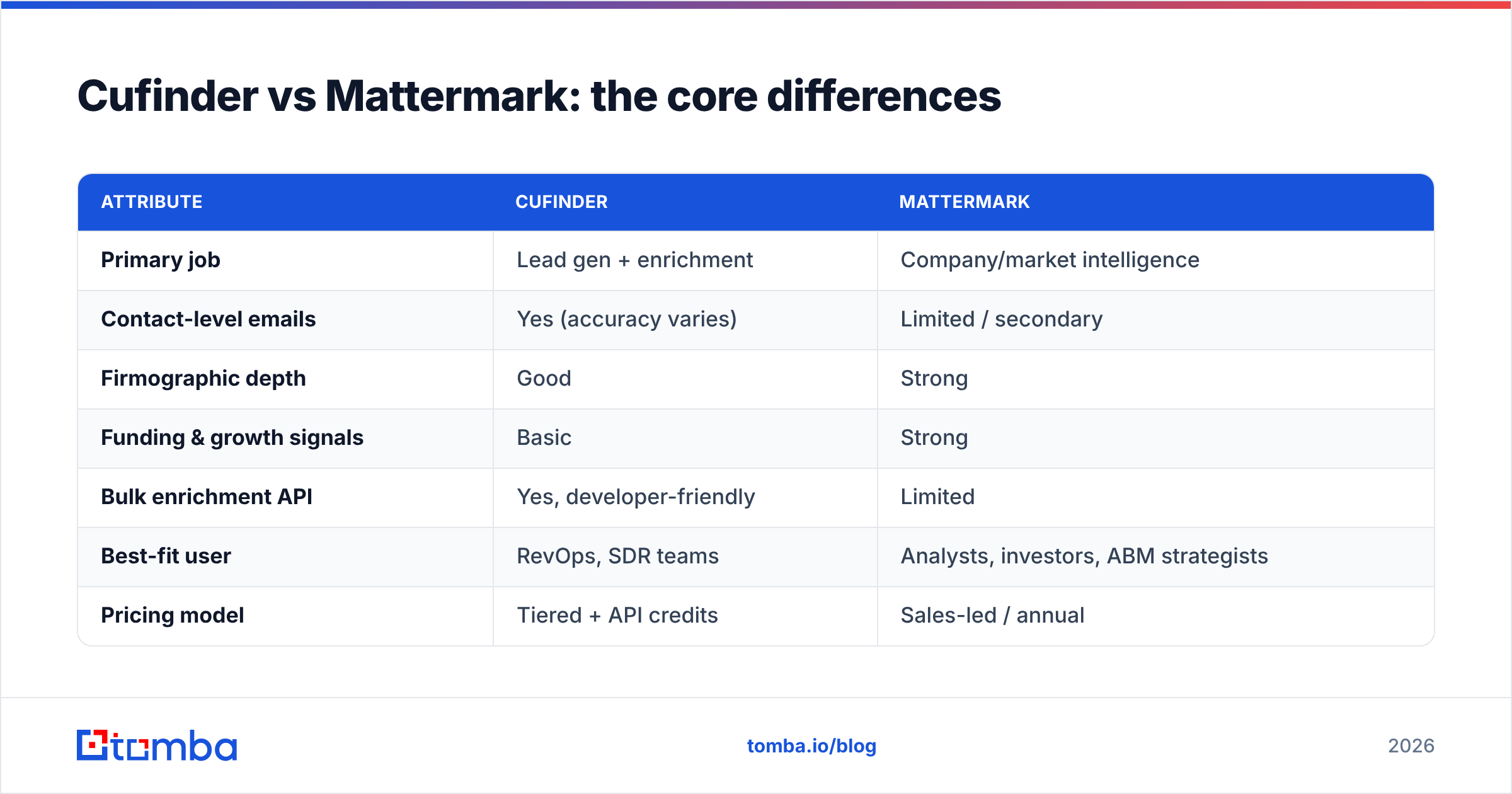
The fastest way to choose is to stop comparing them feature-by-feature and instead match each to the job you're hiring it for. Here's how they line up on the attributes that actually change outcomes.
| Attribute | Cufinder | Mattermark |
|---|---|---|
| Primary job | Lead gen + enrichment | Company/market intelligence |
| Contact-level emails | Yes (accuracy varies) | Limited / secondary |
| Firmographic depth | Good | Strong |
| Funding & growth signals | Basic | Strong |
| Bulk enrichment API | Yes, developer-friendly | Limited |
| Best-fit user | RevOps, SDR teams | Analysts, investors, ABM strategists |
| Pricing model | Tiered + API credits | Sales-led / annual |
| Free entry point | Free tier available | Trial/demo based |
Read that table as two lanes, not a scoreboard. Use these criteria to decide which lane you're in:
- Do you need to email or call people this week? That's a Cufinder-style contact-and-enrichment need, not a research need.
- Are you ranking accounts before anyone reaches out? Mattermark's firmographic and funding signals earn their keep here.
- Is a developer wiring this into your CRM? Cufinder's API and bulk flows are the more natural fit.
- Are you sizing a market or tracking investment activity? Mattermark's analyst DNA wins.
- Is cost-per-valid-contact your real KPI? Then honestly, look past both — a focused email finder usually beats a broad platform on that single metric.
Is Cufinder or Mattermark more accurate?#
Accuracy depends on what you're measuring. For firmographics — industry, size, location, funding — Mattermark's research pedigree tends to hold up well, especially for tech and venture-backed companies. For contact and email data, Cufinder covers more ground because that's a core product goal, but "more coverage" and "more accurate" aren't the same thing.
The uncomfortable truth about every all-in-one B2B database is that email accuracy erodes fast. People change jobs, catch-all domains hide invalid addresses, and a record that was correct in January is a bounce by June. If you send to unverified data, your sender reputation takes the hit, not the vendor's.
That's why serious teams treat any bulk-enriched list as raw material and run it through dedicated email verification before the first send. It's cheap insurance against a wrecked domain. Independent review sites like G2 are useful for spotting where each platform's accuracy claims meet real user experience — read the 3-star reviews, not the 5-star ones.
How do Cufinder and Mattermark price?#
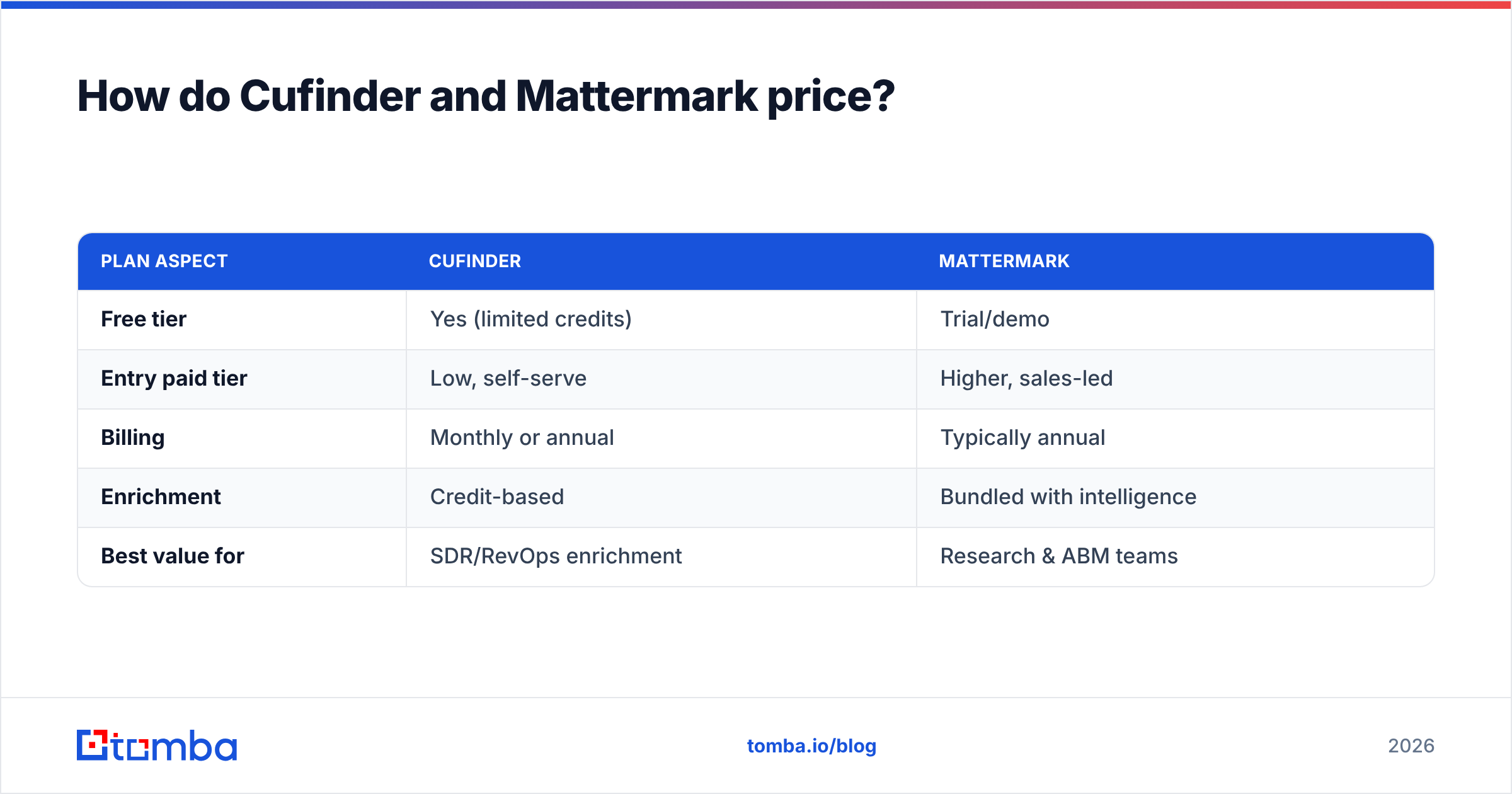
Both lean toward annual, sales-assisted pricing, which makes clean comparison hard. Cufinder publishes tiered plans with an entry-level free option and credit-based enrichment, while Mattermark has historically run demo-and-quote for its intelligence tiers. Treat any number you see in a blog post — including this one — as indicative and confirm on the source.
| Plan aspect | Cufinder | Mattermark |
|---|---|---|
| Free tier | Yes (limited credits) | Trial/demo |
| Entry paid tier | Low, self-serve | Higher, sales-led |
| Billing | Monthly or annual | Typically annual |
| Enrichment | Credit-based | Bundled with intelligence |
| Best value for | SDR/RevOps enrichment | Research & ABM teams |
Check current numbers directly at cufinder.io and mattermark.com before budgeting — pricing pages move faster than review articles.
If you're comparing total cost of ownership, factor in the hidden line item: verification and bounce cleanup. A platform that's slightly cheaper up front but ships more invalid emails can cost more once you price in deliverability damage and rep time chasing dead contacts.
Which should you choose in 2026?#
Match the tool to the motion:
- Choose Cufinder if your bottleneck is filling and enriching CRM records to feed outbound. Its API, bulk flows, and contact focus fit SDR and RevOps teams that need contactable data now.
- Choose Mattermark if your bottleneck is deciding which accounts to pursue. Its firmographic and funding intelligence suits analysts, investors, and ABM strategists building target lists.
- Choose a dedicated finder + verifier if your real problem is reaching people, and cost-per-valid-contact is the metric your board actually cares about.
For most outbound teams, the honest answer is a combination: use an intelligence layer to pick accounts, then a precise contact layer to reach them. Trying to force one all-in-one tool to do both well is where budgets quietly leak.
Where Tomba fits#
Tomba isn't a company-intelligence terminal like Mattermark, and it isn't trying to be a sprawling all-in-one like Cufinder. It's built to do one thing with high accuracy: turn a name and domain into a verified, deliverable email address.
The Tomba Email Finder pairs pattern detection with real-time verification, so you're not shipping guesses into your sequences. Need to enrich a whole list at once? The bulk email finder handles thousands of rows, and domain search pulls every reachable contact at a target company. Everything runs on transparent, published Tomba pricing: a free tier with 25 searches per month, then Starter at $49/mo, Growth at $99/mo, and Pro at $249/mo — no demo required to see what you pay.
Here's the practical stack for 2026: use Mattermark or Cufinder for the layer they're genuinely good at, then run the actual contact discovery and verification through a focused tool so your email deliverability stays intact. Start free with the Tomba Email Finder and pressure-test the accuracy against whatever you're using now — the difference in bounce rate usually settles the argument faster than any comparison table.
Related guides#
Ready to find emails that actually work?
Join 150,000+ professionals who stopped guessing and started sending. Free credits on signup — no credit card required.
Get the Tomba newsletter
Practical outbound tactics and product updates — once every two weeks.
About the author