Curiosity in Sales: The Psychology That Closes More Deals
Curiosity is the quiet skill behind reps who book more meetings and close bigger deals. Here's how to build it into every call, email, and pipeline stage.

TL;DR
- Curiosity in sales is the disciplined habit of wanting to understand a buyer more than you want to talk — and it correlates with more meetings, cleaner discovery, and higher win rates.
- Curious reps ask better questions, create curiosity gaps in their outreach, and diagnose problems before pitching solutions.
- You can train it: swap statements for questions, use "tell me more" prompts, and treat every objection as data instead of a threat.
- Curiosity fails when it becomes an interrogation or a manipulation tactic — the goal is genuine understanding, not a scripted trap.
- Pair curiosity with clean contact data so you spend your energy on the conversation, not on chasing wrong emails.
What is curiosity in sales, really?#
Curiosity in sales is the deliberate choice to prioritize learning about the buyer over performing your pitch. Think of it like a good doctor: they do not walk in and prescribe surgery before asking where it hurts. They ask, probe, and rule things out until the diagnosis is obvious — and only then do they recommend a treatment. Weak reps prescribe on sight; curious reps diagnose first.
Technically, curiosity shows up in three behaviors: asking open questions, listening for what is not said, and following the thread instead of jumping to your agenda. It is the difference between "Here's what our platform does" and "What happens today when a lead comes in and nobody follows up?"
The payoff is not soft. Buyers consistently report that they want reps who understand their problem, not reps who recite features. Research summarized by HubSpot on buyer behavior shows discovery quality — driven almost entirely by the questions a rep asks — is one of the strongest predictors of a deal advancing. Curiosity is the engine behind that discovery.
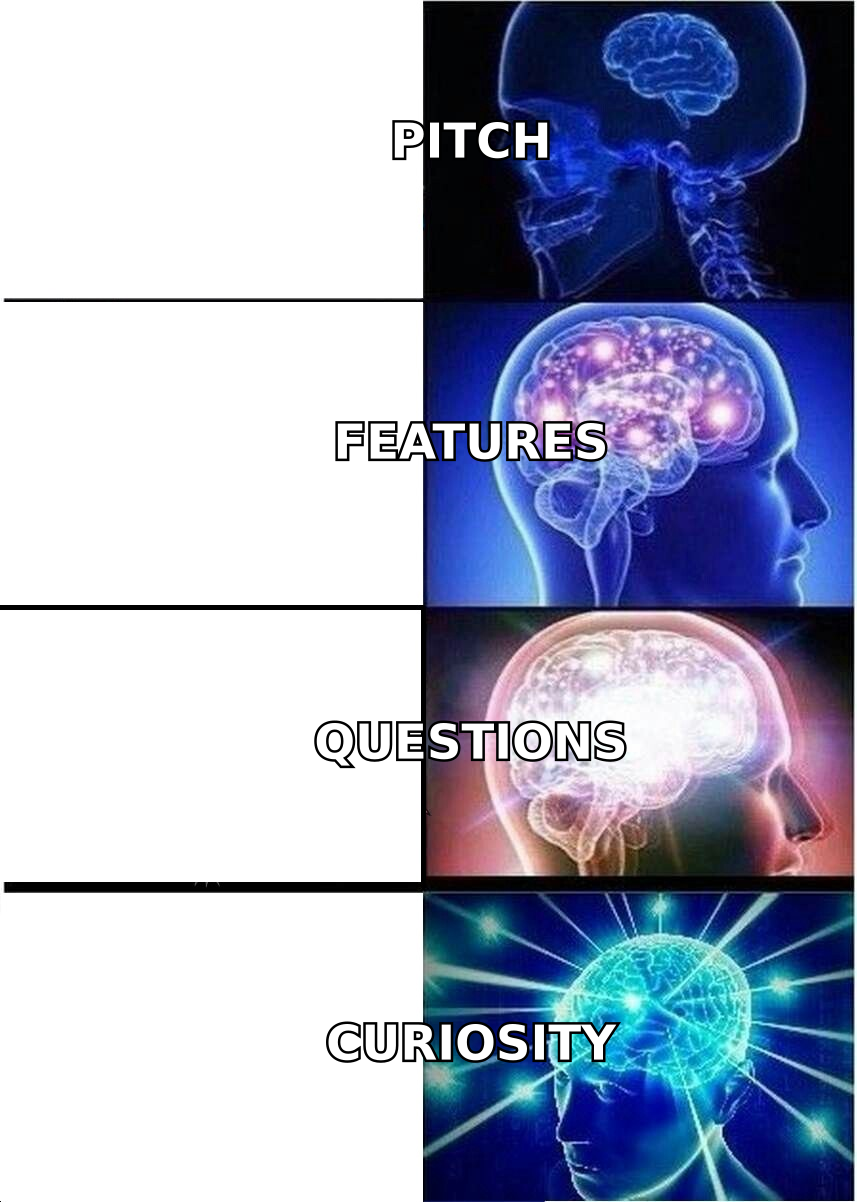
Why does curiosity beat a polished pitch?#
A pitch is a monologue. Curiosity is a conversation, and conversations are where deals actually move.
When you lead with a pitch, you are guessing what the buyer cares about. When you lead with curiosity, the buyer tells you exactly what they care about — and hands you the language, the priorities, and the internal politics you need to win. You stop selling at people and start selling with them.
There is also a trust mechanism at work. People like being asked about themselves, and they extend credibility to those who listen. A rep who asks a sharp question signals competence far more effectively than one who lists integrations. Curiosity is how you earn the right to be believed later, when you finally do talk about your product.
Curiosity also protects your pipeline hygiene. Curious reps disqualify faster because they surface the deal-killers early — no budget, no authority, no real pain — instead of spending three weeks on a deal that was never going to close. Fewer zombie opportunities means a cleaner forecast and a better win rate.
What does a curious sales conversation actually look like?#
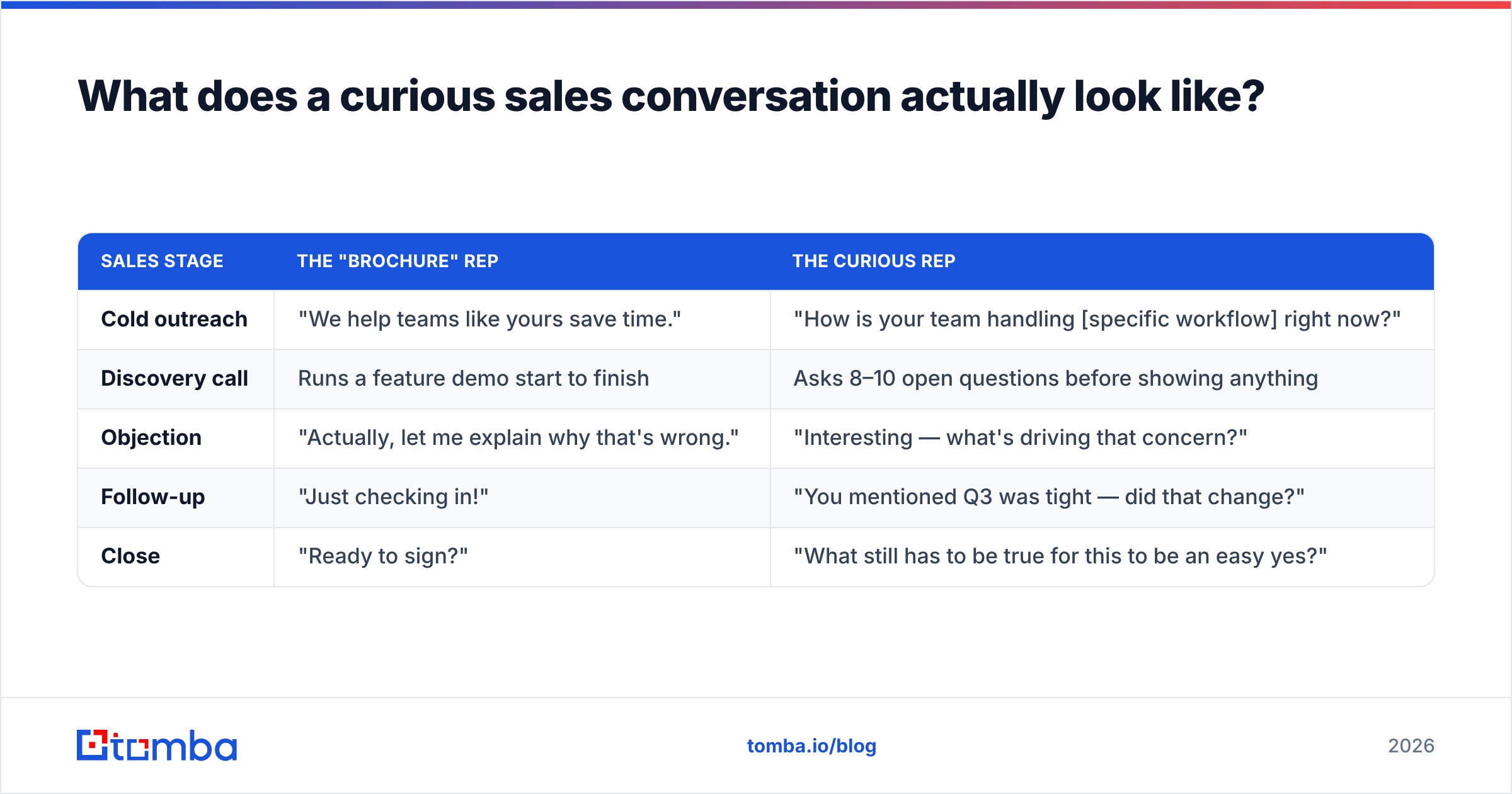
Here is the practical difference between a curious rep and a talking brochure across a typical cycle.
| Sales stage | The "brochure" rep | The curious rep |
|---|---|---|
| Cold outreach | "We help teams like yours save time." | "How is your team handling [specific workflow] right now?" |
| Discovery call | Runs a feature demo start to finish | Asks 8–10 open questions before showing anything |
| Objection | "Actually, let me explain why that's wrong." | "Interesting — what's driving that concern?" |
| Follow-up | "Just checking in!" | "You mentioned Q3 was tight — did that change?" |
| Close | "Ready to sign?" | "What still has to be true for this to be an easy yes?" |
The right column is not more talented. It is more curious. Every entry replaces a statement with a question that makes the buyer do the talking.
How do you actually build curiosity as a skill?#
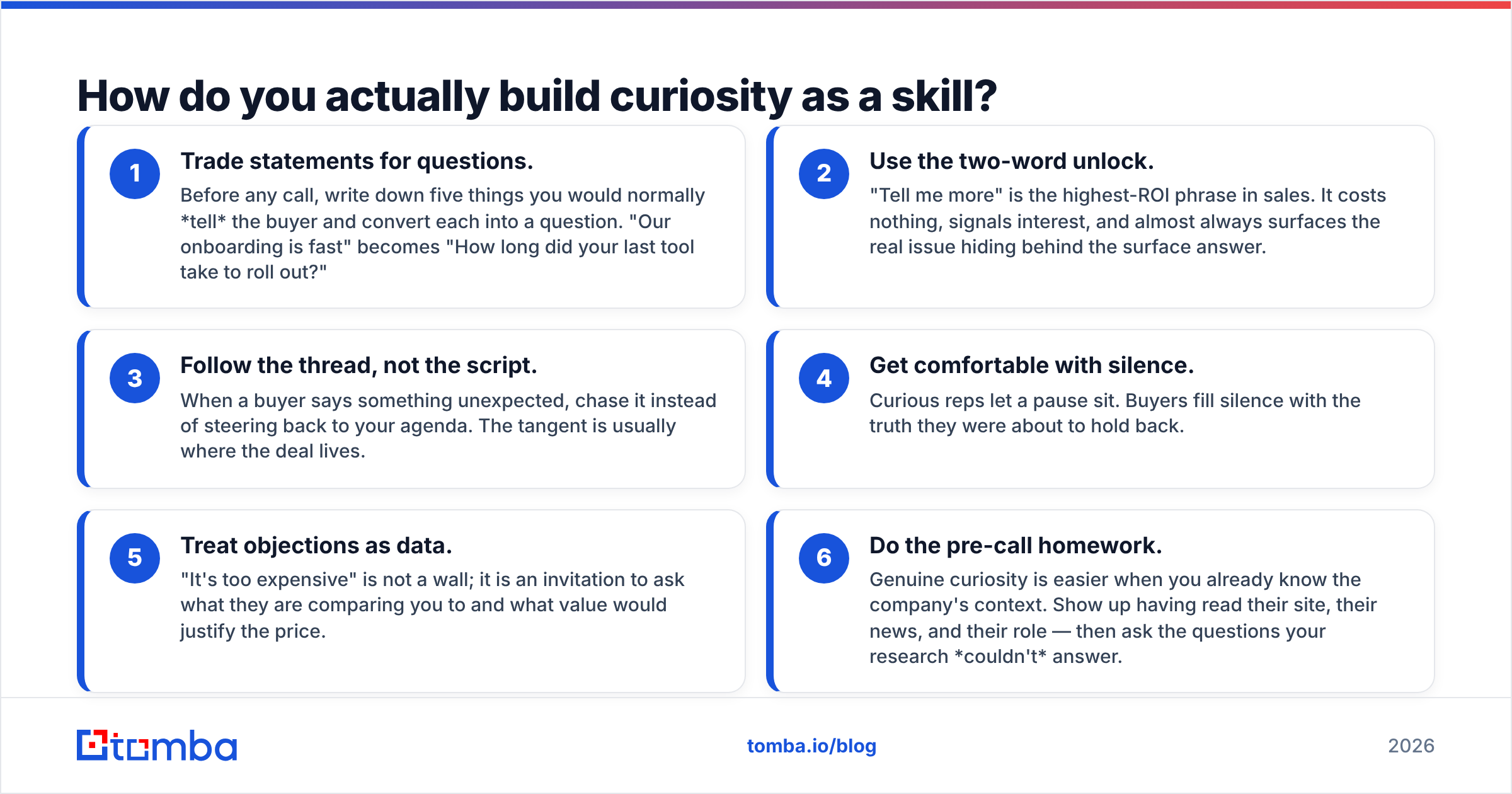
Curiosity feels like a personality trait, but it behaves like a muscle. These habits build it:
- Trade statements for questions. Before any call, write down five things you would normally tell the buyer and convert each into a question. "Our onboarding is fast" becomes "How long did your last tool take to roll out?"
- Use the two-word unlock. "Tell me more" is the highest-ROI phrase in sales. It costs nothing, signals interest, and almost always surfaces the real issue hiding behind the surface answer.
- Follow the thread, not the script. When a buyer says something unexpected, chase it instead of steering back to your agenda. The tangent is usually where the deal lives.
- Get comfortable with silence. Curious reps let a pause sit. Buyers fill silence with the truth they were about to hold back.
- Treat objections as data. "It's too expensive" is not a wall; it is an invitation to ask what they are comparing you to and what value would justify the price.
- Do the pre-call homework. Genuine curiosity is easier when you already know the company's context. Show up having read their site, their news, and their role — then ask the questions your research couldn't answer.
That last point is where preparation and tooling meet. You cannot be curious about a prospect you cannot reach, and you cannot personalize at scale if you are hand-guessing email formats. Getting the right contact with a reliable email finder clears the busywork so your energy goes into the conversation, not the logistics.
Which questions create the most curiosity?#
Not all questions are equal. Closed questions ("Do you use a CRM?") kill momentum. Open, layered questions open it up. Steal these:
- Problem-first: "Walk me through what happens today when [problem] shows up."
- Impact: "What does that cost you — in hours, revenue, or headaches?"
- Priority: "Where does fixing this sit against everything else on your plate?"
- Decision: "If you decided to move forward, who else would want a say?"
- Vision: "What would 'solved' actually look like six months from now?"
Notice these do double duty: they make you look curious while extracting exactly the qualification data (pain, impact, priority, authority, success criteria) a rep needs. Curiosity and discovery frameworks like MEDDIC are the same behavior wearing different clothes.
Can curiosity be used in cold email and outreach?#
Yes — and this is where curiosity becomes a growth lever, not just a call skill. The mechanism is the curiosity gap: you open a loop the reader needs to close, so they keep reading or reply.
A curiosity gap is why "You left something in your cart" outperforms "Sale ends soon." One creates an open question; the other just shouts. In cold email, a subtle gap in the subject line and first sentence can lift your response rate more than any amount of feature-listing. If you struggle to write them, an email subject line generator can give you angles to test.
The rules for using curiosity in outreach without becoming clickbait:
| Do | Don't |
|---|---|
| Open a loop tied to a real, relevant problem | Promise something the email never delivers |
| Reference something specific to their company | Use vague "quick question" bait with no substance |
| Ask one genuine question and stop | Stack three CTAs and a pitch in the first line |
| Let the gap invite a reply | Manufacture fake urgency or false scarcity |
The line is honesty. A curiosity gap you actually resolve builds trust. One you exploit burns it — and your domain reputation with it.

When does curiosity backfire?#
Curiosity has failure modes, and good reps know them.
Interrogation mode. Ten rapid-fire questions with no reaction between them feels like a deposition, not a conversation. Curiosity requires listening to the answers, not just collecting them. React, reflect, then ask the next one.
Manufactured curiosity. Buyers can smell a scripted "I'm so curious about your business!" from a mile away. Fake interest is worse than no interest. If you are not genuinely curious about a prospect, that is often a sign they are not a fit — which is useful information on its own.
Curiosity without direction. Wandering through a call asking random questions wastes a buyer's time. Curiosity should be purposeful: every question is a step toward understanding whether and how you can help. According to Gartner research on B2B buying, buyers already feel overwhelmed by the process — a rep who adds aimless questions makes it worse, while one who asks sharp, relevant ones makes buying easier.
Analysis paralysis. At some point you have learned enough and must make a recommendation. Curiosity that never converts into a point of view is just stalling. Diagnose, then prescribe.
How do you measure whether curiosity is working?#
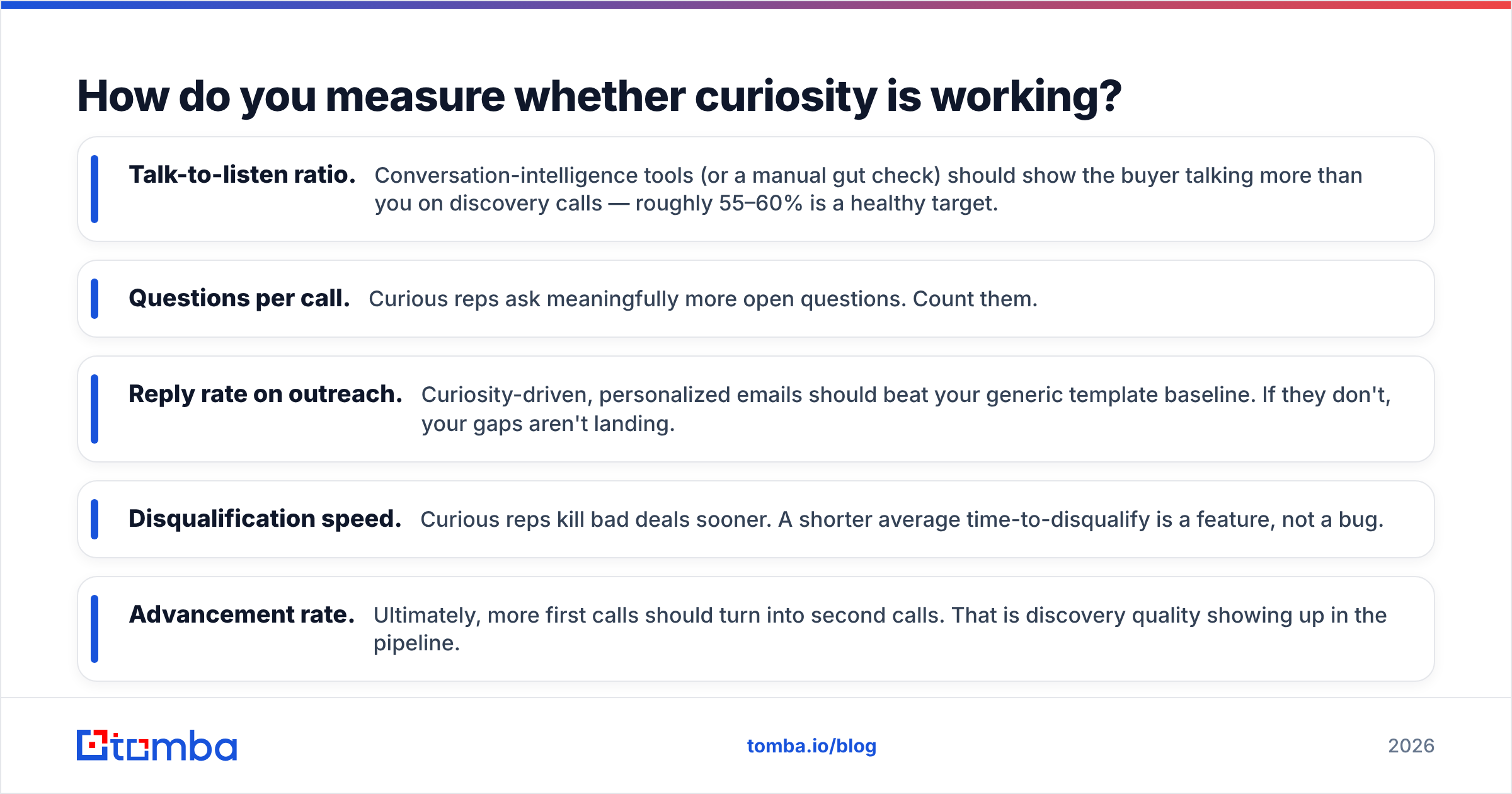
You cannot manage what you do not track. A few practical signals that your curiosity is paying off:
- Talk-to-listen ratio. Conversation-intelligence tools (or a manual gut check) should show the buyer talking more than you on discovery calls — roughly 55–60% is a healthy target.
- Questions per call. Curious reps ask meaningfully more open questions. Count them.
- Reply rate on outreach. Curiosity-driven, personalized emails should beat your generic template baseline. If they don't, your gaps aren't landing.
- Disqualification speed. Curious reps kill bad deals sooner. A shorter average time-to-disqualify is a feature, not a bug.
- Advancement rate. Ultimately, more first calls should turn into second calls. That is discovery quality showing up in the pipeline.
You can validate a tool's or a tactic's reputation the same way buyers validate you — with third-party proof. Reviews on G2 are one honest place to see whether the outreach tools you rely on actually hold up.
Curiosity in sales: the core habits at a glance#
To make this stick, here is the whole discipline compressed into the behaviors that matter most:
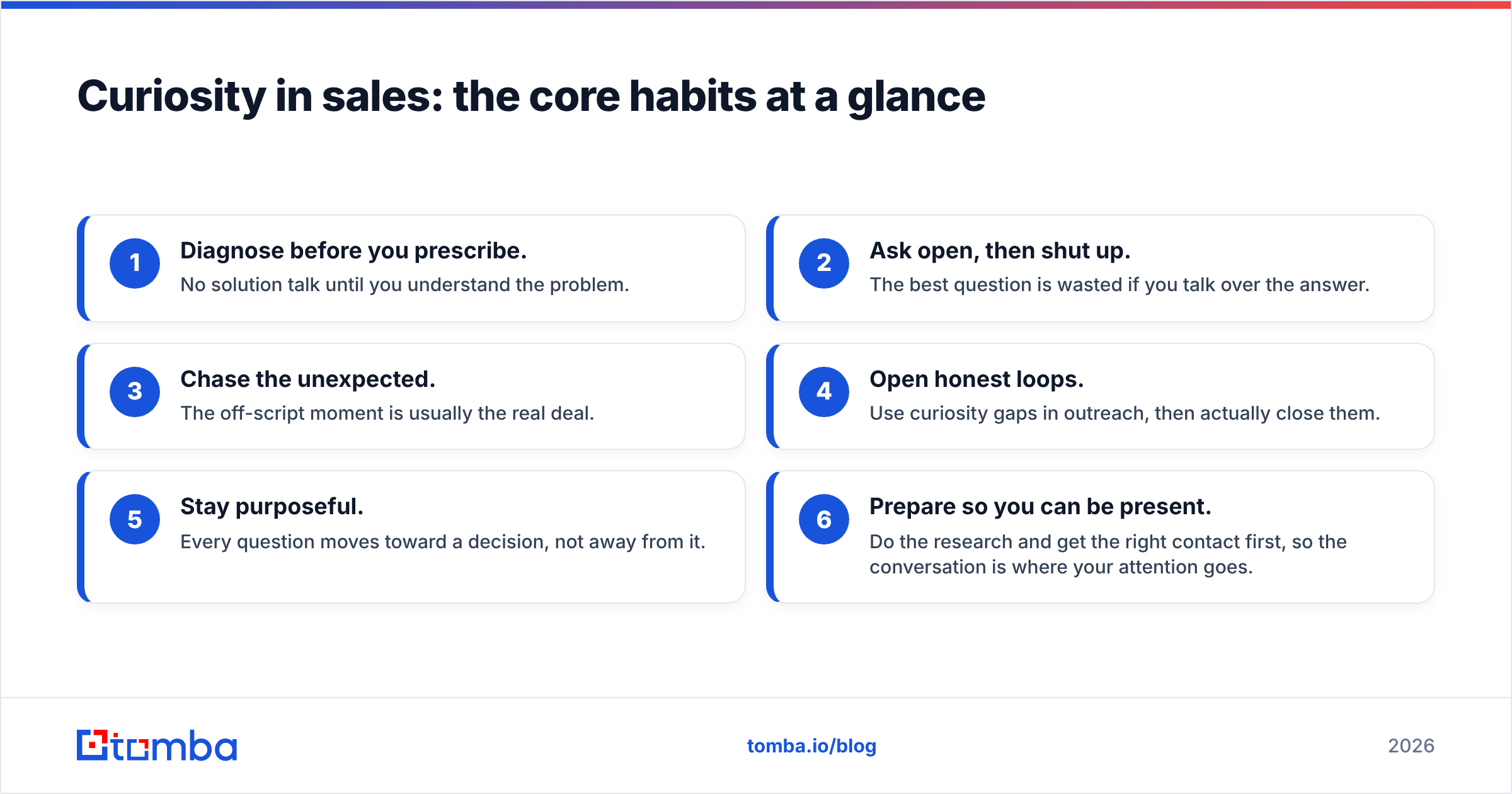
- Diagnose before you prescribe. No solution talk until you understand the problem.
- Ask open, then shut up. The best question is wasted if you talk over the answer.
- Chase the unexpected. The off-script moment is usually the real deal.
- Open honest loops. Use curiosity gaps in outreach, then actually close them.
- Stay purposeful. Every question moves toward a decision, not away from it.
- Prepare so you can be present. Do the research and get the right contact first, so the conversation is where your attention goes.
Curiosity is not a trick you deploy in the last five minutes of a call. It is a posture you bring to the entire cycle — from the first email to the signed contract.
Where does the right data fit into all of this?#
Curiosity only pays off if you are pointed at the right person. All the sharp questions in the world are useless if your email bounces or you are talking to someone with no authority. That is the unglamorous foundation under every curious conversation: accurate, reachable contacts.
If you want to spend your time being curious instead of guessing email formats and cleaning bad lists, start with the Tomba Email Finder. Find the right decision-maker by name, company, or domain, verify the address before you send, and put your energy where it actually wins deals — the conversation. Curiosity is the skill. Good data is what lets you use it. Check the Tomba pricing plans, start on the free tier, and let your questions do the selling.
Related guides#
Ready to find emails that actually work?
Join 150,000+ professionals who stopped guessing and started sending. Free credits on signup — no credit card required.
Get the Tomba newsletter
Practical outbound tactics and product updates — once every two weeks.
About the author