Ditlead vs Seamless.AI in 2026: Which One Should You Buy?
Ditlead sends the emails. Seamless.AI finds the contacts. Comparing them head-to-head only works if you know which job you're actually hiring for — here's the honest breakdown, plus what each one really costs.
TL;DR
- Ditlead and Seamless.AI are not really competitors. Ditlead is a multichannel outreach and sequencing platform; Seamless.AI is a B2B contact database with an AI-powered search layer. One sends, the other supplies.
- If you already have a list and need to run sequences across email, LinkedIn and calls, Ditlead is the relevant tool. If you have reps who need net-new contacts daily, Seamless.AI is the relevant tool.
- Pricing transparency is the sharpest difference: Ditlead publishes self-serve tiers on its site, Seamless.AI runs a sales-led motion with quotes and — per a large volume of public reviews — annual commitments that catch buyers off guard.
- Data quality is where most Seamless.AI complaints land. Unlimited-feeling credit pools mean nothing if a third of the addresses bounce, so verification is non-optional either way.
- The setup most mid-market teams land on: a dedicated data source for accurate contacts, a verifier before send, and a sequencer for delivery. That is usually cheaper and more accurate than buying either platform's "all-in-one" story.
What are Ditlead and Seamless.AI, actually?#
They solve different halves of the same problem, and comparing them as substitutes is how teams end up paying twice.
Ditlead is a sales engagement platform. Its core value is sequencing: you load contacts, build multi-step campaigns that mix cold email, LinkedIn touches and calls, rotate multiple sending inboxes, and manage every reply from a shared unibox. It ships warmup, deliverability controls, a lightweight CRM view of your pipeline, and reporting on reply and booking rates. It is the machine that pushes messages out and catches what comes back.
Seamless.AI is a data platform. Its core value is discovery: you search for companies and job titles, and the product returns contact records — emails, direct dials, mobile numbers — assembled in real time from web sources rather than served from a static file. There's a Chrome extension for prospecting on LinkedIn and company sites, plus writer and intent add-ons. It is the machine that tells you who to contact.
The overlap is thin. Seamless.AI has bolted on light outreach features; Ditlead lets you import lists and enrich in places. Neither substitutes for the other at any serious volume. So the real question is not "which is better" — it's "which gap am I filling, and what's the honest price of filling it?"
How do Ditlead and Seamless.AI compare head-to-head?#
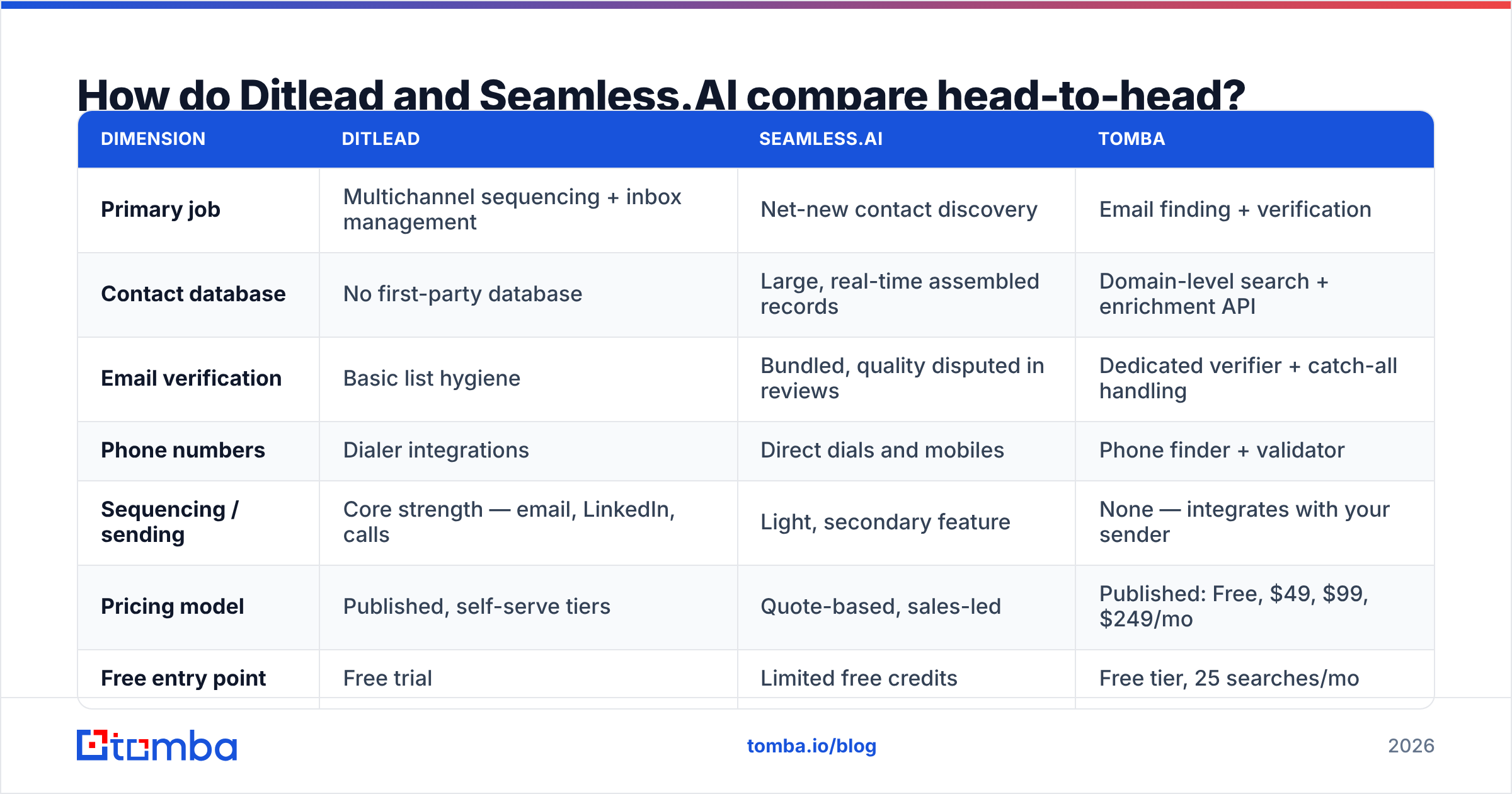
| Dimension | Ditlead | Seamless.AI | Tomba |
|---|---|---|---|
| Primary job | Multichannel sequencing + inbox management | Net-new contact discovery | Email finding + verification |
| Contact database | No first-party database | Large, real-time assembled records | Domain-level search + enrichment API |
| Email verification | Basic list hygiene | Bundled, quality disputed in reviews | Dedicated verifier + catch-all handling |
| Phone numbers | Dialer integrations | Direct dials and mobiles | Phone finder + validator |
| Sequencing / sending | Core strength — email, LinkedIn, calls | Light, secondary feature | None — integrates with your sender |
| Pricing model | Published, self-serve tiers | Quote-based, sales-led | Published: Free, $49, $99, $249/mo |
| Free entry point | Free trial | Limited free credits | Free tier, 25 searches/mo |
| Contract | Monthly available | Annual commitment common per reviews | Monthly, cancel anytime |
| API access | Yes | Enterprise-tier | Yes, on all paid plans |
| Best for | Teams with a list who need to send | Reps who burn through contacts daily | Precise, verified contacts at low cost |
Read that table as three jobs, not three products. Most outbound stacks need at least two of these columns filled, and the mistake is assuming one vendor fills all three well.
What does each one actually cost?#
Ditlead's advantage here is simple: the number is on the website. You can open the pricing page, see the tier, and start on a monthly plan without a call. For a two-person team testing whether outbound works at all, that difference is worth more than any feature bullet. Check the current tiers directly — sequencing platforms reprice often, and per-inbox versus per-seat billing changes the math a lot once you're rotating eight or ten sending accounts.
Seamless.AI does not publish standard pricing. You book a demo, you get a quote, and the quote is typically per-seat and annual. Public reviews on G2 and Capterra include a recurring theme worth knowing before you sign: buyers report auto-renewal terms and difficulty downgrading mid-term. That's not a reason to avoid the product — plenty of teams get real value from it — but it is a reason to read the contract line about renewal notice periods before your procurement team does it for you.

Three cost traps show up repeatedly in this category:
- Per-seat pricing on a data tool. If four reps each need the same 5,000 contacts, you pay four times for one dataset. Credit-pooled or API-based pricing avoids this entirely.
- "Unlimited" credits with fair-use throttles. Unlimited rarely means unlimited. Read the acceptable-use clause and the daily export cap.
- Verification billed separately. If contacts arrive unverified, you pay again to clean them — and you pay a third time in domain reputation when the bad ones bounce.
- Inbox-based sequencer billing. Sequencers that charge per connected mailbox get expensive fast when deliverability best practice pushes you toward many low-volume inboxes.
For reference on the transparent end of the market: Tomba pricing runs Free (25 searches/month), Starter at $49/mo, Growth at $99/mo, and Pro at $249/mo, monthly, no call required. That's not a claim that Tomba replaces a sequencer — it doesn't — but it sets a benchmark for what the data half of your stack should cost.
Is Seamless.AI's data accurate enough to send on?#
Sometimes, and you should verify anyway.
Seamless.AI's model is real-time assembly: instead of serving a record from a warehouse that was refreshed last quarter, it searches and constructs the contact when you ask. In theory that's fresher. In practice it means confidence varies wildly by record, and the platform's own confidence indicators are the thing you need to pay attention to. Reviews consistently report a wide accuracy band — excellent for well-documented enterprise contacts, noticeably weaker for SMBs, non-US markets, and recently changed roles.
Here is the part that costs money quietly. A 20% bounce rate on a 2,000-contact campaign is 400 hard bounces. Mailbox providers read that as a sender who doesn't know their list, and your domain reputation absorbs the damage across every campaign that follows — including the ones with a clean list. Bad data doesn't just waste the credits you spent on it; it taxes everything you send for weeks afterward.
So whichever data source you buy, run the list through an email verifier before the first send. That means SMTP-level checks, syntax and MX validation, role-account flagging, and — the one most tools handle badly — catch-all verification. Catch-all domains accept every address at the gateway, so a naive verifier marks them "valid" and you learn the truth from your bounce report. Treating catch-alls as a separate risk tier, rather than folding them into "valid", is the single highest-leverage list-hygiene habit in cold outbound.
A practical target: get to under 2% bounce before you scale volume. If your source can't deliver that after verification, the source is the problem, not the copy.
Where does Ditlead fall short?#
Two places, both structural rather than fixable with a feature request.
It has no data of its own. Ditlead assumes you arrive with contacts. If your bottleneck is "we don't know who to email", Ditlead does not solve it — you'll still need a discovery layer, whether that's a database subscription, an email finder hitting your target domains, or a scraping workflow feeding it. Buying a sequencer to fix a data problem is the most common wasted purchase in outbound.
It competes in a crowded, mature category. Instantly, Smartlead, Lemlist, Saleshandy and a dozen others do multichannel sequencing well. Ditlead's pitch is breadth-for-price — email plus LinkedIn plus calls plus CRM in one subscription. That's genuinely attractive for a small team consolidating tools, but each individual module is competing against a specialist. If LinkedIn automation is 80% of your motion, a LinkedIn-first tool will out-execute it. If deliverability engineering is your obsession, a deliverability-first sender will give you more knobs.
The honest read: Ditlead is a strong consolidation play for teams under about ten reps who want one bill and one interface. Above that, specialists usually win on depth.
Which one should you pick for your team?#
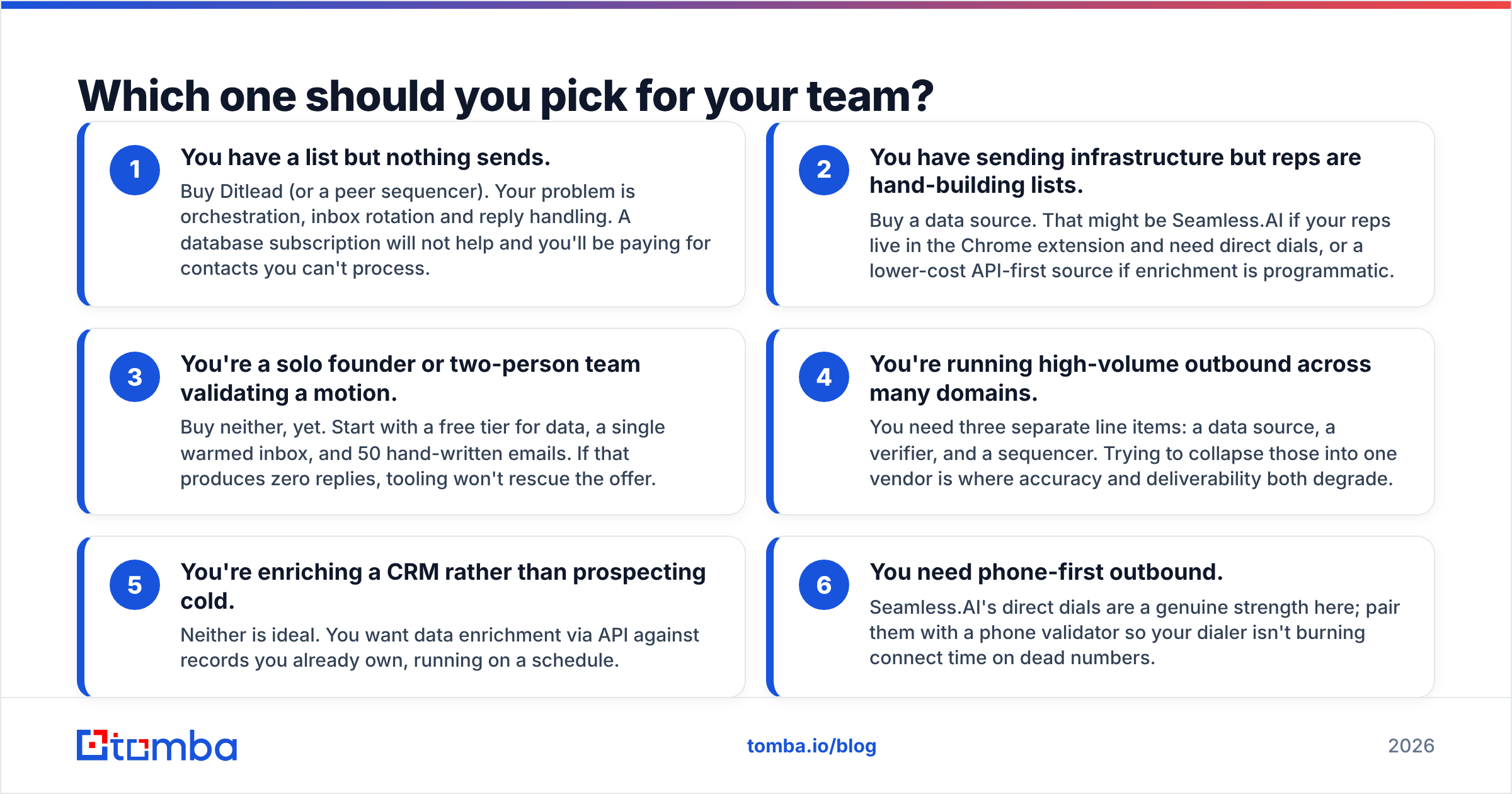
Match the tool to the actual bottleneck. Diagnose before you buy.
- You have a list but nothing sends. Buy Ditlead (or a peer sequencer). Your problem is orchestration, inbox rotation and reply handling. A database subscription will not help and you'll be paying for contacts you can't process.
- You have sending infrastructure but reps are hand-building lists. Buy a data source. That might be Seamless.AI if your reps live in the Chrome extension and need direct dials, or a lower-cost API-first source if enrichment is programmatic.
- You're a solo founder or two-person team validating a motion. Buy neither, yet. Start with a free tier for data, a single warmed inbox, and 50 hand-written emails. If that produces zero replies, tooling won't rescue the offer.
- You're running high-volume outbound across many domains. You need three separate line items: a data source, a verifier, and a sequencer. Trying to collapse those into one vendor is where accuracy and deliverability both degrade.
- You're enriching a CRM rather than prospecting cold. Neither is ideal. You want data enrichment via API against records you already own, running on a schedule.
- You need phone-first outbound. Seamless.AI's direct dials are a genuine strength here; pair them with a phone validator so your dialer isn't burning connect time on dead numbers.
Can you skip both and build a cheaper stack?#
Frequently, yes — and it's worth pricing before you sign anything annual.
Think of it like buying a car versus buying a car plus the fuel plus the insurance from the same dealer at their bundled rate. Bundles are convenient. They're rarely the cheapest, and they're never the best at every component.
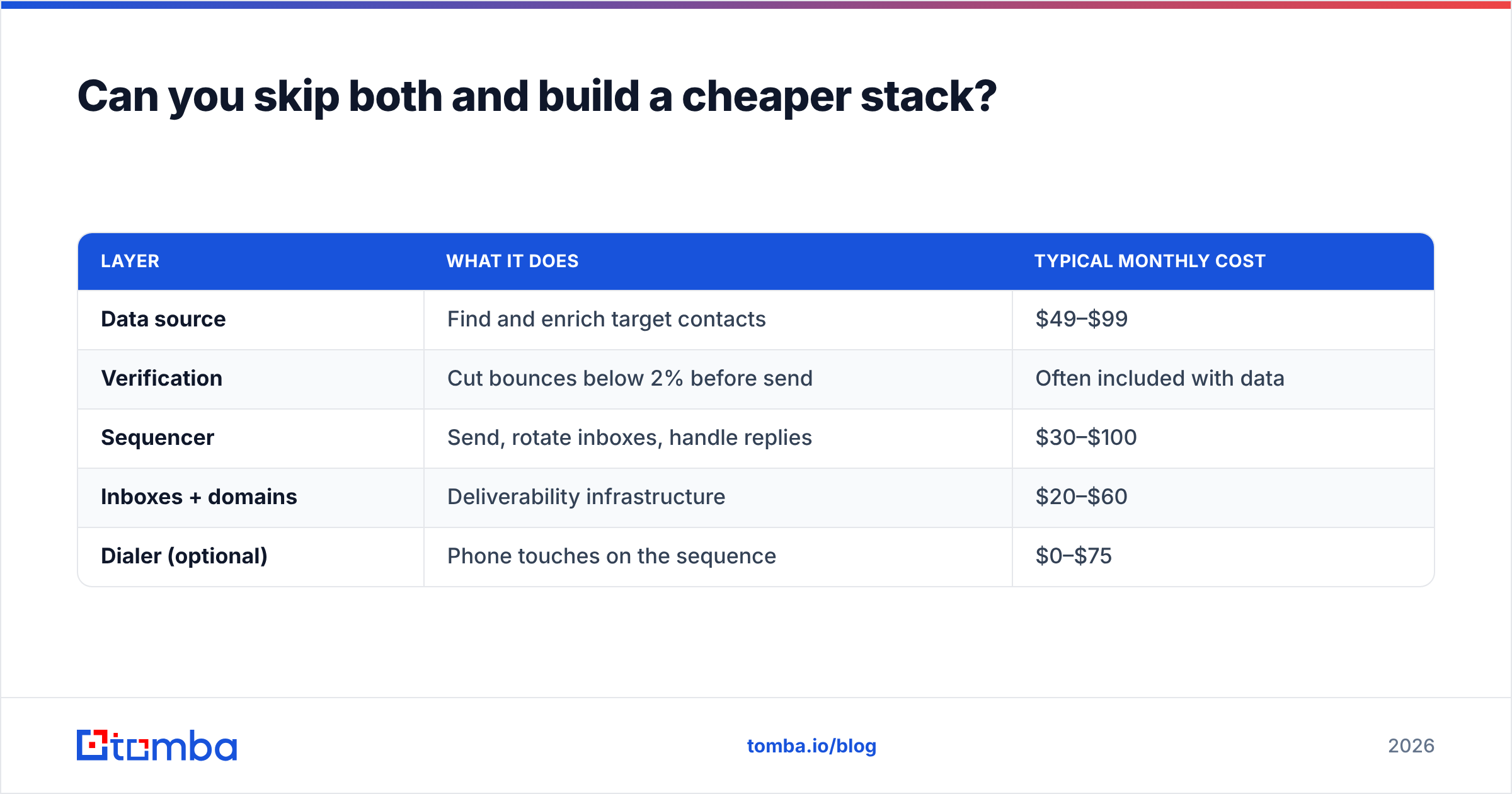
The unbundled version looks like this:
| Layer | What it does | Typical monthly cost |
|---|---|---|
| Data source | Find and enrich target contacts | $49–$99 |
| Verification | Cut bounces below 2% before send | Often included with data |
| Sequencer | Send, rotate inboxes, handle replies | $30–$100 |
| Inboxes + domains | Deliverability infrastructure | $20–$60 |
| Dialer (optional) | Phone touches on the sequence | $0–$75 |
That's a functioning outbound stack in the $100–$300/month range for a small team, on monthly terms, with each layer swappable when it underperforms. Compare that against a single quote-based annual contract and the difference is usually not close — plus you keep the option to fire one component without renegotiating everything.
The practical build: pull contacts by target company using domain search, verify in bulk, push into whichever sequencer you prefer, and automate the whole loop through the Tomba API or a no-code connector so nobody is exporting CSVs by hand at 6pm on a Friday.
What's the final verdict on Ditlead vs Seamless.AI?#
Ditlead wins on pricing transparency, monthly flexibility, and being the right shape of tool if your problem is execution. Seamless.AI wins on raw discovery volume and direct dials if your problem is not knowing who to call — with the caveat that you should budget verification time and read the renewal terms carefully.
Neither is a complete outbound stack. Ditlead without data is an empty machine. Seamless.AI without verification and a real sequencer is a list you can't safely send to. The teams that get outbound working treat data, verification and delivery as three distinct purchases and hold each to its own standard.
Start by fixing the layer that's actually broken. If your reply rates are fine but your list is thin, fix data first. If your list is fine but nothing goes out on schedule, fix sending first. And if you don't know which it is, run 200 verified contacts through a manual sequence for two weeks — the data will tell you where the leak is faster than any demo call.
Ready to fix the data layer without an annual contract? Tomba's Email Finder returns verified professional emails by domain, name or company, with confidence scoring and catch-all handling built in — free for your first 25 searches, $49/mo when you're ready to scale, and cancellable any month. Plug it into whichever sequencer you're already paying for and see what a sub-2% bounce rate does to your reply numbers.
Related guides#
Ready to find emails that actually work?
Join 150,000+ professionals who stopped guessing and started sending. Free credits on signup — no credit card required.
Get the Tomba newsletter
Practical outbound tactics and product updates — once every two weeks.
About the author