Findymail vs Harmonic (2026): Which B2B Data Tool Wins?
Findymail finds verified emails. Harmonic tracks startup growth signals. They solve different halves of the same problem — here's which one your pipeline actually needs, with pricing, coverage, and a hybrid setup.
TL;DR
- Findymail and Harmonic are not really competitors. Findymail is a contact-data tool (find and verify B2B emails). Harmonic is a company-intelligence platform (track startups, headcount growth, funding, and founder signals).
- Pick Findymail if your bottleneck is "I know who to email but not their address." Pick Harmonic if your bottleneck is "I don't know which companies are worth emailing yet."
- Harmonic is priced for VC and corp-dev teams — expect four-to-five figures a year with sales-led quoting. Findymail starts around $49/mo for a few thousand credits.
- Most outbound teams end up needing both halves. The cheapest version of that stack is a signal source plus a dedicated finder/verifier rather than one platform that half-does both.
- If you only have budget for one line item and you're doing volume outbound, buy the email layer first. Signals without deliverable addresses produce nothing.
What are Findymail and Harmonic, actually?#
Two very different products get compared because they both show up in the same "B2B data stack" conversation.
Findymail is a lead-finding tool built around one promise: emails that don't bounce. It sells credits, exposes an API, integrates with LinkedIn and Sales Navigator via a Chrome extension, and includes verification in the same credit spend. Its whole pitch is bounce-rate protection — you get charged for verified results rather than for guesses.
Harmonic is a company and people intelligence database aimed at investors, corp dev, and enterprise GTM teams. It ingests startup signals — funding rounds, headcount changes by department, founder job changes, website and app activity, GitHub and social traction — and lets you build saved searches that alert you when a company crosses a threshold. Contact data exists in Harmonic, but it's a supporting feature, not the product.
So the honest framing of findymail vs harmonic is: one answers how do I reach this person, the other answers which companies should I care about this quarter.

How do Findymail and Harmonic compare head to head?#
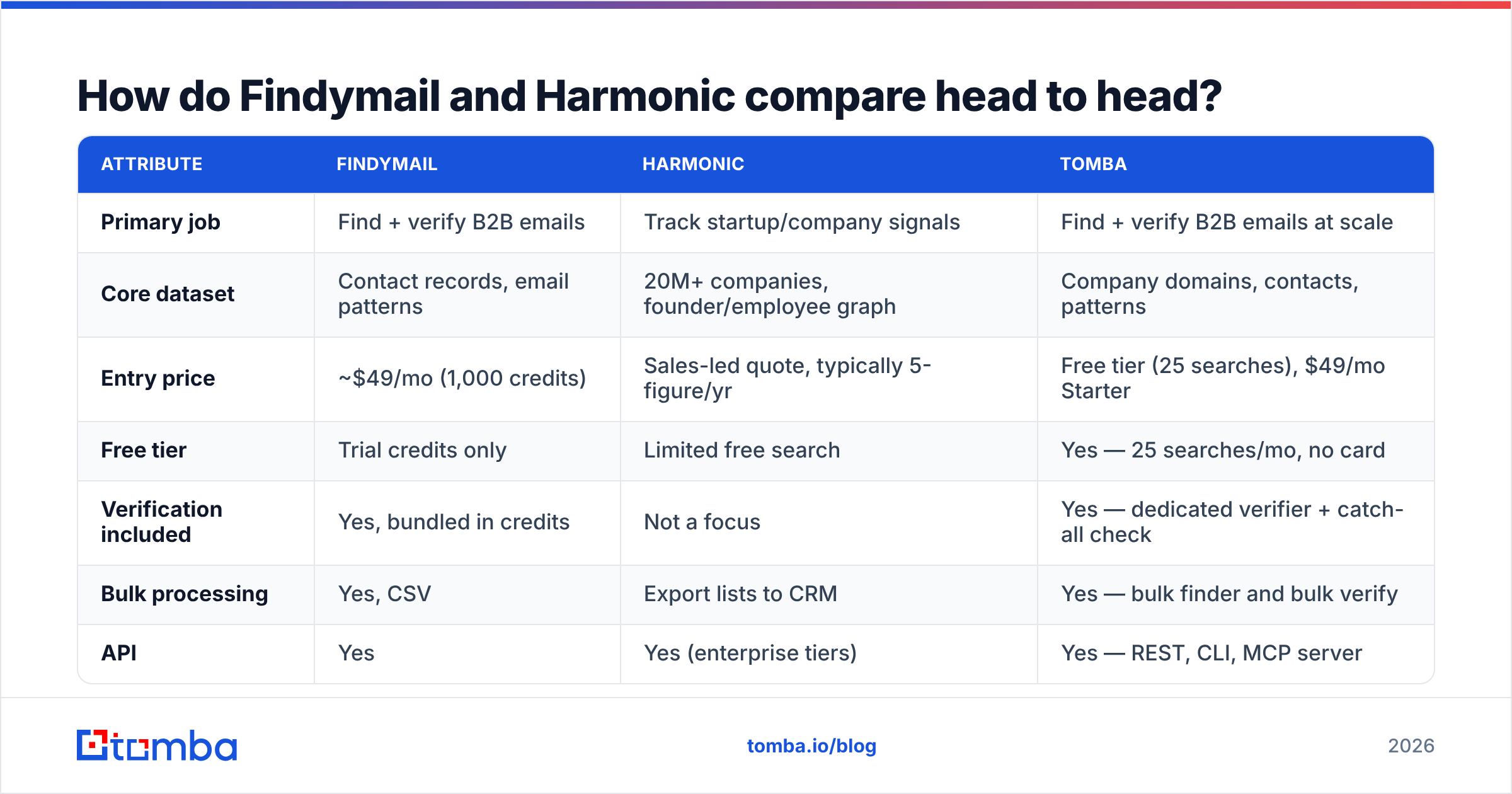
Here's the practical comparison, with Tomba included as a third reference point because it overlaps Findymail's job directly.
| Attribute | Findymail | Harmonic | Tomba |
|---|---|---|---|
| Primary job | Find + verify B2B emails | Track startup/company signals | Find + verify B2B emails at scale |
| Core dataset | Contact records, email patterns | 20M+ companies, founder/employee graph | Company domains, contacts, patterns |
| Entry price | ~$49/mo (1,000 credits) | Sales-led quote, typically 5-figure/yr | Free tier (25 searches), $49/mo Starter |
| Free tier | Trial credits only | Limited free search | Yes — 25 searches/mo, no card |
| Verification included | Yes, bundled in credits | Not a focus | Yes — dedicated verifier + catch-all check |
| Bulk processing | Yes, CSV | Export lists to CRM | Yes — bulk finder and bulk verify |
| API | Yes | Yes (enterprise tiers) | Yes — REST, CLI, MCP server |
| Intent/growth signals | No | Yes — headcount, funding, hiring, traction | No (enrichment only) |
| Best fit | SDRs, agencies, founders | VCs, corp dev, ABM teams targeting startups | Outbound teams needing volume + accuracy |
| Phone numbers | Limited | Limited | Yes — dedicated phone finder |
The table makes the split obvious. There are exactly two rows where they genuinely collide: contact records and API access. Everywhere else, they're solving different problems with different data.
Which one fits your workflow?#
Work backward from the failure you keep hitting.
- Your emails bounce above 4%. That's a data-quality problem, not a targeting problem. You need a finder with verification baked in — Findymail, Tomba, or a comparable tool. Harmonic will not fix a bounce rate.
- Your lists are technically valid but nobody replies. That's a targeting problem. You're emailing companies with no reason to buy right now. Harmonic's signal filters (Series A raised in the last 90 days, engineering headcount up 30%, new VP of Sales) are exactly this.
- You're an agency running outbound for 12 clients. Volume and per-lead cost dominate. Signal platforms priced for venture funds will destroy your margin. Go credit-based.
- You're a fund or corp-dev team sourcing deals. Harmonic is built for you and Findymail isn't. Contact data is the last mile, not the product.
- You sell exclusively into startups under 200 employees. This is the one case where Harmonic's coverage advantage is real — its startup graph is deeper than generic B2B databases that skew toward mid-market and enterprise.
- You need both, on a normal budget. Use a cheaper signal source (job boards, funding newsletters, LinkedIn saved searches) plus a proper email finder, and revisit Harmonic when your ACV justifies it.
Is Harmonic worth the price for a normal sales team?#
Usually not — and that's not a knock on the product.
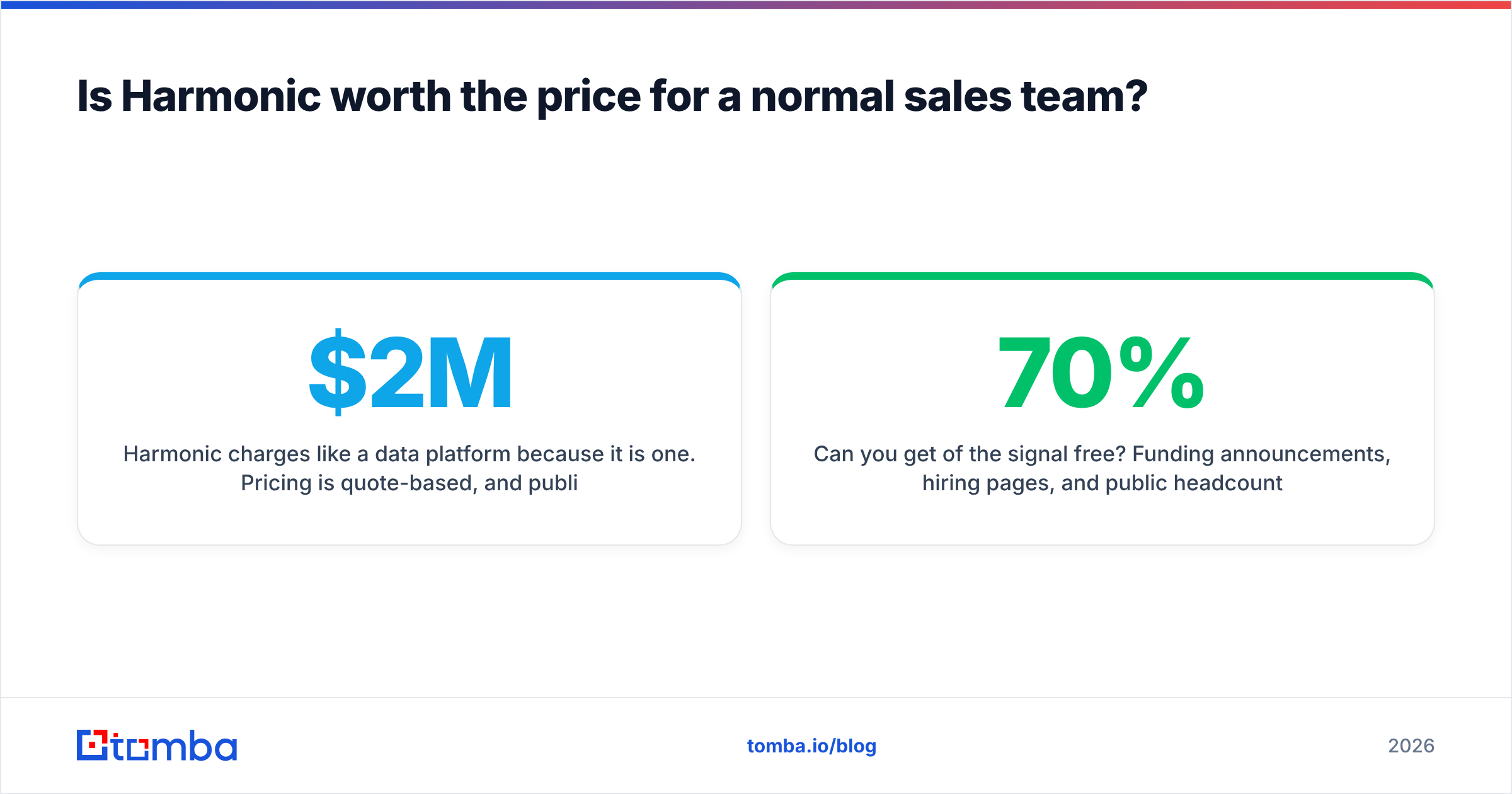
Harmonic charges like a data platform because it is one. Pricing is quote-based, and public reports from users on G2 put annual contracts well into five figures for teams with meaningful seat counts. For a fund evaluating a $2M check, that cost is a rounding error against one avoided mistake. For an SDR team with a $12K ACV, it's a large share of the tooling budget spent on the research half of the funnel while the execution half runs on whatever finder was cheapest.
Ask two questions before committing:
- Does a signal actually change what you do? If your team emails the same ICP list regardless of funding events, you're buying data you won't act on.
- Can you get 70% of the signal free? Funding announcements, hiring pages, and public headcount trends are largely open information. Harmonic's value is aggregation and alerting, not exclusivity. If one analyst can maintain a tracked list manually, start there.
Harmonic earns its price when speed matters — being the first to reach a founder 48 hours after a round closes is a real edge. If your sales cycle doesn't reward that speed, the ROI math gets thin.
Is Findymail accurate enough to run outbound on?#
Findymail's core claim — low bounce rates because unverifiable results aren't billed — holds up reasonably well in practice for standard corporate domains. Where any finder struggles is the same everywhere:
- Catch-all domains, which accept all mail at SMTP and tell you nothing. This is where tools diverge most. A dedicated catch-all verifier that scores confidence beats a binary "unknown" flag.
- Small companies on Google Workspace with no public footprint, where pattern inference has nothing to infer from.
- Regions outside North America and Western Europe, where source coverage thins out for nearly every vendor.
Treat any published accuracy percentage — Findymail's, Tomba's, or anyone's — as a claim to test on your own ICP, not a spec. Run 200 names from your actual target list through each tool's free tier, push the results through a neutral email verifier, and compare hit rate and bounce rate. That test costs an afternoon and beats every comparison post, including this one.

What does the combined stack actually cost?#
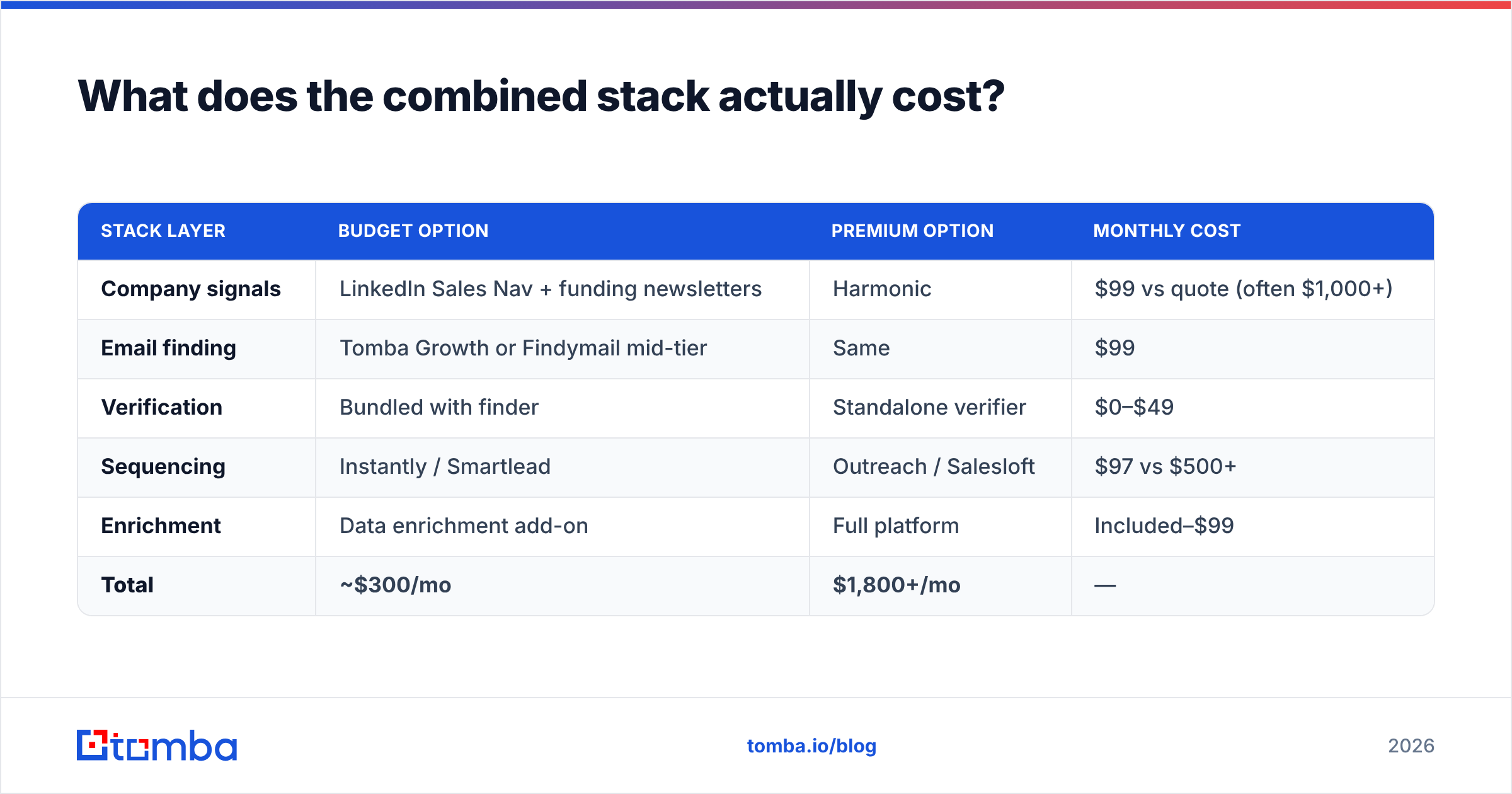
Here's a realistic monthly build for a 3-person outbound team doing ~4,000 contacts a month.
| Stack layer | Budget option | Premium option | Monthly cost |
|---|---|---|---|
| Company signals | LinkedIn Sales Nav + funding newsletters | Harmonic | $99 vs quote (often $1,000+) |
| Email finding | Tomba Growth or Findymail mid-tier | Same | $99 |
| Verification | Bundled with finder | Standalone verifier | $0–$49 |
| Sequencing | Instantly / Smartlead | Outreach / Salesloft | $97 vs $500+ |
| Enrichment | Data enrichment add-on | Full platform | Included–$99 |
| Total | ~$300/mo | $1,800+/mo | — |
The budget stack does about 80% of what the premium stack does for roughly a sixth of the cost. The 20% gap is real-time signal freshness and a deeper private-company graph. Whether that gap is worth $1,500/month depends entirely on your deal size.
A note on the other players: teams comparing these two often also look at BookYourData for pre-built verified lists, which is a legitimately different buying motion — you're purchasing a finished dataset rather than running lookups. If your team lacks the process to run enrichment workflows, a ready-made list can be the faster path to first meetings.
How do you evaluate either tool without wasting a month?#
Run a structured 10-day bake-off.
- Days 1–2: Build the control list. Pull 250 real target accounts with named contacts. Not a random sample — your actual ICP, including the hard segments (small companies, non-US domains, catch-all-heavy industries like agencies and consultancies).
- Days 3–5: Run every tool on the same list. Record hit rate (found / attempted), verification confidence, and cost per found contact. Use free tiers where available — Tomba's free tier gives 25 searches, enough for a smoke test before you commit budget.
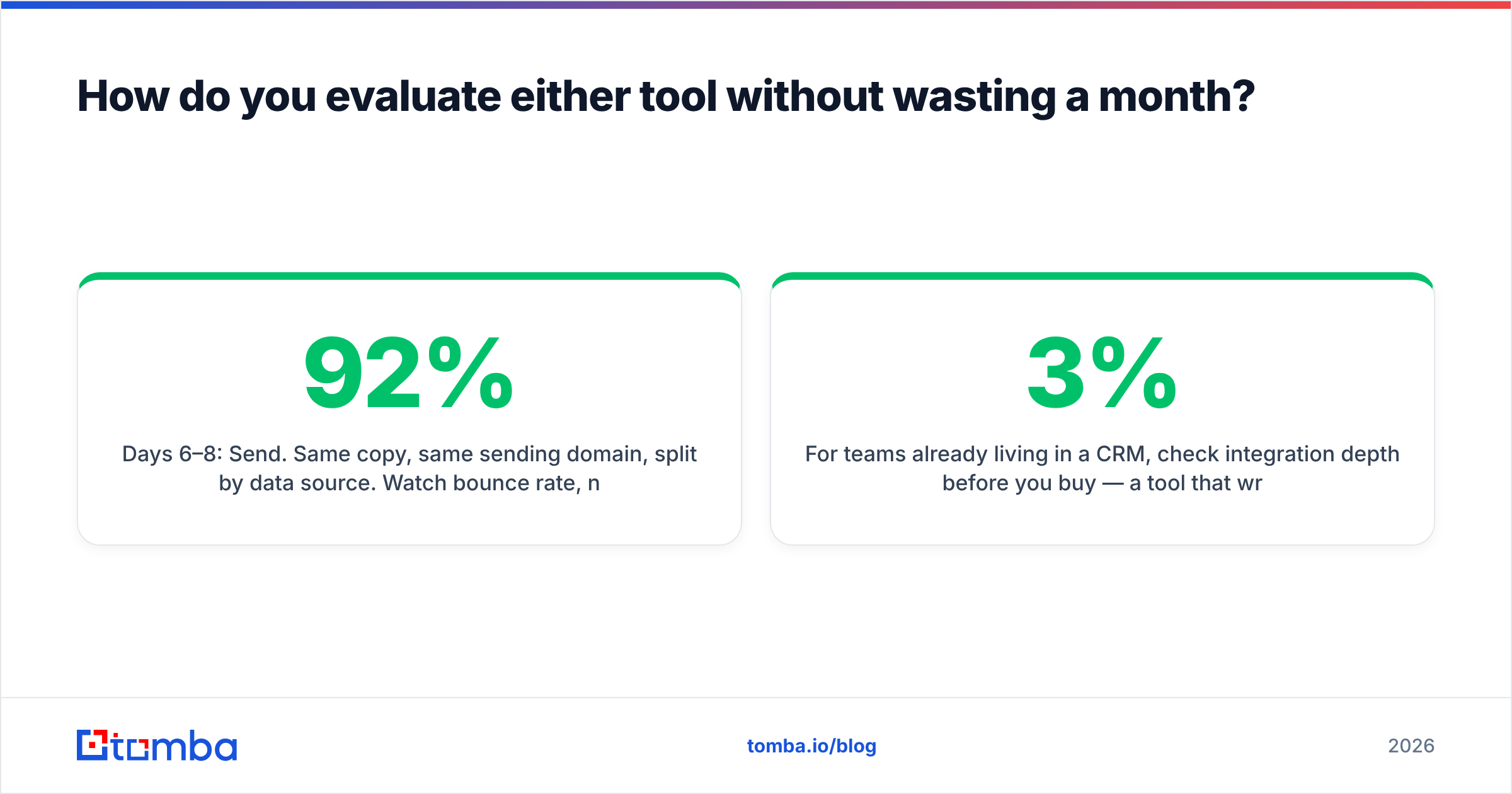
- Days 6–8: Send. Same copy, same sending domain, split by data source. Watch bounce rate, not just hit rate. A tool with a 92% hit rate and 6% bounces is worse than one with 78% and 0.8%.
- Days 9–10: Price it out. Divide total spend by delivered contacts, not credits consumed. That single number ends most vendor debates.
If you're testing signal platforms in parallel, add one more metric: acted-on alerts. Count how many Harmonic notifications actually triggered an email your team wouldn't otherwise have sent. If that number is under 10 a month, you don't have a signal problem.
For teams already living in a CRM, check integration depth before you buy — a tool that writes directly into your HubSpot integration or Salesforce pipeline saves more hours than a 3% accuracy edge. Salesforce's own data management guidance makes the same point: enrichment that requires manual CSV shuttling decays fast.
What's the verdict on Findymail vs Harmonic?#
They're complements, not alternatives — and if you can only fund one, fund the email layer.
- Choose Harmonic if you're an investor, a corp-dev team, or a GTM org whose ACV is high enough that being 48 hours early to a funding event changes revenue. Its startup graph and alerting are genuinely strong, and no email finder replicates them.
- Choose Findymail if you need deliverable addresses without a bounce problem and you're working from lists you already know how to build.
- Choose a broader contact platform if you need finding, verification, catch-all handling, phone numbers, and enrichment under one credit pool rather than three separate line items.
The failure mode we see most often is a team paying premium prices for intelligence while running their actual sends on unverified data. Signals tell you who to talk to. They can't talk to anyone.
Start with the layer that gates everything else. Tomba Email Finder covers the contact half of this stack — find emails by domain, name, or company, verify them before they hit your sequencer, and handle catch-all domains with confidence scoring instead of a shrug. The free tier gives you 25 searches with no card, Starter runs $49/mo, and Growth is $99/mo; full Tomba pricing is public, no sales call required. Run your 250-contact control list through it this week and let the bounce rate decide.
Related guides#
Ready to find emails that actually work?
Join 150,000+ professionals who stopped guessing and started sending. Free credits on signup — no credit card required.
Get the Tomba newsletter
Practical outbound tactics and product updates — once every two weeks.
About the author