FullCircl vs Seamless.AI 2026: Honest Data Comparison
FullCircl sells UK company intelligence and onboarding risk data. Seamless.AI sells US contact records at volume. They solve different problems — and only one of them is likely the tool you actually need.
FullCircl vs Seamless.AI is the comparison most buyers get wrong. One tool maps UK companies and the risk attached to them. The other finds US contacts in bulk. Pick the wrong one and you lose a year to the contract, so here is the short version first.
TL;DR
- FullCircl vs Seamless.AI is not a fair fight. FullCircl is a UK company intelligence and KYB platform. Seamless.AI is a US contact database built for volume.
- FullCircl wins if your buying trigger is a company event — a filing, a director change, a credit shift — and you sell into UK or Irish finance, insurance, or lending.
- Seamless.AI wins if you value raw US contact volume, a Chrome extension, and a big credit allowance over data depth.
- Both are quote-based. Neither publishes pricing, and both usually land as annual contracts. Budget for procurement, not a credit card.
- If all you need is a verified work email, both are heavy. A focused email finder does that one job for $49/mo, with no 12-month lock-in.
What is FullCircl and who is it built for?#
FullCircl is a B2B customer intelligence platform. It came out of the 2021 merger of DueDil (company data) and Artesian Solutions (sales triggers), and it now sits inside IRIS Software Group. Its focus is the UK and Ireland: Companies House filings, credit and risk signals, ownership structures, director networks, and news-based trigger events.
The product splits roughly into two jobs:
- Business Information Graph — a company-level dataset covering UK and Irish registered entities, with financials, group structures, and risk indicators.
- Onboarding / SmartOnboard — KYB (know your business) checks, AML screening, and identity verification workflows for regulated industries.
That second half matters more than most sales-tool comparisons admit. FullCircl's real buyers are often compliance and onboarding teams at banks, insurers, and lenders. They need a clear record that a business was checked before it became a customer. The prospecting layer sits on top of that same graph.
If you are a US SaaS rep trying to book 30 meetings a month, this is not your tool. If you are a commercial insurance broker in Manchester who needs to spot which of your 4,000 target firms just filed accounts showing 40% headcount growth, it very much is. You can read more on the official FullCircl site.
What is Seamless.AI and who is it built for?#
Seamless.AI launched in 2015 and is based in Ohio. It markets itself as a "real-time search engine for B2B sales leads." Instead of serving records from a static warehouse, it crawls and assembles contact data on demand. It then checks that data against its own engine and returns emails, direct dials, and mobile numbers.
The core surfaces are:
- A web app with contact and company search plus filters (title, industry, headcount, revenue, tech stack)
- A Chrome extension that pulls contacts while you browse LinkedIn or a company site
- Bulk list building and CSV export
- Native CRM pushes to Salesforce, HubSpot, and Outreach
- Add-on modules for buyer intent, job-change alerts, and data enrichment
The pitch is volume and speed. For US outbound teams running high-throughput sequences, that pitch lands. The recurring complaint on G2 is not that the data is missing. It is the hit rate — mobile numbers that ring a switchboard, emails that bounce, and contacts who left two roles ago. You can see their own positioning at seamless.ai. That difference in shape is the whole FullCircl vs Seamless.AI story.
FullCircl vs Seamless.AI: how do they compare head-to-head?#
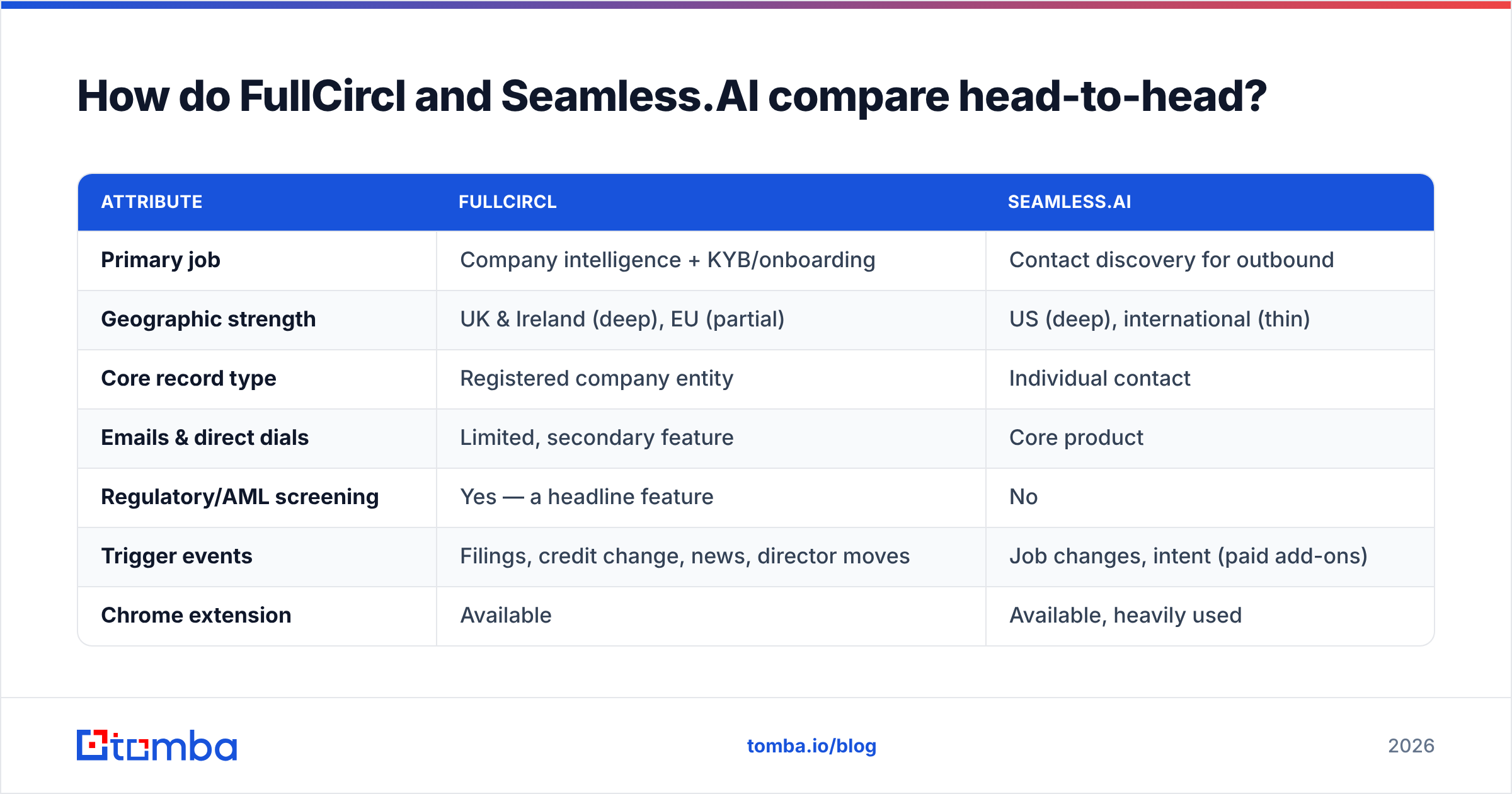
Here is the honest side-by-side. Where a vendor does not publish a number, this table says so rather than inventing one.
| Attribute | FullCircl | Seamless.AI |
|---|---|---|
| Primary job | Company intelligence + KYB/onboarding | Contact discovery for outbound |
| Geographic strength | UK & Ireland (deep), EU (partial) | US (deep), international (thin) |
| Core record type | Registered company entity | Individual contact |
| Emails & direct dials | Limited, secondary feature | Core product |
| Regulatory/AML screening | Yes — a headline feature | No |
| Trigger events | Filings, credit change, news, director moves | Job changes, intent (paid add-ons) |
| Chrome extension | Available | Available, heavily used |
| Free tier | No — demo/trial via sales | Yes, limited credits |
| Published pricing | No — quote only | No — quote only |
| Typical contract | Annual, enterprise | Annual, per-seat |
| Best fit | UK financial services, insurance, lending | US SaaS, staffing, agencies |
| Worst fit | High-volume US SDR outbound | EMEA/APAC prospecting, compliance use |
The table makes the real conclusion obvious. A genuine FullCircl vs Seamless.AI bake-off only happens in one narrow case: a UK-based company moving into the US that has not yet decided whether its data budget should buy account intelligence or contact volume. Everyone else already knows which column they belong in.
FullCircl vs Seamless.AI: which has better data accuracy?#
The answer depends on what you measure. This is where most comparison posts go wrong.
FullCircl's company data is close to authoritative for the UK. Most of it comes from statutory sources: Companies House filings, credit reference agencies, and public registers. Registered address, SIC code, incorporation date, and filed accounts are not estimates. They are public record. FullCircl adds value by stitching those records into group structures and turning changes into alerts. The risk here is mostly lag — how fast a filing reaches your feed — not correctness.
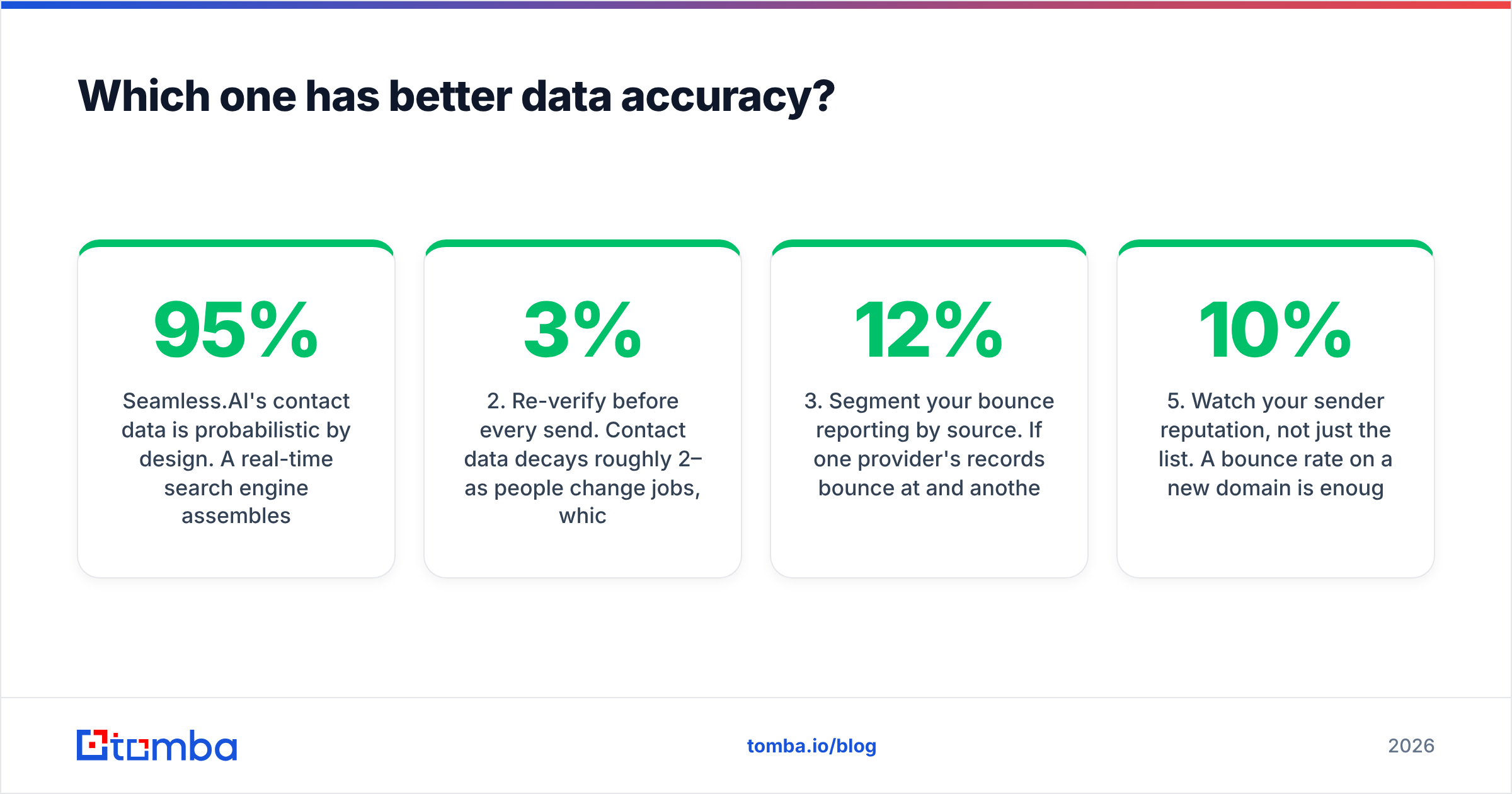
Seamless.AI's contact data is a best guess by design. A real-time search engine builds an email from patterns, crawled sources, and validation signals. That gives you wide coverage and some inevitable misses. Public benchmarks of contact databases show that no vendor holds a steady 95%+ verified rate across every segment. Results swing hard by country, seniority, and company size.
So in FullCircl vs Seamless.AI terms, one tool is accurate about companies and the other is a probability engine about people. Here is what that means if you run outbound:
- Never trust a single source's "verified" label. Vendor-verified and SMTP-verified are different claims.
- Re-verify before every send. Contact data decays roughly 2–3% per month as people change jobs. That compounds fast on a list you built in Q1 and mailed in Q3.
- Segment your bounce reporting by source. If one provider bounces at 12% and another at 3%, you only find out by tagging records on import.
- Treat catch-all domains separately. They pass most syntax checks and still swallow mail. Run them through a dedicated catch-all verifier instead of assuming they are valid.
- Watch your sender reputation, not just the list. A 10% bounce rate on a new domain can depress email deliverability for months.
A cheap habit works with either vendor. Export the list, run it through an independent email verifier, and only then load it into your sequencer. The extra step costs pennies per contact, and it protects the domain you actually send from.
FullCircl vs Seamless.AI pricing: what do they cost in 2026?#
Neither publishes a price list, which is itself the answer.
FullCircl is quoted per use case. Deals are scoped by how many entities you monitor, how many seats you need, and which modules you license — intelligence only, or onboarding and KYB too. Public procurement records and buyer reports put realistic annual spend in the mid five figures for a mid-market financial services team. Enterprise onboarding rollouts run higher. Expect a security review, a data-processing agreement, and a sales cycle measured in months.
Seamless.AI offers a free tier with a small monthly credit allowance, then a sales-led Pro tier priced per seat per year. Credits, not seats, are the lever that bites. Teams often burn their allocation mid-quarter and get quoted an add-on pack. Reviewers also flag auto-renewal terms and trouble downgrading mid-contract, so read the renewal clause before you sign. That is not a knock on the data. It is a knock on the commercial model.
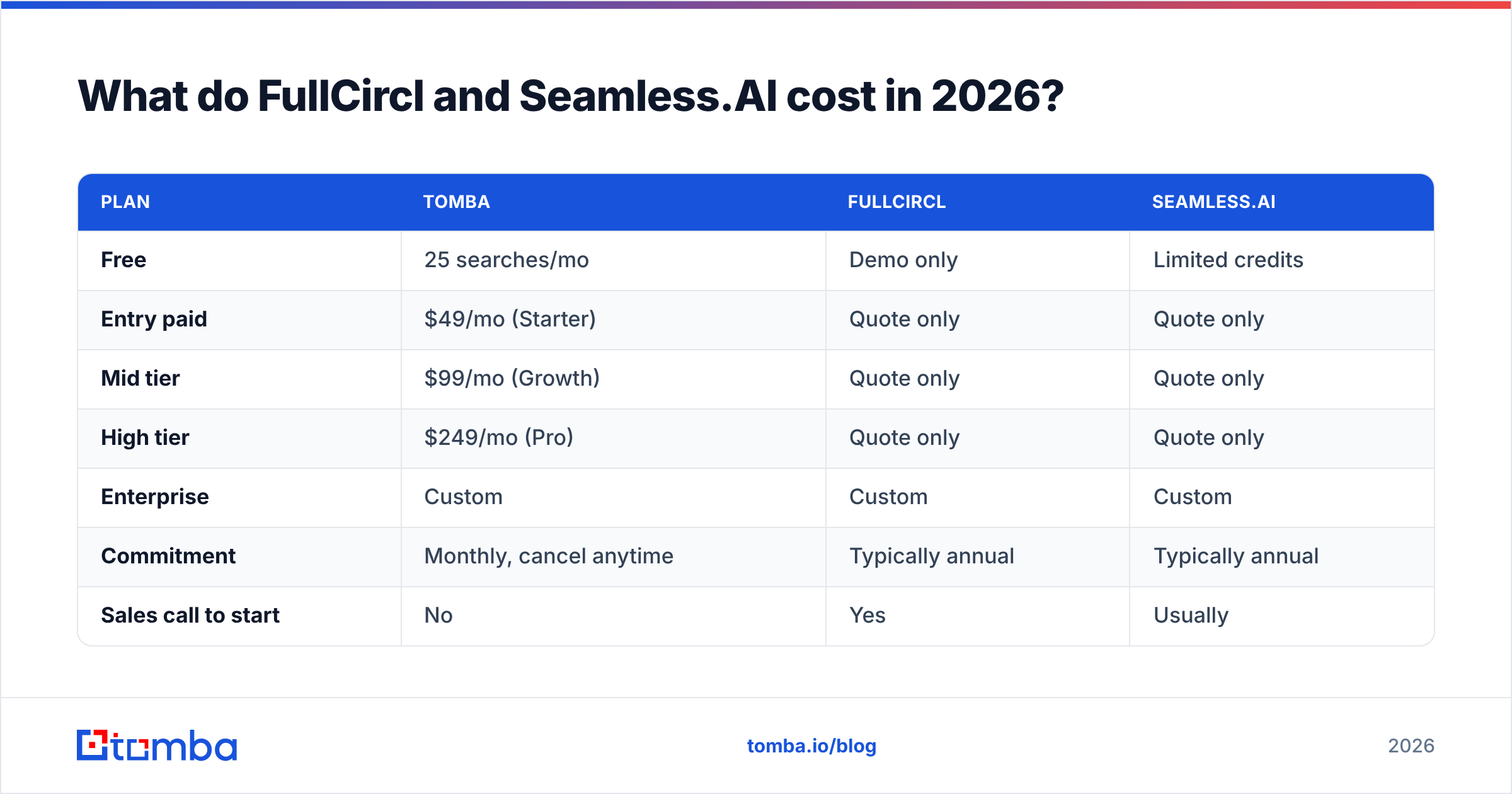
Compare that with a transparent, self-serve alternative:
| Plan | Tomba | FullCircl | Seamless.AI |
|---|---|---|---|
| Free | 25 searches/mo | Demo only | Limited credits |
| Entry paid | $49/mo (Starter) | Quote only | Quote only |
| Mid tier | $99/mo (Growth) | Quote only | Quote only |
| High tier | $249/mo (Pro) | Quote only | Quote only |
| Enterprise | Custom | Custom | Custom |
| Commitment | Monthly, cancel anytime | Typically annual | Typically annual |
| Sales call to start | No | Yes | Usually |
Full Tomba pricing is public for a reason. In any FullCircl vs Seamless.AI evaluation, most teams want to test hit rate on their own ICP before a procurement conversation, not after.

FullCircl vs Seamless.AI: where do both tools fall short?#
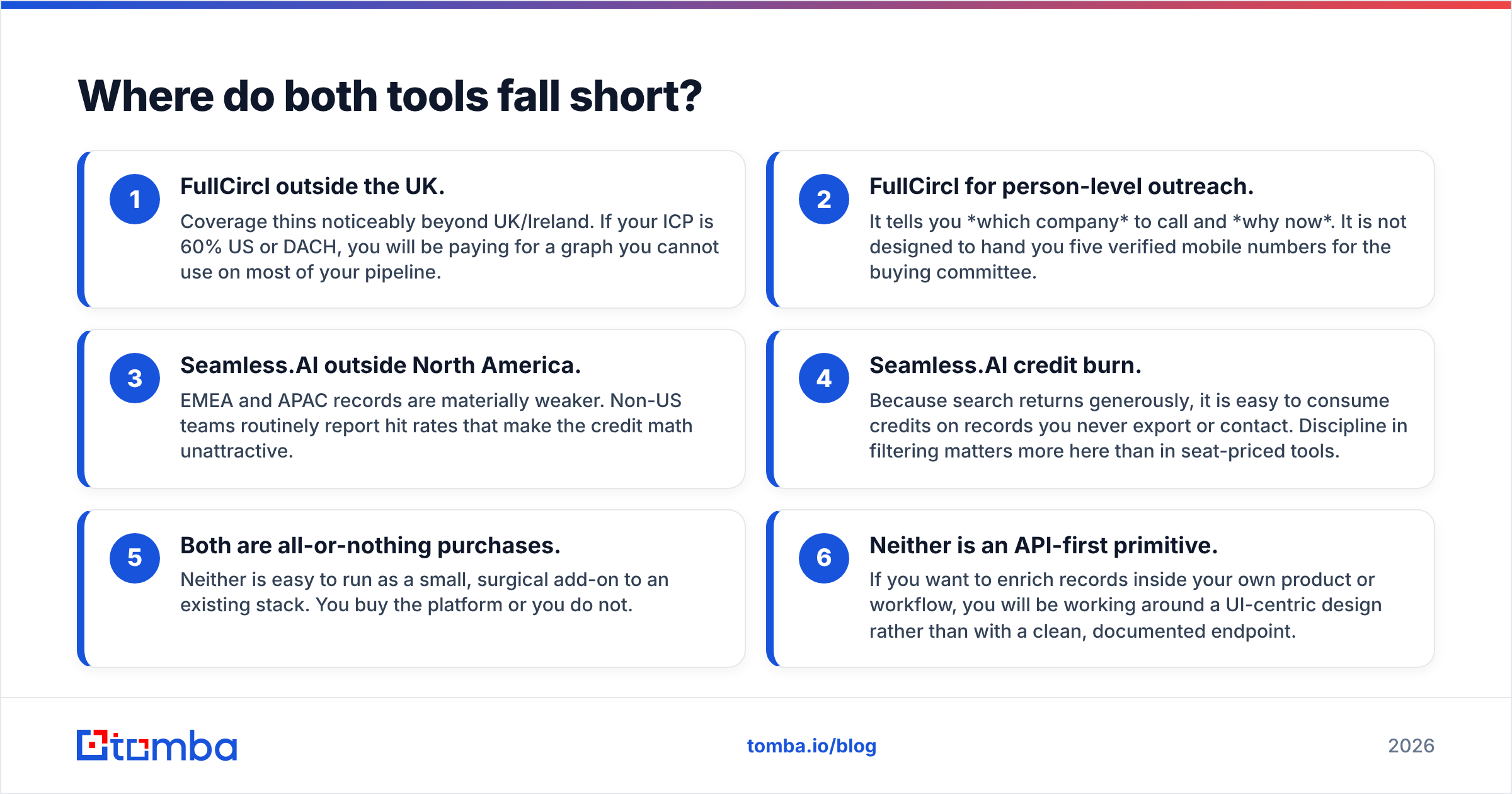
Every platform has a shape, and the shape creates gaps. These are the ones that show up in real deployments:
- FullCircl outside the UK. Coverage thins fast beyond the UK and Ireland. If your ICP is mostly US or DACH, you pay for a graph you cannot use.
- FullCircl for person-level outreach. It tells you which company to call and why now. It will not hand you five verified mobile numbers for the buying committee.
- Seamless.AI outside North America. EMEA and APAC records are much weaker, and the credit math stops working.
- Seamless.AI credit burn. Search returns freely, so credits vanish on records you never export or contact.
- Both are all-or-nothing buys. Neither runs well as a small add-on to an existing stack.
- Neither is API-first. To enrich records inside your own product, you fight a UI-led design instead of using a clean endpoint.
That last gap is where a lot of RevOps teams end up adding a dedicated email finder API alongside — not instead of — their intelligence platform.
Is there a cheaper alternative to both?#
Yes, if you split the two jobs these tools bundle together. Both sides of FullCircl vs Seamless.AI sell one platform for what are really two separate purchases.
Job one: know which accounts to work. That is FullCircl's ground in the UK, and it is hard to copy. Companies House data is free, but the graph, the alerting, and the risk overlay are not. If you need auditable KYB checks, pay for a platform built for them.
Job two: get a correct, deliverable contact for a person at that account. That is a commodity, and paying enterprise rates for it is where budgets leak. A focused stack does it for a fraction:
- Domain search to pull every known email pattern and contact at a target company
- Email finder for first name + last name + domain lookups
- Bulk email finder for list-level work, with verification on the same pass
- Data enrichment to backfill your CRM rather than rebuilding it
Other options depend on your motion. BookYourData works if you would rather buy a pre-built, pay-as-you-go list with a bounce guarantee than run searches yourself. It is a different purchasing model, and it suits one-off campaign lists. Apollo bundles data with sequencing if you want one vendor for both. And if your gap is LinkedIn-sourced contacts, a LinkedIn finder is a narrower, cheaper fix than a full platform.
FullCircl vs Seamless.AI: which should you choose in 2026?#
Use this decision path instead of a feature checklist:
- You sell into UK or Irish regulated industries and need onboarding checks → FullCircl. Nothing in Seamless.AI replaces KYB.
- You run US outbound at volume and your metric is meetings booked → Seamless.AI, with a hard rule: re-verify every export before it hits a sequencer.
- You are UK-based but selling into the US → Seamless.AI for contacts, and ask whether you need the UK graph at all this year.
- You already have account intelligence and just need contacts → skip both and buy a dedicated finder plus a verifier. This is the most common case.
- You are enriching data inside your own product or automation → use API-first tooling. Neither platform is built for that.
- Your budget is under $500/mo → neither. Both are annual, sales-led buys.
One more filter is worth applying. Ask each vendor for a hit-rate test on 200 of your own accounts before you sign. Not their sample list — yours. Any provider that is confident in your ICP will run it. A refusal is a data point too, and it costs you nothing but a week.
The bottom line#
FullCircl vs Seamless.AI comes down to two different questions hiding behind one label. FullCircl answers which company, why now, and is it safe to onboard. Seamless.AI answers who works there and how do I reach them. Teams that buy the wrong one tend to find out four months into a twelve-month contract.
If the second question is what keeps your pipeline thin, you do not need an enterprise platform to fix it. Start with the Tomba Email Finder — 25 free searches a month, no sales call, and verified results you can test on your own target list today. If the hit rate holds up, Starter is $49/mo and cancels whenever you want. If it does not, you lost an afternoon instead of a fiscal year.
Related guides#
Ready to find emails that actually work?
Join 150,000+ professionals who stopped guessing and started sending. Free credits on signup — no credit card required.
Get the Tomba newsletter
Practical outbound tactics and product updates — once every two weeks.
About the author