Gazelle vs Warpleads: Which B2B Lead Data Tool Wins in 2026?
Gazelle.ai predicts which companies are about to grow. Warpleads exports contact lists in bulk. They are not the same product — here is which one your pipeline actually needs, and what both leave you to fix yourself.
Gazelle vs Warpleads is not really a head-to-head fight. The two tools do different jobs. Gazelle.ai ranks companies. Warpleads hands you contacts in bulk. This guide shows which one fits your 2026 outbound stack — and what both leave you to fix.
TL;DR
- These tools are not true competitors. Gazelle.ai is a company-intelligence platform built on growth signals. Warpleads is a bulk lead-export platform built on volume. Comparing them is like comparing a scouting report to a phone book.
- Pick Gazelle if your unit of work is the account. Think economic development, FDI attraction, site selection, or enterprise ABM. The hard question there is "which 200 companies deserve a year of effort?"
- Pick Warpleads if your unit of work is the send. You need tens of thousands of contacts a month, and you plan to filter hard.
- Neither tool removes the verification step. Bulk exports carry stale rows. Account data rarely goes deep on contacts. Both land you in the same place: are these mailboxes real today?
- Pricing clarity is the sharpest difference. Warpleads publishes plans. Gazelle sells quote-only contracts. For most teams under 20 reps, that alone settles the shortlist.
Gazelle vs Warpleads: what are these tools, exactly?#
Start with the category mix-up. It is the reason most "gazelle vs warpleads" comparisons are useless.
Gazelle.ai is a company-intelligence database. The pitch is predictive. It profiles millions of companies worldwide, scores them for growth, and surfaces the ones most likely to invest, hire, or open a new site.
Its best-known users are economic development agencies. Their job is to bring a plant to their region. Enterprise ABM teams use it too. Either way, the center of the product is the firm: financials, ownership, parent-subsidiary trees, headcount trend, industry codes, geography.
Warpleads is a lead-export platform. The pitch is volume. Search a large B2B contact database, filter by role, industry, geo, or tech, then export. Higher tiers offer unlimited exports, aimed squarely at cold-email agencies that burn through lists monthly.
Here the center of the product is the contact row: name, title, company, email, sometimes phone.
So the honest framing is simple. Gazelle tells you who to go after. Warpleads hands you someone to email. Most serious outbound teams need both jobs done. The real question is whether these two vendors are how you buy them.
Gazelle vs Warpleads: how do they compare head-to-head?#
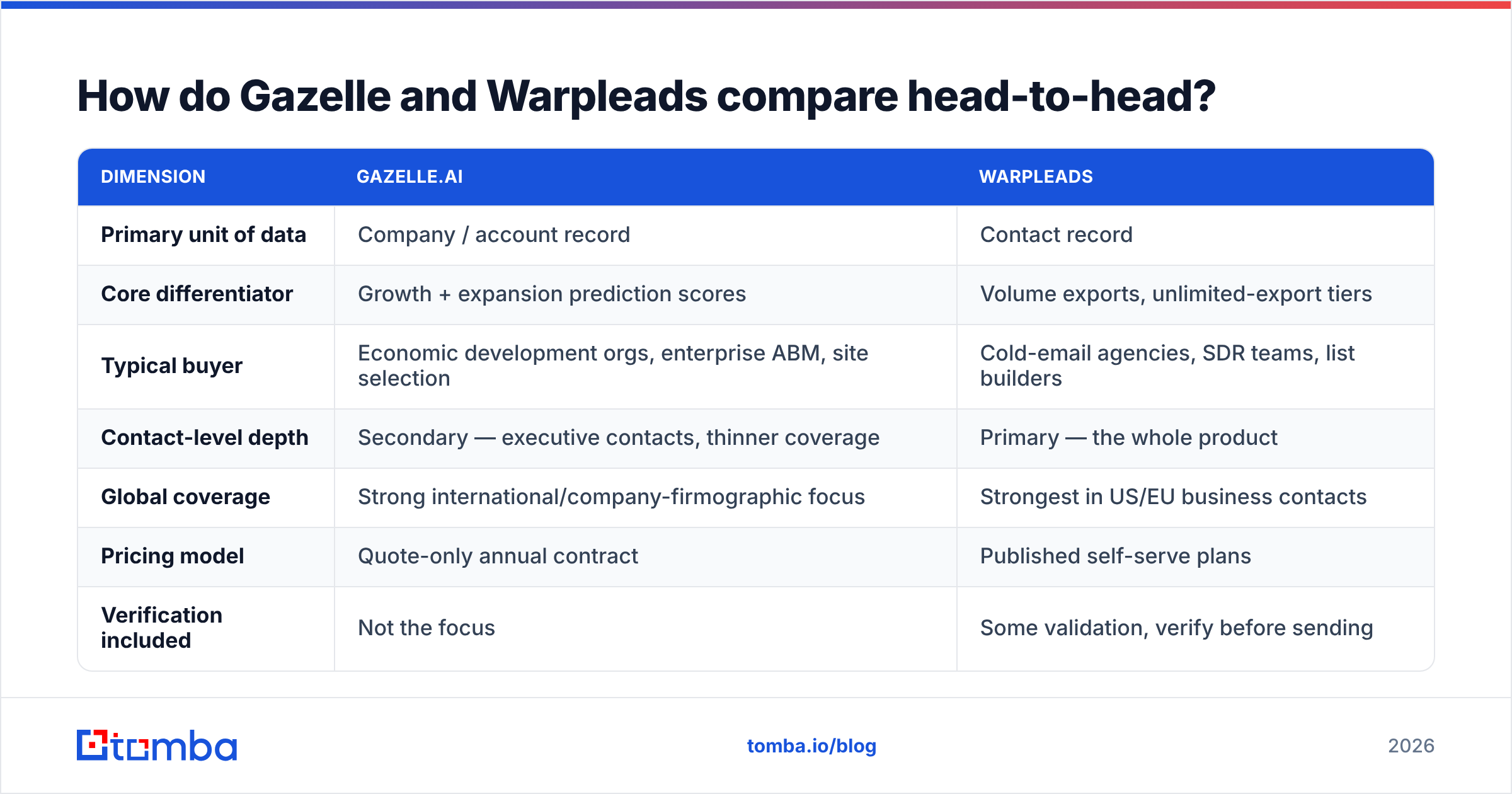
| Dimension | Gazelle.ai | Warpleads |
|---|---|---|
| Primary unit of data | Company / account record | Contact record |
| Core differentiator | Growth + expansion prediction scores | Volume exports, unlimited-export tiers |
| Typical buyer | Economic development orgs, enterprise ABM, site selection | Cold-email agencies, SDR teams, list builders |
| Contact-level depth | Secondary — executive contacts, thinner coverage | Primary — the whole product |
| Global coverage | Strong international/company-firmographic focus | Strongest in US/EU business contacts |
| Pricing model | Quote-only annual contract | Published self-serve plans |
| Verification included | Not the focus | Some validation, verify before sending |
| Best-fit deal size | High ACV, long cycles | Volume plays, short cycles |
| Learning curve | Higher — research-tool ergonomics | Low — filter, export, send |
Most Gazelle vs Warpleads evaluations come down to two rows in that table.
The first is pricing model. Gazelle sells annual contracts through sales calls. That is normal for account intelligence. Demandbase, 6sense, and ZoomInfo all work the same way. But it also means a five-person startup is not the buyer, however good the data is.
Warpleads publishes tiers you can start on this afternoon. If you have no patience for procurement, that gap ends the comparison early.
The second row is unit of data. Export 40,000 contacts with no view of which companies are growing, and you have reach without relevance. Find 300 high-growth accounts you cannot reach anyone inside, and you have relevance without reach. Teams who say "we tried both and neither worked" usually made one of those two mistakes.
What does Gazelle actually do well?#
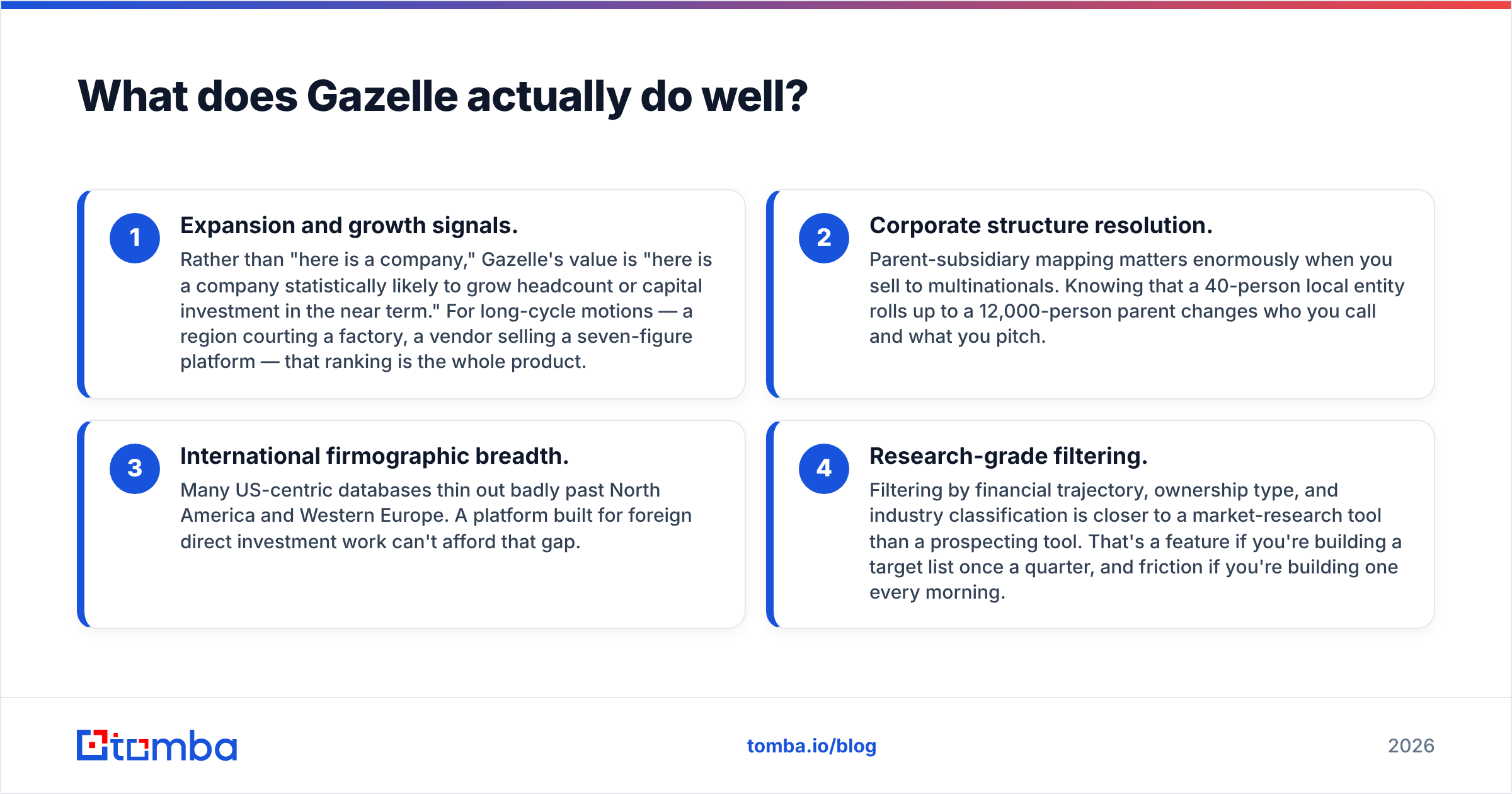
Four things stand out once you strip the marketing away:
- Growth and expansion signals. Gazelle does not just say "here is a company." It says here is a company likely to add staff or spend capital soon. For long cycles — a region courting a factory, a seven-figure platform deal — that ranking is the whole product.
- Corporate structure. Parent-subsidiary mapping matters when you sell to multinationals. A 40-person local office may roll up to a 12,000-person parent. That changes who you call and what you pitch.
- International breadth. Many US-centric databases thin out fast past North America and Western Europe. A tool built for foreign investment work cannot afford that gap.
- Research-grade filters. You can filter by financial trend, ownership type, and industry code. That is closer to market research than prospecting. It helps if you build a target list once a quarter. It slows you down if you build one every morning.
Here is the weak spot for classic SDR work. Gazelle is not built to hand you a contact list at scale. You leave with company names and a few executives. You still need a path from company to person to verified mailbox. A domain search covers that step: feed in the domain, get the people and the email pattern back.
Where does Warpleads actually fit?#
Warpleads sits near Apollo's data layer, Seamless.AI, and BookYourData. BookYourData is a solid pay-as-you-go option that publishes accuracy guarantees, so put it on the same shortlist.
What Warpleads leans on hardest is unlimited exports. Instead of metering credits per contact, higher tiers let you pull large volumes. That changes list-building math for agencies running many client campaigns from one seat.
That model carries an honest tradeoff, and you have to plan around it:
- Unlimited exports do not mean unlimited quality. Any database big enough for unmetered pulls holds rows that were true 14 months ago. Job changes alone spoil a real slice of B2B contact data every year. G2 reviewers report the same pattern across the whole category, whatever the vendor.
- The cost moves downstream. You save on per-credit pricing. You then spend on verification, deliverability recovery, and domain reputation repair if you skip that step.
- Filter discipline replaces credit discipline. When exports cost money, the filter step was forced on you. When they are cheap, nothing stops you pulling 50,000 rows you have no business emailing. Your sender reputation pays the bill.
Used well, it feeds agency pipelines cheaply. That means tight ICP filters, a hard verification pass, and sane send volumes. Used lazily, it is a bounce-rate machine. The tool does not decide which one you get. Your process does.
Gazelle vs Warpleads: which has better data accuracy?#
Neither vendor publishes an audited third-party benchmark. So treat any exact percentage with doubt — including one from a post like this. What you can reason about is structure, and structure predicts accuracy well.
Company data decays slowly. Address, industry, ownership, and rough size change over years. A firmographic database can stay mostly right for a long time. That favors Gazelle's data type.
Contact data decays fast. Titles change, people leave, email formats shift after acquisitions. Every large contact database is a snapshot of a moving target. That is a structural headwind for every volume vendor, Warpleads included. It is not a knock on them alone.
So judge the two on different accuracy questions. For Gazelle, ask how fresh the growth signals are and how often they refresh. For Warpleads, ask what the bounce rate looks like on a 1,000-row sample from your exact ICP, verified by someone else.
That second test is cheap. Run it on every contact vendor before you commit. Export a sample, push it through an independent email verifier, and read three numbers: hard-bounce risk, catch-all share, and unknown or risky share. A sample that comes back 88% deliverable tells you more than any marketing page.
Gazelle vs Warpleads pricing: what do they cost?#
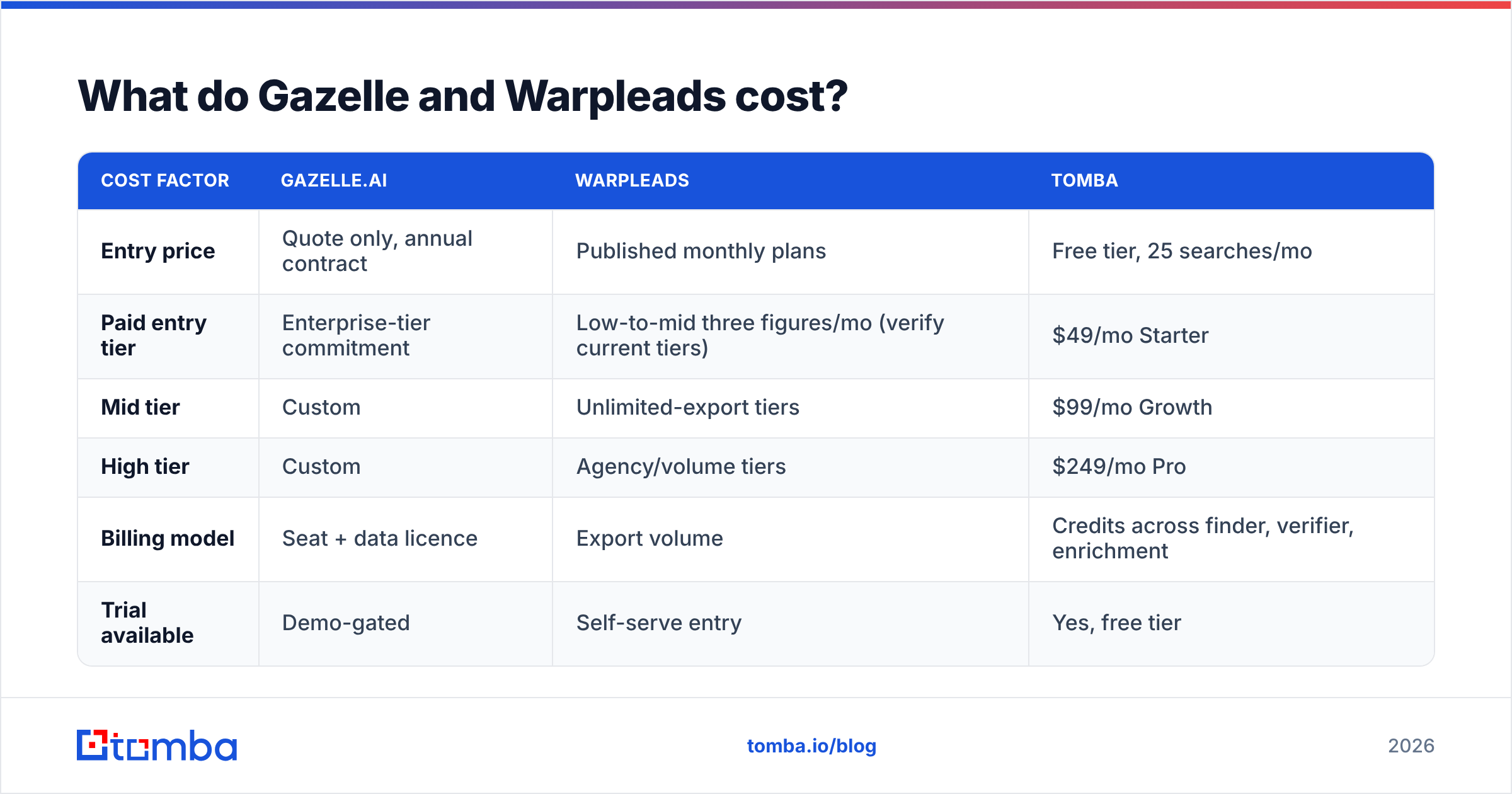
| Cost factor | Gazelle.ai | Warpleads | Tomba |
|---|---|---|---|
| Entry price | Quote only, annual contract | Published monthly plans | Free tier, 25 searches/mo |
| Paid entry tier | Enterprise-tier commitment | Low-to-mid three figures/mo (verify current tiers) | $49/mo Starter |
| Mid tier | Custom | Unlimited-export tiers | $99/mo Growth |
| High tier | Custom | Agency/volume tiers | $249/mo Pro |
| Billing model | Seat + data licence | Export volume | Credits across finder, verifier, enrichment |
| Trial available | Demo-gated | Self-serve entry | Yes, free tier |
Public prices move on both sites, so check the source before you budget. The durable point is the shape of the spend.
Gazelle is a planned annual line item that needs internal sign-off. Warpleads is a monthly cost you can start and stop. A focused finder and verifier like Tomba's plans is the small third line that keeps whatever data you buy sendable.
One hidden cost gets missed. A 1,000-contact campaign at a 12% bounce rate wastes 120 sends. Worse, it drags your domain's email deliverability down for every campaign after it. Verification is the cheapest insurance in the stack.
Gazelle vs Warpleads: which should you pick?#
- Economic development, FDI, or site selection → Gazelle, almost unopposed. Warpleads is not built for this and does not claim to be.
- Enterprise ABM with 50–500 target accounts → Gazelle for the target list. Add a contact-level tool to reach people inside those accounts.
- Agency running cold email for 10+ clients → Warpleads, for the export math. Budget verification as a fixed line, not an optional extra.
- Startup SDR team, one ICP, under $200/mo of tooling → Probably neither. A bulk email finder plus a scraper covers the same ground for far less.
- Technical team building an internal pipeline → Skip both UIs. Pull company lists from any source and resolve contacts through an email finder API.
- Recruiting or partnerships → Volume tools like Warpleads usually beat account-intelligence platforms here. You need people, not company growth scores.
Do you still need a separate email finder and verifier?#
Yes. This is the part both product pages stay quiet about.
Gazelle's output is an account. To turn it into an outreach-ready contact, you need a step from domain to person. You know you want the VP of Operations. You still need the address. That is a finder job.
Warpleads' output is a contact row that was true at some point. To turn it into a safe send, you need to know if the mailbox exists today. Catch-all domains make this harder: they accept everything and tell you nothing. That is a verifier job.
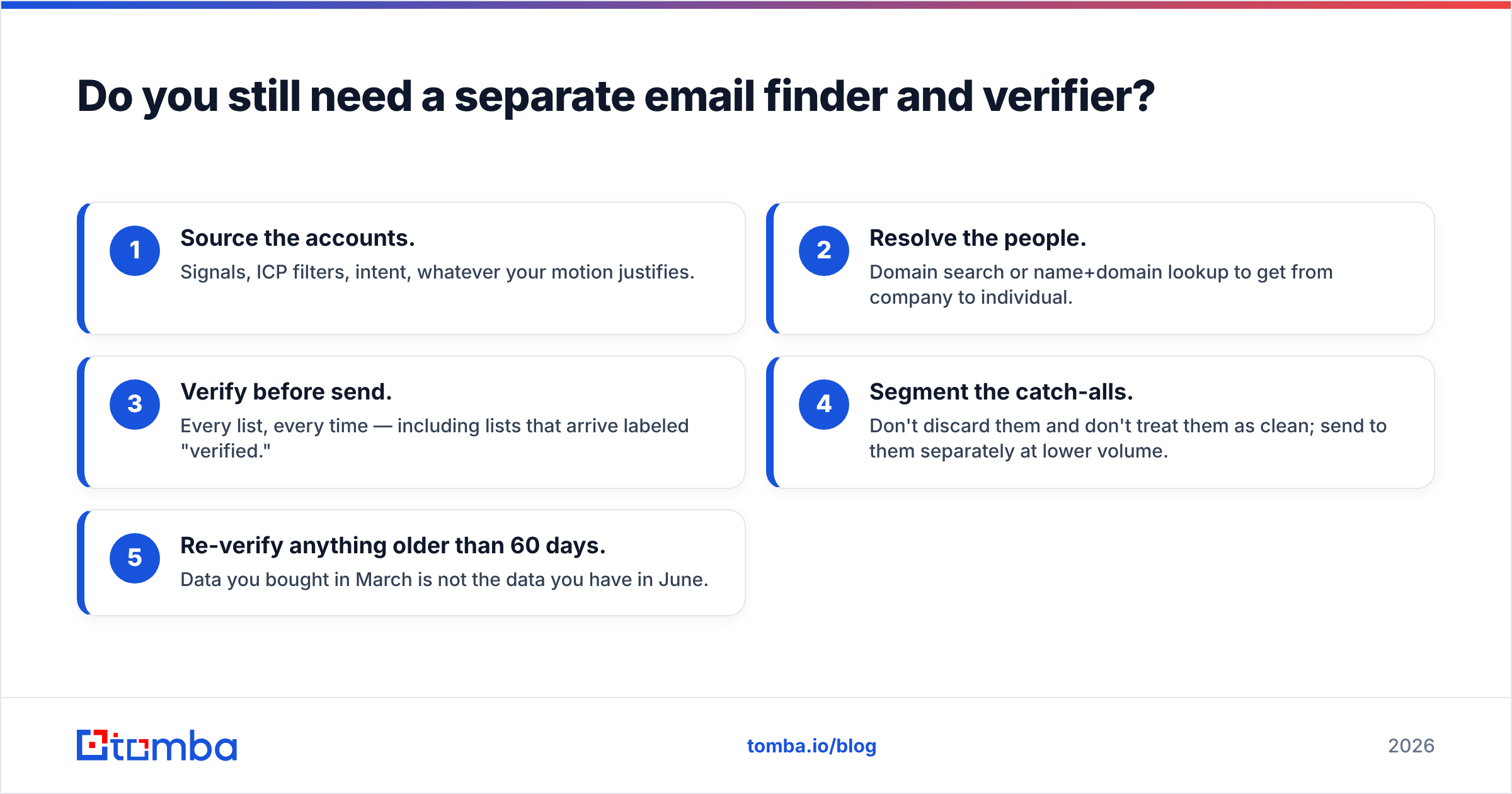
The workflow that survives contact with reality looks like this:
- Source the accounts. Signals, ICP filters, intent — whatever your motion needs.
- Resolve the people. Domain search, or name plus domain lookup, to get from company to person.
- Verify before send. Every list, every time. Yes, even lists that arrive labeled "verified."
- Segment the catch-alls. Do not bin them and do not trust them. Send to them separately, at lower volume.
- Re-verify anything older than 60 days. Data you bought in March is not the data you hold in June.
Skip step 3 and steps 1 and 2 stop mattering. That is the whole case for a verification layer that is independent of whoever sold you the list. You want a second opinion, not the vendor grading its own homework.
What's the verdict on Gazelle vs Warpleads?#
If you must pick one: Gazelle for account strategy, Warpleads for outreach volume. They solve neighboring problems. Buy the wrong one and you get the same complaint — "the data didn't work" — for opposite reasons.
The more useful verdict on Gazelle vs Warpleads is this: neither is a full outbound data stack on its own. Gazelle gives you conviction about targets, but not enough contact depth to act at scale. Warpleads gives you scale without conviction, plus a verification bill.
Teams who get this right treat lead data as three jobs: target, resolve, verify. They refuse to let one vendor claim all three unless it truly earns them.
Whichever way you go, the resolve-and-verify layer decides the campaign. Tomba Email Finder handles that layer directly. Search by domain, name, or company to turn an account list into real, current addresses. Verification runs in the same workflow, so nothing reaches your sequencer unchecked. Start free at 25 searches a month, run a sample from whichever vendor you are testing, and let the bounce numbers decide.
Related guides#
Ready to find emails that actually work?
Join 150,000+ professionals who stopped guessing and started sending. Free credits on signup — no credit card required.
Get the Tomba newsletter
Practical outbound tactics and product updates — once every two weeks.
About the author