GetProspect vs Harmonic: Which B2B Data Tool Wins in 2026?
GetProspect finds verified work emails at scale. Harmonic tracks startup signals before anyone else notices. They solve different problems — here is which one your pipeline actually needs, and what each really costs.
GetProspect vs Harmonic is an odd matchup. One tool finds work emails. The other tracks startup signals. This guide shows which one your pipeline needs, and what each one costs.
TL;DR
- These two are not substitutes. GetProspect finds and verifies work emails. Harmonic spots startups early through funding, hiring, and web signals. Comparing them is like comparing a fishing rod to a sonar array.
- Pick GetProspect if your problem is "I have a list of people and no email addresses."
- Pick Harmonic if your problem is "I don't know which companies to target yet." You will also need budget for a sales-led contract.
- Pricing is the sharpest split. GetProspect lists its plans on its site. Harmonic sends you to a sales rep.
- Most teams need a third piece. Contacts from either tool still have to land in the inbox. That is the job of a strong email finder.
GetProspect vs Harmonic: what does each tool do?#
Most "GetProspect vs Harmonic" posts treat these two as rivals. They are not.
GetProspect is a B2B email finder and contact database. You give it a name and a company domain. It gives back a work email and a status flag. You can also feed it a LinkedIn profile, a Sales Navigator search, or a CSV file. It ships a Chrome extension, a light list manager, and an API. The job is narrow and clear. It turns a person you already picked into a real inbox.
Harmonic is a private-market intelligence platform. It tracks tens of millions of companies and the people inside them. Then it watches for change. New funding. Fast hiring. Job post spikes. GitHub activity. New domains. Founders leaving. Its first buyers were venture funds. Analysts wanted to find a seed-stage startup before the round went public. Now the same signals are sold to sales teams for better timing.
So the real question is not which tool is better. It is simpler than that. Which problem are you solving this quarter? Who to contact, or how to reach them?
GetProspect vs Harmonic: the head-to-head table#
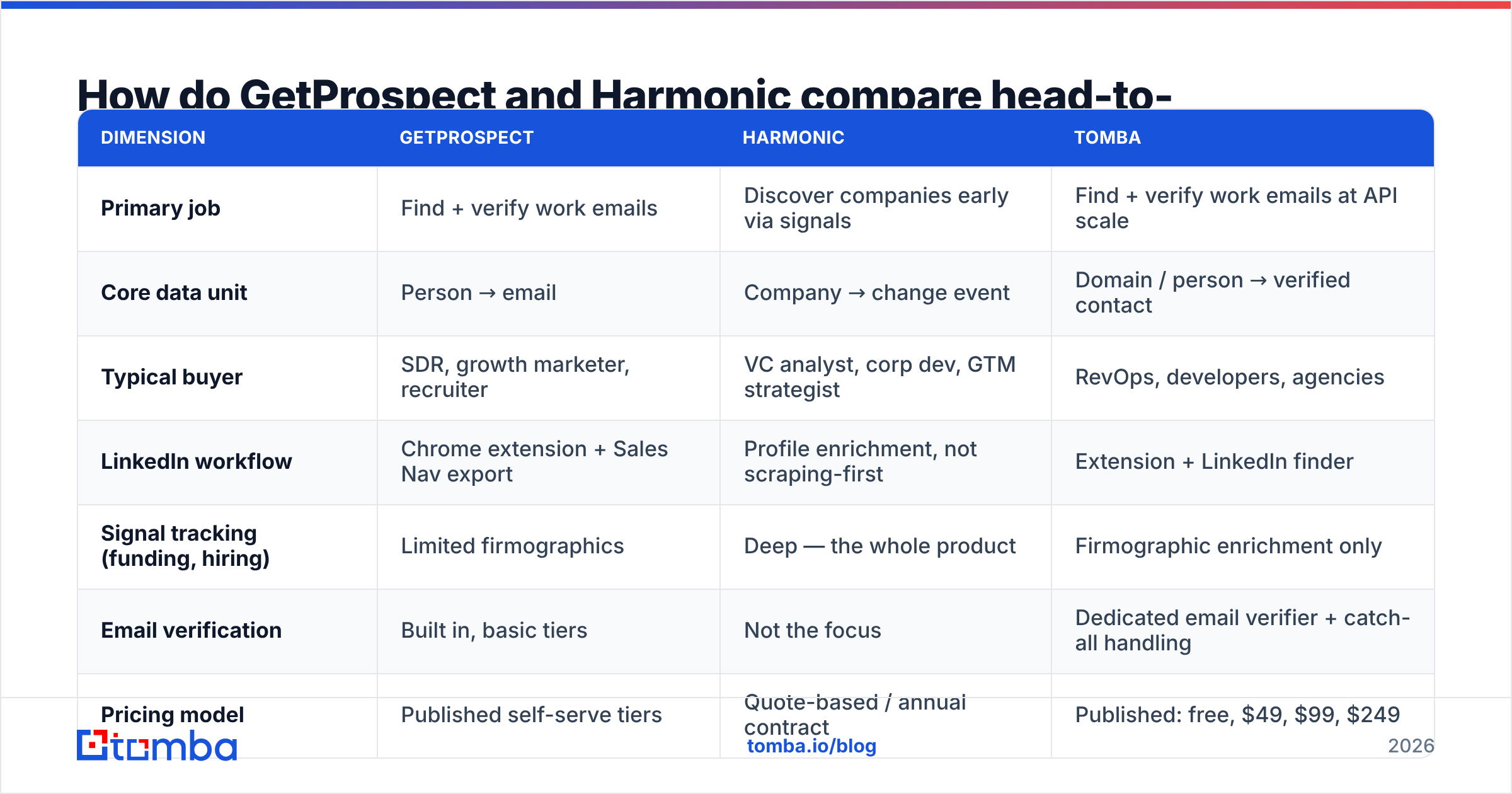
| Dimension | GetProspect | Harmonic | Tomba |
|---|---|---|---|
| Primary job | Find + verify work emails | Discover companies early via signals | Find + verify work emails at API scale |
| Core data unit | Person → email | Company → change event | Domain / person → verified contact |
| Typical buyer | SDR, growth marketer, recruiter | VC analyst, corp dev, GTM strategist | RevOps, developers, agencies |
| LinkedIn workflow | Chrome extension + Sales Nav export | Profile enrichment, not scraping-first | Extension + LinkedIn finder |
| Signal tracking (funding, hiring) | Limited firmographics | Deep — the whole product | Firmographic enrichment only |
| Email verification | Built in, basic tiers | Not the focus | Dedicated email verifier + catch-all handling |
| Pricing model | Published self-serve tiers | Quote-based / annual contract | Published: free, $49, $99, $249 |
| Free tier | Yes, small monthly allowance | No public free tier | 25 searches/mo |
| API access | Yes, on paid plans | Yes, enterprise-oriented | Yes, on all paid plans |
| Best-fit team size | 1–50 reps | Funded teams with data budget | Solo → mid-market |
Read the table row by row. Two of these columns answer the same question. One answers a very different one.
Which tool has better data coverage?#
Coverage means two different things here. That is why vendor claims stay vague.
For GetProspect, coverage means hit rate. How many of the people you look up come back with an email? That number swings a lot by segment. North American SaaS firms with 50–500 staff are the sweet spot. The web holds plenty of clues there, and most use a simple first.last@ format. Hit rates drop for European SMBs that scrub their sites. They drop for solo consultants on custom domains. They drop again for any company on a catch-all mail server.
For Harmonic, coverage means reach into private companies. How many do you learn about before the market does? Its index is deep on venture-backed startups. It is thin on the long tail. Think of the plumbing supplier, the regional staffing firm, the 40-person factory. Is your target "Series A fintechs that just hired a VP of Sales"? Then Harmonic is a real edge. Is it "any company with 20+ staff on Shopify"? Then you are paying a lot for a dataset that misses your market.

Here is the trap. Do not assume a signal tool has contact data as good as a contact tool. Harmonic will tell you a company raised $12M and doubled its engineering team. It will often name the CTO too. Whether that email still works is a separate problem. It also fails in a separate way. And it is the failure that quietly burns your sender reputation.
GetProspect vs Harmonic: how does pricing compare?#
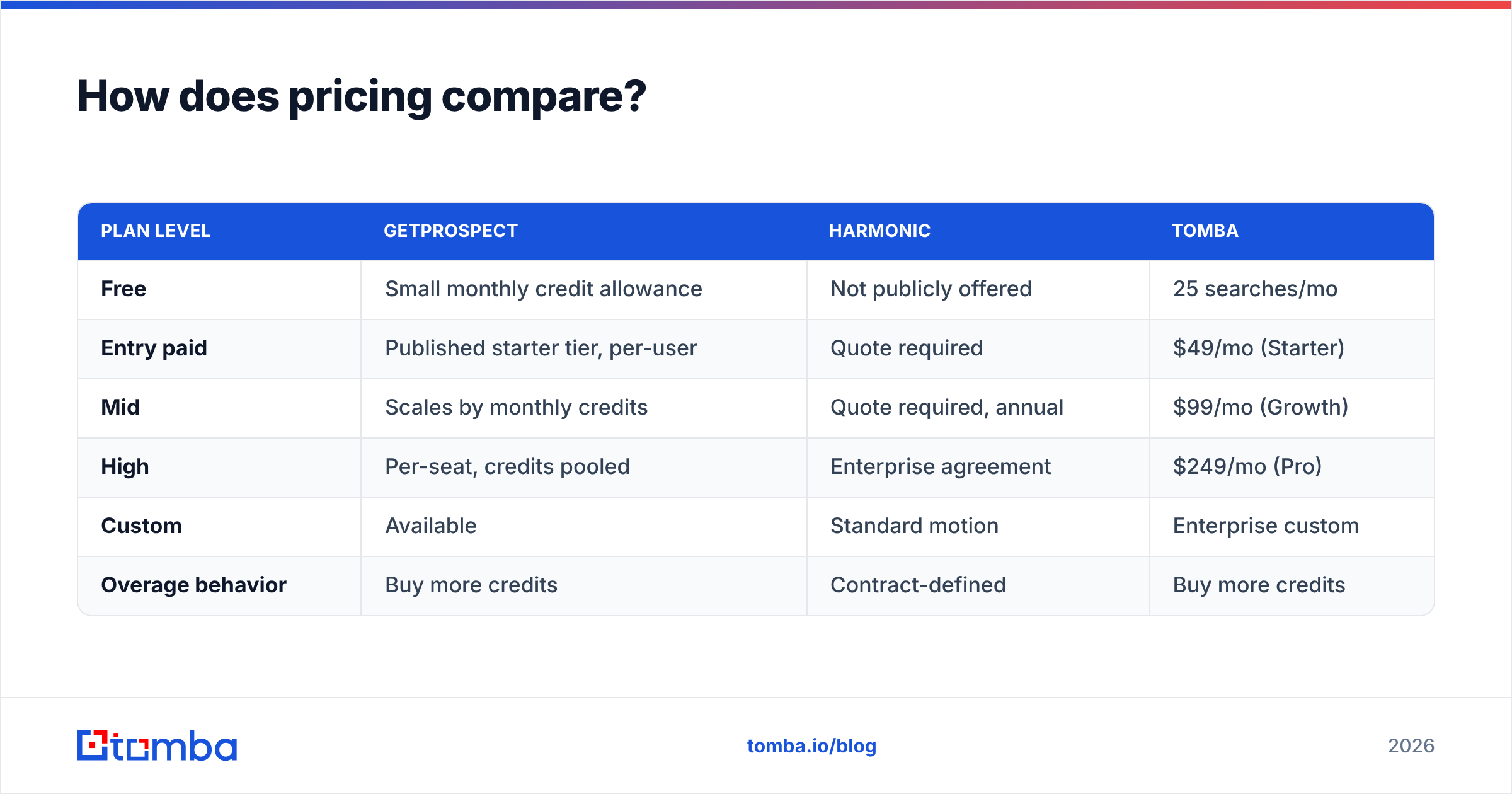
| Plan level | GetProspect | Harmonic | Tomba |
|---|---|---|---|
| Free | Small monthly credit allowance | Not publicly offered | 25 searches/mo |
| Entry paid | Published starter tier, per-user | Quote required | $49/mo (Starter) |
| Mid | Scales by monthly credits | Quote required, annual | $99/mo (Growth) |
| High | Per-seat, credits pooled | Enterprise agreement | $249/mo (Pro) |
| Custom | Available | Standard motion | Enterprise custom |
| Overage behavior | Buy more credits | Contract-defined | Buy more credits |
Check each vendor's own pricing page before you budget. Self-serve tiers change often. Harmonic's list price is not public at all. What does not change is the shape of the two models.
GetProspect's cost is easy to read. You can model it on a napkin. Credits times rate, per seat, done. The friction shows up as you grow. Per-seat pricing punishes teams with three casual users. Credit burn also speeds up when your searches miss. Some tools charge per attempt. Others charge only on a hit. Always ask which.
Harmonic's cost is a negotiation. That is normal for data platforms with their own signal pipelines. It is not always a bad thing either. Big contracts often include onboarding, custom fields, and a real success manager. But you cannot judge the return before a sales cycle. And the price scales with how much the rep thinks you can pay.

For a two-person team testing a new market, that gap decides it. You can start GetProspect this afternoon. You can start Harmonic in three weeks, after a demo, a security review, and a procurement thread.
Who should choose GetProspect?#
Choose GetProspect when these describe you:
- Your list already exists. You built a Sales Navigator search, saved a conference page, or exported a webinar list. You need emails, not discovery.
- You live inside LinkedIn. The extension is the strongest part of the product. It is fast for one-off lookups between calls.
- You want self-serve pricing. No demo, no annual lock-in, no procurement.
- You recruit as well as sell. Recruiters are a large, quiet share of the user base. The person-first flow suits sourcing well.
- Your volume is modest. A few thousand lookups a month, not a few hundred thousand.
Where it strains: heavy automated enrichment, catch-all-heavy markets, and teams that want finding and verifying held to the same bar.
Who should choose Harmonic?#
Choose Harmonic when these describe you:
- Timing is your edge, not volume. You win by reaching a company days after a trigger event. You do not win by sending 5,000 emails a month.
- Your buyers are venture-backed. Startups, scale-ups, technical founders. That is where the index is densest.
- You track people moving jobs. A former champion joining a new company is a strong signal. Harmonic surfaces that well.
- You have a data budget and a data owner. Signal tools pay off only when someone builds them into a workflow. Bought and ignored, they are costly dashboards.
Where it strains: non-venture markets, teams under ten people, and any case where you just need a verified email address. That last mile is not what Harmonic is built for.
Check fresh reviews on G2 before you commit to either one. Review comments show data decay faster than vendor pages do.
Where does Tomba fit in?#
Honestly, Tomba overlaps GetProspect, not Harmonic. Both chase the same job. Here is the difference, stated plainly.
- Verification is its own product, not a checkbox. The email verifier runs as its own pipeline. It handles catch-all domains too. Those are the biggest source of "valid" emails that still bounce.
- API first. Say your job is "enrich 40,000 rows each night from a warehouse." A Chrome extension is the wrong shape for that. The Tomba API, CLI, and MCP server exist for it.
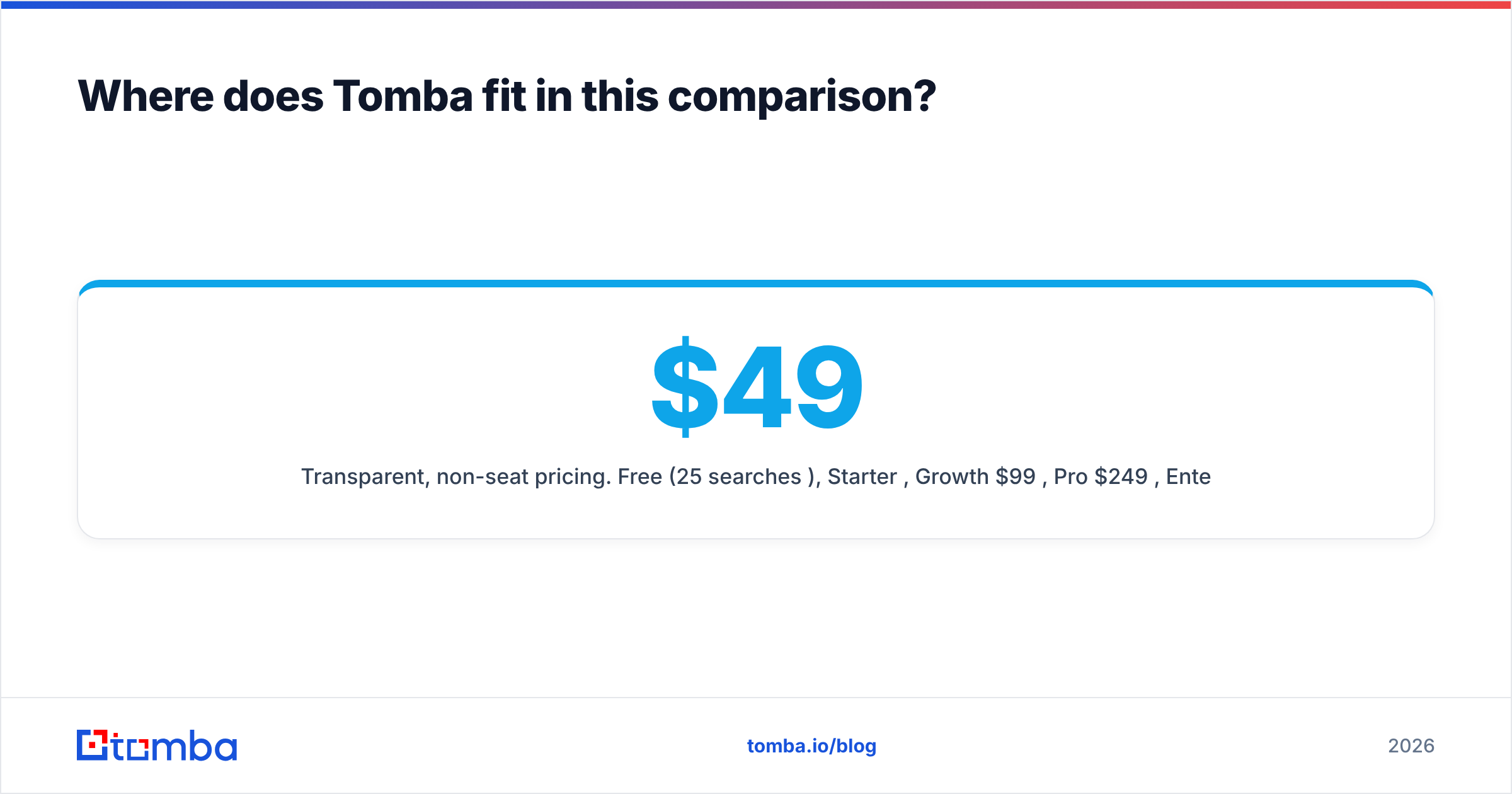
- Clear pricing, no seat tax. Free (25 searches/mo), Starter $49/mo, Growth $99/mo, Pro $249/mo, Enterprise custom. Full Tomba pricing is public, with no demo gate. Credits pool across the account instead of locking to a seat.
- Domain first as well as person first. Domain search returns every address it can find at a company, plus the email pattern. That is faster when you map a whole buying group.
- You can see the sources. Each result shows where it came from and how sure the system is. That beats a green checkmark when compliance asks.
None of that makes Tomba right for signal discovery. Need to know a company raised a round yesterday? Tomba will not tell you. Harmonic will.
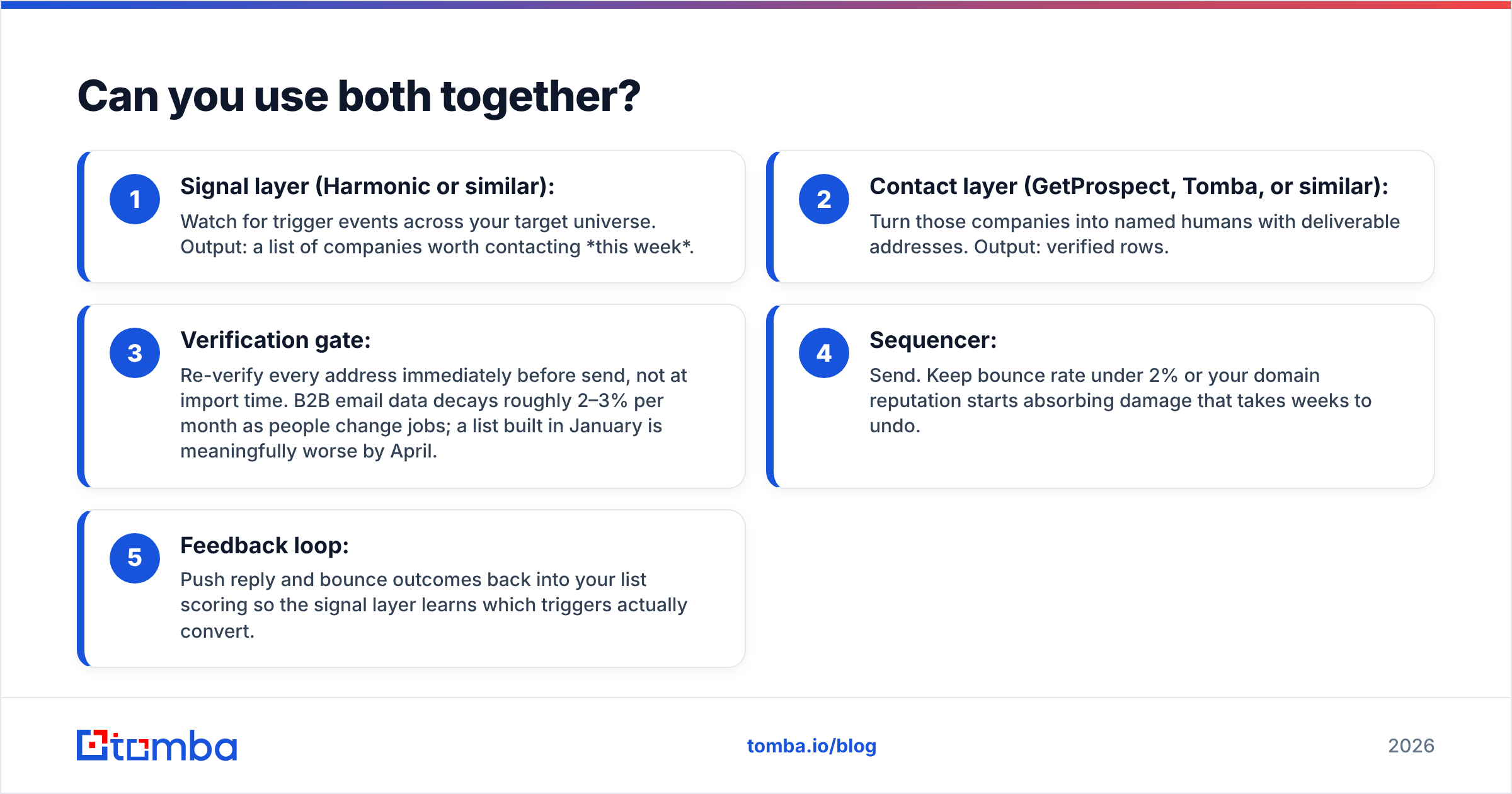
Can you use both together?#
Yes. For some teams that is the right setup. The stack splits along the two problems:
- Signal layer (Harmonic or similar). Watch for trigger events across your target market. Output: companies worth a call this week.
- Contact layer (GetProspect, Tomba, or similar). Turn those companies into named people with working addresses. Output: verified rows.
- Verification gate. Re-check every address right before you send, not at import time. B2B email data decays about 2–3% a month as people change jobs. A list built in January is much worse by April.
- Sequencer. Send. Keep bounces under 2%. Above that, your domain starts taking damage that takes weeks to undo.
- Feedback loop. Push replies and bounces back into your scoring. Then the signal layer learns which triggers convert.
Step 3 is the one teams skip. It is also the one that decides whether the other four paid off. A bulk email finder run just before launch costs a few dollars. It also stops the bounce spike that gets a sending domain throttled.
GetProspect vs Harmonic: the verdict#
If you are picking one tool and one budget line:
- Outbound team that already knows its market → GetProspect. Pick a verification-first tool instead if bounces are your pain.
- Venture, corp dev, or a team built on early timing → Harmonic.
- Developer, RevOps, or agency enriching at volume → neither fits. You want an API-native contact layer.
If you are picking based on risk: GetProspect is the safer start. Published pricing, a free tier, and a flow you can judge in twenty minutes. Harmonic is the bigger bet. Bigger commitment, bigger payoff, but only if your market sits inside its index.
If you are picking based on what really breaks pipelines: it is rarely discovery. It is deliverability. Teams that lose a quarter usually lose it to a burned domain, not to a shortage of company names.
Ready to fix the last mile? Start with Tomba Email Finder. Find work emails by domain, name, or company. Verification runs in the same pipeline, catch-all handling included, instead of bolted on later. The free tier gives you 25 searches a month with no card. Paid plans start at $49/mo, and credits pool across your whole team. Run your GetProspect or Harmonic export through it and compare bounce rates on the next send. That is the only benchmark that pays.
Related guides#
Ready to find emails that actually work?
Join 150,000+ professionals who stopped guessing and started sending. Free credits on signup — no credit card required.
Get the Tomba newsletter
Practical outbound tactics and product updates — once every two weeks.
About the author