Go To Market Strategy for Service Company: 2026 Playbook
Service businesses can't ship a free trial or a self-serve signup. Here's how to build a go-to-market strategy that sells expertise, prices outcomes, and fills a pipeline you can forecast.
A go to market strategy for service company teams has to sell capacity, not code. This playbook covers the six stages, the pricing ladder, and the channels that fill a services pipeline in 2026.
TL;DR
- A go to market strategy for service company growth sells capacity and expertise, not software seats. Your constraint is delivery hours, not server costs. Every GTM decision has to respect that ceiling.
- Skip the "everyone with a website" positioning. The service firms that grow fastest in 2026 pick a narrow ICP (industry + company size + one recurring pain) and build the whole motion around it.
- Your fastest channel is almost never paid ads. It's referral loops, targeted outbound to a verified 200-account list, and proof-of-work content that ranks.
- Price on outcomes or retainers, not hours. Hourly billing caps your revenue at the same number as your headcount.
- Track four numbers: qualified pipeline per month, win rate, average contract value, and utilization. If you only track revenue, you'll scale the wrong thing.
What Is a Go To Market Strategy for Service Company Founders?#
A go to market strategy for service company founders is the documented plan for who you sell to, what problem you solve, how buyers find you, how you price the work, and how you deliver it profitably at volume.
Here's the useful analogy: a SaaS company is a factory — build once, ship infinitely, marginal cost near zero. A service company is a restaurant. You have a fixed number of tables and a fixed number of cooks. You can't serve 10,000 covers because a blog post went viral. That single difference rewrites the playbook.
The practical consequences:
- Demand generation must be throttleable. A SaaS team wants maximum top-of-funnel. You want predictable top-of-funnel, matched to bench capacity. Oversold pipeline burns your delivery team. Undersold pipeline burns cash.
- Your product is a promise. Buyers can't trial it. They buy on proof: case studies, named references, a scoped pilot. So your GTM is really a trust-building machine.
- Sales cycles run long and involve committees. Gartner's B2B buying research finds buying groups of six to ten people for complex purchases. Services deals fit that shape.
- Churn hides in delivery, not in the product. A missed deadline in month three kills a renewal that no amount of marketing spend recovers.
- Your margin is a scheduling problem. Utilization at 60% versus 78% is the difference between a struggling firm and a profitable one, at identical revenue.
If your current plan doesn't have an explicit answer for each of those five, it's a marketing plan, not a GTM strategy.
What Are the Six Stages of a Service GTM Motion?#
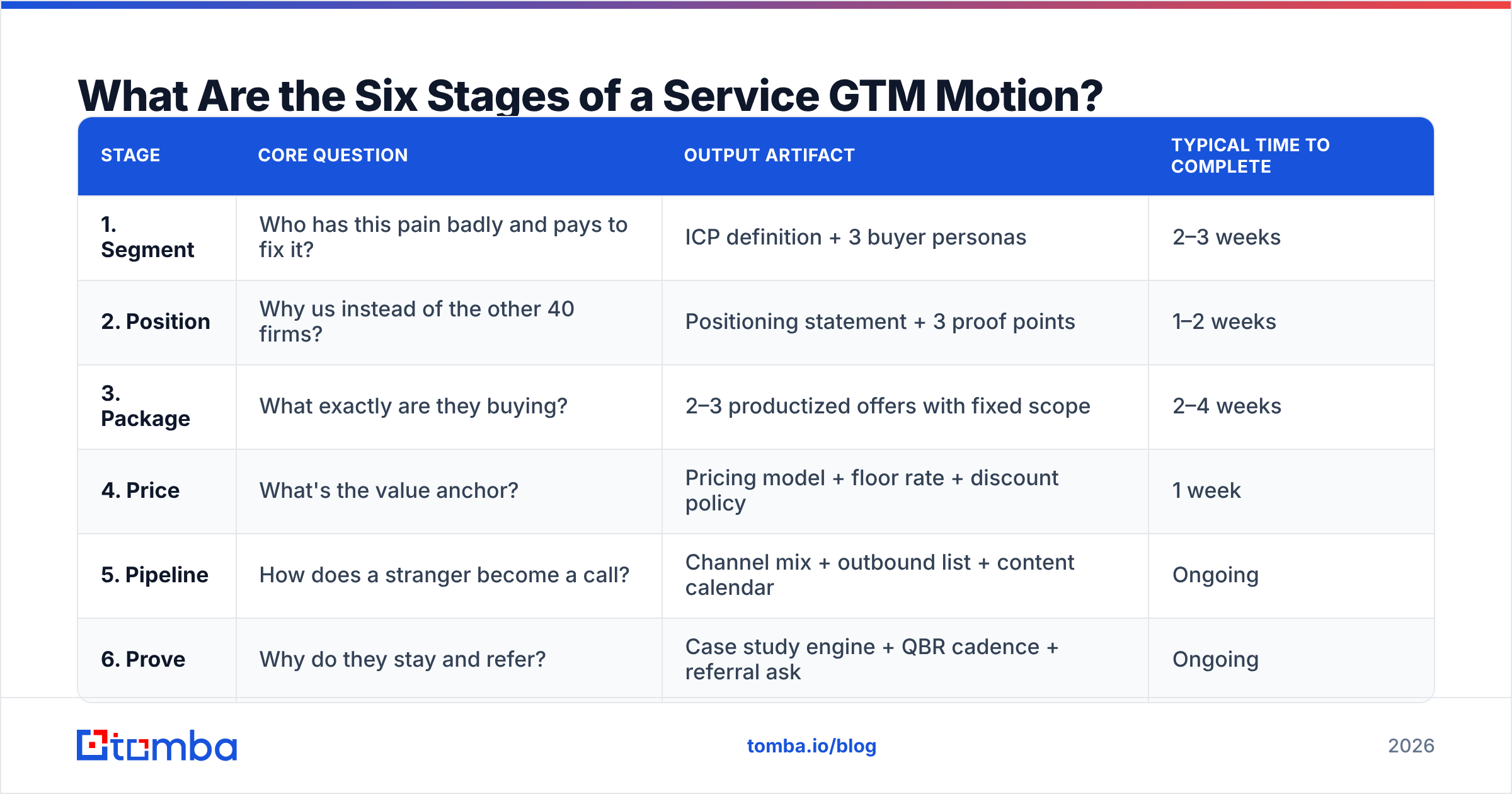
Every service GTM I've seen work — agencies, consultancies, MSPs, staffing firms, fractional teams — moves through the same six stages. Skipping one doesn't speed you up. It just moves the failure later.
| Stage | Core question | Output artifact | Typical time to complete |
|---|---|---|---|
| 1. Segment | Who has this pain badly and pays to fix it? | ICP definition + 3 buyer personas | 2–3 weeks |
| 2. Position | Why us instead of the other 40 firms? | Positioning statement + 3 proof points | 1–2 weeks |
| 3. Package | What exactly are they buying? | 2–3 productized offers with fixed scope | 2–4 weeks |
| 4. Price | What's the value anchor? | Pricing model + floor rate + discount policy | 1 week |
| 5. Pipeline | How does a stranger become a call? | Channel mix + outbound list + content calendar | Ongoing |
| 6. Prove | Why do they stay and refer? | Case study engine + QBR cadence + referral ask | Ongoing |
Stages 1 through 4 are strategy work you do once and revisit quarterly. Stages 5 and 6 are operational and never stop.
The most common failure is jumping straight to stage 5. A firm feels the pipeline gap, hires an SDR, buys a list, and starts sending. Without stages 1–4, that SDR is pitching a fuzzy offer at a fuzzy price to a fuzzy audience. The reply rate confirms it.
How Do You Define an ICP That Actually Narrows Anything?#
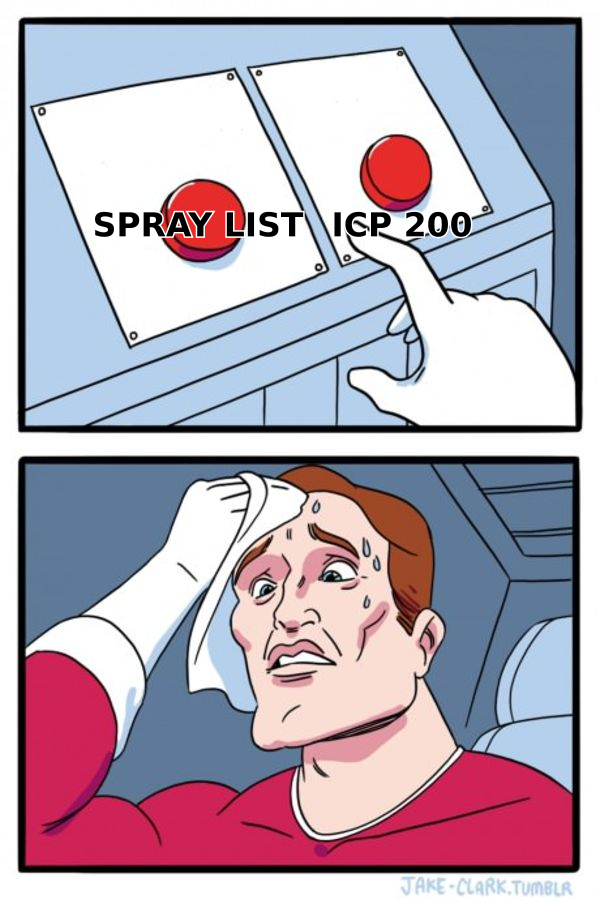
Most "ICP documents" are useless because they describe a range, not a target: "B2B companies, 10–5,000 employees, in North America or Europe." That's not a segment. That's a census.
A usable ICP for a service business has four hard filters and one soft one:
- Industry vertical — one, maybe two. "Series A–B fintech" not "technology."
- Size band — a 40-person company and a 400-person company buy differently, budget differently, and have different decision committees. Pick one band.
- Trigger event — the thing that makes the pain urgent right now. New funding round, a compliance deadline, a leadership hire, a failed audit, a platform migration.
- Buying authority — the specific title that can sign. VP Marketing, Head of RevOps, CFO. If you can't name the title, you can't build the list.
- Soft filter: reference-ability. Will this client's logo help you sell the next three? Weight it.
Once those five are set, the list becomes finite — usually 200 to 2,000 accounts. That's the point. A finite list is workable. You can enrich it, research it, and touch every account several ways. You also avoid burning your sender reputation on 50,000 low-intent contacts.
To go from an account list to a contactable list, you need names and verified addresses at those companies. Running a domain search against each target account returns the people and email patterns at that domain.
A bulk email finder run then turns a CSV of companies into a working outbound file. Verify before you send. A 2% bounce rate is the practical ceiling before mailbox providers start throttling you.
What Positioning Works When Everyone Says "Full-Service"?#
Positioning for services means picking a fight you can win. There are exactly four defensible angles, and "we care more" is not one of them.
- Vertical specialization. "We do RevOps for PE-backed manufacturing companies." You know their systems, their compliance constraints, and their vocabulary. Premium pricing follows automatically.
- Outcome specialization. "We take companies from $2M to $10M ARR through outbound." The buyer isn't purchasing hours; they're purchasing a number.
- Methodology specialization. You have a named, documented process. Buyers can see the machine before they buy it, which lowers perceived risk.
- Speed or model specialization. Fixed-fee sprints, 10-day delivery, embedded fractional teams. You compete on the shape of the engagement, not the content.
The test for whether your positioning is real: can a prospect finish the sentence "I'd hire them specifically when ___"? If the honest answer is "when I need marketing stuff," you have no position.
Write it down as one sentence, in this shape: We help [ICP] achieve [outcome] through [method], unlike [alternative] which [limitation]. Then check your last three lost deals. Were they losses against that alternative, or against something else? If you lost to "did nothing," your problem is urgency, not competition.
Should You Productize Your Services?#
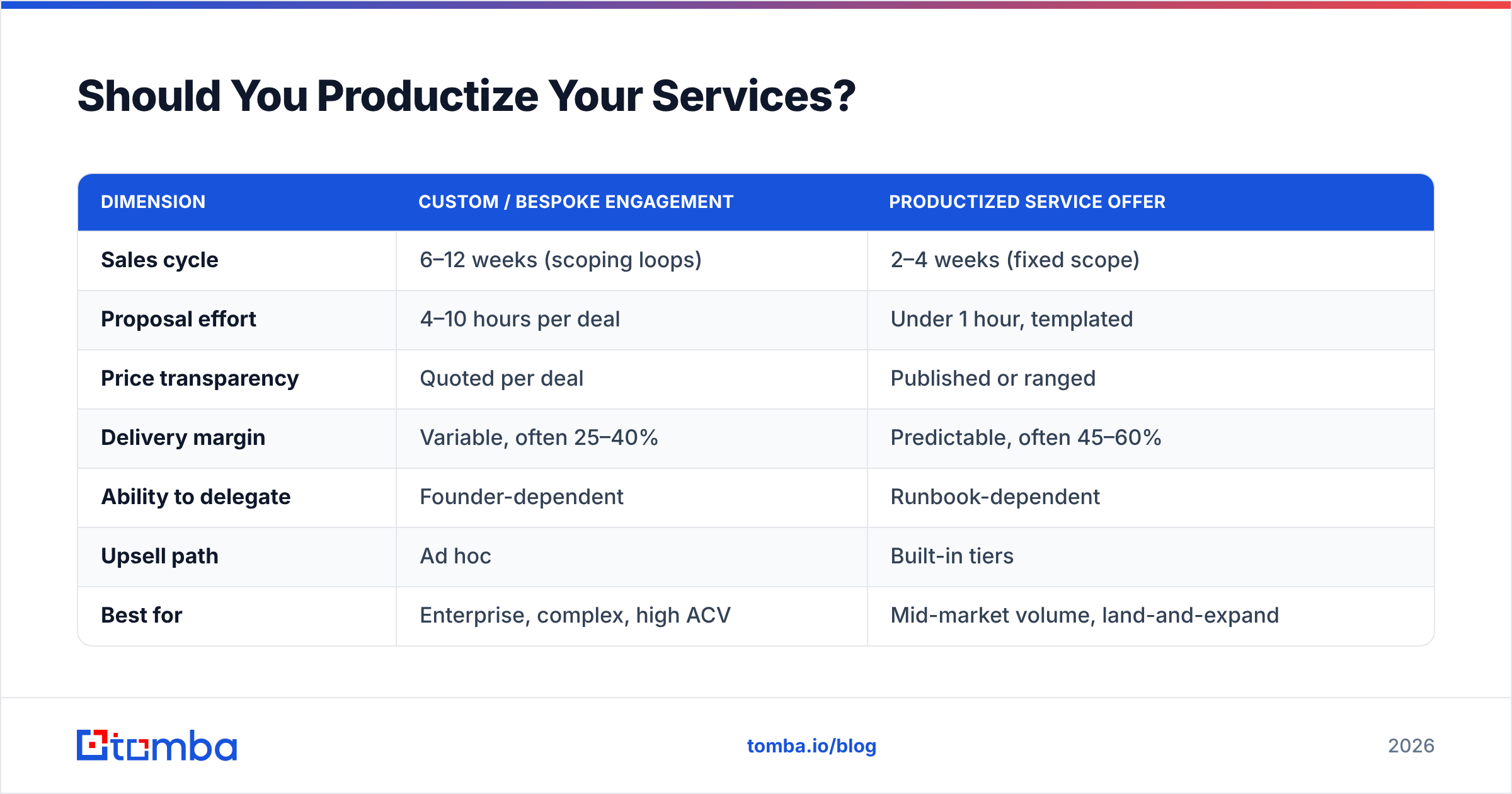
Yes — for at least part of your portfolio. Productizing means converting bespoke work into a fixed-scope, fixed-price, repeatable offer.
| Dimension | Custom / bespoke engagement | Productized service offer |
|---|---|---|
| Sales cycle | 6–12 weeks (scoping loops) | 2–4 weeks (fixed scope) |
| Proposal effort | 4–10 hours per deal | Under 1 hour, templated |
| Price transparency | Quoted per deal | Published or ranged |
| Delivery margin | Variable, often 25–40% | Predictable, often 45–60% |
| Ability to delegate | Founder-dependent | Runbook-dependent |
| Upsell path | Ad hoc | Built-in tiers |
| Best for | Enterprise, complex, high ACV | Mid-market volume, land-and-expand |
The practical pattern most successful firms land on: a productized entry offer (audit, sprint, assessment — priced $3K–$15K) that leads into a custom retainer. The entry offer is cheap to sell, proves competence, and gives you the internal data to scope the retainer accurately. It's the closest a service firm gets to a free trial.
Two cautions. First, don't productize your most differentiated work — that's where your margin lives.
Second, a productized offer only works if the delivery is genuinely repeatable. If each one still requires your best person for 40 hours, you've productized the price, not the service, and you'll eat the difference.
How Should a Service Company Price Its Offers?#
Move up this ladder as fast as your proof allows:
- Hourly — the floor. You're selling time, so revenue is hard-capped at headcount × hours × rate, and every efficiency gain reduces your own income. Use only for genuinely unpredictable scopes.
- Fixed project fee — better. You capture efficiency gains. Requires accurate scoping, which requires historical data, which is why the productized audit matters.
- Monthly retainer — best for cash flow predictability. Sell access + a defined output volume, not a bucket of hours. Retainers make your revenue forecastable, which makes hiring forecastable.
- Outcome / performance pricing — highest ceiling, highest risk. Only viable where you control the outcome and can measure it cleanly. Usually a base retainer plus a performance kicker.
Two rules hold across all four models. Set a floor rate you never go below, and enforce it — discount exceptions become the new price within two quarters. And raise prices on new clients every year while grandfathering existing ones. It's the least painful way to move up-market without a churn event.
Anchor high on the first quote. Services buyers read price as a quality signal far more than software buyers do, because they have no other way to evaluate you before delivery.
Which Channels Actually Fill a Service Pipeline?#
Ranked by what I actually see working for service firms in the $500K–$20M range, not by what's trendy:
| Channel | Time to first deal | Cost profile | Scalability | Best fit |
|---|---|---|---|---|
| Referrals & partner network | 2–6 weeks | Near zero, high effort | Low, non-linear | Every firm, always |
| Targeted outbound email | 4–10 weeks | $200–$1,500/mo tooling | Medium-high | Defined ICP, ACV > $10K |
| Founder-led social / LinkedIn | 3–9 months | Time only | Medium | Expertise-led firms |
| SEO / proof-of-work content | 6–14 months | $2K–$10K/mo | High, compounding | Long-horizon, defensible |
| Communities & events | 2–5 months | $5K–$40K/yr | Low-medium | High-ACV, enterprise |
| Paid search | 2–8 weeks | $3K–$25K/mo | High, expensive | High-intent categories only |
| Cold calling | 3–8 weeks | Salary-heavy | Medium | Local, SMB, urgent pain |
The realistic 2026 stack for most service firms: a formalized referral motion, plus targeted outbound to a verified list, plus one owned content channel. That's three. Adding a fourth before the first three are producing consistently is how firms end up with four mediocre channels.
Formalizing referrals means three things. Ask at a defined moment, usually 60–90 days into a successful engagement, right after a measurable win. Make the ask specific ("who else in your network is dealing with X?"). Then track it in the CRM like any other source. Unstructured "let us know if you hear of anyone" produces roughly nothing.
For outbound, the mechanics matter more than the copy. You need accurate contact data, verified addresses, warmed domains, and a sequence with genuine research in the first line.
Building the contact layer is straightforward. Pull decision-maker addresses with an email finder, clean the list through an email verifier before the first send, then connect the output to your CRM through the available integrations so nothing lives in a spreadsheet graveyard.
How Do You Build the Proof Engine?#
Services sell on evidence. Your GTM is only as strong as the evidence you can produce on demand.
Build these four assets and refresh them quarterly:
- Three case studies with numbers. Not "improved efficiency." Actual figures: "cut lead response time from 19 hours to 40 minutes, lifting demo bookings 34% in one quarter." Get client sign-off in the contract so you're not negotiating permission later.
- A reference bench. Two or three clients who've agreed to take calls. This closes late-stage deals more reliably than any piece of collateral.
- A methodology one-pager. The named process, its stages, and what the client gets at each stage. This is what buyers forward internally to their committee.
- Independent proof. Reviews on G2 or Capterra, a certification, a public benchmark. Third-party validation carries weight yours can't.
On the content side, publish the work rather than opinions about the work. Teardowns, annotated frameworks, the actual template you use internally. Firms that publish their operating documents convert far better than firms publishing thought-leadership takes, because the document is the demonstration.
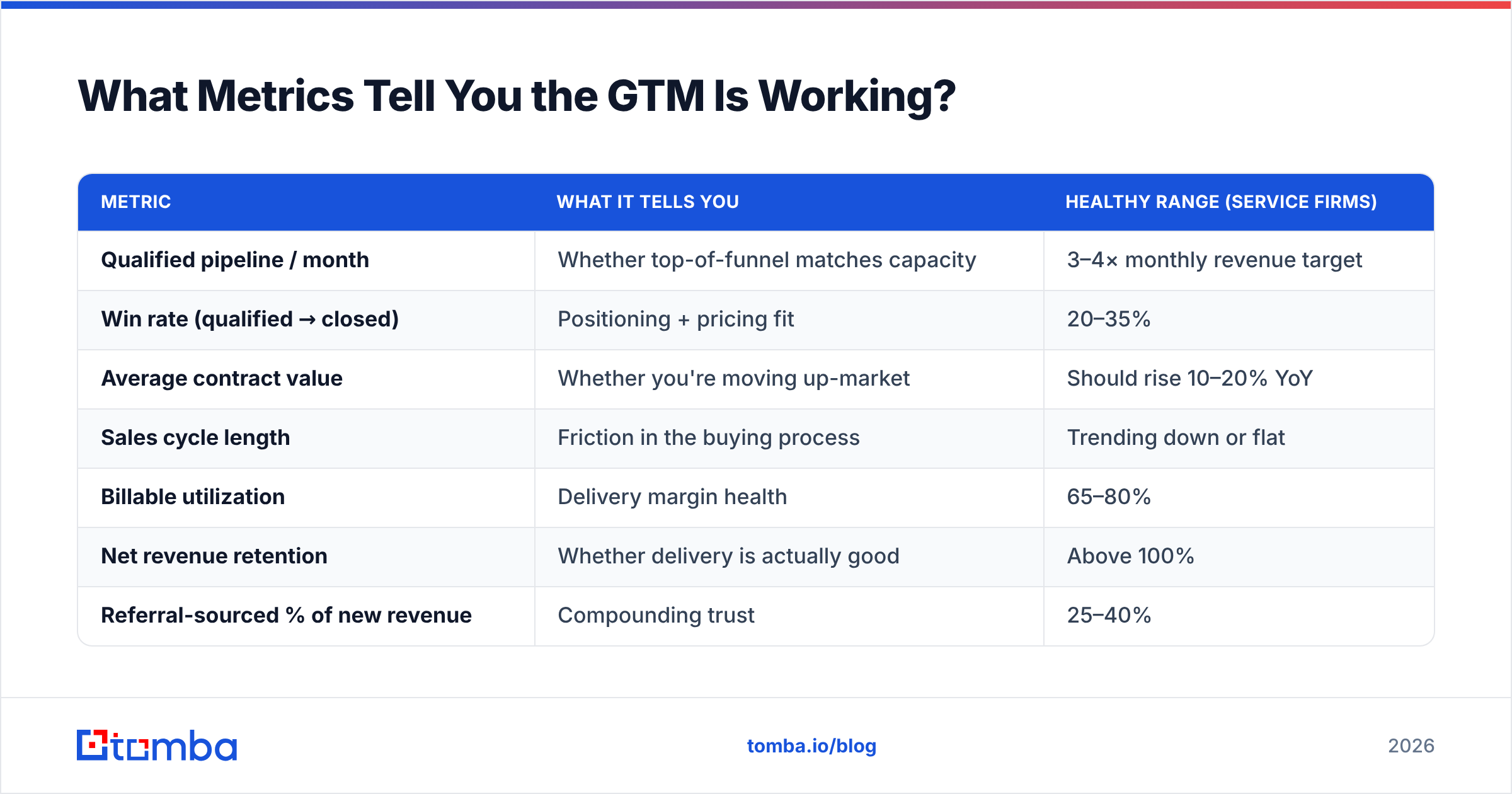
What Metrics Tell You the GTM Is Working?#
Track these weekly, not monthly. Monthly is too slow to correct a bad quarter.
| Metric | What it tells you | Healthy range (service firms) |
|---|---|---|
| Qualified pipeline / month | Whether top-of-funnel matches capacity | 3–4× monthly revenue target |
| Win rate (qualified → closed) | Positioning + pricing fit | 20–35% |
| Average contract value | Whether you're moving up-market | Should rise 10–20% YoY |
| Sales cycle length | Friction in the buying process | Trending down or flat |
| Billable utilization | Delivery margin health | 65–80% |
| Net revenue retention | Whether delivery is actually good | Above 100% |
| Referral-sourced % of new revenue | Compounding trust | 25–40% |
The pairing that matters most is utilization against qualified pipeline. High pipeline with low utilization means you're selling work you can't staff. High utilization with low pipeline means you're a quarter away from a cliff, and nobody has noticed because revenue looks fine today. Neither shows up if you only watch top-line revenue.
Also watch win rate by segment, not in aggregate. An overall 24% win rate might be 45% in your core vertical and 8% everywhere else. That's a positioning instruction, not a sales-training problem.
What Are the Most Common GTM Mistakes Service Firms Make?#
- Selling to everyone. The most expensive mistake, and the hardest to notice because a broad market feels safer than a narrow one.
- Hiring salespeople before founder-led sales is repeatable. If the founder can't articulate a repeatable pitch, a new AE has nothing to run. Document the motion first.
- Competing on price. Services buyers who choose on price churn on price. You'll lose them to whoever quotes 15% less next year.
- Letting delivery and GTM run as separate organizations. Sales promises what delivery can't staff, delivery resents sales, renewals leak. Put them in the same weekly meeting.
- Ignoring the post-sale motion. For most service firms, expansion and referral revenue eventually outweigh net-new. Treat month four as a GTM stage, not an operations handoff.
- Buying data instead of building the list. Bulk-purchased contact files decay fast — B2B contact data goes stale at roughly 25–30% per year as people change roles. Build and verify against your own defined account list instead.
Where Should You Start This Quarter?#
Pick the earliest incomplete stage and finish it before touching anything downstream. Concretely, in the next 30 days:
- Write the ICP with all five filters. Name 200 real accounts that match.
- Write the one-sentence positioning statement. Test it on five past clients — if they can't repeat it back, rewrite it.
- Package one entry offer with fixed scope and a published price range.
- Build and verify the contact list for those 200 accounts.
- Formalize the referral ask and put it on the delivery calendar at day 75.
- Instrument the seven metrics above in a single weekly dashboard.
Nothing on that list requires new headcount or a bigger budget. It requires deciding who you're for, which is the part most firms defer indefinitely because deciding means giving something up.
The one dependency worth solving with a tool is step 4. You can't run targeted outbound against an account list without verified decision-maker contacts, and manual research at 200 accounts is a week of somebody's life.
Tomba Email Finder turns a company domain and a name into a verified professional email, and works in bulk against your whole target list. There's a free tier at 25 searches a month, so you can test the accuracy on accounts you already know before committing. Paid plans start at $49/mo on Starter and scale to $99/mo on Growth
Ready to find emails that actually work?
Join 150,000+ professionals who stopped guessing and started sending. Free credits on signup — no credit card required.
Get the Tomba newsletter
Practical outbound tactics and product updates — once every two weeks.
About the author