Go to Market Strategy Telecommunications: The 2026 Playbook
Telecom GTM breaks in ways SaaS playbooks never predicted: 14-month procurement, RFP gatekeepers, and buying committees of nine. Here's the segmentation, motion, and data stack that actually closes carrier and enterprise connectivity deals.

A go to market strategy telecommunications teams can actually run looks nothing like a SaaS plan. The cycles are longer. The buyers show up in groups of nine. Here is the segmentation, the motions, and the data stack that close carrier and enterprise connectivity deals.
TL;DR
- A go to market strategy telecommunications teams copy from SaaS will fail. Self-serve trials, 30-day cycles, and single decision-makers do not exist in carrier, MSP, or enterprise connectivity sales.
- Segment by buying process, not by company size. Carrier/wholesale, enterprise IT, MSP/channel, and SMB connectivity each need their own motion, contract length, and comp plan.
- The average telecom enterprise deal touches 8-11 people. They sit in network engineering, procurement, security, and finance. Your contact data has to cover all four.
- Channel and partner deals still drive 40-60% of telecom revenue. Build the partner economics first. Build the SDR team second.
- Your GTM data layer is the constraint. Bad contact data on a 14-month cycle wastes two quarters before anyone notices.
Why a Go to Market Strategy Telecommunications Teams Run Looks Different#
Telecom GTM is a different sport from software GTM. The gap is structural, not cosmetic.
In SaaS you speed up a cycle by cutting friction. Free trial, credit card, expand later. Telecom does not work that way. You are selling something tied to physical gear, legal rules, and multi-year budgets. A mid-market company switching SD-WAN vendors is not swapping a Chrome extension. It has to line up circuit provisioning, a security review, and exit fees on the old contract. Then engineering picks a migration window, and they only open two a year.
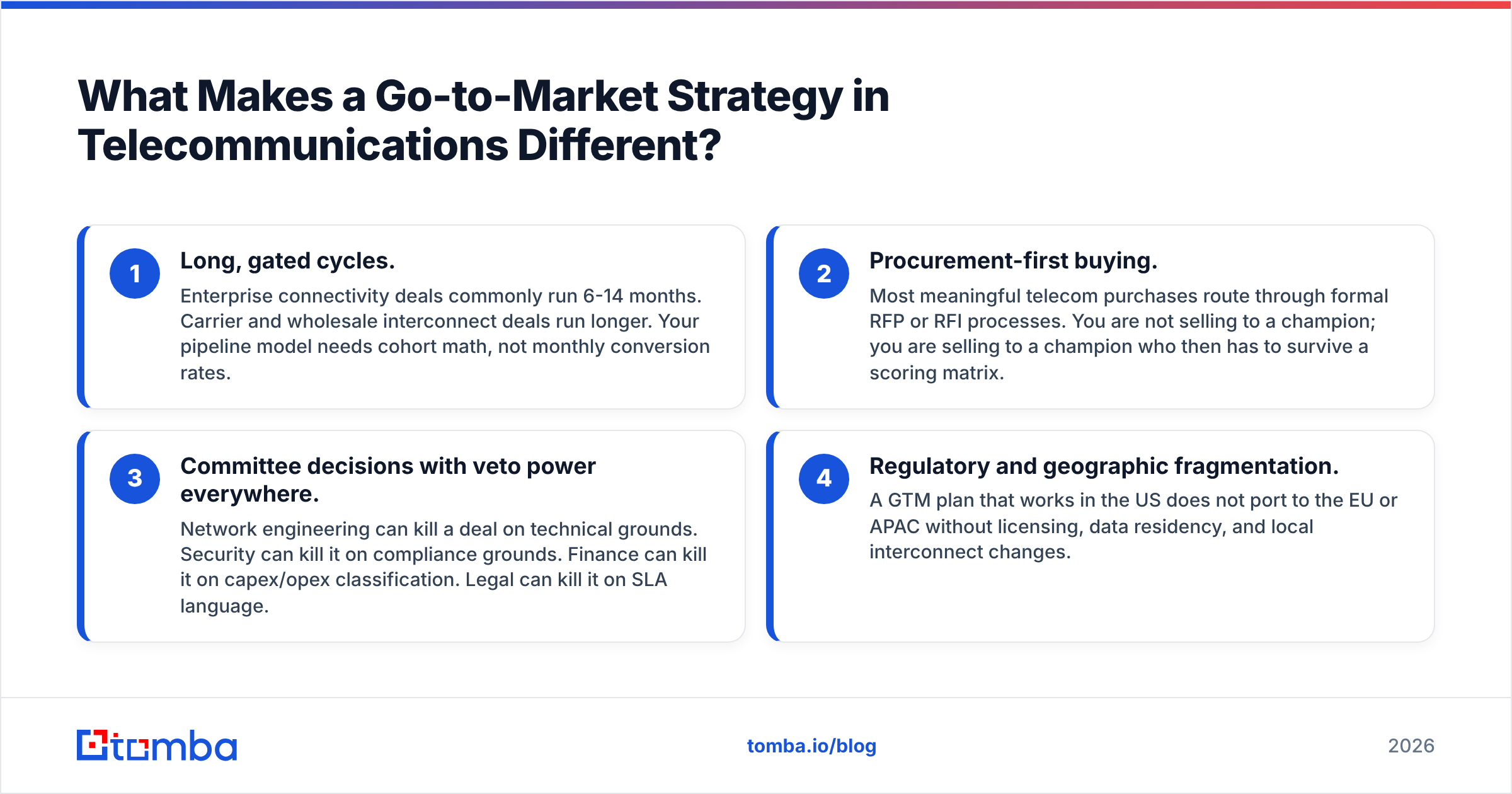
That leaves four hard limits every telecom GTM plan has to absorb:
- Long, gated cycles. Enterprise connectivity deals often run 6-14 months. Carrier and wholesale deals run longer. Your pipeline model needs cohort math, not monthly conversion rates.
- Procurement first. Most telecom purchases go through a formal RFP or RFI. You are not selling to a champion. You are selling to a champion who then has to survive a scoring matrix.
- Committees with veto power. Network engineering can kill a deal on tech grounds. Security can kill it on compliance. Finance can kill it over capex vs. opex. Legal can kill it over SLA wording.
- Rules that shift by region. A plan that works in the US does not port to the EU or APAC. Licensing, data residency, and local interconnect all change.
Miss any of the four and you have a SaaS plan wearing a telecom hat.

How Should You Segment a Telecom Market?#
Segment by buying process, not by revenue band. Two firms with the same headcount can buy in very different ways. What matters is whether they own network gear.
Here is the split that holds up in practice:
- Carrier and wholesale. You sell to tier-1 and tier-2 operators, MVNOs, and interconnect partners. Deals are large. Cycles run 12-24 months. A small set of named accounts drives everything. Field sales and exec sponsorship only.
- Enterprise IT and connectivity buyers. These firms buy SD-WAN, UCaaS, private 5G, or managed connectivity. Cycles run 6-14 months, RFPs drive them, and the committee runs 8-11 people. Most vendor revenue sits here.
- MSP and channel partners. You do not sell to the end customer. You sell through a partner who resells or embeds your service. The economics differ. You are selling margin, enablement, and support quality.
- SMB and prosumer connectivity. Higher volume, lower ACV, closer to a product-led motion. Self-serve works here and nowhere else.
- Public sector and regulated verticals. Healthcare, government, financial services. Same as enterprise, plus buying rules that add 3-6 months. The paperwork alone can add a full-time person.
The mistake is running one motion across all five. A field AE who wins carrier deals is far too costly for SMB connectivity. An SDR sequence that books IT directors is useless for a wholesale interconnect talk.
Which GTM Motion Fits Which Telecom Segment?#
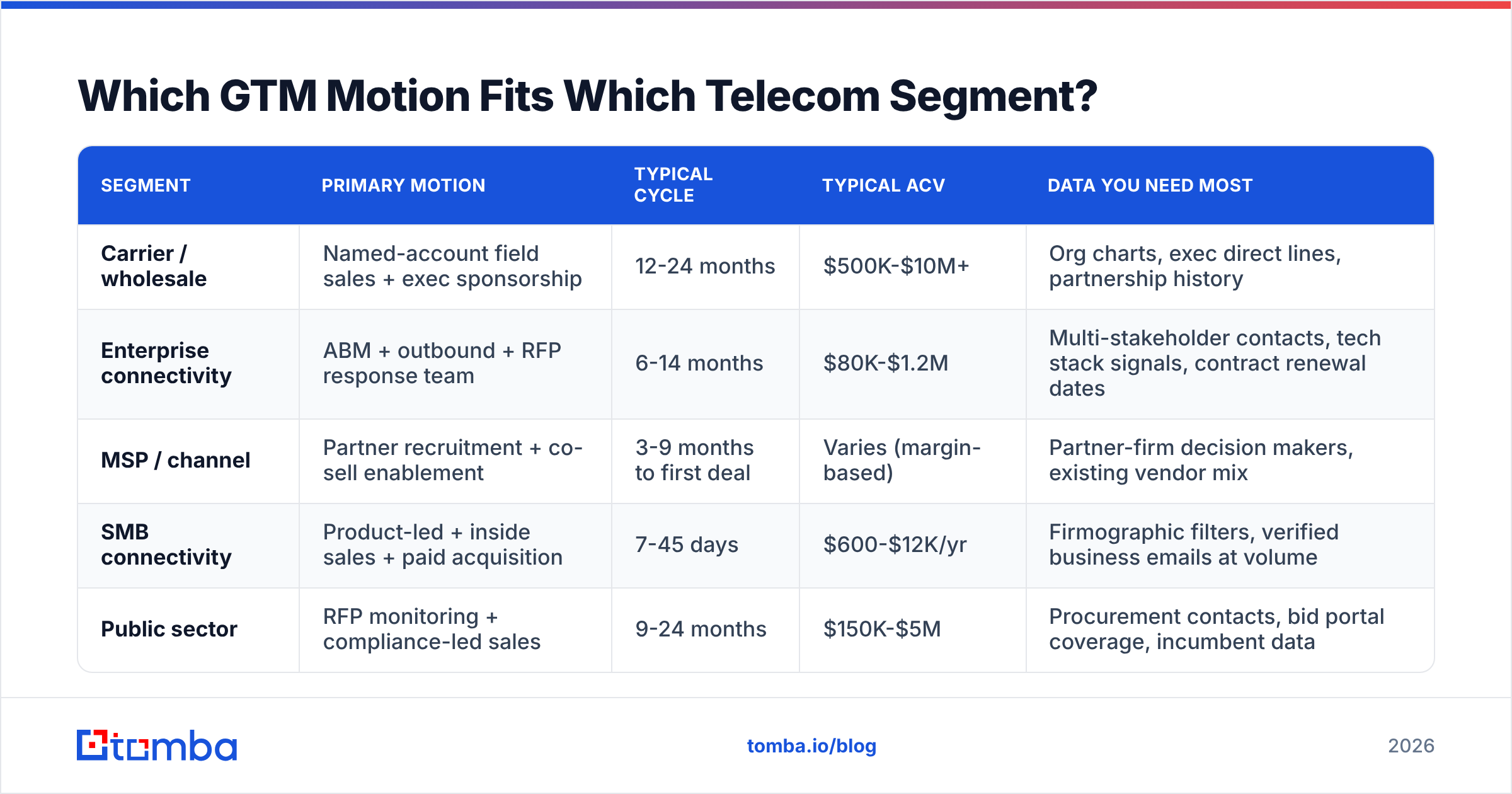
| Segment | Primary motion | Typical cycle | Typical ACV | Data you need most |
|---|---|---|---|---|
| Carrier / wholesale | Named-account field sales + exec sponsorship | 12-24 months | $500K-$10M+ | Org charts, exec direct lines, partnership history |
| Enterprise connectivity | ABM + outbound + RFP response team | 6-14 months | $80K-$1.2M | Multi-stakeholder contacts, tech stack signals, contract renewal dates |
| MSP / channel | Partner recruitment + co-sell enablement | 3-9 months to first deal | Varies (margin-based) | Partner-firm decision makers, existing vendor mix |
| SMB connectivity | Product-led + inside sales + paid acquisition | 7-45 days | $600-$12K/yr | Firmographic filters, verified business emails at volume |
| Public sector | RFP monitoring + compliance-led sales | 9-24 months | $150K-$5M | Procurement contacts, bid portal coverage, incumbent data |
Two things fall out of that table right away.
First, CAC payback swings wildly by segment. An SMB customer at $4K ARR cannot absorb a $9K cost to acquire. A carrier deal at $2M ACV absorbs $200K without blinking. Run one blended CAC target and you will starve your best segment. You will also overfeed your worst.
Second, the data need is not the same in each row. Carrier sales needs depth: twelve correct contacts inside eight companies. SMB needs breadth: forty thousand verified emails with clean filters. Buy one tool for both jobs and you pay enterprise prices for coverage you use on 2% of your volume.
Who Actually Sits on a Telecom Buying Committee?#
This is where most outbound quietly fails. Reps find the VP of IT and run a great first call. Then the deal stalls for five months, because nobody mapped the other seven people.
A real enterprise connectivity committee looks like this:
- Network architect or engineering lead. The technical judge. Cares about latency, backup paths, BGP behavior, and whether your NOC picks up at 3 a.m. Can kill the deal alone.
- VP of IT or CIO. The budget sponsor. Cares about fewer vendors and an easier board slide next quarter.
- Security or CISO delegate. Cares about SOC 2, encryption in transit, and your breach history. More and more, they hold a hard veto.
- Procurement lead. Runs the scoring matrix. Cares about comparing bids, payment terms, and leverage. Wants three vendors in play on purpose.
- Finance or FP&A. Cares about capex vs. opex and the shape of a multi-year commit.
- Site or regional operations. In multi-site rollouts, this is the person whose branches go dark if the cutover goes badly.
Map all six before your first sequence, not after your champion goes quiet. That is a data problem, and you can solve it. Pull the full contact set with a domain search on the target company. Then filter to the roles above instead of guessing at one name.

How Do You Build the Outbound Layer?#
Outbound in telecom is not volume-first. A 5,000-contact blast into enterprise IT earns spam complaints and a burned domain. Your whole buyer set inside a segment may be 3,000 people worldwide.
Build it in this order:
1. Define the account list before the contact list. For enterprise connectivity, the signals are simple. Multi-site footprint. Recent M&A, which forces network cleanup. A renewal window you can estimate. A public cloud migration. Fifty accounts with a real trigger beat 5,000 without one.
2. Map the committee per account. Six to nine named people. Teams skip this step. Use data enrichment to fill in titles, seniority, and department. Then write per-role messaging instead of one generic sequence.
3. Verify before you send. On a 14-month cycle, a 12% bounce rate does more than waste sends. It hurts your sender reputation right as the campaign that matters begins. Run the list through an email verifier first. Telecom lists carry high catch-all rates, since large operators run open mail servers. So you also want catch-all handling that returns a score you can act on.
4. Sequence by role, not by account. The network architect gets a technical brief and a latency benchmark. The CFO gets a TCO model. The procurement lead gets your RFP template and reference list. Send the same three emails to all six and you get one reply, plus six people who now know your name for the wrong reason.
5. Instrument the handoff to RFP. Telecom outbound rarely closes a deal. It earns a seat at the bid table. Treat "invited to bid" as your true outbound metric. Meetings booked is a vanity number when the process is formal.
What Does the Channel Motion Look Like?#
For most telecom vendors, channel is not a side dish. It is 40-60% of revenue, and it runs on its own math.
Direct sales math is about CAC and payback. Channel math is about partner margin, enablement cost, and attach rate. You are not buying customers. You are recruiting sellers who do not work for you and carry three rival products in the bag.
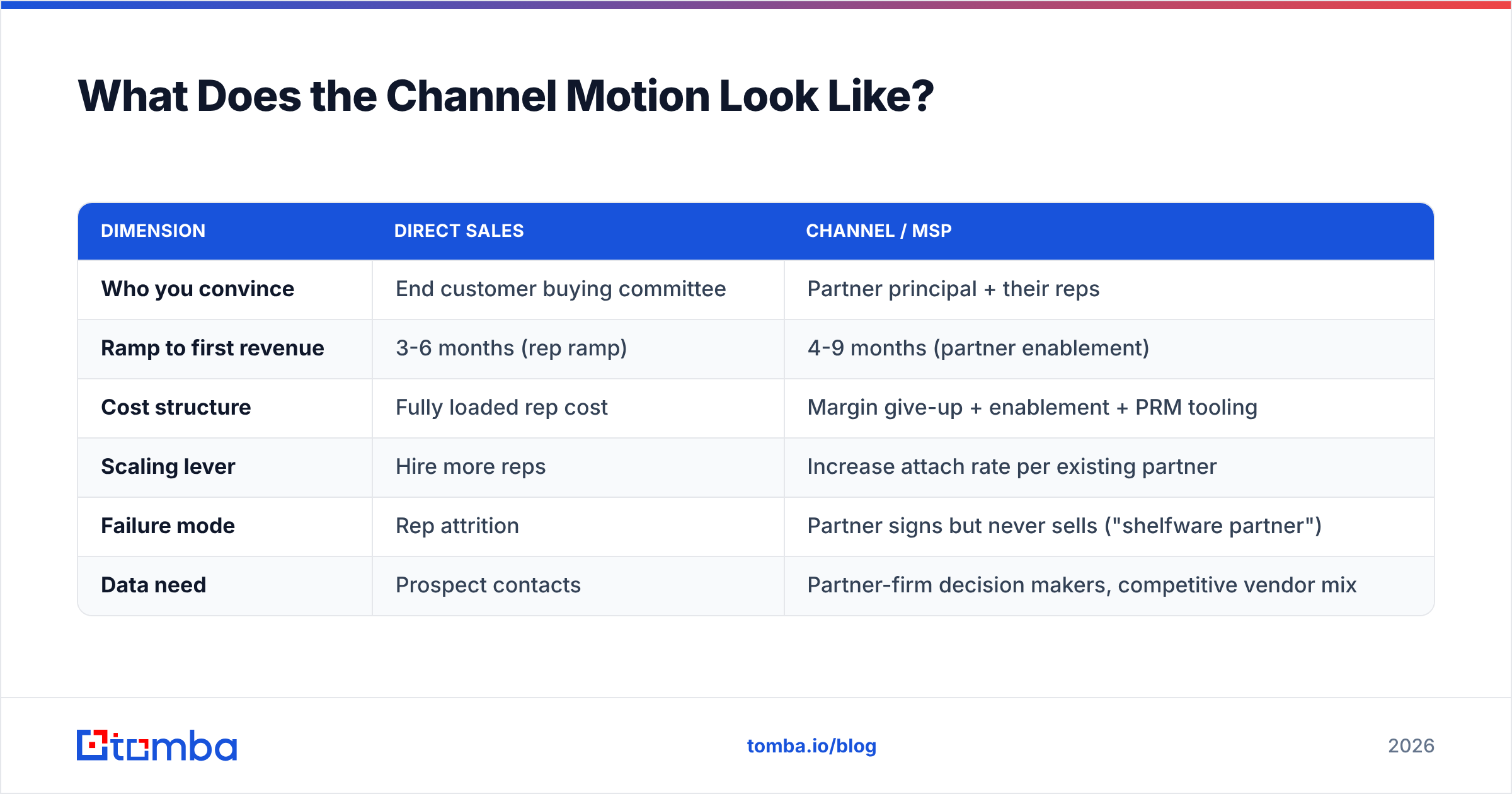
| Dimension | Direct sales | Channel / MSP |
|---|---|---|
| Who you convince | End customer buying committee | Partner principal + their reps |
| Ramp to first revenue | 3-6 months (rep ramp) | 4-9 months (partner enablement) |
| Cost structure | Fully loaded rep cost | Margin give-up + enablement + PRM tooling |
| Scaling lever | Hire more reps | Increase attach rate per existing partner |
| Failure mode | Rep attrition | Partner signs but never sells ("shelfware partner") |
| Data need | Prospect contacts | Partner-firm decision makers, competitive vendor mix |
The most common channel mistake in telecom is counting partners instead of producing ones. Signing 200 MSPs looks great in a board deck. If 12 of them drive 94% of channel revenue, the other 188 eat your enablement budget and return nothing.
Fix it with one rule. No partner gets tier-2 resources until they close a deal on tier-1 resources. And when you recruit, target firms whose vendor mix has a gap you fill. You can spot those from their public tech stack and case studies. That beats cold-calling every MSP in a directory.
How Do You Price and Package for Telecom Buyers?#
Three packaging calls decide whether your deals close or die in finance review.
- Capex vs. opex. Finance teams often set very different approval limits for each. If your offer can be booked as opex, say so in the proposal. That can be the gap between a director signing and a board reviewing.
- Commit structure. Multi-year commits with annual true-ups are the norm, and buyers expect them. A month-to-month offer reads as risk to a network buyer, not as freedom.
- SLA tiers as a real product line. In telecom, the SLA is the product for many buyers. 99.99% vs. 99.999% is not a footnote. It is a separate SKU with its own margin, and you should sell it that way.
Compare that to your own pricing page. If a buyer cannot work out a rough annual number from your public pages, procurement will assume you are pricey and anchor low. Clear tiers help. Tomba pricing lists plan-by-plan limits instead of "contact us" everywhere, and that shortens the qualifying talk even in complex deals.
What Metrics Should a Telecom GTM Team Track?#
Standard SaaS dashboards mislead you here. These metrics predict telecom revenue:
- RFP invitation rate. Of the accounts you worked, how many asked you to bid? That is the real top-of-funnel number.
- RFP win rate by segment. Track public sector, enterprise, and carrier apart. A blended number hides the truth. You may win 40% of enterprise bids and 6% of public sector bids, because your compliance docs are thin.
- Committee coverage. What share of open deals has four or more mapped and contacted people? Deals below that line slip far more often.
- Cohort pipeline velocity. Cycles span quarters, so monthly conversion is noise. Track by entry cohort.
- Partner productivity spread. Not partner count. Revenue per producing partner, and the ratio of producing to signed.
- Net revenue retention by segment. Telecom churn is lumpy. It clusters at renewal, not evenly across months. Model it at the renewal event.
Gartner has found that buyers spend only a small slice of their evaluation time with any one vendor. That is why committee coverage beats call volume. Their B2B buying journey research has the underlying data.
What Does the GTM Data Stack Need to Cover?#
A go to market strategy telecommunications teams can trust is only as good as its contact data. And in telecom, the needs are quite specific.
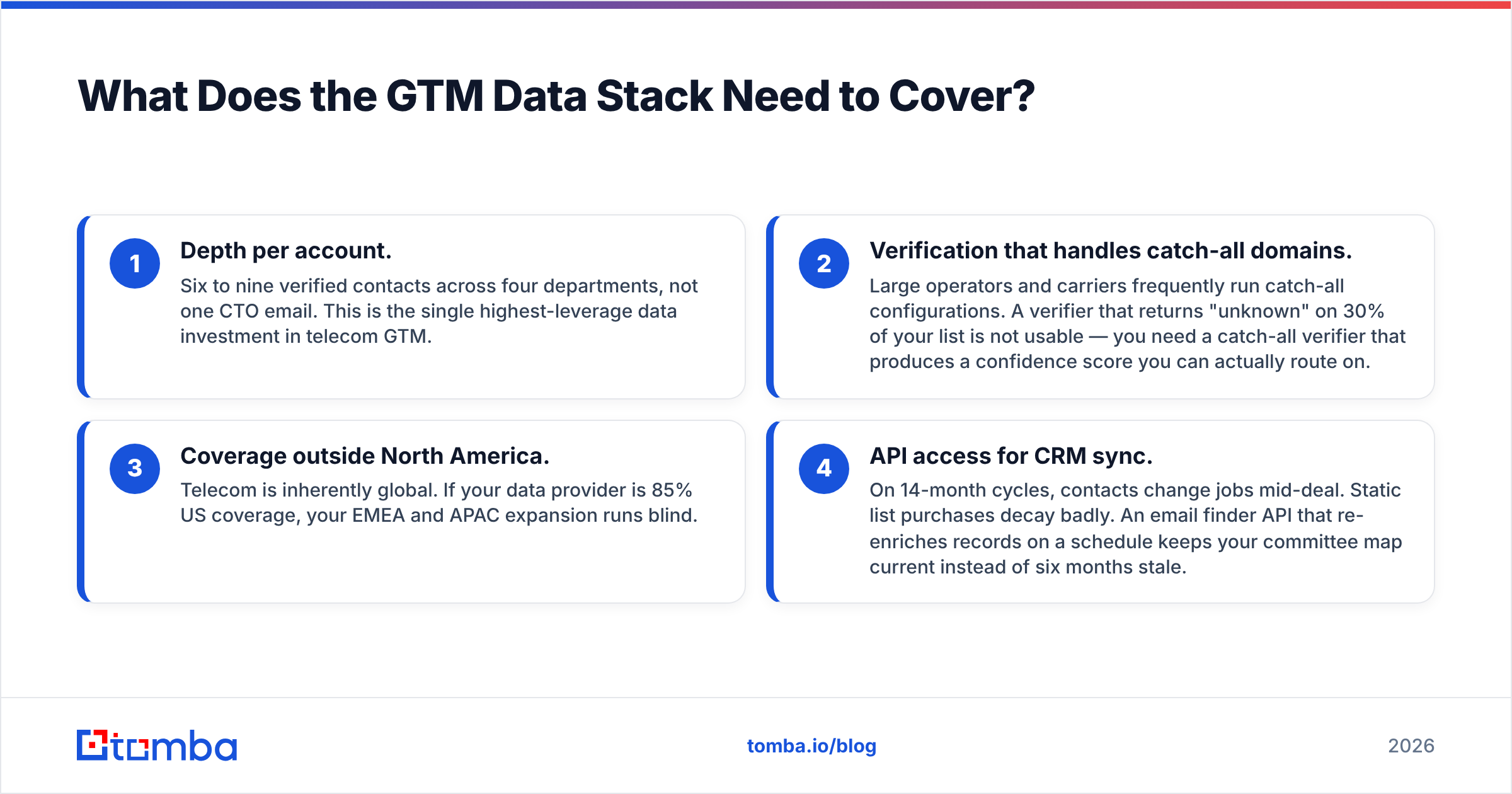
You need four things:
- Depth per account. Six to nine verified contacts across four teams, not one CTO email. This is the highest-leverage data spend in telecom GTM.
- Verification that handles catch-all domains. Large operators often run catch-all mail. A tool that returns "unknown" on 30% of your list is not usable. You need a catch-all verifier that gives a score you can route on.
- Coverage outside North America. Telecom is global by nature. If your provider is 85% US, your EMEA and APAC push runs blind.
- API access for CRM sync. On 14-month cycles, contacts change jobs mid-deal. Static list buys decay fast. An email finder API that re-enriches on a schedule keeps your committee map current.
Comparing vendors? Read G2's data intelligence category and the accuracy docs each vendor publishes before you sign an annual deal. Providers differ sharply on coverage abroad, and that gap never shows up in a US-only trial.
One note on volume. Say your SMB segment needs tens of thousands of verified contacts rather than deep account maps. A list provider like BookYourData fits that job well. Many telecom teams run both: a list source for breadth, a finder and verifier for depth. The two motions need different tools. Forcing one vendor to do both is where budget leaks.
How Do You Sequence the First Four Quarters?#
Building or rebuilding a telecom GTM from scratch? Sequence it like this.
Q1 — Segment and instrument. Pick one segment to win first. Build the account list. Map committees on the top 50. Stand up the data layer. Do not hire SDRs yet.
Q2 — Prove the motion with two reps. Run the full cycle with a small team. Measure RFP invitation rate, not meetings. Fix messaging per role, based on which person keeps stalling the deal.
Q3 — Add the second motion. Usually channel, since it compounds slowly and you want the flywheel turning early. Recruit 10 partners, not 100.
Q4 — Scale what produced. Hire against proven segment economics, with a CAC target per segment rather than one blended number.
The urge is to run every segment in year one. Resist it. Telecom cycles are long. Run four motions at once and you get no clean signal until month 18. By then the budget is gone.
Where Should You Start?#
Start with committee coverage on your top 50 accounts. Nothing else moves the number as fast. Pull the full contact set per account, verify it, and map the six roles above before you send a single email. A go to market strategy telecommunications teams can run well is built on that map, not on volume.
Do that first. Then pick one segment, prove the motion with two reps, and only scale what produced.
Ready to find emails that actually work?
Join 150,000+ professionals who stopped guessing and started sending. Free credits on signup — no credit card required.
Get the Tomba newsletter
Practical outbound tactics and product updates — once every two weeks.
About the author