How to Address CEO in Email: Rules, Examples, Mistakes
Getting the salutation wrong to a CEO costs you the reply before the pitch is read. Here are the exact greetings, formats, and openers that work in 2026 — plus the ones that get deleted.
Short answer: use "Hi [First Name]" for most CEOs, and save "Dear Mr./Ms. [Last Name]" for formal industries and for first contact at a large firm. That is how to address CEO in email in one line. The rest of this guide covers the edge cases — regions, follow-ups, and the greetings that get you deleted.
TL;DR
- Use "Hi [First Name]" for almost every CEO in North America, the UK, Australia, and most tech companies. It is the modern default. It does not read as rude.
- Switch to "Dear Mr./Ms. [Last Name]" for formal fields: law, banking, government, and healthcare boards. Do the same for first contact with a Fortune 500 CEO, or in cultures where titles carry weight (Germany, Japan, Korea, much of the Gulf).
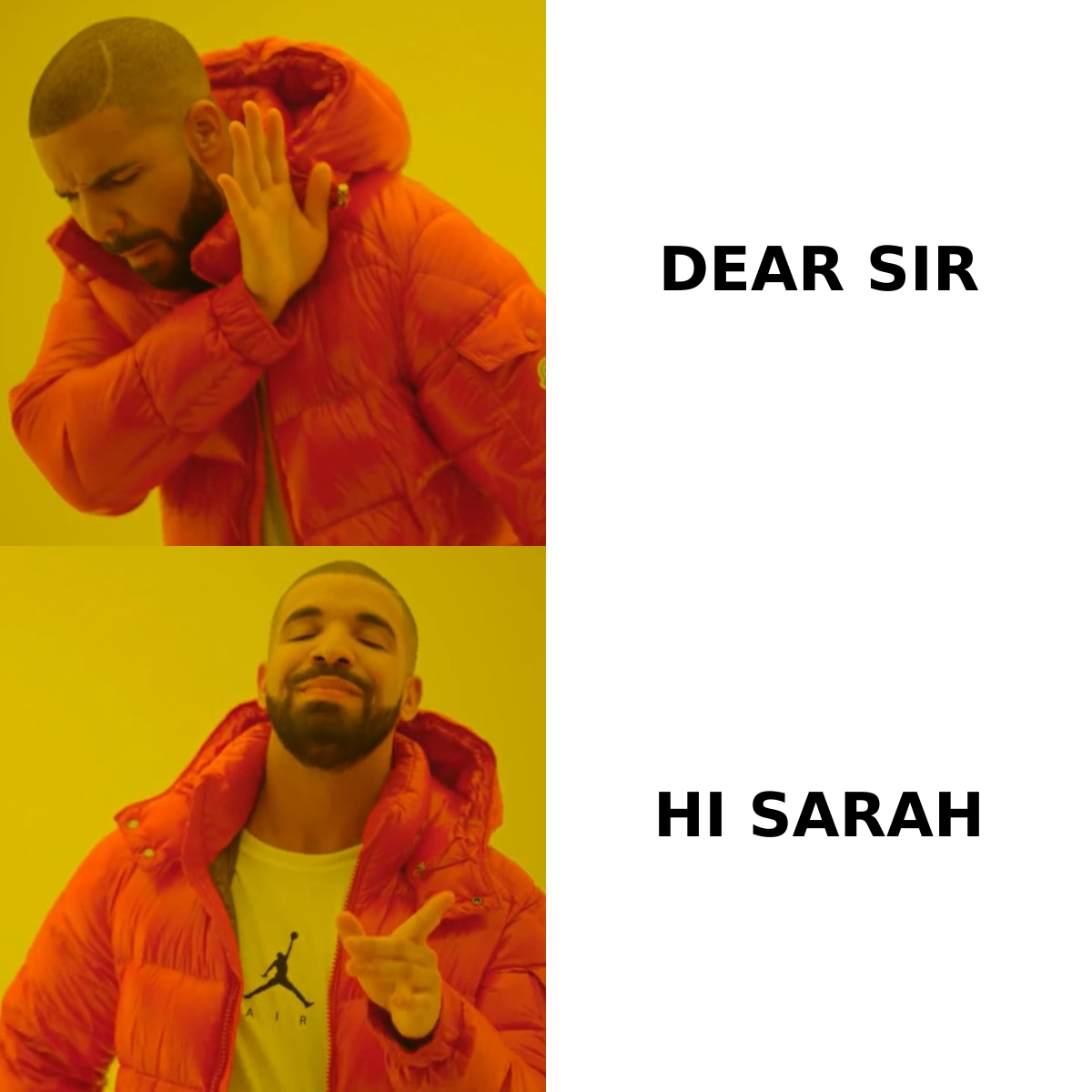
- Never write "Dear Sir/Madam," "To Whom It May Concern," "Dear CEO," or "Hey" to an executive you have never met. Each one says you did no research.
- Get the name and spelling right first. A perfect greeting on a wrong address is still a bounce.
- The greeting buys you the first line. The first line buys you the email. Spend 80% of your effort on what comes after "Hi Sarah,".
Why does the salutation to a CEO matter more than to anyone else?#
Because a CEO's inbox is the most filtered inbox in the company. Software screens it, an executive assistant screens it, and then the CEO gives it a two-second scan.
Think of it like a doorman at a private club. He is not judging your whole personality. He scans for one or two signals that say "this person belongs here." A greeting that reads mass-blasted or clumsily formal is like a rented tuxedo two sizes too big: technically correct, obviously borrowed.
The stakes are measurable. Cold emails to executives see reply rates in the low single digits. Personalization at the opening line is one of the few levers you control before the pitch starts. A wrong salutation costs more than politeness points. It moves your email from "someone who knows me" to "someone who bought my name on a list."
There is also a knock-on effect. If your greeting is generic, your subject line probably is too. Readers pattern-match fast. The salutation is the first data point in a chain of judgments about the rest.
How to address CEO in email: what is the correct format?#
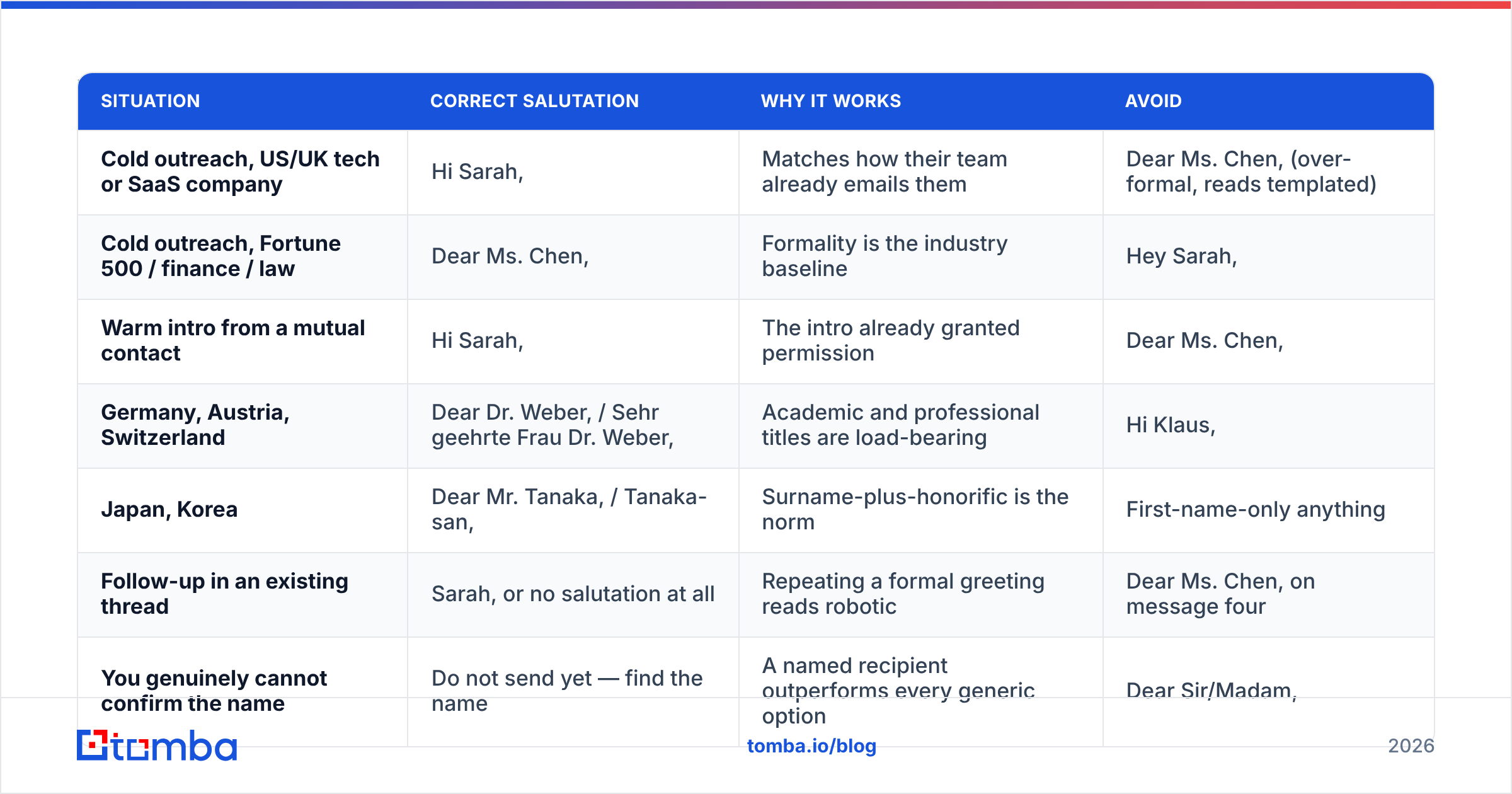
Match formality to three things: company culture, geography, and any prior connection. Here is the decision grid.
| Situation | Correct salutation | Why it works | Avoid |
|---|---|---|---|
| Cold outreach, US/UK tech or SaaS company | Hi Sarah, | Matches how their team already emails them | Dear Ms. Chen, (over-formal, reads templated) |
| Cold outreach, Fortune 500 / finance / law | Dear Ms. Chen, | Formality is the industry baseline | Hey Sarah, |
| Warm intro from a mutual contact | Hi Sarah, | The intro already granted permission | Dear Ms. Chen, |
| Germany, Austria, Switzerland | Dear Dr. Weber, / Sehr geehrte Frau Dr. Weber, | Academic and professional titles are load-bearing | Hi Klaus, |
| Japan, Korea | Dear Mr. Tanaka, / Tanaka-san, | Surname-plus-honorific is the norm | First-name-only anything |
| Follow-up in an existing thread | Sarah, or no salutation at all | Repeating a formal greeting reads robotic | Dear Ms. Chen, on message four |
| You genuinely cannot confirm the name | Do not send yet — find the name | A named recipient outperforms every generic option | Dear Sir/Madam, |
Two notes on that last row. "Dear Sir/Madam" and "To Whom It May Concern" are not neutral in 2026. They are tells. They say the sender could not find a name, or did not try. If you are stuck, the fix is research, not a softer generic. A domain search across the company's site usually surfaces the exec team's names and email pattern in under a minute.
Should you use "Dear" or "Hi" when emailing a CEO?#
"Hi" wins in most modern contexts, but the split is not arbitrary. Use this quick test.
- Check how the company writes. Read the careers page, the blog, and the CEO's LinkedIn posts. Contractions and first names? "Hi [First Name]" is safe. Full titles and third person? Go formal.
- Check the industry. Law, banking, insurance, government, hospitals, and universities skew formal. Software, agencies, DTC brands, media, and startups skew casual.
- Check headcount. Under 200 staff, the CEO still writes their own email, so "Hi [First]" fits. Over 5,000, you are writing to a filter first, and formal is safer.
- Check the geography. English-speaking markets skew casual. Germany, Japan, Korea, France, and much of the Middle East skew formal, and a dropped title can sting.
- Check your connection. A warm intro or a shared alum network earns first names at once. No connection means you earn informality with relevance.
- Check the channel. LinkedIn DMs run one notch more casual than email. "Hey Sarah —" is fine in a DM and presumptuous in an inbox.
One thing trips people up: "Dear" is not more respectful by itself. To a 40-person startup CEO who signs with an initial, "Dear Ms. Chen" reads like a vendor form letter. Respect shows up as relevance and brevity, not as vocabulary from 1994.
Also skip "Dear Mrs." Marital status is irrelevant, and a wrong guess is an unforced error. "Ms." is the default for women in business writing, per style guides like HubSpot's business communication guides.
How do you find a CEO's name and email address before you write?#
You cannot personalize a salutation you cannot verify. Here is the practical order of operations.
Step 1 — Confirm the person and spelling. The About or Leadership page is the primary source. LinkedIn is secondary and often stale for small companies. Watch for nicknames versus legal names (a CEO listed as "Kate" may sign as "Katherine"), hyphenated surnames, and accents that get stripped in addresses.
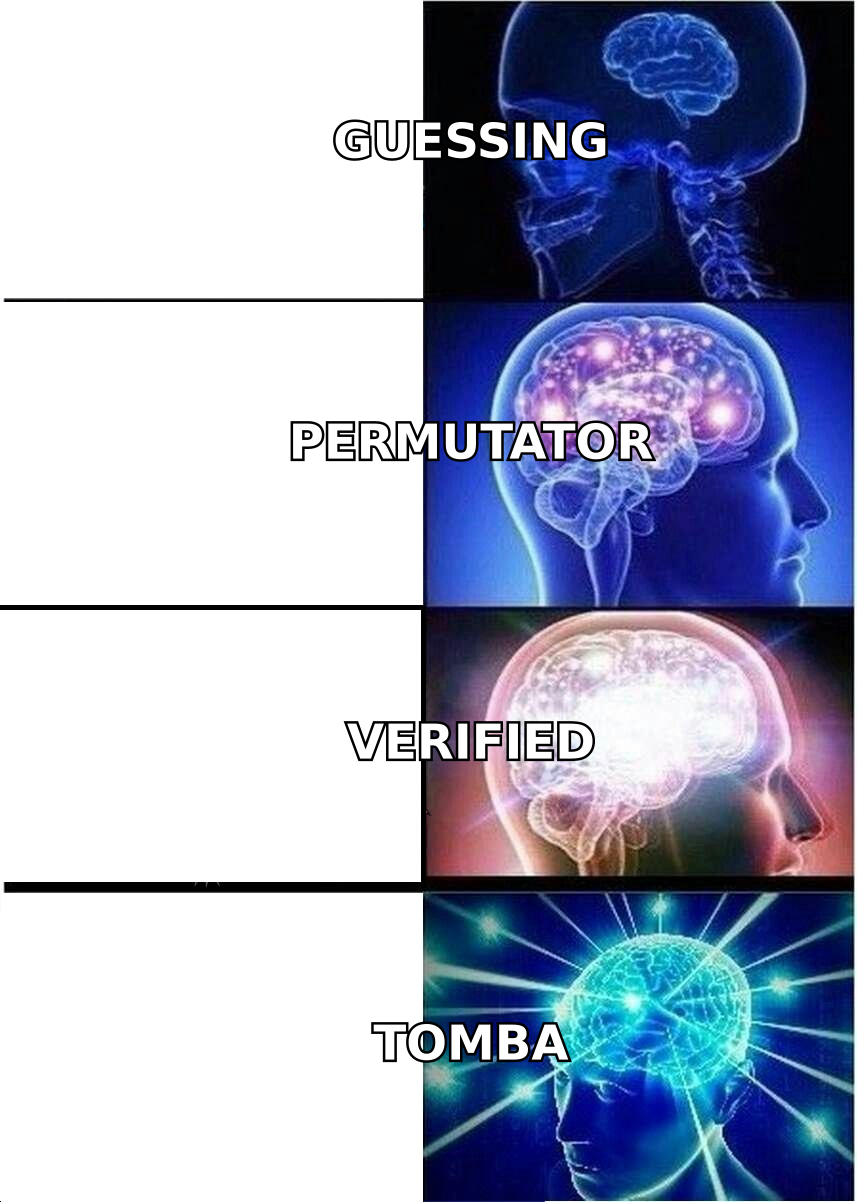
Step 2 — Determine the company email pattern. Most B2B firms use one of a few formats: first.last@, first@, flast@, or firstl@. A company email pattern check settles this in seconds instead of guessing.
Step 3 — Find the specific address. Rather than permutating and hoping, use an email finder that returns the address with its sources. Sources matter here. They tell you whether the address was scraped once in 2019 or confirmed last week.
Step 4 — Verify before sending. Executive addresses churn. CEOs change companies, domains merge after acquisitions, and vanity aliases get retired. Run the address through an email verifier first to protect your sender reputation. A bounce off a CEO's domain is worse than not sending, because that is the domain you most want to keep reaching.
Step 5 — Decide whether to route through the EA. At companies over 1,000 people, the executive assistant is often the real first reader. Addressing the CEO while writing to the EA is standard practice, not a workaround.
What accuracy actually costs you#
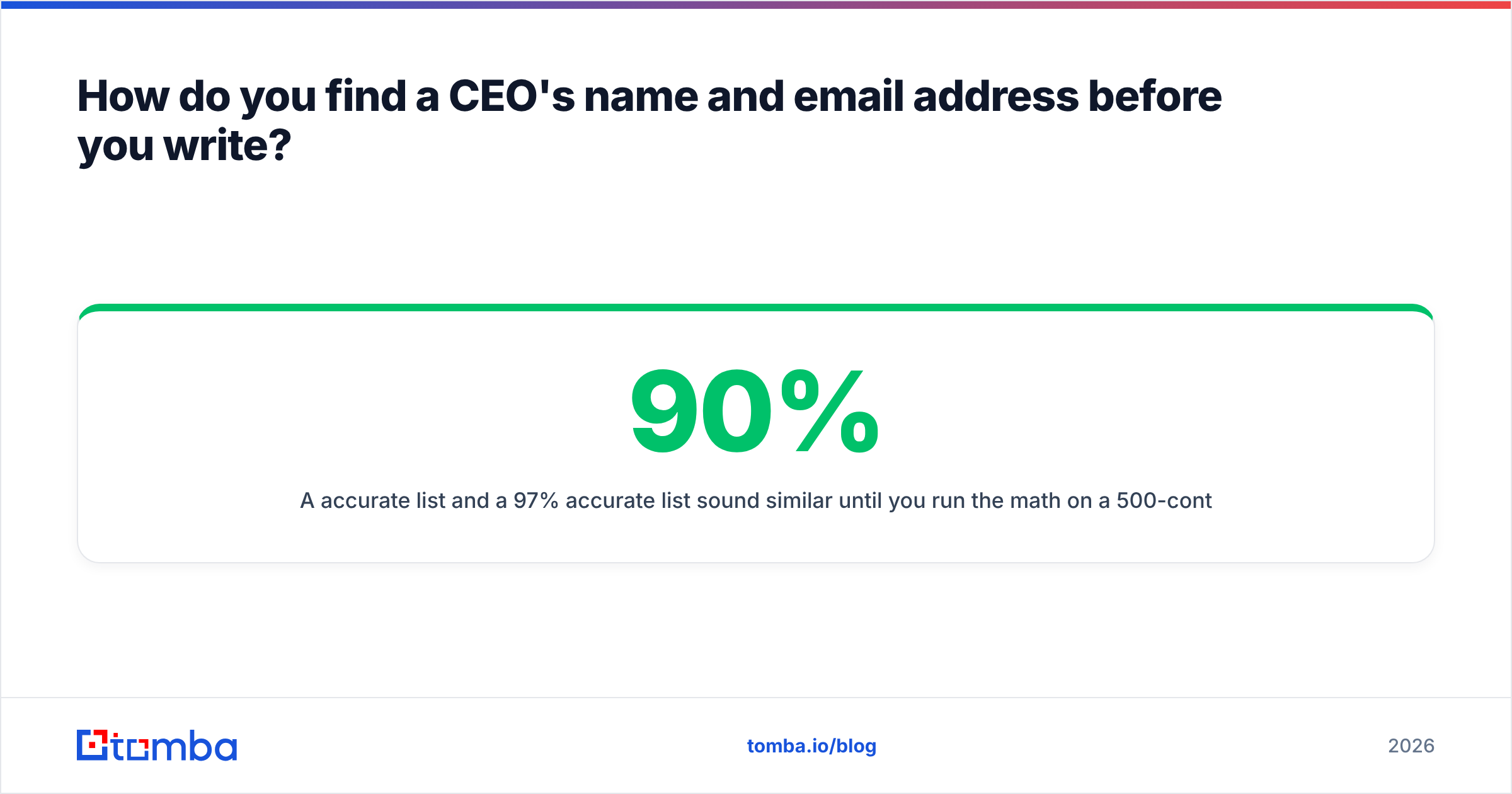
A 90% accurate list and a 97% accurate list sound alike until you run the math on 500 executive contacts. At 90%, fifty emails vanish. If even a few hard-bounce off high-value domains, your sender reputation takes a hit that drags down the other 450. Executive lists are small and expensive to build. Verification is not optional overhead.
What are the most common mistakes when addressing a CEO?#
These are the errors that show up over and over in real campaigns.
Misspelling the name. The most damaging mistake, and the most common. "Dear Mr. Stevenson" to a Mr. Stephenson ends the conversation. Copy-paste the name. Never retype it.
Using the wrong honorific or gender assumption. Names like Andrea, Jordan, Sasha, and Kim do not map to a gendered title. Thousands of non-Anglo names do not either. If you are unsure, use "Hi [First Name]." It is the safest option, not a cop-out.
Dropping earned titles. In German-speaking Europe and in academia, "Dr." and "Prof." are part of the name. Leaving them out gets noticed.
Over-titling. "Dear CEO John Smith" or "Dear Mr. CEO" is worse than plain informality. Job titles do not go in salutations.
Merge-field failures. "Hi {{first_name}}," is the loudest possible admission that you are mass-sending. Always send yourself a live test through the real sequence tool, not a preview pane.
Formality whiplash. Opening with "Dear Ms. Chen," and closing with "Cheers!" three lines later shows the email was assembled from parts.
Repeating the full salutation on every follow-up. By message three, a bare first name or no greeting reads more natural. Re-greeting formally each time makes the sequence feel automated — because it is.
What should come after the greeting?#
Most advice on how to address CEO in email stops at the salutation. The salutation is only the handshake. The first sentence is the reason you are in the room, and it does far more work.
Three openers that consistently outperform, with the reasoning:
The specific observation. "Hi Sarah, — noticed you moved the entire onboarding flow to self-serve in Q1." This proves you looked at the company, not the industry.
The trigger event. "Hi Sarah, — congrats on the Series B. Assuming headcount doubles, the SDR ramp problem usually shows up around month four." Funding rounds, exec hires, product launches, and office openings are all fair reasons to write.
The direct ask, no preamble. "Hi Sarah, — one question: who owns pipeline forecasting at [Company] now?" CEOs answer short questions at a high rate, because answering costs them ten seconds.
What to avoid right after the greeting: "I hope this email finds you well" (deletes on sight), "My name is X and I work at Y" (they can see your signature), and any sentence that starts "As a leading provider of."
Keep the whole email under 120 words. Executive attention is the scarcest resource in the funnel, and every extra sentence lowers your response rate. To pressure-test the subject line that gets it opened, a subject line tester beats guessing.
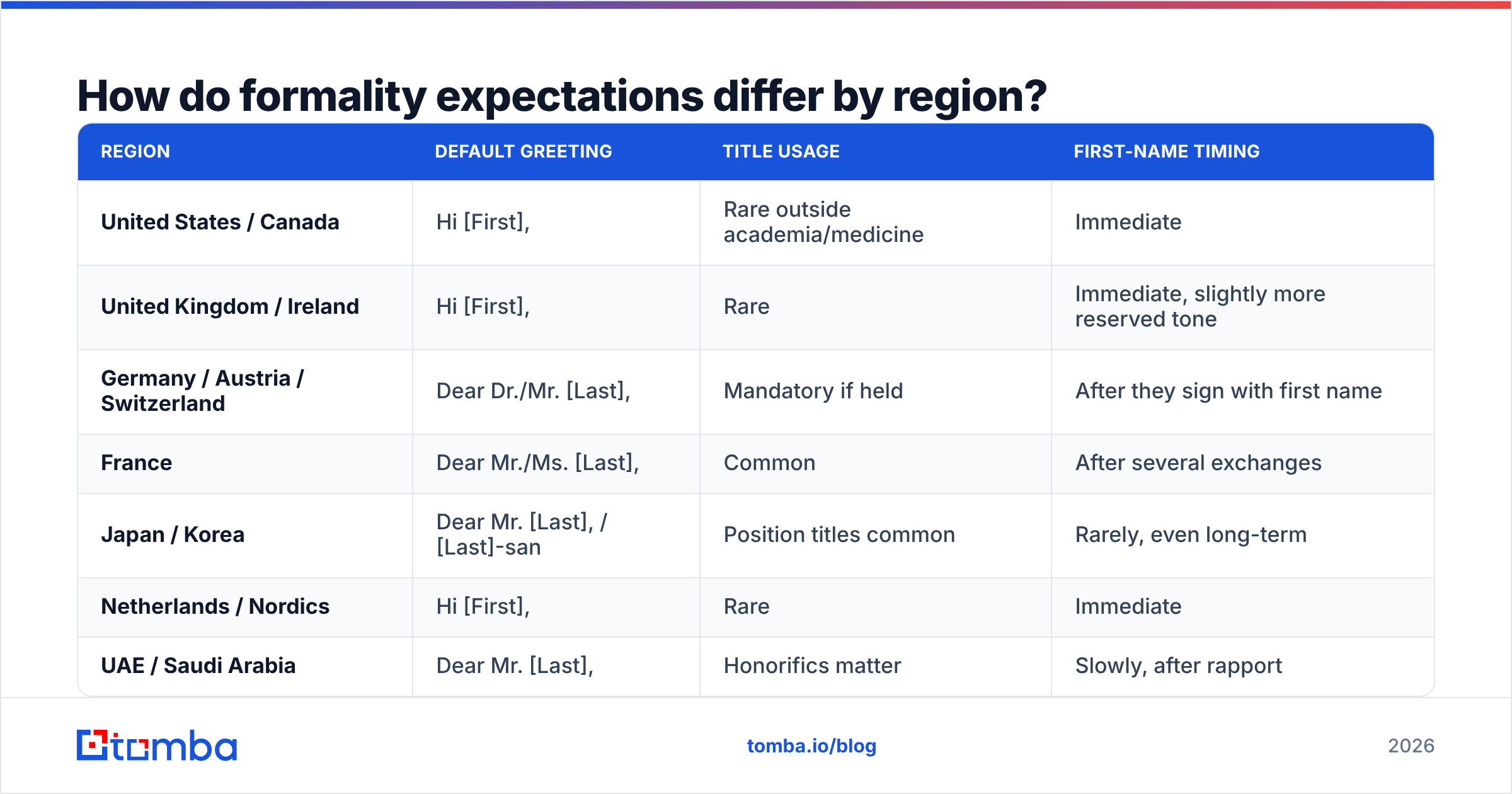
How do formality expectations differ by region?#
| Region | Default greeting | Title usage | First-name timing |
|---|---|---|---|
| United States / Canada | Hi [First], | Rare outside academia/medicine | Immediate |
| United Kingdom / Ireland | Hi [First], | Rare | Immediate, slightly more reserved tone |
| Germany / Austria / Switzerland | Dear Dr./Mr. [Last], | Mandatory if held | After they sign with first name |
| France | Dear Mr./Ms. [Last], | Common | After several exchanges |
| Japan / Korea | Dear Mr. [Last], / [Last]-san | Position titles common | Rarely, even long-term |
| Netherlands / Nordics | Hi [First], | Rare | Immediate |
| UAE / Saudi Arabia | Dear Mr. [Last], | Honorifics matter | Slowly, after rapport |
| Brazil / Latin America | Hi [First], | Moderate | Fast, warm tone expected |
| India | Dear [First] / Dear Mr. [Last], | Context-dependent | Moderate |
If you sell into more than three regions, build the greeting rule into your sequence logic. Do not leave it to each rep. One custom field on the contact record — greeting_style: casual | formal — filled in during enrichment saves a lot of cleanup later. Tools that support contact enrichment can populate country and seniority for you, and that is what the logic keys off.
How do you handle follow-ups and thread etiquette?#
Three rules cover almost every case.
Downshift formality as the thread moves. Message one: "Dear Ms. Chen." Message two, if she replied signing "Sarah": "Hi Sarah." Message three in the same thread: "Sarah," or nothing at all. Mirroring how they sign is the best signal you have.
Never re-introduce yourself. On message four, repeating your name and company tells the CEO that messages one to three came from a machine that is not tracking state.
Respect the EA's routing. If an executive assistant replies for the CEO, address the EA by name from then on. They control access. Treating them as a gatekeeper to route around is the fastest way to get filtered for good.
One more: check your domain authentication before you invest in executive outreach at all. If your SPF record or DMARC alignment is broken, the best-addressed email in the world lands in a spam folder no CEO has ever opened. Google's Postmaster Tools documentation is still the clearest baseline for what bulk senders must configure.
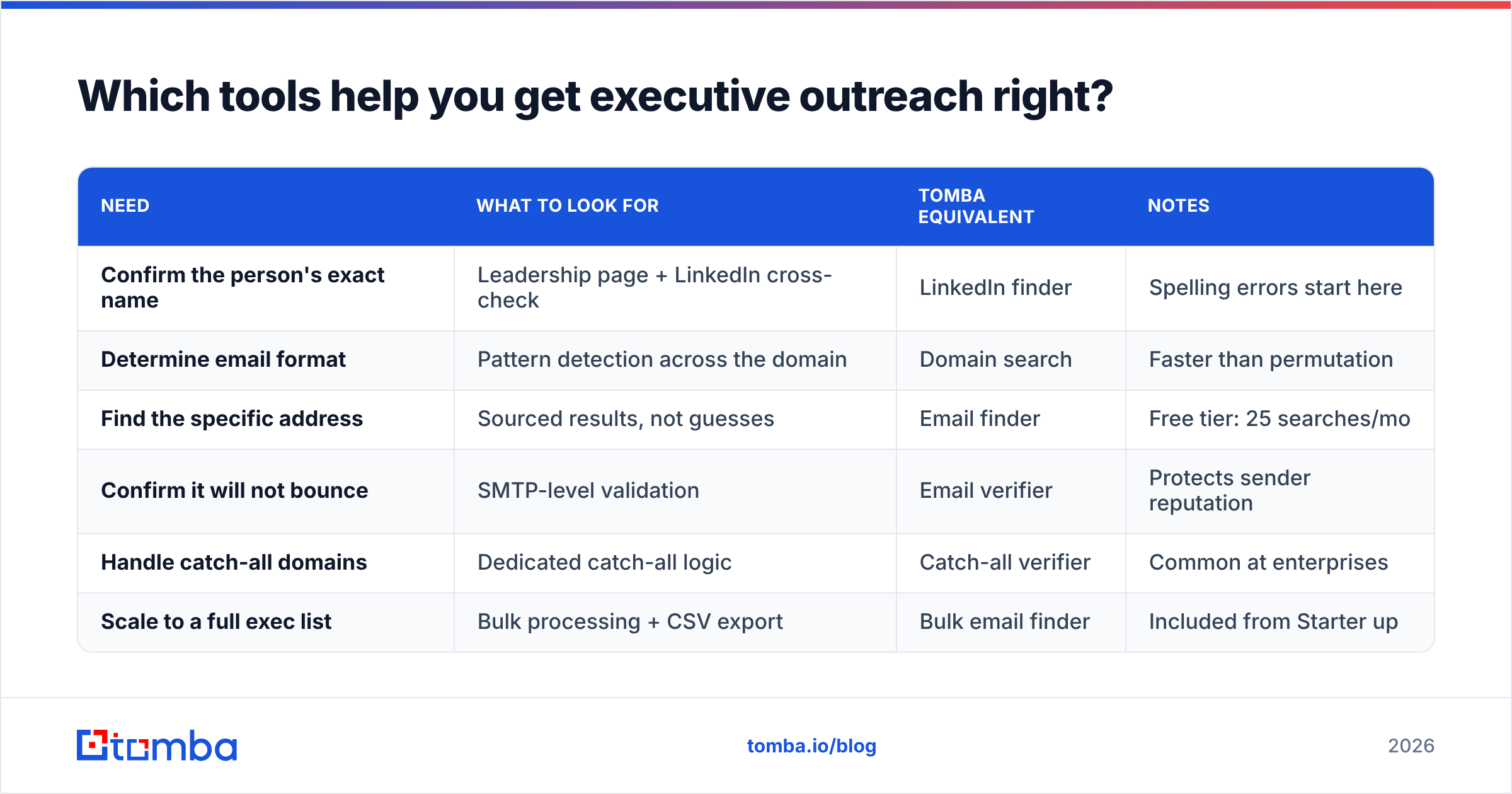
Which tools help you get executive outreach right?#
| Need | What to look for | Tomba equivalent | Notes |
|---|---|---|---|
| Confirm the person's exact name | Leadership page + LinkedIn cross-check | LinkedIn finder | Spelling errors start here |
| Determine email format | Pattern detection across the domain | Domain search | Faster than permutation |
| Find the specific address | Sourced results, not guesses | Email finder | Free tier: 25 searches/mo |
| Confirm it will not bounce | SMTP-level validation | Email verifier | Protects sender reputation |
| Handle catch-all domains | Dedicated catch-all logic | Catch-all verifier | Common at enterprises |
| Scale to a full exec list | Bulk processing + CSV export | Bulk email finder | Included from Starter up |
On cost: the free tier gives you 25 searches a month, enough to test the workflow on a handful of target accounts. Paid plans start at $49/mo (Starter), $99/mo (Growth), and $249/mo (Pro). Enterprise is priced on request, and full Tomba pricing is public.
Peers worth a look include BookYourData, which sells pay-as-you-go verified B2B lists. It fits if you would rather buy a finished list than run lookups. Both approaches work. The right one depends on whether your target accounts are known up front or found as you go. User reviews on G2 are a fair sanity check before you commit.
What does a complete CEO email look like?#
Putting the rules together, for cold outreach to the CEO of a 120-person B2B SaaS company in the US:
Subject: onboarding drop-off at [Company]
Hi Sarah,
Saw the self-serve onboarding launch in March. Companies making that switch usually see activation climb but trial-to-paid dip for about two quarters while the sales motion catches up.
We helped [Similar Company] close that gap in six weeks. Worth fifteen minutes, or should I send this to whoever owns activation now?
— Ben
Ninety-one words. First-name greeting, because it is a US SaaS company under 200 people. A specific observation instead of a compliment. A closing question that is easy to answer either way, with a redirect that often gets forwarded internally — frequently a better outcome than a CEO reply.
Compare that to the version most people send: "Dear Sir/Madam, I hope this email finds you well. My name is Ben and I am reaching out from a leading provider of activation intelligence solutions." Same offer, zero chance.
Ready to write to the right person at the right address?#
The greeting is the easy part once the name is spelled correctly and the address actually delivers. That is the step most outreach skips, and it is why most executive campaigns lose before the copy is ever judged. So the real answer to how to address CEO in email is this: get the name right, verify the address, then keep it short.
Start with the Tomba Email Finder — 25 free searches a month, sourced results, and verification built in. Find the name, confirm the address, then write the greeting.
Ready to find emails that actually work?
Join 150,000+ professionals who stopped guessing and started sending. Free credits on signup — no credit card required.
Get the Tomba newsletter
Practical outbound tactics and product updates — once every two weeks.
About the author