How to Generate Real Estate Leads in 2026: 9 Proven Channels
Zillow leads cost $300+ and convert at 2%. Here are nine real estate lead sources ranked by cost per closing, plus the exact workflow agents use to build owned pipeline instead of renting it.
TL;DR
- Portal leads (Zillow, Realtor.com) are the fastest to start and the most expensive per closing — expect $200–$400 per lead and a 1–3% conversion rate, which puts cost per closing north of $9,000.
- The cheapest closings come from channels you own: your sphere database, expired/FSBO outreach, geographic farming, and investor/commercial email prospecting.
- Speed of response beats lead quality. Contacting a lead in under five minutes raises contact rates dramatically; most agents take hours.
- For commercial, investor, and B2B referral partner outreach, you need verified contact data — not a portal subscription. That's where an email finder replaces a $1,500/mo lead subscription.
- Run two owned channels and one paid channel at once. Paid buys you today's pipeline; owned builds next year's.
What does "generating real estate leads" actually mean in 2026?#
It means one of two things, and confusing them is why most agents overspend.
Renting attention. You pay a portal, an ad network, or a lead vendor for someone else's audience. Zillow Premier Agent, Realtor.com Connections, Google Local Services Ads, Facebook lead forms. The lead shows up the day you pay. The moment you stop paying, the pipeline stops.
Owning attention. You build a database, a geographic farm, a referral network, or a content asset that produces inquiries without per-lead fees. It's slow for 90 days and then it compounds.
Most agents do 100% rented, complain about cost per closing, and never build the owned side. The fix isn't to quit paid — it's to fund owned channels with paid revenue while paid still works.
One more distinction that matters for 2026: residential lead gen and commercial/investor lead gen are different sports. Residential runs on consumer intent (someone searched "homes for sale in Tempe"). Commercial and investor lead gen runs on outbound to identified decision-makers — property managers, fund acquisitions leads, REIT asset managers, contractors, and 1031 exchange buyers. The second group is not on Zillow. You find them by name and company, then reach them directly.
Which real estate lead channels actually pay back?#
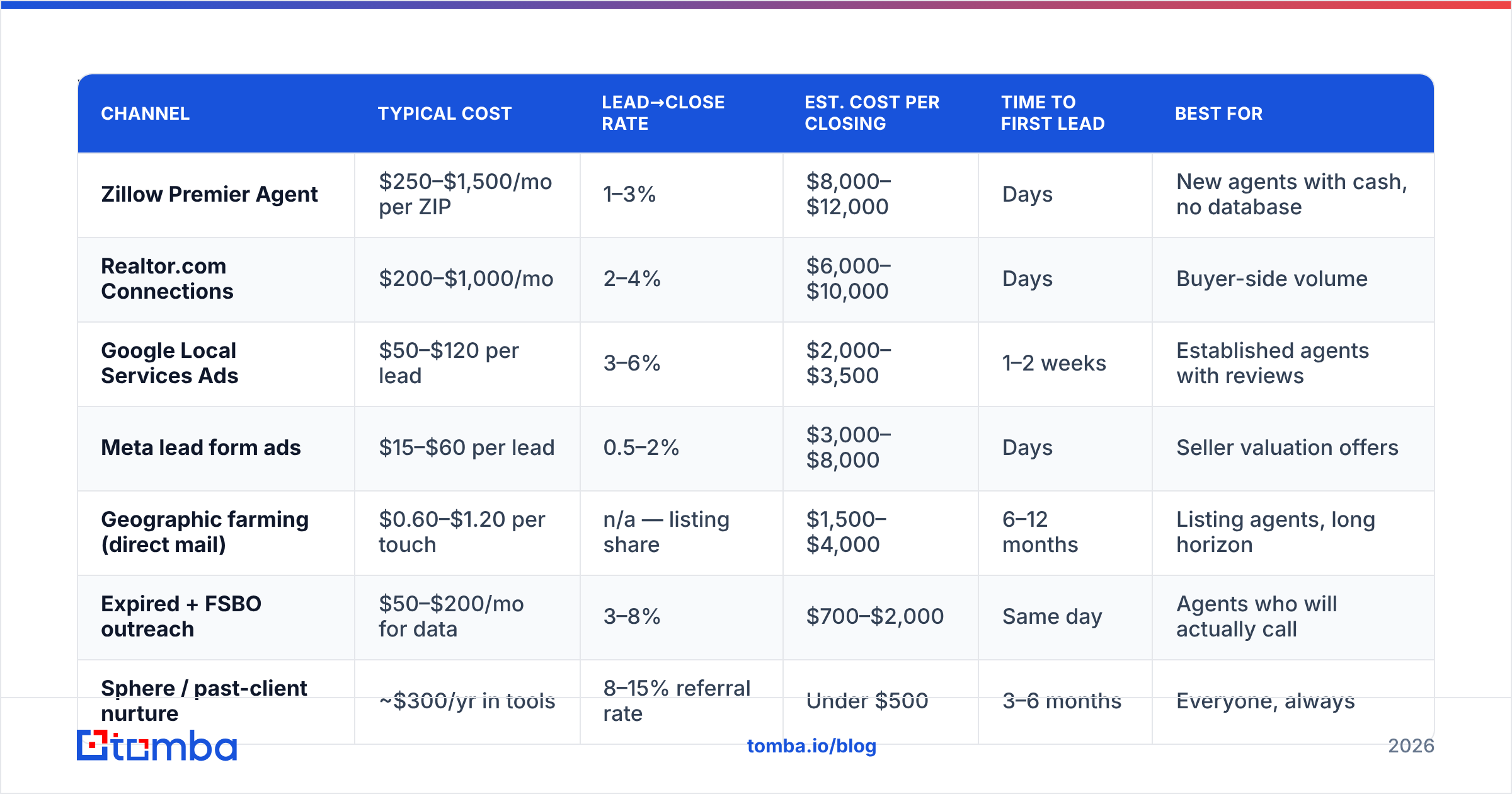
Here's the honest comparison. Costs are 2026 US market averages across mid-size metros; your numbers will vary by price point and market heat.
| Channel | Typical cost | Lead→close rate | Est. cost per closing | Time to first lead | Best for |
|---|---|---|---|---|---|
| Zillow Premier Agent | $250–$1,500/mo per ZIP | 1–3% | $8,000–$12,000 | Days | New agents with cash, no database |
| Realtor.com Connections | $200–$1,000/mo | 2–4% | $6,000–$10,000 | Days | Buyer-side volume |
| Google Local Services Ads | $50–$120 per lead | 3–6% | $2,000–$3,500 | 1–2 weeks | Established agents with reviews |
| Meta lead form ads | $15–$60 per lead | 0.5–2% | $3,000–$8,000 | Days | Seller valuation offers |
| Geographic farming (direct mail) | $0.60–$1.20 per touch | n/a — listing share | $1,500–$4,000 | 6–12 months | Listing agents, long horizon |
| Expired + FSBO outreach | $50–$200/mo for data | 3–8% | $700–$2,000 | Same day | Agents who will actually call |
| Sphere / past-client nurture | ~$300/yr in tools | 8–15% referral rate | Under $500 | 3–6 months | Everyone, always |
| Investor & commercial email outreach | $49–$99/mo for data tools | 1–3% reply→deal | $600–$2,500 | 1–2 weeks | Commercial, multifamily, wholesale |
| Open house + door knock | Time only | 4–10% | Time cost only | Same day | Newer agents with more time than cash |
Read that table twice. The channels at the bottom — the ones that cost the least per closing — are the ones almost nobody starts with, because they require work instead of a credit card.
How do you generate real estate leads without paying portal fees?#
Five owned channels, in order of how fast they pay back.
Mine your existing database first. Every agent has 200–2,000 contacts sitting in a phone, an old CRM export, and a Gmail account. Most of them are stale — wrong email, changed jobs, moved. Before you buy a single new lead, run that list through an email verifier and a phone check so your reactivation campaign doesn't bounce into a spam folder. A 40% bounce rate on your first send will damage the domain you need for the next three years.
Work expireds and FSBOs daily. These are sellers who have already proven intent by listing. They're annoyed, they're skeptical, and they get called by 12 agents. The differentiator is a specific opening: what you'd change about the pricing, the photos, or the exposure — not "are you still thinking of selling?"
Farm a geography, not a city. Pick 300–600 homes with at least 5% annual turnover. Touch them 12+ times a year with something a neighbor would keep: actual sold data, not a magnet. Farming is a two-year commitment; agents who quit at month seven paid full price for zero return.
Build a referral partner network. Divorce attorneys, estate planners, relocation managers at local employers, property managers who don't sell, contractors, 1031 exchange intermediaries. Each of these is a B2B relationship, which means you can find them the way B2B sellers do — by company, by role, by name. Use domain search on the law firm or property management company, identify the right partner or ops lead, and send one specific note about the referral flow you'd send back to them.
Prospect investors and commercial owners directly. Multifamily buyers, syndicators, fund acquisition analysts, and out-of-state landlords do not fill out portal forms. You identify the entity, find the human, verify the email, and pitch a deal. This is the highest-leverage channel for anyone doing commercial, land, or investment sales, and it's almost entirely ignored by residential-trained agents.
What's the fastest way to build a targeted real estate prospect list?#
The workflow is the same whether you're chasing property managers, commercial brokers, or referral partners.
Step 1 — Define the entity list. Pull the companies, not the people. County records for LLC-owned properties, CoStar or Crexi for commercial ownership, local business directories for referral partners, LinkedIn company search for property management firms in your metro. You want 100–300 domains to start.
Step 2 — Find the decision-maker per domain. Run each domain through a lookup that returns names, roles, and email patterns. For a 60-unit property management company, that's the owner or the director of acquisitions — not the leasing agent. Tools like the Tomba Email Finder return the verified address plus the source, so you know whether you're looking at a confirmed address or a pattern guess.
Step 3 — Verify before you send. Real estate company domains churn fast. Small brokerages fold, property managers get acquired, and email patterns change. Verification separates deliverable addresses from catch-all domains that will silently swallow your outreach. If a domain comes back catch-all, a catch-all verifier tells you whether it's worth risking a send.
Step 4 — Enrich for personalization. Company size, property count, recent transactions, tech stack. A first line that references the 14-unit building they bought in March outperforms "I saw your website" by an order of magnitude. Data enrichment fills these fields in bulk instead of one browser tab at a time.
Step 5 — Send from a warmed domain, not your brokerage address. Buy a secondary domain, warm it for three weeks, and keep daily volume under 40 per mailbox. Your brokerage email is for clients under contract. If you burn its reputation with cold volume, transaction emails start landing in spam and that is a real business problem, not a marketing one.
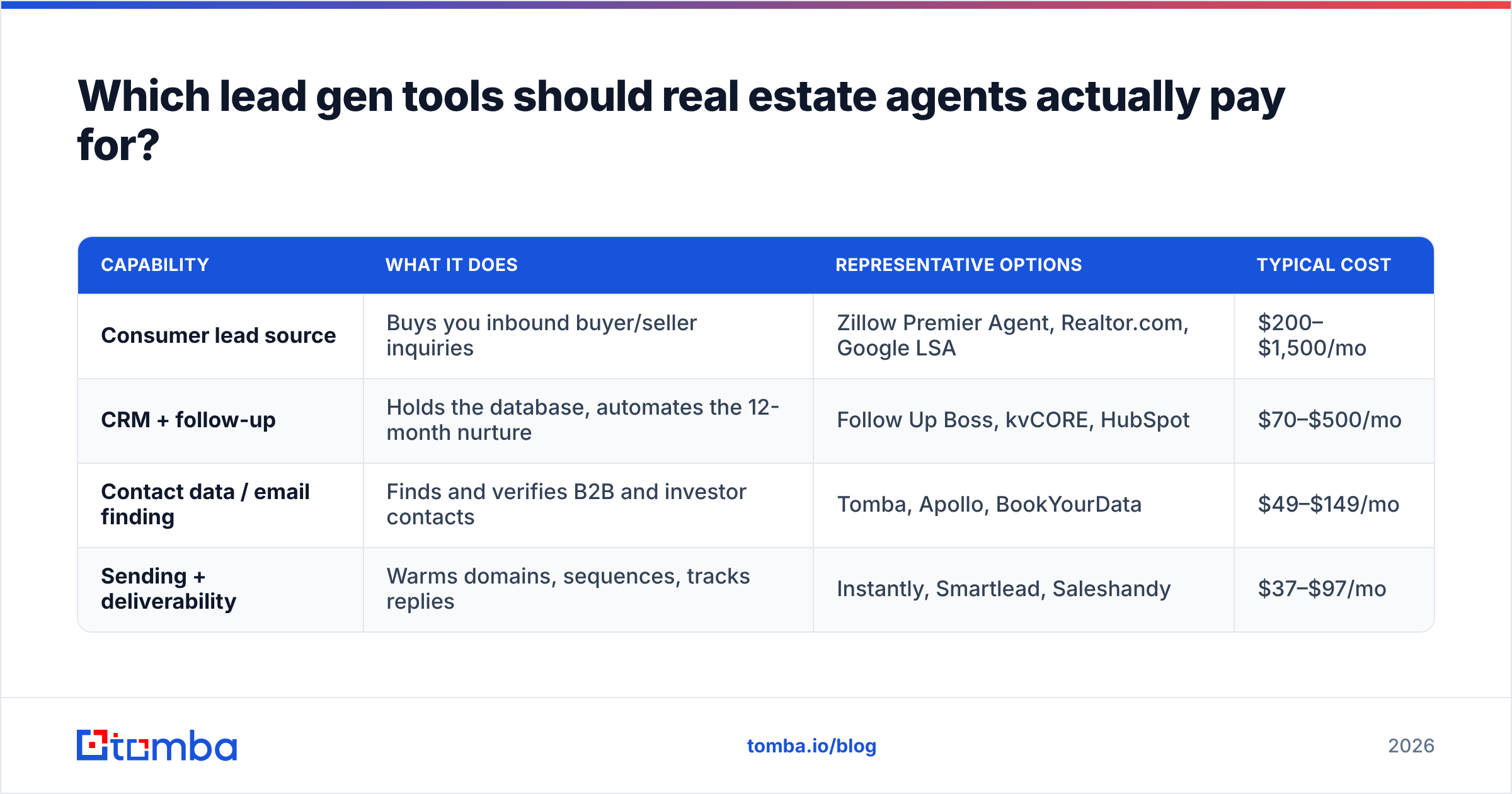
Which lead gen tools should real estate agents actually pay for?#
Stack, not shopping list. You need four capabilities and there's overlap between vendors.
| Capability | What it does | Representative options | Typical cost |
|---|---|---|---|
| Consumer lead source | Buys you inbound buyer/seller inquiries | Zillow Premier Agent, Realtor.com, Google LSA | $200–$1,500/mo |
| CRM + follow-up | Holds the database, automates the 12-month nurture | Follow Up Boss, kvCORE, HubSpot | $70–$500/mo |
| Contact data / email finding | Finds and verifies B2B and investor contacts | Tomba, Apollo, BookYourData | $49–$149/mo |
| Sending + deliverability | Warms domains, sequences, tracks replies | Instantly, Smartlead, Saleshandy | $37–$97/mo |
On the data layer specifically, the three commonly shortlisted options split cleanly by use case. BookYourData sells pre-built, pay-as-you-go verified lists — strong when you want a list handed to you and don't want a subscription. Apollo bundles a large contact database with a sequencer, which suits teams that want one login for everything and accept a heavier tool. Tomba pricing starts with a free tier at 25 searches per month, then $49/mo Starter, $99/mo Growth, and $249/mo Pro, and it's built around finding and verifying specific people at specific domains — which is the exact shape of real estate B2B prospecting, where you know the company and need the human.
If you're doing high-volume list building, run the whole thing through bulk email finder rather than one-off lookups, or wire the Tomba API into your CRM so enrichment happens at import.
For CRM selection, HubSpot's real estate CRM guidance and third-party review data on G2 are more useful than vendor demos — filter by team size, not by feature count.
How fast do you have to respond to a real estate lead?#
Under five minutes, or the lead is functionally worthless.
This is the single most replicated finding in lead response research, and it's the reason two agents can buy the same Zillow ZIP and get 3x different results. The lead filled out a form on four sites. The first agent to reach a live conversation wins, and "first" is measured in minutes, not hours.
Practical implementation:
- Auto-text within 60 seconds. Not an email. A text that names the specific property they inquired about.
- Call within 5 minutes. Then again at 20 minutes from a different number if no answer.
- Six touches over 14 days. Most agents stop after two. The third through sixth touches produce a large share of contacts.
- Move to long-term nurture, not the trash. A buyer lead that goes cold in March is often a transaction in October. Keep them in a monthly market-update sequence with a real unsubscribe link.
Your response rate on outbound email follows the same logic — the follow-ups do most of the work, not the first send.
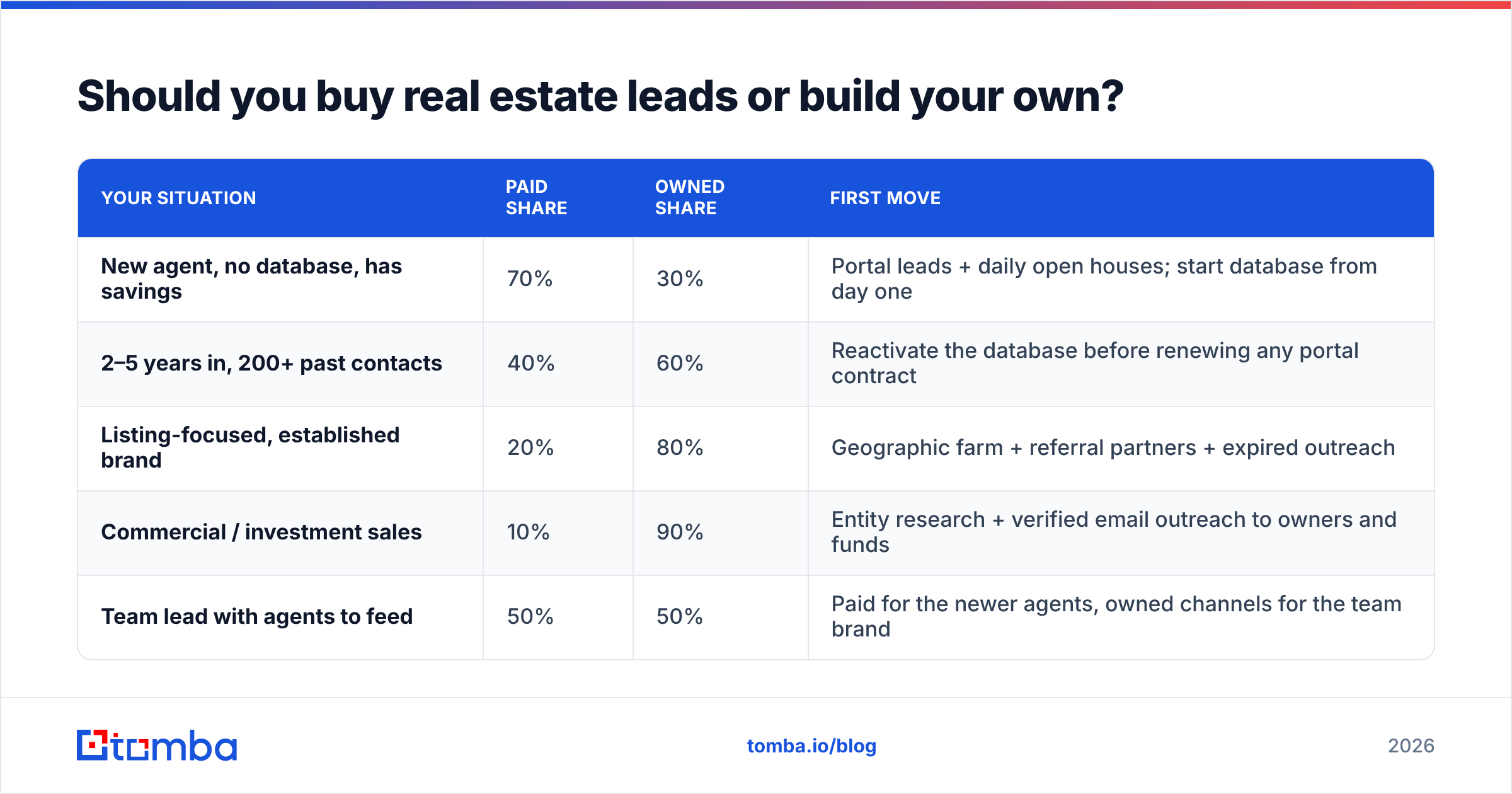
Should you buy real estate leads or build your own?#
Both, in a specific ratio. Here's the decision framework.
| Your situation | Paid share | Owned share | First move |
|---|---|---|---|
| New agent, no database, has savings | 70% | 30% | Portal leads + daily open houses; start database from day one |
| 2–5 years in, 200+ past contacts | 40% | 60% | Reactivate the database before renewing any portal contract |
| Listing-focused, established brand | 20% | 80% | Geographic farm + referral partners + expired outreach |
| Commercial / investment sales | 10% | 90% | Entity research + verified email outreach to owners and funds |
| Team lead with agents to feed | 50% | 50% | Paid for the newer agents, owned channels for the team brand |
The mistake isn't buying leads. It's buying leads for five straight years and never building anything you'd still have if the vendor doubled prices tomorrow — which they periodically do.
A useful test: if your lead vendor cut you off Monday, how many appointments would you have by Friday? If the answer is zero, your owned share is too low regardless of how good this quarter looks.
What does a 90-day real estate lead gen plan look like?#
Days 1–30 — Fix the foundation. Export every contact you have. Dedupe, verify emails and phones, tag by relationship type (past client, sphere, cold lead, referral partner). Set up a real CRM if you don't have one. Pick your one paid channel and commit to a full quarter — channel-hopping every six weeks is how agents conclude that "nothing works."
Days 31–60 — Turn on outbound. Start expired/FSBO calls at a fixed daily block, non-negotiable. Build your first 150-contact B2B list of referral partners and investors, verify it, and start a three-email sequence from a warmed secondary domain. Launch the farm mailer if farming is your play.
Days 61–90 — Measure and cut. Track cost per appointment, not cost per lead. Vendors report leads; your business runs on appointments. Kill any channel that hasn't produced an appointment in 90 days at more than 2x your target cost. Double the budget on whatever produced the cheapest appointment.
Track four numbers weekly: leads generated, contact rate, appointment rate, and cost per appointment. That's it. Dashboards with 30 metrics get ignored by week three.
Common questions#
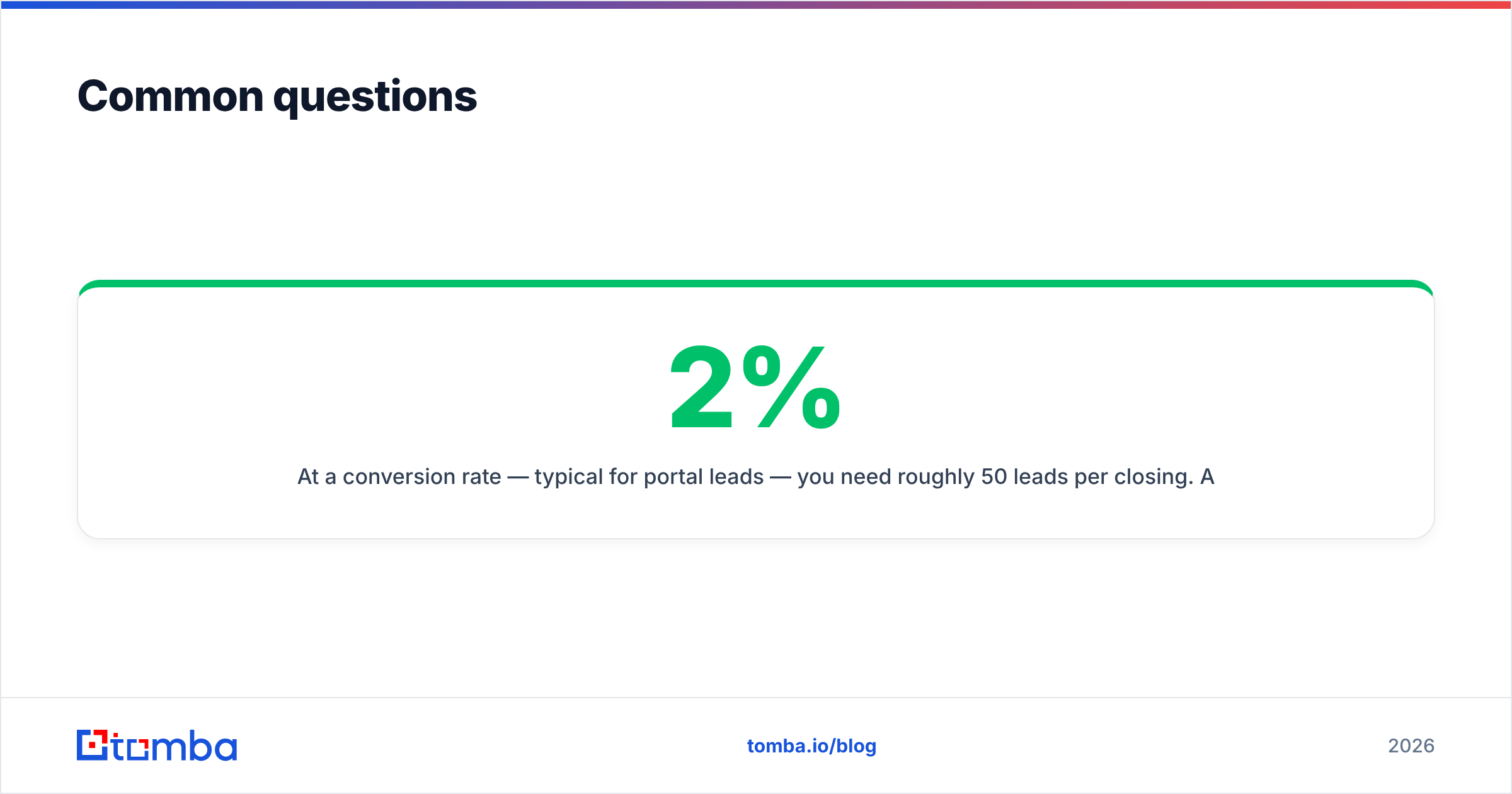
How many leads do you need to close one deal? At a 2% conversion rate — typical for portal leads — you need roughly 50 leads per closing. At an 8% rate on expired listings or a 12% referral rate from a nurtured sphere, you need 8–12. Same closing, radically different input volume, which is why channel choice matters more than volume.
Is cold email legal for real estate prospecting? B2B outreach to business addresses is permitted under CAN-SPAM in the US if you identify yourself, include a physical address, and honor opt-outs. GDPR and CASL are stricter for EU and Canadian recipients — get familiar with the rules for the jurisdictions you send to. Cold-emailing consumers about their home is a different legal category; don't.
Do you need a website for lead generation? For paid consumer leads, the portal is the website. For owned channels, yes — a single-market IDX site with a valuation offer and real neighborhood content will out-earn a generic brokerage subdomain within a year.
What about AI-generated outreach? Useful for research and first drafts, terrible when it writes the whole email. The tell is generic specificity — "I noticed your impressive portfolio." Use AI to summarize a prospect's recent activity, then write the first line yourself.
Start with the list, not the ad spend#
The agents with durable pipelines in 2026 aren't the ones with the biggest Zillow budget. They're the ones with a clean, verified, well-segmented database of past clients, referral partners, investors, and property owners — and a habit of touching it every month.
Build that list first. If you're chasing commercial owners, property managers, investors, or referral partners, start with the Tomba Email Finder: search by domain or by name, get the verified address with its source, and export straight into your CRM. The free tier gives you 25 searches a month to test the workflow on your actual target list before you pay for anything — which is more than you can say for a 12-month portal contract.
Related guides#
// get started
Find, verify and enrich your first contacts today
Start on the free plan with 25 searches a month, then scale when your team is ready.
Free plan · No credit card required · GDPR & CCPA
// about the author