Lead Generation Channels in 2026: The Complete B2B Playbook
A neutral, data-backed breakdown of the 8 lead generation channels that actually fill a B2B pipeline in 2026 — ranked by cost, speed, and intent quality.
Most B2B teams do not have a lead generation problem. They have a channel problem: too many half-built channels, none of them measured, and a pipeline that lurches whenever one of them stalls. This guide fixes that by treating each lead generation channel as a unit you can score, stack, and retire on evidence — not vibes.
TL;DR#
- There are eight durable lead generation channels in 2026: outbound email, cold calling, paid search, paid social, SEO/content, LinkedIn social selling, referrals/partnerships, and events/webinars. Everything else is a tactic inside one of these.
- Channels split by intent, not by trend. Inbound channels (SEO, referrals) capture existing demand; outbound channels (email, calling, ads) create it. You need both, weighted to your sales cycle.
- Cost-per-lead is a vanity metric without intent quality. A $4 SEO lead and a $40 outbound lead can produce the same pipeline if you measure to closed-won, not to form-fill.
- The fastest path to pipeline in 2026 is outbound + accurate contact data, because it is the only channel you fully control. Bad data is what kills it — verified emails change the math.
- Pick two primary channels, instrument them to revenue, then add a third. Teams that run six channels badly lose to teams that run two channels well.
What counts as a lead generation channel?#
A lead generation channel is a repeatable path that turns a stranger into a known, contactable prospect. The key word is repeatable — a one-off viral LinkedIn post is luck; a documented posting cadence that reliably produces inbound replies is a channel.
Think of channels like fishing spots. Each spot has a different fish (buyer), a different bait (offer), and a different cost to reach. You would not use the same rod for a mountain stream and deep-sea trawling. The mistake most teams make is buying every rod and fishing every spot for ten minutes.
Channels divide cleanly into two families:
- Demand capture (inbound): SEO/content, referrals, branded search, review sites. The buyer is already looking. You compete on being found and trusted.
- Demand creation (outbound): cold email, cold calling, paid social, ABM. The buyer is not looking yet. You compete on relevance and timing.
Neither family wins outright. Capture is cheaper per lead but capped by existing demand in your category. Creation is more expensive but uncapped and controllable — you can decide to send 2,000 more emails next week, but you cannot decide that 2,000 more people will Google your category.
Which lead generation channels matter most in 2026?#
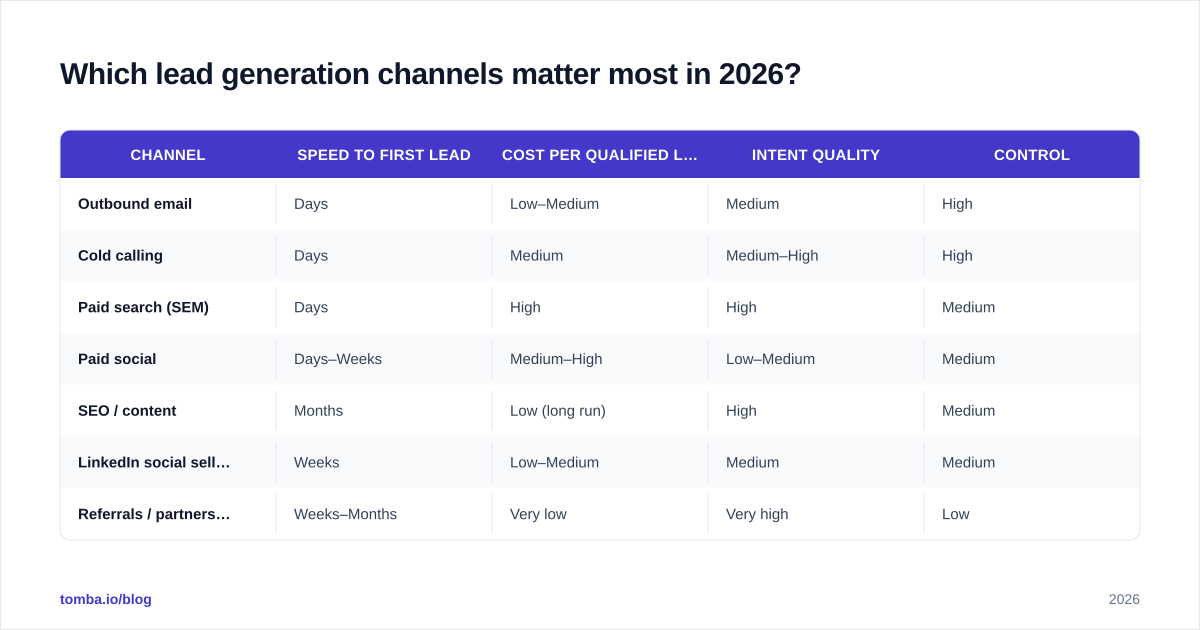
Here is the honest ranking. "Best" depends on your motion, so the table scores each channel on the four variables that actually move a decision: speed to first lead, cost per qualified lead, intent quality, and how much of the channel you control.
| Channel | Speed to first lead | Cost per qualified lead | Intent quality | Control |
|---|---|---|---|---|
| Outbound email | Days | Low–Medium | Medium | High |
| Cold calling | Days | Medium | Medium–High | High |
| Paid search (SEM) | Days | High | High | Medium |
| Paid social | Days–Weeks | Medium–High | Low–Medium | Medium |
| SEO / content | Months | Low (long run) | High | Medium |
| LinkedIn social selling | Weeks | Low–Medium | Medium | Medium |
| Referrals / partnerships | Weeks–Months | Very low | Very high | Low |
| Events / webinars | Weeks | High | Medium–High | Medium |
Read the table by your constraint. If you need pipeline this quarter, the top rows win on speed and control. If you are building a moat for next year, SEO and referrals win on cost and intent. Most teams misallocate by chasing the high-intent channels (referrals, SEO) before they have the volume or content to support them, then panic-buy ads.
According to HubSpot's research on lead generation, companies that document their channel strategy and revisit it quarterly consistently outperform those that treat channels as set-and-forget. The instrument matters more than the channel.

How do outbound channels actually work?#
Outbound is the channel you control end to end, which is why it is the default first channel for most B2B teams in 2026. The mechanics are simple; the execution is where teams fall apart.
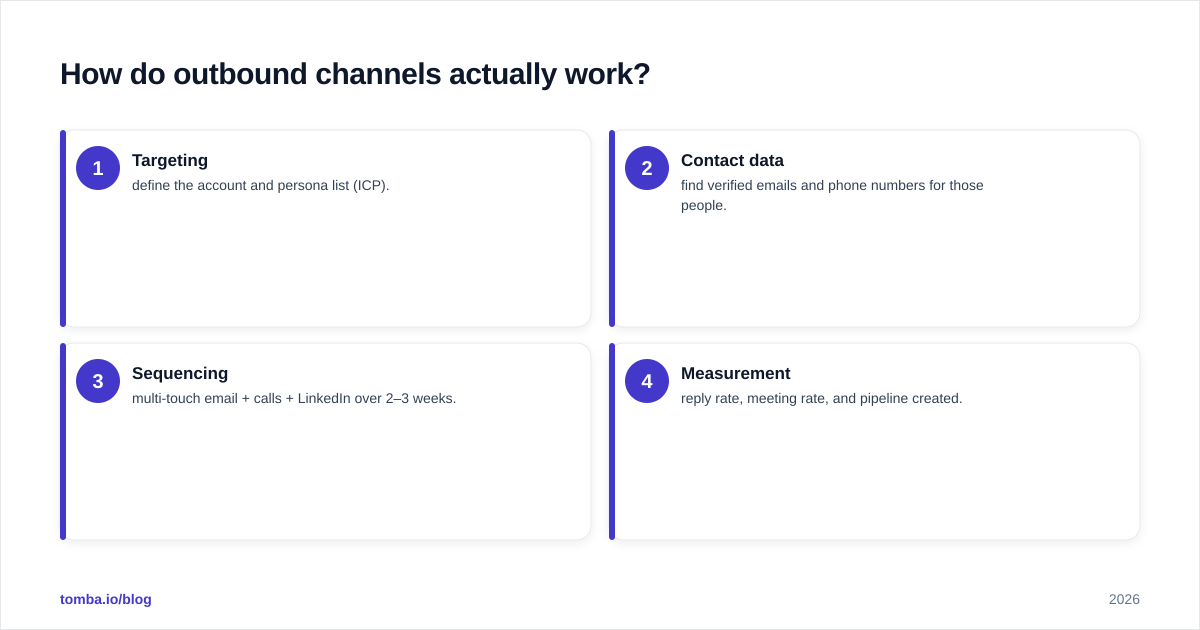
The outbound loop has four stages:
- Targeting — define the account and persona list (ICP).
- Contact data — find verified emails and phone numbers for those people.
- Sequencing — multi-touch email + calls + LinkedIn over 2–3 weeks.
- Measurement — reply rate, meeting rate, and pipeline created.
Stage 2 is where outbound silently dies. You can have a perfect ICP and a great sequence, but if 30% of your emails bounce, your sending domain reputation tanks and the other 70% land in spam. This is not a copywriting problem — it is a data problem. Verifying contacts before you send protects email deliverability and keeps your response rate honest.
This is the single highest-leverage fix in outbound: clean the list before you send. Use an email verifier to strip invalid addresses, and a domain search to find the right people at target accounts in the first place. The teams who skip this step are the same teams who conclude "cold email doesn't work" — when what actually happened is their mail never arrived.
For volume motions, a bulk email finder lets you process a whole account list at once and enrich it before it ever hits your sequencer. Treat data quality as a gate, not an afterthought.
Are inbound channels worth the wait?#
Yes — but only if you can survive the lag. Inbound channels (SEO, content, referrals) are compounding assets: nothing for months, then a flywheel that produces leads while you sleep. The catch is the months.
A realistic SEO timeline for a B2B site in a competitive category in 2026:
- Months 0–3: publishing, near-zero traffic. You are building topical coverage.
- Months 3–6: long-tail pages start ranking, first inbound leads trickle in.
- Months 6–12: category terms move into striking distance, lead volume becomes predictable.
That is why inbound is rarely a first channel for a team that needs revenue now. It is a second or third channel you start early so it matures by the time you need it. The strategic error is starting SEO the quarter you run out of outbound budget — you needed to start it three quarters earlier.
Referrals and partnerships are the highest-intent channel that exists — a warm introduction closes at multiples of any cold touch — but they are the least controllable. You cannot dial up referrals on demand; you can only build the relationships and reputation that produce them. Treat referrals as the output of doing the other channels well, not as a channel you can force.
How do you choose the right channel mix?#
Start from your sales cycle length and average deal size, because those two numbers dictate what you can afford and how fast you need feedback.
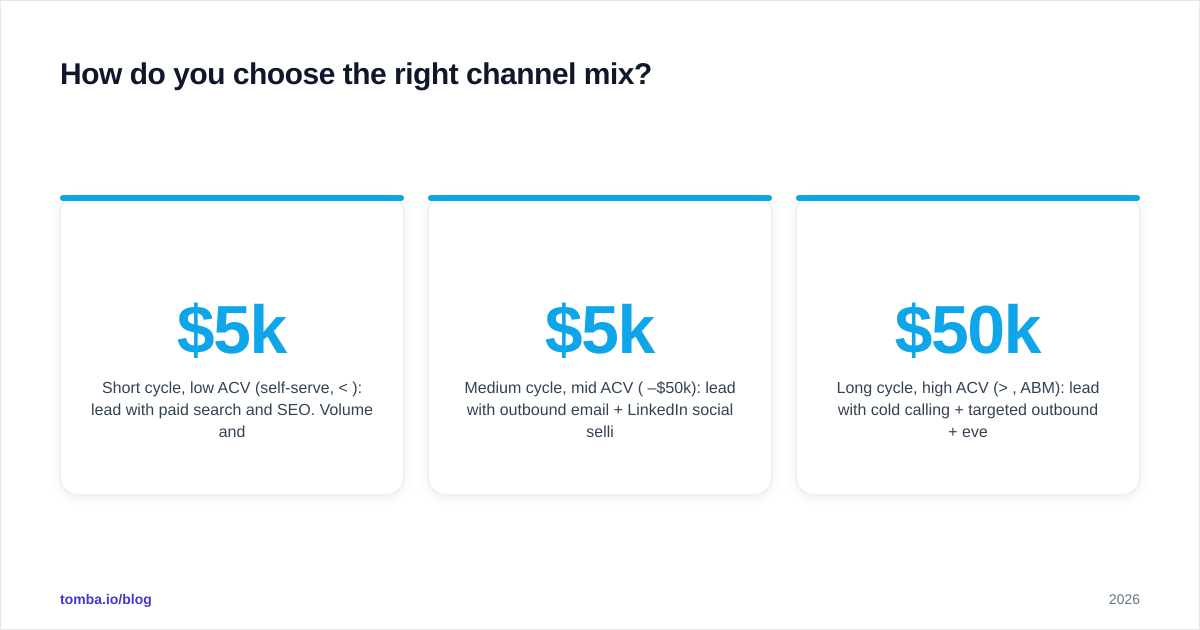
Use this decision frame:
- Short cycle, low ACV (self-serve, < $5k): lead with paid search and SEO. Volume and low cost-per-lead matter most; you cannot afford human-heavy outbound.
- Medium cycle, mid ACV ($5k–$50k): lead with outbound email + LinkedIn social selling, supported by content. This is the classic B2B SaaS motion.
- Long cycle, high ACV (> $50k, ABM): lead with cold calling + targeted outbound + events, because every account justifies human effort and multi-threading.
The mix is not static. A common and correct progression is: start with one controllable channel (outbound) to prove the ICP and messaging, then layer a compounding channel (SEO) once you know what messaging converts, then add referrals as your customer base grows. Gartner's guidance on B2B buying consistently shows buyers move across many touchpoints before talking to sales — which is the real argument for running more than one channel, but not the argument for running all eight badly.
The shiny-object trap is real. Every quarter there is a new channel everyone swears by. The discipline is to add a channel only when your current channels are instrumented and you have spare execution capacity — not because a competitor posted a screenshot of one good week.
What does it cost to run each channel?#
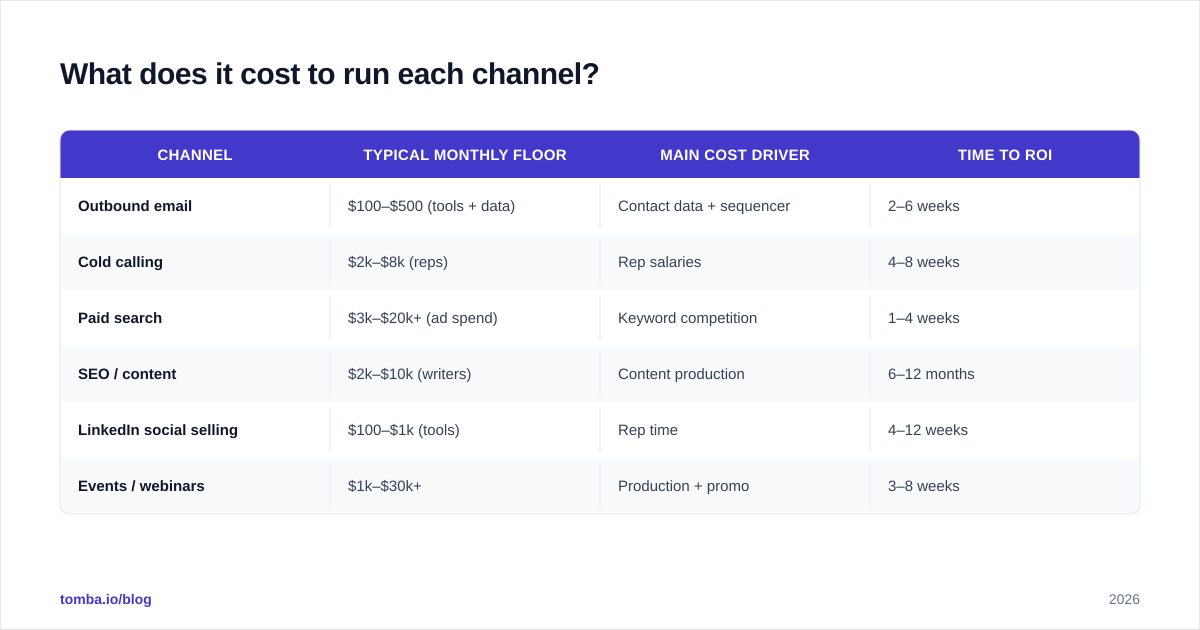
Budget reality, not list prices. The numbers below are directional ranges for a B2B team in 2026 and will vary by category, but the ratios hold.
| Channel | Typical monthly floor | Main cost driver | Time to ROI |
|---|---|---|---|
| Outbound email | $100–$500 (tools + data) | Contact data + sequencer | 2–6 weeks |
| Cold calling | $2k–$8k (reps) | Rep salaries | 4–8 weeks |
| Paid search | $3k–$20k+ (ad spend) | Keyword competition | 1–4 weeks |
| SEO / content | $2k–$10k (writers) | Content production | 6–12 months |
| LinkedIn social selling | $100–$1k (tools) | Rep time | 4–12 weeks |
| Events / webinars | $1k–$30k+ | Production + promo | 3–8 weeks |
Outbound email has the lowest floor because the tooling is cheap — the expensive part is good data, not the software. That is also why it is the most forgiving channel for a small team: you can run a real outbound motion for a few hundred dollars a month, where a comparable paid-search presence starts in the thousands. For reference on stacking the tools, see Tomba pricing, which starts free (25 searches/mo) and scales to $49/mo Starter.
Whatever channel you pick, measure to closed-won revenue, not to leads. A channel that produces 100 cheap leads that never close is more expensive than a channel that produces 10 expensive leads that do. Cost-per-lead is the metric that flatters lazy channels.
How do you measure channel performance correctly?#
One rule: attribute to pipeline and revenue, not to volume. Every channel will happily report a big top-of-funnel number. The number that matters is what comes out the bottom.
Track each channel on these five metrics:
- Leads created — raw volume, the vanity number you start from.
- Qualified rate — what % become MQLs/SQLs. This is where weak channels expose themselves.
- Meeting rate — leads that turn into real conversations.
- Pipeline created — dollar value entering the funnel.
- Closed-won — the only number the CFO cares about.
A channel that looks expensive at the lead stage often looks cheap at the revenue stage, and vice versa. Cross-reference these against the marketing qualified lead definition your sales and marketing teams have agreed on — if they have not agreed on one, your attribution is fiction before you start.
For a deeper read on independent tool and channel benchmarks, G2's category data is a useful sanity check against vendor-supplied numbers, which always flatter the vendor.
Common channel mistakes (and the fix)#
- Running too many channels at once. Two channels run well beats six run badly. Fix: pick two, instrument them, earn the third.
- Treating bad data as a copywriting problem. Bounces and spam are data failures. Fix: verify before you send, every time.
- Starting compounding channels too late. SEO needs a year. Fix: start it the quarter before you need it.
- Measuring to form-fills. Volume lies. Fix: attribute to pipeline and closed-won.
- Abandoning channels before maturity. Most channels look dead at week three. Fix: commit to a channel's real time-to-ROI before you judge it.
Which channel should you start with?#
If you are starting from zero in 2026 and need pipeline you can control, start with outbound — and start by fixing the data, because that is the variable that decides whether the channel works at all. Find the right people at your target accounts, verify their contact details, and only then write the sequence.
Tomba Email Finder is built for exactly this first step: find verified professional emails by domain, name, or company so your outbound channel launches on clean data instead of a bounce list. Pair it with the built-in email verifier and data enrichment, start on the free tier (25 searches/mo), and scale to the $49/mo Starter plan once the channel proves out. Get the data right first, and every other channel decision gets easier.
// get started
Find, verify and enrich your first contacts today
Start on the free plan with 25 searches a month, then scale when your team is ready.
Free plan · No credit card required · GDPR & CCPA
// about the author