How to Get Clients for App Development: 9 Proven Channels
Referrals dry up. Upwork races to the bottom. Here are nine channels app development agencies actually close deals from in 2026 — with cost, ramp time, and close rates compared side by side.
TL;DR
- Referrals close best but do not scale on demand. Treat them as your floor, not your pipeline.
- Targeted outbound to funded startups and non-technical founders is the fastest controllable channel — if your list is clean and your first line is specific.
- Marketplaces like Upwork and Clutch work, but they cost you 10-20% margin and put you in a price fight you did not choose.
- Productized offers ("MVP in 6 weeks, $28k, fixed scope") convert 2-3x better than "we build custom apps."
- The bottleneck for most agencies is not messaging. It is a contact list full of bounced, generic, and role-mismatched addresses.
Why is getting clients for app development so hard right now?#
Because the supply side exploded and the demand side got pickier.
Every founder with a Cursor subscription can ship a prototype. That did not kill demand for real app development shops — it moved it. The projects worth having in 2026 are the ones where a prototype hit a wall: auth that actually holds, offline sync, App Store compliance, HIPAA, a backend that survives 50k users. Those buyers are harder to find because they do not post on job boards. They ask a peer, or they answer an email that sounds like it was written by someone who read their release notes.
Meanwhile the easy channel — inbound from a portfolio site — has been flattened by AI search results. Your "custom mobile app development company" page is competing with an answer box.
So the practical question is not "how to get clients for app development" in the abstract. It is: which channels give you deals you can predict, at a cost you can absorb, in a timeframe your runway allows?
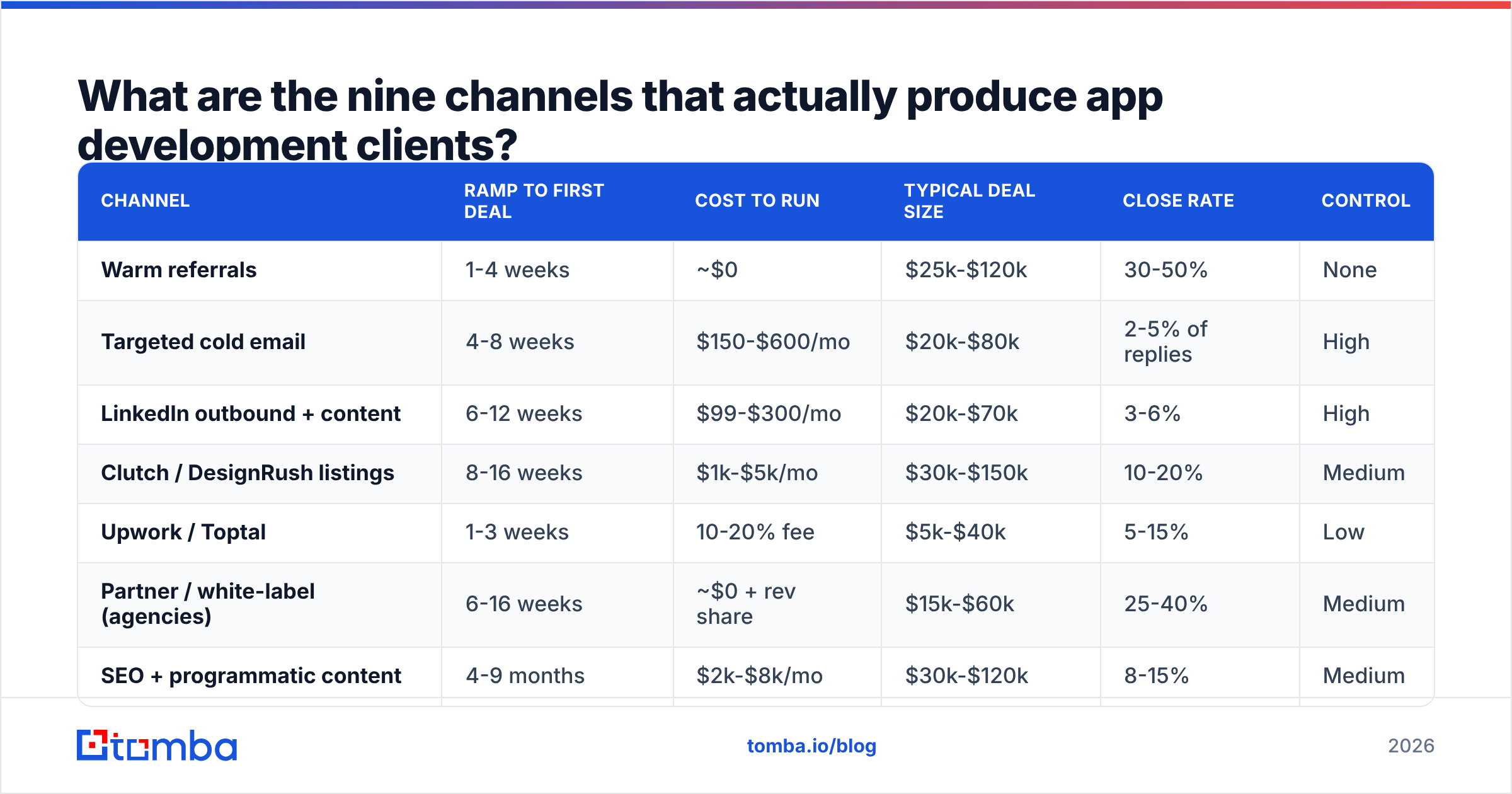
What are the nine channels that actually produce app development clients?#
Here is the honest ranking. "Ramp" means how long before the first signed deal, assuming you start today with no existing assets in that channel.
| Channel | Ramp to first deal | Cost to run | Typical deal size | Close rate | Control |
|---|---|---|---|---|---|
| Warm referrals | 1-4 weeks | ~$0 | $25k-$120k | 30-50% | None |
| Targeted cold email | 4-8 weeks | $150-$600/mo | $20k-$80k | 2-5% of replies | High |
| LinkedIn outbound + content | 6-12 weeks | $99-$300/mo | $20k-$70k | 3-6% | High |
| Clutch / DesignRush listings | 8-16 weeks | $1k-$5k/mo | $30k-$150k | 10-20% | Medium |
| Upwork / Toptal | 1-3 weeks | 10-20% fee | $5k-$40k | 5-15% | Low |
| Partner / white-label (agencies) | 6-16 weeks | ~$0 + rev share | $15k-$60k | 25-40% | Medium |
| SEO + programmatic content | 4-9 months | $2k-$8k/mo | $30k-$120k | 8-15% | Medium |
| Communities (Slack, Discord, IndieHackers) | 4-10 weeks | Time only | $10k-$50k | 10-20% | Medium |
| Paid search (Google Ads) | 2-6 weeks | $3k-$15k/mo | $30k-$100k | 5-10% | High |
Two patterns fall out of that table.
First, the channels with the highest close rates (referrals, partnerships) are the ones you control least. You cannot decide on a Tuesday to receive three referrals.
Second, the channels you fully control (cold email, LinkedIn, paid) have low per-touch close rates but predictable math. If 1 in 40 targeted emails books a call and 1 in 5 calls becomes a proposal and 1 in 3 proposals closes at $45k, you know exactly what 1,200 contacts a month is worth. That predictability is the entire point.
How do you build a target list that is actually worth emailing?#
Start from a trigger, not a title.
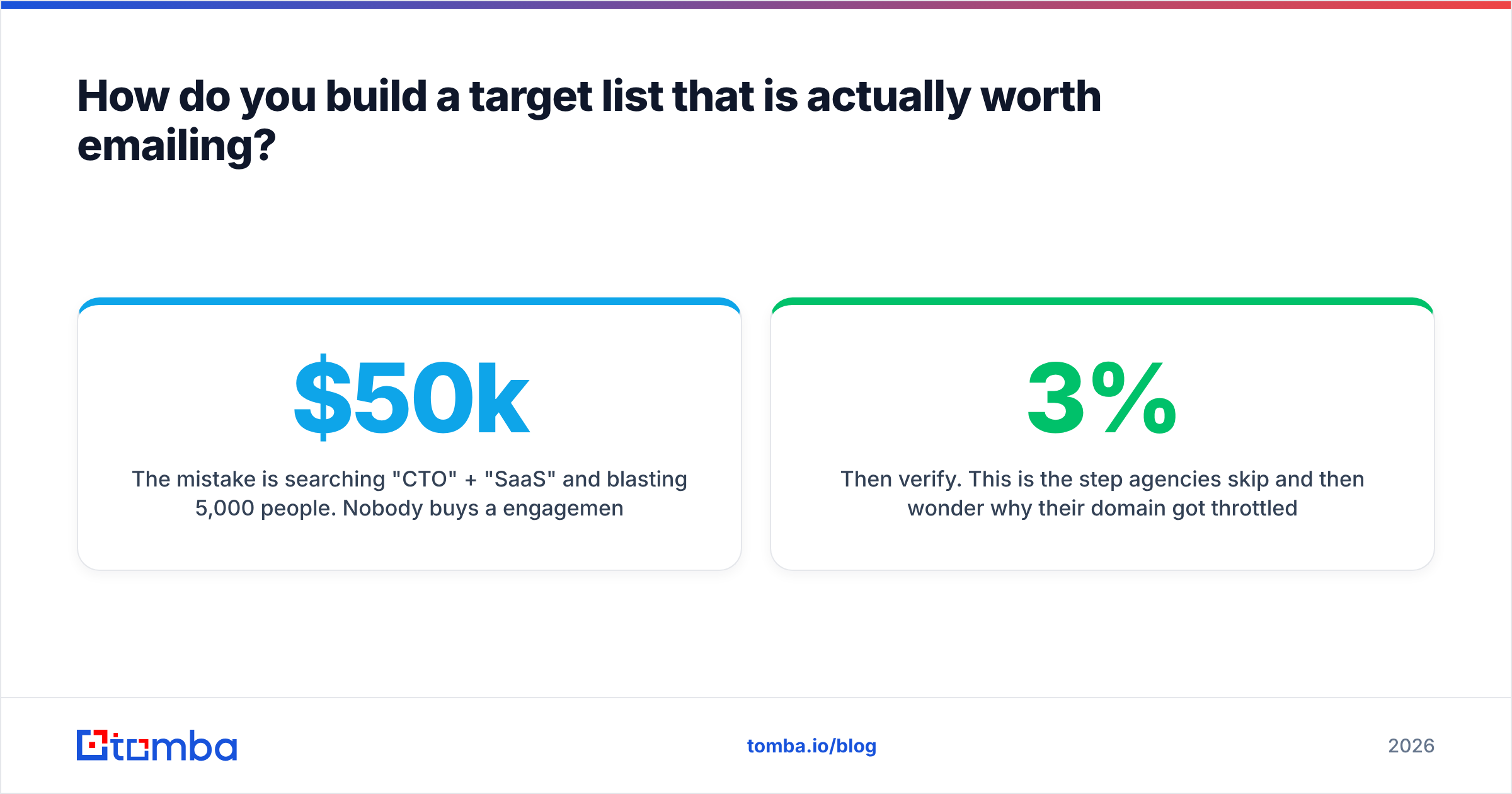
The mistake is searching "CTO" + "SaaS" and blasting 5,000 people. Nobody buys a $50k engagement because you knew their job title. They buy because something just changed. Build your list around one of these triggers:
- Recently funded — Seed and Series A companies in the last 90 days. They have budget and no engineering team yet. Crunchbase News and the funding sections of TechCrunch are free sources.
- Hiring mobile engineers and failing — a job post for "Senior iOS Engineer" open 60+ days means they are behind schedule. That is a build-with-us conversation.
- App with bad reviews or stale updates — an App Store listing that has not shipped in eight months with 2.9 stars is a rescue project. These close fast because the pain is public.
- Tech-stack signals — companies running a specific backend, payment processor, or analytics tool you specialize in. Tomba's technology finder and data enrichment can flag those from a domain list.
- Non-technical founder with a live landing page and a waitlist — pre-product, post-validation. The highest-intent buyer in this entire market.
- Agency partners with overflow — design studios and marketing agencies whose clients keep asking for an app they cannot build.
Once you have companies, you need people. For an app development sale, the buyer is usually the founder/CEO at companies under 50 people, the VP Product or Head of Digital at 50-500, and a procurement-adjacent director above that. Get the name, then get the address — find email addresses by first name, last name, and domain, or run a domain search to pull every public address on a company and infer the pattern.
Then verify. This is the step agencies skip and then wonder why their domain got throttled. Run the list through an email verifier before a single send. A list at 3% bounce is fine; at 8% you are training Google to file you in spam. Google's own sender guidelines put the spam-complaint threshold at 0.3% — bounces and complaints compound.
What does a cold email that books app development calls look like?#
Short, specific, and about their app — not your stack.
The structural rule: your first sentence must be something you could not have written about any other company. "I saw you raised $4M in March" is weak — a scraper wrote that. "Your Android build is on 2.1.4 from January while iOS is on 2.4 — split roadmap?" is strong, because it proves you opened the thing.
A working template:
Subject: your Android build
Hi Dana — noticed the SnapRoute Android app hasn't shipped since January while iOS is on 2.4. Usually that means one contractor holding both platforms.
We took over a similar split for a logistics app last year and got both tracks on the same fortnightly release in about seven weeks. Fixed price, no retainer.
Worth 15 minutes to see if it maps to your setup?
— Sam
Notice what is missing: no company boilerplate, no "we are a full-service digital transformation partner," no calendar link in email one, no attachment. The ask is a 15-minute conversation, not a demo.
Sequence structure that works for high-ticket services:
- Email 1 (day 0) — trigger observation + one relevant outcome + soft ask.
- Email 2 (day 3) — a specific artifact: a two-minute Loom walking through their app's onboarding flow with one concrete fix. This is the highest-reply-rate message in the whole sequence.
- Email 3 (day 8) — a case study one line long, with a number. "Cut cold-start from 4.1s to 900ms for a fintech app with 80k MAU."
- Email 4 (day 15) — breakup. "Assuming this isn't a priority this quarter — want me to check back in Q2?" Breakups pull surprisingly well.
Keep volume low and quality high. Fifty personalized sends a day from a warmed domain beats a thousand generic ones, and it keeps your email deliverability intact. If you are running a new sending domain, ramp over three to four weeks and use a subdomain so a mistake does not burn your main site's reputation.
Is a productized offer better than custom quoting?#
Yes, for lead generation. Maybe not for margin.
The problem with "we build custom apps" is that the prospect cannot evaluate it. They have no anchor for price, timeline, or risk, so they do the only thing they can: collect five quotes and pick the cheapest. You lose to a shop in a cheaper market and never find out why.
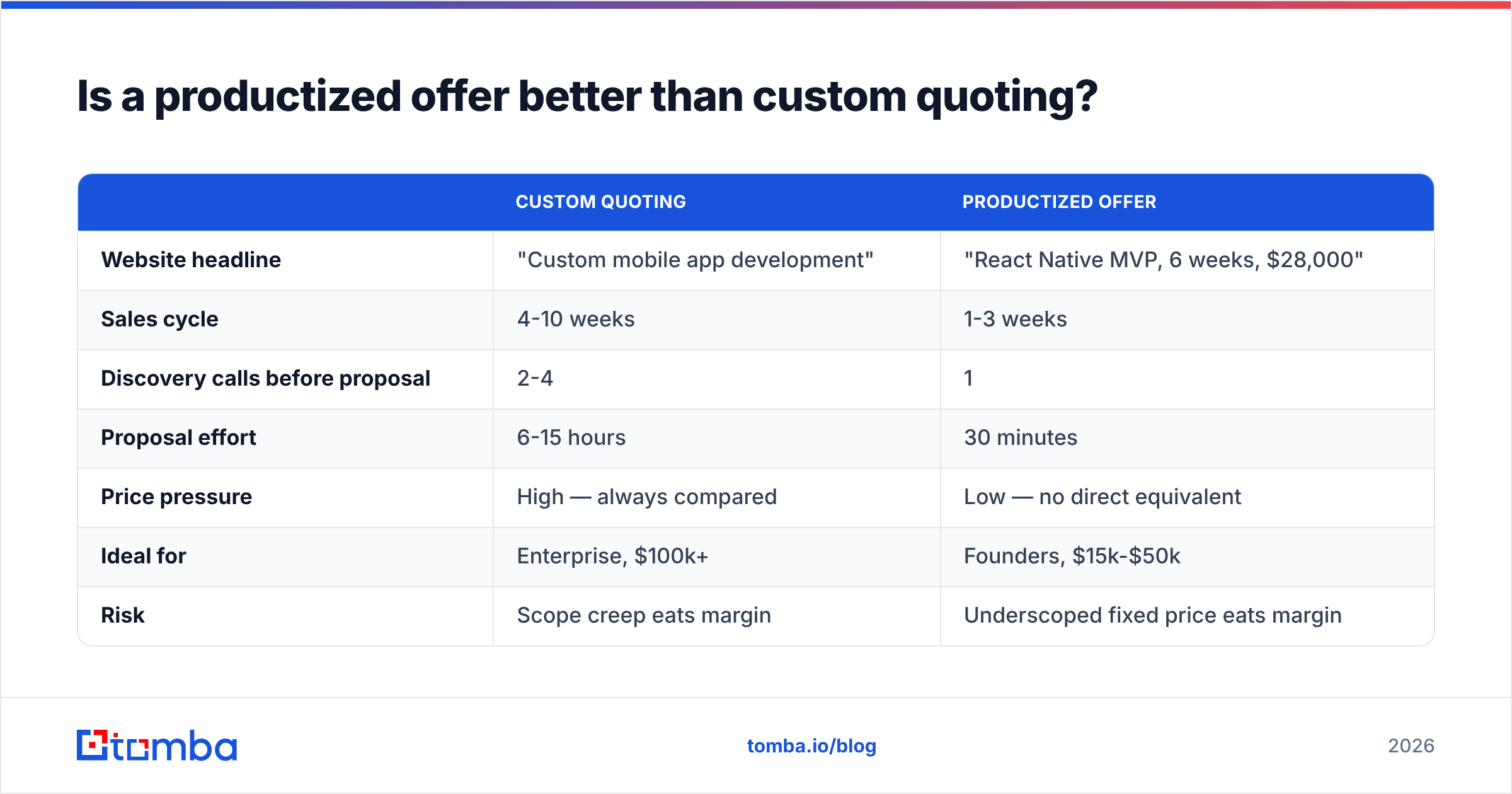
A productized offer removes that. Compare:
| Custom quoting | Productized offer | |
|---|---|---|
| Website headline | "Custom mobile app development" | "React Native MVP, 6 weeks, $28,000" |
| Sales cycle | 4-10 weeks | 1-3 weeks |
| Discovery calls before proposal | 2-4 | 1 |
| Proposal effort | 6-15 hours | 30 minutes |
| Price pressure | High — always compared | Low — no direct equivalent |
| Ideal for | Enterprise, $100k+ | Founders, $15k-$50k |
| Risk | Scope creep eats margin | Underscoped fixed price eats margin |
Most shops that fix their pipeline do both: a productized front door that generates volume and qualified conversations, and custom engagements for the accounts that graduate. The MVP package becomes the trial. Roughly a third of well-run MVP projects turn into a retainer or a phase two, which is where the real revenue lives.
Price it publicly. Agencies fear this because they think it invites comparison. In practice it repels the wrong buyers before they consume a discovery call, which is the whole point. G2's services categories and Clutch profiles both reward listings with clear pricing signals in their ranking logic.
Which inbound channels are worth building in 2026?#
Three, in this order.
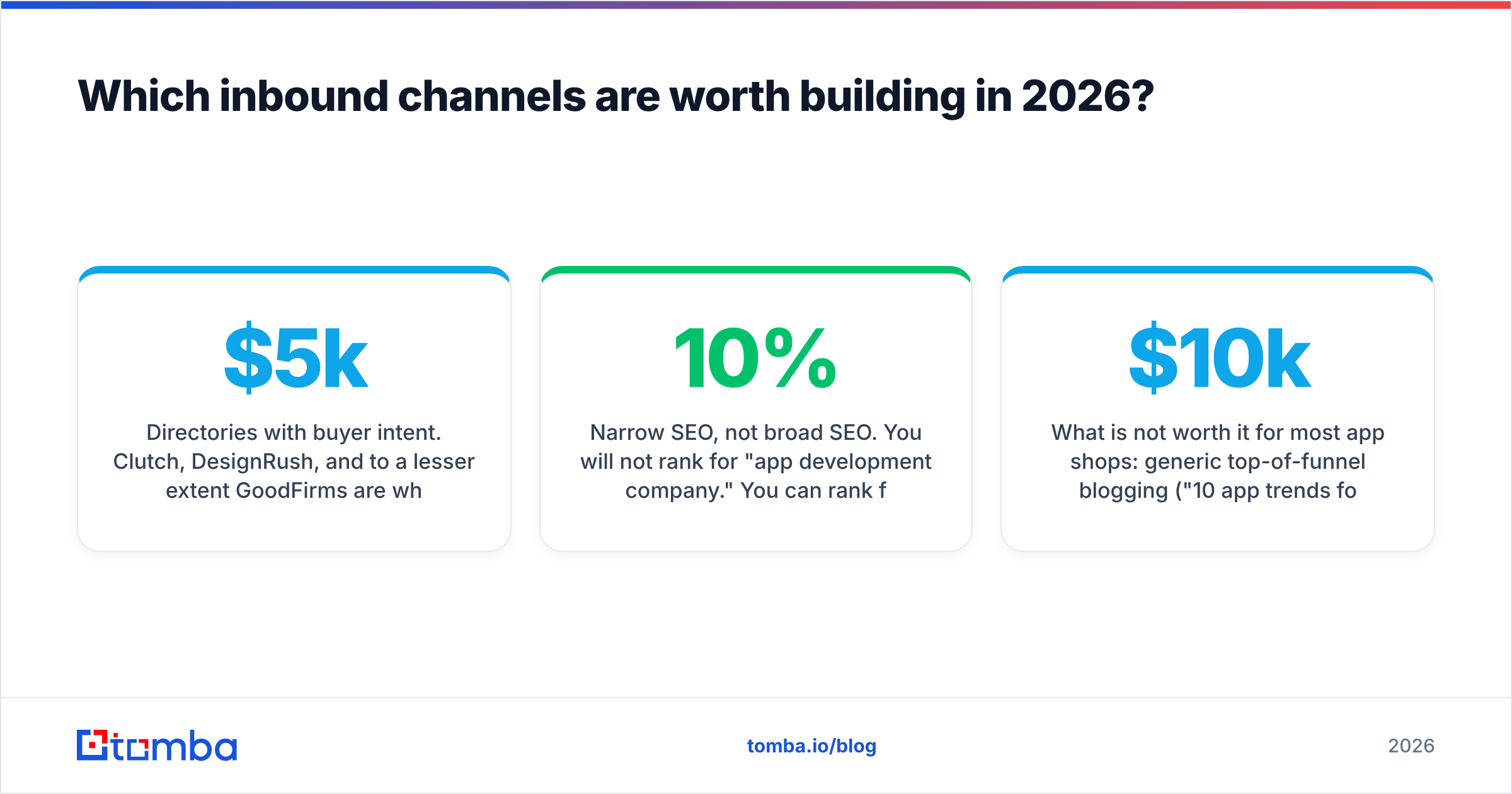
Directories with buyer intent. Clutch, DesignRush, and to a lesser extent GoodFirms are where procurement teams and non-technical founders actually shop for agencies. The reviews are the product. Ten verified reviews with specific project details will outperform a $5k/month sponsored slot on a thin profile. Budget four to six weeks of chasing past clients for reviews before you pay for placement.
Narrow SEO, not broad SEO. You will not rank for "app development company." You can rank for "HIPAA compliant telehealth app development cost" or "React Native vs Flutter for offline-first field apps." These pages get 40 visits a month and convert at 5-10% because the searcher is scoping a real project. Fifteen of those pages beat one homepage rewrite.
Public teardowns. Pick apps in your target vertical and publish an honest UX and performance teardown. Ship it to the founder. This does double duty: it is content that ranks, and it is the single best cold-email attachment in this business. Use an author finder when the teardown targets a company blog and you need the right person to send it to.
What is not worth it for most app shops: generic top-of-funnel blogging ("10 app trends for 2026"), Twitter/X threads, and conference booths under $10k. They generate impressions, not scoped conversations.
How do you qualify app development leads before wasting a call?#
Score every inbound and every reply against four things. Anything under three out of four gets an async email exchange, not a call.
- Budget signal — funding, revenue, or an explicit range. "We're bootstrapped and figuring out budget" is a no for now, not a no forever.
- Decision authority — is the person replying able to sign? At sub-50-person companies it is usually the founder. If you are talking to a product manager at a 400-person company, ask who else needs to be in the room on call two.
- Timeline — "next quarter" is real. "Sometime this year" is a newsletter subscriber.
- Scope clarity — do they have wireframes, a spec, or a working prototype? Zero artifacts means you are selling discovery first, which is a different, smaller sale.
Track this in your CRM from the first reply, not from the first call. Most agencies only log deals after a meeting, which hides the fact that their real conversion problem is between reply and booked call.
For outbound at any volume, enrich before you qualify — pulling headcount, funding stage, and tech stack onto every row with bulk enrichment means your SDR or founder is not opening 40 LinkedIn tabs a day to score a list manually.
What does a realistic 90-day pipeline plan look like?#
Weeks 1-2: pick two verticals and one trigger each. Build a 400-company list. Find and verify contacts. Set up a sending subdomain and warm it.
Weeks 3-6: send 40-60 personalized emails a day across the list. Publish three narrow SEO pages and two teardowns. Ask every past client for a Clutch review. Expect your first booked calls in week 4.
Weeks 7-10: first deals close. Double down on whichever trigger produced replies — usually one of your two verticals outperforms the other by 3x. Kill the loser. Add a partner channel: email ten design studios offering white-label build capacity.
Weeks 11-13: your productized offer page is live with a public price. Directory profile is complete with 8+ reviews. Outbound is a routine, not a project. You now have a number: cost per booked call. Everything after this is optimization.
The agencies that fail at this fail in week 5, when replies are trickling in and nothing has closed yet. That gap between effort and revenue is real and it is roughly six weeks long in this business. Budget for it emotionally and financially before you start.
Where does contact data fit in all of this?#
It is the input every controllable channel depends on. Your positioning can be perfect, your teardowns brilliant, your productized offer priced exactly right — none of it reaches anyone if the address bounces or belongs to the wrong person.
That is the gap Tomba's Email Finder fills. Point it at a domain and a name and get a verified professional address with a confidence score and the sources it was found in, so you know whether you are emailing a real inbox or a guess. Pair it with the verifier before every send, and enrichment to score accounts before you write a word.
The free tier gives you 25 searches a month to test your first trigger list. Starter is $49/mo, Growth $99/mo, and Pro $249/mo when your outbound stops being an experiment — full Tomba pricing is public, no sales call required. Build your first 400-company list this week, verify it, and send fifty emails on Monday.
Related guides#
// get started
Find, verify and enrich your first contacts today
Start on the free plan with 25 searches a month, then scale when your team is ready.
Free plan · No credit card required · GDPR & CCPA
Get the Tomba newsletter
Product and data updates
// about the author