How To Get Sales Leads For Free: 9 Methods That Work
Free lead sources are real, but most burn hours for junk data. Here are nine methods that actually produce contactable B2B leads, ranked by cost per usable contact.
TL;DR
- Free lead generation is real, but "free" means you pay in time instead of money. The best free methods cost you 2-6 hours a week and return 50-300 contactable leads a month.
- The highest-yield free sources in 2026: LinkedIn search + free finder tiers, community mining (Slack, Reddit, niche forums), review-site intent signals on G2 and Capterra, and your own inbound exhaust (site visitors, newsletter, podcast guests).
- Free email-finder tiers are the multiplier. Without one you have names; with one you have contactable names. Tomba's free tier gives 25 searches a month, Hunter gives 25, Apollo gives limited credits with export caps.
- Skip: purchased "free sample" lists, scraped CSVs from Telegram, and expired-domain contact dumps. Bounce rates above 15% will damage your sending domain faster than the leads help you.
- Verify everything before you send. One free lead that bounces costs more than one paid lead that lands.
What does "free sales leads" actually mean?#
There are three different things people mean by free, and mixing them up is why most "free lead gen" advice fails.
Free as in zero-cost tooling. You use the free tier of a product — LinkedIn's basic search, a free email finder, Google Sheets — and accept usage caps. Real leads, hard ceiling on volume.
Free as in earned attention. You publish, comment, answer, or speak, and people come to you. No caps, but a long lag and unpredictable volume.
Free as in stolen or dumped data. Someone hands you a 500,000-row CSV in a Telegram group. This is not free; it is expensive. Bad data gets your domain blacklisted, and re-establishing sender reputation takes months.
This post covers the first two. The third is a trap, and the section on data quality explains exactly how it bites.
The honest frame: free lead generation trades money for your hours. If your time is worth $60/hour and a method takes 4 hours to produce 40 leads, those leads cost $6 each — more than most paid databases. The methods below are ranked by how well they beat that math.

Which free lead sources are worth your time in 2026?#
Here is the comparison that matters — not "is it free" but "what does an hour of effort return."
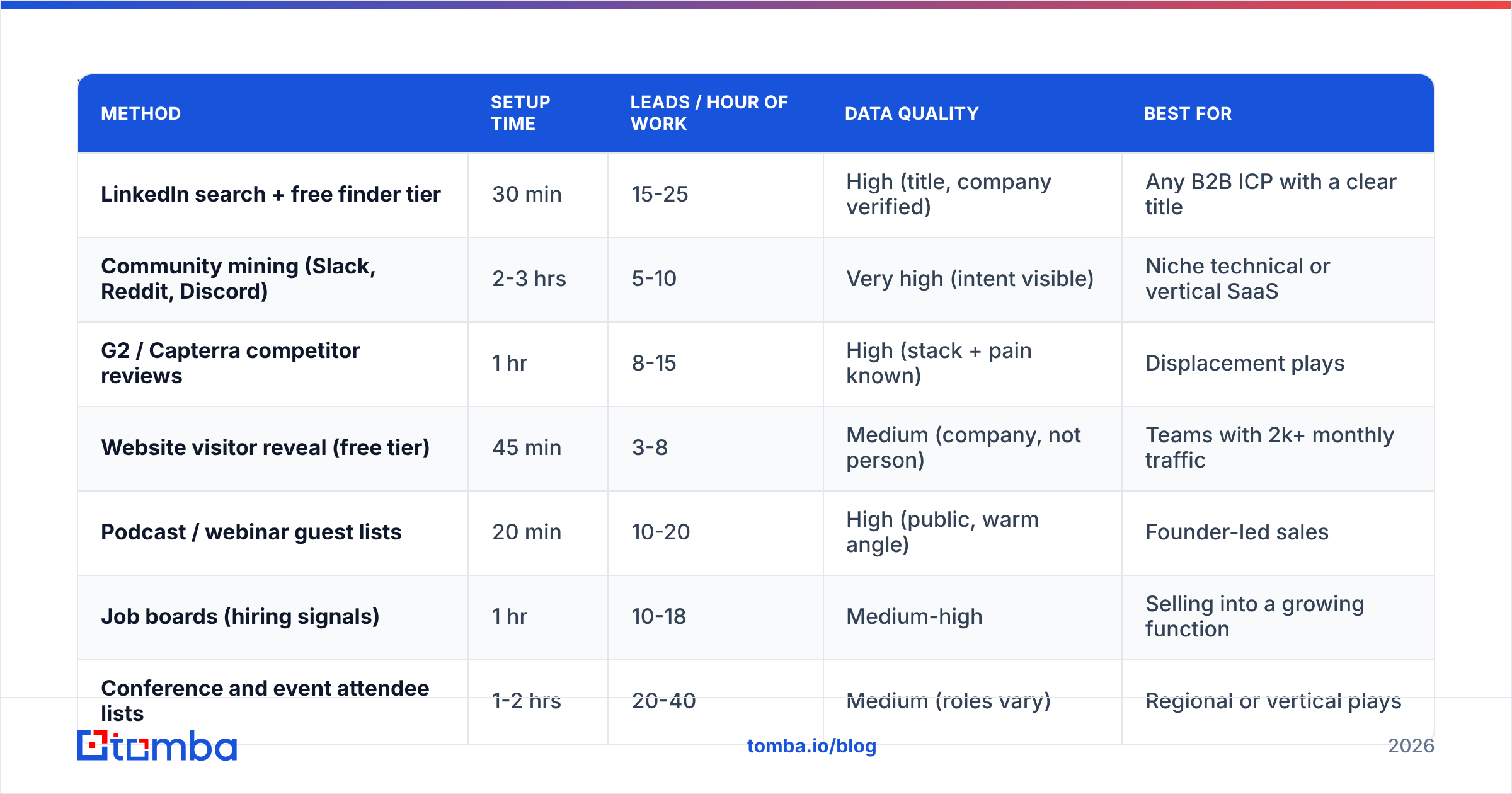
| Method | Setup time | Leads / hour of work | Data quality | Best for |
|---|---|---|---|---|
| LinkedIn search + free finder tier | 30 min | 15-25 | High (title, company verified) | Any B2B ICP with a clear title |
| Community mining (Slack, Reddit, Discord) | 2-3 hrs | 5-10 | Very high (intent visible) | Niche technical or vertical SaaS |
| G2 / Capterra competitor reviews | 1 hr | 8-15 | High (stack + pain known) | Displacement plays |
| Website visitor reveal (free tier) | 45 min | 3-8 | Medium (company, not person) | Teams with 2k+ monthly traffic |
| Podcast / webinar guest lists | 20 min | 10-20 | High (public, warm angle) | Founder-led sales |
| Job boards (hiring signals) | 1 hr | 10-18 | Medium-high | Selling into a growing function |
| Conference and event attendee lists | 1-2 hrs | 20-40 | Medium (roles vary) | Regional or vertical plays |
| Your own CRM's closed-lost | 30 min | 25-50 | Very high (already qualified) | Anyone with 12+ months of history |
| Purchased "free sample" lists | 5 min | 100+ | Very low (30-60% bounce) | Nobody |
Two things jump out. First, the highest-quality free source is data you already own — closed-lost deals, churned accounts, and stalled trials. Almost nobody works this list, and it takes half an hour. Second, community mining has the worst leads-per-hour number and the best conversion rate, because you are reading a person describe their problem in their own words before you ever email them.
How do you turn free names into contactable emails?#
This is the step where most free lead gen collapses. You can build a list of 200 perfect-fit prospects from LinkedIn in an afternoon and still have zero email addresses.
Three approaches, in order of reliability:
- Use a free email-finder tier. Most finders offer 25-50 free lookups per month. Tomba's free tier gives 25 searches monthly through the email finder, which is enough to test whether a segment responds before you spend anything. Hunter's free plan is comparable at 25 searches. Apollo bundles credits but restricts CSV export on free.
- Derive the pattern, then verify. Find one known email at the company (a press page, a support address, a GitHub commit), infer the pattern with a company email pattern checker, generate the rest, then verify each one. This is genuinely free at any volume but takes roughly 90 seconds per contact.
- Ask. LinkedIn connection request, a reply to their newsletter, a comment on their post. Slowest, highest reply rate, zero data risk.
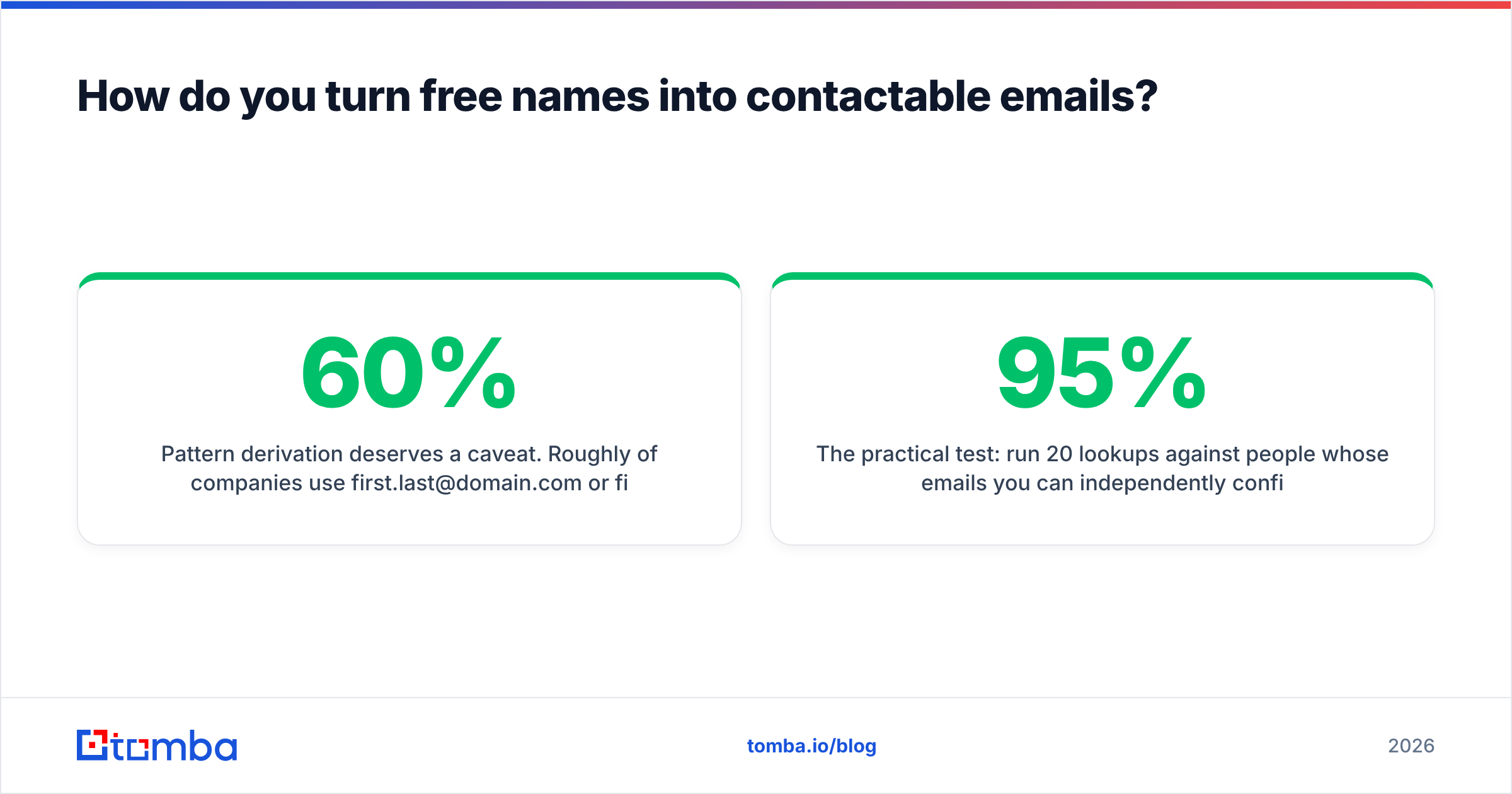
Pattern derivation deserves a caveat. Roughly 60% of companies use first.last@domain.com or first@domain.com, so you will be right most of the time — but "most of the time" at 40% error is catastrophic for deliverability. Always run derived addresses through an email verifier before sending. A verification pass is cheaper than a blacklist.
What accuracy should you expect from free tiers?#
Free tiers of email finders are not degraded versions of the data — they are the same database with a lower quota. The accuracy you get on 25 free searches is the accuracy you get on 25,000 paid ones. What changes is throughput, bulk processing, and API access.
The practical test: run 20 lookups against people whose emails you can independently confirm (your own team, past customers, public contacts). If more than 3 come back wrong or unfound, that provider's coverage is weak for your segment. Coverage varies enormously by geography and company size — a tool with 95% hit rate on US mid-market SaaS may hit 40% on European industrial firms.

What are the nine free methods, step by step?#
1. LinkedIn search plus a free finder tier#
Search by title, headcount, and geography using LinkedIn's free filters (Sales Navigator is not required for basic ICP building). Export nothing — LinkedIn's terms prohibit automated scraping, and account bans are permanent. Instead, work manually: open 25 profiles, note name and company, then resolve emails with a LinkedIn finder or standard finder.
Realistic output: 20-25 contactable leads per hour, all matching your ICP exactly.
2. Community mining#
Join the 3-5 Slack, Discord, or Reddit communities where your buyers complain. Search historical messages for your problem keywords ("we're evaluating", "does anyone use", "migrating off"). Every hit is a person with active intent who has publicly described their situation.
Do not pitch in-channel. Reply helpfully, then follow up by email with context they already gave you.
3. G2 and Capterra competitor reviews#
Reviewers on G2 and Capterra list their name, title, company size, and — critically — what they dislike about the tool they are using. Filter your competitor's page to 1-3 star reviews from the past six months. That is a displacement list with the objection pre-written.
4. Your own closed-lost and churned accounts#
Pull every deal marked closed-lost in the past 18 months. Filter for "no budget" and "bad timing" — not "lost to competitor." Budget cycles reset, champions get promoted, and the person who said no last year may now own the decision. This is the single highest-converting free list you have access to.
5. Website visitor identification#
If you get more than 2,000 monthly visitors, a portion of them are companies researching you. Free tiers of visitor-ID tools surface the company (not the person). Combine with a domain search to find the right contact at that company.
6. Job board hiring signals#
A company hiring three SDRs is buying sales tooling. A company hiring a Head of Data is buying infrastructure. Scan LinkedIn Jobs and Indeed for role signals tied to your product, then target the hiring manager listed on the posting.
7. Podcast, webinar, and conference speaker lists#
Speaker pages are public, name-and-title complete, and give you a genuine opening line. Event agendas from the past 12 months in your vertical will yield hundreds of qualified names in under an hour.
8. Newsletter and content subscribers#
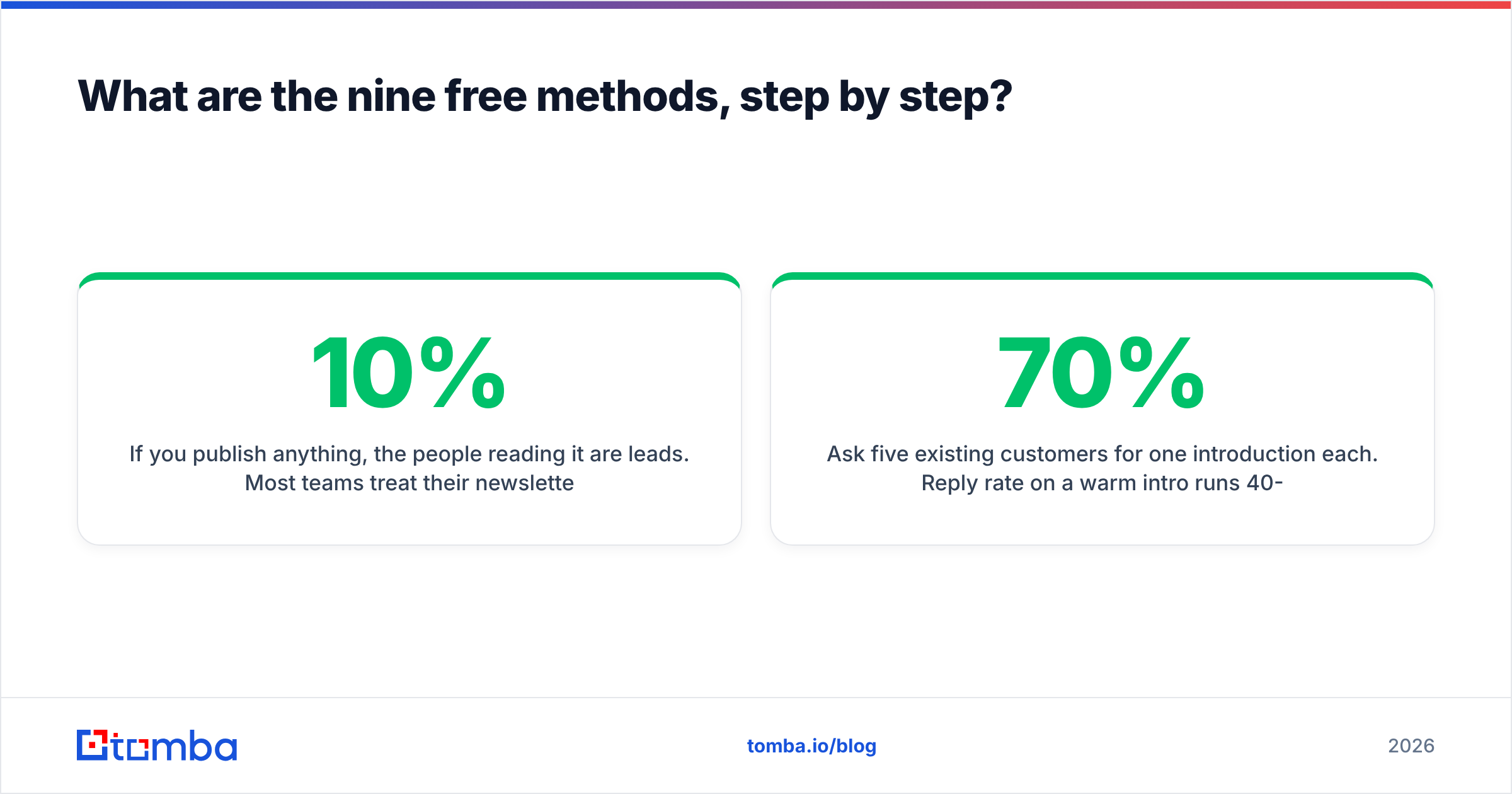
If you publish anything, the people reading it are leads. Most teams treat their newsletter as a nurture channel and never work it as a prospecting list. Segment by open behaviour and reach out to the top 10% directly.
9. Mutual-connection referrals#
Ask five existing customers for one introduction each. Reply rate on a warm intro runs 40-70% versus 3-8% cold. This is free, unscalable, and the best converting method on the list.
Is free lead generation actually cheaper than paying?#
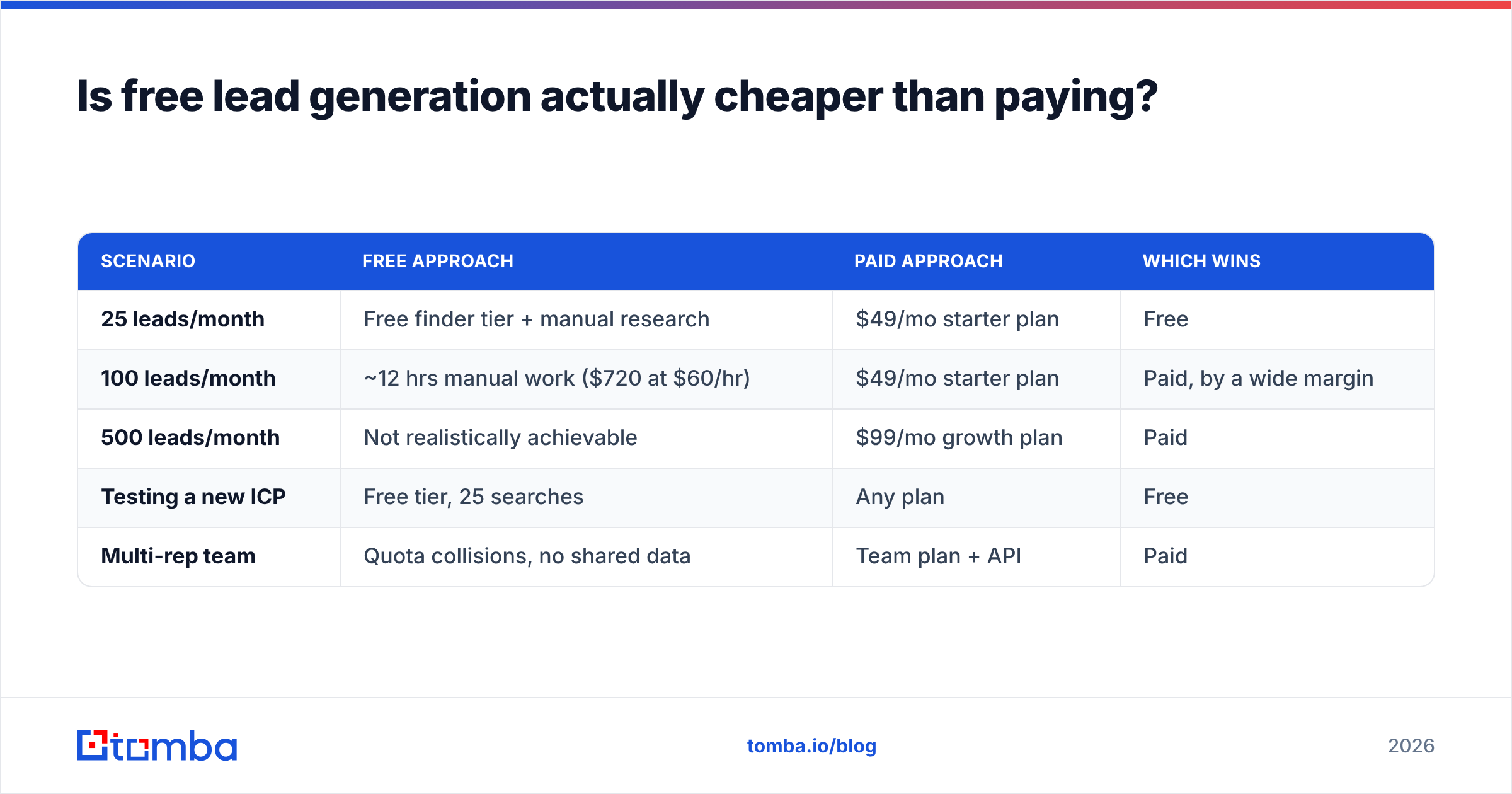
Only up to a point, and the crossover is sharper than most teams expect.
| Scenario | Free approach | Paid approach | Which wins |
|---|---|---|---|
| 25 leads/month | Free finder tier + manual research | $49/mo starter plan | Free |
| 100 leads/month | ~12 hrs manual work ($720 at $60/hr) | $49/mo starter plan | Paid, by a wide margin |
| 500 leads/month | Not realistically achievable | $99/mo growth plan | Paid |
| Testing a new ICP | Free tier, 25 searches | Any plan | Free |
| Multi-rep team | Quota collisions, no shared data | Team plan + API | Paid |
The pattern: free wins for validation and for very low volume. Once you need more than roughly 50-75 leads a month, the labour cost of free methods exceeds the price of an entry plan. At Tomba, pricing starts at $49/mo for Starter, $99/mo for Growth, and $249/mo for Pro — which means the break-even against your own time is somewhere under one working day per month.
Peers price similarly. Hunter, Findymail, and BookYourData all offer entry tiers in the same range, with BookYourData taking a pay-as-you-go angle that suits teams with lumpy, project-based buying. Compare on coverage for your specific segment rather than on headline price — a cheaper tool with 50% hit rate on your ICP is more expensive per usable contact.
What free lead sources should you avoid?#
Bulk CSVs from marketplaces and forums. These are typically 2-5 years old, aggregated from breaches, and 30-60% invalid. Sending to them produces bounce rates that trigger spam-folder placement across your entire domain. Recovery from a damaged domain takes 60-90 days of careful warming.
Scrapers that violate platform terms. LinkedIn, in particular, actively detects and permanently bans automated extraction. Losing the account you built your network on is not worth 500 rows.
"Free" tools that require you to install a data-sharing extension. Some free finders operate on a contribution model — you get credits by exposing your own contact list and inbox metadata. Read what you are agreeing to before installing.
Unverified generated addresses. Generating firstname.lastname@company.com for 200 people and sending blind is how good domains die. If you generate, verify. Every time. A free email checker handles one-off checks; bulk lists need a proper verification pass.
For a broader view on how bounce rates translate into inbox placement, Google's Postmaster Tools documentation is the authoritative reference on what actually triggers filtering.
How do you keep free leads from wrecking deliverability?#
Free-sourced lists are riskier than paid ones because they mix sources with different freshness. Three guardrails:
- Verify before every send, not once per quarter. A list verified in January is 4-6% decayed by April. Job changes are the main driver.
- Separate your sending domains. Prospect from a secondary domain, keep your primary clean for customers and billing. If something goes wrong, the damage is contained.
- Cap daily volume by mailbox. 30-50 cold sends per mailbox per day, ramping over three weeks. Free leads tempt you to blast because they felt cheap — resist it.
- Watch catch-all domains. Roughly 15% of B2B domains accept everything, so a "valid" result means nothing. A catch-all verifier resolves these separately rather than lumping them in as deliverable.
Track your bounce rate weekly. Under 2% is healthy, 2-5% needs attention, and above 5% means stop sending and re-verify the whole list. Your email deliverability is the constraint that makes all the free volume worthless if you ignore it.
What does a realistic free lead gen week look like?#
Two hours on Monday: pull 25 LinkedIn profiles matching one tight ICP segment, resolve emails with your free tier quota, verify.
One hour on Tuesday: scan G2 competitor reviews from the past 30 days, pull 10 named reviewers with relevant complaints.
Thirty minutes Wednesday: work the closed-lost list — five re-engagement emails referencing what changed since.
One hour Thursday: community reading. No pitching. Note 5-8 people describing your problem.
Thirty minutes Friday: verify everything from the week, dedupe, load into sequence.
That is five hours for roughly 45-50 qualified, verified, contactable leads. At a 5% reply rate and a 30% meeting conversion, that is roughly one to two meetings per week — enough to validate a channel, not enough to hit an aggressive quota. Which is exactly the point: free proves the motion works, then you pay to scale it.
Ready to turn free research into verified contacts?#
Free methods get you names. Verified emails turn names into pipeline — and that is the step where most free lead generation stalls out. Start with the Tomba Email Finder free tier: 25 searches a month, no card required, same data quality as every paid plan. Run it against the 25 best-fit prospects you found this week, verify the results, and see whether the segment replies before you commit a dollar. If it works, Starter at $49/mo removes the ceiling.
Related guides#
// get started
Find, verify and enrich your first contacts today
Start on the free plan with 25 searches a month, then scale when your team is ready.
Free plan · No credit card required · GDPR & CCPA
// about the author