Best Lead Generation Tools in 2026: Top 12 Compared
A no-fluff breakdown of the best lead generation tools in 2026 — by category, price, and use case — so you stop paying for stale data and start booking real meetings.
TL;DR
- The "best lead generation tools" depend on the job: there are data/finder tools, outreach/sequencing tools, intent/visitor tools, and all-in-one platforms. Most teams need two or three, not one.
- Accuracy beats volume. A 100k-record export at 60% deliverability wastes more money than a 10k list at 95%.
- For finding and verifying contact data, Tomba Email Finder leads on price-to-accuracy: a free tier, then $49/mo Starter.
- All-in-one platforms (Apollo, Instantly) bundle data + sending but lock you into their database quality.
- Pick your stack by motion: outbound email, ABM/intent, or inbound website capture each reward a different tool category.
What counts as a lead generation tool in 2026?#
A lead generation tool is anything that helps you identify, reach, or capture a potential buyer. The mistake most teams make is treating that as one category. It isn't. In practice there are four jobs, and the "best" tool is the one that wins the specific job you're hiring for.
Think of it like building a kitchen. You don't buy one machine that chops, boils, and bakes badly — you buy a good knife, a good pot, and a good oven. Lead gen works the same way:
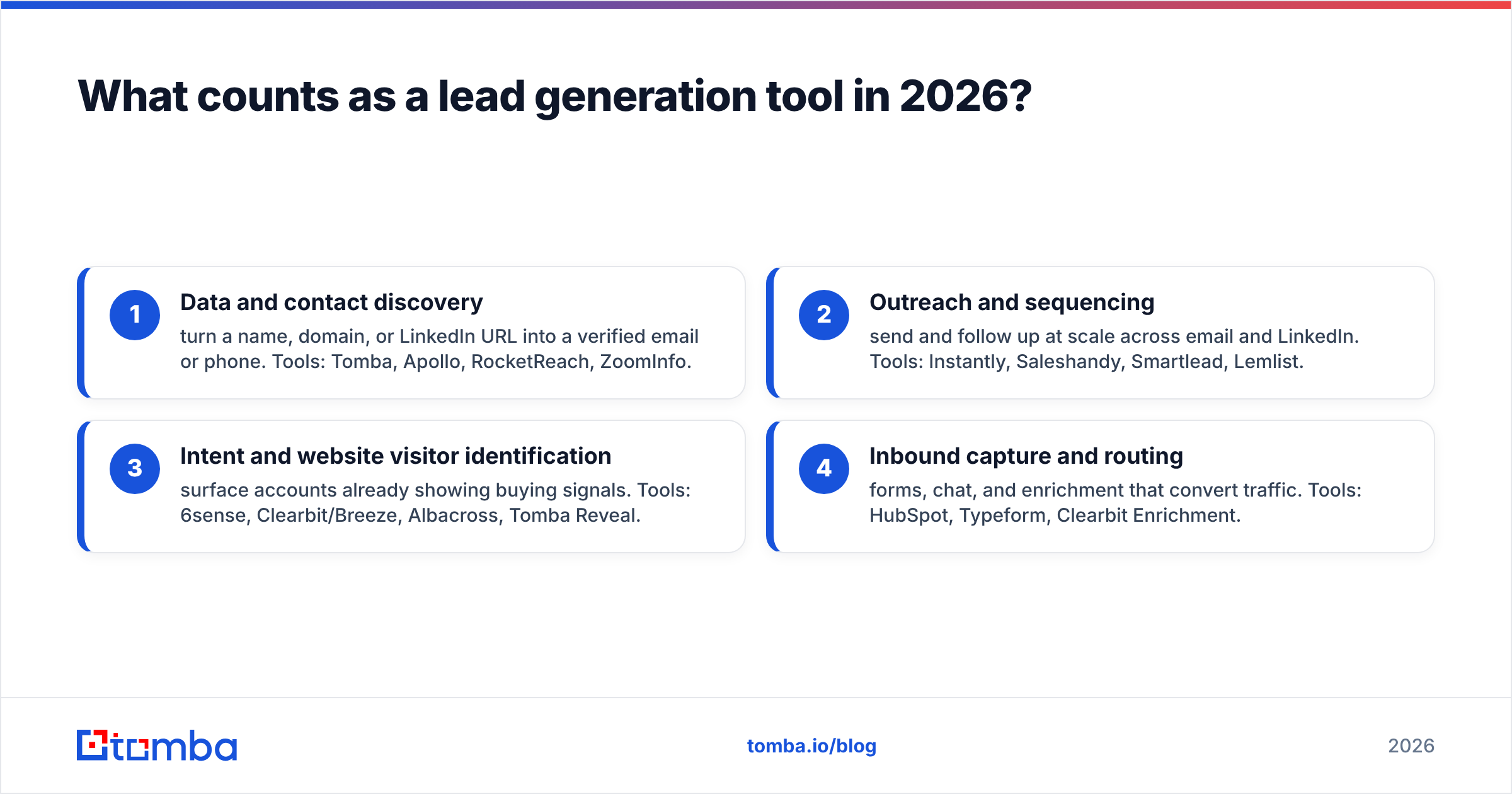
- Data and contact discovery — turn a name, domain, or LinkedIn URL into a verified email or phone. Tools: Tomba, Apollo, RocketReach, ZoomInfo.
- Outreach and sequencing — send and follow up at scale across email and LinkedIn. Tools: Instantly, Saleshandy, Smartlead, Lemlist.
- Intent and website visitor identification — surface accounts already showing buying signals. Tools: 6sense, Clearbit/Breeze, Albacross, Tomba Reveal.
- Inbound capture and routing — forms, chat, and enrichment that convert traffic. Tools: HubSpot, Typeform, Clearbit Enrichment.
Most "best lead generation tools" lists blur these together and then argue about price. That's why they're useless. Below, the comparison is organized by job, so you can assemble a stack instead of overpaying for one bloated platform.

Which lead generation tools are best by category?#
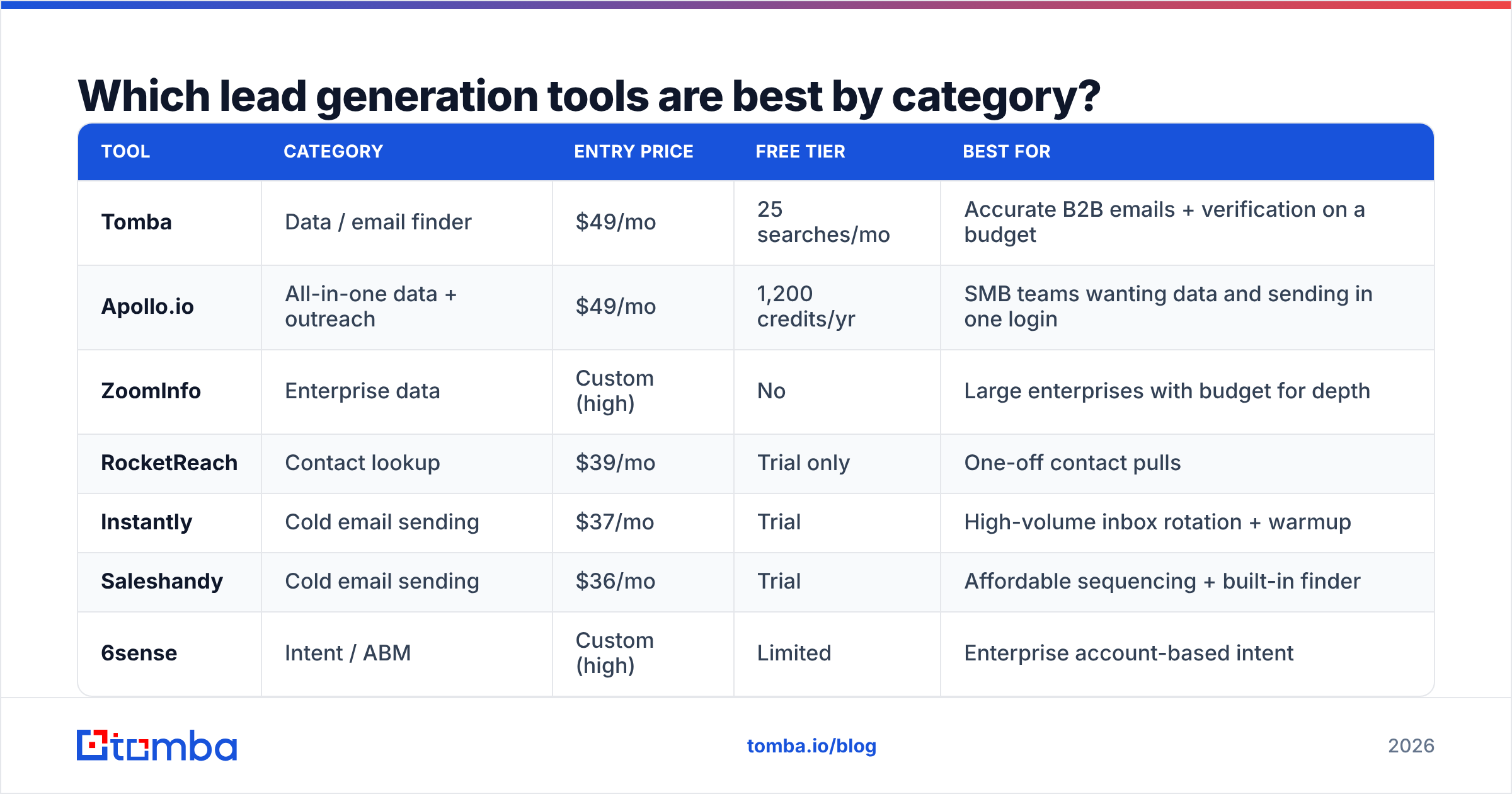
Here's the core comparison. Prices are entry/most-popular tiers as published in 2026; always confirm on the vendor's own page since plans shift.
| Tool | Category | Entry price | Free tier | Best for |
|---|---|---|---|---|
| Tomba | Data / email finder | $49/mo | 25 searches/mo | Accurate B2B emails + verification on a budget |
| Apollo.io | All-in-one data + outreach | $49/mo | 1,200 credits/yr | SMB teams wanting data and sending in one login |
| ZoomInfo | Enterprise data | Custom (high) | No | Large enterprises with budget for depth |
| RocketReach | Contact lookup | $39/mo | Trial only | One-off contact pulls |
| Instantly | Cold email sending | $37/mo | Trial | High-volume inbox rotation + warmup |
| Saleshandy | Cold email sending | $36/mo | Trial | Affordable sequencing + built-in finder |
| 6sense | Intent / ABM | Custom (high) | Limited | Enterprise account-based intent |
| HubSpot | Inbound CRM + forms | Free–$$$ | Yes | Inbound capture, nurturing, reporting |
A few honest notes. ZoomInfo and 6sense are powerful but priced for enterprise — expect five figures annually and an annual contract. Apollo is the popular "do everything" pick, but its bundled sending shares deliverability risk across thousands of users, and its data accuracy varies by region. RocketReach is convenient for ad-hoc lookups but expensive per credit at scale. For pure data accuracy at a price an SMB can actually approve, Tomba and Apollo are the usual finalists — see the Apollo alternative breakdown if that's your shortlist.
How do you choose the best lead generation tool for your motion?#
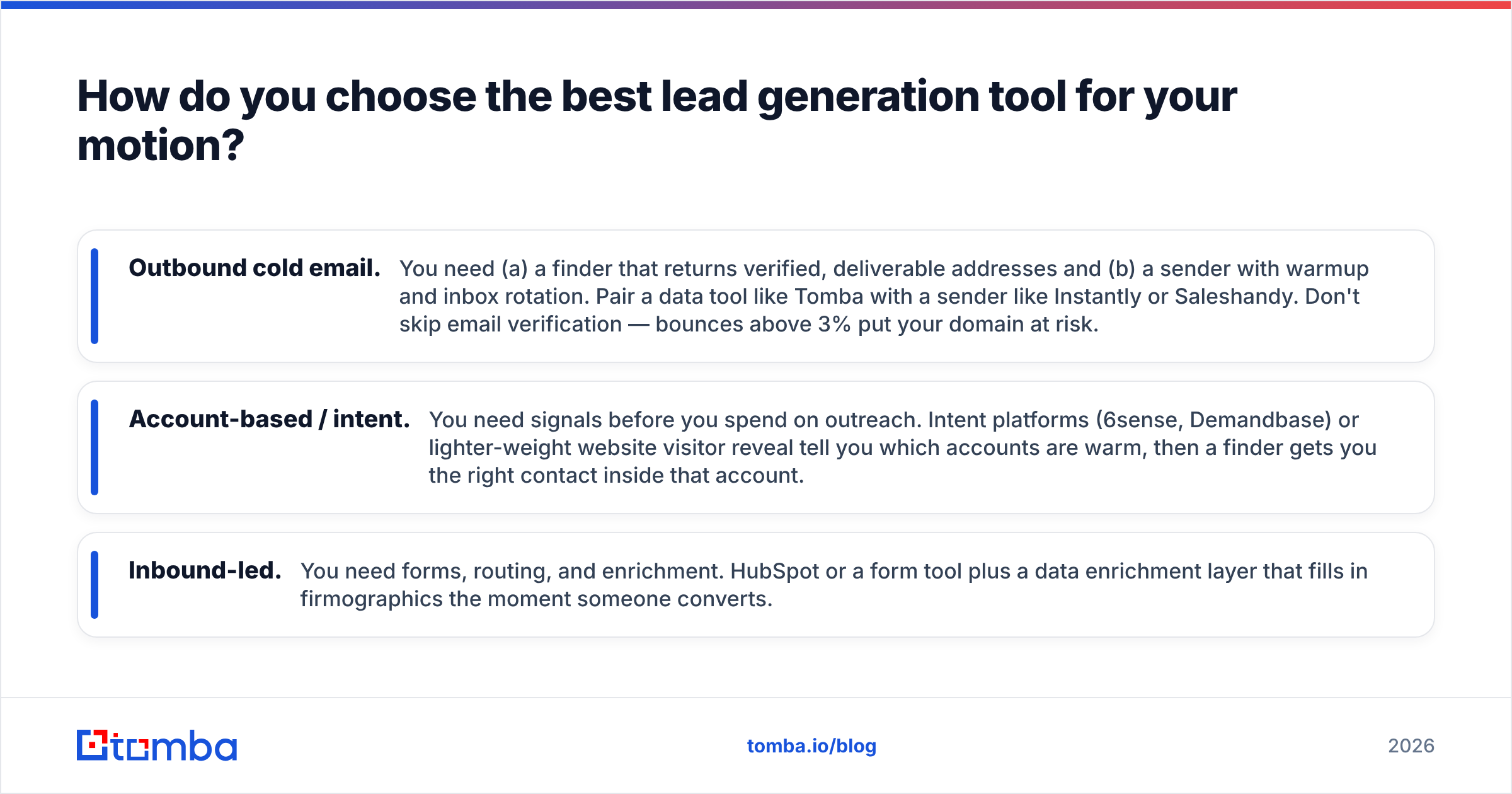
Start from how you actually generate revenue, not from a feature checklist. Three common motions, three different "best" answers:
- Outbound cold email. You need (a) a finder that returns verified, deliverable addresses and (b) a sender with warmup and inbox rotation. Pair a data tool like Tomba with a sender like Instantly or Saleshandy. Don't skip email verification — bounces above 3% put your domain at risk.
- Account-based / intent. You need signals before you spend on outreach. Intent platforms (6sense, Demandbase) or lighter-weight website visitor reveal tell you which accounts are warm, then a finder gets you the right contact inside that account.
- Inbound-led. You need forms, routing, and enrichment. HubSpot or a form tool plus a data enrichment layer that fills in firmographics the moment someone converts.
The unifying rule: every motion eventually needs clean contact data. That's why a finder/verifier sits at the center of almost every stack, even when the headline tool is a sequencer or an intent platform.
Why does data accuracy matter more than tool count?#
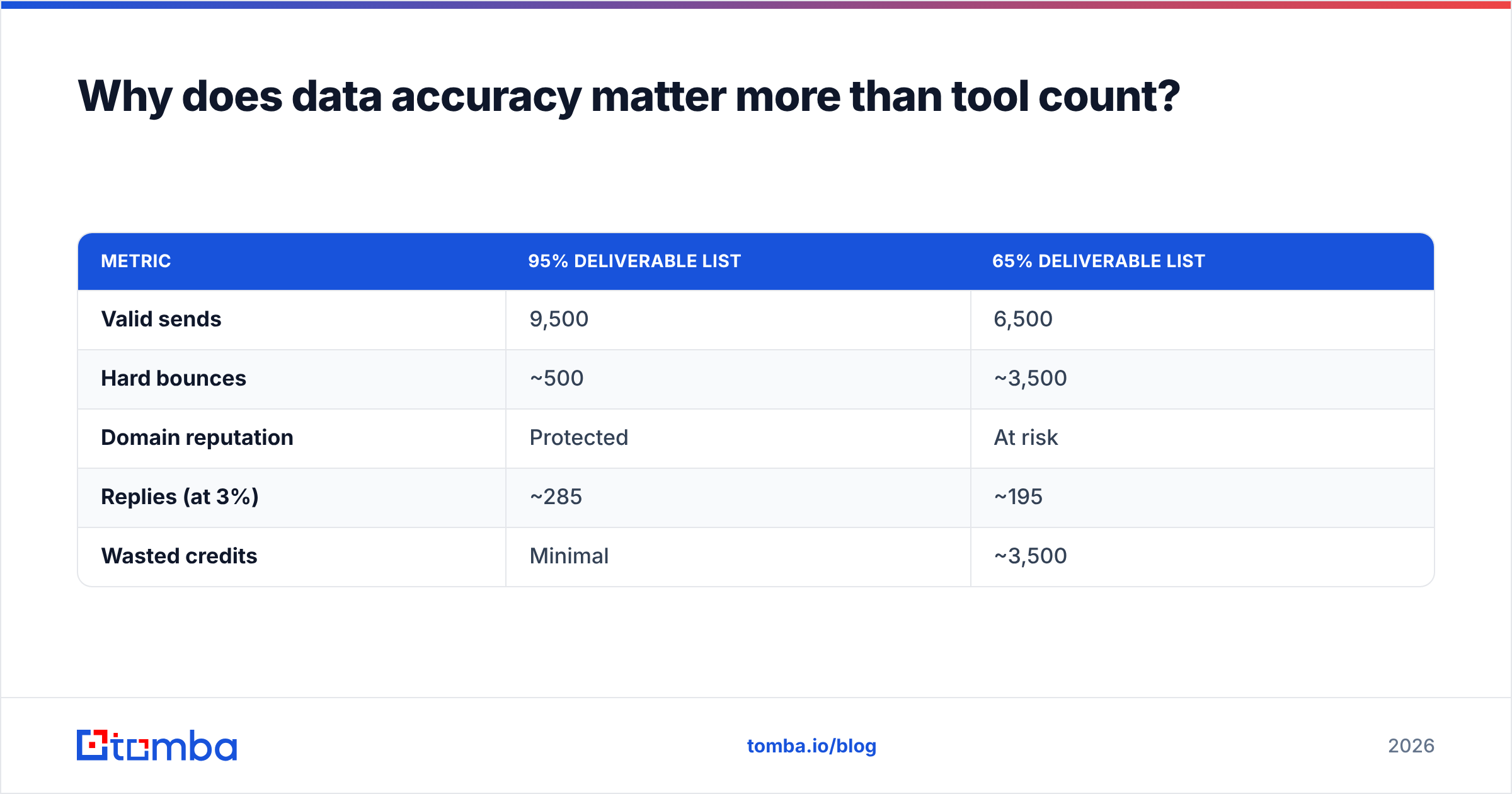
Because bad data taxes everything downstream. A lead generation tool that exports a huge list looks impressive until you send to it. Run the math on a 10,000-contact campaign:
| Metric | 95% deliverable list | 65% deliverable list |
|---|---|---|
| Valid sends | 9,500 | 6,500 |
| Hard bounces | ~500 | ~3,500 |
| Domain reputation | Protected | At risk |
| Replies (at 3%) | ~285 | ~195 |
| Wasted credits | Minimal | ~3,500 |
The cheaper-looking list is the expensive one. High bounce rates trigger spam filters, hurt sender reputation, and can blacklist the sending domain you spent months warming up. That's why verification isn't a nice-to-have — it's the difference between a campaign that lands and one that quietly dies in spam folders.
This is also where free "buy a list" shortcuts fall apart. Purchased lists are scraped, stale, and shared across hundreds of buyers, so the same prospects get hammered and your reputation pays for it. Generating leads with a real-time finder and verifier — versus buying a static list — is the single biggest quality lever you control. Independent reviews on G2 consistently rank tools on data freshness for exactly this reason.
What does a lean, high-accuracy lead gen stack look like?#
You can cover most B2B lead generation with three tools and stay under $200/month. Here's a practical build, ordered by what to buy first:
- Finder + verifier (the foundation). Tomba handles email discovery by name, domain, or company, plus verification and domain search in one workspace. Start free, scale on the $49/mo Starter. This is the data layer everything else depends on.
- Sender (the engine). A dedicated cold-email tool — Instantly or Saleshandy — for warmup, inbox rotation, and follow-up sequences. Keep your finder and sender separate so a sending issue never corrupts your data source.
- CRM (the memory). HubSpot's free tier is enough to track pipeline early. Connect it directly through the HubSpot integration so enriched contacts flow in without copy-paste.
Optional fourth layer when you scale: a website visitor reveal tool to catch warm anonymous traffic, and bulk lead generation for processing thousands of records at once. For teams that live in spreadsheets, the Google Sheets add-on and Tomba API let you enrich data wherever it already lives.
The point of this structure: each tool does one job well, you can swap any layer without rebuilding the others, and your data quality never depends on a sender's bundled database. Compare full Tomba pricing against an all-in-one and the lean stack usually wins on both cost and deliverability.
Are free lead generation tools worth using?#
Yes — for validation and small volume, not as your whole strategy. Free tiers let you prove a workflow before paying. Tomba's free plan includes 25 searches a month, enough to test data quality on your real target accounts. HubSpot's free CRM genuinely runs early-stage pipeline. Free utilities like an email permutator, spam checker, or SPF checker plug specific gaps at zero cost.
Where free breaks down is volume and freshness. Free credits run out, and "free list" providers monetize by reselling the same stale contacts. Use free tiers to confirm a tool returns accurate data for your niche, then upgrade when the unit economics make sense — typically once a single closed deal pays for a year of the tool.
How should you evaluate vendors before committing?#
Run the same three-step test on any tool on your shortlist, regardless of category:
- Test on your accounts, not their demo. Pull 50 contacts you can independently verify. Measure real deliverability, not the vendor's claimed accuracy.
- Check the contract terms. Enterprise tools (ZoomInfo, 6sense) often require annual commitments and credit rollback clauses. SMB tools like Tomba and Saleshandy stay month-to-month — far lower risk while you're still learning what works.
- Confirm the integrations you need. A tool is only as useful as its connection to your CRM and sender. Verify native support for Salesforce, HubSpot, or Zapier before you buy, not after.
Cross-reference vendor claims with third-party review sites like Capterra and the vendor's own documentation. If a tool won't let you test data quality before a contract, treat that as a signal.
The bottom line#
The best lead generation tools in 2026 aren't a single product — they're a small, deliberate stack where a high-accuracy data layer feeds a reliable sender and a CRM that remembers everything. Get the data layer right and every downstream metric improves; get it wrong and no amount of clever copy or sending volume saves the campaign.
If you're building or rebuilding that foundation, start with the data. Tomba Email Finder gives you verified B2B emails by name, domain, or company, with a free tier to test accuracy on your own target accounts and a $49/mo Starter when you're ready to scale. Find the right contacts first, verify before you send, and let the rest of your stack do its job. Spin up a free account, run 25 searches against accounts you know, and judge the data quality for yourself.
// get started
Find, verify and enrich your first contacts today
Start on the free plan with 25 searches a month, then scale when your team is ready.
Free plan · No credit card required · GDPR & CCPA
// about the author