How to Make Emails GDPR Compliant: A 2026 Playbook
GDPR does not ban cold email — it bans sloppy cold email. Here is the exact seven-step process for making outbound emails compliant without gutting your pipeline.
Learning how to make emails GDPR compliant takes a day of setup and a few habits you keep. It is not a legal maze. Below are the seven steps, the country-by-country rules, and the traps that quietly get outbound teams fined.
TL;DR
- GDPR does not outlaw cold email to business contacts. It outlaws sending without a lawful basis, without transparency, and without a working opt-out.
- For B2B outbound, legitimate interest (Article 6(1)(f)) is the workable legal basis. Two conditions: you document a Legitimate Interest Assessment, and your targeting is genuinely relevant.
- Two laws stack. GDPR governs the data; the ePrivacy Directive — and each country's version of it — governs the sending. Germany and Italy are strict. The UK, Ireland, and the Netherlands allow corporate B2B outreach with fewer strings.
- The work itself is dull: log where each contact came from, link a privacy notice in every email, offer one-click unsubscribe, keep a suppression list that actually suppresses, and set a retention clock.
- Your data source decides most of this for you. Tools that log where each email came from make compliance a lookup. Scraped lists make it a guess.
Why does GDPR still confuse outbound teams in 2026?#
Because most teams read one blog post claiming "cold email is illegal in Europe," panicked, and never checked. It is not illegal. The General Data Protection Regulation is a data-processing law, not an email ban. Handle personal data about someone in the EU or EEA and three rules apply. You need a lawful reason. You must tell them. You must let them stop you.
A work email address like sarah.klein@company.de is personal data, because it identifies a specific human. A generic info@company.de usually is not, because no individual is identifiable from it. That single distinction changes your obligations more than anything else in this article.
Two rulebooks also apply at once. GDPR covers whether you may hold and process the contact record. The ePrivacy Directive covers whether you may send an unsolicited commercial message, and each member state implements it separately. So you can be perfectly GDPR-clean and still break German unfair-competition law. Compliance means clearing both gates.

How to make emails GDPR compliant: the seven steps#
Work through these in order. Each one produces an artifact you can hand to a regulator or a security-reviewing prospect. The first four are paperwork you do once.
- Pick and document your lawful basis. For B2B cold outreach, that is almost always legitimate interest. Write a Legitimate Interest Assessment (LIA) in three short sections: purpose, necessity, balancing test. One page is fine. Undocumented legitimate interest counts as no legal basis at all when a Data Protection Authority asks.
- Verify your data provenance. For every contact, you should be able to answer three questions. Where did this come from? When? What public source backs it up? If your provider cannot show you sources, you inherit their risk with none of their evidence.
- Filter for genuine relevance. The balancing test in your LIA collapses if you email a dentist about warehouse robotics. Tight ICP targeting is not just better conversion. It is your legal defence.
- Add transparency to every send. State who you are and how you got their address. Link to a privacy notice that covers outbound prospecting specifically. "We obtained your address from your company's public website" is a sentence, not a burden.
The last three are habits you keep running.
- Make opting out one click. No login, no "reply STOP and we'll process it," no preference-centre maze. Honour it within days, not the 30 you legally get.
- Suppress permanently and centrally. An unsubscribe that only applies to one sequence in one tool is a future complaint. Suppression lists must sit above every sending tool you own.
- Set a retention clock. Non-responders should expire. Allow six to twelve months of silence, then delete or fully anonymise. Indefinite retention is the most common finding in DPA enforcement notices against outbound teams.
Which legal basis actually applies to cold email?#
Legitimate interest, in almost every case. Consent is the basis everyone assumes, but you cannot get valid consent from a person you have not contacted yet. Contract does not apply before a sale. That leaves legitimate interest, which the ICO and the European Data Protection Board both accept for direct marketing when it is proportionate.
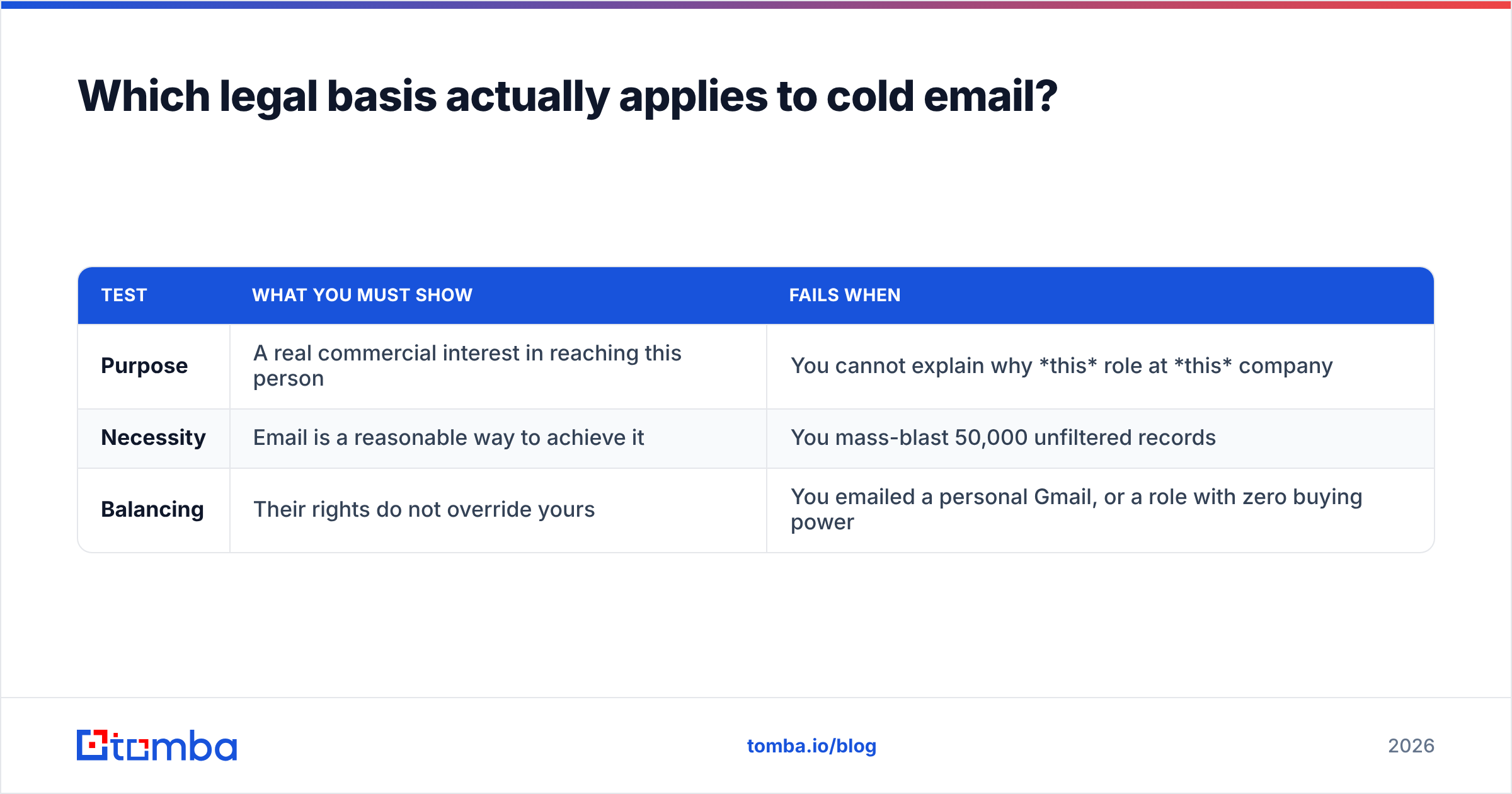
Your LIA needs to survive three questions:
| Test | What you must show | Fails when |
|---|---|---|
| Purpose | A real commercial interest in reaching this person | You cannot explain why this role at this company |
| Necessity | Email is a reasonable way to achieve it | You mass-blast 50,000 unfiltered records |
| Balancing | Their rights do not override yours | You emailed a personal Gmail, or a role with zero buying power |
The balancing test is where scraped consumer-style lists die. A B2B email to a named decision-maker at a company that plausibly buys your category clears it. A 200,000-row purchased list of "verified leads" with no provenance does not.
How do GDPR rules differ across EU countries?#
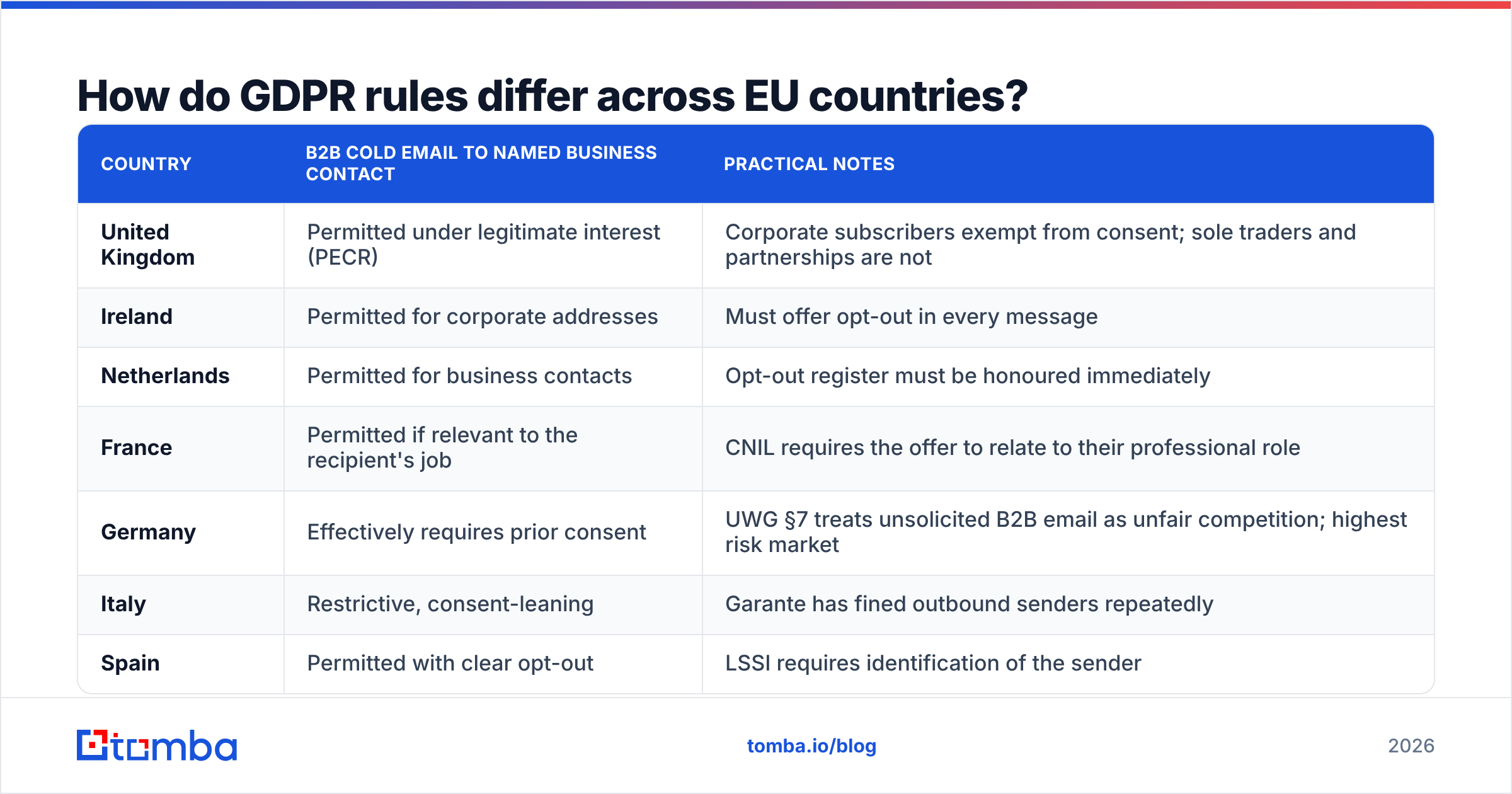
The ePrivacy layer is where the map gets uneven. GDPR is uniform; national ePrivacy rules are not. Here is the practical shape of it for B2B email:
| Country | B2B cold email to named business contact | Practical notes |
|---|---|---|
| United Kingdom | Permitted under legitimate interest (PECR) | Corporate subscribers exempt from consent; sole traders and partnerships are not |
| Ireland | Permitted for corporate addresses | Must offer opt-out in every message |
| Netherlands | Permitted for business contacts | Opt-out register must be honoured immediately |
| France | Permitted if relevant to the recipient's job | CNIL requires the offer to relate to their professional role |
| Germany | Effectively requires prior consent | UWG §7 treats unsolicited B2B email as unfair competition; highest risk market |
| Italy | Restrictive, consent-leaning | Garante has fined outbound senders repeatedly |
| Spain | Permitted with clear opt-out | LSSI requires identification of the sender |
Two takeaways. First, "EU-compliant" is not a single setting. Segment your sending by country, and route Germany and Italy through a consent-first or referral-first motion. Second, the UK is not in the EU, but it kept UK GDPR nearly verbatim, so your process transfers with almost no change.
What does a compliant cold email actually look like?#
Structurally, a compliant email is barely different from a good one. The difference is four small additions that most senders skip:
- Sender identity. Real name, real company, real registered address in the footer. Not "The Growth Team."
- A source disclosure line. One sentence near the end: "I found your details on your company site while researching logistics software buyers in the DACH region."
- A privacy notice link. It must describe prospecting specifically: what data you hold, the legitimate-interest basis, the retention period, and how to ask for access or erasure.
- An unsubscribe that works. Visible, single-click, and wired to a global suppression list.
Nothing here reduces reply rates. The source-disclosure line often raises them, because it answers the question every cold recipient silently asks. If you need a starting structure, the cold email templates library is a reasonable base. Add the four elements above before you send.
One thing to avoid: burying compliance text in 6px grey type. Regulators treat deliberately unreadable notices as no notice at all.
How does your data source change your compliance risk?#
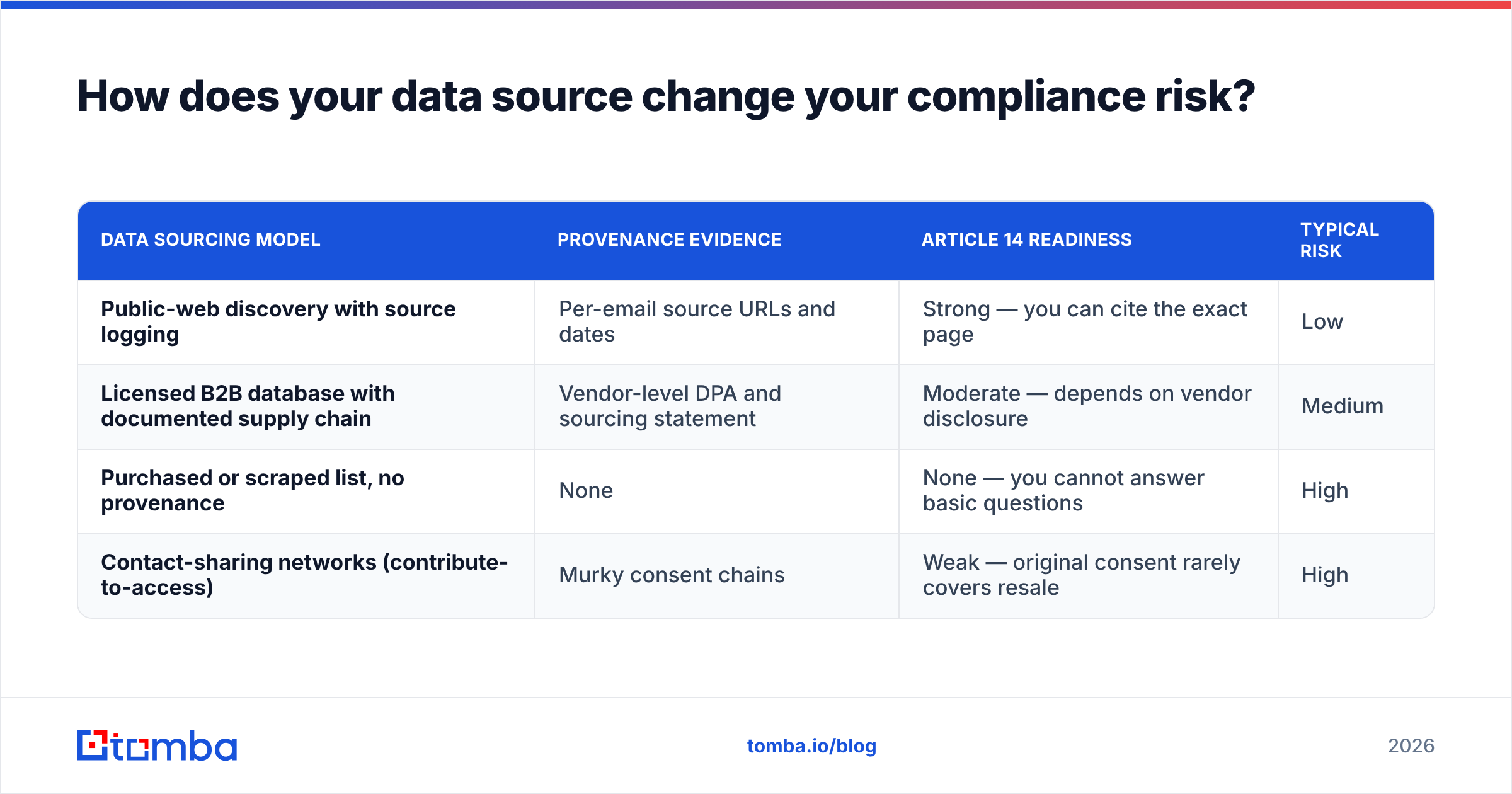
More than any other decision you make. Article 14 of GDPR says you must tell people when you obtain their data indirectly. To do that, you need to know how you obtained it. Providers fall into three tiers:
| Data sourcing model | Provenance evidence | Article 14 readiness | Typical risk |
|---|---|---|---|
| Public-web discovery with source logging | Per-email source URLs and dates | Strong — you can cite the exact page | Low |
| Licensed B2B database with documented supply chain | Vendor-level DPA and sourcing statement | Moderate — depends on vendor disclosure | Medium |
| Purchased or scraped list, no provenance | None | None — you cannot answer basic questions | High |
| Contact-sharing networks (contribute-to-access) | Murky consent chains | Weak — original consent rarely covers resale | High |
This is why sourcing transparency matters more than raw database size. Tomba publishes its data sources and returns the public pages an email was discovered on. An Article 14 disclosure becomes a lookup rather than an invention. BookYourData takes a different but equally defensible route: a licensed, pay-as-you-go database with documented sourcing. It is worth a look if you prefer buying verified records outright. Both models beat the anonymous list broker by a wide margin.
Verification matters here too, for a different reason. Dead addresses inflate bounces and damage sender reputation. They also weaken your claim that the processing was careful and targeted. Running lists through an email verifier before you send is both a deliverability step and a compliance step.
What are the penalties, realistically?#
The headline number is €20 million or 4% of global annual turnover, whichever is higher. That tier is for severe, systemic violations, not a startup with a sloppy unsubscribe link.
What actually happens to outbound teams is more mundane:
- Complaint-driven investigations. One annoyed recipient files with their national DPA. You get a written request asking where you got their data, on what basis, and what your retention policy is. Miss the deadline and the file escalates.
- Fines in the €5,000–€150,000 range for small and mid-size senders, usually for missing lawful basis documentation or ignored erasure requests.
- Enterprise deals stalling in security review. This is the cost nobody budgets for. A prospect's procurement team asks how you sourced their employee's email. Your answer decides whether the deal moves.
- Domain and platform damage. Complaints track with spam reports, and spam reports drag down email deliverability. The legal risk and the inbox risk pull in the same direction.
Guidance from national authorities like the UK Information Commissioner's Office is genuinely readable. Give it thirty minutes before you build your process on assumptions.
What should your compliance stack look like?#
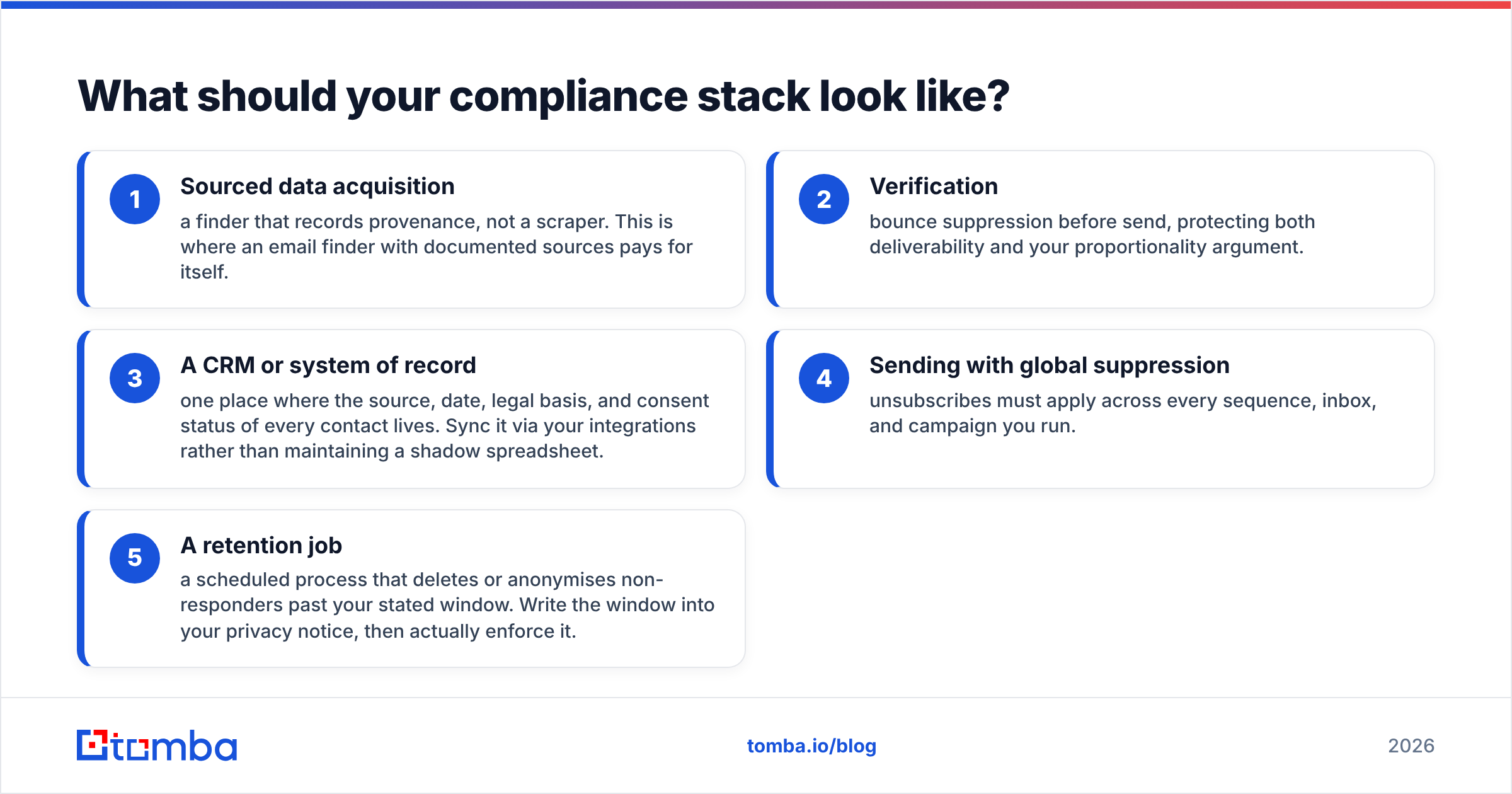
You need five capabilities. They can live in five tools or two, but none can be missing:
- Sourced data acquisition. A finder that records provenance, not a scraper. This is where an email finder with documented sources pays for itself.
- Verification. Bounce suppression before send, which protects both deliverability and your proportionality argument.
- A CRM or system of record. One place that holds the source, date, legal basis, and consent status of every contact. Sync it through your integrations instead of keeping a shadow spreadsheet.
- Sending with global suppression. Unsubscribes must apply across every sequence, inbox, and campaign you run.
- A retention job. A scheduled process that deletes or anonymises non-responders past your stated window. Write the window into your privacy notice, then enforce it.
The failure mode is almost never a missing tool. It is the gap between tools: the contact that arrived on a scraped CSV, so nobody knows its source; the unsubscribe that fired in one platform and not the other.
How do you audit an existing list you already have?#
If you inherited a database of unknown origin, do not just keep sending. Run this triage:
- Segment by provenance. Anything you can trace to a public professional source or a documented vendor stays. Anything else goes to a quarantine segment.
- Delete the quarantine segment. This feels expensive and is not. Untraceable records have low deliverability and high complaint rates. They were costing you before they were a legal problem.
- Strip personal-domain addresses. Gmail, Outlook.com and Yahoo addresses in a B2B list fail the balancing test almost by default.
- Re-verify what remains. Records older than six months decay at roughly 2–3% per month as people change jobs.
- Backfill provenance where you can. Re-run surviving contacts through a sourced domain search so each one carries a current, citable public source.
- Document the audit itself. A dated memo of what you removed and why is strong evidence of good faith if a complaint lands.
Most teams find that 30–60% of an inherited list does not survive. The remaining segment usually beats the original on reply rate, because relevance and legality tend to travel together.
Is GDPR compliance worth the effort for outbound?#
Yes, and not mainly for legal reasons. Every requirement above doubles as quality control. Documented sourcing means better data. Relevance filtering means better targeting. Working unsubscribes mean fewer spam complaints. Retention limits mean your database is not 40% job-changers. Teams that do this properly usually see their response rate improve, because the discipline that satisfies a regulator is the same one that satisfies a buyer.
The teams that get burned treat compliance as a footer to paste in. The teams that thrive treat it as an input to how they build lists in the first place.
So start where the risk concentrates: your data. Knowing how to make emails GDPR compliant does not help if you cannot say where a contact came from. Tomba Email Finder returns the public sources behind every address it discovers, so your Article 14 disclosures and LIA balancing tests rest on evidence instead of assumption. The free tier gives you 25 searches a month, and paid plans start at $49/mo — see Tomba pricing for the full breakdown. Build the sourced list first. The compliance paperwork gets much easier after that.
Related guides#
Ready to find emails that actually work?
Join 150,000+ professionals who stopped guessing and started sending. Free credits on signup — no credit card required.
Get the Tomba newsletter
Practical outbound tactics and product updates — once every two weeks.
About the author